Category Archives: Book Group

The Book Group in Amanda Lohrey’s Labyrinth

Amanda Lohrey, The Labyrinth (Text Publishing 2020)
Having threatened us with another Rachel Cusk title, this month’s Book Chooser opted for last year’s Miles Franklin Award winner, a decision I applauded.

Before the meeting: The book’s narrator, Erica Marsden, moves to a small town on the south coast of New South Wales to be near the prison where her son is serving a life sentence for murder. Harking back to her own childhood in a mental institution where her father was head psychiatrist and inspired by a dream, she decides that a way out of her depression is to ‘make something’, and sets out to create a labyrinth in the weedy patch of sand beside her shack. Between dispiriting prison visits, she makes connections in the local community, and runs into an illegal immigrant who has just the skills needed to help design and build the labyrinth. As she realises her plan, she regains a degree of equilibrium, and her son seems – tentatively, incompletely – to be returning from the weirdness that had led him to commit a horrific act and then be lost in rage-filled (and, she believes, mother-blaming) isolation.

That’s it. It’s beautifully written, including some evocative moments when Erica is bemused by unspoken understanding among diverse male characters. I loved it.

My one small complaint is that there are no illustrations. Even though the descriptions the making of the labyrinth are very clear, I lack the visual imagination needed to interpret them. When I looked online, key words like ‘seed pattern’ seemed to have different technical meanings from the ones Erica gives. I mention this in the hope that an illustrated edition may be on the way.

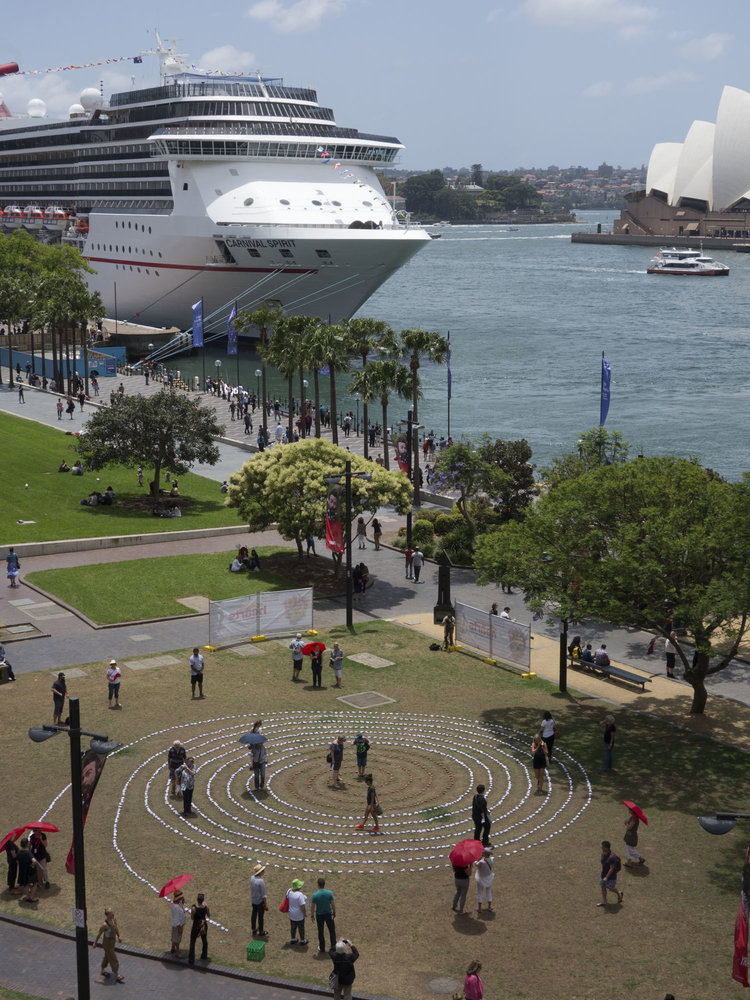
What you get from a work of art depends on what you bring to it. I brought quite a bit to this book that intensified my enjoyment of it. I’ve seen the labyrinth at Chartres, and it was covered with wooden chairs just as Erica describes it. I’ve meditatively walked a small labyrinth at Glendalough in Ireland. Much more significantly, I took part in Connecting Hearts Project, an art work created by the Emerging Artist, which invited participants, among other things, to walk a kind of labyrinth made of terracotta hearts while reflecting on our common humanity, on our connection to people fleeing persecution, especially those held in detention by successive Australian governments, and on what it means to belong. With her permission, here are a couple of images:
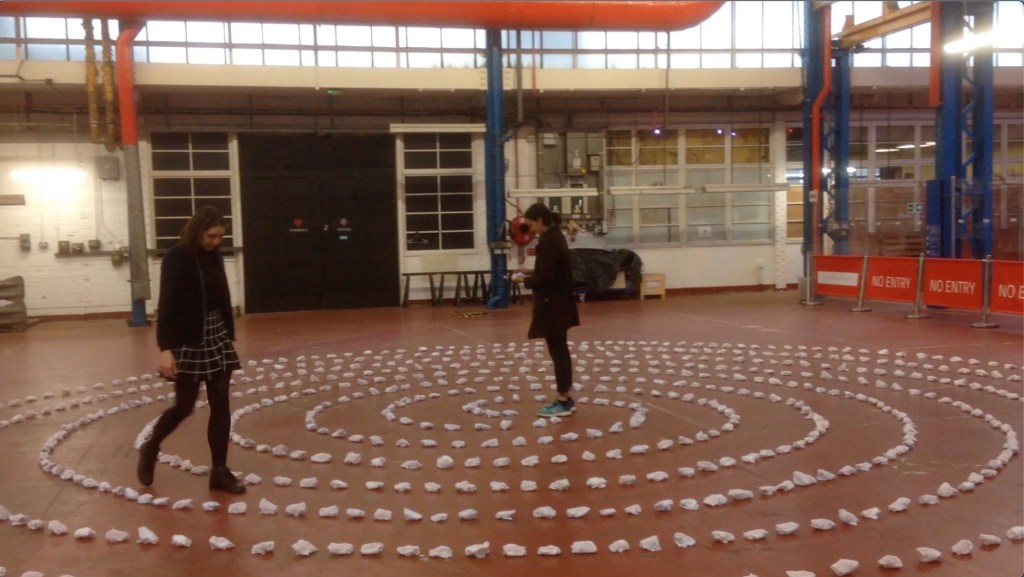
And a video of the London iteration, where the spiral/labyrinth appears from 2 minutes 22 seconds:

After the meeting: There were six of us. The streets were awash outside, but we were warm and dry in our host’s home, which had been a rundown mess when we met there just before the onset of Covid, but he and his family have rebuilt as a joy and a wonder to behold. We ate well, and drank well (I wasn’t the only one to bring non-alcoholic beer, one of the many pleasures of the evening).

Probably because we were all so pleased to be meeting in person again, and because of the absence of him who has been tacitly designated the group facilitator, we spent a long time chatting – mainly about the new house and the current theatre work of one of us, complete with some great inside-theatre gossip – before focusing on the book.

The terrific discussion was kicked off by someone who said he had reread the second half of the book because it seemed that everything that had been built up in the first part was then wasted in the second. Characters were introduced with the beginnings of narrative arcs, and nothing came of it: an architect promises to get back to Erica with ideas for a labyrinth, then nothing; a teenage girl is seen self-harming, then nothing; Erica meets a neighbour’s daughter, then nothing. On a second reading he felt he had been too harsh, but still felt like things more or less petered out.

I couldn’t fault him on his description, but I felt that it worked, and struggled to say why. In some way, the incompleteness of the stories was the point. The labyrinth itself (mild spoiler alert) is never finished, and there’s a tiny movement in a key relationship towards the end that could be the beginning of significant change. I passed around printouts of some of the above pictures.

A third chap said he read the book as a study in grief: after the ordeal of her son’s trial and imprisonment for a horrific crime, Erica is in a fugue state, and the failures to connect or follow through on other people’s stories is a function of that. He drew our attention to the last two paragraphs, and when they were singled out in this context I think we could all see how beautifully the book is brought home. Both the opening speaker and I said we now felt like rereading the book from the beginning.

One chap confessed right at the start that he hadn’t read the book. He said he enjoyed the discussion, and I almost wished I could have been him when, in the middle of all the discussion of grief and fugue states, small town communities, the perils of living as a refugee, the points of similarity and difference between this book and, say, Sea Change, and so on, someone asked, ‘What about the book burning?’

Then five of us made our various ways home, all through streets that were awash.

The Book Group in Second Place with Rachel Cusk

Rachel Cusk, Second Place (Faber & Faber 2021)

Before the meeting: I borrowed a copy of the book from my local library and just had time to read it and return it before heading out of town over the New Year. So I scanned a random page, intending to focus my pre-meeting blogging on that page.

Then the Book Chooser sent around a WhatsApp asking how we’d all feel about changing to Transit, an earlier book that ‘gives a better sense of how Rachel Cusk has transformed the novel form’. After some discussion, it was agreed that each of us could read either or both of the books, and we’d let the discussion play out as it would. I decided to stick with just Second Place.

‘Second Place’ is the name given by the narrator to a kind of guest dwelling on her property on the edge of a darkly beautiful marshland. As she spells out for the benefit of slow readers, it also refers to the status of women under patriarchy – and there you have the subject of the book. When she was young, the narrator – known as M – fell under the spell of landscapes by L, a celebrated painter, and she now believes he is perfectly suited to capture the beauty of her marshland. She writes to invite him to stay as her guest in the Second Place. After some pretty rude back and forth, he accepts the invitation, turns up with an unexpected female friend, and continues as he has begun, the guest from hell. Somewhere along the line, we realise that M, without quite admitting it to herself, hopes that his paintings of her marsh will reveal something of her to herself. This develops into wanting him to paint a portrait of her, which he eventually does, devastatingly.

The story, we are told in an end note, was inspired by Lorenzo in Taos, Mabel Dodge Luhan’s 1932 memoir of the time D. H. Lawrence came to stay with her in Taos, New Mexico. I haven’t read that book, but it feels as if the note explains a lot: maybe this book is not so much a novel in its own right, as a response to – a retelling of, a meditation on – that other book. In the early parts of Second Place, M tells her story to someone called Jeffers. We are given no information about Jeffers at all, but Lorenzo in Taos was addressed to the US poet Robinson Jeffers. It seems that this device is a straight lift from the source material, a little Easter egg for the scholarly reader (or for someone like me who google-skims reviews).

By and large, the book left me cold. The characters don’t feel fully imagined. What I take to be the thematic concern about art and artists could be boiled down to the familiar warning: ‘Never meet your heroes. They’re sure to disappoint.’ M does a lot of introspecting, and the dialogue generally feels stilted. If something is being said about sexism, it’s that some men are cruel, and some women are vulnerable. Not exactly a revelation, and not exactly leading anywhere interesting.

On the random page I scanned (page 74), M and L run into each other walking by the marsh very early one morning. She asks him, pretty much out of the blue, if he will paint her portrait:

He looked at me with a faintly quizzical expression.

‘But I can’t really see you,’ he said.

‘Why not?’ l asked, and I believe it was the utterance that lay at the furthest bottom of my soul, the thing I had always been asking and still wanted to ask, because I had never yet received an answer.

That line about the utterance at the furthest bottom of her soul reads just as awkwardly in context as it does here. All too often the characters are going about their business and then there’s a little introspective interjection, sometimes addressed to the mysterious Jeffers, to explain the significance of what we’ve just read. The reader can’t ‘see’ the narrator either. When she talks about the furthest bottom of her soul it’s hard to take her seriously, but maybe that’s the point. Maybe she’s a needy person who has no idea about art but wants to be immortalised, a risible figure; or maybe we’re meant to take seriously her introspective misery and the way she turns to art as a way of feeling seen and perhaps understanding herself. I didn’t know at this point of the story, and I still didn’t know, or much care, by the end.

Back to page 74: She doesn’t get an answer from L, because Brett, L’s young female friend, turns up and interrupts them:

She was holding a bundle in her hands, which turned out to be all the linen from the bed in the second place, and she tried to offer it to me as I stood there in my nightdress on the wet grass.

‘Would you believe it,’ she said, ‘but I can’t sleep against this fabric. It irritates my skin – I woke up this morning with a face like a broken mirror! Do you have anything softer?’

She stepped closer, across the line that generally separates one person from another, when they’re not intimately acquainted. Her skin looked perfectly fine even at close quarters, glowing with youth and health. She wrinkled her little nose and peered at my face.

‘Do you have this fabric on your bed too? It looks like it might be having the same effect on you!’

L ignored this basic piece of effrontery, and stood with his arms folded looking at the view

Unlike all the other characters, the obnoxious Brett is realised with almost cinematic clarity, bringing a welcome element of waspish comedy to the narrative. But this slightly surreal interruption doesn’t so much move the story forward as expand, a little baldly, on the novel’s thematic concerns. Unlike L, Brett thinks she can see M. M wants to be seen, but not like this, close up: this is effrontery. As it turns out, the exchange foreshadows the climactic moment when the narrator stumbles upon L and Brett, probably high on something, collaborating on a viciously unkind representation of her.

Though my Leavisite lecturers in Eng Lit in the 1970s did this sort of thing with relish, it’s unfair to judge a book by one randomly selected page. But the thing is I don’t remember much else about the book. Harsh? Yes. Sentence by sentence I enjoyed reading it, and I expected my view to soften as a result of the Group’s discussion.

After the meeting: Thanks to Omicron, we were back on zoom. There were eight of us, and unlike when we meet in person, the discussion was fairly disciplined – generally only one person spoke at any given time, and we didn’t spend a lot of time on other subjects.

All but one of us had read Second Place. One had read In Transit. Only one (I think) had read both. It sounds as if In Transit was a much better experience, as we were treated to a number of readings from it, whereas no one was to be persuaded to read more than an odd phrase from Second Place.

One chap took vehemently against M. In his reading, she was a wealthy woman who decided it would be fun to have a famous artist as a scalp – so that she could boast of having had him stay, and have a painting of her place and perhaps of herself on her wall. This chap knows a number of famous people and has witnessed first-hand the effect of ‘fans’ intruding on their privacy, so his sympathy lay with the obnoxious L.

Another had read a review in the Guardian that, he said, read the book as somehow referring to Rachel Cusk having sold a house for millions of pounds and left England in protest over Brexit. Neither he nor the rest of us were clear how the book and the life were related, but it fitted the generally perplexed mood.

Another had read a little Rachel Cusk a couple of years ago and couldn’t bring himself go back to it for this meeting. He couldn’t remember anything of the books except a general sense of turgidness. The word ‘turgidness’ struck a chord with many of us.

A number of people said they appreciated the perceptive writing about art and life, life and death, men and women. An overlapping number said they were irritated or bored by tedious writing about the same subjects. Some read it as a strong feminist text. One man read quotes that, the antithesis of feminism, described the cruelty of men and the suffering of women as inherent, part of the essential nature of things. Which brought us to the question of whether we are to take M seriously or see her as a dire warning.

Those who had read In Transit spoke of Cusk’s splendid skewering of social cruelty. They were delighted by the way she dispensed with a narrative arc and with the depiction of rounded characters. I couldn’t understand what they said she did instead – I’ll have to read the book to find out. Perhaps the things I found exasperating about Second Place are a feature rather than a bug, but I still can’t see it.

In the one noteworthy straying from the subject, one chap who has recently moved into a new home, which he is in the final stages of renovating, gave us a quick guided tour. It’s a house we met in when it was newly bought a couple of major lockdowns ago, and it was a joy to behold the transformation he had wrought.

The Book Group and The GrandMasters #Sh*tf*ckery

The Book Group had our end of year meeting last night. I wasn’t going to blog about it as there was no book to discuss, but things happened to change my mind.

We had our now-traditional ‘gentlemen’s picnic’ – which is to say, everyone brought food. We had dumplings, barbecued prawns, delicious roast potatoes with rosemary and garlic, Portuguese chicken, plus a bowl of peas so we’d have some greens, followed by a fruit platter, pastéis de nata and mince pies, all accompanied by excellent conversation and much laughter.

Then down to work. Instead of a book, in what may become a tradition, we each brought a poem and read it aloud. The poems ranged from Les Murray’s ‘An Absolutely Ordinary Rainbow‘, read to us beautifully by a man to whom Les Murray had read it as a student audience of one, to a completely foul Rodney Rude limerick. Between those extremes were Janet Frame, David Malouf, Barbara Vernon (the fabulous opening stage direction to her 1957 play The Multicoloured Umbrella), Raymond Carver, Adrian Wiggins, anonymous children’s versifiers, and Naomi Shihab Nye. Readings were punctuated by wonderful anecdotes about complex intimacies, the sound of rain on an iron roof, 9th century Japanese poetics, student life in times past, father–son connections and more.

Finally, the Kris Kringle. We each brought a book from our shelves, suitably wrapped and given out at random. Once the books were unwrapped we all looked happy with what we’d got, though the one who’d scored three folded pieces of waxed cloth looked a little mystified and his happy appearance may have been a little strained. (He found out later in the evening that the giver had brought the wrong one of two identically wrapped parcels from home, and will get the book to him soon.) I’m delighted by my book, and because it’s a very quick read, I get to do this blog post:

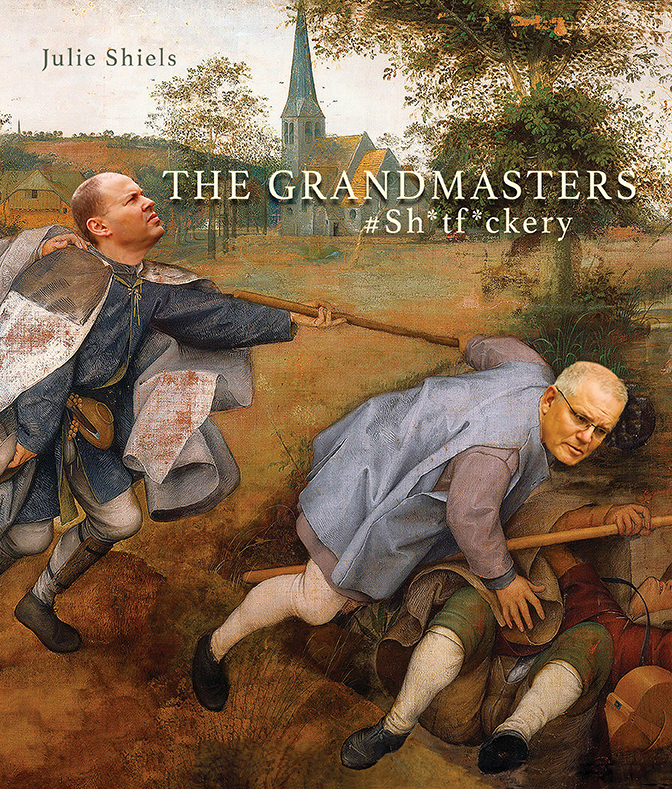
Julie Shiels, The GrandMasters #Sh*tf*ckery (M.33 2021)

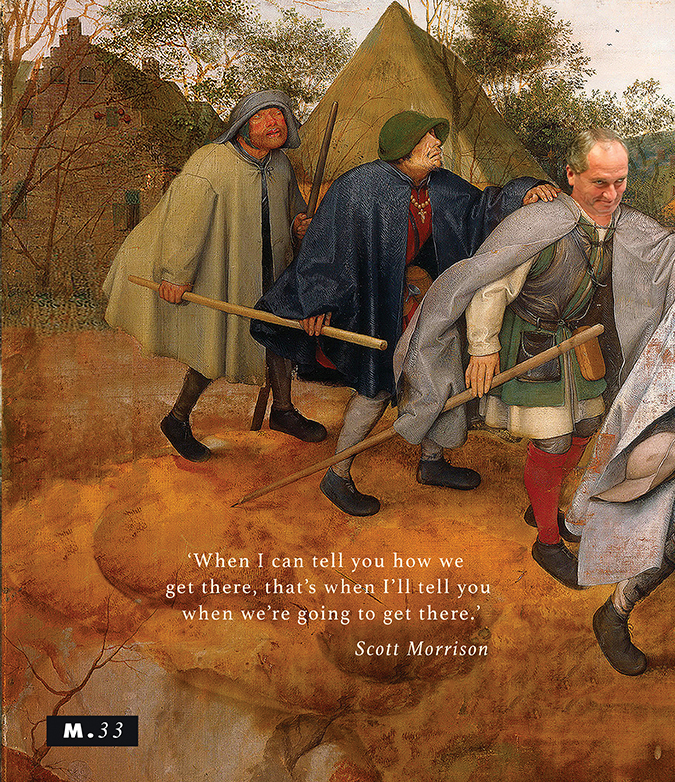
Julie Shiels is a Melbourne artist who created a series of digital collages, starting during the Great Covid–19 Lockdown of 2020. She took a number of paintings by old masters, gave some of their personages the faces of contemporary Australian political leaders, and added pointed captions. For example, the dustjacket (left) has The Parable of the Blind Leading the Blind by Pieter Bruegel the Elder featuring Scott Morrison, Josh Frydenberg and Barnaby Joyce. The satirical point would be clear enough, but then there’s the caption, a quote from the Prime Minister: ‘When I can tell you how we get there, that’s when I’ll tell you when we’re going to get there.’

The book simmers with rage, as it covers Robodebt, the federal government’s handling of the vaccine rollout, the scandal around Christian Porter, the Britney Higgins matter, climate change, Peter Dutton deciding to smile, Karen Andrews describing herself as compassionate, the abandonment of Australia’s Afghan friends, and so on.

I laughed out loud at the title page, which has a smirking Morrison standing by the woman’s corpse in Jerome Preudhomme’s The Death of Lucretia, while Michaelia Cash and Marise Payne play other roles – the caption: ‘Blokes don’t get it right all the time.’ Other pages – including but not limited to variations on the rape of Lucretia – are too horrible to be funny, but horrible in a bracing way. Some images land only in the general vicinity of their targets, and some – such as Scott Morrison as Aeneas carrying his ailing father in Pompeo Bartoni’s Aeneas Fleeing from Troy, saying ‘We are all Melburnians now’, or Dan Tehan as Rubens’ Saturn Devouring His Son – hit the bullseye.

This is an art book. The quality of the reproductions is excellent. The face-changes are mostly convincing, and where they’re not the effect is comic rather than shambolic (Julie Shiels must have trawled through millions of photographs to get the heads at just the right angle, the faces with just the right expression).

I recommend it as a gift for a politics-junkie friend who is into art. According to the M.33 website, only 300 copies were published, so you may need to be quick if you want one. The collages, being digital creations in the first place, can be see on Julie Shiels’s website at this link.


The GrandMasters #Sh*tf*ckery is the 15th book I’ve read for the Australian Women Writers Challenge 2021.

Matt Nable’s Still at the Book Group

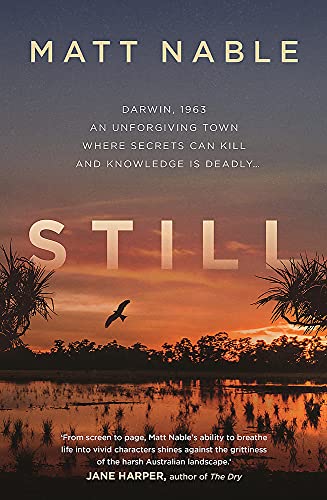
Matt Nable, Still (Hachette 2021)

Before the meeting: The Chooser for this book was strangely apologetic: a page-turner that he’d really enjoyed, he said, but he could easily find a second option … No one objected to a page-turner, especially as the 1960s Darwin setting made it a logical follow-up to Return to Uluru. The chat on WhatsApp brushed his apologetic tone aside.

Then came the book’s opening sentences, and my heart sank:

The long tufts of spinifex curled over on a gust of warm wind. Whispered voices broke with a gravelled edge and the sounds of violence disturbed a brown snake resting in a tight coil on the corner of a steep embankment.

This isn’t meant to be read word by word. Every adjective except ‘brown’ is unnecessary (‘tight’, ‘steep’), feeble (‘warm’) or off kilter (‘long’, ‘gravelled’). Where are an embankment’s corners, and what does it mean to be on one of them? Why are the two parts of the second sentence linked by ‘and’ rather than being separate sentences? But none of that matters if you read it fast and just take in ‘spinifex … wind … whispers … gravel … violence … snake’.

Sadly what follows needs to be read in the same careless, abstracted way: don’t linger over any sentence; don’t think too hard about any plot developments; don’t concern yourself with probability; just go with the flow. It’s Midsomer Murders in print, transposed to 1963 during the NT build-up, minus any self-mockery, mystery or nuance.

Maybe this is peculiar to me as a copy editor, but consistently, several times a page, I was yanked out of the narrative by a malaprop, a run-on, an Americanism, a non-sequitur, a physical impossibility, a roaring cliché, or glaringly unnecessary words … I wonder who made the decision that this book was good to go.

To test my feeling that the badness was pervasive, I asked the Emerging Artist to pick a number between 1 and 375, and another between 1 and 30. This would give me a page and a line. The first time, she picked page 34 line 2, which falls in the middle of this sentence:

Ned could smell Riley’s aftershave, the same one he always wore, it was sweet and, though pleasant initially, Riley wore too much of it and it invariably became overpowering and distracting.

Apart from the run-on, the hanging modifier, and the odd use of ‘distracting’, why not just, ‘Ned could smell Riley’s overpowering aftershave’ or, ‘Riley’s aftershave was as overpowering as ever’? Or maybe just delete the sentence, because like many references to smell in this book it feels as if it’s there because the author was told to include appeals to all the senses.

The EA’s second pick, page 105, line 5, turned out to be the final line of the one episode that I enjoyed, where the white policeman hero Ned Potter tries to catch a barramundi with his bare hands, as he has been taught by an Aboriginal man, and fails. The first words are what Ned imagines the victorious fish saying as it swims away:

Fuck you, Ned. He resolved to try again, to win, to catch a barramundi by hand.

On first reading, the second of these sentences felt like dead wordage. Why not let the fish have the last word? Or if we must have Ned making a resolution, why not end the sentence with ‘win’? The last phrase is only necessary if you don’t trust the reader to have read the previous three pages. It turns out – spoiler alert – that this sentence is there to foreshadow emphatically that Ned will indeed try again before the book ends, and there are no prizes for guessing whether he succeeds.

The book’s cover features high praise from Jane Harper – which is enough to make me decide not to read any of her novels.

I came to the meeting hoping others would be less unforgiving and find joy in the novel, which they’d be able to communicate – and dreading it as well, as it would confirm that I’m a joyless pedant.

Just before the meeting: We decided to meet in person. In the online deliberations leading up to the decision, we all disclosed our wide range of vaccination statuses. Possibly on no interest to anyone but copy-editors, here’s the range: double vaxed, double vaxxed, double vacc’d and double vaccinated.

After the meeting: I enjoyed this meeting hugely.

Most people enjoyed the book, as I’d hoped and feared. I guess I’m a joyless pedant, and a literature snob. No one was unkind enough to say either of those things in so many words, though the word ‘pedant’ was used. At least one person couldn’t believe that I was unmoved and unconvinced by the plight of the main female character. Even those who sympathised with the gist of my rant (and yes, I did have a rant, but only after a number of people had spoken positively about the book) had trouble seeing that I wasn’t swept along by the sheer pace of the narrative.

Our resident retired assistant film director said the book works very well as a fleshed-out treatment for a movie, and I’d say the majority of us concurred. Various people referred to the convincing dialogue, the back and forth of the narrative, the occasional sex scene, the violence, the narrative drive, the attention to place, and indeed the predominantly visual, scene-based nature of the writing. The cliche elements are acceptable because it is after all a genre piece. Someone thought I was being snooty about it because it’s an unpretentious page-turner, but I deny the charge. Dervla McTiernan’s The Ruín is a page turner, but it’s literate, and just look at Peter Corris or Peter Temple.

One man felt that the book was in many ways similar to Return to Uluru, and even superior in its treatment of racism. That’s a view so far from my own that I can’t begin to understand it.

I tried my party trick of asking someone to pick two numbers. The line that turned up was the last paragraph in this exchange between Ned and Ron Thompson of the coroner’s office, which takes place in the morgue:

Ned walked toward Thompson, settled beside him and looked over the bodies again.

‘That’s Lionel Frazier.’ Ned pointed to the body.

‘The white fella?’

‘Yep.’

Thompson looked over the body of the larger man. ‘He’s a Kanaka.’

‘What?’

‘The big one here.’ Thompson nodded at the larger corpse.

A punctilious copy editor would query the ambiguous phrase ‘looked over’ even if it only occurred once, and the awkward repetition of ‘larger’ might attract the blue pencil, but the narrative moves along, and there’s nothing outstandingly terrible in this writing. My party trick failed to make my point.

A degree of consensus was reached on the notion that the author had a story to tell, which he imagined in cinematic terms rather than in words; the book is a stepping stone to the complete work, which will be a film or TV series whose script will have passed through several more drafts and then be interpreted by a director and actors. Someone has heard that a TV series is already in the works. There was also a degree of consensus that I got i my own way as a reader of this book. (I disagreed, but not strongly.)

Did I mention that we met in person? We shook hands and even rubbed shoulders. We ate and drank together: I even shared a can. Excellent gossip was exchanged about the rich, famous and powerful, and toward the end of the evening we contemplated the terrifying inanity of the Prime Minister’s plan to take a PowerPoint presentation to Glasgow. We learned from Google that Opus Dei is an institution of the Catholic Church. We learned that Alex Buzo’s Norm and Ahmed is due for another short season in Parramatta and that Girl from the North Country is worth seeing.

The Book Group and Mark McKenna Return to Uluru

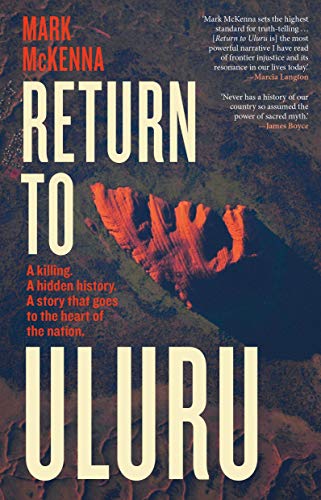
Mark McKenna, Return to Uluru (Black Inc 2021)

This was a very welcome birthday gift in March this year, but somehow I didn’t get around to reading it until it became the September title for the Book Group.

Before the meeting: It’s a terrific, powerful history that reads partly as a thriller and partly as a prose poem.

Mark McKenna has previously written two books that focus on the history of particular places: Looking for Blackfellas’ Point (2002) and From the Edge: Australia’s Lost Histories (2016). His recent Quarterly Essay, Moment of Truth: History and Australia’s future (2018) takes its readers on a visit to Cook’s landing place at Kurnell. Return to Uluru similarly has a place for its main subject. It tells many stories about Uluru: stories from settler Australia that change radically over the decades, stories from Aṉangu culture and from First Nations people more generally, culminating in the Uluru Statement from the Heart.

The central strand is a compelling narrative, what McKenna calls the ‘biography of one moment in one man’s life, a moment that encompassed the entire history of the centre and went straight to the heart of the nation’s long struggle to come to terms with its past’ (page 25).

The man in question is Bill McKinnon, a legendary Territorian policeman, who travelled in the steps of the explorers in the 1930s, taking camels on long journeys through what non-Indigenous Australians saw as the harsh and inhospitable terrain of central Australia, climbing what was then called Ayer’s Rock and adding to the cairn at its highest point, dealing with hostile ‘Blacks’ and doing the heroic work of bringing murderers to justice in the face of enormous odds. He was celebrated in newspaper articles and by writers like Frank Clune. A representative of an heroic Aussie type, a Crocodile Dundee without the comedy, he was also accused of brutal mistreatment of Aboriginal people, and in particular of the unlawful killing of one prisoner.

That killing is the moment that the book revolves around. It happened in a cave near Kapi Mutitjulu, a waterhole at the southern end of Uluru. McKinnon claimed that he fired blind into the cave where an escaped prisoner was hiding, and that he did so in self defence. An official enquiry found that he had done no wrong, but Aṉangu witnesses – and some non-Indigenous people – said different, and in the course of writing this book McKenna stumbled on some damning evidence written in McKinnon’s own hand. The image of the legendary outback bushman evaporates in front of our eyes to be replaced by something much darker. Deeply gruesome details emerge.

There is a story that is left mainly untold: the story of the man shot by McKinnon, whose name was Yokununna. In whitefella versions of the story he was a murderer who was captured by McKinnon, escaped, and was killed while resisting recapture. The murder of which he was accused, we are told, was a matter of tribal law. In an endnote, McKenna explains that he has ‘refrained from reproducing these details due to their ongoing cultural sensitivity’, but we are left in no doubt that Yokununna was no criminal, and that when he died he was drawing McKinnon’s attention away from his fellow escapees. The book ends with some of his remains being returned to his descendants.

My copy is a hardback, and its many photos are reproduced with wonderful clarity. Beautiful though they are, they serve as more than decoration. They including the view of Uluru from the International Space Station on the cover, many photos taken by Bill McKinnon, and others by the book’s author. So there’s a pictorial dialogue that spans the decades. We get a sense of how McKinnon saw himself. We feel the romance of the centre (in 1932, McKinnon commissioned a dozen mulga wood plaques from Albert Namatjira, making him one of the first whitefellas to encourage, and pay, Namatjira for an artwork). And we see the descendants of the men brutalised by McKinnon, now back on country. We see Uluru’s senior custodian, grandson of one of the men arrested along with Yokununna, pointing to the opening in the rock that McKinnon fired through.

At the meeting: I had expected this to be one of those meetings where we are united in appreciation of the book and spend the time reminding each other of bits we made special note of. But it was much more interesting than that.

For some, the central idea of the book – that the killing in the cave could be taken as telling the tale of central Australia in miniature – just didn’t hold up, and the telling of it was irksomely longwinded and repetitive. They would have preferred more about people who made cameo appearances, such as Ted Strehlow, Charles Mountford and Olive Pink, and perhaps more about early non-Indigenous encounters with Uluru in the 19th century.

The descriptions of Uluru and the surrounding countryside, some felt, was uninspired. At times, the reader was expected to share assumptions and accept generalisations that some of us just didn’t accept or share – for example, at one stage ‘the Commonwealth was deeply embarrassed’ by McKinnon’s behaviour, but we aren’t told who ‘the Commonwealth’ was or what the evidence was for their emotional state. (This didn’t bother me, partly because I gave a lot of weight to McKenna’s brief account of the Coniston massacre and subsequent exoneration of the perpetrators, so understood that Canberra administrators of the Northern Territory didn’t want further bad publicity.)

One man said he read the book as a foreword and three short stories, which he enjoyed. The aim, as he saw it, was to write a whitefella myth of Uluru, and while he felt the appeal of that (we’re all whitefellas in our group), he was uneasy – I think I heard this right – that there may be some coopting of Aṉangu culture.

Those of us who had got that far all agreed in being moved and impressed by the passages where McKenna meets with the families of McKinnon and Yokununna. At least one man found the most powerful moment in the book to be when McKenna tells McKinnon’s grandson what he has discovered and says he understands the distress this may cause to the family if he publishes it. The grandson, for whom McKinnon has been a family hero, gives his blessing: ‘All of the family, Mum included, are on board for reconciliation, we wouldn’t want anything else.’ Even those who felt that the ‘reconciliation’ offered by the book is largely illusory (I’m not one of them) were moved by this. The passages where Yokununna’s skull is returned to his family and they have their version of events vindicated are equally powerful.

In an inspired moment this month’s Book Selector had invited us all to bring our own photos of Uluru, so the evening ended with a bit of show and tell. The images ranged from a picture of someone’s friend at the top of Uluru in the early 1980s, a photo very like one of McKinnon’s from the same time, to a photo, also from the 1980s, of the photographer’s family posing cheerfully in a burnt out landscape with a number of old Aṉangu women holding up prize goannas.

And the land lay still with James Robertson and the Book Group

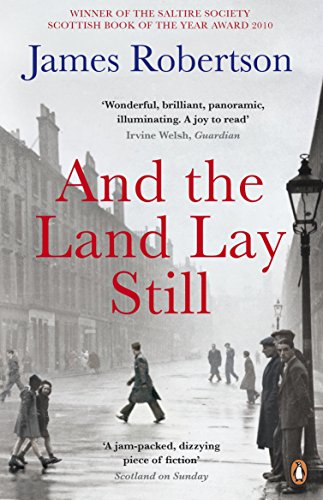
James Robertson, And the Land Lay Still (Hamish Hamilton 2011)

Before the meeting: The Book Group had a run of Russian novels last year. This year we’ve moved to Scotland, though as with Russia any fears of sameishness would have been misplaced: a bigger contrast between this book and Janice Galloway’s The Trick Is to Keep Breathing would be hard to imagine. Where that book is introspective, claustrophobic and grim (though some disagreed about that), this one is expansive, multifarious and in the end upbeat.

Among other things, And the land lay still is a history of Scotland in the second half of the 20th century, with a focus on the growth of Scottish nationalism leading to the yes vote for the Scottish Devolution Referendum in 1997. The book’s title comes from ‘The Summons’, a 1984 sonnet by Edwin Morgan who was to become Scotland’s first national poet in 2004: the poem marks a moment when the Scottish electorate did not vote for the – it ends, ‘a far horn grew to break that people’s sleep.’ The book relates the slow and tortuous response to that summoning horn. It traces the lives of a diverse score of characters: a Tory member of the UK Parliament, the photographer son of a photographer, a war veteran, a boring spy, a vicious thug, a woman who hosts a bohemian salon, an English nurse who moved to Scotland when she married a Scot and stayed, a rich girl who becomes addicted to a string of radical causes, an investigative journalist who gets into serious trouble and, appearing in italics between the main chapters, a wandering tramp-like figure who takes on an uncanny symbolic identity in his own mind and in the mind of the novel.

At the end of the first of the book’s six parts, just as I was settling into one story, I was shocked to realise that a whole new narrative was beginning, with new characters in a different time and place. And the sharp breaks continue with each new part, and then within the parts. Perhaps the spy’s story dragged on a bit (his name is Jimmy Bond, but he changes it to Peter to avoid bad jokes, and the dragging on is partly intentional, making the point that spies can be very boring people). The depiction of the Tory politician’s sexuality may involve a slightly blunt satirical jibe about Maggie Thatcher’s appeal. And the eventual fate of the hideously violent thug may be too kind, too neatly conveyed. But if those are faults, they’re minor ones. This is a terrific book, with some spectacularly good writing. And it’s very Scottish.

Here’s the passage where the music of Scottish language first asserts itself and where I became totally hooked. The speaker is Walter, a minor character who is a folk singer:

In thae days, if ye were a working-class boy and ye wanted a better kind o life than the one that was mapped oot for ye, there was just two ways o daein it: ye could become a professional footballer, if ye were skilled enough, or ye could become a professional boxer, if ye were hard enough. And then this third opportunity came along: ye could form a band and sing your way tae glory if ye were bonnie enough. Weel, I wasna skilled or hard or bonnie enough for any o thae things, sae I become a plumber. But then something amazing happened. I was on a job doon at Lauder, on the road tae England, and I was there for aboot a week wi a couple o other boys, up and doon the road every day, and on the last day, when we'd finished the job, we went for a few pints in a pub afore we came back up the road. And there was this auld man there, and he just started singing. There was a wee lull in the general noise, ye ken, and he started singing intae that space. The haill pub went silent as he sang, he didna hae the best voice, it was auld and quavery and a bit flat but by Christ he had us aw spellbound, we aw listened, even the guys that were wi me, on and on he went, verse efter verse efter verse, a story aboot a sister and her lover, and her brothers killing him because he wasna good enough for her, and her defiance when the faither tried tae mairry her aff tae another man. Weel I'd never heard anything like it in my life, and when he was done I went over and bought the auld fellow a drink and asked him aboot it.

After the meeting:

Sadly, we’re still meeting remotely, but we are meeting. One person couldn’t make it because he’d had his first Astra Zeneca shot in the morning and was feeling wiped out, which led to a lot of comparing of post-shot symptoms at the meeting.

Those who’d finished the book loved it. No one had stopped reading from lack of interest. Some felt that at 670 pages it was too long, but no one would say which character they would have cut. Some felt that now and then they were being treated to a lecture on Scottish history that they could have done without, that the vividly realised characters, their relationships and life stories made the detailing of broader history unnecessary. I disagreed. I loved the interplay of those elements. The English-born group member said he too loved the explicit history, as it led him to revisit his young understanding of what was going on in Scotland and see it afresh.

We spent a lot of the meeting reminding each other of the good bits. One or two chaps had to clap their hands over their ears now and then as we discussed parts they hadn’t read, but someone pointed out that Rule 738B says that books may be discussed in their entirety regardless of whether everyone in the room (or zoom) has read the whole thing.

Some responded strongly to a sweet romance (if you’ve read the book, you’ll know what I mean if I say ‘the kiss’), others to the relationship between the salt-of-the-earth father and his wrong-‘un son. Someone reminded us of the way now and then a character tells a story that stands alone as a kind of parable. We didn’t get as far as the way one such story is told early in the book as a kind of folk legend, then again as an eye-witness account, and yet again as a brief newspaper story.

There was some discussion of gender fluidity, but I can’t remember how, or even if, that related to the book.

I got some advice about a dilemma to do with lockdown hair and my barber having shut up shop, which definitely had nothing to do with the book.

It looks as if our next meeting, in six weeks time, will also be on screens.

Janice Galloway’s Trick Is to Keep Breathing at the Book Group

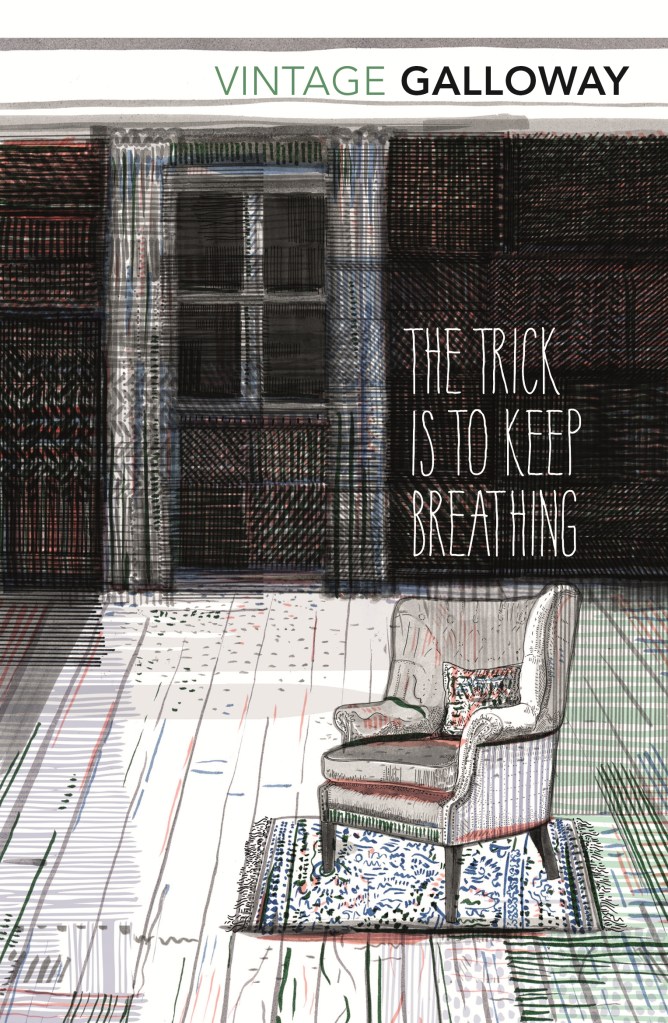
Janice Galloway, The Trick is to Keep Breathing (1989, Vintage Classics 2015)

Before the meeting: When I was about half way through this book, the following exchange happened on WhatsApp:

The Trick Is to Keep Breathing is a possibly-brilliant novel that I, for one, hated.

It’s a first person narration by Joy, a woman who has tipped over the edge into extreme depression and mental disorder when her married lover drowns on a holiday in Spain. At first I thought that my copy of the book, in a Penguin Vintage Classics edition, had been poorly reproduced from old film: the type is mostly dark and slightly blurred, though occasionally, apparently at random, a sentence or two is lighter and clear. There are odd blank spaces as if several lines are missing. And every now and then the margin boasts a word or a column of words, perhaps partly obscured by the gutter or running off the edge of the page. It took a while to realise all this was deliberate, a way of physicalising the state of Joy’s mind, on a continuum with the way the width of the column changes every now and then when Joy relays to us a horoscope or an advertisement from a magazine, or the type switches to italics as, bit by bit, the traumatic event in Spain is revealed.

It must be this typographic play that led the New York Times reviewer quoted on the back cover to write: ‘Resembles Tristram Shandy as rewritten by Sylvia Plath.’ I haven’t read Sylvia Plath’s novel, The Bell Jar, but a bit of unconventional typesetting doesn’t make a Tristram Shandy.

The portrayal of Joy’s unrelenting descent into darkness, starvation and disorder must be what led the judges to award it the MIND/Allen Lane Book of the Year for 1990. According to the website of ‘mental health charity’ MIND, ‘this well-established literary prize celebrates writing that heightens understanding of mental health issues in all their forms’. Elsewhere, Fay Weldon, a frequent judge, acknowledges that it is a little-known prize, and that ‘”literature” is not what concerns us here, but effectiveness, accessibility, honesty, optimism and helpfulness’. She wrote that in 2011. The judges’ desires were different in 1990, or they read the book differently from me, because I found very little optimism or helpfulness in it, and while Joy’s experience is vividly realised, I don’t think my understanding of anything is heightened.

The novel is a nightmare account of an experience of grief, anguish, disordered thinking, despair, self-starvation. The men in Joy’s life are generally sexually exploitative and/or clueless about her mental state. Her one woman friend has gone to the USA, and that friend’s well-disposed mother offers baked goods as an optimistic panacea. The doctors she encounters are unable to help, and in some cases, callously, don’t even try. If her account of her time in a mental institution is even half accurate, then the system needed to be burned to the ground: but it’s more of a darkly satirical fantasy, almost certainly with some truth but not something you’d trust as an account of anyone’s actual lived experience. For me, and I may be completely idiosyncratic here, the book came across as a kind of mental-illness porn.

At least one member of the group has signalled in advance that he loved the book. I’m open to persuasion, but only by a crack. I expect there will be discussion of the ending, which may be ambiguous, though I’m fairly clear about how I read it. I’m looking forward to the conversation.

After the meeting: Covid–19 brought restrictions to Sydney again on Wednesday, and though we were only six people and could have met legally in someone’s home, we decided to meet online.

Once we got settled in – ‘Hi, I like your beard’ ‘How did the test turn out?’ ‘Are people wearing masks in your part of town?’ – we moved on to a terrific discussion of the book.

Why it was terrific is that two completely incompatible readings of the book were aired, and the proponents of each could see that the other was coherent and justifiable from the text. It was all in how you read the tone. I guess I was at one extreme, reading the tone as something like that of Truffaut’s movie The Story of Adèle H, unremitting misery: Joy is sunk in grief and depression, goes through the motions of daily life and relationships, keeping up appearances but unable to show anyone – friends, former lovers, current sexual predators, co-workers, doctors – the depth of her despair. The chap putting forward the other extreme read it as grimly comic: through her terrible grief, Joy never loses her sense of herself, holding onto what she can of relationships and keeping with her routines as a way of staying in the world, vulnerable to predators but keeping her core self shielded from them, bantering defiantly with the useless doctors. Others were in different points along a spectrum between the two readings. No one else had read the ending as grimly as I had, and when I read the final paragraph to make my point, my opponent offered a completely valid alternative reading. I say ‘opponent’, and at one stage someone thought we were being a bit intolerant of each other, but I really don’t think that was happening: certainly I was delighted by the difference, and my respect for the book ballooned, give that it could sustain such different readings.

There was some talk about the terrible weather in Glasgow, and how what someone from tropical North Queensland (that is, me) might see as unrelentingly grim, might be seen by others (including possibly Janice Galloway) as dourly amusing. We’re reading another Scottish book for our next meeting to put that theory to the test.

The Book Group and Lamorna Ash’s Dark, Salt, Clear

Lamorna Ash, Dark, Salt, Clear: Life in a Cornish Fishing Town (Bloomsbury 2020)

Before the Meeting: Lamorna Ash, a posh young Londoner fresh from university, decided to visit the part of Britain her mother came from, and from which she got her first name. She lived for two stints in the fishing village of Newlyn, just a couple of miles north of Lamorna in Cornwall, all her senses on the alert to see and understand everything about it, its people, and the life of fishermen (no fisherwomen during her time there) and their families. She went out on trawlers and smaller fishing boats. She drank with young and old. She formed solid friendships. She learned to gut fish and oscillated between horror and unholy glee as she graduated to stabbing rays in the heart – all part of a fisherman’s job. She talked and listened to everyone who would give her the time of day. And she wrote a lot of it down.

Meanwhile, she read or remembered writing by Elizabeth Bishop (whose poem ‘At the fishhouses‘ describes the sea as ‘Dark, salt, clear’), Barry Lopez, Walter Benjamin, Marianne Moore, Herman Melville, Antonia Barber (author of the picture book The Mousehole Cat, whose name doesn’t appear in the well-deserved praise of the book), W G Sebald, and other literary giants – and found ways they shed light on what she was discovering.

Then she made all that into this book. I enjoyed it. The author’s extreme youth gives rise to some embarrassing moments – as when she explains that ‘yarn’ is an old term meaning ‘story’, or when she reflects on how differently one sees the world when one is older, for values of older that are less than 25. The literary references sometimes feel forced. But by about page 100 these qualities had come to feel like part of the charm of the book. She’s capable of mocking herself, as when she writes of the walks she takes to stave off loneliness:

I often leave notes for myself on my phone when I go on these solitary walks, little inanities I wish I had someone else with me to whom I could say them out loud. This morning I wrote myself a particularly bold one. ‘For someone who gets lost a lot, coastal walks are a godsend. Only if the sound of the sea disappears from your left ear, can you have possibly gone wrong.’

Well yes, I guess it’s an inanity, but no more so than many of her observations, and this little moment of self-deprecation earned my forgiveness for a lot.

On the other hand, no forgiveness is required for her description of her week on board the trawler Filadelfia, which forms the book’s narrative backbone. Here’s her wonderful account of gutting a stingray:

I flip the ray over on to its back. Its stomach is a cadaverous grey and its almond-shaped mouth gapes open and shut like the puckering of a teenage kiss. The lips are so human I am momentarily dumbstruck. Open and shut, open and shut, its mouth sounds out a wordless plea.

I shake myself from my trance and hear Stevie prompting me to make an upside-down V incision along the translucent flap of skin that conceals its vital organs. Underneath is a mess of multi-coloured, pulsating guts – bright pinks, yellows and oranges. Over the roar of the engine, the men guide me to seize hold of a fistful of guts and pull them away from the ray’s body. But as I do so, the ray’s muscular wings start to close in upon my hand. In film footage of rays swimming, they use their wings, properly named pectoral fins, to propel themselves forward, gracefully rippling through the water like thin material animated by wind.

The ray’s last desperate bid to defend itself shocks me out of the automatic, mechanical state I usually induce in myself while gutting. In panic, I try to withdraw my arm, but its wings are still clutching me tightly. Beyond the boat, the waves have picked up and the boat slams down into the water. ‘You have to stab it!’ the men cry, goading me on as if we were outside the Swordy [hotel in Newlyn] preparing for a brawl. I let out a cry and stab the ray in the heart.

(page 256)

Her initial horror changes to murderous glee. The crew take to giving her all the rays to gut, and nickname her Raymundo.

After the meeting: For no particular reason we met in an Indian restaurant, the food was excellent, and the tragedy currently unfolding on the subcontinent had no obvious impact on the mood of our hosts, but there were nine of us at a long table. Conversation was animated and the book was discussed vigorously, but it was hard to manage a single shared for more than a very brief time. Next meeting’s host, who is responsible for summarising each meeting, put it well on WhatsApp: ‘

So yes, it was a excellent banquet last night where I got a week’s worth of meat, we agreed the book was somewhere between 2.5 & 4.5 stars, was either deeply revealing or a series of pleasant vignettes, … was in a place we should all visit and was generally an enjoyable read.

The 2.5 party hadn’t finished the book and didn’t intend to. He hadn’t read the fascinating historical account of how the town was saved from actual destruction in the 1930s at the hands of bureaucratic health and safety regulations, how a petition was taken to London on a small fishing vessel whose crew were astonished to see the banks of the Thames crowded with well wishers. He felt that the (to me fascinating) tidbits of Cornish language were mere padding.

The 4.5 party, just loved the book. He was completely charmed by the author’s voice. He described her quotes from other writers as smacking of undergraduate naivety and enthusiasm, but saw it as part of her youthful charm. (Given that our group is made up, all but one, of old farts gentlemen of a certain age, the youth of the writer was an issue for all of us one way or another.) He spoke eloquently of the way the narration would move from descriptions of social life in the pub to a deep dive into some aspect of the life of the town.

Whereas I, and others, found the description of life on fishing trips, of the way time at sea opens up spaces for communication and reflection, one man who has worked on boats said he found that fairly ordinary and wished there was a lot more about the women left ashore. Though the difficulties of the life were touched on, we were left feeling that a much darker story could have been told.

One chap had been to Cornwall a couple of years ago, and could show us photos of the town, including the very boat on which a pigeon dies in once of the book’s many atmospheric anecdotes. Actually he showed us these pics on WhatsApp before the meeting; he brought them to the dinner on a tablet, but couldn’t see a way to pass it around.

A couple of chaps drew comparisons between this book and James Rebanks’s A Shepherd’s Life. Each of them is an account of a community, a place, a working life that has endured for centuries and is under threat in the modern capitalist world. One is a passionate insider’s story, the other that of an interested visitor. It’s not that Lamorna Ash was trying to do do a James Rebanks: she’s completely upfront about her outsider, ‘posh’ status, her lack of skin in the game, but the book is still a serious piece of non-fiction, combining advocacy, memoir, linguistic sidelights, character studies, and adventure on the high seas.

The Book Group and David Williamson’s Removalists

David Williamson, The Removalists (Currency Press 1972)

Last night the Book Group had an extracurricular outing to see David Williamson’s play The Removalists at the New Theatre (which is about as new as the Pont Neuf in Paris).

Written before the outing: I have a soft spot for this play. I saw the first Sydney production at the Nimrod Theatre in 1971, an astonishing 50 years ago, as part of the exhilarating resurgence of Australian theatre at the time. In early 1973, the first copies of the book arrived in the Currency Press office soon after I started working there in my first real job – it was a big seller for them, and as far as I can tell is still selling well. I visited the set of Tom Jeffreys’ film in 1974, and was in awe of the intense inner focus of actor John Hargreaves as he waited for the cameras to roll.

Before our theatre outing I revisited the book – a first edition, stiff and yellowing on a shelf near Alex Buzo’s Macquarie and Dorothy Hewett’s The Chapel Perilous. In a successful bid for the educational market, Currency’s founders, theatre critic Katharine Brisbane and her scholar husband Philip Parsons, prefaced the text of the play with two essays, ‘Reflections on Violence’ by historian Ian Turner, and ‘Authority and Punishment’ by eminent defence lawyer Frank Galbally (who is mentioned in the play) and Kerry Milte (who was soon to become the subject of interesting dramas of his own). John Bell, who directed the Nimrod production, has an afterword, and the front and back covers fold out to reveal cartoons by Bruce Petty. I haven’t seen the current edition of the book, but the image of the cover on Currency’s web site mentions Galbally and Turner, but not Petty.

This prefatory material is all about violence and authority. Ian Turner sums it up well:

The Removalists raises three questions: one sociological (is Australian society violent of its essence?); one political (do the forces of ‘law and order’ rest on violence?’); one psychological (do all of us have the kinds of aggressive instincts or behaviour patterns which Williamson depicts?).

The essays talk about the streak of male violence in Australian culture (what would today be called toxic masculinity), and they talk about historic violence against First Nations peoples and Asians, especially the Chinese on the goldfields. The domestic violence at the heart of the play is barely mentioned. John Bell does offer an early version of what has become a common observation abut Williamson’s writing: strong women actors are necessary to stop the female characters from ‘degenerating into stilted, unconvincing types’. The edition of the book currently on sale may have been updated. Certainly, in 2014 Currency published ‘The Unexpected Feminist’, a feminist reading of the play by Van Badham (online here).

In case you don’t know the plot: two women, sisters, turn up at a two-man (sic) police station asking for a document establishing that the younger woman has been assaulted, in order to legitimise their plan to move her and her baby out of the marital home while her husband is out at the pub; the older policeman, with sleazy motivation, offers to come and help the move; the younger policeman, fresh out of training, goes along unwillingly; at the home, the husband comes home unexpectedly, and the situation escalates into lethal violence.

Reading the text, I imagine that a successful staging in 2021 would have to take into account our much better understanding of domestic abuse and violence, and our (I hope) intolerance of having it minimised. Though the play doesn’t endorse the way the sergeant and the husband make light of the DV, it isn’t much interested in it except as precipitating violence among the men. Some of the minimising language could have come from the pages of Jess Hill’s See What You Made Me Do (my review here). John Bell’s comment about how much depends on the women actors has become much weightier with age.

The outing: Nine of us, including two ring-ins, had a cheerful Thai dinner across the street from the theatre. When we crossed over 15 minutes or so before lights down, fate decreed that the third row from the front, in my opinion the best seats in the house, was empty. There was a sizeable audience, almost all of whom I’d guess were high school students who have the play as a set text. It was exhilarating to be in a big live audience full of youthful energy – for some of the Book Group it was the first time they’d sat shoulder-to-shoulder in a theatre since the beginning of Covid days.

I had been wondering how the play would deal with #MeToo. It turned out that Johann Walraven, the director, was more interested in how it relates to #BlackLivesMatter. This was announced in the first moments. As the lights come up, while the two policeman are seen in the shadowy police station on stage right, an Aboriginal man watches a flickering TV screen in his living room on stage left. He turns off the television and walks out of the room, the lights come up on the police station, and the play as written, in which all the other characters are white, begins. The production doesn’t take any liberties with the script, but the power plays of the other characters in relation to Kenny, the husband (Alfie Gledhill), are now seen through a racialised lens. In a climactic moment there’s a George Floyd reference that feels absolutely integral to the play, and is gutting.

The misogyny was still unsettling. It’s there from the opening scene in which the Sergeant gives voice to the myth of false rape claims, through Kenny’s minimising of his violence against Fiona (Eliza Nicholls), to a sleazy discussion of sex-workers towards the end. It’s meant to be unsettling: it’s the thing about the Sergeant that makes us realise he’s something much uglier than a harmless scallywag who plays the system. And Kenny’s talk of ‘love-taps’ is echoed by the Sergeant later in reference to his own ferocious assaults on Kenny – no minimising possible there, as we’re seeing it for ourselves. I imagine it would have to be written differently today, but the audience is left in no doubt that this is a scene that the two women are smart to be getting out of.

My abiding impression from the 1971 production at the Nimrod Street Theatre is of Max Phipps as Ross, the young constable. It was his transformation from gormless innocence to rage, violence and cunning that burned the play into my memory. Last night, the play belonged to Laurence Coy as the Sergeant. Lecherous, self-righteous, bullying, vicious, self-pitying, out of control, blustering, I’d thought of the character as little more than a crucible for Ross’s transformation, but in this production he’s a tortured human being, and Ross (Lloyd Allison-Young) is pretty much collateral damage. Possibly the most powerful moment last night wasn’t in the big, horrifying violence, but a small moment that almost didn’t happen. In the middle of a rant about self-control as the test of manhood, the Sergeant shouts that his wife had twenty-seven kidney fits after childbirth. Kate (Shannon Ryan), the obnoxious older sister, moves towards him, and says gently, ‘Twenty-seven kidney fits. That’s terrible.’ In a fleeting moment of humanity, the Sergeant says, ‘Yes. We gave her up at one stage.’ In classic David Williamson style, the moment is undercut with some rough humour, but the actors caught this tiny wisp of tenderness and vulnerability and made sure we saw it.


Full disclosure: Laurence Coy is a member of the Book Group – but he really is that good in this play.

The Book Group on David Mitchell’s Utopia Avenue

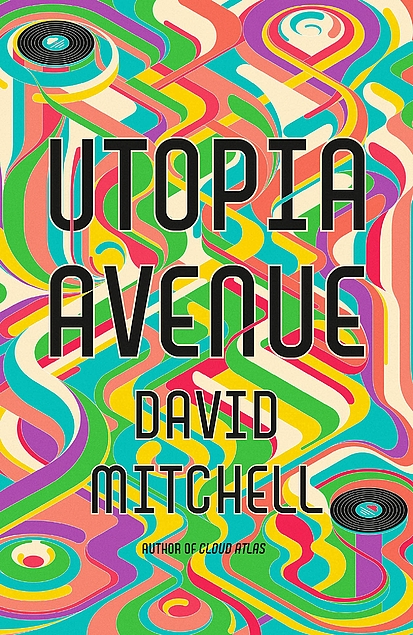
David Mitchell, Utopia Avenue (Sceptre 2020)

Before the meeting: This is the first book by David Mitchell that I’ve read. Once again, the Book Group has taken me off my customary reading track.

The book takes its title from Utopia Avenue, a fictional English rock band in the late 1960s: a socially awkward guitar player from a wealthy Dutch family who wrestles with his personal demons (word chosen carefully), a working-class bass player with long hair and a troubled relationship (an understatement) with his father, a rough Yorkshire lad on the drums, a middle-class woman folk-singer who is a wonder on the keyboards, and their Canadian manager, a decent man who gets them together and believes in their talent. Three of the four band members are song-writers, and the book’s chapters are named for their songs. Its longer sections are named for the band’s three albums.

The novel charts the band’s progress from their coming together, to their disastrous first gig, to a painful but comparatively rapid rise in the charts, to success at home and in the USA and (not a spoiler) their eventual break-up. Plus a brief reunion fifty-one years later.

Even though the book is unmistakably fiction, it has a powerful documentary quality. It feels animated by a love for that moment in pop history (roughly the time when David Mitchell was being born, I just found out). There’s careful attention to period details – how to make a phone call and why you might hesitate to call internationally, how to negotiate sexual politics when the world is on the cusp of second-wave feminism, how to manage the politics of the US war in Vietnam when you’re a ‘non-political’ band, the meaning of long hair. We are often told what song is playing in the background, and although I was living in a monastery in the years in question, this evokes the flavour of the times wonderfully. Historical figures make cameo appearances: Brian Jones, David Bowie, Janis Joplin, Leonard Cohen – and Jimmy Saville with the faintest whiff of the revelations to come much later. Francis Bacon presides over a whole chapter. Words of wisdom are quoted from Mama Cass and Mick Jagger. The band members sit and discuss the newly-released Sergeant Pepper’s track by track. I felt I was in safe hands: I believe that Jagger actually said the things attributed to him, that Mama Cass gave such sex-and-marijuana parties (in fact I’m pretty sure I’ve seen one just like it in a movie), that Leonard Cohen spoke with this flirtatious formality, that radio and television shows were tacky in something close to this way. The research doesn’t push itself to the front of the picture, but it provides a solid, fine-grained background.

Possibly someone who knows more about music than I do will complain that the descriptions of the band’s concerts are inauthentic (as one of the Book Group has been scathing about Tim Winton’s descriptions of surfing), but I loved them. For example, in Side One of the third album, where the band begins to play Jasper’s song ‘Sound Mind’, I wouldn’t know a chop-slap from a scale of triads, but I do get the excitement of the moment:

Jasper strums; asks the tech-guy for more volume on his guitar; shuts his eyes … and slams into an amp-blowing, bent-string howl; and fires off a scale of triads, starting from high E, all the way down. Jasper rewards his first cheer of the night with a new riff that isn’t ‘Sound Mind’: nobody will ever know it’s a rip-off of Cream’s ‘Born Under a Bad Sign’. It gets the audience thunder-clapping in time. Griff, Dean and Elf join in on drums, bass and Hammond. Jasper steers the jam through three cycles before wrapping it up in a Wah-Wah’d B flat, the opening of ‘Sound mind’. Dean comes in with the bass riff; Elf comes in on the next bar; and Griff chop-slaps on the next. Jasper leans in for his psycho-whisper …

(Page 461)

What I’m saying is that this is a terrific historical novel. But then … astonishingly integrated with the rest, is a fantasy narrative strand. There are characters who are hundreds of years old, something akin to demonic possession and something akin to exorcism. For me as a newcomer to David Mitchell, when this strand comes to the fore, it does so as a brilliant plot twist. Seasoned Mitchell readers wouldn’t be so joyfully blindsided. For them, hints abound. For example, the lead guitarist is Jasper De Zoet, a name that suggests that he may be a descendant of the title character of Mitchell’s 2010 novel, The Thousand Autumns of Jacob De Zoet. (Again, not a spoiler: he is revealed to be just that.) It turns out that any number of minor characters have wandered into these pages from earlier Mitchell novels, just as others have wandered in from the real-life 1960s, and the weird stuff harks back to the imagined realities of earlier books. It speaks wonders for Mitchell’s writing that I didn’t have a sense that I was coming in late: everything makes sense in terms of the present-time story, and everything is explained coherently. Only towards the end, when there are hints that the odd behaviour of a young child is doing what in a TV show would be laying the grounds for next season, I went DuckDuckGoing and found the notion that all Mitchell’s novels are connected into an über-novel – which I think means that each of his novels adds something to an ongoing story that stretches over centuries.

I’m left with at least one mystery. When Dean, the bass player, goes to an anti-Vietnam demonstration in London, he is attracted to a woman named Lara. She says something about the demonstrators being in a great revolutionary tradition, and this uncharacteristically stilted conversation follows (remember, this is in the middle of a demo where people are being attacked by police with batons):

‘What’s yer surname, Lara?’ asked Dean.
‘Why do you ask?’
‘One day yer going to be famous.’
Lara lit a Marlboro. ‘Lara Veroner Gubitosi.’
‘Wow. That’s … long.’
‘Most names on Earth are longer than “Dean Moss”.’
‘S’pose so. Are yer Italian, then?’
‘I’m from many places.’

Something is being hinted at here, and I don’t know what it is. As far as I can find out, Lara Veroner Gubitosi isn’t a historical personage. Nor, as far as I know, is she a character from another David Mitchell novel. I tried for an anagram, and came up with ‘revolutionaries brag’ or ‘love is but a roaring’. Neither feels conclusive. Maybe it too is a hint of things to come in future novels.

So I’m taking two questions to the Group. How do the musicians among us feel about the descriptions of music? and, Why is that minor character called Lara Veroner Gubitosi?

After the meeting: There was some WhatsApp discussion of what music should be playing at this dinner. It was a long list, and it looked like a real possibility that book talk would be secondary to fogeys reminiscing about the 60s, even though a couple of the chaps weren’t born then.

The playlist was there and a source of much pleasure. Likewise the reminiscing. One of us could boast that back in the mid 60s he was a founding member of one of the London clubs that feature in the book. Another was close friends with Joe Strummer. Yet another knew someone who auditioned to replace Pete Best when was turfed as drummer for the Beatles – and believed that Ringo was absolutely the right person for the job. Closer to the experience of the rest of us was the chap who said he still has the little tin he kept his dope in, and when he lifts the lid – every couple of years – he can still smell the 70s.

We did talk about the book, a lot. One or two found it too long. one said that the structure of our meeting – all in a single, focused conversation for some time, then splintering into two or three disparate chats, then back together again, repeat – was similar to the book’s structure. There was a difference of interpretation about Jacob’s story: some read it as a graphic and moving account of schizophrenia, whereas I’m convinced that while that’s clearly there as a metaphorical resonance, the weird events he experiences are real in the world of the book. When I mentioned as evidence that the same immortal creatures appear in other David Mitchell books, someone said that that was all very well, but just sticking to the book in front of us, the schizophrenic reading held up. The one person who had read other David Mitchell novels abstained from the debate, and of course the emotional force of the story was the same whichever way you read it.

It’s a book that conversation can thrive on. Judgements divided about the cameo appearances of real people, heavily leaning toward the view that they worked well. On my question about the descriptions of music, those who knew more about music than I do (which wouldn’t take much) enjoyed the descriptions at least as much as I did. On my question about Lara Veroner Gubitosi, the consensus seemed to be that I have too much time on my hands, though at least one person conceded that David Mitchell may well be playing little games with us. We talked about the book’s portrayal of the difference between British and US pop culture, of the situation of women in rock at that time, of the realism in the account of Dean being hit with a possibly opportunistic paternity claim.

In non-book conversation, we were generally dismayed at Scott Morrison’s statement that it was when his wife suggested that he imagine their daughters being sexually abused that he realised he needed to empathise with a young woman currently in the news; we barely mentioned the former US President; there was some back and forth, mainly back, about Elizabeth Farrelly’s new book, Killing Sydney; Covid got surprisingly little wavelength; there was some amusing reporting on how some women (met at parties? on dating apps? I don’t know) are fascinated at the concept of an all male Book Group, who not only meet, but once they’ve met actually talk about the book. We had what we have come to call a Gentlemen’s Picnic – that is, we brought food. There was too much, and it was excellent.