Category Archives: Book Group

Andrey Kurkov’s Grey Bees at the Book Group

Andrey Kurkov, Grey Bees (2018, translation by Boris Dralyuk, MacLehose Press 2020, 2022)

Before the meeting: I hadn’t heard of Andrey Kurkov before this book was nominated for the Book Group. He’s a Ukrainian novelist, children’s writer, essayist and broadcaster. In an interview on PBS early last year he said that, though he is ethnically Russian and writes in the Russian language, Putin’s invasion has made him ashamed to be Russian, and he is now considering writing only in Ukrainian. He finds it impossible to write fiction in the current situation, but he continues to write and broadcast about the war – his series of broadcasts for the BBC, ‘Letter from Ukraine’, is available online.

Grey Bees, originally written in Russian, was first published in 2018. Russia had annexed Crimea, and there was armed conflict with Russian separatists in two breakaway ‘people’s republics’ in the Donbas region in the eastern part of Ukraine. The novel is set in a time when the front between those forces stretched for about 450 kilometres (it’s now closer to three thousand). The area between the fronts is known as the ‘grey zone’. In his useful Preface to the 2020 English edition, the author explains:

Most of the inhabitants of the villages and towns in the grey zone left at the very start of the conflict, abandoning their flats and houses, their orchards and farms. Some fled to Russia, others moved to the peaceful part of Ukraine, and others still joined the separatists. But here and there, a few stubborn residents refused to budge. … No one knows exactly how many people remain in the grey zone, inside the war. Their only visitors are Ukrainian soldiers and militant separatists, who enter either in search of the enemy, or simply out of curiosity – to check whether anyone’s still alive. And the locals, whose chief aim is to survive, treat both sides with the highest degree of diplomacy and humble bonhomie.

(Page 12–13)

Sergey Sergeyich, the hero of Grey Bees, lives in a tiny village in the grey zone, one of two cantankerous old men who have refused to leave. The electricity has been cut off. He has to trek to the next village to buy food. He depends on a charity’s annual delivery of coal for heating through the savage winter. He is a beekeeper, whose emotional life focuses on the wellbeing of the beehives that spend the winter in his garden shed. His wife and daughter are long gone, and he has never really got along with Pashka, the other remainer.

The opening scenes reminded me of Czech comedies in the 1960s like The Firemen’s Ball. There, people’s lives were miserable under the Soviet regime and the comedy was subversive as well as desperately funny. Here the enemy is the war itself, and the quiet desperation of the characters is made tolerable to the reader by their comic focus on tiny issues – like the way the two men hide from each other whatever good food they’ve managed to get hold of (where good food can include a block of lard!), or Sergey’s decision to swap the street signs so he no longer lives in Lenin Street. There’s a touch of Waiting for Godot: how can anything happen so long as they are trapped in this place?

Then, as the days warm up and the buzzing of his bees becomes more demanding, Sergey decides to take them to a place that hasn’t been laid waste by the war, and we follow him on a journey south, to environments that are more friendly to him as well as his bees. He meets with kindness, and is kind in return. He sets out to visit a Tatar beekeeper he met at a conference years before, and arrives in a tiny village in Crimea that is occupied by the Russians. In the process of getting there he has to pass through Russian checkpoints, and he is looked at with suspicion on all sides: coming from Donbas, is he a separatist or a loyal Ukrainian? He’s attacked on suspicion of being one and harassed when he is assumed to be the other. An Orthodox man, he falls foul of the Russian authorities when he befriends a Muslim family.

Though terrible things happen, what shines through is Sergey’s unassuming human kindness. The background buzzing of the bees is warmly reassuring: they go about their work, and can be counted on to produce honey, which is universally welcomed.

Towards the end, when the Russian authorities meddle with one of the hives, Sergey has dreams that the bees of that hive have turned monstrously grey, and the allegorical role of the bees, which is a quiet undercurrent for most of the book, comes front and centre in some splendidly surrealistic passages.

To give you a taste of the writing, here’s a little from page 76, when Sergey is still in the village. Spring is on the way:

The sun had spread even more of its yellowness through the yard. The trampled snow had turned yellow, as had the fence, and the grey walls of the shed and the garage.
It wasn’t that Sergeyich didn’t like it – on the contrary. But he felt that the sun’s unexpected playfulness, as appealing as it may be, disrupted the usual order of things. And so, in his thoughts, he reproached the celestial object, as if it could, like a person, acknowledge that it had acted improperly.
The artillery was whooping somewhere far, far away. Sergeyich could only hear it if he wished to hear it. And as soon as he went back to his thoughts, turning into Michurin Lane, its whooping melted away, blending into the silence.

In his preface to the 2020 edition, Andrey Kurkov says that on his visits to the grey zone he ‘witnessed the population’s fear of war and possibly death gradually transform into apathy’. Sergey’s dislike of disruption, even by warmth and playfulness, and the way he can be deaf to the whoops of the artillery, are ways of showing that apathy. It’s a terrific achievement of this book that it brings tremendous energy and compassion to bear on the person lost in apathy, and never loses sight of his enduring humanity.

After the meeting: It turned out this was an excellent choice for the group – someone awarded the Chooser two gold koalas, which must come from a children’s show I’ve missed out on.

Conversation looped around the Russian invasion of Ukraine, to other terrible events of recent days in the local and international scenes, sometimes becoming heated, but not acrimonious, and kept coming back to the book. I think it was Kurkov’s insistence on keeping close to the humanity of his characters, especially Sergey, focusing on what could be benign between people, even while not mitigating the horrors of the war. The father of one group member was Ukrainian, but always identified as Russian. He himself has never learned either language but he could speak a little of how the book stirred memories of his father. The rest of us lacked such a direct connection, but I think the general feel was that we came away from the book with a much more solid grasp of the depth and reach of the current war, and the centuries of Ukraine–Russia relations that preceded it.

I got blank stares when I mentioned The Firemen’s Ball.

Tove Ditlevsen’s Childhood, Youth, Dependency and the Book Group

Tove Ditlevsen, Childhood, Youth, Dependency: The Copenhagen Trilogy, 1968–1971 (Penguin 2020)
First two books translated by Tiina Nunnally 1985; the third by Michael Favala Goldman 2009

Before the meeting: In January this year as part of a series of belated obituaries, The New York Times published an article on Tove Ditlevsen, 47 years after her death. You can read the whole thing at this link (you might have to sign up for a free account to get access).

The short version: Tove Ditlevsen (1917–1976) was one of Denmark’s most popular authors. Her published works included 11 books of poetry, seven novels and four story collections, as well as the three short memoirs, Childhood (Barndom in Danish), Youth (Ungdom) and Dependency (Gift) that have been collected here as The Copenhagen Trilogy. She didn’t enjoy critical success during her lifetime and was virtually unknown outside Denmark. None of her books of poetry were translated into English. Then in 2016 translator Michael Favala Goldman picked up a copy of Gift in an airport, considered it to be a masterpiece, and set the snowball in motion for a critical discovery in the English-speaking world and elsewhere.

I was prompted to go looking for that background by something about the book itself. Perhaps because I’ve recently read two brilliant memoirs by Annie Ernaux (blog posts here and here), not to mention Proust’s vast À la recherche du temps perdu, I felt that the first book (Barndom/Childhood) and much of the second (Ungdom/Youth) were too neat, too confident in their detail to be trusted as memoir.

The first book begins with Ditlevsen as a small child trying unsuccessfully to avoid triggering her mother’s anger, and observing the life of their apartment block. ‘Childhood is long and narrow like a coffin, and you can’t get out of it on your own.’ She goes to school, and has an ambivalent relationship with the cool girls who gather at ‘the trash-can corner’. She thinks of herself as unattractive and no one contradicts her. She is hospitalised with diphtheria. She reads a lot and writes poetry that she keeps in a secret album.

In Youth, still living at home, she has a series of terrible jobs, is befriended by the worldly Nina, and enters the world of boys and kissing goodnight at the door. She continues to write and, encouraged by her older brother and Nina, dares to show her poems to a literary gent who offers qualified encouragement of her writing and allows her to borrow from his well stocked bookshelves, then disappears without explanation. Another older man becomes a mentor and publishes one of her poems in his literary journal. She fantasises becoming his wife. At the end of this volume, she has had a book of poems published.

Rather than memoirs, these books read as novelisations of the writer’s early life, and as novels they have an almost generic quality. I was so lulled into thinking of them as fiction that I was taken aback when, in Dependency, Piet Hein turns up as a character. Piet Hein, as you probably know, was a Danish polymath (1905–1996) who wrote little poems he called grooks, of which probably the most famous is

The road to wisdom? Well, it's plain
And simple to express:
Err
and err
and err again,
but less
and less
and less.

He was a real person, who would have been known to the book’s first readers at least as well as Ditlevsen herself, and he was very much alive when the book was published. He is portrayed mockingly as a charming but callous serial monogamist. Maybe, I thought, all the other people named – and to varying degrees shamed – were real as well. I did a little duck-duck-going, and sure enough the people given full names mostly did exist. So I’m guessing that part of the books’ original appeal may have been their gossip value – a popular writer was spilling the beans.

In the third book, things get much worse for Tove, and as a result (I’m sorry to confess this of myself as a reader) the book is much more interesting. Its Danish title, Gift, means ‘poison’ but it’s also some form of the word for ‘marriage’. Michael Favala Goldman’s title, Dependency, suggests both Ditlevsen’s approach to marriage and relationships, and her harrowing experience of drug addiction. In this book, Ditlevsen marries, divorces, and has a child with a new lover (not Piet Hein). When she falls pregnant a second time she has an illegal and traumatic abortion, which leads to her first experience of the opioid painkiller Demerol. The book comes fully alive and gripping in the detailed account of the abortion and her subsequent addiction to Demerol. The harrowing process of drying out, relapsing, drying out again, is described with tremendous force.

I’m not sure I needed the first two books, but I was shaken and stirred by the third.

There’s not a lot of lightness – her relationships with men are terrible and mainly explicitly transactional, though (spoiler alert) that changes at the very end. One snippet of literary gossip is an exception that’s worth mentioning as a moment that makes her (and us) realise how grim her life has become in the grip of addiction and of the controlling lover who administers her ‘shots’. It also casts a somewhat benign light on her ambivalence about her children. She accepts a rare invitation to dinner:

During the dinner I sat next to Evelyn Waugh, a small, vibrant, youthful man with a pale face and curious eyes. … Kjeld Abell asked Evelyn Waugh if they had such young and beautiful female authors in England. He said no, and when I asked what brought him to Denmark, he answered that he always took trips around the world when his children were home on vacation from boarding school, because he couldn’t stand them.

(Page 334)

After the meeting: It was a long time between meetings – I wrote the previous paragraphs a couple of months ago – and my memories of the book had faded when at last we met. In the days leading up to the meeting there were ominous rumblings on our WhatsApp group giving advance notice that many group members either disliked the book intensely or couldn’t finish it for reasons other than lack of time. A lone voice said it was brilliant. It was promising to be an interesting evening.

But then, one chap was attacked by an unruly plate-glass door on his way here and had to be taken to a hospital emergency, which would have been bad enough, but the man who drove him to hospital was the book’s main advocate and – I learned later – he himself had just finished the book and thought it was a masterpiece.

Because of the accident itself and the absence of advocacy, discussion was fairly muted. One chap who had also just finished reading the book gave a spirited account of why he loved it (making it three out of 11 definite thumbs up; maybe three definite thumbs-down). He read it quickly. He couldn’t put it down, he said, and then at time he had to put it down. My sense was that a number of people got to the moments when you have to put the book down and just didn’t want to pick it up again – some would say they were lily-livered.

Someone pointed out that a good deal of the action takes place in Denmark occupied by the Germans, and it’s a revelation that for Ditlevsen and her literary pals the occupation was little more than a dark shadow on the edges of their lives.

But it wasn’t long before conversation moved to other pressing matters: the Women’s Football World Cup – the Matilda’s had beaten France, but not yet been defeated by England, and many of us were in love; the Voice referendum, Peter Dutton’s dastardliness and Anthony Albanese’s alleged lack of statesmanship; the mushroom dinner; parental dementia; and far too much food.

No one was interested in my recitation of the above grook.

The Book Group and Percival Everett’s Trees

Percival Everett, The Trees: A novel (Graywolf Press 2021)

Before the meeting: This is another excellent book I wouldn’t have read but for my wonderful book group.

The book moves disconcertingly from genre to genre. After a bit of hayseed comedy, it develops into one of those murder mysteries where wisecracking out-of-town detectives arrive to help resentful local cops with an apparently insoluble case. Then there’s some social satire as the detectives, who are both African-American, make fun of the racism endemic in the small town. It’s all good TV detective show fun with an anti-racist bent.

Then the corpses multiply, each murder scene featuring a dead and mutilated White person paired with a long-dead Black person whose clenched fist holds the other’s severed testicles. It could be a highly implausible serial-killer yarn, or a revenge ghost story about racist violence in the USA (against Chinese people as well as African Americans, as the narrative makes unnervingly clear). A magic realist parable, perhaps, in which the murder scenes eerily evoke, and partly reverse, iconic images of lynchings? Or a tale of witchcraft? Certainly one key character identifies as a witch, but then she is also an amateur archivist who has accumulated records of thousands of lynchings from 1913 to the present. Or maybe, as the plot widens, it’s a zombie apocalypse, one whose allegorical meaning lies right on the surface. And Donald Trump makes an appearance. In the end, it’s a genre mash-up that manages – perilously – to stay coherent.

It’s all – to quote Quentin Tarantino from another context – ‘so much fun’. But it doesn’t lose sight of the monstrous historical reality. For example, one chapter consists of a ten-page list of names, in the manner of a spread in Claudia Rankine’s brilliant book, Citizen (my blog post here), and reminding me of Nana Kwama Adjei-Brenyah’s short story ‘The Finkelstein 5’, in which Black vigilantes kill random white people while shouting the names of Black people who have been murdered (my blog post about Friday Black, the book the story appears in, here).

A book that plays around like this with form and genre, that preaches a little, chills a lot and leaves a lot of questions unanswered, has to work brilliantly at the scene level and even the sentence level. This one does. I could give lots of examples, but take the moment at about the one-quarter mark, when the detectives, Ed and Jim, visit the juke joint on the edge of town.

The narrator doesn’t say so, but everyone in the joint is Black. Apart from one character who passes for White and another who is revealed to be Black late in the book, this is Ed and Jim’s first encounter with the town’s Black people. (In classic movie structure the one-quarter mark is the second turning point, often involving a change of location.) When they walk in, everything stops:

Jim and Ed stared back at the staring faces.
‘Yes, we’re cops,’ Jim said loudly. ‘And we don’t like it either. Everybody carry on. Have fun. Break the law, if you like.’
A couple of people laughed, then others. There was the sound of someone breaking a rack at the pool table in back. The dancing and chatting started up again.

(Page 75)

Maybe you have to enjoy writers like Elmore Leonard to be tickled by moments like this. I do and I am. You almost don’t notice that what is being described is a tacit alliance, or at least deep mutual understanding, among the Black characters, whether they’re cops, people relaxing at a bar, or possibly murderers.

What happens as Ed and Jim question the bartenders continues on that note. The bartenders express no sorrow for the racist White men who have been killed, but it’s different with the photograph of the Black corpse whose face has been beaten in. This corpse has appeared at the first murder scene, disappeared, turned up at the second murder scene, and disappeared again. Soon after this scene he will be identified [rest of this sentence whited out, but you can select it with your cursor if you don’t mind spoilers], mistakenly but with great thematic impact, with Emmett Till, whose murder sparked outrage in 1955. At this stage, most of the townspeople, Black and White, believe that this ancient corpse is somehow the murderer.

Jim pulled the picture from his pocket. ‘This is kind of hard to look at, but tell me if you recognise this man.’
The man cringed at the sight. ‘Ain’t nobody gonna recognise him. What the fuck happened?’
Jim shrugged. ‘If this man is alive, we want to find him before that cracker sheriff and his deputies do.’
‘How can that man be alive?’ the bartender asked.
Jim shrugged again.
‘Franklin, come here and look at this.’
The other bartender came over. Jim held up the photo for him to see. ‘Lord, have mercy. What’s that?’
‘That’s a human being,’ Ed said. ‘Somebody did that to another human being. Do you recognise him?’
The second man shook his head. ‘He must be dead. Is he dead?’
‘On and off,’ Jim said.
The man offered a puzzled look.
‘We don’t know,’ Ed said.

(Page 76)

‘Somebody did that to another human being’ lands like a well placed rock in the middle of the hard-boiled humour. It’s a sentence that is to gather force like a snowball in an avalanche. An awful lot of the writing in this book is as impeccable as that.

Why The Trees? Trees don’t feature in the book much at all. But a character sings the Billie Holiday classic (written by Abel Meeropol / Lewis Allan):

Southern trees bear strange fruit
Blood on the leaves and blood at the root
Black bodies swinging in the southern breeze
Strange fruit hanging from the poplar trees

Pastoral scene of the gallant south
The bulging eyes and the twisted mouth
Scent of magnolias, sweet and fresh
Then the sudden smell of burning flesh

Here is fruit for the crows to pluck
For the rain to gather, for the wind to suck
For the sun to rot, for the trees to drop
Here is a strange and bitter crop

Nearer to the meeting (spoiler): On Friday 28 April news broke that Carolyn Bryant Donham, the woman whose accusation led to a notorious racist murder, had died. Percival Everett got there just before Real Life: in the novel Carolyn Bryant, aka Granny C, is the third person to die in the presence of the small Black corpse. It’s unlikely that the Real Life Carolyn Bryant even heard of this book, but the timing!

After the meeting: Tragically I came down with a heavy cold (not Covid) on the morning of the meeting, and spared them all the risk of infection. It’s now a couple of days later and the customary brief account of the evening hasn’t materialised, so all I can say in this section of my blog post is: a) one chap beforehand said he could barely read for tears of laughter, until the book went dark and the laughter dried up; b) on the night itself, the conversation turned – as it does – to identity politics, including pronouns (several of us have gender non-conforming family members or friends); and c) they all had a good time while I stayed home nursing a stuffy nose.

Robbie Arnott, Limberlost and the Book Group

Robbie Arnott, Limberlost (Text Publishing 2023)

Before the meeting: To fully appreciate this book, you may need to have read Gene Stratton-Porter’s 1909 classic of USA children’s literature, A Girl of the Limberlost. I haven’t read it, but Sue at Whispering Gums has, and loved it. You can read her review of Limberlost at this link.

The novel’s main character is Ned, a young teenager living on an orchard in Tasmania towards the end of World War Two. His two older brothers are away at the war, leaving Ned and his older sister to help their gruff, widowed father on the struggling farm. Ned has a secret goal of buying a boat – he’ll raise the money over summer by shooting rabbits and selling their pelts. Rabbit fur is prized as material for making slouch hats for soldiers, and Ned hopes his father will believe his killing project is inspired by patriotism rather than self-interest.

The story unfolds as you’d expect, reaching forward to Ned’s later life as father of two adult daughters and back to an incident involving a whale. There’s more I could say about the book as a whole – the Tasmanian bush, Ned’s father, the boat, the whale and a wounded quoll – but this is a ‘Page 76’ blog.

Page 76 comes almost exactly at the novel’s one-third point. The local vet has given Ned’s project a boost by asking as payment for services rendered that he clear rabbits from her garden and the forest behind her place. (US readers note: in Australia a vet is a veterinarian surgeon, not a former soldier.)

Before rereading the page closely for this blog post, I would have said that it deals with the practicalities of trapping and shooting rabbits – a necessary bit of telling before we move on to the important bits of the story (the boat, the quoll, the father, the girl next door, etcetera). But slowing down to read it, I realise that it’s full of the stuff that makes the book engrossing.

Bending my rules a little, here’s part of the description of the vet’s patch of forest on page 75:

A place of dark-eyed wallabies and fat-faced possums and flickering wrens and eagle-sized ravens and swarms of rabbits beyond counting, beyond thought. A place so thoroughly non-paddock and non-river and non-orchard that, when he picked his way through its structures, Ned began to unmoor from the leafy dirt and drift away from the version of the world he knew. A wave of prickles needled through him. He felt a shifting beneath his flesh: all his pain and shame and anger and sorrow would peel off his nerves, steam from his bones and fry off his skin.

Only after bringing the place to our attention as so full of life and a kind of enchantment, the narrative moves on to Ned’s activities. The first full sentence on page 76 pulls us up short:

By the time the sun had fully risen, his hands were full of death.

What follows a brutal edge to it. First the traps:

Each morning he’d find at least two of their corpses in the teeth of his traps, sometimes three. He’d skin them at the edge of the garden and hurl the bodies far into the trees.

Then the shooting:

After he’d stashed the skins in his bag he’d move through the forest, towards the small clearings that lay within its interior. Here other rabbits inched over the grass, grazing at pace, their cheeks swelling in the low light. Ned stepped quietly, made sure he was obscured by the darkness of the ferns, waited. He’d raise the rifle and pick out the fattest animal, the cleanest fur. Missing was difficult, although occasionally he managed it.

It’s not that Ned has any particular feeling about the killing. Earlier, we’ve seen him working out the best way to place the traps, and he’s fascinated by skinning techniques. Here his focus is on moving quietly, picking the best victim. But Robbie Arnott’s prose insinuates a different perspective: the dead rabbits are ‘corpses’ and ‘bodies’; the living animals graze ‘at pace’. The comment that ‘missing was difficult’ comes from Ned’s pragmatic perspective, but it conjures up an image of innocent, vulnerable creatures. I’m reminded of the hunting scene in Renoir’s La règle du jeu, where the humans are cheerful and relaxed, but the camera shows rabbits first fleeing for their lives then dying in close-up, tails and ears twitching. The counterpoint there between the characters’ perspective and that of Renoir’s camera is similar to the tension between Ned’s view and Arnott’s prose.

The narrative doesn’t pass judgment. It leaves that to Ned’s daughters much later. This page offer a final harsh image (‘In the trees, ravens picked apart his kills.’), and something that has underlain much of the story so far comes into full view. As Ned makes his way back, ‘his bag heavy with pelts’, he feels ‘the unmooring, the needling, the shifting’ named on the previous page:

The burning away of his emotions, until he saw only the forest around him, and felt only the weight of his bag and gun, and the warmth of the morning.

Then this (moving on to page 78 – Maggie, Toby and Bill are his siblings):

Outside of those mornings in the forest he was exposed to an uncontrollable stinging in the folds of his mind … To counter this, he avoided thinking about anything that brought on the sting. The war. The school year that awaited him. The mare. The quoll. Maggie, ice hammered from metal ships, northern seas of endless chop. The rush of Toby’s smile, and how soon they might see each other. His father. How his father, after he’d read Toby’s letter, had asked Ned if anything had come from Bill. The blank fissure in the old man’s face when Ned had shaken his head.

The saga of the rabbits and the boat is something that Ned has dreamed up to distract himself from deeper issues: the questions of his relationship to the land that the captured quoll embodies, the ordinary angst of being a teenager, and over it all the cloud of war. Arnott doesn’t hit us over the head with this, but it’s always bubbling under the surface.

After the meeting:

As always it was a fun evening with far too much to eat. A couple of chps brought Tasmanian-themed food and drink. I had offered to host at short notice when our designated host came down with Covid (not as bad as the first time, he said, but still rotten). As a result I inherited substantial leftovers. We spent some time, quite unrelated to the book, as a bunch of old codgers trying to help each other understand the young people these days. We had minimal success, perhaps because the younger and wiser group members (overlapping categories) were detained elsewhere by work, family commitments and the aforementioned Covid.

The book struck a deep chord for a number of people. Two had read it twice. One said he resonated strongly because like Ned he had two older brothers and has two adult daughters, and Ned’s experience chimed with his own. The other had read Robbie Arnott’s first novel, Flames, then returned to Limberlost, enjoying the way it revisited similar concerns in a very different mode. One man’s partner had loved A Girl of the Limberlost with a passion, but otherwise we’d all read this book without illumination from that one.

I confessed to blogging about page 76. Someone promptly read a beautiful passage from page 77-78, in which Ned is haunted by images of violence among birds, in ancient and modern warfare, and in the sight of the girl next door carrying a rifle.

Some insights were shared about the quoll that Ned accidentally traps and then keeps until it has recovered from its wounds: it mirrors back to Ned the wildness and rage he can’t admit to feeling; it’s a beautiful thing that transcends humdrum daily life; it becomes an intimate shared experience between Ned and the girl next door; it provides one of a number of occasions when Ned’s father surprises him by being sympathetic.

There was a lot more. I came away from the meeting with a much deeper understanding of the book, and of the traditional rural masculinity it depicts.

This is Happiness, Niall Williams and the Book Group

Niall Williams, This Is Happiness (Bloomsbury 2019)

Before the meeting: When we discussed Niall Williams’s History of the Rain in October, a number of people had also read his next book, This Is Happiness. December’s chooser, impressed by their enthusiasm, decided we should all read it.

The book’s first sentence, ‘It had stopped raining’, which sits on a page by itself, is pretty much identical with the final sentence of the earlier book, and the tiny, backward village of Faha in West Ireland is again the setting, but the bulk of the narrative takes place in an earlier period, and there is no obvious reference to the characters or events of History of the Rain. It’s the story of the coming of electricity to the village; a coming of age story of young Noe, who has taken leave of the seminary and is telling the story as an old man in the USA; and a big romantic story of love lost and found by Christy, an older man who befriend Noe.

Page 75* must be one of the book’s few pages that doesn’t mention the absence of rain. It happens in the thick of one of the book’s comic set pieces. It’s not the set piece when the lights go down and the cinema comes alive with amorous grapplings, or the one where Noe goes to the communion rail at Sunday Mass in order to get a good look at the woman Christy left at the altar, or the spectacular one where he is knocked unconscious by a falling electricity pole. On page 75 Noe and Christy are on the first of a number of epic pub crawls.

These pub crawls are as much about music as about alcohol, music performed by men who are shy and nondescript until they start playing, and then are brilliant conduits of a great folk tradition. On this first adventure, when the evening is well under way, Christy startles Noe and everyone else in Craven’s pub by starting to sing:

Not only was Christy singing, he was singing with screwed-up eyes and fists by his side a ballad about love. He was singing it full-throated and full-hearted and before he had reached the second verse it was clear even to Roo the dog that a passionate truth was present in that place. It wasn’t only that this didn’t happen in Craven’s, it was that there was something raw in it, something deeply felt, that was, even to those who had descended blinking into the umbrae and penumbrae of numberless bottles of stout, immediately apparent and made those who first looked now look away.

(page 73)

Christy has come to Faha as a worker in the great electricity project. This episode is our first inkling of his profoundly romantic reason for signing up for the work. Not so obviously, it prepares us for the major role music is to play in Noe’s story. Page 75 itself is a beautiful piece of misdirection. After Christy has sung, Noe writes:

I did the only thing I could do. I went to the counter and got two bottles of stout.

Those bottles are followed by another two, and then another. Greavy the guard arrives and declares that it’s Closing Time (as Noe says, this is one more way in which Faha lags behind the times), but the two of them are incapable of moving. Alcohol-based humour usually leaves me cold, but Niall Williams’s version made me laugh out loud. I suppose the whole book could be read as an extended Irish joke: the villagers have an almost superstitious awe of the one telephone in town, and the coming of electricity has almost cosmic significance for them. If you read the whole book like that, the stereotypical Irish drunkenness in this passage is representative (including the sly invocation of Waiting for Godot):

Getting up proved aspirational. There was the idea of it, quite clear. Unmistakably clear now. There were hands placed on knees for push-off. There was a Right now. There was another when that failed to produce action. A Right so following. And still nothing. Between thought and verb a vacancy, not intended, but not grievous, just gently perplexed, and in that perplex the realisation that Craven’s was not in fact such a bad place at all, was downright comfortable in fact, in fact there were few places on this earth as agreeable. True? Too true. A person could stay here, could stay right here and be quite happy now, quite, for a very long time. What’s your rush? There’s no rush. All the problems of the world could be settled right here.
Right.
Will we go so?

I don’t want to minimise the book’s humour. Far from it. But there’s a seriousness to it that page 75 gives no clue of. Christy’s romance is genuinely touching. The villagers’ resistance to the coming of electricity is more than comic: and these villagers are described as custodians of their land, defending an ancient culture under siege by capitalism – without being at all heavy handed, the narrative reminds us that the Irish were the first people to be colonised by the English. The dramatic decline in the Catholic Church’s power since the 1950s is deftly evoked both in Noe’s commentary and in his own story: his turning away from his priestly vocation is a tiny reflection of the ending of Church-domination in Ireland at large.

After the meeting: There were seven of us. Covid–19 and other coronaviruses kept some away, while one or two had better things to do – and one sent video of spectacular drone art over Sydney Harbour.

This was our end-of-year meeting so we had other business besides the book, but it generated quite a bit of discussion. The discussion was unusual in that quite a few of us read out favourite passages. Indeed, two of the absentees sent lists of quotes – it’s that kind of book. One interesting insight was that the narrative as we receive it is created by an old man looking back on a key moment in his youth, making a story out of it, and casting a benevolent glow over the community in which that moment happened.

Other business, besides of course the plentiful food including a splendid pavlova, included a Kris–Kringle book exchange with the usual mixture of cautious delight and polite almost-hidden dismay, and a poetry reading. We were each supposed to bring a poem, and most did, even one of the absentees.

Poems were a nonsense poem by CJ Dennis (‘Triantiwontigongolope’), a poem about climate change (that was me – Kit Kelen’s ‘Parable’), a Thomas Hardy (‘Heredity’), a Robert Frost (‘A Time to Talk’), a poem from Claudia Rankine’s Just Us (‘sound and fury’), and two poems of Australian patriotism that couldn’t have been more different (Sara Mansour’s ‘My Australia‘ – link to her performing it on YouTube – and a poem whose name and creator I don’t remember celebrating the lump in the throat brought on by, for example, Anzac Day). This little reading, including by two people who said they felt awkward reading poetry aloud, left us reeling.

And that was a wrap for the Book Group for 2022.

* Currently when blogging about books I take a closer look, arbitrarily, at page 75 – moving on to page 76 at my next birthday if the idea works well enough.

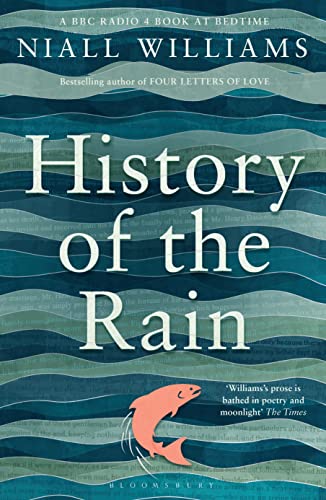
Niall Williams’s History of the Rain and the Book Group

Niall Williams, History of the Rain (Bloomsbury 2014)

Before the meeting: I fell in love with this book at the first paragraph:

The longer my father lived in this world the more he knew there was another to come. It was not that he thought this world beyond saving, although in darkness I suppose there was some of that, but rather that he imagined there must be a finer one where God corrected His mistakes and men and women lived in the second draft of Creation and did not know despair.

That’s nineteen-year-old Ruth Swain, whose mother is a MacCarroll, writing from her sickbed in a book-filled room at the top of a house in the tiny Irish village of Faha, where it has been raining for centuries.

Ruth has inherited her father’s vast library and her head is filled with the books she has read while sick, especially the novels of Dickens. As she tells us the story of her family – her grandparents Irish and English, her mother Mary, her father Virgil and her twin brother Aeneas whom everyone calls Aeny – her prose bristles with references to those books, usually taking the intertextuality to a comic extreme by naming the book’s publisher, date of publication, and its number on her father’s shelves. Her style, as she is told by a schoolteacher who visits her, is ‘a bit Extreme’:

I am that anachronism, a book-reader, and from this my writing has developed Eccentric Superabundance of Style, Alarming Borrowings, Erratic Fluctuations, and I Must lose my tendency to Capitalisation.

Her narrative is indeed eccentric, alarming, erratic, and overflowing with Irish charm. I totally believed in her – so much so that when I reached the Acknowledgements at the end of the story and read Niall Williams speaking in his own voice it was like coming down to earth with a thud.

Ruth’s father is a poet. We don’t get to read a single line written by him, but – in striking contrast to the poet mother in Edwina Preston’s Bad Art Mother (my blog post here) – we have total confidence in his creative process. Here’s a little of the description of the moment when he first begins to create poems, when he is ‘brimming’ after the birth of his children:

There were no words at first. At first there was a kind of beat and hum that was in his blood or in the river and he discovered how somewhere in his inner ear, a pulsing of its own, a kind of pre-language that at first he wasn’t even aware he was sounding. It was release. It was where the brimming spilled, in sound. To say he hummed is not right. Because you’ll suppose a tune or tunefulness and there was none, just a dull droning inside him.

(Page 262)

As well as a multitude of writers, Ruth’s head is filled with the people of Faha, their malapropisms, their idiosyncrasies, their all-knowingness. Possibly because I spent my childhood in the Irish-Catholic diaspora of North Queensland, I didn’t recoil from what you might see as sentimentality in their portrayal, but was delighted by their comic energy. Take this, for example, from the moment when the newborn twins are being baptised in river water in the kitchen of their home:

Everyone closed in around us, everyone wanted to see. It was as if our story was already being told and was moving the hearts of Faha, making people think These two will need help, for right then there was an opening of shirt buttons, a rummaging in handbags, in wallets and coat pockets, a general flurry of rooting about, and then, as the river water was being scooped from the bucket, into our swaddling on the kitchen floor came assorted Miraculous Medals, rosary beads, Memorial cards, brown and blue and green scapulars of various antiquity (and body odour), two Padre Pios, two Pope John Pauls, one Little Flower, Saint Thérèse of Lisieux, Patron-of-the-Missions card, several (because we had been Lost & Found) Saint Anthonys, one Saint Teresa of Ávila, Patron of Headache Sufferers, and from the handbag of Margaret Crowe a sort of crouched-down Lionel Messi-looking Saint Francis of Assisi, all of them well-worn and used and in our first moments in this world falling around Aeney and I now like holy human rain.

(Page 269)

The only reference in that list I had to google is Lionel Messi. All the rest is vintage irish-Catholic. I was so enchanted I barely noticed that horrible ‘Aeney and I’ at the end.

I laughed out loud. I inflicted passages on my long-suffering partner. I cried, though not at the sad bits, which were the only place where the book’s hold on me slackened a little. No, it was when Ruth relents for a moment and lets her awkward and consistently rebuffed suitor wash her hair.

After the meeting: Our host gave us an excellent Irish stew and roast potatoes, which were supplemented by a salad, pastizzi from Newtown and various cheeses, chocolates and ice creams brought by the rest of us.

Not everyone had finished the book; one was still waiting for it to arrive at his local bookshop. Not everyone loved it as much as I did. But we had an animate discussion of the what-about-that-bit variety, and I wasn’t the only one who had been prompted to read sections aloud, as much for the reader’s pleasure as for the listener’s. We all had the impression that the listeners, in this case, enjoyed the experience.

I wasn’t the only one to have wept at the hair-washing incident.

The Book Group and George Haddad’s Losing Face

George Haddad, Losing Face (UQP 2022)

Before the meeting: This book is part of the wealth of interesting new writing to come from culturally complex Western Sydney over recent decades. I’ve blogged about some of it, including poetry by Maryam Hazam, Eunice Andrada and Sara M Saleh, and fiction by Michael Mohammed Ahmad, Luke Carman, Felicity Castagna and Suneeta Peres da Costa. I have mentioned George Haddad at least once in this blog, for his short story ‘Broken Zippers‘ in Overland 237. This is his first novel.

Joey is in his late teenage years, part of a Christian Lebanese community in Western Sydney, working in a supermarket and pretty aimless. He’s friendly with Emma, who (I think) is an ‘Aussie’, which in this context means of British or Irish heritage. Joey’s Aussie father has been absent for most of his life. He gets on well with his mother, and their mostly amiable bickering is a key pleasure in the first chapters. Joey’s younger brother occasionally looks up from his phone to join the conversation. Tayta Elaine, Joey’s grandmother and the family matriarch, completes the portrait of a warm, supportive, noisy family.

Trouble starts for Joey elsewhere. He goes to a music festival with Emma, his best friend Kyri, and Boxer, who’s a bit of a bully from school days. The drug-infused euphoria of that event takes a dark turn when Boxer and Emma start to make out, but the real trouble comes a couple of weeks later when Joey and Kyri again go out with Boxer and an even worse bully: the four of them pick up a young woman, Lisa, on the train, drugs are involved, and they sexually assault her. What had been charming and engaging sketch of life in a particular community now coheres into a narrative charged with moral jeopardy.

The story is plainly told. In particular, the story of what happens with Lisa is given without evasive language. Joey is not a witness to the worst parts of what happens, and we are given all the mitigating circumstances, but we do see how he participated in precise detail, including the moment soon after the event when he apologises and she acknowledges his apology. But she goes to the police the next day, and Joey and the others are charged sexual offences. Joey’s friends’ and family’s disappointment and anger leave him isolated, and the approaching trial becomes the focus of the narrative. As readers we see a lot of nuance, but though we feel for Joey, the question of accountability hangs heavy over the story – so that the outcome of the trial becomes a secondary consideration. It’s beautifully done.

Meanwhile, Tayta Elaine’s story unrolls in alternate chapters. Apart from being a widowed matriarch, she is addicted to gambling, and much of her sections is taken up with her internal self-negotiations in which she justifies feeding far too much of her pension into poker machines and committing mild frauds to stay afloat. These sections are much less convincing. I feel they were there as necessary ballast to Joey’s story: his generation isn’t the only one to be morally compromised. But this narrative doesn’t grab with nearly the same force.

While thinking about this blog post, I read a short review of the book by Bri Lee in The Monthly. My impression that she is uncomfortable at being asked to empathise at all with a character involved in sexual violence, but she’s too polite to repudiate the project outright:

Joey believes his part in the crime wasn’t as bad as others. What’s often excruciating for a post-MeToo reader is to try to divine whether or not the author believes in outdated ideas or if it’s just the characters who do. Losing Face walks this very old tightrope: what is the difference between re-presenting the problem and actually critiquing the problem?

This is quite misleading. It’s not just Joey who sees his ‘part in the crime’ that way. Lisa doesn’t want him charged, and police charge him with a lesser crime. This is not to say he’s blameless or that he sees himself as blameless. He’s racked with guilt and doesn’t know what to do. There’s very little resource around for him. Bri Lee concludes her review, ‘Elaine is looking at herself in the mirror at the end of the book. Joey is not.’ We must have read different books. In my reading Elaine has gone even further down the path of addiction and bad stuff has happened to her, but she has little or no insight into her own responsibility for her misadventures (not that we blame her, given her tragic back story): she sees only that men are bastards. Joey, by contrast, has decided to change his life.

I hope it’s not a spoiler to give you part of the book’s final conversation between Joey and Tayta. If a mirror is involved, Tayta may be holding it up, but it’s Joey who is looking at himself:

‘I tell you something, Joey. Deep in the mind, any man from all time, no matter what they like to fuck – women, other men, goats – deep in the mind, they still believe woman is weaker than man.’

She stood up. Joey was empty.

She walked towards the garden and kicked with her slipper at a weed growing from a crack in the concrete until it dislodged. ‘And this is why that shit happen to the young girl in the car park with you and them kleb.’ She sounded like she was swallowing her tears. She bent over, picked up the weed and flung it into the garden. ‘And this is why, all around the world, men always doing shit to women in car parks.’

Joey’s anxiety had indeed lifted like magic earlier, and it turned like magic too.

(Page 256)

Just before the meeting I reread the book’s Prologue, which I had forgotten. It’s in the form of an Arab folktale about a terrorising djinn who agrees to leave the women of a camp alone if they gave her the manhood of all their boys. The women do so, and when the little boys grow up, they don’t grow beards, have no gusto for work and must be led, confused, through the desert.

I went into the meeting wondering what to make of that, and wondering what anyone else had made of Bri Lee’s review.

The meeting: This was the first time many of us had been together in person for a long time. We marvelled at the excellence of the bring-a-plate meal, and the luxury of sitting maskless around a table to eat it.

It took us a while to get to Losing Face. Our host was fresh from a battle with a government department in his local area, and there was much experience-based lamentation about bureaucracies. I was able to relay some wise words passed on to me by an employee of that department who had heard it from an old man when he was young: ‘Always remember that the department has no heart to break and no arse to kick.’

We all liked the book. In the process of discussing it, we came to appreciate the way our sympathies and expectations were managed. At first, the sexual assault scene feels like a nasty incident that may well turn out to be one of a sequence. Joey does his best to reassure himself that he’s a decent person, and as we go along with him, or not, we’re uneasy about the moral universe of the novel. When the police knock on Joey’s door it comes as a surprise, and we’re ambivalent: we’re apprehensive for Joey, who has our sympathy, but relieved that this is not going to be a novel in which the main character descends into callous depravity.

I’ll avoid spoilers, but will say that for such a short novel, Losing Face includes a lot of complexity about moral responsibility and the workings of the law. I’d forgotten some of the surprise twists of the legal proceedings.

Joey’s Aussie father – who turns up when Joey is in trouble – struck a chord with our gathering of mostly Aussie-fathers. A little paradoxically, the Western Sydney setting felt familiar and somehow comfortable to us inner-western Sydney types. There’s a queer dimension to the story, which someone felt was a bit tacked on, but someone with relevant experience said his gaydar went off very early in the book. Someone asked, ‘What will Joey do next?’ and we realised that the ending is wide open. I think we all felt that he’s in the process of changing his life, that he’s not going to just shrug off the whole episode, but we had a number of scenarios.

This month’s Chooser was one of the two who couldn’t make it to the meeting. Sadly he had to bask remotely in the glory of having chosen well.

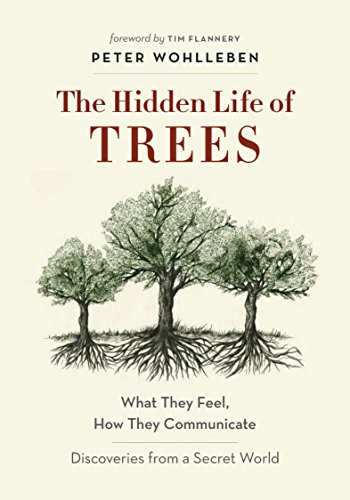
Peter Wohlleben’s Hidden Life of Trees at the book group

Peter Wohlleben, The Hidden Life of Trees: What They Feel, How They Communicate―Discoveries from A Secret World (2015), English translation Jane Billinghurst (Black Inc 2016)

Before the meeting: This book received a lot of attention in the press when it was published, in a way that me feel I didn’t need to read it. We now all know that trees emit scents that affect the way other nearby trees react to, for example, insect attacks or fungal infections. We know that a complex network of underground funguses helps forest trees to grow and pass nutrients from one to the other. We know that trees that spring up close to the tree their seeds fell from continue to interact with the ‘parent’ tree. In general, we know that careful observation and experimentation is revealing that the received wisdom about trees, like the received wisdom about many other things, needs a major overhaul.

Peter Wohlleben has spent decades managing a forest in the Eifel, a low mountain range in western Germany and eastern Belgium. He gives guided tours of the forest, is a committed conservationist and, as the book makes abundantly clear, loves trees with a passion. His passion is catching, and the scientific findings he describes are fascinating. He doesn’t intimidate his readers with scientific jargon or hector us with conservationist polemic. Instead, he is personal, lively, charming, and whimsical.

I found the book unsettling in two ways. First, the whimsy: there are mother trees and orphan trees; trees send and receive messages; trees are impatient or well-disciplined or altruistic. That makes for lively reading, and works well as metaphor. There’s no harm in saying, for example, that a tree tries to grow out of its neighbours’ shade because it wants more light. But surely that’s a figure of speech, it’s not that the tree wants something the way a human infant or even a puppy does. Peter Wohlleben does seem at times to be attributing actual thoughts, desires and emotions to the trees. He says occasionally that we can’t know what trees are feeling – but he comes close to implying that that’s just because we don’t have a common language. That is to say, maybe what I read as whimsy is actually a perfectly serious, I would say mystical, anthropomorphism. I react against that: surely we can respect trees, and forests, without attributing consciousness to them.

My second difficulty is the book’s exclusive attention to the northern hemisphere. As I read about beeches, oaks, birches and poplars, I yearned for information about angophoras, figs and eucalypts, about sclerophyll forests in general.

The Black Inc edition I borrowed from the library seems to be aware of my two misgivings. It signals that the book is relevant to Australian conditions by adding a foreword by Tim Flannery (though he doesn’t add any antipodean information), and that it’s based in solid science by including ‘Notes from a Forest Scientist’ by Dr Suzanne Simard, whose research provides the basis for much of the book.

I did enjoy the book. My discontents, far from leading me to toss it aside, prompted me to read more. I’ve recently read Richard Powers’ wonderful novel, The Overstory, which covers some of the same territory. I expect to blog soon about naturalist John Blay’s Wild Nature, an account of his big walk through the forests of south-east Australia that immerses the reader in the experience of those forests, with excursions into the history of the battle to conserve them and occasionally into some of the science. And I’ve got Suzanne Simard’s seminal work, Finding the Mother Tree, on order from Gleebooks. (It arrived as I was about to hit ‘Publish’.)

After the meeting: A group member has Covid, and there’s currently a surge in hospitalisations and deaths in Australia, so we decided too revert to zoom. It was a small, short meeting.

I’d felt a bit strange about writing almost entirely about my discontents with the book before the meeting, but as it happened, that’s how the meeting went as well. About half the group hadn’t finished the book, in spite of it being quite short. The same two problems were prominent: the anthropomorphising got on people’s wicks (one person was delighted to learn that word – he knew what it meant as soon as he heard it); and the complete absence of Australian/sclerophyll/tropical forests was, at least to one person, very annoying. Other discontents were the lameness of the humour (humour which I hadn’t noticed), and the lack of structure – it just seemed to be one thing after another, with a lot of repetition among the things.

Yet there was something like consensus that the book’s content was interesting and important. A number of people mentioned other books: Bill Gammage’s The Biggest Estate on Earth (2011) as a partial remedy for the absence of Australian content; Merlin Sheldrake’s Entangled Life (2020) as an example of even more exasperating anthropomorphism. Not everyone shared my love of The Overstory. There were some anecdotes about the death and regrowth of trees from our own experience, and one folktale.

Then we talked about Covid. Of the seven of us, four had had it at least once. The chap with the current positive result wasn’t there, so that makes five out of eight.

Douglas Stuart’s Shuggie Bain

Douglas Stuart, Shuggie Bain (Picador 2020)

This is a Book Group book.

Before the meeting

Shuggie Bain is the story of a boy who grows up in poverty in Glasgow, the youngest of three children. His mother, Agnes, is an alcoholic who is brutally treated by her husband, Shuggie’s father, and then abandoned by him. Once a stunning beauty, she struggles to maintain appearances as she descends into increasingly desperate poverty, alienated from other women and sexually exploited, often violently, by men. From an early age, Shuggie takes on the burden of looking after her, protecting her and trying to make things better. The downward trend is reversed at times when Agnes joins AA, finds part-time employment and has a relationship with a decent man, but there is never any doubt about how her story will end, or that she will take Shuggie down with her. Through it all, Shuggie is singled out by adults and other children as different, not a proper boy – it’s a story of growing up gay.

The Wikipedia entry on Douglas Stuart gives an account of his childhood that could easily be a plot summary of the book. It’s surely no coincidence that ‘Shuggie’ rhymes with ‘Dougie’ (though maybe not in Australian pronunciation, if ‘Shug’ is short for ‘sugar’ as in The Color Purple), and the opening line of the acknowledgements refers to the author’s mother ‘and her struggle’. So the book presents itself as a fictionalised version of the author’s own childhood. As such it’s a valiant work of imagination, wrangling terrible experience into words. I admire it, I read it compulsively, I must have been moved by the horror because when I reached the book’s one moment of genuine tenderness I felt an extraordinary sense of a weight lifting from my mind, even though I knew it was only temporary. But …

… if I hadn’t been reading it for the book group, I would have stopped at page 37, where Agnes is beaten and raped by Big Shug. Really, do I need any more images of that sort lodged in my brain? I did read on, encouraged by the fact that the book won the Booker Prize in 2020, and I’m glad I did, but I found the insistence on the misery of Agnes and every other character in the book disturbing. I can explain what I mean by way of a tiny moment fairly early on. Agnes has regained consciousness after a night of drunkenness, destruction and violence:

Agnes wrapped her lips around the cold metal tap and gulped the fluoride-heavy water, panting and gasping like a thirsty dog. 

(page 72)

She has been beaten up, raped, and shunned. She has done appalling things in her drunken state. Now, the tone of this sentence implies, she has reached such a state of degradation that she drinks directly from a tap, and not only that, but the water has been fluoridated! Where I come from, you don’t have to be subhuman to drink fluoridated water from a cold tap. It feels as if the narrator, if not the book itself, has lost perspective, and I lose faith. It could be that this sentence is a momentary false note. After all, as Randall Jarrell said, a novel is a prose narrative of some length that has something wrong with it. But my uneasy sense that perhaps this was a work of Misery Porn persisted for the rest of the book, even while I engaged intensely with the characters.

Between reading the book and the Book Group meeting: I took the book, and my unease about it, seriously enough to do some counterpoint reading – that is, to read writing that deals with similar material from different points of view. Interestingly enough, the other reading led me to a better appreciation of Shuggie Bain.

1. Jimmy Barnes’s memoir Working Class Boy (link to my blog post here). The early chapters tell of a childhood in a family and community in Glasgow, where alcohol-fuelled violence is as prevalent as in Shuggie’s. Young Jimmy could easily have been one of the boys who terrorised young Shuggie.

They are different kinds of book, of course. Jimmy Barnes can expect his readers to know him as a rock star, and to read the memoir as his back story. As he tells it, the young Jimmy was able to escape from the violence at home, and he went pretty wild on drugs and alcohol himself. Writing as a grandfather, he repents the errors of his youth and writes with generosity and forgiveness of his parents.

The narrator of Shuggy Bain doesn’t have that kind of safe distance from the events he describes. The novel has a visceral immediacy. The account of Agnes’s degradation is told from a point of view not far removed from Shuggie’s own, so the reader is aligned with the helpless child bystander. If the narrator has any distance at all, I imagine it’s that of an adult Shuggie who has escaped Glasgow, and looks back in horror at what he witnessed and endured.

2. Wendy McCarthy on the ABC’s Conversations podcast describes her own response when she saw her father lying drunk in the gutter.

This boy said to me, ‘You know your father’s a drunk,’ and I said, ‘Yep,’ and just kept walking. I learnt something then: I’m not going to carry his shame.

(The link is here. The quote is at 14 minutes and 20 seconds.)

Wendy McCarthy was already at high school when that happened, and had had time to build her inner resources. Shuggie Bain is a novel about a child who didn’t have that chance, and who was caught in the vortex of his mother’s shame.

3. Kit Kelen’s Book of Mother (blog post to come). On the face of it, this poetry collection has nothing in common with Shuggie Bain. Mostly, it plunges the reader into the experience of living with the poet’s mother’s dementia. The son/poet-narrator is an adult, but the poetry captures a kind of mental vertigo that has a lot in common with the way Shuggie is drawn into his mother’s struggles. Comparing the books, I realised Shuggie isn’t just a dreadfully abused child, but he’s also a person of extraordinary heroism. When everyone else abandons Agnes or – in the case of Shuggie’s siblings – escapes her destructive gravitational pull, Shuggie stays, loving her and trying to make things better for her, until the bitter end.

After the meeting: We met in person, all but three who were respectively on the road with a theatrical production, visiting New York for major family event, and home with non-Covid sick children. As usual we ate well and eclectically. Among other things we discussed the role of table tennis for one of us in the process of retiring from regular work; the joy for another at having no income to declare as he too is in the process of hanging up his tools; and our shared relief at having a government that isn’t just about slogans, announcements and cruelty.

The Chooser kicked off conversation about the book by saying that if he’s known what it was about he wouldn’t have picked it, but he’d trusted his wife’s recommendation. I think we were unanimously glad he had, as the book provoked animated, and at times intensely personal conversation.

Many, if not most, had had to overcome initial reluctance that ranged from my own borderline prissiness to not wanting to dredge up memories of a major alcohol-related disruption in his own life.

A number of the chaps said they’d had to take breaks from reading it – one said a dull work on (I think) the energy grid was a perfect palate cleanser. One of the night’s three absentees texted that it was like Hanya Yanigahara’s A Little Life ‘but without the gratuitous violence etc.’ Another absentee sent us a long text part way through the evening, and encapsulated the general sentiment in his summing up: ‘In the end it was really good but hard going. I’m glad it’s over but glad I finished.’

A number of things were identified as having won us over. We agreed that it’s beautifully written – one man said he kept stopping to reread sentences for the sheer pleasure. It feels real – you believe that the author has experienced something close to Shuggie’s life. The narrative has a strong forward drive: as readers we share Shuggie’s hope that Agnes will snap out of the downward spiral, or at least we want it desperately even though we know it’s futile – and we keep turning the pages. The moments of lightness, tenderness and spirited resistance (there are more than the one I remembered) are beacons in the gloom. And we feel strongly for all the characters: Shuggie’s older brother Leekie won more than one heart, and (for me at least) Eugene, the one man who genuinely loves Agnes, tore my heart out when he became the unintentional agent of her destruction.

It’s a terrific book. Next meeting’s Chooser has been urged to choose something cheerful.

Abdulrazak Gurnah’s Afterlives at the Book Group

Abdulrazak Gurnah, Afterlives (Bloomsbury 2020)

Before the meeting: It was my turn to pick the book. I loved Abdulrazak Gurnah’s Gravel Heart when I read it last year, and I chose this one over three contenders because a) I like the idea of us reading work by Nobel Laureates, and it’s so good to have one whose writing is accessible, b) it’s time we read a book by a non-European writer – the last ones were Burruberongal woman Julie Janson’s Benevolence in October 2020, and two months before that In the Country of Men by US-born Libyan-parentage Hisham Matar.

Afterlives is a terrific book. It was longlisted for the Walter Scott Prize for Historical Fiction 2021. That prize was won by Hilary Mantel’s The Mirror and the Light. I have no quarrel with the judges, but my horizons were expanded much more by this book than by that one.

It’s set in the first half of the 20th century in what is now Tanzania and was then German East Africa / Deutsch-Ostafrika. It’s a family saga, a romance, a war story, a picaresque, a colonial tragedy. It tells the huge story of colonial brutality and East African engagement in two world wars, and also focuses closely on the intimate story of a handful of characters. It’s beautifully written, brilliantly visual, and paying attention to the intricacies of language in Africa under colonial occupation.

It takes risks: in the first third of the book a main, beloved character named Ilya disappears – he’s an African who was educated by German missionaries, and decides as an adult to join the askari, the native troops who serve under the Germans. His absence remains an unresolved ache for the other characters and the reader until the final pages, when a character from the next generation manages to unearth his story – and then the book abruptly ends.

In this colonial context, possibly the most painful story is that of the askari or schutztruppe, African soldiers who are brutally treated by their German officers and in turn perpetrate terrible atrocities on other Africans – not unlike the Native Police in the colony of Queensland where my great-grandfather grew sugar in the late 1800s. This passage is from the account of the First World War as experienced by the characters (my emphasis):

Even as the schutztruppe lost soldiers and carriers through battle, disease and desertion, their officers kept fighting on with manic obstinacy and persistence. The askari left the land devastated, its people starving and dying in the hundreds of thousands, while they struggled on in their blind and murderous embrace of a cause whose origins they did not know and whose ambitions were vain and ultimately intended for their domination. The carriers died in huge numbers from malaria and dysentery and exhaustion, and no one bothered to count them. They deserted in sheer terror, to perish in the ravaged countryside. Later these events would be turned into stories of absurd and nonchalant heroics, a sideshow to the great tragedies in Europe, but for those who lived through it, this was a time when their land was soaked in blood and littered with corpses.

(Page 91)

My love for the absurd and nonchalant heroics of The African Queen just became much more complex. After reading this book, it would be hard to think of African suffering, or for that matter African love or prayer (the mosque is significant for some characters), as a sideshow to anything.

After the meeting: There were only five of us, others being out of town with family for Easter/school holidays and otherwise detained – no one in Covid iso this time. We’re still a little bit thrilled to be meeting in person: this is the third time in more than two years. Our host departed from recent bring-a-dish tradition and provided all the food – tuna steaks and a fabulous broccoli salad resting o a bed of tahini. I had been dreading a conversation about the election campaign and had laid bets that someone would predict an LNP win: it didn’t happen until the very end of the evening when there was consensus that it was a toxic topic, press coverage was abysmal and the leaders of both major parties, for different reasons, were invitations to despair.

We talked about theatre – Girl from the North Country, The Picture of Dorian Gray and White Pearl – and other books and podcasts (the ABC’s The Ring In on the Fine Cotton Affair was strongly recommended). There were outrageous travellers’ tales, gossip about the very rich, and general catch-up. When we finally came to the book, we had a terrific conversation, all appreciative.

The book conversation began with a confession: ‘I read it weeks ago, in a single sitting. I loved it but I don’t remember anything of it.’ When asked to say what he loved about it, he who had confessed proceeded to give an account of the book that was much more specific than I would have been able to manage: the detailed descriptions of life in a small Tanzanian town, the sweetness of the characters, the way terrible violence is described but doesn’t dominate the narrative, the overall sense that one is learning history that has been a closed book, the sex scenes – and there was more.

One chap was interested enough in the history to do some research. He produced an atlas and showed us the part of Africa where the action takes place. He had printed out a number of pages on the history of what was German East Africa, and some illustrations of askari in uniform. He was happy to report that the novel’s public events – mainly rebellions and battles – were historically accurate.

One man had read the book twice. The first time, several months ago, he appreciated all the things others had named but was left feeling somehow distanced from the characters – so different from reading that other novelist of colonial pain, Amitav Ghosh. He cared enough to read it again. This time he was no more engaged, but felt it to be a feature rather than a problem. On reflection, he came to understand (I hope I’m representing his subtle comments accurately) that his sense of non-engagement was because we are being shown the deep effects of colonisation on the colonised: the characters are beset by cruelty and oppression on all sides, and they are intent on survival. This means they reach out with kindness to each other – there is an amazing amount of kindness in this book, often in unexpected places – and live very much for what joy and they can find in the present. There’s no room for them to reach out to us readers.

I loved this insight. It helped to see the book as a whole. For example, Hamza, the male romantic lead, responds to most situations with silence. We can tell that he is variously humiliated, elated, disappointed, puzzled, grateful, terrified, but he never communicates it. The narration shows us what happens to him and what he does in response (usually he tends to passivity), but we are not given his internal dialogue. He doesn’t talk to us, the readers.

It also makes sense of the ending. Someone said that the last few pages, in which the fate of Ilya is discovered, feels like a postscript, yet (I think it was me who said this) it resolves an issue that has been hanging from very early in the story. In such a beautifully constructed book, it’s unlikely that this is a rough and ready tying up of loose threads. It’s hard to say more about this without being spoilerish so I’ll just say, with apologies for being vague, that the book’s final sentence, which on first reading felt naggingly anticlimactic, picks up the deep theme the group member identified, and offers a sharp change of perspective on the way the rest of the narrative has been resolved.

Afterwards, I thought it would be interesting to hear a conversation between Abdulrazak Gurmah and Alice Walker, the final moments of whose very different novel Possessing the Secret of Joy make an interesting contrast.

When we arrived the sky was clear. As we left the rain was bucketing down and, just like after the last meeting, the streets were awash.