Category Archives: Page 7x/47/7

Summer reads 4: Javier Zamora’s Unaccompanied

Javier Zamora, Unaccompanied (Copper Canyon Press 2017)

In the 1990s when Javier Zamora was nine years old, he made his way unaccompanied from El Salvador, evading US border protection, to meet up with his parents who had fled to the US to escape political persecution. He is co-founder of Undocupoets, a group that lobbied to increase opportunity for undocumented writers in the US.

This is his first published book. It’s a collection of poems that revolve around his harrowing solo journey, including its before and after, not as a linear narrative but mostly in the way memories arise piecemeal: a moment of terror in the desert; recollections of his beloved abuela (grandmother), who he’s unlikely ever to see again; fragments first person narratives from his mother, his father and others; an address to the then newly elected President Trump; moments of longing for his home in El Salvador … I’m not trying to be a smart-arse, but the book is a poetic documentation of the process of becoming what is known in the USA as an undocumented person. In the present time of the poems, he still lives with the possibility of la Migra bursting into his life.

That little boy was unaccompanied when he made his way to the US, but the poetry is alive with relationships. That is, he never lost the sense that there were people who cared about him deeply – the terror was that he might never see them again.

The author photo on the back cover shows a smiling young man, apparently relaxed and confident: Look, he could be saying, I have come through. One poem in the collection, ‘Exiliados’, has that feeling. It appears toward the end of the book, and gathers tremendous emotional force from all that has gone before:
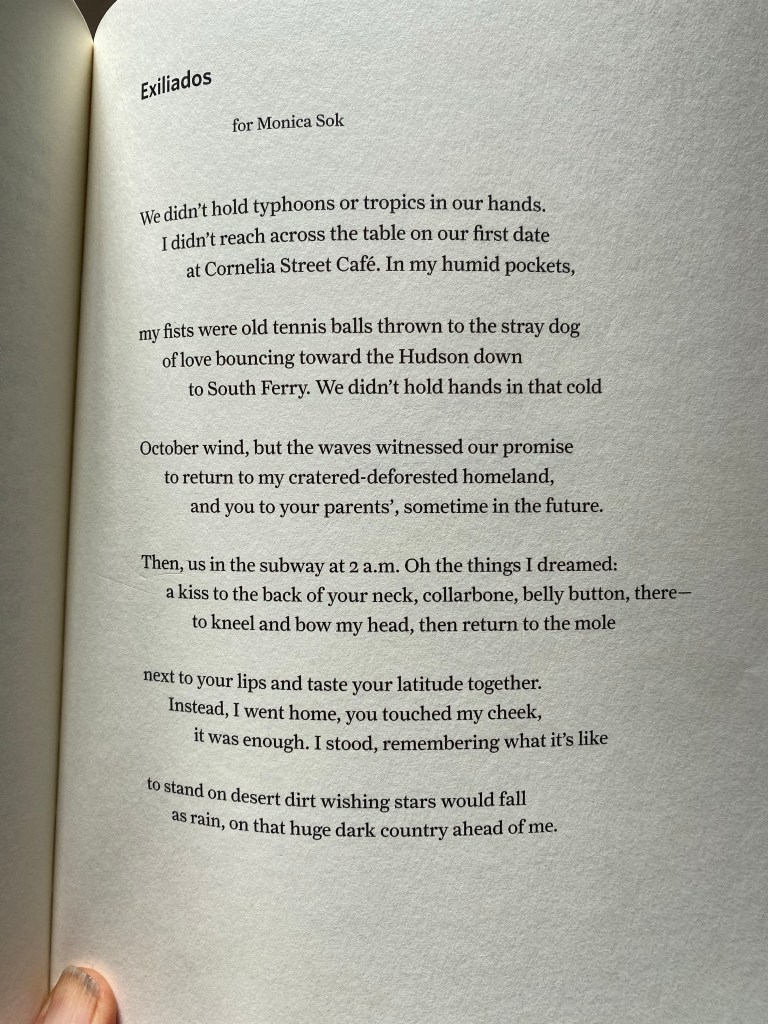
Exiliados
for Monica Sok

The title and dedication do a lot of work. Like most of the Spanish words that pepper the poems, ‘Exiliados’ is easily understood by the non-Spanish speaker. Zamora does us the courtesy of not providing a glossary, leaving us to deal with it if we don’t know his mother language – his own linguistic upheaval is central to the story, and any difficulty we have can only help grasp it. The dedication is to a person whose name comes from a non-English speaking culture. You don’t need to know any more about Monica Sok to get the poem completely, but as it happens she is a Cambodian-American poet whose book A Nail the Evening Hangs On was published in 2020 by the same company that published Unaccompanied. Before we reach the first line, we know that the poem is addressed from one exile to another – exiles at least in the sense that they come from elsewhere and don’t belong to the mainstream white culture.

We didn't hold typhoons or tropics in our hands.
xxxI didn't reach across the table on our first date
xxxxxxat Cornelia Street Café.

Neither the tropics of El Salvador nor the typhoons of Cambodia are present at this meeting. Both people have left their homes behind. Other poems in the book name places in El Salvador, and when one of those places is unfamiliar to me I feel that that is no surprise to the poet. Here by contrast, when he names the Cornelia Street Cafe, it feels like a name-drop. And sure enough, the cafe has its own Wikipedia entry informing us that it has been voted one of the best places to listen to jazz music. Sadly, and perhaps fittingly in the context of so much pecariousness, the cafe closed down in 2018, after this book was published. But the point here is to establish that the meeting is happening in hip Manhattan.

It’s a date, but the speaker is tentative. His hands, like the hands of the other person, can’t bring his past life to the table. Nor can they reach out to make contact.

xxxxxat Cornelia Street Café. In my humid pockets,

my fists were old tennis balls thrown to the stray dog
xxxof love bouncing toward the Hudson down
xxxxxxto South Ferry.

More New York place names, references to humdrum Manhattan life where people throw dogs to balls and no one lives in fear of armed men in white vans. It’s romcom territory. His fists are sweating in his pockets at the prospect of love, but he’s too much the stray dog to be sure of his welcome.

xxxxxxto South Ferry. We didn't hold hands in that cold

October wind, but the waves witnessed our promise 
xxxto return to my cratered-deforested homeland,
xxxxxxand you to your parents', sometime in the future.

Two exiles, two New York poets, they speak of their homelands and the promise to return.

Then, us in the subway at 2 a.m. Oh the things I dreamed:
xxxa kiss to the back of your neck, collarbone, belly button, there
xxxxxxto kneel and bow my head, then return to the mole

next to your lips and taste your latitude together.
xxxInstead, I went home, you touched my cheek, 
xxxxxxit was enough.

What was a meeting of minds is now embodied, a moment of desire. (I don’t understand ‘latitude’, but I don’t care!) We don’t know if this was the first date that led to an intimate relationship, or if this touch on the cheek is as far as the romantic possibilities of the relationship have gone. Unlike a romcom, the poem isn’t concerned about that. Like many other poems in this collection, it focuses tightly on the moment.

In the first lines, hands were busy doing nothing – not holding places or origin, not reaching out, staying in pockets like old tennis balls that love might find, definitely not holding each other as their owners walked in the cold October wind. Now at last, the woman’s hand has made contact, and ‘it was enough’.

xxxxxxit was enough. I stood, remembering what it's like

to stand on desert dirt wishing stars would fall 
xxxas rain, on that huge dark country ahead of me.

‘The Future is dark,’ Virginia Woolf wrote in her diary in 1915 after a bout of depression, ‘which is the best way the future can be, I think.’ That’s how I read the ‘huge dark country’ here. When the nine-year-old arrived in the USA, and the future could have held anything. Now a young woman touches a young man’s cheek at 2 o’clock in the morning after they’ve talked for hours, and he feels the same sense of a vast unknown ahead, full of promise and possible danger.

This is a book that puts flesh on the bones of the continuing US headlines about the Mexican border, and especially the stories of unaccompanied children caged under President Trump. I don’t know if there has been anything quite like it about asylum seekers in Australia.
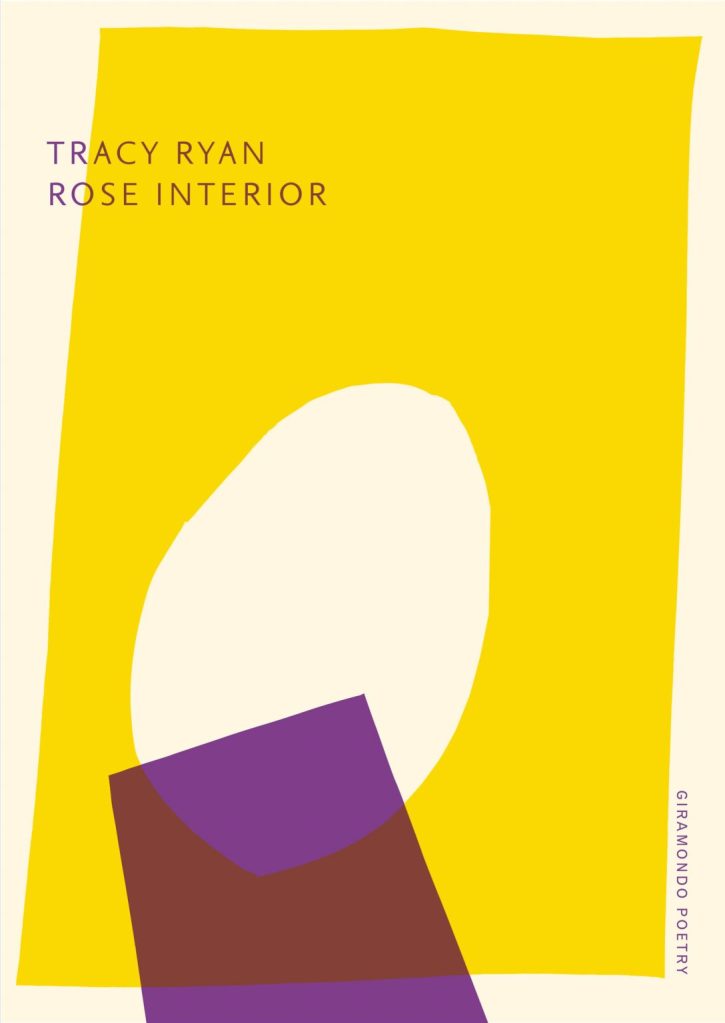
Summer reads 3: Tracy Ryan’s Rose Interior

Tracy Ryan, Rose Interior: New Poems (Giramondo 2021)

There’s a lot to love in this book from Western Australian poet and novelist Tracy Ryan.

A note on the Giramondo website describes it well:

The poems in Rose Interior move between the inside and outside of everything they touch, from the domestic scene, both cosy and claustrophobic, to the social and ecological settings we must all answer for. Poems from Ireland, Switzerland and Australia consider life at home in the personal sense: through the body, childhood memories and family houses, ‘a room within a dream’. Wherever home lies, it’s always on borrowed time.

It’s the domesticity that most appeals to me – that and the occasional poems about ageing. In particular, as a recent adopter of hearing aids I love ‘Soft of Hearing’, which begin with this brilliant description of what has also been my experience:

The hard edges went
longer ago than you know
as if the crusts of syllables
were trimmed off for your ageing

ears to swallow only
what's soft.

And it only gets better from there.

There are profound poems about bereavement. There’s ‘Ghost Story’, which I take to be about age related cognitive decline:

Sometimes I catch the other me,
elves to shoemaker, who's already
filled the pot with water as I just
turned to do

And I could go on picking out lines to quote. The book is divided into three sections, the third of which is eighteen poems on aspects of the Covid pandemic. With a light enough touch, they bring profound thoughtfulness to home education, zoom backgrounds, bread-making, and other standard Covid themes. To pick one beautifully accessible poem, here’s ‘Post Storm, Still Pandemic’:

In the book, this poem follows ‘Storm in Pandemic’, whose title is a good description of its content. When you read it in that context, this poem’s title is likewise a good summary of the content: the storm is past, but there’s still a pandemic.

Post Storm, Still Pandemic
Afraid to look outside in case it shatters 
illusions we've come through this. Blinks, 
but power stayed on, the roof has held.
Out there is turmoil, noise, last bluster, yet 
worst has passed. 

It’s probably worth mentioning at the start the apparently effortless way (definitely effortless for the reader) that the poem works with a basic line of five beats, not quite iambic pentameter, sometimes longer, sometimes shorter, keeping a conversational tone and drawing no attention to its technique.

The first line captures that moment when a severe storm is over, but you can’t quite believe it. The line break after ‘shatters’ creates a fine moment of ambiguity. The reader wonders: In case what shatters? then the new line reveals that the verb is transitive, and non-literal – only illusions are shattered, not windows or indeed the whole world. Then the common phrase ‘we emerge, blinking, into the light’ is evoked by the single word ‘Blinks’, and one by one the elements of normal life are found to be in working order.You almost don’t notice the book’s central motifs of inside and outside, of home being ‘on borrowed time’.

worst has passed. At night, so blurred, 
I couldn't tell wind from rain, bad 
synaesthesia, all colours tossed together 
to make dark. Night was a tunnel, only one 
way through.

I like the way this description of the disturbed night manages to include in just four lines the slightly esoteric notion of synaesthesia (something perceived by one sense being experienced as another), a little colour theory, and the image of time as a tunnel. The density of tropes is a kind of analogue for the eventfulness of the night.

way through. City still stricken, our guilt.
How can we rest and write while others dread?
They tussle with neighbours who haven't 
cleared away or tied things down: Your fence 
is in my pool. Here with gaping space 
between us, it's more like this, direct 
interface: is there a tree on the house, how 
did small ones fare in burrow or nest, what 
in the world is left? 

A change of perspective. The poem’s speaker lives in the country – Tracy Ryan’s bio tells us that she grew up in the outer suburbs of Perth and now lives in the wheatbelt. Here she counts her blessings, but not without first acknowledging a pang of something like survivor guilt. City – and suburb – dwellers are so much worse off, at the mercy of improvident neighbours in a severe storm. (I relate to this as a couple of years ago a tree that fell from my yard narrowly missed a neighbour’s rotary clothes line.) In the country, such relatively petty inter-human quarrels aren’t a thing. One’s response is more direct to the thing itself: damage to property, and – another broadening of perspective – concern for the other animals and the environment in general. (Tracy Ryan and her husband John Kinsella have a blog called Mutually Said: Poets Vegan Anarchist Pacifist: I love the way, here and elsewhere in the book, the poet’s principled positions – in this case caring for non-human animals – appear with no hint of moralism or proselytising.)

in the world is left? On Reunion Island, back 
with the 1918 flu, they say, after the first ravages 
a cyclone came and washed it all away, 
common disaster chasing off a worse. 

The perspective broadens again, in space to the far side of the Indian Ocean, and in time to the last great pandemic. This is the first time the Covid-19 pandemic has appeared in this poem, however obliquely. Given the drama of the storm we have forgotten it for a moment.

common disaster chasing off a worse. I hover 
here on the far side of the same ocean,  
wish for truth in it, the notion of harsh  
weather as unexpected cleansing.

And we’re back to the first person singular, in this place, facing – by wishing not to face – the difficulties and dangers of the present. The notion of harsh weather as unexpected cleansing (such a resonant phrase) isn’t always mistaken, but it may have been in Réunion in 1919, and certainly would have been in Western Australia in 2021. The poem knows this, acknowledges that it’s a false hope even while acknowledging its appeal. My mind leaps to the way some of us thought the Covid pandemic itself, harsh as it was, might provide an unexpected opportunity for states and corporations to put aside short-sighted self-interest and rise to the challenge of the climate emergency – another disaster chasing off a worse. But nah!

There are many poems in this book that I hope to read over and again.


I am grateful to Giramondo Publishing for my copy of Rose Interior.

Summer reads 2: The Gleaner Song Lin

Song Lin, The Gleaner Song, translated by Dong Li (Giramondo 2021)

Song Lin (宋琳) was a campus poet in Beijing in the 1980s, and was active in the 1989 protests in Tiananmen Square, for which he was imprisoned for a year. On his release he married a French woman, and in 1991 went to live in Paris. After spending time in France, Singapore and Argentina, he returned to China in 2003, and now lives in Yunnan province. He has published many books of poetry and prose, including two bilingual French-Chinese volumes, and currently edits the poetry journal Jintian (Today), which ran for nine issues in the late 1970s before being censored, and was revived in 1999.

The Gleaner Song had its beginnings when Song Lin was on a long walk in the countryside of upstate New York with the young Chinese-born poet-translator Dong Li. Describing that walk in his introduction, Dong Li writes:

I saw his eyes light up as a deer leapt from the wild into a wide-open field. As the evening hues shifted farther into the forest, his line of sight followed the deer until it vanished into the night. We talked about the deer, and later he asked me to translate a poem that he had written to record the occasion.

That translation was to become the final poem in this book. It’s preceded by poems spanning four decades and as many continents, incorporating classic Chinese forms and elements of western modernism. Mostly I found it a difficult book, but in interesting ways.

To talk about the difficulty, and why it’s worth dealing with, I want to have a closer look at one poem, ‘Notes from South Xinjiang’. You can read the whole poem, without my commentary, on the Cordite Poetry Review website, where it was published in February 2022.

The rest of this blog post gets a bit detailed. A short version: the poem is a number of brief observations and reflections during a visit to South Xinjiang, the southern part of the Xinjiang Uyghur Autonomous Region in northwest China, much of which is taken up by the Taklamakan Desert, and most of whose population are Uyghur. It is a prose poem made up of 23 short numbered paragraphs. On a first reading, probably in bed at night, I enjoyed the sense of a mind at play in a new place, but I knew there was a lot I hadn’t understood. Here is what I found when I reread the poem with the internet open beside me:

Notes from South Xinjiang

1. The reckless god reads the braille of the desert.

The poem announces at the start that its subject is a desert. The gist of this first paragraph is clear enough: the shapes made by the wind on desert sands can look like braille, but it would be reckless to read a meaning into them – which by implication is what the poet, godlike, may be about to attempt. But is ‘the reckless god’ someone from ancient Chinese tradition, and would I read the poem differently if I knew? That question remains unanswered.

2. One night in Kupa, I received a telegram from Mars: there were traces of water.

I looked up ‘Kupa’ and found a river in Croatia. But there is a town called Kuqa (or Kuche) on the edge of the Taklamakan Desert, so I’m pretty sure that’s where the poet was. Wikipedia gives a long list of variants but ‘Kupa’ is not one of them. Who can blame a copy editor for not picking up what is almost certainly a transcription error, but mistakes like this add a layer of difficulty for the uninformed reader. So the poet is on the edge of the desert which he imagines as Mars-like. There may even be a suggestion that Mars has water where this desert does not. Certainly in photographs it looks vast and dry.

3. Dead rivers look like twisted mummies in the gallery of the sky.

I parse this to mean the dead rivers as seen from the sky – that is, in the gallery of images held in the sky rather than a gallery of images of the sky, which was my first reading. A map of the region shows a network of rivers, with a note to say they are ‘usually’ dry.

Why mummies? It’s not an obvious visual likeness, but it turns out that 4000-year-old mummies have been found in this area. This is the poem’s first oblique reference to the region’s ancient history

4. Language, dust of dust, flies on the long, long road.

I don’t know if the ambiguity of ‘flies’ – is language as insignificant as insects or does it fly away? – is something that happened in the translation, but either way it works well: human activity, especially language, is dwarfed by the desert. This paragraph introduces human activity more explicitly, and specifically the idea of the road, which is taken up the next five paragraphs.

5. An oar stands before the boat-shaped coffin. Sailors of the desert sea, tell me, what kind of sail do you dream of?
6. Business caravans head east, and west. The sun bakes eyebrows, beards, and crusty flatbreads.
7. Go. Once you lie down, you run the risk of being air-dried.
8. From one invisible border to another, I count those disappeared countries.
9. A silkworm once dreamed of Rome; or rather, Rome once dreamed of a silkworm.

These six paragraphs reflect on past human travel in the desert. Paragraph 5: the mummies from 4000 years ago had boat-shaped coffins. Paragraphs 6 and 7 refer to conditions endured by caravans of any era. Paragraph 8: perhaps the poet knows what those disappeared countries are, where those borders were – I don’t, but neither of us needs to know that for the line to work. Paragraph 9 is a lovely evocation of the history of the Silk Roads which passed through this region, skirting the desert (according to this map).

10. Breeze in the dense forest, homonym of silk and porcelain.

This paragraph is an example of what must be a nightmare for translators. It makes no sense as a stand-alone sentence in English. Really, all one can take from it is that some words in a Chinese language sound the same as others. Maybe in the original it’s an elegant pun, or a cute but inconsequential observation. As I can’t read or speak Chinese, I have no way of knowing, and I can’t see how a translator could do other than what Dong Li has done here: translation is impossible. (In other poems, Dong Li explains linguistic play in a footnote, but that’s a bit like explaining the mechanics of a joke – it still doesn’t make you laugh.)

From here on the poem bristles with specific historical and cultural references. It’s as if the poet is wandering abut the region, making random, elegant notes about things he sees. He also, incidentally, challenges the ignorant reader to do a bit of work. Or from another perspective, he points to a number of doors that open on vistas of new knowledge.

11. The Han princess Liu Xijun – Sappho of Wusun country – was married to a vast and endless homesickness.

Song Lin gives his western readers a small hand by comparing Liu Xijun to Sappho, the earliest woman poet in the western tradition. Liu Xijun wrote one of the earliest poems in Chinese written by a woman. Wusun country, as far as I can tell, was a little to the north of South Xinjiang, but near enough. Liu Xijun’s poem includes the lines, ‘Living here, I long for my land, and my heart aches / Wishing I could be a yellow swan, and return to my old home.’

Having paid homage to traditional Han culture, the poem now moves on to religion:

12. Under the statue of Kumarajiva, I thought: perhaps his intelligible translation saved Buddhism.
13. On their pilgrimage to Chang'an, the three Buddhist masters walked in the opposite direction to the three wise men.

Kumarajiva’s statue is in Kuqa. He was a Buddhist monk of the 4th and 5th centuries of the current era, who translated many Buddhist texts from Sanskrit to Chinese. His translations are still in use today.

Chang’an is the ancient name for Xi’an: I don’t know the story of the three Buddhist masters who – I’m guessing – travelled through South Xinjiang. The reference to the three wise men is another example of Song Lin’s cross-cultural awareness. I read him as suggesting an equivalence between the foundation of Christianity and the bringing of Buddhism to China.

14. If Emperor Wu of the Han dynasty knew that the Ferghana horse was a horse with a disease, would the history of Ferghana be re-written?

At about 100 CE, China imported huge numbers of horses from Ferghana in central Asia, roughly contemporary Uzbekistan, coerced by an army sent there by Emperor Wu. The horses remained popular for the next thousand years. They were said to sweat blood, which – according to Wikipedia – modern authorities believe was caused by the activity of parasites.

15. The donors depicted on the murals have thin eyebrows.
16. Stupa - navigation system of the desert.
17. What a pity! Gan Ying saw the sea but did not know which one he saw.

Paragraphs 15 and 16 are mercifully straightforward, though I don’t know if thin eyebrows have particular meaning in Chinese iconography.

Gan Yin was a diplomat who travelled west in 97 CE in search of Rome, but only got as far the ‘the western sea’, which – according to Wikipedia – could have been the Mediterranean Sea, the Black Sea or the Persian Gulf.

18. Petals of the mandala – one five-baht coin after another.
19. The auricle of the crescent rises on the ruins where Xuanzang preached.

Paragraph 18 doesn’t need any extra research.

Xuanzang was a key Buddhist teacher of the 7th century CE. The ancient novel that was the basis of television’s Monkey Magic was a fictionalised version of his journeys. He visited Kuche (now Kuqa) in 630 CE. The crescent of Islam, compared here to an ear, has risen where once actual ears heard him preach.

20. In the dark labyrinth of the karez, flowing water looks for bright vineyards.

This is a beautifully concise evocation of the Turfan Karez System, which consists of 5000 kilometres of wells and underwater channels around Turpan, on the edge of the Taklamakan desert. It’s tentatively listed as a World Heritage site.

21. Migration – from Sanskrit to Charian, Uighur to Chinese; over battlefields and millennia of forgetting, Maitrisimit flies into my vision like a phoenix.

Oh dear, I couldn’t find ‘Charian’ online, but Tocharian languages were spoken in South Xinjiang from 400 to 1200 CE. The paragraph should begin ‘Migration – from Sanskrrit to Tocharian’. (Does this mean no one actually managed to read the poem thoroughly when the book was in production?) So the migration described follows the flow of languages that have succeeded each other over the millennia.

According to Wikipedia, ‘Maitrisimit’, full name ‘Maitrisimit nom bitig’ is an Old Uyghur translation of the Tocharian text of a Buddhist drama, which itself (departing from Wikipedia here) is probably from a Sanskrit original. The way the text survives the extinction of language after language is captured in the image of the phoenix (not necessarily a reference to western mythologies, as China too has a phoenix).

This is the poem’s first mention of the Uyghurs, and possibly suggests – ‘Uighur to Chinese’ – that their culture is in the process of being wiped out. Given the necessarily oblique way Chinese poetry has addressed political matters over the last half century, it’s perhaps not too much of a stretch to see this as a disguised protest.

22. Another Uighur muqam: alas the musailaisi wine, the ice-cold beauty, come quickly and rub out my burning desire for you!

The poet has visited the statue of Kumarajiva, some murals, a statue of a Ferghana horse, and so on. Now he relaxes at a musical performance, a Uyghur muqam, drinking musailaisi, traditional Uyghur wine. I’m pretty sure his address to the wine echoes centuries of conventional drinking songs and poems. If there is a protest at the treatment of the Uyghurs, it is thoroughly disguised, but still visible to reader who want to see it.

23. In Kashgar, Shen Wei said to me: there are people wherever poplars grow.

As you’d expect, Kashgar is another city in South Xinjiang. Shin Wei is a poet, younger than Song Lin, who lives in South Xinjiang. So the poem ends on a note of collegiality among poets (an almost Jennifer-Maidenish note). I have no idea what Shen Wei’s remark means. In English the sound play between ‘people’ and ‘poplars’ creates a kind of resonance, and the original Chinese may have a similar play, but that’s a guess.

In the end, I have to resign myself to the reality that not everything in a poem can be translated, and be grateful for as much as does make it across the barriers of language and culture.


I am grateful to the Giiramondo Publishing Company for my copy of The Gleaner Song.

Jessica Au’s cold enough for snow

Jessica Au, Cold Enough for Snow (Giramondo 2022)

Cold Enough for Snow won the inaugural Novel Prize in 2020. It’s very short, hardly more than a novella. In it, the narrator, a young woman I guess to be in her late 20s, takes her mother on a holiday to Japan. The two women have lived in different cities for some time and this is a kind of reunion. The recount of their holiday is interspersed with the young woman’s memories of family stories, her transformative university experience, an episode from her sister’s life, and a little about a former boyfriend and her husband. No big stormy scenes, no tears or even really any laughter. The biggest drama of the holiday occurs when the mother believes she has lost her passport then finds it in a zipped compartment of her bag.

Yet it’s hard to put the book down.

What is not said looms large. The narrator tells us early in the book that she invited her mother to come on the trip ‘for reasons [she] could not yet name’. She never does name them, but the question has been raised for the reader.

For most of the book the narrator is insufferably patronising to her mother, making all the decisions, telling her what to do, giving her brief lectures about the art they see, generally explaining the world to her, and – on the occasions when her mother does speak – barely managing to be respectful.

We come to understand that this is a migrant story – the mother came to Australia from Hong Kong and she and her husband made great sacrifices so their daughters could have every advantage. In their turn, the daughters grow up in a different culture, unable to speak their parents’ language, relating to them in mutual incomprehension. In my reading, the narrator is lost between two worlds, having been overwhelmed by the attractions of western culture but not quite at home there. Her mother becomes an enigmatic emblem of the culture she has lost: mostly silent, patient, largely unreadable.

None of this is spelled out. It’s conveyed by something unsettling going on beneath the flat, unemotional surface of the writing. There’s no direct speech. Most characters and most places are unnamed. We are often given details but not the general picture or the way the details connect: it’s as if the narrator is a visitor to the world, interested but largely uncomprehending. It’s a book that cries out for some close reading.

Page 75 is a good example of what I mean. The narrator is remembering a visit to the father of her husband, Laurie (Laurie is one of the few named characters):

Laurie had taken a photo of me standing next to the bright yellow car in a field of green sugarcane. As we drove he pointed out his old high school, the house of a childhood friend, the beaten track where he’d trained and competed as a kid. We stopped at a large lake, which seemed to be an almost perfect circle. Laurie explained that the lake had been formed by a crater, and that no one knew how deep it really was. He’d swum across it many times as a teenager, and once, he and his first girlfriend had borrowed a friend’s canoe and taken a tent and camped at the other side.

(Page 75)

This seems straightforward, but there’s a hint of the uncanny valley about it. As the first sentence focuses on the colours of the photograph (a product, perhaps of the narrator’s studies of visual art), you hardly notice that it places the car in a canefield – the reader almost automatically adjusts the image to place the car on the roadside next to the canefield, but the discrepancy has a subliminal effect. Then there’s the lack of names or sense of place. An Australian reader will know they are in North Queensland, probably driving from Cairns airport through sugarcane country, then up the steep climb to the Atherton Tableland, and stopping at Lake Barrine (or possibly Lake Eacham). Stripping out the names could be a matter of avoiding the colonisers’ language, an oblique acknowledgement of Indigenous ownership. In the immediate context, though, it seems to stem from the narrator’s lack of engagement with the world beyond her immediate relationship. She sees only what Laurie draws to her attention.

Once arrived at their destination, there’s this:

Even though he had not lived there for many years, Laurie moved around with a deep sense of familiarity, the kind that could only come from childhood. He went freely from room to room, picking up objects like he owned them, knowing all the paintings on the walls and where everything was kept. In the spare room, he found a shoebox full of old photos, and showed me one of his fifth birthday party, all the boys dressed up as pirates, hanging off a wooden ship his father had built for them, and that had stayed in the garden for many years.

There is very little description of the rooms or the objects that Laurie picks up. It’s as if the narrator isn’t at home enough in the world to name them, or even perhaps see them. By contrast, Laurie has a place, a piece of country, a house, that are full of memories. Even though he now lives in the unnamed city that has a university and trams, he still has this deeply familiar childhood place, a rootedness – exactly what the narrator lacks. Even after years away from his father, there’s a sense of continuity in the relationship. On the following pages it turns out that the father is an artist and can talk to the narrator about art in a way that her mother simply cannot (though once again we are told nothing of the conversation’s content.

This passage appears toward the end of the book. I chose it because of my arbitrary policy of picking page 75 for a little close reading when I blog about books, but also because I’m a North Queenslander. What’s true of the descriptions here is also true of places in Japan, and in Glebe in Sydney (I think). Jessica Au has given us a tremendously subtle portrait of a second-generation immigrant trying to find her bearings, and perhaps – depending how you read the book’s final moment, which I won’t spoil here – succeeding.


I am grateful to Giramondo Publishing for my copy of Cold Enough for Snow.

Kathryn Mannix With the End in Mind

Kathryn Mannix, With the End in Mind: Dying, Death, and Wisdom in an Age of Denial (William Collins 2017)

Kathryn Mannix is a British doctor specialising in palliative care. She brings to this book 40 years’ experience of tending to people who are in the process of dying. Death, she says in her introduction, has become increasingly taboo. The vast improvements in healthcare in the last hundred years

radically changed people’s experiences of illness and offered hope of cure, or at least postponement of dying, that was previously impossible. This triggered a behavioural change that saw the sickest people being rushed into hospital for treatment instead of waiting at home to die.

While these changes have been of immense benefit to countless people, they have changed our sense of what is normal when it comes to dying:

Instead of dying in a dear and familiar room with people we love around us, we now die in ambulances and emergency rooms and intensive care units, our loved ones separated from us by machinery of life preservation.

(Page 2)

It’s time, she says, to talk about dying, and she gets the conversation rolling by telling 30 death stories.

I approached the book with a sense of dread: did I really want to read story after story of people dying? The dread was misplaced. The exemplary nature of the stories is always there, and names etc have been changed to protect people’s privacy in the manner of clinical case studies, but these are compelling stories of recognisably real people facing extreme challenges. There are moments of horror, and moments of enormous relief – more of the latter than of the former, as palliative medicine exists for the sole purpose of relieving suffering ( mental and spiritual pain as much as physical). If I have to die, and if it’s from some other cause than a piano falling from the sky or the long leaching away of dementia, I want Kathryn Mannix or a similar death-midwife to be there to help manage the process.

Early chapters introduce the idea of a recognisable dying pattern. Contrary to the image often presented by movies and so on, panic and terrible pain aren’t part of that pattern. In a number of the book’s stories, a doctor or nurse describes this pattern to someone who is nearing death, or to those at their literal or figurative bedside (‘Look, see what’s happening now,’ they say, quietly). The first description comes when Mannix is in training. A hospital patient with a terminal illness is terrified of dying, and with the patient’s assent, Mannix’s leader describes to her what dying is like. His description takes several pages. Here it is, omitting the specifics of the scene, such as Mannix’s initially shocked reactions and the patient’s increasing relief:

‘What we expect to happen from now on is that you will just be progressively more tired, and you will need longer sleeps, and spend less time awake …
‘As time goes by, we find that people begin to spend more time sleeping, and some of that time they are even more deeply asleep, they slip into a coma. I mean that they are unconscious …
‘So if people are too deeply unconscious to take their medications for part of the day, we will find a different way to give those drugs, to make sure they remain in comfort ….
‘We see people spending more time asleep, and less time awake. Sometimes when they appear to be only asleep, they are actually unconscious, yet when they wake up they tell us they had a good sleep. It seems we don’t notice that we become unconscious. And so, at the very end of life, a person is simply unconscious all of the time. And then their breathing starts to change. Sometimes deep and slow, sometimes shallow and faster, and then, very gently, the breathing slows down, and very gently stops. No sudden rush of pain at the end. No feeling of fading away. No panic. Just very, very peaceful …
‘The important thing to notice is that its not the same as falling asleep. In fact, if you are well enough to feel you need a nap, then you are well enough to wake up again afterwards. Becoming unconscious doesn’t feel like falling asleep. You won’t even notice it happening.’

(Pages 19–20)

That is the guts of the book: both the common pattern and the usefulness of talking explicitly about it. Mannix isn’t prescriptive or doctrinaire. People face their own imminent death and that of loved ones in ways that are particular to each person. There are stories of people who simply don’t want to acknowledge that they are dying, and there are deaths that don’t follow such a peaceful course. One of the most moving stories is the one about Sally, who remains relentlessly optimistic even when it’s evident to everyone around her that she’s dying. The dilemma of the palliative care specialist is captured in a moment when Mannix has tactfully attempted to point out that the dying process has begun, but Sally insists on talking cheerfully about beating her cancer:

This was exactly the same coping style Sally had used of old: downplay the negatives, emphasise the tiniest positives, pretend it will all be fine, make plans for the future. She seemed unaware of her true situation, but a single glance at Andy [her husband] told me that he was fully alert both to the devastation that was unfolding, and to his wife’s inability to contemplate it.

What will happen if I say ‘Hospice’? I wondered. Will she find an excuse? Will she be shocked? Will she dismiss me? Will all her denial come crashing down around her? How on earth do I play this?

(Page 75)

The suspense is genuinely huge. I won’t spoil it except to say that the resolution manages to be respectful, kind and smart – and as in many of these cases it’s arrived at by the grieving family as much as by the professionals.

This is the kind of book that prompts autobiographical reflection, especially if you happen to be older than 70. I’ll spare you my thoughts about my own mortality, but there’s a terrific little section on talking about death to children, that prompted me to try to remember how I was introduced to it. Mannix says that at around the age of seven children understand that death happens to everyone, and a little later that it will even happen to them. I’m pretty sure I knew about death well before I was seven: my father would cut off the heads of chickens with the axe for special occasions, and we routinely sold cattle to the butcher. When one of us little ones cried too long or too loudl, my mother would say, cheerfully, ‘You sound like Paddy the bull. I’ll sell you to the butcher.’ There’s more: by the age of seven (Grade 3 in convent school), I wasn’t particularly worried about death, because I’d known for some years about heaven and hell, and terror of hell made death seem pretty much like a non-event. No doubt that early experience influences my emotional response to the subject of death in ways I’m not aware of, but I do know that I am hugely relieved that, for me as a thinking feeling being, death is the end of life and not a transition to anything.

It’s also a book that makes one wonder about cultural differences. It sure looks as if the NHS ensures that dying people are much better cared for in Britain than in Australia. And it’s hard to imagine this book written in a US context. What on earth would USians do in place of all those cups of tea-and-sympathy? Given what we’re told about healthcare in the US, an equivalent book written there would feature only the affluent, leaving a great silence about the uninsured who are doomed to die without access to Dr Mannix’s palliative care specialist teams?

Michael Galvin’s Ben Book

Michael Galvin, The Ben Book: A Father’s Memoir (Ginninderra Press 2020)

Michael Galvin is a self-described ageing baby boomer, a former academic whose son Benjamin, born in 1984, lived with the disease known as Duchenne muscular dystrophy, from which he died when he was 22 years old.

The Ben Book tells their story. A brief introduction says the book was written in the first years after Ben’s death, and some of it was clearly written when grief was raw, but it took more than ten years ‘to be able to face up to its publication’. It is an intensely personal memoir about a relationship, about being a carer as well as a father and a friend, even a best friend. According to the introduction, the book is published with at least two types of reader in mind, those who are ‘involved in the muscular dystrophy community’ and those who have no involvement with the world of disability. I belong in the latter group, so have no comment on the book’s possible reception in the former, except to say I hope people new to that group will find validation and some kind of reassurance in its pages.

For me as an outsider to the world of disability, the book is full of revelations. It doesn’t dwell on the physiology of Ben’s condition, but gives a strikingly dynamic portrait of Ben himself and how he dealt with the progressive weakening and breakdown of his muscles – from a physically active boy, to a teenager who needed a wheelchair to get around but still played wheelchair sports, to a young man who could do almost nothing physical without assistance. There are gruellingly detailed descriptions of the kinds of intimate assistance he needed, exhilarating moments of joy, encounters with able-ism ranging from the irritating to the devastating, and a tactfully vague account of the toll taken on the parents’ marriage and on Ben’s younger, non-disabled sister. At its heart is a loving portrait of a resilient, thoughtful young person, who was discovering new things about the world until the end. The book must have been unbelievably difficult to write. It’s a heroic book about a heroic young man and the heroic family he was born into.

To give you a sense of the writing, I’ll talk about page 75. Ben was 22 years old. He and Michael had been going to a counsellor for some ‘mutually beneficial anger management’. On this day Michael had been ‘overwhelmed with all the sadness [he] felt about Ben’s condition’. He wept and spoke from his heart about how much he loved him and how devastated he would be to lose him. Michael the narrator describes his words as ‘dramatic, self-centred statements’. That’s evidently not how Ben heard them – Galvin tells us that he replied calmly, over and over, ‘I know, Dad.’ When they left the counsellor’s office a significant milestone had been passed – there was to be no more avoiding the imminence of Ben’s death:

We walked aimlessly for an hour or so in the Parklands, saying little, grateful to be alive, and to be together (I speak for myself; I think I speak for him too). I think we noticed every bird that chirruped, on that particular afternoon.

A toilet stop was needed, and there’s a glancing reference to the probability that the toilet is a gay beat – nothing is made of this except the mild comedy of the ‘strange and confusing sight’ that a stranger would have encountered. Then the narrative rests a while on what happened in the counselling session, beginning with a quote from Cormac McCarthy’s All the Pretty Horses:

Because the question for me was always whether that shape we see in our lives was there from the beginning or whether these random events are only called a pattern after the fact.

Galvin often reaches out to literature as a sustaining reference point. As well as this and other quotes from Cormac McCarthy, there are Les Murray’s ‘A Perfectly Ordinary Rainbow’, Victor Frankel’s From Death Camp to Existentialism, Pat Barker’s Regeneration trilogy, Ingmar Bergman’s The Seventh Seal, Joan Didion, Isabel Allende, and more. There is a brief section about the importance of religion, particularly the religion of one’s childhood, but it’s secular literature that’s woven into the texture of the telling to provide perspective and emotional resource. I read this particular quote as a caveat, warning the reader that Galvin may be an unreliable narrator. (Someone once said, and as an Eng Lit academic Galvin knows, all memoir is unreliable.)

Referring to the counselling session, in one of the few moments where he writes about his life before parenthood, Galvin writes:

Ben reacted better than I did when the same things happened to me when I was young. I was a callow fifteen-year-old, about to go to boarding school. For fifteen years, I had been very close to my granddad, a stern man, an unemotional man. The night before I was to leave, I was with him when he burst into tears, and told me how lonely he was going to be when I went away. Until that moment, I don’t think I had given his feelings a moment’s thought. Now I was that old man … When his turn came, Ben showed more empathy and guts than I ever did.

The book is subtitled A father’s memoir. It’s as much Michael’s story as it is Ben’s. This small passage, possibly more than any other, shows us the depth of the father’s admiration for the son, rooted in a sense of his own limitations. It’s a strength of the book that it refrains from generalisiing about courage and disability. Ben isn’t brave and empathetic because of his disability, but he has risen to its challenges with courage and empathy. (I’m reminded that when I briefly had Bell’s palsy some decades ago, the only two people who responded to it with unembarrassed empathy were a small boy who had endured much surgeries because of how his body was at birth, and an older woman with post-polio syndrome.)

On a personal note: I met Michael Galvin when he arrived at that boarding school as a fifteen year old. I was the year ahead of him, a significant difference at that time of life, but we were friends until we both graduated in English at Sydney University. We lost touch soon after that, for nearly 50 years, and only recently renewed contact by email. When he told me about his son and this book, I immediately ordered a copy from Ginninderra Press. I don’t recognise the man in the photo on the cover, and reading the memoir was an uncanny experience: I knew they were the words of a man I knew when we were both young, but they were in the unrecognisable voice of someone who has been through the mill. I’ll give him the last word here:

Writing this account has been driven as much by need as desire. The desperation of a man, getting close to retirement himself, struggling to survive emotionally, his nerves as worn out as old shock absorbers, wanting to make sense of the biggest things in his life … I somehow cling to the crazy idea that, if I can keep Ben alive in words, I might keep him alive, or at least not dead, in other ways.

Well, it turns out that was the second last word. I get the actual last word: The book does keep Ben alive in words, and as a result he lives ‘in other ways’, in the minds of readers, including me.

Aly and Stephens, Uncivil Wars

Waleed Aly & Scott Stephens, Uncivil Wars: How Contempt is Corroding Democracy (Quarterly Essay 87, 2022)
– plus correspondence in Quarterly Essay 88

Waleed Aly and Scott Stephens are co-hosts of the ABC radio show and podcast The Minefield, on which they set out to negotiate the moral and ethical dilemmas of modern life. Their unscripted chats don’t shy away from big words like ‘epistemic’ or ‘teleological’ and refer frequently to philosophers ancient and modern, with occasional insights from the Islamic tradition. There’s usually a guest who has expertise in the topic of the week. There’s banter, an occasional malapropism, and usually – the main source of pleasure for me as a listener – a sense that no one knows quite where the conversation will go. One of the recurring motifs is the importance of thoughtful, deliberative communication, of which the show is a fine example.

Of necessity, in this Quarterly Essay Aly and Stephens speak with one voice – no mutual demurs, no pricking of pomposities, no license to meander. It’s not as much fun as the podcast but, especially when read along with the correspondence in QE88, it’s a stimulating and challenging essay.

The essay begins with a description of much current public conversation:

It is now entirely common for each of the opposing sides of a vociferous debate to consider themselves shamed and silenced, unable to speak without being branded in some malevolent way.

(Page 1)

Their diagnosis is that people on all sides of hot-button topics see the others as acting in bad faith, as tools of oppression, or perhaps as deluded fools – and the debate descends into mutual contempt. It’s not the readiness to be outraged or the short fuse to anger, but contempt that puts an end to any useful dialogue.

The essay then falls into four sections. First, some moral philosophy, which proposes some definitions of contempt and describes recent defences of it as a moral virtue. Second, some history: contempt as the air we breathe as fostered when the great US press barons of the 19th century realised that their profits would grow if their newspapers stirred up emotions, of which contempt was a real winner. Capitalist commodification of emotion reached an extreme with social media, particularly with Twitter’s retweet button and Facebook’s like button, both of which make it possible to broadcast an opinion to the world without any mental effort. Third: how this plays out in politics. The essay distinguishes between ‘thin’ democracy – in which people get to vote and that’s pretty much it – and ‘thick’ democracy, ‘which imagines society as a more dynamic organism where people can have their preferences and interests changed by interactions with others’. This is familiar ground to The Minefield‘s listeners. The final section, titled ‘Democracy as Marriage’, is a call for us to be more attentive to each other, including those with whom we disagree, and perhaps especially those with whom we disagree passionately.

As well as drawing on a wonderfully broad range of cultural touchstones – from Godard’s movie Contempt to George Floyd’s brother Philonise, with Simone Weil and James Baldwin featuring prominently – the essay draws heavily on recent events in the USA, because of its global cultural dominance and because it has gone further down the contempt road and so shows what can happen.

This Quarterly Essay featured in a special edition of the podcast, which originated as a session at the 2022 Festival of Dangerous Ideas in Sydney. You can listen to it here.

I can’t have a closer look at page 75* as there are only 64 pages to the essay. On page 47 (chosen because I was born in 1947 – is that arbitrary enough for you?) the essay is engaging with the argument in favour of ‘upward’ contempt as a way of doing politics. Quoting US philosopher Amy Chua, it argues that ‘to aggregate and compare … the average earning capacity of white and non-white families’ and similar statistics may be useful but it overlooks differences among white people, particularly class:

Many working-class whites clearly felt alienated from the culture and institutions that surrounded them. Few people with any mainstream cultural or political power seemed to take that alienation seriously. It’s easy to imagine that working-class whites felt themselves to be objects of contempt. And in an environment where such emotion can be commodified and turned into profit, someone like Donald Trump was always liable to come along.

The politics of contempt is what enabled the rise of Donald Trump and Trumpism. This leads into the beginning of the most interesting section of the essay, four pages in which James Baldwin is invoked. His body of work, the essay asserts, ‘stands as a monument to the refusal of contempt. It is shot through with sensitivity to its danger and warnings of its self-sabotage.’

So that’s page 47.

Leaping ahead to the correspondence in QE 88: it kicks off with a long essay by African-Australian Nyadol Nyuon, which argues with lawyerly precision that Aly and Stephens have missed the main point by apparently assuming an unreal symmetry between social groups struggling against oppression and those who are enforcing it (those are my terms: she is much more specific than that). In particular, she challenges their reading of James Baldwin. It’s a powerful piece of writing, and anyone who reads the original essay ought to read it. And not only it but the seven other thoughtful and not entirely supportive correspondents. And Aly and Stephens’s final reply.

Taken together, this is an inspiring example of serious conversation about real things. People misconstrue each other, but its generally in good faith. There’s an occasional sarcastic gibe, perhaps some defensiveness (if Nyadol Nyuon went after me I’d be a lot more defensive than thee authors, who hold their ground but remain genuinely respectful), some interesting anecdotes that are tangential to the topic, maybe a little self-promotion. But it’s a conversation, rich, thoughtful and mutually attentive.


* Currently when blogging about books I take a closer look, arbitrarily, at page 75 – moving on to page 76 at my next birthday if the idea works well enough.

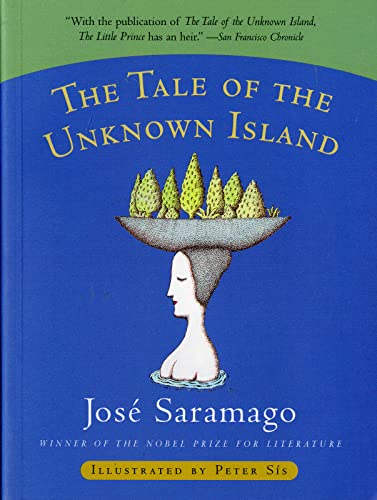
José Saramago’s Tale of the Unknown Island

José Saramago, The Tale of the Unknown Island (translated by Margaret Jull Costa, illustrated by Peter Sís 1999)

This is one of those tiny, beautifully designed books that sit at the front of bookshelves offering themselves as last-minute birthday gifts. At least, that’s how I think it came to be sitting on my to-be-read bookshelf for years, possibly decades. I don’t remember who gave it to me, but I’m glad they did.

José Saramago published this very short, parable-like story in 1997 in Portuguese with the title O conto da ilha desconhecida. This version, translated into crystal clear fairy-tale English by Margaret Jill Costa and illustrated by the brilliant children’s illustrator Peter Sís, followed two years later.

In 2017 the story was adapted for the stage by Ellen McDougall and Clare Slater and performed at the Gate theatre in London with the title The Unknown Island (the Guardian‘s enthusiastic review here).

It’s not a children’s book, but it builds on conventions of children’s literature. A man appears at a gate of the king’s castle and asks for a boat. He refuses to be sent away, and the story goes from there. He wants the boat in order to set sail to find the unknown island. Everyone, from the king to the cleaning lady, tells him that there are no more unknown islands, but he persists, first in his request and then, when (not a spoiler really) the king gives him a boat, in persuading other people to help on the quest.

It’s a parable about creativity, or perhaps about scientific enquiry. Certainly it resonates against the kinds of things that reactionary politicians say regularly about university research grants (as in this example from almost exactly a year ago). But it twists and turns, slipping out from under such neat encapsulations. Naive readers like me will be surprised and delighted by how it turns out.

The book was perfect for reading in the sauna, and I read it there in two sessions, both of them with quite a lot of chat eating into potential reading time. Sadly the glue holding my beautiful little book together couldn’t withstand the heat, so now I need to handle it with great care.

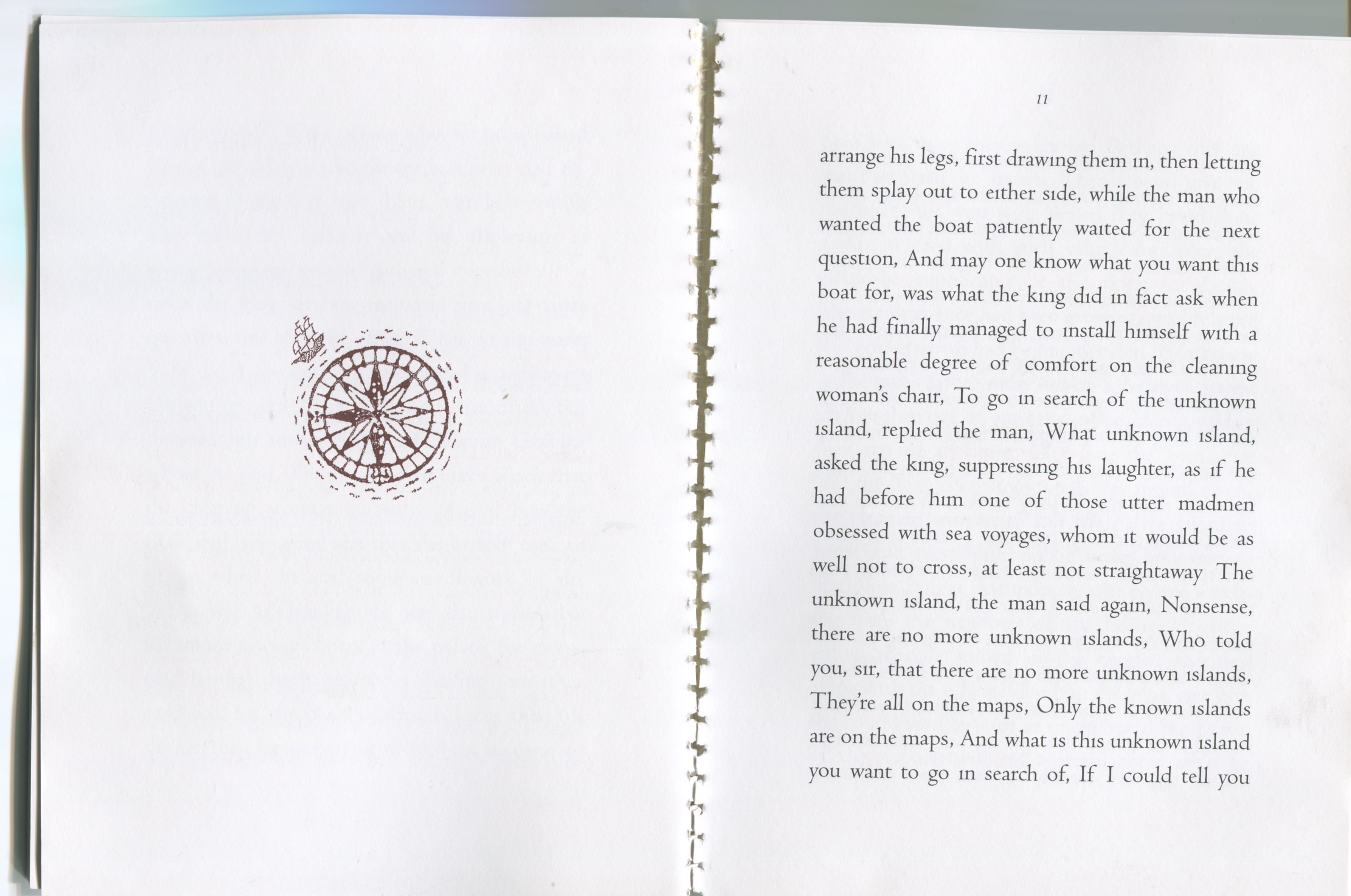
For a closer look, I can’t take a snapshot of page 75*, because there are only 51 pages. Assuming that page 75 is usually about a fifth of the way through a novel, I’ll focus instead on pages 10 and 11. Here they are, heat damage and all, at the beginning of the king’s encounter with the man who wants a boat:

Peter Sís’s compass sits in the middle of the left hand page, silently endorsing the man who wants a boat. All his illustrations have a similar simplicity of line, and make similar luxurious use of white space, though some of them, like the cover image above, have a weird, surrealist quality.

This is early in the book. The king has condescended to meet the man at the door for petitions, a door he rarely visits in person, and his discomfort manifests as awkwardness in the only chair available, which belongs to the cleaning woman (who is to feature prominently in the rest of the story).

Characteristically, the narrative isn’t broken up with a paragraph for each speaker, and sometimes the transition from one speaker to another doesn’t even merit a full stop. Commas will do, suggesting that we don’t need to pause over the king’s questions, because the man will answer them easily – whether he is indeed ‘one of those utter madmen’ or not. (He’s not. But though his insistence that unknown islands still exist is impeccably logical, he’s not what any conservative arts fund would consider a sound prospect either.) So on the one hand there’s a fine, childlike simplicity to the narrative, but on the other there’s an unsettling edge to its presentation. That unsettling quality becomes more marked as the story progresses.

José Saramago received Nobel Prize for Literature in 1998. The press release accompanying the announcement described him as a writer ‘who with parables sustained by imagination, compassion and irony continually enables us once again to apprehend an elusory reality’. This little book with its hugely resonant tale is my excellent introduction to his riting.


* Currently when blogging about books I take a closer look, arbitrarily, at page 75 – moving on to page 76 at my next birthday if the idea works well enough.

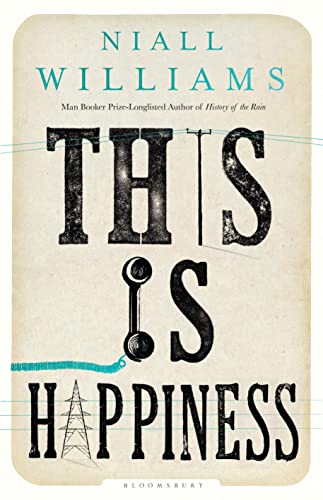
This is Happiness, Niall Williams and the Book Group

Niall Williams, This Is Happiness (Bloomsbury 2019)

Before the meeting: When we discussed Niall Williams’s History of the Rain in October, a number of people had also read his next book, This Is Happiness. December’s chooser, impressed by their enthusiasm, decided we should all read it.

The book’s first sentence, ‘It had stopped raining’, which sits on a page by itself, is pretty much identical with the final sentence of the earlier book, and the tiny, backward village of Faha in West Ireland is again the setting, but the bulk of the narrative takes place in an earlier period, and there is no obvious reference to the characters or events of History of the Rain. It’s the story of the coming of electricity to the village; a coming of age story of young Noe, who has taken leave of the seminary and is telling the story as an old man in the USA; and a big romantic story of love lost and found by Christy, an older man who befriend Noe.

Page 75* must be one of the book’s few pages that doesn’t mention the absence of rain. It happens in the thick of one of the book’s comic set pieces. It’s not the set piece when the lights go down and the cinema comes alive with amorous grapplings, or the one where Noe goes to the communion rail at Sunday Mass in order to get a good look at the woman Christy left at the altar, or the spectacular one where he is knocked unconscious by a falling electricity pole. On page 75 Noe and Christy are on the first of a number of epic pub crawls.

These pub crawls are as much about music as about alcohol, music performed by men who are shy and nondescript until they start playing, and then are brilliant conduits of a great folk tradition. On this first adventure, when the evening is well under way, Christy startles Noe and everyone else in Craven’s pub by starting to sing:

Not only was Christy singing, he was singing with screwed-up eyes and fists by his side a ballad about love. He was singing it full-throated and full-hearted and before he had reached the second verse it was clear even to Roo the dog that a passionate truth was present in that place. It wasn’t only that this didn’t happen in Craven’s, it was that there was something raw in it, something deeply felt, that was, even to those who had descended blinking into the umbrae and penumbrae of numberless bottles of stout, immediately apparent and made those who first looked now look away.

(page 73)

Christy has come to Faha as a worker in the great electricity project. This episode is our first inkling of his profoundly romantic reason for signing up for the work. Not so obviously, it prepares us for the major role music is to play in Noe’s story. Page 75 itself is a beautiful piece of misdirection. After Christy has sung, Noe writes:

I did the only thing I could do. I went to the counter and got two bottles of stout.

Those bottles are followed by another two, and then another. Greavy the guard arrives and declares that it’s Closing Time (as Noe says, this is one more way in which Faha lags behind the times), but the two of them are incapable of moving. Alcohol-based humour usually leaves me cold, but Niall Williams’s version made me laugh out loud. I suppose the whole book could be read as an extended Irish joke: the villagers have an almost superstitious awe of the one telephone in town, and the coming of electricity has almost cosmic significance for them. If you read the whole book like that, the stereotypical Irish drunkenness in this passage is representative (including the sly invocation of Waiting for Godot):

Getting up proved aspirational. There was the idea of it, quite clear. Unmistakably clear now. There were hands placed on knees for push-off. There was a Right now. There was another when that failed to produce action. A Right so following. And still nothing. Between thought and verb a vacancy, not intended, but not grievous, just gently perplexed, and in that perplex the realisation that Craven’s was not in fact such a bad place at all, was downright comfortable in fact, in fact there were few places on this earth as agreeable. True? Too true. A person could stay here, could stay right here and be quite happy now, quite, for a very long time. What’s your rush? There’s no rush. All the problems of the world could be settled right here.
Right.
Will we go so?

I don’t want to minimise the book’s humour. Far from it. But there’s a seriousness to it that page 75 gives no clue of. Christy’s romance is genuinely touching. The villagers’ resistance to the coming of electricity is more than comic: and these villagers are described as custodians of their land, defending an ancient culture under siege by capitalism – without being at all heavy handed, the narrative reminds us that the Irish were the first people to be colonised by the English. The dramatic decline in the Catholic Church’s power since the 1950s is deftly evoked both in Noe’s commentary and in his own story: his turning away from his priestly vocation is a tiny reflection of the ending of Church-domination in Ireland at large.

After the meeting: There were seven of us. Covid–19 and other coronaviruses kept some away, while one or two had better things to do – and one sent video of spectacular drone art over Sydney Harbour.

This was our end-of-year meeting so we had other business besides the book, but it generated quite a bit of discussion. The discussion was unusual in that quite a few of us read out favourite passages. Indeed, two of the absentees sent lists of quotes – it’s that kind of book. One interesting insight was that the narrative as we receive it is created by an old man looking back on a key moment in his youth, making a story out of it, and casting a benevolent glow over the community in which that moment happened.

Other business, besides of course the plentiful food including a splendid pavlova, included a Kris–Kringle book exchange with the usual mixture of cautious delight and polite almost-hidden dismay, and a poetry reading. We were each supposed to bring a poem, and most did, even one of the absentees.

Poems were a nonsense poem by CJ Dennis (‘Triantiwontigongolope’), a poem about climate change (that was me – Kit Kelen’s ‘Parable’), a Thomas Hardy (‘Heredity’), a Robert Frost (‘A Time to Talk’), a poem from Claudia Rankine’s Just Us (‘sound and fury’), and two poems of Australian patriotism that couldn’t have been more different (Sara Mansour’s ‘My Australia‘ – link to her performing it on YouTube – and a poem whose name and creator I don’t remember celebrating the lump in the throat brought on by, for example, Anzac Day). This little reading, including by two people who said they felt awkward reading poetry aloud, left us reeling.

And that was a wrap for the Book Group for 2022.

* Currently when blogging about books I take a closer look, arbitrarily, at page 75 – moving on to page 76 at my next birthday if the idea works well enough.

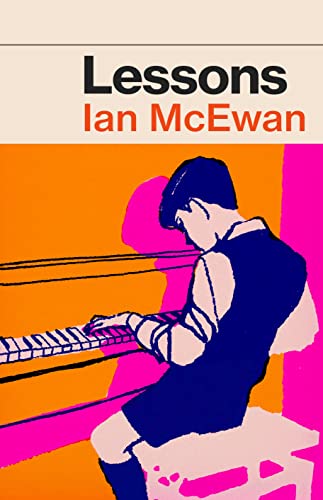
Ian McEwan’s Lessons: page 75

Ian McEwan, Lessons (Jonathan Cape 2022)

This is a tentative experiment in a different way (for me) of blogging about books: take page 75 and write whatever comes to mind about it. After my next birthday, if I keep this up, I’ll take page 76.

Page 75 of Lessons would probably have a red line drawn through it by someone writing a film script. It’s mainly a minor character’s backstory.

By this stage of the novel, the main character, Roland Baines, has been abandoned by his wife, Alissa, with no warning and no real word of explanation, leaving him to care for their infant son. He has received a couple of postcards from European addresses, the most recent saying she is about to visit her parents in Germany. Page 75 begins with his wondering why she is visiting her parents and imagining that if she tells them what she has done, ‘the row would be like no other’. McEwan delivers on this tease later when Roland hears the mother’s account of that row, which is quite different from what he imagines. Later still, that account is confirmed by Alissa herself.

The rest of the page begins the back story of Alissa’s mother, Jane: born in 1920, educated in a grammar school, and by the end of the page nursing literary ambitions working as a part-time typist at Cyril Connolly’s prestigious literary magazine Horizon (a real magazine):

She later told her son-in-law that she was seated in an invisible corner and given the dullest correspondence. She wasn’t beautiful or well connected and socially adroit like many of the young women who passed through the office. Reasonably enough, Connolly barely noticed her but occasionally she was in the presence of literary gods. She saw, or thought she saw, George Orwell, Aldous Huxley and a woman who may well have been Virginia Woolf. But, as Roland knew, Woolf had been dead for two years and Huxley was living in California.

There are many passages like this in the book: passages that fill us in on someone’s background, or summarise a novel or (in one case) a children’s picture book. As here, the writing keeps the main narrative in sight: we’re getting Jane’s story, but it’s as told to Roland, and commented on by him. There are plenty of dramatic scenes in the novel – Roland visits Berlin as the wall is coming down; he has a weird physical struggle with a conservative politician in the wilds of Scotland; in his 70s, he confronts a woman who sexually abused him as a 14 year old – but even in undramatic passages like this, there’s plenty of complexity to hold a reader’s interest. There’s also a version of one of the novel’s recurring motifs: a life lived in the shadow of fame.

The novel tells the story of Roland’s life, from early childhood in Libya, his time at boarding school where he has a deeply troubling sexual experience with his piano teacher, through years of drifting, his shortlived marriage to Alissa, single parenthood, some years of happiness in a new relationship, to old age. His early promise as a pianist is blighted by the early quasi-consensual sexual abuse: that and his abandonment by Alissa are the two intimate experiences that shape his life. The Suez crisis, the Cuban crisis, the building and fall of the Berlin wall, Brexit and Covid 19: each of these also has a direct impact. The novel is immensely satisfying as the story of an ordinary life that covers, as it happens, almost exactly the same period as my own. I feel as if I know Roland.

Rereading page 75 makes me realise that his story also functions as a conduit for other stories, mostly stories of women: his mother, the piano teacher, Alissa, Alissa’s mother Jane, Daphne who is a good friend and confidante in the early chapters and later become much more, and finally, briefly, his granddaughter Stefanie. Each of these stories can be seen as holding lessons for Roland, and for us, or at least they can be seen as posing questions: about adults’ responsibility to young people in their care, about complex issues of consent, about how to face death, about the competing demands of art and personal relationships, about ways to assess success and failure. Not that it’s didactic. When Roland reads Tomi Ungerer’s Flix to his granddaughter, he tries to make it a teaching moment by asking her if the story ‘is trying to tell us something about people’:

She looked at him blankly. ‘Don’t be silly, Opa. It’s about cats and dogs.’
He saw her point. A shame to ruin a good tale by turning it into a lesson. That could be for later.

(Page 481-482)

Lessons is a good tale, or a whole entwined mass of good tales. One of them is the tale of a man who is offered many lessons and learns some of them. If there is one overarching lesson, it’s that the more you know about someone’s life, the less easy it is to make a sharp moral judgement.