Category Archives: Page 7x/47/7

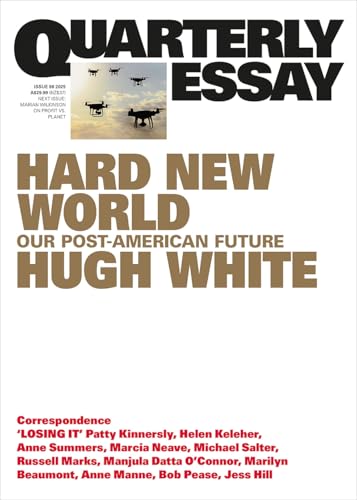
Hugh White’s Hard New World

Hugh White, Hard New World: Our Post-American Future (Quarterly Essay 98, 2025)
– plus correspondence in Quarterly Essay 99

This is Hugh White’s fourth Quarterly Essay. As the titles, and especially subtitles, of his essays demonstrate, he has been on the same track for fifteen years (links are to my blog posts):

The gaps between essays, like those between major bushfires, have been getting shorter, and his argument more pressing. The US isolationism of Trump’s second coming, the genocidal war crimes of the US ally Israel, and what looks like Vladimir Putin’s unending war on Ukraine all make his argument more cogent and persuasive.

In a nutshell, he argues that after the end of the Cold War in which two superpowers were in uneasy stand-off, and the period since then when there was just the one, we are now and have for some time been in a multipolar world. The USA no longer has the resources to dominate the globe, and nor does it have sound reasons to do it. In the past, when a single power could potentially dominate the whole of Eurasia, the USA had reason to be concerned for its own security. And when no other power hcould match the US’s economic heft, the US had the resources to do something about it. Now, as China’s economy is by key indicators larger than that of the US, it at the same time shows no sign of becoming a dominant force in the rest of Asia or Europe – India is a rising power, Indonesia isn’t far off, Russia would be a problem, and likewise Europe can if provoked present a united front. The US has neither the resources nor strategic reason to continue to invest in the security of the Asia pacific region. It no longer makes sense for Australia to depend on the US for its security.

There’s a lot more to his argument.

Something I found refreshing is the way, having made it clear that he considers Donald Trump to be sociopathic, he considers his approaches to global politics as being erratic and weird, but in essence correct as he ‘rejects the whole idea of America as the global leader, upholding and enforcing international order and promoting American values for the good of the world as a whole’. Specifically, he’s not going to take on China, and nor would it make sense to do so. To quote page 47*:

There is no evidence that Trump cares much, if at all, about the strategic contest with China in Asia. On the contrary, a lot of evidence points the other way. It suggests that Trump is happy to deal with China in the same way he deals with Russia, as a fellow great power in a multipolar world. That means conceding China’s right to an exclusive sphere of influence in its own backyard, just as he insists on America’s right to dominate the Western Hemisphere.
So, in strategic questions, Trump really isn’t a China hawk … He dislikes America’s Asian allies and has often dismissed the idea that America should defend Taiwan.

Xi Jinping’s great parade to celebrate the end of World War Two, with its attendant photos of Xi, Putin Kim Jong Un and Modi in cheerful togetherness hadn’t happened when this essay was written, but Trump’s Truth Social message to Xi, ‘Please give my warmest regards to Vladimir Putin, and Kim Jong Un, as you conspire against The United States of America,’ looks more like posturing for his base than any substantial evidence that Hugh White is wrong.

The essay ends with a draft speech for an Australia leader to communicate a necessary shift in policy. A few speeches like it, he says, ‘could start the national conversation we need to have, but which we have so far done our best to avoid’. The speech includes this:

In these very different circumstances we cannot expect America to keep playing the same role as hitherto in the security of our region and as Australia’s ally. That old order cannot be preserved by war or the threat of war. Our focus instead must be to help create a new order in Asia which fits the new distribution of power and best protects our core national interests, and to do whatever we can to help ensure a peaceful transition from the old order to the new. Then we must prepare Australia to survive and thrive in this new order. That starts by accepting that our relationship with America will change. It will remain an important relationship, but it will become less central to our security in the years to come as America’s laters and role in Asia change. We will rely more on our relations with our neighbours to help keep the region peaceful and minimise any threats, and we will rely more on our own forces to defend us from any threats that do arise.
All this will be demanding. The new world we face will be harder than the one we have known for so long. But there is no choice.

I’m well outside my comfort zone on the subject of international relations, defence, security, war and threats of war, but I found this essay compelling.


Correspondence on White’s previous Quarterly Essays included a number that dismissed him as simply wrong, a winner-take-all debater, selective with his facts and using little reason. I quoted a number of them in my post on QE 86. Perhaps it’s just that current and former prime ministers no longer engage in this kind of forum, but the correspondence on this one, published in QE 98, mainly from academics in relevant fields, is generally supportive of its central thesis.


I wrote the blog post on the land of Gadigal and Wangal of the Eora Nation at the moment the sky is clear but the ground is sodden with recent rain. I acknowledge Elders past and present, and welcome any First Nations readers.


My blogging practice is to focus on the page that coincides with my age, currently 78.
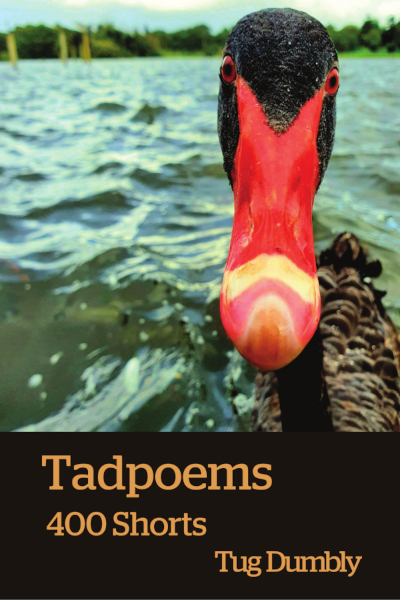
Jock Serong’s Rules of Backyard Cricket

Jock Serong, The Rules of Backyard Cricket (Text 2017)

I was given The Rules of Backyard Cricket as a gift some years ago. Friends had told me it was excellent, but I knew nothing about it. The cover illustration, which shows two small boys in silhouette, one of them pretending to shoot the other in the back of the head, suggested that it might be less benign than the ‘Cricket’ episode of Bluey.

The opening chapters have a lot in common with that episode. Two brothers in the suburbs spend endless hours playing cricket with makeshift equipment and their own idiosyncratic rules. Like Bluey‘s Rusty they become excellent and go on to bat for Australia.

But that’s where the similarity ends: the brothers, Darren and Wally Keefe, are locked in vicious mutual combat even while their brotherly bond is strong, which puts the book in a long tradition of stories about quarrelling brothers: think Cain and Abel, Jacob and Esau, Romulus and Remus, William and Harry. As they come to prominence in the cricketing world, Darren, the younger brother, attracts headlines for his off-pitch misbehaviour with drugs and chaotic relationships, and a terrible hand injury excludes him from cricketing heights. Wally becomes captain of the Australian team and can be depended on to present the ideal face of professional sport, though his personal life suffers under the strain. They typecast themselves: ‘Wally as responsible, grave: a leader. [Darren] a force of nature: a talented freak with no mooring.’ (Page 73)

In the background is the world of organised crime, match-fixing and corruption – embodied in Craig, their friend from teenage years who now lives a shadowy criminal life. Also in the background is their single mother, whose unfailing belief in both of them has been crucial to their success, and their long-suffering women partners, where I choose the word ‘suffering’ deliberately.

At the start of the novel, Darren is locked in the boot of a car, on the way to an unknown destination where, he assumes, he is about to be killed. He’s not sure who is going to kill him or why, and as he tries to work his way free he thinks back over his life, and in so doing narrates the book. Each chapter begins with a brief report on what’s happening in that boot, a device that both reassures readers that the story is something other than a biography of two fictional sportsmen, and challenges us to spot the moment when Darren falls foul of someone murderous.

I’m not a cricket fan, but I can follow a conversation about it (unlike the AFL in Helen Garner’s The Season). I loved the descriptions of cricket matches here – the fast bowling, the sledging, the many technicalities. Some readers will need to skim those bits. I’m with them in not getting most of the references to famous cricketers, but it didn’t worry me.

On page 78*, about a quarter into the book, the teenaged brothers have recently moved out of home. Wally is being recognised as a cricketer of ‘phenomenal self discipline’ but, according to Darren, when they play in the back yard he’s still ‘vengeful, savage and petulant’. They are in a sports-gear shop where Wally has a job, and where Darren visits to play with the cricket gear.

Two things happen on this page, one to do with the boys’ relationship and the other introducing a character who will play a crucial role. First, Wally sneers at Darren for believing an improbable story about a Test cricketer being given a transfusion ‘from a coconut’:

I look around and ensure there’s no one else in the shop, then I charge straight at him and throw him to the ground. He’s still laughing while I try to get a hand free to hit the smug bastard.
Three minutes later, a lady with two small boys has entered the shop and Wally’s standing behind the counter smiling politely with his hair all over the place and one ear bright red from being crushed in my fist only seconds before. I’m standing slightly off to stage right, breathing hard and rearranging my shirt.
The woman looks askance at us, but leaves a tennis racquet for restringing.

There’s comedy in the way the brothers fight compulsively like much younger children. But there’s something unnerving about the way Wally laughs and recovers quickly to present a polite face to the world. By referencing stage directions – ‘slightly off to stage right’ – Darren invites us to visualise the scene: one brother stands centre stage as far as the world is concerned, while the other is a dishevelled and disreputable support actor. This is the story as seen by the latter, and the scene is emblematic of their relationship.

Then:

One night at Altona, as dusk softens the colours of evening training, were called over from the nets to the empty seats, where a girl not much older than us is waiting. We’re introduced by a club official: Amy Harris is from the local paper, a cadet journalist sent to do a story on the school-age prodigies playing first-grade for Altona.
Her brown hair’s pulled back into a tight ponytail. No makeup.
She’s tall and athletic-looking, dressed for work, not display. I like her immediately. She snorts when Wally tries to impress her by quoting from C. L. R. James: ‘What do they know of cricket who only cricket know?’
‘I dunno,’ she counters. ‘What do they know?’
Wally’s crestfallen, and I’m left with an opening to field the next few questions. She’s done her research, even knows somehow about Mum and Dad. Her questions to me are all angled at my character; Wally’s are all about his cricket. It takes me a while to latch onto this, but like an idiot I play extravagantly into her hands.

Darren’s extravagance gives Amy her headline when he says that he and Wally bring people what they want from cricket now, drama and action: ‘Bradman is dead.’ It’s one of Darren’s rare victories in their lifelong rivalry – and like all his victories it’s a bit on the nose.

If you don’t know who Bradman was, you’d be pretty lost in this book. But you don’t necessarily have to know about C. L. R. James. In fact, it feels as if Jock Serong is speaking directly here, as it seems unlikely that Darren would have read the work of Trinidadian Marxist intellectual C. L. R. James, even if he had heard James’s riff on Kipling’s, ‘What do they know of England who only England know?’ Whether Amy knows where the quote comes from doesn’t matter. She sees it for what it is, a bit of misjudged pretension on Wally’s part. She’s out for a juicy headline. She’ll continue to be out for juicy stories for the rest of the book.

Like the fighting between the brothers, the headlines get darker as time goes by. So yes, the book is about cricket – backyard, community, state, international test and one-day varieties. It’s also about the corrupting effects of capitalism on sport, about masculinity toxic and otherwise, about the damaging effects of celebrity, about the role of the media. And it moves at a ripping pace.


I wrote the blog post on the land of Gadigal and Wangal of the Eora Nation where the days may be be growing warmer and lorikeets are starting to make their presence known. I acknowledge Elders past and present, and welcome any First Nations readers.


My blogging practice is to focus on the page that coincides with my age, currently 78.
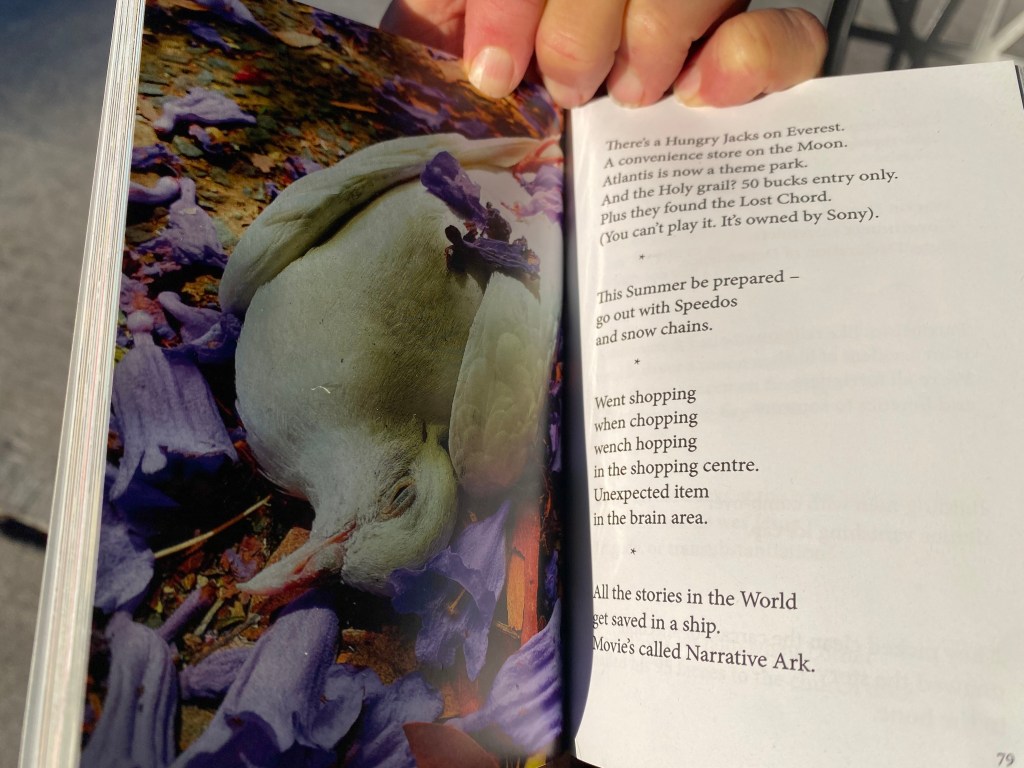
Yao Feng’s Great Wall Capriccio

Yao Feng, Great Wall Capriccio and Other Poems, translated by Kit Kelen, Karen Kun and Penny Fang Xia (Flying Island Books 2014)

Beijing born Yao Feng is a much awarded poet, translator, artist and prose writer. In 2014 when this small book was published he was Associate Professor in the Portuguese Department at the University of Macau, where Kit Kelen, one of the translators of this book and series editor of Flying Island Books, was also a professor.

One of the lovely things about Flying Island Books is that they have two publishers, one in the cosmopolitan city of Macao (which seems to be the accepted spelling in English) and the other in Markwell, a tiny village 16 kilometres from Bulahdelah in New South Wales. The Macao partner is ASM (the Association of Stories in Macao), which has been described as ‘the most devoted publisher of translated literature in Macao’. As far as I can tell ASM was originally Kit Kelen’s baby, and is now under the directorship of Karen Kun, another of this book’s translators.

The book’s title poem is a series of eight dramatic monologues by characters who have stood on the Great Wall over centuries, from lonely soldiers to graffiiti-ing tourists. There are other poems that deal with Chinese history, including ‘memories yet to be disarmed’, a reflection on a painting in memory of the Cultural Revolution. But not all the poems are about China – and not all of them are on serious subjects. The poet sits in the sun and watches jacaranda blooms at the summer solstice, he looks in the mirror and sees that his ears have mysteriously disappeared, he imagines in what circumstances he might renounce his atheism and ‘approach God on all fours’. Poems are set in various parts of China, but also in Portugal, the Netherlands, the USA, Japan … the list goes on. There are poems about Pushkin, Ceaușescu, Aung San Suu Kyi and Marilyn Monroe. In other words, these 130 pages contain multitudes, and are a terrific introduction to this poet.

The poem on page 78, which I’m focusing on because of my arbitrary blogging rule*, has personal resonance for me.

hot pot place

menu, filled with names of animal organs
bubbling water, smoke
blurred our faces
we sipped our beer
salvaging chunks of cooked corpse
the law of the jungle has it —
to kill or be killed
to sustain a life, others must die
to feed a life, others must be sacrificed
a pile of bodies and we thrive
with laughter
what appetite!
not even the least sorrow for life

Let me start with my grandson.

My four-year-old grandson is uncompromisingly vegetarian. He likes lambs or pigs to pat in a petting zoo, not to eat. When he overheard a WhatsApp message from someone saying they’d bring a chook to the Book Group, he asked if the chook would be alive, and I felt like a criminal when I told him it would be cooked and ready to eat. There was horror in his voice when he told me one afternoon that the lunch at daycare had been spaghetti bolognese.(He went hungry that day.)

‘Hot Pot Place’ lobs neatly right there. In case you need reminding, in such restaurants a variety of uncooked food is placed on the table, and the diners drop their chosen morsels into a communal pot of boiling stock. The first four lines conjure a cheerfully exuberant social occasion in one: the smells, the sounds the tastes are effectively implied.

The tone changes in the fifth line. The diners aren’t just fishing pieces of meat from the pot, but ‘salvaging chunks of cooked corpse’. The harshness of the language is completely in tune with my grandson’s horror at bolognese sauce, and the next four lines, with their change from past to present tense, can be read as a defensive response from a meat-eater. Everywhere in nature animals eat the corpses of other animals. So it makes sense to enjoy this meal.

But this is a poem, not an argument. The lines about the law of the jungle can also be read as affirming: in eating meat we are playing our part in the natural order of things.

I remember the particular joy I had as a child – quite a bit older than four, I think – when a bullock I’d known from when he was a calf was cooked on a spit at a party to celebrate a family member’s major birthday. Terry, the bullock, even had a nickname. We children called him Pookie because his head was often adorned by a little cap of cow poo from approaching his adopted mother’s udder from behind. I don’t remember feeling any horror, more a kind of comfort that I was eating an animal I knew, not one that had been turned into a commodity.

Then the last four lines. Are they the words of someone recoiling from the carnivorous spectacle? Or are they celebrating the event? Or even somehow both?

It’s not possible to read the phrase ‘a pile of bodies’ without thinking of horrendous events of the last hundred years, including some events where the bodies have been those of animals – I’m thinking of beached whales and recent massive fish kills in New South Wales. So the line ‘a pile of bodies and we thrive’ holds an almost impossible tension. It doesn’t condemn, but it won’t look away.

The last line, I think, does make a judgement. The poem’s speaker isn’t arguing for vegetarianism. It’s ‘sorrow for life’ that is absent, not guilt. He is noticing a callousness in himself and his companions. My mind goes back to Terry/Pookie: along with the joy of eating him, there was something that you might call reverence. The poem doesn’t ask, but it opens out towards asking: is it possible to thrive with laughter and appetite and at the same time honour the lives of the beings we eat, to feel the sadness of the dispensation in which ‘to feed a life, others must be sacrificed’?

My grandson would probably read the poem differently from me. It’s a bit beyond his capacity right now, but if he ever does get to read it, I hope he finds as much joy in it as I have.

This is my sixth post for National Poetry Month, and the fourth bilingual book from the Flying Island Books.


I first read Great Wall Capriccio while flying between Djaubay land and Gadigal Wangal land. I wrote the blog post on the land of Gadigal and Wangal of the Eora Nation. I acknowledge Elders past and present of all those Nations, and welcome any First Nations readers.


My blogging practice is to focus on the page that coincides with my age, currently 78.
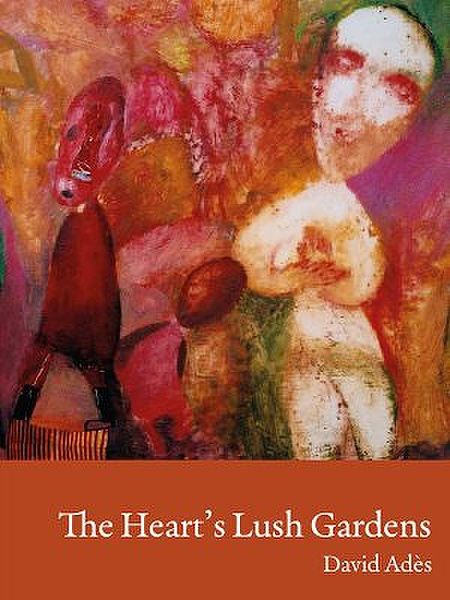
Patricia Sykes Among the Gone of It

Patricia Sykes, Among the Gone of It, with Chinese translation by Xu Daozhi and Wu Xi (Flying Island Books 2017)

This is my fifth post for National Poetry Month, and my third bilingual book this month from the Flying Island Poets series.

A web search for “Patricia Sykes poet” produces a large number of hits that begin, ‘Patricia Sykes is a poet and librettist.’ She has collaborated with composer Liza Lim to create The Navigator, a chamber opera, and a number of her poems have been set to music. As a child she was a resident in the Abbotsford Convent orphanage in Melbourne (now an arts precinct), and as an adult she was a member of the Women’s Circus, both of which have been subjects of her poetry – in The Abbotsford Mysteries (2011) and Wire Dancing (1999) respectively, both published by Spinifex Press.

Of the translators, Xu Daozhi has a PhD in English literature studies from the University of Hong Kong and Wu Xi is a poet and scholar who was also stationed in Hong Kong at the time of translation. Again, I can’t comment on their work except to admire its visual beauty.

The poems in Among the Gone of It that spoke to me most strongly were those dealing with illness and ageing. By happy coincidence, one of these poems falls partly on page 47*.

‘Cassandra Vegas’ is a sequence of six poems in which the title character undergoes major surgery for cancer. Her name signals the poems’ concerns. In Greek myth, Cassandra had the gift of seeing the future, and Vegas is a synonym for gambling: so much language around illness and surgery is about prognosis (prophecy) and percentages (gambling odds). The sequence begins with ‘Casino’, in which Cassandra contemplates the risks of surgery or not-surgery:

to operate will swell the death odds
not to operate makes death certain

This is followed by ‘Theatre’ and ‘Anaesthesia’, whose titles give you their place in the narrative, though not their poetry. In ‘Angel Switch’ she is in intensive care after the operation. In ‘Vegas, Vagus’ she leaves hospital,

the craved bliss of silken air
a leaf's kiss on her bald head
like welcome to a newborn

and learns how to deal with the changes in her body.

The final poem is ‘Ante’, of which all but the first three stanzas are on pages 46–47.

The title, meaning ‘before’, at first seems ironic, as the poem is in the position where you might expect one titled ‘Aftermath’. But it also sits in anticipation of whatever is to come next – an ante is a bet placed on the table before the next hand is dealt.

The first three stanzas have dealt methodically with the immediate past (‘praise from one of the surgeons’), the present (‘each mouthful is a reinvention’) and the unknowable future (‘her chromosomes do not speak / how then can she prophesy?’). The poem now opens out:

she is old in the tooth, the head 
the centuries blink, crises grow worse
she has plenty of voice but less reach

she thinks of Apollo's rank kiss
thinks of the woman the god
the half real the half myth

Not that the preceding poems in the sequence have been straightforward narrative, but this marks a shift. ‘She is old in the tooth, the head’ is a simple literal statement, but with ‘the centuries blink’ it takes on a grander meaning. As in Walter Pater’s famous description of the Mona Lisa, ‘She is older than the rocks among which she sits’, the woman in this poem has become archetypal. The crises that grow worse refer both to her individual worsening health crises and to the deepening crises of the society and world around her. In another context, ‘plenty of voice but less reach’ could be a lament about contemporary poetry in general – there’s a lot of it out there, but the readership is small. (I’ve just been listening to a lecture by Sarah Holland-Batt on the Fully Lit podcast, in which she says, ‘Australia has never been short of poets, it’s short only of poetry readers.’)

In the next stanza the archetype is further identified. Cassandra in Greek myth was given the gift of prophecy by the god Apollo, but when she didn’t reciprocate his desire (his ‘rank kiss’), he added the curse that no one would believe her prophecies.

The remaining stanzas enlarge on that last line: what does ‘the half real the half myth’ mean?

The next stanza is a kind of bridge. It first evokes her post-surgery difficulty eating, as described earlier, and then goes to a new place:

the food in her bowl
contracts, congeals, each doubt
a portion, a fragrance, a dance

The unpleasant image of food contracting and congealing becomes a metaphor for doubt – the uncertainty, tentativeness, anxiety that can follow major surgery. Somehow these doubts, this unpleasant food, are transformed, in three steps. The food is a portion – it is what has been allotted to her, what has landed on her plate. Unpleasant as it looks, it has a fragrance – let’s attend to qualities other than its visual qualities. But there’s a subtle shift. Food has a fragrance, but here each doubt is a fragrance. The poem is leaving the literal food behind and talking now about what it represents metaphorically. In the final word of the stanza, the food has gone completely, the doubts are transformed into a dance.

The next three stanzas spell out the nature of that dance:

she visits ocean, gathers beads of it 
aqua, turquoise, milky blue
strings them, prays them, swims them

knows nothing, everything, watches
doors, the hours, changes,
stays the same, wonders

Crude paraphrase: ‘She is fully alive to the world.’ I love the idea of gathering beads of ocean – to wear, to pray like a rosary, to immerse herself in them. And I love the line break at the end of this stanza. If the poem finished here, we’d be left with Cassandra filled with wonder. That meaning lingers for a moment, but at the start of the next line the meaning of ‘wonders’ morphs from ‘has a sense of awe’ to ‘asks the following questions’.

stays the same, wonders

if what she guards is herself
or a presence called life

The play with myth is resolved. Like all of us, this woman is an embodiment of something sacred, ‘a presence called life’. ‘Guards’ is an interesting word. Unlike words like ‘battle’ or ‘struggle’ commonly used in this context, it implied strength but also tenderness and caring: she is not defensive, but protective, of the ‘presence’.

And the poem ends with an acknowledgement that survival is inevitably temporary. A harsh paraphrase of the final stanza might be, ‘Wonders how she will die.’ But it’s interesting to notice what that paraphrase leaves out (and I so wish I could read the Chinese translation). In this phrasing she won’t die – she will be killed. The ‘thing’ could be a car, a cancer, a virus, a lightning strike. And what it will kill is this precious, tender thing. It’s not fear of death being expressed, but a cherishing of life, knowing that death will come. The pedant in me would insist that ‘softly’ is an adverb, that it should be ‘bright, soft breath’. I can’t justify it, but the pedant is just wrong this time.

And I’m so glad there’s no full stop at the end. Even punctuation can carry metaphorical meaning.

wonders how it will come
the thing that will kill the bright softly breath

I first read Among the Gone of It while flying between Djagubay land and air and Gadigal Wangal land and air. I wrote the blog post on the Country of Gadigal and Wangal of the Eora Nation. I acknowledge Elders past and present of all those Nations, and welcome any First Nations readers.


My blogging practice is to focus on the page that coincides with my age, currently 78. The last poem in Among the Gone of It finishes on page 77, so my personal algorithm sends me to page 47 (I was born in 1947).
Judy Johnson’s Exhibit

Judy Johnson, Exhibit, translated into Chinese by Iris Fan Xing (Flying Island Books & ASM 2013)

This is my fourth post for National Poetry Month.

Like Geoff Page’s Codicil, Exhibit is a bilingual book, aiming to bring an Australian poet to a Chinese readership.

According to the book’s dust-flap, Judy Johnson has been writing and publishing poetry for 20 years, and has won a number of prizes. She was editor of Picaro Press’s Wagtails series of chapbooks for some years. In 2021 she appeared with David Ades on his Poet’s Corner video show (link here), where among other things she spoke interestingly about her African-American convict ancestors and her book Dark Convicts, which I now have on order from Gleebooks.

Iris Fan Xing, the translator, was a PhD student at the University of Western Australia when the book was published in 2013. An interview with Robert Wood in Liminal Review of Books in 2021 (at this link) makes lovely reading for anyone who’s interested in translators, wonder-workers who are usually pretty much invisible. Sadly, my only response to her work in this book is to enjoy its visual beauty.

The book’s verso pages – that is to say, the English text – are terrific. To attempt the impossible and generalise: the poems tend to focus on small things (‘Three Tools’ fulfils the promise of its title), specific places (‘Walking Nobby’s Breakwall’ is almost a poetic manifesto for focusing on the small and partial), small interactions (‘Words, after an Absence’), without ever being trivial. Again and again in this book I was struck by a brilliant metaphor.

A poem that could provide a fun exercise for students, one of several set in Ireland, is ‘Saint Kevin and the Blackbird’ (which you can read as first published in Westerly in 2012 at this link – it’s a PDF, and you need to scroll quite a lot). The late great Seamus Heaney wrote a poem of the same name (which you can read at this link). Both poems tell the legend of a bird building a nest in the saint’s hand outstretched in prayer. One imagines what is happening in the saint’s mind and body; the other makes acerbic feminist comment on his broader life. Judy Johnson isn’t afraid to take on the big names.

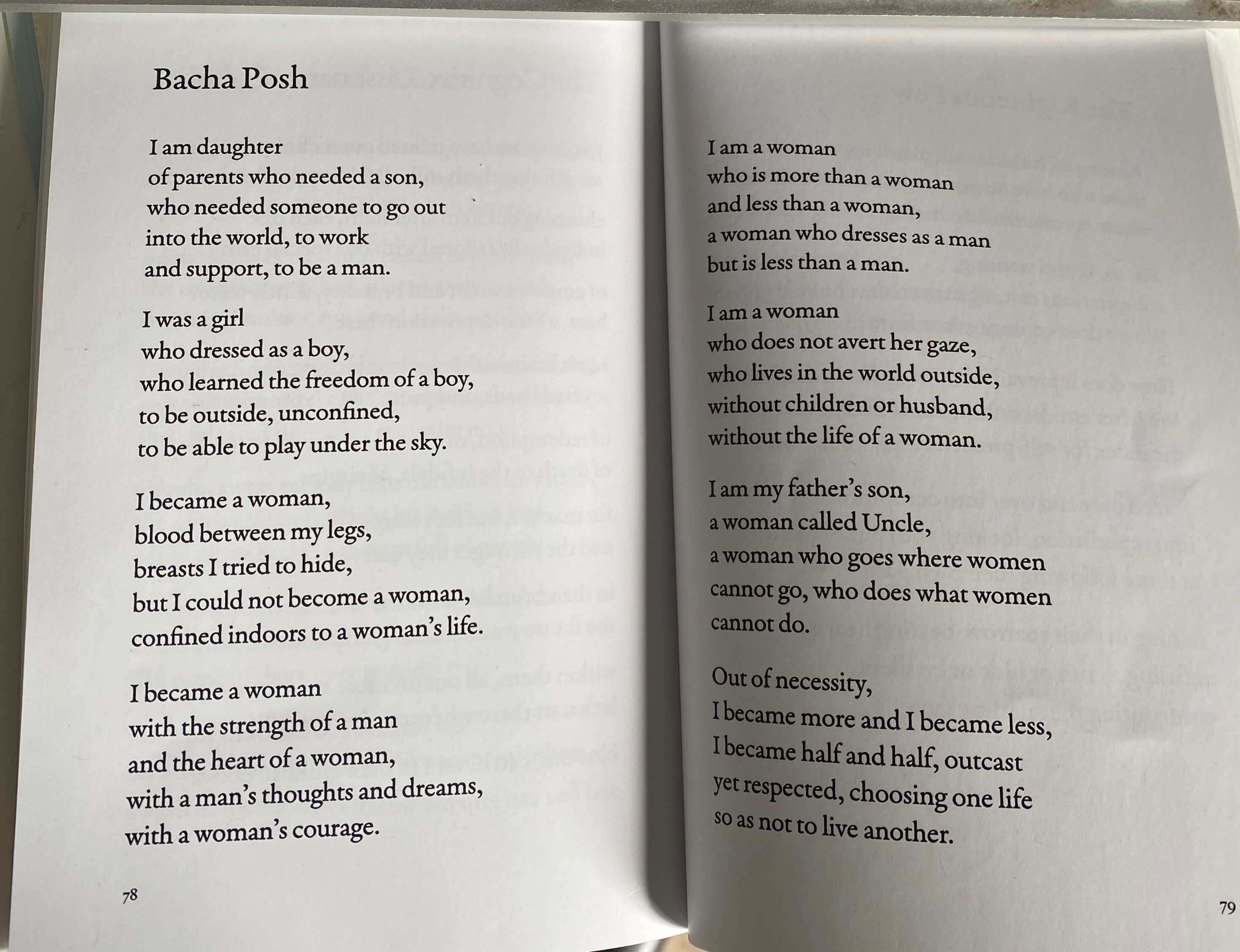
If you were browsing in a bookshop and flipped to page 78* of Exhibit, you’d be looking at the first of two pages of the poem ‘Thirty-Four Years On’. Here it is, with the Chinese translation opposite:

The title is a bit of a tease: thirty-four years on from what? My guess, based on the numbers given in the poem, is that its present moment is the year 2001, and the immediate prompt of the poem is a fireworks display, probably as part of Australia’s centennial celebrations. The fireworks remind the poem’s speaker of a similar display from her childhood, which she calculates to have been 34 years earlier. (It’s not that 34 is a significant anniversary, as in the episode of the Seth Hogan show Platonic when a character celebrates her ‘big two-six’.)

Thirty Four Years On
I watch fireworks two streets away
spring the night of its entrapment

I’m used to thinking of fireworks as embodying ephemerality: now they’re here, and beautiful, now they’re gone leaving nothing but the smell of cordite. In this poem they have a different effect. The night is normally trapped in just one time, but the fireworks explosion frees the speaker’s mind to be in more than one time at once, like magic:

the way a magician springs 
a waterfall of coloured flowers
from a black top-hat.

This is the kind of thing I mean about Judy Johnson’s use of metaphor. The firework’s time-freeing effect is magic, and the fireworks share other elements with a magician’s act – the cascading colours produced from a hat, which further bolsters the metaphor by being black like the night.

The next three stanzas play with time and space in more or less abstract ways. How this relates to the opening image won’t become clear until the following stanza.

Don't tell me nothing is as it was.

A possible paraphrase of this is, ‘I don’t want you to remind me of the obvious fact that that things are always changing.’ The poem’s speaker is experiencing the present moment as identical to some other moment.

Distance closes and expands.

She is also experiencing physical space as relative. In her mind, she is living in two times and places at once.

A million year eye-blink 
calls the light of stars
to my reaching fingertips.

Isn’t that beautifully put? We know how long it takes light to reach us from the stars, but that’s not how we experience it. It’s both a million years and an eye-blink. At the same time, the stars remind us that the poem started with a fireworks display two streets away – and also 34 years ago.

The next stanza brings us back to the present moment:

In the dark I am adult 
and six years old
yearning for a space beyond
the scaffold of my bones.

At a literal level, then, the fireworks remind the speaker of a similar display when she was six years old. The ‘scaffold of my bones’ echoes the ‘entrapment’ of the night. She remembers as a child longing for transcendence.

Because I’m looking at the poem closely, I’ve done my sums. Judy Johnson was born in 1961. She was six in 1967, and 34 years after that, she is 40 and Australia is celebrating its Centenary. The poem is prompted by a fireworks display in 2001.

Having been taken back to that moment, she then moves forward in time:

In a year's time when I am seven 
an artery balloon will burst
inside my father's heart.

If the poem ended here, it would be a bit of a downer: ‘Ah, these magical fireworks remind me of a similar display when I was six. Oh, then my father died.’ But that’s not the tone. The next stanza, over the page, also a three-liner, moves forward to the next year, 1969, with an abrupt change of register from intensely personal to public. 1969 is the year when ‘Neil Armstrong will take / his giant leap for mankind’.

This progression changes the way her father’s sudden death is presented: not so much a personal trauma as simply the next major event after the fireworks, with the moon landing the one after that. It’s not that the pain of her father’s death is minimised – it’s just not indulged, and it’s not mentioned again in the four remaining stanzas of the poem. In my reading, that silence is the heart of the poem.

I want to quote one more stanza:

The second hand of the clock
holds each moment in suspension
just before, like a slingshot
it lets go.

The observable way a second hand moves jerkily becomes a metaphor for the way we remember moments, almost like still photographs, but that time moves on inexorably.

The final paragraphs return to the fireworks, seen through a window, whose ‘four corners / are cardboard clips in an old album / holding in their freeze frame / that same photograph’. Time moves on, things change constantly, but this moment make those past moments present: the fireworks, the clouds of smoke (‘black an silver rags’), and

the same small footprint of a man
appearing on the ghostgum moon.

I’ve heard Evelyn Araluen speak derisively about how settler Australians love to write about ghost gums. At the risk of incurring her mockery, I think ‘ghostgum moon’ is perfect here – as an Australian reference that contains the word ‘ghost’ it does a lot of subliminal work. The poem focuses closely on that ‘same small footprint of a man’, leaving the bursting artery balloon in the realm of the unspoken, almost unspeakable, but with just the wisp of a reference to it in those final two words of the poem.

(For reasons that are probably peculiar to me, I find myself remembering Biblical quotes and theological concepts from my youth: ‘The seven years seemed to him to be just seven days, so great was his love’; the sacrifice of the Mass doesn’t just commemorate Jesus’ sacrifice on the cross, it is that sacrifice, happening in the present moment, not repeated but the same.)

Not that I saw all that on first reading, but I felt some of it, which is what poetry can make happen.


I first read Exhibit while flying over countries between Djabugay land and Gadigal Wangal land. I wrote the blog post on the land of Gadigal and Wangal of the Eora Nation. I acknowledge Elders past and present of all those Nations, and welcome any First Nations readers.


My blogging practice is to focus on the page that coincides with my age, currently 78.
Geoff Page’s Codicil

Geoff Page, Codicil, tanslated into Chinese by Chris Song and Matthew Cheng (Flying Island Books 2019)

It’s National Poetry Month in Australia. The Red Room Poetry site lists a plethora of events, workshops and competitions, promoted by ambassadors ranging from journalist Stan Grant to comedian Suren Jayemanne.

Codicil is the third book of poetry I’ve read so far in Poetry Month. I plan to read and blog about three more.

Geoff Page’s poetry has been around for a long time. I have an alarming number of anthologies of Australian poetry on my bookshelves, and his work appears in most of them, from Poet’s Choice (Island Press 1971, a limited, hand-set and -printed edition of 500 copies) to Contemporary Australian Poetry (Puncher & Wattmann 2016). His work is wonderfully accessible, using traditional forms without being trite or hidebound. For an intelligent discussion of his poetry, you’d find it hard to go past Martin Duwell’s review of his New Selected Poems (Puncher & Wattmann 2013). The whole review is worth reading, but I’ll just quote his description of Page as ‘a public poet who reflects the social concerns of the time of the Bicentennial and into the first decade of the twenty-first century’, and as a writer of personal poems with the ‘dominant image of himself as an outsider in a family he loves’.

Duwell’s description fits Codicil, which includes some new poems and at least three of his most anthologised poems, ‘Smalltown Memorials‘ (1975), ‘Grit’ (1979) and ‘My Mother’s God‘ (1988) – the links are to recordings of Page reading the poems on the Poetry Archive website. What I take to be the most recent poems here deal with ageing and the approach of death – the title poem is instructions for the disposal of the poet’s ashes on the Clarence River, where he spent his childhood.

I imagine that the poems were selected by the translators, themselves accomplished poets in Hong Kong, with the intention of introducing Page’s work to Chinese readers. I wish I could read Chinese, because I’d love to know how they have dealt with the frequent Australian idioms and throwaway references. Like this from ‘Three Akubras’:

Three Akubras in a row
my brothers underneath them
standing at the saleyards there

Or this, from ‘Severance’, an imagined speech to an employee being sacked:

User Pays and 
Market Forces
are all the rhet-
oric you'll get.

(And what have they done with that weird hyphen that’s there for the sake of metre and rhyme?)

And I’d love to know what a Chinese reader might make of his occasional professions of allegiance to iambics, as in ‘I Think I Could Turn Awhile’, in which he imagines writing ‘like the Americans’, an heir to Whitman. But then:

I'd hear the clipped
iambics calling,
my template just
beneath the line

For me, alas, the bilingual aspect of the book amounts to a purely visual effect – and it is fascinating to see what these very Australian poems look like in Chinese characters.

Here’s an image of pages 77 & 78*:

The poem, first published in Island magazine in September 2009, is neither a public poem dealing with issues of the day, nor a personal poem dealing directly with family or mortality. I read it as a letter to friends who are on a boat somewhere on the Baltic Sea, perhaps in response to a photo they have sent. Whatever, it’s a wonderful evocation of a still, moonless night on the water.

It’s almost a sonnet. The first eight lines paint the scene, and the almost perfectly regular iambic pentameters (de-dum de-dum de-dum de-dum) enact the calm of the night.

Late August in the Baltic 
for Julie & Håkan

Late August in the Baltic and
the night has got some darkness now.
Tonight, no moon, no lid of cloud.

You're on the lee side of an island,
one of those low Swedish mounds.
You're in a bay not spelt in lights;

you wake at two and go on deck.
The water is a black shellac;

Then there’s a turn, so gentle, in mid stanza with just a semicolon to mark it. The lines get shorter, and the literal elements of the poem – the island, the time of year, the deck, the absence of lights on shore – give way to more fanciful language:

the curvatures of heaven

continue underneath
as now, at last, you see it.

Then the regular iambics re-establish themselves – as if a small wave of metaphor has momentarily disrupted the stillness of the poem, and it can now continue, but with a broader view:

The universe is all about you,

high above and far beneath.
Such stillness will not be repeated.
You’re at the centre of the stars.

Pause for a moment to look at the second last line. Without it, the poem would have been a sonnet, and the bunching up of sibilants in ‘Such stillness’ strikes a dissonant note. I don’t think this is a flaw. What the line says – a warning not to expect life always to be like this – is unobtrusively reinforced by its comparative harshness and a faint sense that it disrupts the form. Whatever, it makes sure that what is to come in the last line is read as humbling rather than grandiose.

The last line gies us the word that has been implied but conspicuously missing from the first part of the poem: ‘stars’. It’s not completely irrelevant that this is the word that comes at the end of each book of Dante’s Divine Comedy.

We are at the centre of myriad points of light – not a narcissistic centre, but one who for this unrepeatable moment has a glimpse of the immensity and splendour of the cosmos. I’m reminded of Yayoi Kazuma’s infinity mirror rooms.

I’m in awe of Chris Song and Matthew Cheng for taking on the task of translating a poem that works so much through the rhythms and traditions of its native language.


I read Codicil on Wulgurukaba land, beautiful Yunbenun. I wrote the blog post on the land of Gadigal and Wangal of the Eora Nation. I acknowledge Elders past and present of all those Nations, and welcome any First Nations readers.


My blogging practice is to focus on the page that coincides with my age, currently 78.
Anything Can Happen with Susan Hampton at the Book Club

Susan Hampton, Anything Can Happen (Puncher and Wattmann 2024)

We decided on this book before checking on availability. All was good for the Kindle readers, but there was a long queue at the library and it was out of stock in Sydney bookshops, pending reprint. Nor did we have any luck at Avid Reader in Brisbane on our travels. In the end, the Emerging Artist bought it for the Kindle app and we read the book to each other.

So that is how I experienced Anything Can Happen: being read to or reading it aloud on beaches, in cafes, under the benign tropical winter sun. I recommend it.

Before the meeting: Susan Hampton is a poet. She has ghost written a celebrated memoir with a First Nations person, and The Kindly Ones, a novel in verse, but this book is the first long prose work of her own making. It’s not an autobiography, but memoir. She makes that distinction in the first pages:

Whereas in autobiography ‘everything’ is told, often in chronological order, the memoir is partial, with the capacity for time loops … The scenes of your childhood, the river, the back lane, the silo, rise up to replace your mother’s arm. That dissolves and you find you’re hearing or in fact making up a conversation.

Anything Can Happen isn’t in chronological order, and it doesn’t attempt to tell everything. It gives us accounts of key relationships: Hampton’s Slovenian husband, Joe, whom she left after a very few years but who was an important part of her life until his death in Slovenia decades later; her mother and grandmother; her son Ben; Tommy, a woman in her thirties on whom she had a crush when she was a teenager and who stayed in her life until Tommy died in her 80s, by then a close friend of the Susan’s mother; a number of romantic and/or toxic entanglements and other friendships with women.

There are glimpses of a working-class childhood in the Hunter region; of life as an academic single mother in the Inner West of Sydney (she and I had children at different schools in the same suburb in the 1980s); of a number of years living in a rural area and becoming a kind of hub for a Lesbian community; of later married life in the beautiful mid-north coast of New South Wales (she married her partner Charlotte in the British embassy in Canberra before same-sex marriage became legal in Australia).

And there’s an impressionistic account of her development as a writer. A main thread of this account is a novel project, which remains on the go for decades and still exists only as a series of unsatisfactory drafts and many books full of notes. One of the many pleasures of this book is the dawning realisation that it is an extended piece of prose from a writer who says she is incapable of writing such a thing.

In a memoir of a life that has seen so many wildly different phases, you could open up any page and get a different sense of what kind of book it is. At page 78, Susan joins the Gay and Lesbian Mardi Gras. She walks alone among the Dykes on Bikes. One or two women sat on each bike, and often one of the side-car:

Then I came further into the parade and encountered a feral gang from Victoria who in a general atmosphere of flirting, surrounded me (you were not supposed to walk through the parade but go straight to your float and keep with it, rules I never obeyed). Instead of being hassled by the marshals I was entranced by these women who looked like they spent their lives gardening or herding sheep and driving around in old utes (this later turned out to be true). In some sense, I recognised them – people who had grown up in small towns, gone to the city, then made a return to the paddocks and sunrises and outdoor work, bringing their drug habits with them. I stayed with them for quite a while, quizzing them about where they were from, what they did with their lives, meanwhile we danced around each other to house music from speakers on the next truck, waiting for the parade to move off.

Just a few pages earlier, Hampton has reflected that her autobiographical writing is ‘partially confected, altered, made more symbolic, exaggerated, even invented’ because after all, ‘you wanted the reader to be swept along in the story, to turn the page’. I don’t at all doubt the truthfulness of this paragraph, but it’s also a nice example of detail being selected in order to serve the longer story. The Dykes on Bikes are colourful context, but the ‘feral gang from Victoria’ are there to foreshadow the years in which Hampton was to own a small property in rural Victoria and, even while she did scholarly and poetic work indoors, became one of just such a feral gang. And there’s recurring motif of Hampton ignoring rules – here she disobeys the Mardi Gras rule; elsewhere she climbs fences into private property, snoops in people’s bedrooms, even pilfers personal items. These details may be ‘partially confected’, or they may be part of a ruthless honesty about her own failings – either way they do keep us turning the pages (or swiping the screen).

Then there’s this sentence, easy to miss among all the colour and movement:

It was a humid night and the crowds were pressing in, wanting to see the trannies and the dreaded lezos in their ripped clothes and the buff gay guys and really anything different from themselves.

There’s a gentle challenge to the reader here. The Gay and Lesbian Mardi Gras parade is an event primarily for the LGBTQI+ community (a term Hampton doesn’t use) but it’s also a spectacle enjoyed by the mainstream, possibly voyeuristically she suggests. Could something similar happen with this book? Unlike, say, Kerryn Higgs’s excellent novel All That False Instruction, this book doesn’t set out to ‘explain’ Lesbian experience to mainstream readers. If anything, the author is seeking to understand her own story, of which Lesnianism is a major part but not the whole. But, she suggests indirectly here, some readers may be here for the inside story on ‘the dreaded lezos’ – as at the Mardi Gras, they may not be unwelcome, but they are on the outside pressing in.

By the time I had segued through to Wonderwoman rising above the truck on her frame and holding out one arm with the lasso of truth in the air, I had formulated a plan. Once Ben was finished school, I wanted to find maybe twenty acres with a mud-brick cottage, sheds, fruit trees if possible, off the grid, solar panels, tank water, a big dam. I wanted to be down the end of a white road in country no one cared about, and look after it. For a few years at least.

And that is more or less where the story soon goes.

We read this book along with Debra Oswald’s 100 Years of Betty. Where that book feels as if it grew from a treatment for a TV series, and never quite shook off its origins, this one may well have started out as a collection of prose poems, and has kept some of the compressed, elliptical, elements of that beginning.

After the meeting: We met in a pub, and had a lot of catching up to do. Two of the five of us had met Susan Hampton, one just briefly, and one for some time when they both lived in Canberra (where in the book she says she made a number of good friends). So our book conversation was a little more gossipy than usual – though not at all nasty or juicy. I had hoped someone would know the identities of the women known as the Gardener and the Radiographer with whom Hampton had an unsettling relationship, but that wasn’t to be.

We all enjoyed the book, partly because so many of its places were familiar to at least some of us, and it was pleasurable to have them described from a different point of view. One person felt that there was an almost sociological tone to the chapters about Hampton’s family background, and that seemed to spread in some way to a kind of distance or detachment in the telling as a whole. (I don’t know what I think about that.It didn’t strike me that way, but I don’t think it’s wrong.) We noted that there are gaps in the story, but realise they may have been necessary to protect other people’s privacy.

One of the many rules of the Book Club has been ‘No Lesbian novels unless the Lesbianism is incidental to the plot.’ The club’s membership is majority Lesbian, and the rule was there because (I’m told) novels about Lesbianism tend to be badly written. With The Safekeep and Anything Can Happen, the prohibition has gone the way of Mardi Gras rules on page 78.


We read Anything Can Happen to each other on Wulgurukaba land, beneath an intense blue sky on the island of Yunbenun. The Book Club met on Gadigal Wangal country, which is where I have written the blog post. I acknowledge the Elders past and present of those Nations, and welcome any First Nations readers of this blog.


My blogging practice is to focus on the page that coincides with my age, currently 78.
Bronwyn Rodden’s Stranded

Bronwyn Rodden, Stranded (Flying Island Pocket Poets Series 2024)

I have brought a stack of books from the Flying Island Pocket Poets series on a winter holiday. They’re perfect travel companions – physically light and small in size, but with engrossing content.

In the title poem of Stranded, an animal

It sticks its fine-pointed 
head into our picnic,
our anger doesn't move it,
its hunger ties it to us

It strikes me that Bronwyn’s poetry is a bit like that: the poems’ speaker sticks her fine-pointed head into all manner of subjects – places, people, animals, plants, paintings – with a hunger to observe and record. She travels to Ireland, Madagascar and Western Australia, stays in hotels in Adelaide and the Blue Mountains, and writes verse about what she sees.

Many of the poems are a very high-order version of the creative-writing exercise where you go for a walk around the block and then write a poem about what you have seen. It’s as if the reader is looking over the speaker’s shoulder on her travels and encounters. There’s an austere restraint about the poems: not the restraint of imagist poetry that aims to let the things speak for themselves, but a deliberate flatness of affect, an absence of reflexivity.

Because I’m short of time – so much walking and lying in the sun to do – I’ll limit myself to page 78. It’s a long way from being my favourite poem in the book, but a close-ish reading offers rewards:

Unusually, ‘Panda’ is a character sketch, but its unemotive language is characteristic.

Panda

Toenails round as fingernails,
vermillion ovals pretty as cellophane
bows tying up the beautiful,
lacquered package that was her.

The stanza begins with the word ‘toenails’ and only arrives at the person belonging to them, ‘her’, at the last word. I imagine the poem’s speaker sitting in an airport or a cafe when her attention is caught by the carefully-tended toenails of a woman sitting nearby. Her first observation is that they are ’round as fingernails’. I have never thought of fingernails as round, but I can tell that there’s something singular about these. Then, improbably, they are likened to cellophane, which is justified after the beautifully placed line break: like cellophane bows wrapping a parcel, they are the final touch to the woman’s beauty regime.

In this stanza, the speaker portrays the other woman pretty much as an extension of the beautifully tended toenails. She is objectified – the speaker sees her as having objectified herself, made herself into a ‘beautiful, lacquered package’. But there’s something unsettling about the speaker’s relationship to her: she’s just an observer, free to describe the other woman without engaging with her as another fully human person, unaware that she is doing the objectifying.

The point of view shifts in the second stanza.

It all went well till they moved 
from Manila and the price of pedicures
zoomed from fifty cents to twenty-five
dollars. And she fell pregnant.

The woman is no longer an object but a person with a history. She has a nationality. She is in a relationship and has emigrated (‘they moved’). Her beauty regime has financial practicalities. She is a parent. The speaker is no longer summing her up on the basis of her toenails, but has engaged with her, imagining a life story for her. Or perhaps there’s a new speaker in this stanza, an omniscient narrator, or a friend who actually knows the woman and is tacitly reprimanding the speaker of the first stanza for her objectifying gaze. (Incidentally, notice the break at the end of the third line, which give the word ‘dollars’ a shocking emphasis.)

Then there’s another shift.

She’s still round as a panda,
and her toenails are in-grown
and her husband looks at her in
old photographs in bathing suits.

The first stanza may have been patronising, but it sketched a beautifully turned-out woman. Now it seems that her self-packaging is an attempt to keep the ageing process at bay. The pretty toenails of the first stanza are now in-grown. Perhaps time has passed. Or perhaps the speaker has taken a closer look and seen past the toenails’ prettiness to their painful condition. Their roundness has become a feature of the woman herself.

Why ‘still round’? Is roundness an attractive quality? If so, what’s going on with the husband? There’s a terrific line break: ‘and her husband looks at her in’ … Is it going to be pity, disgust, or even – as that ‘and’ allows to be possible – desire? She may still have the qualities her husband found attractive (‘She’s still round’), but it turns out he prefers images of her younger self.

The third stanza is elusive. The image of the woman as a panda sets her up to be a comic figure – round, cuddly, likeable, but not an equal to the observer. There’s pathos in the way she tries, and fails, to keep her youthful beauty. And something is not being said: we are left wondering what is happening for the speaker. Has she maintained her mildly satirical, racism-tinted distance? Has the poem tipped over into pity, even contempt? Or is there an unstated undercurrent of solidarity, fellow-feeling – one woman of a certain age to another?

On first reading, I would have gone with the second option – pity, even contempt. I was dismayed that my page 78 rule meant I had to write about this poem and might have to invoke ‘own voices‘ rhetoric. But as I’ve sat with it, let it unfold in my mind, noticed in particular the litany effect of the ands in the third stanza, I’ve come to read it as essentially comradely. The question, ‘I’ve called her ‘Panda’, what would she call me?’ lurks just benerath the surface.

To speak pedantically for a moment, there are no giant pandas on the Philippines.


I wrote this blog post on Wulgurukaba land, beautiful Yunbenun, where yesterday I saw an echidna going about its business in the late afternoon. I acknowledge the Elders past and present, and welcome any First Nations readers.


My blogging practice is to focus on the page that coincides with my age, currently 78.
Lizz Murphy’s Bitumen Psalms

Lizz Murphy, Bitumen Psalms (Flying Island 2024)

This book is another jewel in the Flying Island Pocket Poets series, more than 100 pocket-sized books (14 x 11 cm) so far, published under the stewardship of Kit Kelen. It’s a wonderful series, in which well-established poets appear cheek by jowl with brand new talents. You can subscribe here to receive 10 books at the start of each year.

The poems in Bitumen Psalms are mostly short, or sequences of short stanzas that might be stand-alone poems. I had to consult the table of contents a number of times to check whether what I was seeing on a page was a number of separate poems or the stanzas of a single poem. Mostly they weren’t, but publishing the poems without titles leaves open the possibility of reading them all as one continuous mega-poem.

The book is in seven sections. The first, ‘Bitumen Psalms’, is a long poem made up of short stanzas, each a glimpse seen from a car travelling from inland New South Wales to the sea. A recurring line, ‘I forbid the camera’ spells it out: these are word snapshots – similes and haiku-like compression in place of shutter-clicks.

‘All Weathers’ is seven pages of glimpses of people. ‘Marking Time’ is spent in hospital, whether as visitor or as patient is not clear, and doesn’t need to be. ‘Cast Your Wing’, the section I enjoyed most, begins with the poem ‘I don’t go outside often enough’, and takes the reader out into a world of birds, animals, clouds and light. ‘Things’ takes us back inside again, mostly, for three pages of, mostly, domestic objects wittily observed. ‘Shudders’ is three pages of computer-related joke-poems. ‘Breath and Air’, the final section, has four longer poems in which birds feature. It includes the killer lines (in ‘Under the filling moon’):

A hundred thousand
children at risk
and I am writing about birds

Like most of those in the book, the one on page 47* is untitled. It differs by giving clear indications that the three blocks of print are to be read as a single poem in three parts.

Exactly how they constitute a single poem isn’t straightforward.

On first reading section i, I expected to following sections to clarify who they are who ‘rise like ghosts’ – birds, perhaps, or moths? And section ii seemed to be heading that way with its wings and beaks – ah, it’s birds. But section iii puts the kibosh on that, being definitely about insects.

My initial expectation having been thwarted, I take a pleasurable moment to sit with the poem, to simply enjoy its three images and let any connections arise. I have to suppress the impulse to figure out, even nail down, what the poet had in mind, but I’m gradually learning what critics of contemporary poetry mean when they say that it’s the reader’s job to create meaning in a poem as much as it is the poet’s. (Or sometimes, they say, the job of a number of readers collaborating: so feel free to say something in the comments section.)

i.
they rise like ghosts
or gauzy angels
against charcoal

This vividly evokes white and fluttering things taking to the air at night. (I get the whiteness from ‘like ghosts’, and the fluttering from the sound of ‘ghosts / or gauzy’, and of course they have the wings of angels.) It doesn’t identify them. While that creates a kind of puzzle for the reader, it’s not the main effect. It’s more like an invitation to reflect on the image, to bring your own experience to bear on it, or to let it do the work, calling up images from your mind. It gives the reader room to reflect.

I saw moths, but then:

ii.
spread wings
agitate cooling air
beaks pierce night

The strong sound of ‘spread wings’ contrasts with the flutteriness of the first section, and the night-piercing beaks make it clear that these are not the same creatures. Perhaps the poem is simply turning its attention to a new subject, a new image, something else the poet sees as night falls. But there’s something purposeful about these birds, their wings and beaks. I catch a hint that they are swooping to prey on the moths, swallows perhaps, and now I can’t read the lines any other way.

The third section, at first a jarring contrast to the observations of nature that precede it, now fits.

iii.
summer glut
insects smearing
windscreens

The subject is still the death of insects, but the language of economics (‘glut’) and technology (‘windscreens’) intrudes. It’s a very different death from the targeted killing by hungry birds – it’s now happening on an industrial scale, and it’s soulless, collateral damage. And is it just me, or is there an edge of nostalgia here? Having insects smeared on a windscreens used to be a feature of long-distance drives in the country. In my experience this is no longer so. The summer glut is a thing of the past. This is not just death of individual insects, but the wiping out of populations. The poem has moved from a gentle observation of insect and bird life to a deep sorrow about the state of the world. Or at least it has moved me in that way.

I love this book. You can flip it open at any page and find something to smile at or mull on.


I wrote this blog post on unceded Wulgurukaba land, Yunbenun, where yesterday I met a family of five red-tailed black cockatoos, gorgeous and unafraid. I acknowledge Elders past and present who have cared for this country for millennia, and welcome any First Nations readers.


My blogging practice is to focus on the page that coincides with my age, currently 78. The last poem in Bitumen Psalms finishes on page 75, so my personal algorithm sends me to page 47 (I was born in 1947).
China Miéville’s Un Lun Dun

China Miéville, Un Lun Dun (Macmillan 2007)

I was quite a few pages into Un Lun Dun before I realised it’s a children’s book. It’s wonderfully fast-paced. It’s witty, endlessly inventive, full of surprising plot twists, respectful of young readers and welcoming to old ones. I had a great time from start to finish. I’d say China Miéville did too, and so would any 10 or 11 year old with the stamina for a 521 page novel and a taste for the scary fantastic.

UnLondon – like Parisn’t, No York and other abcities – exists alongside its real-world equivalent. It’s mostly constructed from garbage and discarded objects that have crossed over. Broken umbrellas are particularly significant. The citizens of UnLondon are a motley lot, not all of them completely human. They are threatened by the Smog, a sentient noxious cloud that feeds on smoke and pollutants, can break up into smoglets and possess the living and the dead. Aided by its greedy or power-hungry humanish accomplices, it plans to take over UnLondon and, later, the world. There are smombies, binjas, stink-junkies, a doughnut-shaped sun and any number of weird creatures and buildings, many of them not only described but lovingly illustrated in ink drawings by the author.

Into this situation wander young Zanna and her friend Deeba. Zanna is hailed as the Shwazzy, which we learn is a phonetic representation of the French choisie. A prophetic book foretells she will defeat the Smog. But, mercifully for the enjoyability of the novel, the book is thoroughly unreliable (much to its own regret, because of course the book can talk).

At page 78* things are just warming up, but even on this one page a gallery of characters is on display and there’s plenty of colour and movement.

Let me take you through it.

As his skin touched the metal, there was a loud crack. An arc of sparks raced down the metal into the big man’s hand.
He jerked and flew back, landing on his back, dazed and shaking. His false beard was smoking.

The skin belongs to Jones, an UnLondon bus conductor. Naturally, he also conducts electricity, and here he sends an elecric shock into the sword wielded by a big, bearded man who is attempting to abduct Zanna.

Jones shook his finger: there was a single drop of blood where he had pricked it. He checked Obaday’s head. ‘He’ll be alright,’ he said to Skool.

Jones has injured his finger by touching the tip of the bearded man’s sword. Along with Jones and a milk carton called Curdle, Obaday and Skool are Zanna and Deeba’s companions. Obaday, who wears clothes made of paper and has pins instead of hair, has been knocked unconscious on page 77. The silent Skool, Obaday’s friend and constant companion, is invisible inside a deep-sea diver’s suit. (The meaning of Skool’s name is to be revealed in the final battle scene.)

‘It was that Hemi!’ Zanna said. ‘We saw him in the market.’
‘He was upstairs,’ said Deeba. ‘He was looking through the ceiling . . .’
‘He must’ve jumped on just as we set off,’ said Jones. ‘Maybe he was the lookout for this charmer.’ He pointed at the still-shuddering attacker. ‘That went a bit wrong, then, didn’t it?’ He took handfuls of cord and ribbon from Obaday’s paper pockets. ‘Tie him up!’ Jones shouted, and several passengers obeyed.
‘I dunno,’ said Deeba doubtfully. ‘Didn’t look like that to me . . .’
Jones looked around. ‘Well, he’s gone now, straight through the floor. Keep an eye out, alright?’ Deeba and Zanna were looking about avidly, but Hemi was gone.

Hemi is a boy who approached our heroines when they first arrived in UnLondon. He seemed friendly, but they were warned that he was a ghost boy who wanted to steal their bodies. This, is turns out much later, was only partly true. But they fled from him and now they realise that he has followed them onto the flying bus, and has somehow passed down through the ceiling of the lower deck and then out through the floor. Hemi is an ambiguious figure at this stage of the story – as Deeba’s doubts about Jones’s narrative remind us.

But Hemi and the man with the sword must now wait because the bus is being attacked by a grossbottle, a giant fly, with a platform on its back carrying a gang of heavily armed airwaymen and airwaywomen.

‘We’ll deal with that later. Have to focus now. That grossbottle’s coming. As quick as you can, stay down and hold on. Rosa! Evasion!’

Rosa is the bus driver.

The bus veered, pitched and accelerated. Passengers shrieked. Jones hooked a leg around the pole and leaned out, notching an arrow into his bow.
With a growl of wings the grossbottle came close. Jones fired. His arrows thwacked into the fly’s disgusting great eyes and disappeared inside. The insect buzzed angrily but did not slow. The men and women it carried aimed a collection of motley guns. Their faces were ferocious.

And so it goes.

There is an army of unbrellas, an infestation of Black Widows in Webminster Cathedral, a shadowy organisation called the Concern that sees the Smog’s attack as a commercial opportunity, a diabolical link between the Smog and the UK government. Things are rarely what they seem. Expectations are always met but rarely in the way you expect.

What’s not to like?


I wrote this blog post on Wulgurukaba land, the luxuriant island of Yunbenun, and have finished it with the tropical sun warming my back. I acknowledge the Elders past and present, and welcome any First Nations readers.


My blogging practice is to focus on the page that coincides with my age, currently 78.