Category Archives: Books

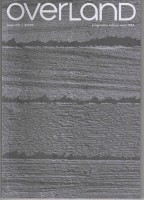
Overland 214

Jeff Sparrow (editor), Overland 214 Autumn 2014
Overland-214

There’s something irresistible about triplets: faith, hope and charity / birth, copulation and death / the three Graces / thesis, antithesis, synthesis / silence, exile, cunning … they’re everywhere. Overland‘s deputy editor Jacinda Woodhead invokes a nice one in this issue’s Editorial: for 60 years, she says, the journal has been encouraging dissent, interrogation and craft. It’s not just a pretty phrase: there’s plenty of all three in this issue, including in the first essay, Welcome to Curtin by Avan Judd Stallard, which comes craftily at Australia’s treatment of asylum seekers. It’s a memoir of working in the Curtin detention centre: prevented by the threat of seven years in prison from talking about the treatment of detainees, he describes instead the relationships and attitudes of the workers, with a short story writer’s eye for structure and significant detail.

Jennifer Mills, the fiction editor, introduces a 60th anniversary year feature, Fancy cuts, in which contemporary writers are invited to revisit short stories from the archives, invokes mother triplet: Overland has always been committed to the urgent, emerging or marginalised voices of its day. To kick off the feature, Josephine Rowe’s A small cleared space riffs surprisingly on Roma O’Brien’s When the bough breaks, a story of a hospital stillbirth that must have been harrowing when it was published in 1965, but now reads as a tale from an era of almost unbelievable callousness.

B J Thomason’s A slippery bastard deftly interrogates the myth of poet, horseman and Boer-murderer Breaker Morant, and in passing links him with two other mythologised slippery bastards. So we have triplet of Australian anti-heroes: Breaker Morant, Ned Kelly and Chopper Reed.

‘Cats are out, sloths are in’ by Jeff Sparrow is positively bursting with triplets. Subtitled Truth, politics and non-fiction, it looks at the fact-checking practice or otherwise of clickbait sites like Gawker, Buzzfeed, and Upworthy and more ‘serious’ liberal news sources like Crikey, the Conversation, the ABC. Current fact checking differs from the famous rigour of, say the New Yorker, in three significant ways (for which you’ll need to read the article). But checking facts has a limited usefulness, unless you realise they are part of a triplet: ‘facts’, theory and political practice.

There are three short stories in the Fiction section, including Anthony Panegyres’ Submerging, a parable about global warming embedded in a genuinely distressing tale of adolescent misery.

Up the back, are the three finalists in the 2013 Overland Judith Wright Poetry Prize. Peter Minter, the judge, says he looks for poems in which every line ’embodies perception, ideation and the breath‘. That’s a lovely triplet. I’m sorry that I didn’t warm to any of the poems.

There are other triplets, including the three mysteries in Stanley Kubrick’s 2001: A Space Odyssey in The last space waltz? by Claire Corbett, but not everything comes in threes. Four columnists are entertaining and intelligent: Alison Croggon reflects on how literacy and orality affect memory and perception (a subject Ross Gibson tackles at length in his book about William Dawes’s notebooks,  26 Views of the Starburst World); Giovanni Tiso ponders gloomily on our changing concept of the future; Mel Campbell challenges habit of thinking of writing in terms of productivity; Stephen Wright managed to make me laugh a number of times in a column devoted to wishing he was funnier. I missed Rurijk Davidson, another regular columnist – on leave perhaps?

There are two excellent pieces that I couldn’t shoehorn into my numerical scheme. Brendan Keogh’s On video game criticism, cast as a letter to Susan Sontag, manages to communicate the intellectual excitement in its eponymous field, even to someone whose video game experience doesn’t go much beyond Space Invaders, Pacman and Tetris. Jill Jolliffe’s A new thalidomide? tells you more than you wish was true about hospital use of DES and other drugs, often without consent, on single mothers from the 1940s all through the 1960s in Australia, with health consequences still being discovered, including in the grandchildren of the women given the drug.

Sixty years of dissent, interrogation and craft! May the road rise to meet you, Overland, and the wind be at your back for at least 60 more.
Alice Oswald’s Memorial

Alice Oswald, Memorial: An excavation of the Iliad (Faber & Faber 2011)

0571274161

Introducing his translation of The Divine Comedy, Clive James reminded us that it wasn’t just a story, but a poem. In creating her ‘excavation’ of the Iliad, Alice Oswald leaves the story out altogether. In a way, that makes the book a perfect companion to the Marvel comics Iliad (though I may be unfair in assuming that Marvel just tells the story: comics have come a long way since I was an avid reader of Classics Illustrated comics).

So what is left of Homer’s epic of the Trojan War if you take out the narrative? The short answer is: a powerful lament / memorial for the slain, interspersed with lyrical evocations of the natural world, Homer’s similes cut loose from the things they refer to. The whole poem is presented here, the author tells us in her introduction, as ‘a kind of oral cemetery’: where you would expect to find a table of contents there are eight pages of single names, in capital letters, one name to a page, so by the time you reach the first poem, which begins

The first to die was PROTESILAUS
A focused man who hurried to darkness
With forty black ships leaving the land behind
Men sailed with him from those flower-lit cliffs
Where the grass gives growth to everything
Pyrasus __Iton __Peteleus __Antron
He died in mid-air jumping to be first ashore
There was his house half-built
His wife rushing out clawing her face

it’s as if you’ve already been strolling among the tombs. What follows, page after page, is heartbreaking and beautiful, like the AIDS quilt. Every war should have its narrative stripped away like this.

Actually, that’s all I want to say.

Alice Oswald won the 2013 Popescu Prize for Memorial. She read from the book at the award presentation. You can see her reading below or at this link. You don’t have to worry about spoilers: everyone named in capital letters dies.

Clive’s Dante’s Heaven

Dante Alighieri, The Divine Comedy, Book Three: Heaven, translated by Clive James (Picador 2013)

1447244214I was about 12 when I first met the notion that heaven might be boring. I sneaked the Collected Plays of  George Bernard Shaw from the good china cabinet1 to read Pygmalion, and progressed by way of Saint Joan (including its wonderful Preface) to Man and Superman before it occurred to my parents that Shaw might not be terribly age-appropriate. When a character in that last play (Don Juan, maybe?) argued that hell was preferable to heaven, my orthodox Catholic faith was robust enough to dismiss him as silly, but the fact that I remember it indicates that the idea struck a chord.

I mention this early adventure in transgressive reading because I suspect that if I’d read Dante’s Heaven at that age I wouldn’t have dismissed the idea so easily: Dante’s heaven, at least in Clive James’s translation, is boring. It’s like a prison where the lights are never turned off, except the inhabitants won’t shut up about how happy they are.

In an exhilarating passage at the end of Canto 22, Dante looks down from his vantage point near Gemini in the zodiac and sees the earth:

______ And this paltry world we prize,
This little threshing floor where we have been
Always so fierce, was made plain from its hills
To river mouths, while I was wheeling there
With those eternal Twins. They turn like mills,
And I with them, the universe laid bare.

The thing is, quite a bit of Heaven is preoccupied with just the kind of paltry fierceness that is put in perspective here, and I confess to not finding the subjects of that fierceness all that interesting. I can appreciate Dante’s magisterial erudition and his brilliant poetic skill (as filtered through Clive James’s translation). I have some grasp of the magnitude of his task – creating a literary Italian language, combining classical and Christian frames of reference, wrestling mediaeval scholastic philosophy and theology into elegant verse, exploring the relationship of earthly and divine love, inveighing against corruption in his contemporary church, giving lessons in church and secular history (some of which, impressive though it is, I wouldn’t want unleashed on the young without health warnings), writing fierce political polemic (and putting it in the mouths of blissful souls in heaven), combining elaborate doctrine with ecstatic visionary experience (though it looks to me as if the visionary experience is a laborious, almost geometric construct rather than the report of an actual vision, as in mystics like Julian of Norwich), all while spinning a yarn with enough fantastical invention to keep the less committed punters happy. The book would obviously reward extended study, but reading it as I did with minimal recourse to commentary was all too often like visiting a museum.

Beatrice has replaced Virgil as Dante’s guide. She’s a lot prettier (her eyes become more ineffably beautiful with each new level of heaven, culminating in Canto 30 in a breathtakingly wonderful declaration of the inadequacy of Dante’s words to describe them) but she’s also much more long-winded, and claims God’s authority for everything she says, not exactly a recipe for lively conversation. I imagine her lectures – and those of other garrulous blissful souls – were serious fun for Dante’s contemporaries, as poetic renderings of cool philosophy or science are these days; off the top of my head I think of Kathryn Lomer on sunflowers or Jennifer Maiden on the uses of liquid nitrogen. But 700 years later, these lectures are mostly to be endured rather than enjoyed, and where they are not politically barbed they are almost unbearably abstract.

Clive James’s introduction anticipates this response: ‘What kind of story,’ he asks, ‘has all the action in the first third [that is, in Hell], and then settles back to stage a discussion of obscure spiritual matters?’ He answers his own question:

But the Divine Comedy isn’t just a story, it’s a poem: one of the biggest, most varied and most accomplished poems in all the world. Appreciated at the level of its verse, the thing never stops getting steadily more beautiful as it goes on.

If that’s so, this translation is – perhaps inevitably – an honourable failure. I’m grateful to James for opting for readability, I love his mastery of the quatrain form, and I read whole passages aloud to my dog as we walked around Marrickville, just for the pleasure of hearing them, but suspect his awareness of his own mortality may have led him to rush things at times. I’m probably not the first to note that at 10:188-189 he has Christ adoring the Church, an error that wouldn’t have survived a Beta reader process.2

I did attempt to deal with my general discontent by paying close attention to a couple of the annoying passages. Here’s one (James 13:69–84; Dante 13:52–66):

———————————Of all truths, this is chief:
That which dies not and that which dies are there
As nothing but the splendour of our Sire’s
Idea, which, loving, he begets. Because
That living light – which, streaming from the fires
Of its bright source, is never, as it pours,
Detached from its first well, nor from the love
Which, with those two, makes three – collects its beams
Through its own goodness, mirrored there above
In nine angelic orders, without seams
Stitched into one forever, it descends
To earthly potencies from act to act,
Becoming such that all things have their ends
In brief contingency, the fleeting fact –
Things generated with, or without, seed –
Produced by movements of the heavens.

If that takes some untangling, it’s partly because Clive James has twisted the language a little to make it rhyme and scan. I looked up the original, and found that the phrase ‘Of all truths, this is chief’ isn’t in Dante, and seems to be there to rhyme with ‘belief’ a few lines earlier; where James has one long, convoluted sentence, ‘Because … heavens’, Dante has two; the confusing stitching metaphor is James’s. But the difficulty is mainly because (I think) the passage deals in mediaeval theology about the Holy Trinity and the nature of Creation. It may have been demanding on Dante’s contemporaries but for us (and I include people like me who have actually studied a bit of Scholastic philosophy), without serious study it will remain incomprehensible, and frankly I don’t care enough to find out. Whatever pizzazz it once had is pretty dead, at least to me. And that’s true of too much of the book as a whole.

The next book I plan to read is Alice Oswald’s Memorial, a translation of The Iliad that leaves out most of the original. Maybe someone should do something of the kind with Dante.
—–
1 We didn’t have a lot of books in my childhood home, and only one or two were kept in the china cabinet – whether because they were particularly precious or to keep them away from young eyes I don’t know.

2 Clive James: ‘the Church, the Bride of Christ, will sing / Matins to its dear bridegroom, that he may /Adore her’. Dante: ‘la sposa di Dio surge / a mattinar lo sposo perché l’ami’. With my limited Italian, I read that literally as ‘the bride of God rises to sing matins to the groom because she loves him’. James seems to have been momentarily distracted from the meaning by the need to make his lines scan.

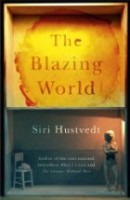
The Book Group and Siri Hustvedt’s Blazing World

Siri Hustvedt, The Blazing World (Sceptre 2014)

144477963X

Before the meeting: I’d missed a number of book group meetings – travelling, and then other evening commitments had got in the way. Alice Munro, The Red Badge of Courage, some Hemingway, The Dinner by Herman Koch – all were discussed without me. I thought I was going to miss out on the Siri Hustvedt dinner as well until Friday, when I realised the evening was wide open. I dashed into Gleebooks on Saturday morning and bought a copy, not actually intending to read the whole thing – I had a lot on my plate and the group’s emails that been less than enticing: ‘I am only up to page 32 and struggling with it!’ ‘I think page 32 is a mammoth effort.’ I planned to read to page 40 or so, enough to have some hope of following the talk when we met.

It was not to be.

The book is presented as a collection of documents – journal entries, art reviews, interviews, transcripts of statements, scholarly essays – by and about a New York artist Harriet Burden, edited by a scholar named I V Hess, whose ponderous introduction accounts for the first 12 pages and no doubt led to the book’s lack of appeal in some quarters. But Harry, as she is known to her friends, transcends the ponderousness. Having been the wife of a successful art dealer, she embarks after his death on a new artistic trajectory. Her work and she herself have been largely ignored or discounted by the art scene, and she comes up with a project to present new works as the creations of a series of three male artists. She’s tackling gender issues with passion born of a lifetime’s struggle, and at the same time exploring questions about the role of the creator’s reputation in how a work of art is seen, and deeper philosophical and psychological issues of identity, creativity, intersubjectivity, perception. I was hooked.

Other pressing demands on my time fell by the wayside and I read the book in three days. I rationalised that it was relevant to the online writing course I’m doing: this was a chance to see if in spite of its fragmentary appearance the book had something like the classic three-act structure. And behold, it does have the nine plot points we have been learning to identify, pretty much where they are suppose to fall. As a result, at any point in the novel you can feel it moving in a clear direction: the scholarly citations, the dissertations on hoaxes (mainly gender based ones such as James Tiptree Jr, but Ern Malley is mentioned in passing), the intellectual arguments, the meta moments such as the reference to ‘an obscure novelist and essayist, Siri Hustvedt’, the detailed descriptions of artworks, the ruminations on art history, the quotes from Whitman, Milton and Emily Dickinson, are all borne on a current leading inexorably towards what we know from near the start is a conclusion with more than one dead body. Novels, of course, don’t have to be tied to the classic three-act structure as tightly as we’re told films do, but I was gobsmacked to see how closely this novel, apparently so all over the place, sticks to the shape. It’s hard to talk about without spoilers, but here – perhaps of interest only to me – are the 9 points (there are 380 pages in the novel):

  1. set-up: We meet all the characters, or at least learn their names; Harry is widowed and in upheaval; she dreams up the Maskings project
  2. inciting incident (10%): page 39–40, she chooses her first ‘mask’
  3. change of plans: page 41–58, three new, widely divergent perspectives are introduced
  4. significant setback (25%): page 117, Harry’s first ‘mask’ having told her he was damaged by the project, she tells her friend Rachel: ‘There’s something in me, Rachel, something I don’t understand. … It’s something horrible inside me.’
  5. midpoint – sometimes called the point of no return (50%): page 213, ‘We have made the pact’
  6. darkest hour (75%): page 301, ‘He said, You look dead, Harry. She said, I feel dead.’
  7. glimmer of hope: page 314 ‘And then I said the right thing for once.’
  8. climax (90%+): Depending on how you read it, the climax is either page 322–324, a description of an artwork (he said, tactfully avoiding any spoliation), or page 351–361, which I don’t know how to characterise without giving too much away
  9. resolution: the very last page, the description of another artwork.

As I drove to the meeting I was prepared to be alone in having been completely absorbed, completely satisfied by the book.

The meeting: There were six of us, of whom two had read the whole book and one other was intending to finish it. A key thing that made the difference seemed to be that the three finishers had an interest in some kind in the art world: thanks to the Art Student, I’ve picked up a smattering over the last few years so I knew of many of the women artists named in the text, and found something almost uncannily familiar some of Harry’s observations about being an older woman in a scene that privileges youth and masculinity; another finisher has recently been an art student at TAFE; and the third has some wonderful art on his walls and is generally interested in it. Without some kind of prior interest, the device of multiple narrators and the general sense of contrivance seem to have stopped people from engaging.

There’s not much more to be said about the discussion of the book: conversation ranged instead over Pesach (last night was the second night), walking out of the theatre, a risqué witticism that Governor Marie Bashir once made to one of our number, the excellent seafood pie we ate, the inequity of raising the pension age, the difference between our current way of taking in most information through seeing and earlier times when it was mainly through hearing. The book, wonderful though it is, was a bit of a fizzer, but the dinner was a great success.

PS added later: I forgot to mention that one of us had started reading the book on his Kindle and found it very frustrating. When he shifted to a hard copy it became a much more manageable and pleasant experience. The difficulty seemed to have something to do with the way footnotes are treated in the ebook. They work better on the page.

Paul Toohey’s Sinking Feeling

Paul Toohey, That Sinking Feeling: Asylum Seekers and the Search for the Indonesian Solution (Quarterly Essay Nº 53, 2014)

qe53Possibly the most hope-inspiring thing about this Quarterly Essay is that a journalist who works for the Murdoch empire is writing for a publication whose presiding intellectual presence is one of that empire’s most stringent critics. Perhaps Australia isn’t Echo Chamber Land after all.
Toohey spent time in Indonesia interviewing refugees who planned to travel to Australia with people smugglers. He observed the different attitudes and behaviours of the different groups (Iranians, Afghans, Iraqis, Sri Lankans). He visited the villa of at least one people smuggler, and told a number of people the latest developments in Australia’s policy regarding the boats (this was before last year’s election). He was there at a small coastal town soon after a boat foundered after setting off with a full load of would-be asylum seekers, interviewed the survivors and did what he could (which turned out to be nothing) to help a small orphaned girl. These passages convey a vivid sense of the desperation that leads people to become ‘boat people’, and the tragedy involved in just one of ‘the boats’ going down.

He went to Texas, where he explored the differences between our response asylum seekers and the USA’s to illegal immigrants from Mexico. (The main difference is that the USA knows that the ‘illegals’ who survive serve a useful function in the economy, whereas refugees who arrive in Australia by boat are perceived, absurdly, as a security threat and a potential drain.)

He visited the detention centre on Manus Island after the riot in which Reza Barati was killed, and spoke to some of the locals.

He argues for an ‘Indonesian solution’, that is, cooperation with Indonesia in processing asylum seekers there, which would indeed stop the need for boats. The main obstacle to such a solution is the general misperception of Indonesia in Australia, fostered by the media and pandered to by governments. He doesn’t say in so many words that this misperception is grounded in racism, but that’s how I understand him. He is particularly scathing on Tony Abbott’s mishandling of relationships with Indonesia and his deliberate thwarting of Julia Gillard’s attempts to solve the problem, but equally scathing about all three recent Prime Ministers playing the politics rather than seeking a real solution.

Toohey may be a Murdoch man, but he’s one with mud on his boots. He makes it clear he’s not an ‘asylum-seeker advocate’, a member of the ‘detached elites’; he does some muted ABC-bashing, and he misrepresents the ‘pro-asylum view’ as supporting the ALP, but he has a journalist’s admirable commitment to getting at the truth that puts our political leaders of every stripe to shame. It’s a serious, challenging, grounded contribution to this important debate.

As I finished his essay, I read an article in The Big Smoke, in which by Julian Burnside made a proposal that Toohey would probably see as so much wishful thinking, but looks good to me:

• Boat-arrivals would be detained initially for one month, for preliminary health and security checks, subject to extension if a court was persuaded that a particular individual should be detained longer;

• After initial detention, they would be released into the community, with the right to work, Centrelink and Medicare benefits;

• They would be released into the community on terms calculated to make sure they remained available for the balance of their visa processing;

• During the time their visa applications were being processed, they would be required to live in specified regional cities. Any government benefits they received would thus work for the benefit of the regional economy. There are plenty of towns around the country that would welcome an increase in their population.

Burnside continues:

Let us make some bold assumptions. Let’s assume that the spike in arrivals that we saw in 2012 became the new norm (highly unlikely); and let’s assume that every asylum seeker remained on Centrelink benefits (also highly unlikely: they are highly motivated). It would cost us about $500 million a year. We would save $4.5 billion a year by treating them decently. And the $500 million would be spent in the struggling economies of regional towns and cities.

I wish I could have some faith that our government, committed as it now is to silence and three word slogans, or the opposition, which shows no sign of diverging, might give serious attention to some of the actual thinking that’s going on.

As always, up the back of this Quarterly Essay there is correspondence about the previous issue. Sometimes the correspondence includes stringent debate. This time, responding to Linda Jaivin’s Found in Translation, it gives a tiny glimpse into the community of translators, the people who struggle valiantly to break down the parochialism of our alarmingly monolingual society.

Southerly 73/3

David Brooks and Elizabeth McMahon (editors), Southerly Vol 73 No 3 2013: The Naked Writer

1nw

Alain de Botton was on the ABC recently arguing that we need to reclaim art (and by extension literature) from the academies and museums, to recognise its role in our ordinary lives. He was annoyingly persuasive, and had me wondering whether I really needed to read Southerly, which is after all solidly grounded in the English Department of the University of Sydney, largely written and edited by academics for academics. It seems to have stopped publishing poems by Jennifer Maiden, the regular appearance of which led me to re-subscribe a couple of years ago. So despite the fabulously daring cover, I approached this issue warily. What was in it for me?

It seems I enjoy reading about friendship. Alex Miller’s ‘A Circle of Kindred Spirits’ is a moving account of biographer Hazel Rowley’s career, seen through the prism of Miller’s long friendship with her, which they conducted almost entirely by email. Ann-Marie Priest’s ‘“Colour and Crazy Love”: Gwen Harwood and Vera Cottew’ explores a deep friendship between two women that has been sidelined in most discussions of Gwen Harwood’s poetry. It’s a beautiful essay, explicating some of the poetry and exploring the complex possibilities of friendship between women.

Scott Esposito’s ‘The Gate Deferred: J.M. Coetzee and the Battle against Doubt’ is interesting for similar reasons: at heart it’s about the relationship between readers and writers. The essay explores Coetzee’s engagement with Kafka. Far from writing dry academic analysis, Esposito begins by telling us how as a child of non-religious parents he (Esposito) experienced his own version of Pascal’s ‘le silence eternel des espaces infinis m’effraie’ (the Pascal reference is mine), then gives us a beautiful account of how in Coetzee he found someone with a similar sense of things, expressed in part by Coetzee’s engagement with Kafka. Coetzee, Esposito writes,

gives us not an answer to Kafka, nor an interpretation of him, but rather his experience of dwelling within Kafka’s mysteries.

Esposito comes close to dwelling within Coetzee’s mysteries. (I haven’t read enough of J M Coetzee – just Disgrace and the three volumes of quasi-memoir – to have an opinion on the validity or otherwise of Esposito’s reading, but that seems beside the point.)

Rowena Lennox’s ‘Head of a Dog’ is about another kind of relationship – that between dogs and humans. Her account of walking her dog made me wonder if she lives near me: could my collie be the one she describes as driving her kelpie-cattle dog cross to such paroxysms of exhilarated rage simply by existing behind a fence? Dogs ‘are the closest we have come to living with and knowing another species’, she writes, and whatever the cat brigade may say I think she’s right. The essay ranges widely, drawing on, among others, Frank Dalby Davison (Dusty), Jack London (The Call of the Wild), and Aboriginal elders Tim Yilngayari and Daly Pulkaa (as quoted by Deborah Bird Rose in Dingo Makes Us Human).

There are fine poems: Tracy Ryan has four on a hoard hidden and centuries later found;  Judith Beveridge (‘Peterhead’), Geoff Page (‘Angus’) and Stephen Edgar (‘The Sense of an Ending’) lend lustre (and just watch that Stephen Edgar use rhyme!); Ali Jane Smith (‘The Galapagos’), Simeon Kronenberg(‘Death of a Bull’) and Ross Donlon (‘Storm Water’) each do narratives it will be good to spend more time with.

There are fine reviews. I was especially glad of Anne Brewster on Melissa Lucashenko’s novel Mullumbimby, which I plan to read, and John Tranter being generous, illuminating and a little gossipy on Pam Brown’s Home by Dark.

That’s just some of the highlights for me. Other people may fall with cries of joy on the 42 page offcut from a forthcoming experimental novel by John A. Scott, Michael Buhagiar’s elegant discussion of Christopher Brennan’s debt to A. C. Swinburne, Robet Darby’s explication of the homoerotic content of a Martin Boyd novel, or … well, there’s quite a lot that I haven’t mentioned.

I’m going to finish with some whingeing, so feel free to stop reading now.

• First, does Southerly deliberately follow US spelling conventions for things like centre/center or the verb practice/practise?

• Second, is it just a little disrespectful to display a poet’s naked body on the cover and make no reference to him or his work except in the photo credit? If you’re interested, here’s a video of spoken word poet Randall Stephens full frontal, clothed and performing:

• Third, was it inattention or editorial illiteracy that allowed Ann-Marie Priest to go into print saying that

there is no mainstream literary tradition of female friendship, as there is with male friendship (think of Tennyson’s In Memoriam A.H.H., Achilles and Patroclus in The Illiad, and Jonathon and David in the Bible).

Maybe Ruth and Naomi just a few pages over from David and Jonathan ‘in the Bible’ don’t constitute a tradition, but surely they deserve a mention; even spellcheck knows how to spell The Iliad; and however many people name their children Jonathon, it’s Jonathan in the Bible. Even if you don’t count the ‘with’ that really ought to be an ‘of’, that’s an impressive error count in so few words.

David Malouf’s Earth Hour

DavidMalouf. Earth Hour (UQP 2014)

0702250139 As I was reading Clive James’s translation of Dante’s Purgatorio recently, one of my unexpected small pleasures was the occasional recognition of a place name. ‘Fiesole – that’s Anny’s town!’ I would exclaim under my breath, or ‘Campagnatico – isn’t that where David Malouf used to live?’ My pleasure comes from my North Queensland provenance: if you live in New York, Paris or even Sydney, you’re forever walking down streets that have appeared in poems, novels, movies; if you’re from Innisfail, North Queensland, not so much. My Purgatorio moments weren’t completely without wider usefulness, of course, as they gave me a whiff of how Dante’s contemporaries would have read the poem: they knew all the places he mentions, and had a wealth of personal associations with them. Any personal connection a modern reader has is a pale shadow, but a shadow all the same.

The shoe was on the other foot as I read the poems in Earth Hour. The poetry may address what they used to call universal themes (do they still call them that?), but it often addresses them as they arise in places I know, and nowhere more dramatically than in ‘At Laterina’. For a start, the poem is dedicated ‘For Jeffrey Smart (1921–2013)’: I know who Jeffrey Smart is, I know his portrait of David Malouf as petrol pump attendant, and what’s more I have fond memories of him as Phidias, the artist on the ABC Children’s Hour of my childhood, all of which may not add to an understanding of the poem, but it does add to my sense of connection with it. The poem meditates on the passage of time in an Italian village (‘Centuries pass / unnoticed here; it’s days that are tedious’), and moves on to the ‘sweet loaded breath’ of the tiglio in bloom. I’m engaged enough to find out that tiglio is lime tree. Then:

__________________Was it always
like this? Did native sons high on a scaffold
in Piedmont, streaked with smuts in a smoky canefield
near Innisfail, North Queensland, feel the planet
shrink in their memory of it, the streets, the decades
one as each June makes them when we catch
on a gust of heated air, as at a key-change,
its green, original fragrance?

I certainly feel the planet shrink, and in a good way.

There’s so much to love in this book: renderings of Horace, Heine and Baudelaire that range from elegant close translation to wildly divergent variations on the originals’ theme [Added later – not as divergent as I thought once I had the right Baudelaire poem – see Brendan Doyle’s comment below]; meditations on deep time, on what it means to be human, on our effect on the planet; profound pieces on ageing and mortality. I’m not able to do much more than name some of the poems that I am deeply grateful for: ‘Whistling in the Dark’ (‘Seeking a mind in the machine, and in constellations’), ‘A Green Miscellany’ (‘No, not nature but a green / miscellany, our years-in-the-making masterpiece’), ‘Touching the Earth’ (about worms), ‘Long Story Short’ (reminiscent of Blake’s ‘A Poison Tree’), ‘Persimmons: Campagnatico’ (about trees bearing fruit at the end of winter), ‘Nightsong, Nightlong’ (about a bird, and a heart), ‘Eternal Moment at Poggio Madonna’ (about a sleeping cat). That will have to do.

David Malouf turned 80 recently, and was celebrated on the show that has replaced Ramona Koval’s Book Show on the ABC. You can hear an excellent interview with Michael Cathcart here, and a discussion of his work here, by a panel comprising Ivor Indyk, academic Yvonne Smith, and poet Jaya Savige.

Finally, as a service to any drop-in readers looking for information about the translations in Earth Hour, here are links to the originals and literal translations: Horace Odes II, ii, Horace Odes I, xxvii, Baudelaire’s Spleen (link corrected thanks to Brendan Doyle], Heine’s Der Scheidende and Morphine.

Overland 213

Jeff Sparrow (editor), Overland 213 Summer 2013

213o I’m coming to this Overland late: the next issue must be just about due. Here are some brief notes with links, and because I’m late in writing the links are all live.

The reliably enjoyable regular columnists,  Alison Croggon, Rjurik Davidson and Stephen Wright demonstrate that just about any life event can prompt a writer and habitual reader to reflect on readerly–writerly matters: in this case they start respectively from packing up to move house,  serious injury and building a bedroom–library. Mel Campbell’s article The Writer as Performer offers a more sobering view of the writer’s life – the freelance writer as no more free of panoptic supervision than the less glamorised office worker.

In Paul Keating’s Redfern Park speech and its rhetorical legacy, Tom Clark does a very nice job of explicating the distinctive nature of that speech – different in significant ways from Paul Keating’s usual mode, and interestingly the subject of public squabbles over its authorship (the existence of the squabbles is what’s interesting rather than any proposed resolution). John Campbell, the Anti-Kim by David Brophy, explores a Victorian proto boy’s-own-adventure story and the reality behind it.

The centrepiece of this issue is the 2013 Overland Victoria University Short Story Prize for New and Emerging Writers. The three shortlisted stories are published here, along with comments from the chief judge, Jennifer Mills. All three of the stories are worth your time: Turncoat by Jennifer Down (the winner), Rush by Nic Low and The job by Robyn Dennison. I’m not quarrelling with the judges’ decision at all, but if you only click on one of them I recommend you choose Nic Low’s for sheer subversive fun.

As ever, poetry is sequestered up the back on tinted paper, and as ever it’s a feast. Treasure hunt, a prose poem by Anne Elvey, finds poetic form for the experience of a parent’s dementia.  Refrigerator by Elizabeth Allen, also a prose poem, has this memorable ‘out of the mouths of babes’ moment:

There were also the brightly coloured fish in my brother’s aquarium. One day when I saw my five-year-old sister staring at the tank, I said to her, ‘The fish are pretty aren’t they?’ She said, ‘I’m not looking at the fish. I’m looking at the space between them.’

Fiona Wright gives us Marrickville, an inner city love poem … kind of. Samuel Wagan Watson’s Cloud burst invokes T S Eliot’s ‘The Hollow Men’ to devastating effect. Walmadany by Brenda Saunders puts poetic flesh on the issue of mining on traditional Aboriginal land. Mark Mordue (I didn’t know your eyes were blue) and Larry Buttrose (Toast) have elegies for their fathers, the latter with the arresting opening lines:

The smell of toast reminds me of my father,
Not only because he was cremated.

I want to pick a nit over Northgate by Adam Formosa, which begins

A cigarette bud sits
at my windscreen

but then doesn’t take the image of cigarette as blossom anywhere. It leaves its readers wrestling with phantom meanings until we finally conclude that bud was just a misspelled butt, and no metaphor was intended. The poem about the cigarette bud is yet to be written.

Maree Dawes brb

Maree Dawes, brb: be right back (Spineless Wonders 2014)

brb A friend of mine once suspected her husband of having an online affair. He was spending an awful lot of time on the computer and she was fairly sure some of it was in chat rooms. Oh dear, I thought, I spend an awful lot of time online myself – just look at my blog output. What suspicions have I been arousing? While it’s true I’ve made some good friends thanks to the internet, I’m glad to report that chat rooms, multi-user fantasy games, bitcoin, and perhaps especially cybersex have never had the remotest appeal. So brb, a verse novella about raunchy chat room experiences, was a long way from presenting a temptation, though it was a bit of a titillation, and something of an education.

Maree Dawes’s protagonist is known only by her online ‘handles’, of which Boadicea (shortened to ‘cea’ in chats) is the main one. Her spouse, known to us only as ‘he’, is often away from home, and has given her a number of hours online as a gift. (How time flies, that such a gift marks the story as belonging to an earlier epoch! You can almost hear the dial-up tone.) Boadicea ventures into a chat room. After a rocky start she finds a warmly affectionate community, where people exchange an awful lot of ‘huggles’. We learn that it’s nominally a room devoted to books and literature, but from the beginning Boadicea is looking for adventure. She falls in love and has at least one torrid erotic encounter with a disembodied lover. There are hints of cyber-bonks with other, less emotionally significant chatsters, and there’s one piece of serious nastiness.

The narrative never really forgets that it’s all a bit silly, and the tone is generally comic. At the same time real emotions are involved, and the poetry explores a strange twilight state where relationships forged using only keyboard and screen can sometimes seem more substantial than those in the physical world, lacking as it does the delete key and the logout option. [If you’re worried about spoilers skip the next sentence.] For me the most powerful moments come when Boadicea is giving up her online life, tearing herself away from its addictive pull – in what feels like a cross between giving up cigarettes and losing faith in God. [End of spoilerish bit.] The poetry develops a deeper resonance, too, in moments that explore the relationship of words and sensuality, as in this non-computer moment from ‘me: 4 am’, rendered in online conventions:

me: ease under sheet

he rolls over grabs my breast, kisses my mouth smoothes my waist

me: stop
me: wait
me: back off
me: you have to tell me what you are doing
me: I need to know
me:  first the words
me: then the touch

me: these unplanned caresses
me: are too much

After eight lines in which she demonstrates the kind of words she means, there’s this:

oh forget it he says, I want to make love not lyric poems, it’s 4 am go back to sleep

And one is left wondering if ‘me’ was so wrong to want words. Do poetry and sex have to belong to different realms?

Appropriately enough, brb is published as an ebook, available from the pubisher as a PDF direct from Spineless Wonders or in Kindle-compatible or DRM-free ePub formats from tomely.com. I downloaded my complimentary copy to my tablet in the Kindle and ePub versions. The Kindle version was much friendlier. The ePub version made me yearn for the stability of words on paper. [Added later: The publisher asked me to enlarge on these comments, and I then did an experiment which I should have done before making these comments. Part of the difference was that the ePub version’s font size was very large, which played merry havoc with line breaks and even page breaks, whereas the Kindle’s font was of  a size that allowed the poems to sit comfortably within the page. This was not a fault of the file formats, but resulted from the different default settings on the apps I was using. What I said about the stability of words on paper still applies.]

awwbadge_2014brb is the fourth book I’ve read and reviewed as part of the 2014 Australian Women Writers Challenge.

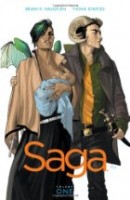
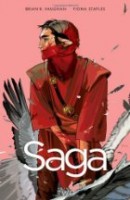
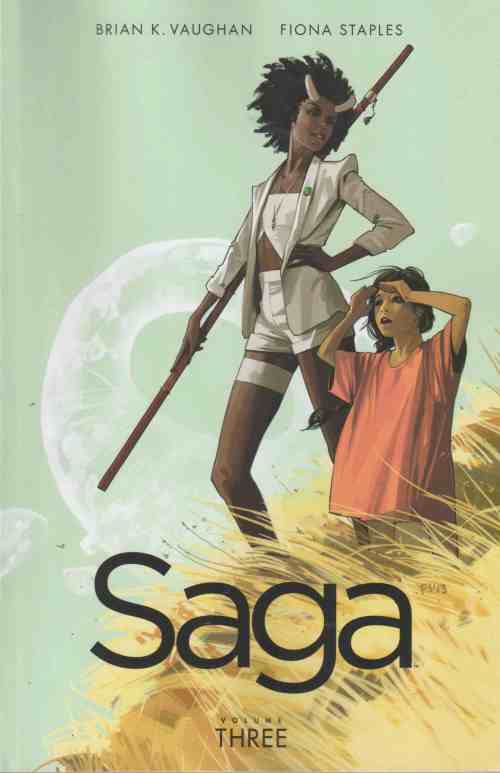
Vaughan and Staples’ Saga

Brian K. Vaughan and Fiona Staples, Saga, Vol. 1 (Image Comics 2013)
—————– Vol. 2 (Image Comics 2013)
—————– Vol. 3 (Image Comics 2014)

160706601716070669203SAGA


These are the first three volumes of the autobiography of Hazel, the child of a great romance between two people from different species. Her birth is something of a miracle, because no one was sure it was biologically possible – she is born with the beginnings of her mother’s wings and her father’s horns. More than that, the two species, originally from the planet Landfall and its moon Wreath, have been locked for centuries in bitter warfare that has spread to the whole galaxy. It’s an interstellar Romeo and Juliet in which the lovers don’t die, at least not before they’ve had a baby.

So it’s a mixture of science fiction and fantasy that wouldn’t be out of place as an extended Doctor Who narrative, though it includes a lot more physical and verbal grossness than would ever happen around the Tardis – male genitals can rarely have been portrayed as repulsively as in the images of the giant Fard in Volume 2, and the characters swear like troopers or inner-city hipsters.

Volume 1 begins with Hazel’s birth and ends with her paternal grandparents materialising on the young family’s organic, sentient spaceship, with a lot of bang-bang, kiss-kiss, magic and gore in between, as the lethal emissaries of several powerful organisations are out to kill Hazel’s parents and capture the baby.

In Volume 2, the chase continues. There are flashbacks to the parents’ courtship and the refreshingly frank conversation that followed hard on the moment of conception. Back in the present, the plot thickens when, among other things, Hazel’s father’s jilted fiancée joins forces with a mercenary named The Will, a planet turns out to be a giant egg (which hatches), and they visit someone who is either the wisest person in the universe or a hack romance writer.

By the end of Volume 3, Hazel – now a toddler – is miraculously still alive, along with her parents, her grandmother and her spectral babysitter. The cast of interesting characters, both allies and enemies, has expanded, as has the tally of dead bodies and ingenious monsters in their wake.

The first two of these books were a birthday present from a son who knows I’m interested in comics. I had misgivings. Having recently faced the fact that super-heroes are inherently boring, I was half expecting a similar epiphany about science fiction/fantasy comics. But no, these books are witty, warm, interestingly plotted, well-paced, and at heart sweet. (I say ‘at heart’ because the frequent nakedness, swearing and superficial cynicism do a good job of protecting the warm, soft, even idealistic core of the narrative.)

I also had misgivings about the art. But once you accept the demands of the genre, which evidently include a quota of garishness and bare flesh, Fiona Staples’ visuals are brilliant. I particularly like the way our heroine, Hazel’s mother, is lithe, tough, gorgeous, and fiercely maternal.

So I spent my own good money on the third book, which just arrived in Sydney’s Kinokuniya this week. Given that the story is narrated by Hazel in what sounds like a young adult voice, I imagine the series has another 20 or so years to cover. It’s coming out in monthly instalments, of which these three volumes cover the first 18. There’s an interesting interview with Brian K Vaughan on the Comic Book Resources site, which incidentally draws attention to a couple of details in Fiona Staples’ images that I hadn’t noticed, but that definitely move the story over into Mature Readers Only territory.