Category Archives: Books

After Proust, the Prelude?

Now that I’ve finished reading À la recherche du temps perdu, there’s an odd gap in my mornings. (I am aware of the irony of having Proust as part of a daily habit, given how much he had to say about the opposition between habit and full consciousness, but reading a couple of pages of his work was a habit all the same.) I want to take on something else.

A conversation last week with a 40ish friend helped me to think about criteria for the next reading project. My friend was raised without religious instruction and, realising that this had left a huge gap in his cultural knowledge, he had decided to read the Bible. Most of the way through Genesis he was disappointed, not only by the tedious begats, but by what he felt was poor storytelling. He singled out the story of Abraham’s interrupted sacrifice of Isaac as particularly nonsensical. I realised that those stories – Adam and Eve; Noah; Lot’s wife; Abraham, Sara and the angel; Isaac, Leah and Rachel; David dancing naked before the Ark of the Covenant – would seem very different if read cursorily for the first time rather than received with the force of canonicality (if that’s a word) behind them. I want to spend a couple of minutes each morning engaging with a substantial work of literature, not rushing it, not studying it, but letting each small portion settle for a day before I take on the next one.

Homer came to mind: I know people who have spent years reading the Iliad and the Odyssey as a group project. Or James Joyce: all those Bloomsday celebrations can’t be for nothing, and Finnegan’s Wake is at least as daunting as À la recherche. Byron’s Don Juan. The Epic of Gilgamesh. The Aeneid (though I did that, 20 lines a day, in my mid 20s, so it would be a repeat). Middlemarch (another repeat, but why not take it slow?).The Divina Commedia in Italian. Das Kapital (but not in German). It’s a long list of contenders.

Don’t ask me why because I don’t know, but I’ve decided to read Wordsworth’s ‘The Prelude’. In my time at Sydney University, the emphasis was on close reading. I’m grateful for what I learned in that way, but it meant that we got to read an excerpt from this long poem without being told anything about the poem itself, or encouraged to find out about it for ourselves. In fact, I didn’t know until I looked up the Wikipedia entry just now that Wordsworth began working on it in his late 20s and continued to do so all his life; that it was intended as the introduction to an epic, The Recluse, which he never finished. I believe that the version I’m about to read was published posthumously in 1850, the year Wordsworth died. I don’t expect references to it to crop up in movies, other poems, newspaper articles, the way references to Proust have in the last 22 months, and I’m not ruling out the possibility of abandoning ship, but I’ll start tomorrow morning, a page of blank verse a day, and I’ll blog about how it’s going in a month.

Janice Galloway’s Trick Is to Keep Breathing at the Book Group

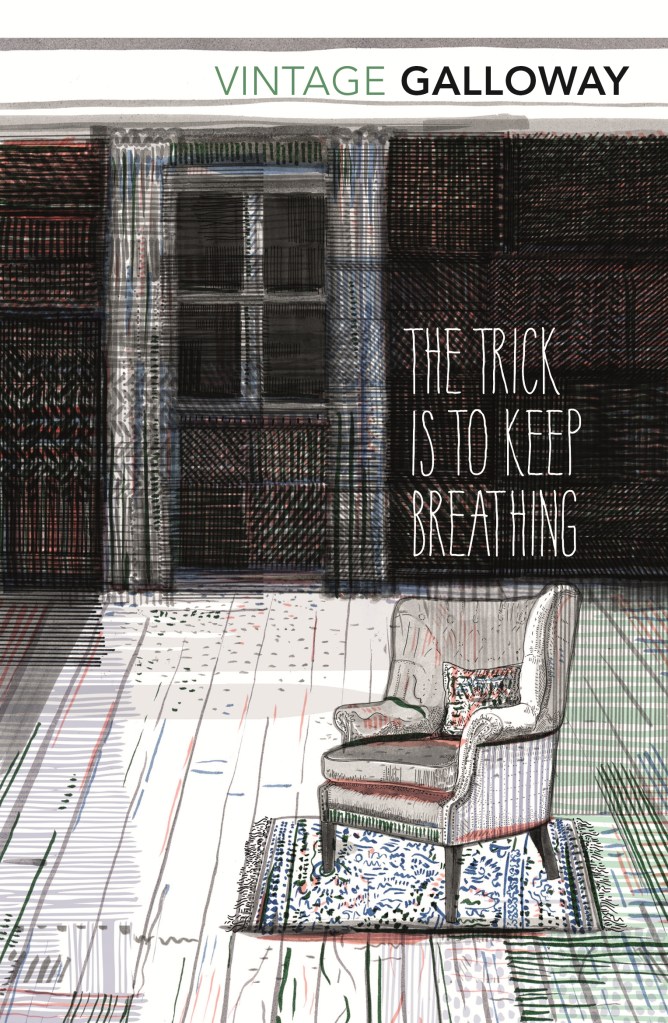
Janice Galloway, The Trick is to Keep Breathing (1989, Vintage Classics 2015)

Before the meeting: When I was about half way through this book, the following exchange happened on WhatsApp:

The Trick Is to Keep Breathing is a possibly-brilliant novel that I, for one, hated.

It’s a first person narration by Joy, a woman who has tipped over the edge into extreme depression and mental disorder when her married lover drowns on a holiday in Spain. At first I thought that my copy of the book, in a Penguin Vintage Classics edition, had been poorly reproduced from old film: the type is mostly dark and slightly blurred, though occasionally, apparently at random, a sentence or two is lighter and clear. There are odd blank spaces as if several lines are missing. And every now and then the margin boasts a word or a column of words, perhaps partly obscured by the gutter or running off the edge of the page. It took a while to realise all this was deliberate, a way of physicalising the state of Joy’s mind, on a continuum with the way the width of the column changes every now and then when Joy relays to us a horoscope or an advertisement from a magazine, or the type switches to italics as, bit by bit, the traumatic event in Spain is revealed.

It must be this typographic play that led the New York Times reviewer quoted on the back cover to write: ‘Resembles Tristram Shandy as rewritten by Sylvia Plath.’ I haven’t read Sylvia Plath’s novel, The Bell Jar, but a bit of unconventional typesetting doesn’t make a Tristram Shandy.

The portrayal of Joy’s unrelenting descent into darkness, starvation and disorder must be what led the judges to award it the MIND/Allen Lane Book of the Year for 1990. According to the website of ‘mental health charity’ MIND, ‘this well-established literary prize celebrates writing that heightens understanding of mental health issues in all their forms’. Elsewhere, Fay Weldon, a frequent judge, acknowledges that it is a little-known prize, and that ‘”literature” is not what concerns us here, but effectiveness, accessibility, honesty, optimism and helpfulness’. She wrote that in 2011. The judges’ desires were different in 1990, or they read the book differently from me, because I found very little optimism or helpfulness in it, and while Joy’s experience is vividly realised, I don’t think my understanding of anything is heightened.

The novel is a nightmare account of an experience of grief, anguish, disordered thinking, despair, self-starvation. The men in Joy’s life are generally sexually exploitative and/or clueless about her mental state. Her one woman friend has gone to the USA, and that friend’s well-disposed mother offers baked goods as an optimistic panacea. The doctors she encounters are unable to help, and in some cases, callously, don’t even try. If her account of her time in a mental institution is even half accurate, then the system needed to be burned to the ground: but it’s more of a darkly satirical fantasy, almost certainly with some truth but not something you’d trust as an account of anyone’s actual lived experience. For me, and I may be completely idiosyncratic here, the book came across as a kind of mental-illness porn.

At least one member of the group has signalled in advance that he loved the book. I’m open to persuasion, but only by a crack. I expect there will be discussion of the ending, which may be ambiguous, though I’m fairly clear about how I read it. I’m looking forward to the conversation.

After the meeting: Covid–19 brought restrictions to Sydney again on Wednesday, and though we were only six people and could have met legally in someone’s home, we decided to meet online.

Once we got settled in – ‘Hi, I like your beard’ ‘How did the test turn out?’ ‘Are people wearing masks in your part of town?’ – we moved on to a terrific discussion of the book.

Why it was terrific is that two completely incompatible readings of the book were aired, and the proponents of each could see that the other was coherent and justifiable from the text. It was all in how you read the tone. I guess I was at one extreme, reading the tone as something like that of Truffaut’s movie The Story of Adèle H, unremitting misery: Joy is sunk in grief and depression, goes through the motions of daily life and relationships, keeping up appearances but unable to show anyone – friends, former lovers, current sexual predators, co-workers, doctors – the depth of her despair. The chap putting forward the other extreme read it as grimly comic: through her terrible grief, Joy never loses her sense of herself, holding onto what she can of relationships and keeping with her routines as a way of staying in the world, vulnerable to predators but keeping her core self shielded from them, bantering defiantly with the useless doctors. Others were in different points along a spectrum between the two readings. No one else had read the ending as grimly as I had, and when I read the final paragraph to make my point, my opponent offered a completely valid alternative reading. I say ‘opponent’, and at one stage someone thought we were being a bit intolerant of each other, but I really don’t think that was happening: certainly I was delighted by the difference, and my respect for the book ballooned, give that it could sustain such different readings.

There was some talk about the terrible weather in Glasgow, and how what someone from tropical North Queensland (that is, me) might see as unrelentingly grim, might be seen by others (including possibly Janice Galloway) as dourly amusing. We’re reading another Scottish book for our next meeting to put that theory to the test.

Proust Progress Report 22: The end

Marcel Proust, À la recherche du temps perdu (text established under the direction of Jean-Yves Tadié ©1987–1992): Book 7, Le temps retrouvé, pp 2334–2401

Finished!

Seven volumes, 2401 pages, finished!

Having read a little of À la recherche du temps perdu first thing most mornings for the last 22 months, I’ve reached the end. My copy of the book has suffered: not only has the print on its covers worn way as in the image to the left, but the back cover has broken free, taking the last four pages with it.

I probably should have something brilliantly perceptive to say, but nah! I’m enjoying Patrick Alexander’s translation of the whole work one tweet at a time at @ProustTweet, and seeing how much I missed by reading it with my inadequate French; and I’ll probably read Alain de Botton’s How Proust Can Change Your Life sometime soon, but if my life has been changed I can’t tell (yet).

In the final 70 pages, Marcel continues his detailed account and analysis of the currents and undercurrents of high society, of the toll taken by time on his A-listers as seen at his last matinée. When he meets Gilberte’s daughter, he realises that this young woman is like a place in a forest where many roads meet (‘les «étoiles» des carrefours‘) – so many threads of his life, so many relationships converge in her person, and through her he is able to see how different parts of his story interconnect.

But then, with hardly so much as a paragraph break, he moves on to contemplating the huge project he is about to embark on – namely this book. There are wonderful passages about his plans and expectations. Having long since lost his fear of death, he now fears it again, but now he fears it for the sake of his work, not for himself. He will write all through the night, perhaps for a thousand nights, but cannot know whether his destiny will, like Scheherazade’s sultan, allow him to live another day in order to hear the rest of a story:

Et je vivrais dans l’anxiété de ne pas savoir si le Maître de ma destinée, moins indulgent que le sultan Sheriar, le matin quand j’interromprais mon récit, voudrait bien surseoir à mon arrêt de mort et me permettrait de reprendre la suite le prochain soir.

And there’s this, about what it would mean to take on the project:

[L’écrivain] devrait préparer son livre, minutieusement, avec de perpétuels regroupements de forces, comme une offensive, le supporter comme une fatigue, l’accepter comme une règle, le construire comme une église, le suivre comme un régime, le vaincre comme un obstacle, le conquérir comme une amitié, le suralimenter comme un enfant, le créer comme un monde sans laisser de côté ces mystères qui n’ont probablement leur explication que dans d’autres mondes et dont le pressentiment est ce qui nous émeut le plus dans la vie et dans l’art.

In English:

[The writer] would have to prepare his book with meticulous care, perpetually regrouping his forces as for an offensive, to bear it as a load, to accept it as a discipline, to build it like a church, to follow it like a fitness routine, to overcome it like an obstacle, to win it like a friendship, to feed it like a child, to create it like a world, bearing in mind those mysteries which probably only have their explanation in other worlds, the sense of which is what moves us the most in life and in art.

Later, typically, he undercuts this heroic tone, saying that the project is less like building a cathedral and more like sewing a dress. He says that Françoise, his barely literate housekeeper, understands the nature of the work better than many educated, literary people.

The prospect of death hangs over the closing pages, and the knowledge that his anxiety was well founded – this volume and the preceding one were published after Proust died – intensifies the poignancy. Having lived with this book for nearly two years, if only for a couple of minutes a day, I’m now surprised to find I have an urge to start all over again. Here’s the last sentence:

Aussi, si elle m’était laissée assez longtemps pour accomplir mon œuvre, ne manquerais-je pas d’abord d’y décrire les hommes, cela dût-il les faire ressembler à des êtres monstrueux, comme occupant une place si considérable, à côté de celle si restreinte qui leur est réservée dans l’espace, une place au contraire prolongée sans mesure puisqu’ils touchent simultanément, comme des géants plongés dans les années à des époques, vécues par eux si distantes, entre lesquelles tant de jours sont venus se placer – dans le Temps.

I had serious trouble translating that, and when I looked up Stephen Hudson’s translation (here) I got the impression that he had trouble too. Here’s his (the ‘…’ in the first bit marks the omission of several phrases that aren’t in the edition I’m reading):

If at least, time enough were allotted to me to accomplish my work, I would not fail to … therein describe men, if need be, as monsters occupying a place in Time infinitely more important than the restricted one reserved for them in space, a place, on the contrary, prolonged immeasurably since, simultaneously touching widely separated years and the distant periods they have lived through—between which so many days have ranged themselves—they stand like giants immersed in Time.

I don’t think mine’s any better, but here it is:

So, if a long enough time was left to me to accomplish my work, first of all I would not fail to describe men in it, making them resemble monstrous beings that occupy a place so much more substantial than the restricted one reserved for them in space – a place, rather, that extends immeasurably because, like giants immersed in the years, they simultaneously touch all the distant periods they have lived through, between which so many days have been placed – a place in Time.

That ‘longtemps‘ at the start of this sentence reaches all the way back to the first sentence of the first novel:

Longtemps, je me suis couché de bonne heure.

Ayad Akhtar’s Homeland Elegies

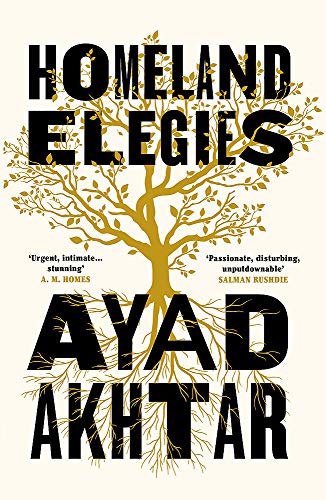
Ayad Akhtar, Homeland Elegies (Headline 2020)

The Emerging Artist has been urging this terrific book on everyone who will listen (it was her insistence that made it jump my To Be Read queue). It’s a novel that manages to include mini-essays about politics, economics, religion, cancel culture and the art of war while telling a deeply personal story about an immigrant Pakistani Muslim family in the USA, particularly after the 11 September attacks and during the Trump era. The author has described it as literary reality TV, by which I think he means that while it follows the author’s life closely and is populated by recognisable characters from his real story, and so reads like memoir, it’s actually carefully structured fiction. The epigraph, from Alison Bechdel, gives fair warning:

I only make things up about things that have already happened …

Ayad Akhtar is a Pulitzer winning dramatist. His play Disgraced was put on by the Sydney Theatre Company in 2016, so some of my readers may know his work, but this book is my introduction. It has made me a fan.

Like Philip Roth’s The Human Stain, Homeland Elegies starts with current presidential scandals – for Roth it was Clinton’s sexual misdemeanours, for Akhtar it’s Trump’s all-round egregiousness. But where Roth forgot about Clinton and moved on to his protagonist’s own misdemeanours, Akhtar stays with Trump, or at least with his (or the narrator’s) father’s infatuation with him, and Trump remains at least an ominous background presence for the duration. In the end, the book is an exploration of the state of the US nation under Trump. I read it as a kind of elegy for the USA that has been ailing for decades and been given what may be its death blow by Trumpism (it was published before the 2020 election, but hasn’t been defanged by Biden’s election). It also includes an earlier immigrant generation’s lament for a lost homeland – hence the plural elegies of the title.

In the first pages, in a section named ‘Overture: To America’, the narrator’s university mentor remarks ‘almost offhandedly’, long before the advent of Trump or even the Tea Party, that

America had begun as a colony and that a colony it remained, that is, a place still defined by its plunder, where enrichment is paramount and civil order an afterthought. The fatherland in whose name – and for whose benefit – the predation continued was no longer a physical fatherland but a spiritual one: the American Self.

The rest of the book can be read as the narrator’s process of discovering what that means.

I may be making it sound dull and programmatic. It’s anything but. Its arguments are complex and compelling, and given to Proust-like reversals. Its characters, especially the narrator’s father, leap off the page. At the sentence level it’s alive and engaging. Take this brilliant passage about the early part of Trump’s ascendancy:

The national mood was Hobbesian: nasty, brutish, nihilistic – and no one embodied all this better than Donald Trump. Trump was no aberration or idiosyncrasy, as Mike saw it, but a reflection, a human mirror image in which to see all we’d allowed ourselves to become. Sure, you could read the man for metaphors – an unapologetically racist real estate magnate embodying the rise of white property rights; a self-absorbed idiot epitomising the rampant social self-obsession and narcissism that was making us all stupider by the day; greed and corruption so naked and endemic it could only be made sense of as the outsize expression of our own deepest desires – yes, you could read the man as if he were a symbol to be deciphered, but Mike thought it was much simpler than all that. Trump had just felt the national mood, and his particular genius was a need for attention so craven, so unrelenting, he was willing to don any and every shade of our moment’s ugliness, consequences be damned.

(page 242)

‘What oft was thought but ne’er so well expressed.’ That is, the characterisation of Donald J Trump may not be startlingly original, but this is beautifully put, and there’s a lot more of it in context. No sooner have you stopped cheering (if you’re me) for this passionate statement of a vital truth, than the narrator takes us into the sleepless night that his friend Mike’s tirade has brought on. And just in case the reader wants to cheer for Mike, it turns out that Mike makes a logical – or at least logical to him – leap to arguing that it makes sense to vote Republican. This is a book that never falls in love with its own rhetorical power. It avoids cheap shots and easy answers. In a short final section, the narrator is to give a talk at a university. At first the Muslim student organisation calls for his invitation to be rescinded because his work is ‘offensive and demeaning’, but then when someone puts up posters accusing him of being pro-terrorist, the Muslims rally to back him. He’s not implying the bogus argument, ‘I’m being attacked from both sides, so I must be right,’ but holding out for complexity, for thoughtful reading. The book as a whole repays thoughtful reading in spades.

Evelyn Araluen’s Dropbear

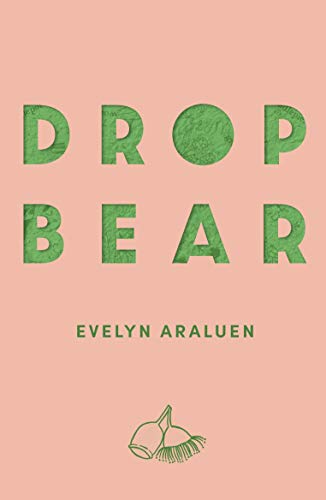
Evelyn Araluen, Dropbear (University of Queensland Press 2021)

This is a formidable book. I’d heard Evelyn Araluen read some of its poems, which she always does with a slight, dangerous smile, and was looking forward to reading them. The smile is mostly still in evidence, but the danger doesn’t feel slight. What’s endangered is any hope of emerging with Australian settler colonialist assumptions intact, or at least untroubled. In the book’s generous notes, Araluen spells out her understanding

that the material and political reality of the colonial past which Indigenous peoples inherit is also a literary one. Our resistance, therefore, must also be literary.

(page 99)

What looks like an elegantly designed slim volume of poems is actually a piece of incendiary resistance to colonial attempts at genocide and erasure, from May Gibbs’s cute bush creatures to perfunctory or self-serving acknowledgements of country, by way of a whole gallery of settler-Australian poets and poetic tropes. There are rage-fuelled mash-ups taken from widely read, familiar texts; poems whose ideal readers have PhDs in critical theory or contemporary poetics; and longer prose poems that could just as easily be categorised as essays and short stories. There are poems that turn their gaze away from the colonisers and dwell on family and the natural world.

In her conversation with Tony Birch at the Sydney Writers’ Festival My blog post is at this link), Araluen said. ‘This is not a cancel culture book.’ And that’s an important point to make. ‘For the parents’, one of the longer pieces, is in part an expression of gratitude and appreciation for her parents who read May Gibbs to her and her siblings, which when she first ‘discovered theory’ she thought meant they were ‘losing to the settlers’:

While my siblings and I consumed those stories, we were
never taught to settle for them. My parents ever pretended 
these books could truly know country or culture or 
me – but they had both come from circumstances in which 
literacy and the access it affords was never a given. They just 
wanted me to be able to read.

The acts of resistance in this book are not rants against an easily demonised foe. They involve the poet’s own inner wrestles, and bring a finely tuned, disciplined intelligence to bear on issues that lie at the heart of Australian culture. The book isn’t an easy read, especially for old white men, but it’s not hostile. Speaking as an old white man I felt it as a bracing invitation and a forthright offer of guidance and even help.

Added later: There’s an excellent discussion of Dropbear by Jeanine Leane in Sydney Review of Books, at this link. Here’s a taste:

Dropbear is blunt, biting and beautifully crafted. Although it is those things, it is more than the sum of those things. It’s a radical and timely affront to the history, the myths, the gossip and the stereotypes that still confront us all as the Country’s First Peoples.

Dropbear is the tenth book I’ve read for the Australian Women Writers Challenge 2021.

Journal Blitz 7

Given the lack of government support for the arts in general and literary magazines in particular, it’s no small miracle that so many of them survive and continue to publish excellent work. I do my little bit, subscribing to three and buying an occasional one-off as the spirit moves me. Then I find time to read them, sometimes falling terribly behind.


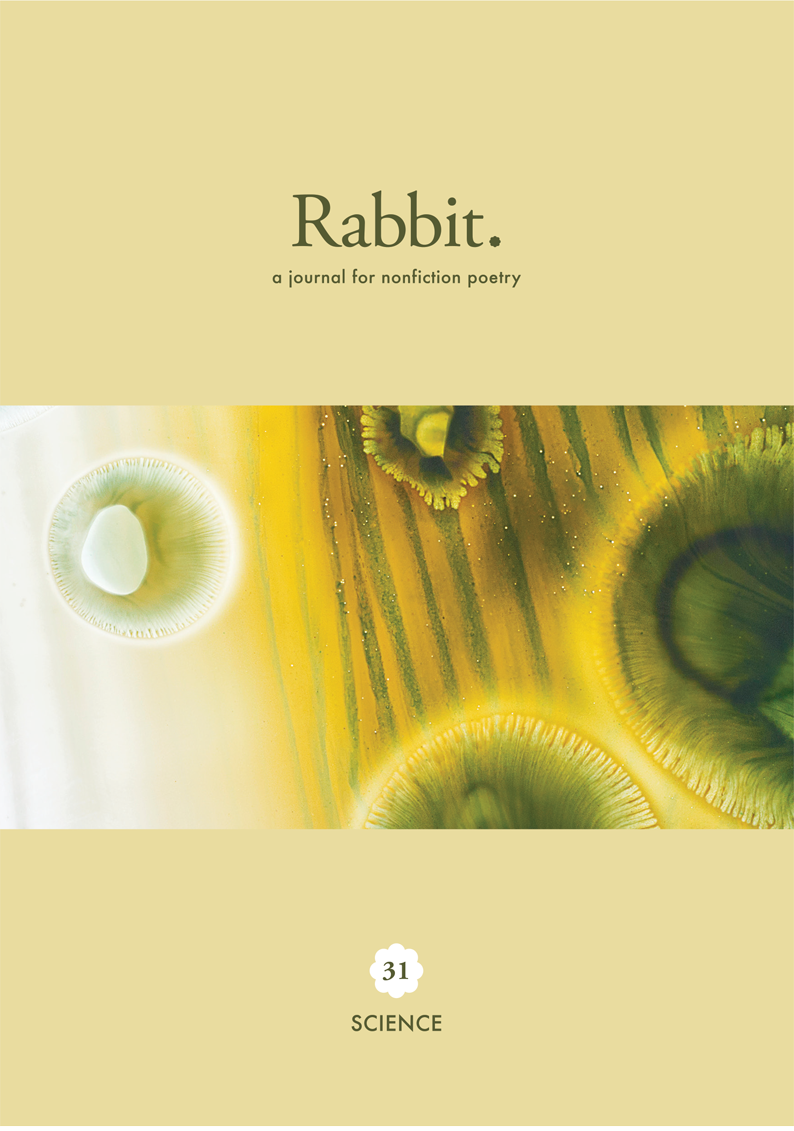
Jessica L Wilkinson (editor), Tricia Dearborn (guest editor), Devika Belimoria (artist), Rabbit 31: Science (2020)

Rabbit is a ‘journal of nonfiction poetry’. I don’t subscribe, and I’ve only read one previous issue, Number 10 (my blog post here). Like that issue, this one is beautifully designed – it features gorgeous images made by Devika Belimoria using a mysterious (to me) process involving acrylic paint and macrophotography.

The Science issue is edited by Tricia Dearborn, whose poetry I love. Whereas Tricia’s own science-related poems tend to be accessible to a non-specialist reader (as I have testified in blog posts here, here, and here), some of the poems she has chosen here are dauntingly technical. But one good thing about anthologies is one can skim, though I didn’t skim very much at all.

To give you a taste, here’s a sampling of opening lines:

From ‘Perpetual Motion’, a series of prose poems by Amit Majmudar:

Amazonian nomads, last studied in the 1940s in Brazil (in that anthropologist's recordings of their dirges, you can hear chainsaws buck alive in the background), had a religion based on the quest for eternal life – only immortality wasn't a quality, as it is for us, but a place they had to keep walking to find

From Jacqui Malins, ‘If you’:

If you are reading this I may be dead
or alive and you have survived past
infancy

Jilly O’Brien, ‘No Laughing Matter’, which is a prime example of what Tricia Dearborn’s editorial describes as ‘science at play – revealing the world, cracking bad jokes and considering the big questions’:

Pierre met Marie in the lab
He had his ion her

Jaya Savige, ‘Starstruck’:

I cannot honestly claim to have met Stephen
Hawking. But once I was skidding down the steepest 
bridge in Cambridge – in the rain, on my rusty BMX 

As well as the science poems, this Rabbit contains the winners of the 2020 Venie Holmgren Environmental Prize, with clear and accessible notes from the judges; a number of articles including one by Tricia Dearborn about her own poetry’s relation to science; a stimulating interview with Astrid Lorange; an essay adapted from a performance piece; and several reviews of recently published books of poetry. All good reading.

I have taken Rabbit 31 into the sauna with me over a couple of weeks. It was ideal reading in that contemplative environment, but alas, it’s bound with glue, and my copy is now pretty much a loose-leaf gathering of poems, images and articles. (Also I was mocked for inappropriate sauna behaviour.)


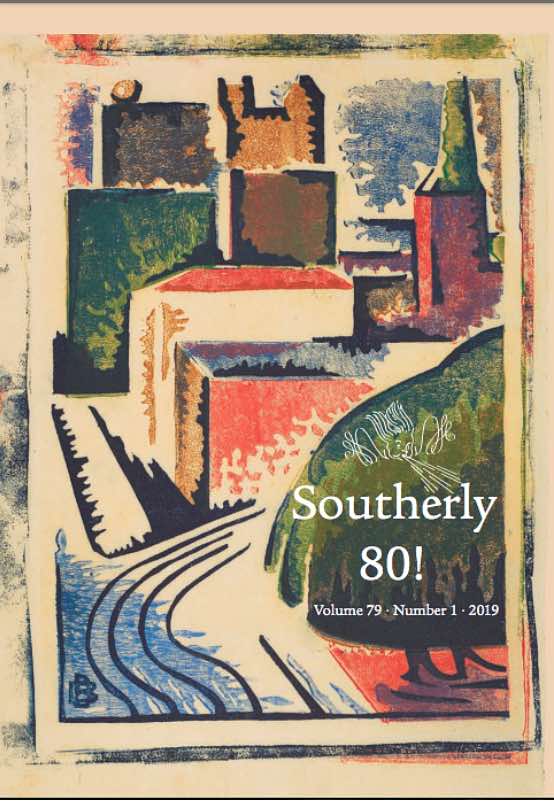
Elizabeth McMahon (editor), Southerly 80!, Vol 79 No 1 (2019)

Southerly, Journal of the English Association, Sydney, has turned 80, and though no issue has appeared since this one came out in 2019, rumours of its death were apparently exaggerated. At least, the website is back up and running.

As befits a journal of such longevity, this Southerly has something for a range of tastes: poems, stories, memoirs, critical articles, notes about literary history, and a substantial number of reviews. A handful of contributors have been around for the majority of the journal’s lifespan, while others are writers appearing in print for the first time.

In ‘A Bell Note’, David Brooks, retiring editor, offers a fascinating account of his years in the chair, including the difficulty of producing the journal with mostly unpaid labour (contributors are paid, but not editorial staff) in an environment that has become increasingly hostile to literary magazines, or at least to the notion of funding them. His account of the role of literary magazines in the funding economy is worth quoting:

The government was using the journals as a means, on the one hand, of arm’s-length funding of writers (through their payments to contributors), so that, at ground level, it did not have to involve itself in deciding which writers to fund, and, at another level, the journals’ decisions as to who was worth publishing and supporting aided the Board in its decisions concerning which writers to give individual grants to. The journals, in other words, were supported because they were a vital filter in the government’s wider program of support for Australian writing. But increasingly, in the last two decades, this ground has shifted. Literary journals continue to perform this same function, but it’s now largely for the publishing industry; to the government they are supplicants, mendicants.

Richard Nile’s ‘Desert Worlds’ is a survey of the way literature has portrayed the Australian soldiers’ sojourn in Egypt in 1916. It’s almost as if the proponents of patriotic myths should be very glad of the disaster of Gallipoli, because without it those gallant men might now be remembered as racist, sexist, drunken hoons.

Alison Hoddinott’s ‘Poetry and Musicophobia’ does a quick tour of distinguished poets and other writers who have been, not deaf like Henry Lawson, but tone deaf – unable to hold or even recognise a tune, even while being extremely sensitive to the musicality of language. There are amusing anecdotes about Hal Porter, Ezra Pound and Sylvia Plath, among others.

’Editing Daniel’ is a brief account of the life and work of Daniel Thomas, art historian and gallery director, written by Hannah Fink, co-editor of Recent Past: Writing Australian art, the first collection of Thomas’s writing.

Jumana Bayeh’s ‘Australian Literature and the Arab-Australian Migrant Novel’ glances at a couple of pages of Patrick White’s The Aunt’s Story where, she says, an Arab-Australian character appears in an Australian novel for the first time, then goes on to a fascinating discussion of two much more recent novels by Arab-Australians, Loubna Haikal’s Seducing Mr Maclean (2002) and Michael Muhammad Ahmad’s The Lebs (2018), with Edward Said’s Orientalism as theoretical backdrop.

There’s a wonderful variety of poems, including: the melancholy ‘wrap’ by joanne burns (whose apparently is reviewed by Margaret Bradstock elsewhere in the journal); the harrowing ‘Explant (caveat emptor)’ by Beth Spencer (I had to look up breast explant surgery to understand this poem); Anne Elvey’s poem in memoriam Deborah Bird Rose, ‘Grevillea Robusta’; and Jaya Savige’s ‘Coonoowrin (Crookneck)’, on which I spent far too much time and still have only deciphered less than a quarter. Just in case my reader shares my love of impossible word puzzles, here’s the opening of that last-named poem:

Hushbound, mountchain, coiled for-kin ache
revenant, calm. Warm hay be stark enigma flags, but cannot 
rarely be sore heart to tune and luck upon your sighin'?

Decoded:

Husband, mountain, [unintelligible] 
[unintelligible], come. We may be [unintelligible], but can it
really be so hard to turn and look upon your son?

If you can fill in the blanks, the comments section is open.

Of the reviews, Michelle Cahill made me want to read David Brooks’s The Grass Library; Toby Fitch reviewing Dave Drayton’s P(oe)Ms offered valuable insight into some contemporary poetics; Oliver Wakelin on Luke Carman’s Intimate Antipodes, perhaps inadvertently, caught me up on some literary gossip.


Jacinda Woodhead (editor), Overland 237 (Winter 2019)

As a marker of how far behind I am in my Overland reading, while I was reading this issue, the last one edited by Jacinda Woodhead, the fourth edited by her successors, Evelyn Araluen and Jonathan Dunk, has landed in my letterbox.

Mind you, Overland isn’t all that committed to timeliness either. The punchiest article in this issue, ‘Crocodile tears‘ by Russell Marks, is a blistering criticism of a book published in 2016, Cathy McLennan’s Saltwater. After noting that the book met critical acclaim and won awards (not to mention modified praise from bloggers such as me, link here), it goes on:

All of this should come as a surprise because Saltwater‘s myriad problems could have excluded from publication altogether.

Drawing on his own extensive experience as a lawyer working with and for First Nations people, he makes a very convincing case that Cathy McLennan’s memoir of her time as a young lawyer working for an Aboriginal legal service in Townsville is full of poor legal practice which the older McLennan seems to endorse, is misleading in many ways and feeds a racist agenda, while distracting readers from its reactionary politics by ‘vivid and shocksploitative descriptions of her clients and their lives’. (I searched online in vain for any rebuttal of the article.)

The only moment that felt seriously dated was a citation of Naomi Wolf’s The Beauty Myth in Hannah McCann’s ‘Look good, feel good‘, an otherwise excellent article about the emotional labour of beauty salon workers. Though The Beauty Myth may well hold up, it’s hard to imagine an article in Overland these days quoting someone who so bizarrely argues against masks and basic contact tracing mechanisms.

My other highlights in this issue were: ‘Only the lonely‘ by Rachael McGuirk, discusses the NSW Special Commission of Inquiry into the Drug ‘Ice’ from the perspective provided by her family’s long-term, harrowing experiences with drugs, mental illness and the justice system, ‘Inspired and multiple‘ by Rebecca Ruth Gould and Kayvan Tahmasebian, who describe their process of co-translating poetry as ‘a dance in chains’; ‘At the crossroads‘ by Con Karavias, a history lesson about the German revolution that raged from 1918 to 1923, but will never be restored to mainstream respectability because to do so would be to acknowledge that conservative forces unleashed Hitler and Nazism in order to crush it.

Of the four short stories, ‘Womanhood‘ by Mubanga Kalimamukwento, a Zambian coming of age story involving female genital modification, had most impact on me. ‘The Sublime Composition‘ by Gareth Sion Jenkins incorporates elements of Microsoft Word’s track changes feature in a deconstruction of an incident recorded in Thomas Mitchell’s journals of exploration, but it’s an extract from a work in progress, a taste rather than a meal.

In the eight pages of poetry, I loved the way ‘Tenor and vehicles‘ by Shastra Deo and ‘Learning‘ by Jini Maxwell resonated with each other. One begins:

Fact: things are like other things. Supposition: liking
tweets is like a simile. 

The other:

There is a very fine line
between writing and just sitting down

Overland has a number of regular features:

  • a guest artist. Number 237 has Matt Chun, who is currently – or was in January 2020 – the Children’s Literature Fellow at the State Library of Victoria, and who brings a children’s illustrator’s sensitivity to these sometimes necessarily grim pages.
  • three columnists: On failure by Alison Croggon; On the school as utopia by Giovanni Tiso; and On writing in water by Mel Campbell
  • the results of at least one competition. This time it’s the 2019 Fair Australia Prize (FAP), an annual prize co-sponsored by the United Workers Union and Maurice Blackburn Lawyers. The winners – two short stories, an essay, a poem and a cartoon – share a fresh directness in the way they address issues facing working people in Australian and, in the general fiction prize winner, in India.

And three more journals are now on the shelf above my desk …

Christos Tsiolkas’ Damascus

Christos Tsiolkas, Damascus (Allen & Unwin 2019)

I’m not a Christos Tsiolkas fan. I read most of The Slap aloud on a long car journey and it wasn’t a pleasant experience – the sex scenes were embarrassing and the characters’ misogyny repugnant. But I knew I had to read Damascus.

Like two other novels that come to mind – Mary’s Testament by Colm Tóibín, and The Book of Rachel by Leslie Cannold (links are to my blog posts) – this promised to explore the stories I received in childhood as containing the deep and enduring meaning of life; to explore them, interrogate them, reimagine them. Those other novels told the stories of Jesus’ mother and imagined sister respectively; the central character of this one is the man most responsible for shaping the Jesus story, St Paul, once known as Saul of Tarsus.

Damascus delivers on the promise, in spades. I’m not equipped to comment in any detail on Tsiolkas’ use of the sources. I have only read excerpts from Paul’s epistles, I couldn’t say for sure whether I’ve ever read the book of Acts, and I know nothing about the apocryphal gospel of Thomas except that it exists. Tsiolkas has immersed himself in these documents, and emerged with a story stripped of holy-card or gold-leaf piety, about a man, and a nascent community, coming to grips with a transforming way of understanding what it is to be human.

The world of the novel is callous and often violent. Israel and the rest of Western Asia is under brutal Roman occupation. It’s a place where divisions between free and enslaved, male and female, Jew and Stranger, Roman and non-Roman are rigidly enforced. For a man to touch a woman, or a free person to touch a slave, is a shocking transgression, and in the wrong time and place can meet with shocking punishment. Anyone born disabled or with a physical abnormality, or even sometimes a person born female, would be dumped alive in a cave outside the city and left to starve or be killed by wild beasts. The novel doesn’t draw a discreet veil over any of this horror: the opening scene is a graphic account of a stoning; the fate of rejected babies is realised in nightmarish detail; a man is seen breathing his last after days suspended on a cross, pecked at by carrion crows; a young Jew is castrated and has his tongue plucked out for desecrating a Roman shrine, and then is killed and buried unceremoniously by his brothers because of the shame. Pagan practices involving animal sacrifice that are familiar enough to us are described in stomach churning bodiliness.

In this world, the people who follow Jeshua, as he is called, believe in the brotherhood and sisterhood of all. Slaves and free, women and men eat and drink and embrace together. They are reviled as a death cult because they revere someone who was subjected to the ultimate humiliation of crucifixion, but they are tender and affectionate with each other. Their ritual greeting – ‘He is risen’ ‘Truly he is coming’ – sounds a little Handmaid’s Tale-ish, and foreshadows the way that community was to harden into an institution, but in the present time of the novel we see a genuine striving to live the truth of loving all.

At the beginning, Saul is a zealous, scholarly Jew who supplements what he earns as a tent-maker by hunting down Christians, entrapping them and handing them over to the authorities for execution. He’s also riddled with guilt and self-hatred because of his compulsive sexual attraction to men, and has a troubled relationship with his family because he is unmarried. According to Acts, he was struck down on the road to Damascus where he heard a voice saying, ‘Saul, Saul, why do you persecute me?’ and that moment marked his dramatic conversion to Christianity. The book handles that moment beautifully. it’s told from Paul’s point of view, and we’re never completely sure what happened. There is a lot of light. He is brutally beaten, incurring permanent injuries, and it’s the days of care he received from a Christian group, even though they know he is their persecutor, and even though he repudiates them, that brings about his conversion. Part of the care is warm intimate connection with another man – and though we’re never told whether any actual sex is involved, a strong homoerotic tenderness pervades his relationships with other male followers of Jeshua: much kissing on the lips, sleeping in each other’s arms, bathing each other and so on. Paul is loving with the women members of the community as well, but never with this kind of intimacy.

Paul wants to expand the community to include non-Jews – Strangers. He takes on a young man, Timothy (who is there in Acts), whose mother was a Jew and father Greek. Acts tells us that Paul circumcised him. Damascus gives us the detail of that – the gore (this is a Christos Tsiolkas novel, after all), but also the religious dilemma: Paul is going against his own preaching that is the coming kingdom there is neither Jew nor Greek, but the emotional and social demands of the moment overwhelm the correct line.

The Biblical Paul’s injunction, ‘Slaves be obedient to your masters,’ is the basis for a major narrative thread. Consistent with the rest of the novel, the horrors of slavery and the terrible implications of that injunction are realised.

As anyone who has read even a little about the beginnings of Christianity knows, those early years were full of controversy. The first Christians were Jews, and what now reads as antisemitism in the gospels was written as one group of Jews attacking others. The story of Mary Magdalen meeting the risen Jesus is a vestige of her role as a leader in the early community. The story of doubting Thomas, who said he wouldn’t believe that Jesus had risen unless he saw him with his own eyes, is polemic against the real-life Thomas who preached a different version from the one that became canonical. One of the terrific things about Damascus is the way it includes the controversy: a body of belief is in the process of forming, and the proponents of different positions have enormous difficulty staying loving with each other, and can fail spectacularly. Realistically, none of them shake off the religious world-views they inherited as children: conversion is always a work in progress.

Thomas is a major character. In this novel he, not John, is the disciple most beloved of ‘the Lord’. He is the one who witnessed the crucifixion. And he doesn’t believe in the resurrection. He and Paul – and the other leaders, mainly James in Jerusalem, whom we don’t meet – clash, and he is expelled from the community. By the end of the novel, there are four generations of Christians, the belief that Jeshua will return in triumph imminently is wearing thing, and there is a groping towards a different way of understanding the meaning of his life and death. We – or at least I – feel it is unbearably sad when Thomas, who is every bit a generous, forgiving and loving against the odds as Paul or any of the others, is rancorously dismissed, when his understanding – that the kingdom of heaven is to be found in how we can be with each other, not in any supernatural intervention – is perhaps the richest of all.

So, it’s a terrific book. I don’t know what Christos Tsiolkas’ devout Orthodox relatives will make of it, but it helps this lapsed Catholic look back on his roots with fresh respect, even awe. I hope it’s not pushing the Biblical allusions too far to say that in this book the word of the Christian New Testament is made stinky, fluid-emitting, blistered, burned and suffering flesh.

Proust Progress Report 21

Marcel Proust, À la recherche du temps perdu (text established under the direction of Jean-Yves Tadié ©1987–1992): Book 7, Le temps retrouvé, pp 2273–2334

If I’d kept to my original plan of five pages a day, or even my second plan of three a day, I would have finished À la recherche du temps perdu by now. But I’ve slowed down and had a couple of gaps, so I’m only just entering the strait.

Not that the pace is picking up, but this last month’s reading has had a definite end-is-nigh feel. As I mentioned last month, a sequence of tiny experiences – standing on some uneven paving, hearing a spoon click against a plate, feeling a starched cloth against his lips – send the narrator into complex rumination about the nature of memory and art.

I won’t even try to summarise his reflections on art, but he has a lot to say about the importance of drawing on one’s own experience, and on paying attention to one’s own idiosyncratic (not his word) responses to the material experiences. The specifics of this, remembered, half-remembered, retained only in the unconscious, are what make a work of fiction live. ‘A book’, he says, ‘is a great cemetery where we can no longer read the eroded names on most of the tombs.’

Un livre est un grand cimetière où sur la plupart des tombes on ne peut plus lire les noms effacés

Having earlier given up on his pretensions to be a writer, he now decides to write a book based on his fresh understanding of a certain kind of memory as a way to transcend time. It’s fabulously self-referential, and it does make me want to start all over again to see how the book lives up to his stated intention.

All that thinking happens in the library of a house where he has turned up for a social event. The musical piece in the next room finishes and he goes into the salon, which is full of people he hasn’t seen for years while out of town at health establishments. And they’re all in fancy dress: the men have stuck white moustaches and beards on their faces and most people are wearing white wigs; one young man has put on ingenious fake wrinkles; a glamorous woman has made herself look overweight … which leads into reflections on old age. Just as he as decided to write a work about transcending time, he is confronted with evidence of time’s inexorable effects on human beings.

Individual humans age, some more devastatingly than others. Some people disappear from society altogether – they may have been the subject of scandal, or they may have been Germans. Some who were barely on the fringes of le monde now have great prestige. Others have swapped dubious reputations for status as men of high moral standing. The same title is now inhabited by a different person altogether. The young have no idea of the origins and history of the people who now shine on the social scene. And who but the old now remember that the still-beautiful Duchesse de Guermantes – Oriane – could once make or break a social occasion by deigning to appear for half an hour, or staying home.

Proust’s contrast between the virtues of solitude and the emptiness of social life is here the clearest it has ever been.

Through all this, there’s what amounts to a roll call of the novel’s characters alive and dead: the devious Morel now gives character references in court; Mme Verdurin is now the Princesse de Guermantes; Bloch is a prestigious man of letters; no one quite remembers how Gilberte became a Guermantes; Oriane is as commanding a presence as ever, but in a flash-forward of three years we see her in sad decline.

The loose ends are being tied up. I have 70 pages to go and am missing Proust already.

The Book Group and Lamorna Ash’s Dark, Salt, Clear

Lamorna Ash, Dark, Salt, Clear: Life in a Cornish Fishing Town (Bloomsbury 2020)

Before the Meeting: Lamorna Ash, a posh young Londoner fresh from university, decided to visit the part of Britain her mother came from, and from which she got her first name. She lived for two stints in the fishing village of Newlyn, just a couple of miles north of Lamorna in Cornwall, all her senses on the alert to see and understand everything about it, its people, and the life of fishermen (no fisherwomen during her time there) and their families. She went out on trawlers and smaller fishing boats. She drank with young and old. She formed solid friendships. She learned to gut fish and oscillated between horror and unholy glee as she graduated to stabbing rays in the heart – all part of a fisherman’s job. She talked and listened to everyone who would give her the time of day. And she wrote a lot of it down.

Meanwhile, she read or remembered writing by Elizabeth Bishop (whose poem ‘At the fishhouses‘ describes the sea as ‘Dark, salt, clear’), Barry Lopez, Walter Benjamin, Marianne Moore, Herman Melville, Antonia Barber (author of the picture book The Mousehole Cat, whose name doesn’t appear in the well-deserved praise of the book), W G Sebald, and other literary giants – and found ways they shed light on what she was discovering.

Then she made all that into this book. I enjoyed it. The author’s extreme youth gives rise to some embarrassing moments – as when she explains that ‘yarn’ is an old term meaning ‘story’, or when she reflects on how differently one sees the world when one is older, for values of older that are less than 25. The literary references sometimes feel forced. But by about page 100 these qualities had come to feel like part of the charm of the book. She’s capable of mocking herself, as when she writes of the walks she takes to stave off loneliness:

I often leave notes for myself on my phone when I go on these solitary walks, little inanities I wish I had someone else with me to whom I could say them out loud. This morning I wrote myself a particularly bold one. ‘For someone who gets lost a lot, coastal walks are a godsend. Only if the sound of the sea disappears from your left ear, can you have possibly gone wrong.’

Well yes, I guess it’s an inanity, but no more so than many of her observations, and this little moment of self-deprecation earned my forgiveness for a lot.

On the other hand, no forgiveness is required for her description of her week on board the trawler Filadelfia, which forms the book’s narrative backbone. Here’s her wonderful account of gutting a stingray:

I flip the ray over on to its back. Its stomach is a cadaverous grey and its almond-shaped mouth gapes open and shut like the puckering of a teenage kiss. The lips are so human I am momentarily dumbstruck. Open and shut, open and shut, its mouth sounds out a wordless plea.

I shake myself from my trance and hear Stevie prompting me to make an upside-down V incision along the translucent flap of skin that conceals its vital organs. Underneath is a mess of multi-coloured, pulsating guts – bright pinks, yellows and oranges. Over the roar of the engine, the men guide me to seize hold of a fistful of guts and pull them away from the ray’s body. But as I do so, the ray’s muscular wings start to close in upon my hand. In film footage of rays swimming, they use their wings, properly named pectoral fins, to propel themselves forward, gracefully rippling through the water like thin material animated by wind.

The ray’s last desperate bid to defend itself shocks me out of the automatic, mechanical state I usually induce in myself while gutting. In panic, I try to withdraw my arm, but its wings are still clutching me tightly. Beyond the boat, the waves have picked up and the boat slams down into the water. ‘You have to stab it!’ the men cry, goading me on as if we were outside the Swordy [hotel in Newlyn] preparing for a brawl. I let out a cry and stab the ray in the heart.

(page 256)

Her initial horror changes to murderous glee. The crew take to giving her all the rays to gut, and nickname her Raymundo.

After the meeting: For no particular reason we met in an Indian restaurant, the food was excellent, and the tragedy currently unfolding on the subcontinent had no obvious impact on the mood of our hosts, but there were nine of us at a long table. Conversation was animated and the book was discussed vigorously, but it was hard to manage a single shared for more than a very brief time. Next meeting’s host, who is responsible for summarising each meeting, put it well on WhatsApp: ‘

So yes, it was a excellent banquet last night where I got a week’s worth of meat, we agreed the book was somewhere between 2.5 & 4.5 stars, was either deeply revealing or a series of pleasant vignettes, … was in a place we should all visit and was generally an enjoyable read.

The 2.5 party hadn’t finished the book and didn’t intend to. He hadn’t read the fascinating historical account of how the town was saved from actual destruction in the 1930s at the hands of bureaucratic health and safety regulations, how a petition was taken to London on a small fishing vessel whose crew were astonished to see the banks of the Thames crowded with well wishers. He felt that the (to me fascinating) tidbits of Cornish language were mere padding.

The 4.5 party, just loved the book. He was completely charmed by the author’s voice. He described her quotes from other writers as smacking of undergraduate naivety and enthusiasm, but saw it as part of her youthful charm. (Given that our group is made up, all but one, of old farts gentlemen of a certain age, the youth of the writer was an issue for all of us one way or another.) He spoke eloquently of the way the narration would move from descriptions of social life in the pub to a deep dive into some aspect of the life of the town.

Whereas I, and others, found the description of life on fishing trips, of the way time at sea opens up spaces for communication and reflection, one man who has worked on boats said he found that fairly ordinary and wished there was a lot more about the women left ashore. Though the difficulties of the life were touched on, we were left feeling that a much darker story could have been told.

One chap had been to Cornwall a couple of years ago, and could show us photos of the town, including the very boat on which a pigeon dies in once of the book’s many atmospheric anecdotes. Actually he showed us these pics on WhatsApp before the meeting; he brought them to the dinner on a tablet, but couldn’t see a way to pass it around.

A couple of chaps drew comparisons between this book and James Rebanks’s A Shepherd’s Life. Each of them is an account of a community, a place, a working life that has endured for centuries and is under threat in the modern capitalist world. One is a passionate insider’s story, the other that of an interested visitor. It’s not that Lamorna Ash was trying to do do a James Rebanks: she’s completely upfront about her outsider, ‘posh’ status, her lack of skin in the game, but the book is still a serious piece of non-fiction, combining advocacy, memoir, linguistic sidelights, character studies, and adventure on the high seas.

Eileen Chong’s Thousand Crimson Blooms

Eileen Chong, A Thousand Crimson Blooms (UQP 2021)

Someone* said recently that the work of a poet isn’t just to write poetry. Poets also teach, mentor, encourage other poets, edit, proselytise for poetry … and the list went on. At the launch of A Thousand Crimson Blooms last month it was clear that by this criterion Eileen Chong is a real poet. I chatted with an emerging poet who has won prizes and attributes it to her inspiration and mentorship. Three other poets, all women of colour, read at the launch, and each testified to Eileen’s kindness, collegiality and solidarity.

The poems in A Thousand Crimson Blooms bear strong testimony to the poet as embedded in a community of poets and other artists. Many of the poems carry epigraphs, and we are given meticulous notes referring us to their sources – most of which are other poems, and at least one is a quote from a conversation with another poet. Sometimes the notes give us web addresses where we can see images of works that inspired a poem.

The sense of connectedness goes further. A central feature of this book, as in Eileen Chong’s previous collections, is the sense of living heritage, in birthplace (her own Singapore and her husband’s Scotland), in family (especially her mother and grandmother), in food (maybe not as much as in earlier books, but this is still poetry that makes you hungry), in language (a number of poems make play with the components of Chinese ideograms), and always in poetic tradition.

This connectedness and rootedness provide a sustaining background in poetry that mostly deals with personal pain: bereavement, sexual abuse, illness and surgery, involuntary childlessness, the challenges of migration.

This is a terrific book. I learned a lot, I cried, I laughed, I was confronted. Only a couple of times I was mystified. More than a couple of times I was surprised by the twist of a last line. I was sent down interesting rabbit holes, and found myself reflecting deeply on my own life. Eileen Chong reads her own work beautifully: you can hear her, among other places, when/if the Sydney Writers’ Festival release a podcast of the session that included her – The Unacknowledged Legislators.

There are so many poems I’d like to spend time with here. There are powerful poems about loss that it would feel almost indecent to write about in this necessarily abbreviated way. There’s ‘Making Sense’, whose beginning sheds light on the poems in general:

I tell my students:
poetry is a way to make sense 
of what you fear. 

I sing to them of 
blackbirds. I read my poems 
aloud

There’s ‘Spring Festival’, which includes similarly suggestive lines:

My husband reminds me I write poems 
in threes: three lines, three pathways.
One for the old life, one for the new 

and one for the hours 
I do not notice as they pass.

There’s the ‘The Hymen Diaries’, each of whose four parts responds to a work of art (see mention of rabbit holes above). There’s ‘Child’, whose subtitle, After Andy Kissane’s ‘Joy and a Fibro Shack’, offers generous possibilities for a ‘compare and contrast’ kind of discussion – and many poems like that.

I’ve picked the title poem, ‘A Thousand Crimson Blooms’, mainly because before spending this time with it I didn’t understand how it hung together, starting with what feels like kindergarten innocence and ending with lacerating pain. You can see an earlier version of the poem with a slightly different title on the Peril magazine website (here). Here’s the poem as it appears in the book:

To start with the epigraph: I haven’t read the poem it comes from, ‘Don’t Trample This Flower’ by Bing Xin, but I have learned that Bing Xin was a prolific Chinese woman writer of the 20th century, many of whose works were written for young readers (Wikipedia entry here). These lines are a straightforward call to pay attention to something that is beautiful, easily overlooked and vulnerable.

There’s a smooth transition to the opening lines of the poem. Like the epigraph, they address children/little ones: having looked, now, let’s draw. We’re in a domestic or classroom setting; the voice is that of an adult – a teacher or parent? – addressing small children, possibly in a rural environment. The third line’s invocation of the daily cycle of time has a traditional Chinese feel. It reminds me of the ancient poem, ‘The Peasant’s Song’, that begins, ‘Sun up, work / sundown, rest.’ (That’s Ezra Pound’s translation, in his Canto XLIV.) It’s a benign opening, and my fridge door is covered with just the kind of artworks that the little ones might create. (I should mention to anyone who’s just visiting the blog that I have a three-year-old granddaughter who loves to put pencil/crayon/brush to paper.)

The next three lines could be summarised as detailing the process of drawing the dog and rooster, and the children’s focused, unblinking attention to the task. But the language alerts us that something may be slightly off. ‘Let’s shape their bodies with our hands’ may be just an odd way of describing the movement of hands holding pencils, but it feels a little more dominating. Maybe we’ve moved on from drawing to shaping in clay. The second line takes us a step further with the hint of violence in ‘gouge’. The adult speaker has taken us quite a way from paying close attention to something vulnerable to something on the edge of cruelty, even if it is only cruelty to the paper. In the third line, as I read it, the ‘little ones’ speak. The ‘lidless eyes’ suggests a kind of forced, sustained attention that is far from the relaxed, open regard of the epigraph. That there are a hundred eyes suggests that the context has moved from the intimate to the institutional. I have to admit that on first reading I resisted this darkening mood, but once seen I can’t unsee it, and it refers to a common phenomenon. The late artist Kim Gamble, for example, used to lament the way education put a damper on creativity: that children who draw and paint beautifully in Year 1 of school are generally creating cliché images with no spark of originality by the time they are in Year 3.

I’m generally sceptical of poets who talk about the crucial importance of punctuation and spacing, but I think it’s interesting that where the Peril version has a simple paragraph space before the next stanza, this version has an asterisk. The poet wants to be clear that there’s a substantial break. The stanzas change here too, from three-liners to four-liners, but it’s the asterisk that most clearly signals a gear-change.

Sure enough, there’s now a radical change in tone. The benign teacher/parent has been superseded by a harsh authoritarian voice. If the earlier stanzas were in a small, friendly kindergarten classroom, this is now a disciplined, bullying high-school class, perhaps a laboratory, where there is no room for emotion or vulnerability. Science experiments using test tubes and bunsen burners become metaphors, or maybe metonyms, for the harm done to people in such an impersonal environment. (I don’t think there’s an implication that science is necessarily that way, but the reference to glass and fire do conjure up a chemistry lab in my mind.)

The final stanza follows another leap – in time, in setting, in scale. The speakers are the bullied ones, and the 50 people of the second stanza have grown to be a thousand. Blue-and-white vases are traditional Chinese creations, vulnerable like the flower of the epigraph, emblematic of a long history of artisanal skill and creativity (of the kind that produces gasps on Antiques Roadshow). We have been prepared for their appearance by the echo of traditional Chinese poetry in the first stanza. They are broken, with violence that parallels the breaking of the benign teacher-child relationship of the earlier stanzas. ‘They’ is undefined. If I stick with the classroom reading, they are a particular kind of educator, and in making us do the kind of ‘creativity’ that the curriculum requires, they not only take us away from our innate creative impulses, they make us tread all over them.

The second last line takes us back to the flower of the epigraph, only now the flower is not ‘by your feet’, but part of oneself. It is our blood, our suffering, that now produces the flower, that becomes the subject of art. Creativity and pain are now closely linked.

The final line takes a step back. I can best say how I read it by attempting a paraphrase: In our present wounded condition, any attempt to make art must find a deep connection to tradition or some other form of community, if it is to have any vitality. Of course, it doesn’t refer only to the making of art: I think of the importance that First Nations elders place on connection to culture as a means to youth suicide prevention.

Now that I’ve understood how the poem coheres, it hasn’t quite finished with me (and perhaps never will have). The reading that I’ve sketched so far is loosely tethered to my own life experience. But that reading can expand. The poem could be read as a meditation on part of Bing Xin’s life story: I only know the Wikipedia version, and haven’t read any of her poetry, but she was denounced during the Cultural Revolution, a time when blue-and-white vases were quite literally being smashed.

The poem can be read as a response to a work of art: it was initially written on commission as a response to The Masks of Me, a mixed media installation by Vipoo Srivilasa consisting of ‘a group of small masks that celebrate cultural differences and diversity’. You can see the artwork and the artist’s statement on the Peril magazine site, at this link. Actually, I can’t see this reading at all.

Since it has given its title to this book, the poem can be read as referring to the collection of poems. Many of these poems are indeed filled with pain, unflinchingly named, but what makes them readable – more than just readable, deeply satisfying – is their rootedness. This poem itself is an example of that. The classical references, the restrained language, the way the images are allowed to do their own work on the reader, the formal neatness: all these are a kind of rootedness that let the poem flower.


* Sorry, I don’t remember who said it. I think it was on Al Filreis’s PoemTalk podcast.


A Thousand Crimson Blooms is the ninth book I’ve read for the Australian Women Writers Challenge 2021.