Category Archives: Books

Guides through grief, torture and trauma

I’m not the intended audience for either of these books, but they’re both written, or co-written, by writers whose work I love. One of the writers is my niece. Each of the books is related to its author’s other job: Edwina is a yoga teacher when she’s not writing, and Jennifer Maiden has been employed as Writer in Residence at STARTTS (NSW Service for the Treatment and Rehabilitation of Torture and Trauma Survivors).


Edwina Shaw, A Guide Through Grief: First aid for your heart and soul (Red Backed Wren 2020)
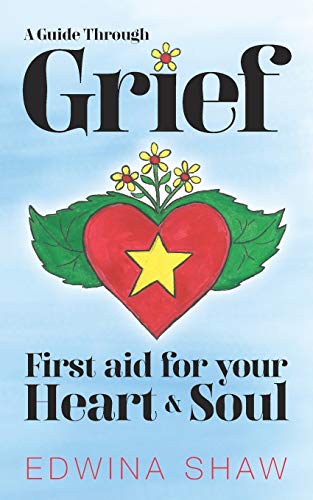
Edwina’s book has a further subtitle on the title page: ‘Practical tools, creative activities and yoga exercises to help you cope with the loss of someone you love’. It announces itself as a self-help book. OK, I’m deeply suspicious of self-help books so, as blood’s not thicker than prejudice, I approached A Guide through Grief with my defences up.

It turns out that, yes, there are plenty of practical tools etcetera. At the end of each chapter there are several suggested activities: journalling and other writing tasks, affirmations à la Louise Hay, rituals with a New Age feel, the promised yoga exercises, and some recipes. Some or all of these may hit just the right note for some readers, and I’ve got nothing against a good recipe for chicken soup, but if that’s all there was to the book my heart would have hardened against it. (Luckily, an introductory ‘How to use this book’ explicitly invites readers to turn up their noses at some exercises, depending on taste.)

But the book is also a memoir. Edwina’s reflections on grief and loss, the need to weep and to stay connected, the importance of facing the reality rather than taking refuge in work or destructive activity of one kind or another, the passage of time – all these are entwined with accounts of personal experience. The book is rooted in her own bereavements: her father died of cancer when she was 14, her younger brother killed himself not long after, her grandmother died a peaceful death in old age, and then, devastatingly, decades later, a baby son died soon after birth. The self-help advice and suggestions have been tested in the laboratory of the writer’s own life, and she shows at least some of her workings.

I had tears in my eyes in many places. Partly this is because three of its four main deaths affected me deeply at the time. (I was ridiculously pleased to read in the paragraph about the impersonal remoteness of her brother’s funeral on page 110: ‘Only my uncle’s speech reflected the true essence of Matty’s personality.’ At least I’d been part of bucking the trend.) It’s also because Edwina can write. I happen to have read this book as I’m making my way, three pages a day, through Proust’s account of bereavement in the sixth volume of À la recherche du temps perdu. I’m not suggesting that Edwina Shaw and Marcel Proust are in any way similar writers, but Proust’s description of humans as ‘amphibious creatures who are immersed simultaneously in the past and in present-time reality’, which I read this morning, resonates through Edwina’s accounts of the role of memory in grieving.

The book does an elegant two-step: it evokes one person’s experience of loss and her grieving work, and gives practical suggestions on how the reader can do their own work. I skipped the yoga and I skim-read the affirmations; you might ignore the writing exercises – which I might actually try. I doubt if I’ll ever practise a ‘visualisation’ in which I sit naked on the lap of a mother goddess, but I’ll remember Edwina’s wise aunt who said that ‘for every death there is one hundred hours’ worth of crying’. I love her argument for wrenching funerals from the control of religious institutions and for-profit enterprises. Edwina says in her introduction that this is the book she wishes someone had given her when she was 14. I hope I’d have the moral fibre to give it to someone in that situation: it could save lives.


Margaret Bennett & Jennifer Maiden, Workbook Questions: Writing of Torture, Trauma Experience (Quemar Press 2019)
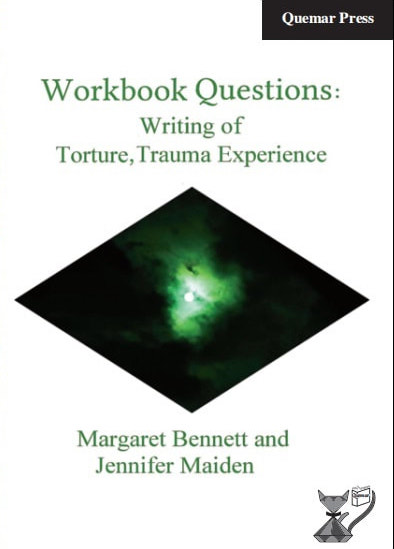
Workbook Questions is what it says on the lid: 47 pages of carefully-devised questions intended as prompts in writing exercises for ‘Torture and Related Trauma Survivors and for Survivors of Camps and Incarceration’. So the main intended audience is limited – though an opening section of ‘General Questions’ is designed to make the book useful to anyone addressing trauma of any sort, not just torture and incarceration, which is a much broader readership/user base. It turns out that the list of questions is preceded by a 30-page ‘Conversation’ between the authors: Margaret Bennett, former Executive Director of STARTTS with a background in group therapy and counselling, and Jennifer Maiden, poet.

A more conventional presentation might have spelled out a carefully referenced rationale for the questions, probably with each question numbered for easy cross-reference: ‘The reasons for starting out with neutral questions about parents are as follows,’ etcetera.

Although such explanations are covered in the ‘conversation’, it is much more interesting and readable than that. Two women who have worked with each other and know each other well discuss the circumstances that led to this set of questions, the insights they bring from their different experiences and expertise, what they found worked in the groups, the value of writing as opposed to speaking as a way of integrating traumatic experiences, and autobiographical anecdotes.

Maiden and Bennett take turns in speaking/writing, and each turn is printed as a single paragraph. As these paragraphs can run for several pages and cover a range of topics, the reader has to do work that would be done by an editor in a more conventionally presented work, but the work pays off. I imagine that this conversation will be very useful, not only to people working with survivors of torture, trauma and incarceration, but also to to scholars interested in Jennifer Maiden’s poetry, in which these themes appear frequently.


A Guide through Grief and Workbook Questions are the 20th and 21st books I’ve read for the 2020 Australian Women Writers Challenge.
Rhoda Lerman’s Book of the Night

Rhoda Lerman, The Book of the Night (©1984, Women’s Press 1986)

This book is on a list of SF/F must-reads I stumbled on some years ago, a list that has since introduced me to some wonderful novels from the dark crannies of the genre, as well as its spotlit centre-stage (some of my blog posts about them are here, here, here and here). I took The Book of the Night down from my TBR SF/F bookshelf thinking it would be a bit of light reading before I move on to Jess Hill’s See What You Made Me Do or other demanding reads. Ha! A 1984 Kirkus Review may have been a tad negative, but it captured something of the feel of the book when it called it an ‘an over-riddling allegory, steamy as a cow shed with unprocessed invention and quasi-feminist murk.’

This is a book set on the Irish island of Iona in the 10th century CE, though elsewhere in the world it’s the late 20th century: coke-bottle caps turn up in the first chapter and a tourist group comes visiting at one stage. On the island is a monastery whose monks who are caught up in that great moment when the Irish church was resisting the call to be obedient to Rome. And there is traffic between the world of the living and that of the dead. The main character, Celeste, is brought to the island as a young girl by her father who becomes increasingly lost in incoherent quasi-mystical wordplay. He sends her, disguised as a boy, to join the monastery, and through a series of misadventures, including some spectacularly metaphorical sex, she becomes – as you do – a cow.

There’s a man who by flapping his arms and farting flies out a window. Celeste’s father has unmetaphorical sex with a woman who comes to the island as a cook, and Celeste, who at that stage is believed to be a (human) male, is cast out of the monastery as the putative father. There’s a bloody battle, a walk through the underworld, an underclass who deliberately split their noses to avoid paying a nose tax. There’s more than one scene where a human man and a cow have consensual sex – told from the cow’s point of view. At least, I think that’s what’s happening among all the fiery language. Above all, there’s elaborate punning wordplay, and the whole story seems to revolve around the philosophical concept that, according to an authorial note, under certain circumstances, ‘An organism is able to reorganise itself into a higher level of order, to transcend itself.’

Take this as a confession of my thickness, but none of it made much sense to me. That didn’t stop me from enjoying the ride. The Kirkus Reviewer was wrong to describe the book as an allegory. That’s like wanting the zombies in zombie movies to mean something: maybe they do, maybe they don’t, but if you don’t respond to them viscerally as zombies, there’s no point. Rhoda Lerman may be have been exploring serious ideas, but (did I mention the farting man who flew?) she’s not po-faced about it. I did go back and skim-read the first couple of chapters again, and it turns out that this is one of those books where that’s a fruitful thing to do: what felt like gobbledygook on first reading now casts light on the confusing and tumultuous final few pages. I’m not going to read it all again, at least not right away, but I’m prepared to believe that in the midst of the exuberant, self-contradictory, sometimes chaotic eventfulness and wordiness, which are a blast in their own right, there’s something coherent going on.

As far as I can tell, this was Rhoda Lerman’s only fantasy novel. I have no idea what impact if any she had on the genre. It’s a long way from The Lord of the Rings.

Proust Progress Report 16: She’s gone

Marcel Proust, À la recherche du temps perdu (text established under the direction of Jean-Yves Tadié ©1987–1992): the beginning of Book 6, Albertine disparue (pages 1919–1999)

Albertine disparue (English titles The Fugitive and The Sweet Cheat Gone) takes up immediately after the moment at the end of Book 5 when the servant Françoise tells Marcel that Mlle Albertine has packed her bags and left. The 80 pages I’ve read this month are single-mindedly devoted to his reactions. First he tries to get her back by his usual convoluted method of dissembling his true feelings, and he almost succeeds. Then (I’ll try to avoid spoilers) it becomes clear that Albertine will definitely never return, and the narration gives us the twists and turns of his mental processes: what happens to his obsessive jealousy now that she’s gone? does he find relief from the claustrophobia he suffered when she was living with him? does he love her and need her more than he realised?

If Proust is remembered most for his treatment of memory, these pages, in which his grief-stricken mind remembers Albertine in a hundred ways, must be key. He is made up of multiple mois, each learning of her departure at his own time. Albertine has split up into multiple tiny household deities, each animating an otherwise mundane object with an emotional charge. He catches himself in myriad ways thinking of her as somehow alive and – for example – being glad to see how much he does love her. Many, if not all, of the threads of the narrative so far, help shape these moments (and such is the treatment of time, you can’t tell whether the moments are spread over weeks, months or even perhaps years). All the earlier deaths and liaisons and desires we have been told about are summoned to shed light on his present state.

Though Marcel does take action, at first to persuade Albertine to return and then to seek evidence to support or refute his obsessive suspicion that she was secretly an active lesbian, my impression is that he barely leaves his apartment in these pages or talks to anyone apart from the people he sends to negotiate and investigate.

This is all fascinating, no irony intended. The intricate dissection of the character’s mental processes is stunning. I’m probably influenced by the knowledge that these last two books were published after Proust’s death, and weren’t subjected to the same thorough revision process as the previous ones, but it does feel somewhat repetitious (as opposed to obsessive, and I know there’s a big overlap), and I hope he soon manages to move on.

I may have mentioned that, unlike Miles Franklin whose copy of À la recherche du temps perdu has notes in the margins indicating that she frequently looked up words she didn’t know, and unlike Clive James who took 15 years to read it dictionary in hand, I’m willing to read on with just a rough sense of the meaning. Typically, I’ll look up two or three in every three-page reading session. And it’s one of the pleasures of reading this book that often when I look up a word, it’s as if the meaning of a sentence or an image solidifies before my eyes. An example from this morning:

On dit quelquefois qu’il peut subsister quelque chose d’un être après la mort si cet être était un artiste et mettait un peu de soi dans son oeuvre. C’est peut-être de la même manière qu’une sorte de bouture prélevé sur un être et greffée au coeur d’un autre, continue à y poursuivre sa vie, même quand l’être d’où elle avait été détachée a péri.

This is how I read that at first:

They say that something of a person may live on after death if that person was an artist and put a little of themselves into their work. Perhaps in the same way a sort of blah-blah removed from a person and blah-blahed to the heart of another continues to carry on its life, even when the person from whom it had been detached has perished.

I got the gist. But decided out of interest to look up bouture and greffée. Bouture is a gardening term meaning ‘cutting’, from bouturer, ‘to propagate by cuttings’. I hardly needed to look up greffer, whose meaning of ‘graft’ or ‘implant’ is now clear. And the image comes viscerally alive. Or cardiacally, if that’s a word.

I doubt if I’ll manage three pages every day over Christmas and New Year, as we’ll be taking advantage of the open state borders and doing a bit of driving. But I’ll try to keep to schedule and do another progress report on 14 January. Maybe poor Marcel will have cheered up and got a hobby.

Journal Blitz 6

I subscribe to a number of literary journals as a way of supporting Australian cultural workers – specifically writers. I generally read the journals I subscribe to, plus occasional others: the prospect of this reading tends to loom as an obligation as the pile of unread journals grows, but the reading itself dependably turns out to be a joyful and invigorating experience. Then I blog, in the hope of communicating some of that pleasure, and possibly encouraging some of my readers to back these crucial enterprises. So here goes, with three journals that were published, um, some time ago …


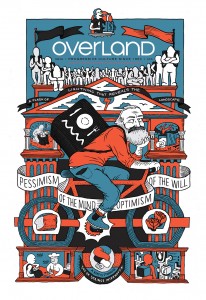
Jacinda Woodhead (editor), Overland 236 (Spring 2019)

I mistakenly wrote that Overland 235 was the last issue of the journal edited by Jacinda Woodhead. This one is actually her second last, and the new editors have brought out their third issue as I’m writing.

Overland 236 kicks off with two excellent articles. (Links are to the full items on the Overland web site.) In ‘After hours‘ Leigh Hopkinson, herself a former stripper, writes about the death of a stripper in a Melbourne club (Overland tend to be Melbourne-centred), and uses the case as a springboard to describe the terrible, and worsening, conditions of women who work in the adult entertainment industry. In ‘The great acceleration‘ Jeff Sparrow traces the history by which cars came to be established as the dominant, ‘natural’ mode of transport in the USA. Did you know, for instance, that before the automobile industry made a concerted effort to introduce the concept of a jaywalker, the term jaydriver was in common use, meaning someone who drove a car in the city with cloddish disregard of the danger for pedestrians, especially children?

There are more articles later, of which two stand out for me. But then, face to face by Joanna Horton is a wonderful account of the joys – and difficulties – of door-knocking for the Greens. Tina Ngata’s Toppling Cook puts a strong case, from an Aotearoa/New Zealand perspective, against celebrating the 250th anniversary of James Cook’s voyages of exploration.

Guest artist Sam Wallman has three spreads of sequential art (what some might call comics) that are brilliantly accessible lessons in recent English history, specifically the Sun boycott in the Liverpool region, the Annual Durham Miners’ Gala and the Grenfell Tower fire.

There are 13 pages of interesting and challenging poetry. My North Queensland heart leads me to single out ‘Toad‘ by Damen O’Brien, which begins:

Toad in the garden, which is the same as
a snake in Eden or a crack in a mirror.

and includes the gorgeously evocative line:

Inexhaustible armies of malevolence

Of the especially rich batch of short stories, the ones that most struck me are Jack Vening’s ‘Don’t tell me‘, a runner-up in the Victoria University Short Story Prize, and Allanah Hunt’s ‘Running to home‘, winner of the Nakata Brophy Prize for Young Indigenous Writers. No spoilers from me on either of them.


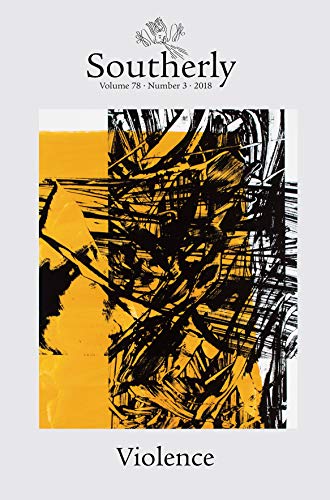
Elizabeth McMahon (editor), Southerly Vol 78 No 3 2018: Violence (2019)

Southerly, after 80 years of publication Australia’s second-oldest literary journal*, is in trouble. In March this year the editors published a plea for help on Facebook, and in October the website went down with a promise of reappearing soon – we’re still waiting. The editors, who aren’t paid for their work, have set up a crowdfunding platform at https://gum.co/wYZRP in the hope of prolonging the journal’s life. As a reader I’m still back in 2019, and though the editors were already desperately chasing funds then, the journal itself came out, behind schedule but in rude good health. There has been at least one issue since.

Like the Overland, this Southerly starts very strongly, with three poems: jenni nixon’s ‘knock on the door at 6am’ is an impressionistic narrative that earns the right to its epigraph from Gandhi, ‘poverty is the worst form of violence’; Brenda Saunders’ ‘Boab tree, Derby’ comes at the famous ‘Prison Tree’ in a number of choral voices (click here if you want to know about the tree); Andy Jackson’s ‘To name what we feel’ enacts the ambivalence of working on a phone-in service for violent men.

And it goes on from there, compellingly. There’s memoir (including Brenda Downing’s writerly ‘Letter to the Editor’ in which she arrives at a huge ethical dilemma when she tracks down the man who sexual abused her when she was very young), essay (including David Brooks’ ‘A Roo Battue’, on the continuing mass slaughter of kangaroos, which raises the spectre of extinction for some species), short stories (including Winnie Dunn’s brilliant ‘Wanting to be White’, a drama set in a Western Sydney Starbucks). I usually skip the scholarly articles, but Fiona Morrison’s ‘The Antiphonal Time of Violence in Leah Purcell’s The Drover’s Wife‘ was a way to revisit the pleasures of a great night in the theatre. Likewise I tend to skip or skim the reviews, but Rachael Versace’s review of David Malouf’s An Open Book, by quoting generously and incisively, opened the door to revisiting the pleasures of that book.

There is one moment of eerie prescience in this Southerly. Josephine Clarke’s ‘transnational’ laments the way technology, while enabling connection over great distances, still leaves us bodily unconnected. Covid–19 wasn’t even a blip on the horizon when it was published, yet there’s this:

what if I take ill? who will come back /
come home / come through 

and hold my hand      my real hand
where the creases run labyrinthine across my palm

– my palm where your newborn head once rested
and was safe   

*The oldest is a children’s literary journal, The School Magazine, published since 1915 by the NSW Department of Education.


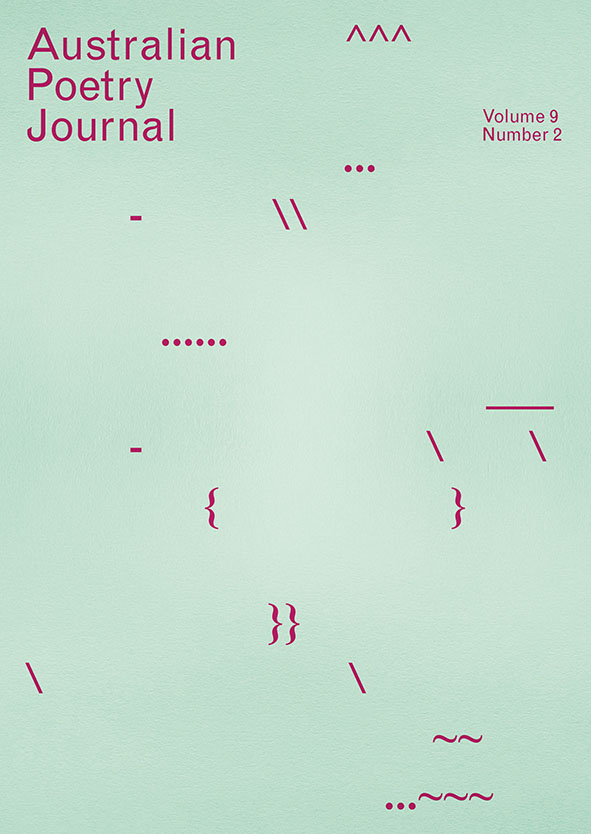
Andy Jackson and Jennifer Harrison (editors), Australian Poetry Journal Volume 9, Number 2: DIS– (2019)

Andy Jackson and Jennifer Harrison, guest editors of this issue of Australian Poetry Journal, are both poets and advocates for writers with self-identified disability/ies. They have collected more than 60 poems related to disability, aiming, as Andy’s foreword puts it:

… for a diversity of voices, in many senses of that word – bodily experience, cultural background, age, gender, philosophy, aesthetic. We also strongly prioritised poems of lived experience, including the voices of carers, friends, lovers – poems of solidarity and care that recognise that distancing ourselves from disability is impossible.

By arranging the poems, mostly, in reverse alphabetical order of poem title, the editors have added an extra stroke of disorder: each poem stands on its own, spatially disconnected from others on the same subject or by the same author, defying easy categorisation. The effect is indeed a marvellous ‘diversity of voices’, all dealing one way or another with disability. As Jennifer Harrison says in her Foreword:

What poetry gives us is birdsong alongside activism, the outside word alongside the internal world of emotions, hope shadowing despair … Poetry has a unique ability to see behind doors previously closed …

In this journal, many poets opens doors to whole worlds of difference.

A number of them are poets whose work I already know. Fiona Wright, who has written a lot about her own struggles, speaks to someone who may be a version of her younger self in ‘poem for jessie’ (‘I want you to remember / how to want’). David Brooks makes translation look easy with a version of Baudelaire’s ‘The Albatross’, which in this context becomes a powerful metaphor for physical disability. Samuel Wagan Watson’s ‘DISlocation’ captures a raw moment of betrayal (‘I may have challenges but my sensory perception is still sharp’).

Mal McKimmie’s ‘Thirteen Ways of Looking at Blackbirds’ is wonderful. It begins:

There are no 'blackbirds with disabilities' –
_____________all blackbirds can fly.
There are only 'blackbirds with disabilities' – 
_____________all blackbirds will one day fall from the sky.

E A Gleeson, whose bio tells us that she ‘cares for her sister who lives with significant physical and intellectual challenges’ gives us a graphic childhood vignette in ‘The First Seizure’. Oliver Mills, in ‘De-Coding’, speaks clearly and succinctly, and wittily, about the difficulty of being understood when you have cerebral palsy, as he does: :

When I'm out of breath
Or having a lazy laugh
I make the sound of a creaking door

I could go on quoting. There’s plenty here for anyone interested in poetry. There are drawings, as well as poems, by people with mental illness diagnoses and people with learning difficulties. Just reading the poets’ bios is a revelation of the myriad ways the body and mind can differ from the typical. Even if you’re (temporarily) non-disabled and not interested in poetry, these pages may expand your world immensely. They have mine.

As a bonus, up the back, half a dozen pages are given over to Rachael Mead, winner of the 2019 Australian Poetry/Nature, Art & Habitat Residency. She lived in a village in the Taleggio Valley in northern Italy in June 2019, and three of the poems she write during her stay there are reproduced here. What with one thing and another, it’s glorious to read her poem, ‘Pacing myself’, about waking in that beautiful place, so far beyond the reach of most of us just now.


Speaking of journals, there’s some good news on the horizon concerning Heat, which ceased publication in 2011, after 39 issues in two series over 15 years. According to the Giramondo web site, ‘The third series of Heat, in a new design and format, will be published from 2022.’

The Book Group and John Irving’s Prayer for Owen Meany

John Irving, A Prayer for Owen Meany (Bloomsbury 1989)

Before the meeting: This is an odd book. It tells the life story of Owen Meany, a young man who is tiny in stature and huge in voice like the hero of Gunther Grass’s The Tin Drum (which I haven’t read, though I’ve seen the movie). From an early age Owen has a profound belief that he is an instrument of God, and he has a vision of his own death, including the exact date and some of the circumstances. His story is told by his best friend Johnny Wheelwright, who doesn’t have a lot to distinguish him from any other child of an old New England family, except that his mother never revealed the identity of his father and she herself was killed in a bizarre Little League accident when he was eleven.

I loved the first hundred pages or so, which introduce us to the characters who inhabit the small New Hampshire town of Gravesend, and tell the story of Owen and Johnny’s childhood friendship, their shared quest to find the identity of Johnny’s father, their adolescent adventures. I was happily back to my enjoyment of The World According to Garp (1978) and The Hotel New Hampshire (1981), both of which I read when they were newly published. John Irving has an eye for the detail that brings a scene to life, and manages to keep his story slightly off-kilter without every completely descending into quirkiness. His characters are vividly realised in a few strokes, with an almost Dickensian oddness. My love waned in a very long sequence involving the staging of two theatrical pieces concurrently, a Christmas pageant and a production of A Christmas Carol. In both of them Owen is improbably compelling, at least in rehearsals, as the Christ Child and the Ghost of Christmas Yet to Come. Both predictably descend into chaos. These chapters rattle along, full of amusing and touching incidents and character development, but I was straining at the bit, wanting the story to move forward.

Then at almost exactly the midpoint of the novel, in the narrator’s present time, I was rapped over the knuckles in a moment that’s close to being explicitly meta. John (as he is now known) laments that his girl students don’t read Hardy’s novels with an eye to foreshadowing. ‘I hope you realise,’ John Irving was saying at barely one remove, ‘that all that stuff about Owen as Christ, Owen as a ghost predicting the future, Owen and a number of armless figures, Owen practising a special basketball move, all that was giving you very specific hints about where this narrative is going.’ Well, I took the hint, and from that point on I read everything as foreshadowing.

When all that carefully constructed foreshadowing came together in the final pages of the book, it was most satisfactory – or just a bit too neatly tied together, depending on your point of view. I was left uneasily cold by the religiosity of the story, which to be fair was signalled on the very first page when John-the-narrator tells us that Owen was the reason he believes in God. Owen becomes a Christ figure, but without arms, and John lives out his day as a vaguely religious, celibate man whose only purpose, apart from teaching English literature to teenage Canadian girls, is to bear witness to Owen’s story. Religion is his analgesic. ‘Don’t underestimate the church’ – he says at one point – ‘its healing power, and the comforting way it can set you apart.’ (Page 415) It’s a religious faith that depends on miracles for its existence (the kind of miracles that exist only in the pages of carefully contrived novels), and leads to a lack of engagement with the world, or with anything but the memory of his Christ-like friend. It leaves a sour taste in this reader’s mouth.

But, speaking of foreshadowing, John’s present time coincides with the Contra scandal under Reagan, and though he has been living in Canada for decades he is addicted to the US news. So much of John’s (and presumably Irving’s) commentary on Reagan’s US feels eerily prophetic of Trump and Trumpism. I recognise John’s newspaper addiction as an old-media version of my (our?) Twitter addiction. It’s not that things were the same back then, but by contrasting the Kennedy era of Johnny and Owen’s adolescence with the Reagan era of John’s middle age, the passions that burned over the US invasion of Vietnam with the apathy that greeted the Contra scandal, the novel captures a change in the US’s political culture, a change that has since deepened to an extent that would have looked wildly fantastical in the 1980s.

After the meeting: Last night was our last meeting for 2020 and our second since we all started to relax a little about Covid–19. All but two of us made it – one of the absentees had to attend a family do, and the other had been tested for the Covids with his young daughter and was staying home as a good citizen (he WhatsApped us this morning to say the result was, as expected, negative). We had what we’ve been calling a Gentlemen’s Picnic: everyone brought food. We ate well, including salmon with anchovy butter pats, barbecued sausages, charcoal chicken, several salads and three different desserts. Covid deprived us of meatballs slow cooked with figs. Our host had Gospel music playing as we arrived, which he said was the nearest he could come to the religiosity of the book, and at the end of the evening he treated us to a couple of short films he had made – potentially setting a dangerous precedent as I’m sure may of us have substantial slide shows we’d love to share.

It’s not that we didn’t talk about other things: family news, good TV and movies (a Michael Jordan film is apparently excellent, and I’m not the only one who loved Corpus Christi), a bit of reminiscence about the 18 years of book group and rumination on how it has changed this year (because of Covid and zoom? because of the level of trust that has enabled discussion to become more robust? because the person who noticed the change has been a more frequent attender this year?), Trump deprivation syndrome, and show-biz anecdotes all got an airing. But the book generated a lot of discussion.

I wasn’t an outlier, as it turned out. Someone described the book, memorably, as a shaggy dog story. A man who said he hadn’t finished it was having trouble following comments about how all the threads came together in the last scene: it turned out he’d read all but the last 10 pages or so, which just goes to show how skilfully John Irving postpones his revelations until the last possible moment. Someone said – articulating my sentiments exactly – that in the first couple of pages he breathed a sigh of relief: after reading a number of books for the group that, whatever their other virtues, were pretty rockily written, with this he knew he was in the hands of an accomplished storyteller.

Someone felt that this was a book written by someone who had a big back catalogue, who now could relax and just spin a yarn without being too serious about it, venting about current politics as the spirit moved him. Not everyone agreed. Some, me included, felt we were expected to take the religious theme seriously but found it pretty hard to do so. One said most of the religious stuff was largely incomprehensible to him. I asked if the recurring image of armlessness was purely decorative or had some thematic significance. One of our architects took offence, demanding, ‘What’s wrong with decoration?’ and describing the way those recurring images created a patterning that was pleasing in itself and helped the reader track the story. Our Book Chooser, who first read the book 30+ years ago, loved it then and loved it again this time, thought the armlessness represented Owen’s helplessness in the light of fate. This led someone to comment that though Johnny keeps his arms, he is ineffectual, spiritually armless. None of us could remember what we were told about the armless image drawn by the 17th century sagamore Watahantowet when he signed away the land to the invaders, but felt that might offer some help. I just looked it up:

Some said it was how it made the Sagamore feel to give up all that land – to have his arms cut off – and others pointed it out the earlier ‘marks’ made by Watahantowet revealed that the figure, although armless, held a feather in his mouth; this was said to indicate the sagamore’s frustration at being unable to write. But in several other versions of the totem ascribed to Watahantowet, the figure has a tomahawk in his mouth …

There’s more. The upshot is that the armlessness could signify many contradictory things. It’s a good example of how so much of the early pages of the book are full of foreshadowing, and of how hard it is to pin down the book’s actual position. Is John Wheelwright a dependable narrator? Does Johnny have a feather between his teeth, while Owen had a tomahawk? The questions aren’t resolved, and we don’t even know if they are meant to be taken seriously. We admired the first sentence of the book as an example of foreshadowing; evidently John Irving himself admired it too.

A number of chaps had done some supplementary reading. One of them had read that John Irving starts with a clear image of how a book is going to end and then makes sure everything leads to that point. This rings very true.

In order to give the appearance of completeness, I’ll finish with a quote from the one chap who hadn’t read the book at all, except for the author’s introduction in his copy. He said he concluded on the basis of that introduction that John Irving was a wanker. Not everyone agreed.

SWF 2020, 11th and final post

I’ve been blogging about the online 2020 Sydney Writers’ Festival (I almost forgot the apostrophe) most of the year. The Festival is still going on, and its website is listing events to mid-January next year. I’ll keep listening, but I won’t blog any more. Here are links to the Festival podcasts currently on my phone, in case you’d like to check them out.

Drawn from Life: Alice Oseman in Conversation 21 October: YA phenomenon and graphic novelist Alice Oseman chats with media phenomenon Jes Layton.

Secrets and Lies: Donor-Conceived Rights 21 October: Dani Shapiro, USA-based author talks to Australian author Bri Lee about issues raised in her memoir, Inheritance, including those related to children conceived by sperm donation.

Griffith Review 68: Getting On 28 October: Tony Birch, Andrew Stafford and Jane R. Goodall talk with Griffith Review editor, Ashley Hay, about getting older.

Trent Dalton: All Our Shimmering Skies 4 November: Trent Dalton in conversation with Annabel Crabb bout his second novel

Guardian Australia Book Club with Helen Garner 6 November: No elaboration needed from me. The interviewer is Michael Williams, now artistic director of the SWF.

Behrouz Boochani and Tara June Winch in Conversation 11 November: Again, no elaboration needed from me about either of the participants. I will mention that Tara June Winch acquitted herself admirably in Hard Quiz recently.

Tony Birch: The White Girl 18 November: Tony Birch is here again to talk with Evelyn Araluen about his novel The White Girl.

Julia Phillips: Disappearing Earth 3 December: The author of the excellent Disappearing Earth talks to Tam Zimet, until recently associate director of the SWF.

It’s nice to finish with one of the rare books that I’ve read that also features in this year’s Festival

November Verse 9 & Proust Progress Report 15

November verse 9: Paraphrasing Proust
To dump or not to dump, or rather
when to dump my Albertine.
How boring is our life together
when I'm not jealous? Yet how keen
my pain when jealousy arouses.
Time has come to cut my losses.
The memory I want to keep
is of a parting moment's deep
and sweet vibration. Dramas
aren't the way to say we're done.
So do it sweet, but do it soon.
No repeat of when my mama
left me there, alone in bed
without a kiss to soothe my dread.

This was prompted by a passage* from:

Marcel Proust, À la recherche du temps perdu (text established under the direction of Jean-Yves Tadié ©1987–1992): La prisonnière (1919), p 1817 to the end (page 1915).

So much has happened in this month’s three-pages-of-Proust-a-day. The bourgeois Mme Verdurin wreaked her revenge on the Baron de Charlus by warning his beloved protégé Charlie that he had to cut the baron loose or his career would be ruined. There are huge all-night quarrels between the narrator and Albertine: he’s still obsessed with keeping her away from other women, especially but not exclusively from known Lesbians, and has decided to call an end to the relationship – but with characteristically convoluted reasoning, he’s going to wait until things are going well, so that he’ll be left feeling good about it all, rather than having a sour aftertaste. Among other twists and turns, he pretends to call it off, as a way of manipulating her to recommit to the relationship. It’s excruciating, and also – when you can remember to keep some perspective – hilarious.

There are, of course, moments that may or may not contribute to the story arc. The narrator gives Albertine a lecture about pervasive themes in the works of, among others, Dostoyevsky. They go on a day trip to Versailles where a very tall waitress rudely ignores Albertine. He ruminates on whether it’s right to think of Albertine as a work of art he has created – thankfully, he decides it isn’t. He acknowledges his double standard: he himself looks with lust at other women, while going to extraordinary lengths to stop Albertine from doing the same.

In the last few pages he wakes up one morning feeling at peace with the world and wanting to go off on adventures. The time is ripe to kick Albertine out. He rings for the servant Françoise, who (not really a spoiler, since the next book is Albertine disparue – literally Albertine the disappeared, and the Moncrieff English translation of this chapter has a spoilertastic chapter heading, ‘Flight of Albertine’) tells him that she has packed her bags and left that morning. He is astonished at his own distraught reaction to the news.

The wonderful Tegan Bennett Daylight was talking about something completely different on the ABC recently, when she mentioned that she had recently read Proust, and loved the way there is so much detail. She may be the first person I’ve heard talk about Proust while I’ve been reading him who seems to have read the same books as I am reading.


* Je sentais que ma vie avec Albertine n’était, pour une part, quand je n’étais pas jaloux, qu’ennui, pour l’autre part, quand j’étais jaloux, que souffrance. À supposer qu’il y eût du bonheur, il ne pouvait durer. … Seulement, maintenant encore, je m’imaginais que le souvenir que je garderais d’elle serait comme une sorte de vibration, prolongée par une pédale, de la dernière minute de notre séparation. Aussi je tenais à choisir une minute douce, afin que ce fût elle qui continuât à vibrer en moi. Il ne fallait pas être trop difficile, attendre trop, il fallait être sage. Et pourtant, ayant tant attendu, ce serait folie de ne pas attendre quelques jours de plus, jusqu’à ce qu’une minute acceptable se présentât, plutôt que de risquer de la voir partir avec cette même révolte que j’avais autrefois quand maman s’éloignait de mon lit sans me redire bonsoir …
(page 1899)

November verse 7 & Jeanette Winterson’s Weight

November verse 7: Pick your myth
Trump's confidence is his Achilles'
heel? He's sulking in his tent.
Freud's Oedipus was doomed to kill his
dad. Camus' Sysiphe was meant
to be heureux. And Jeanette Winter-
son: will Atlas represent her?
Did those old poets know us all,
no life too big, no fate too small?
I dip into the well of fable,
ornament of childhood days,
and find Perseus in the maze.
With Ariadne's thread, he's able
to find his way. But I'm not sure
I'm ready for a minotaur.

This verse was prompted by a piece of US political commentary and by:

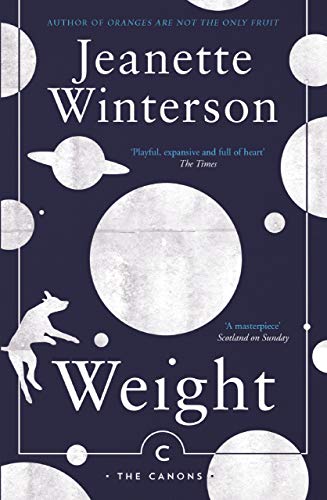
Jeanette Winterson, Weight (©2005, Canongate 2018)

Weight is Jeanette Winterson’s contribution to Canongate’s series The Myths. Other titles in the series include Margaret Atwood’s The Penelopiad, Philip Pullman’s The Good Man Jesus, the Scoundrel Christ and Ali Smith’s Girl Meets Boy.

Weight is a lively retelling of the Greek myth of Atlas, the Titan who was condemned to hold the heavens on his shoulders for eternity. This being Jeanette Winterson, there’s quite a lot of rhapsodic testifying as to the myth’s deeper meanings and its personal significance for the writer.

The retelling focuses on Atlas’s relationship with Heracles, who briefly relieves him of his burden. There’s a bit of rough humour at Heracles’ expense and reflections on their different kinds of strength: Atlas can hold still and Heracles is a man of action. Heracles comes close to stealing the limelight as the narrative follows him to his marriage to Deianeira and his horrible death in the burning shirt of Nessus. But Atlas has his quiet surprises as well, such as when Laika, the astronaut dog, comes into his life.

I confess I didn’t quite follow a lot of the meditation on the myth’s meaning. Something about boundaries and desire, fate and decision. It becomes personal. Jeanette Winterson finds in Atlas an echo of her own adoption story, her ignorance about her birthparents (this was written before Why Be Happy When You Could Be Normal, where she writes about her birth mother), and her rejection by her adopted mother:

Having no one to carry me, I learned to carry myself.
My girlfriend says I have an Atlas complex.

The task she took on, first as a rejected child and then as a writer, was to create a world of the imagination, a world that she has had to carry as a great weight.

I generally read Jeanette Winterson’s writing with a mixture of irritation and exhilaration. This book was no different. I’m irritated by her (presumably deliberate) false version of the myth that Atlas held up the whole world, when it was the heavens that he had to hold up in the original story. I’m irritated by the crude dick humour around Heracles (though maybe it’s not meant as humour but, even more irritatingly, as a version of male sexuality). I’m irritated by the way the prose sometimes feels like revivalist preaching, whether the subject is scientific cosmology or the pain of not knowing who your parents are. I’m irritated by occasional lapses of logic. But – and this is why I kept reading and am glad I did – I’m exhilarated by the way the book yokes together a scientific understanding of the universe with images from Ancient Greek myth (Laika nestling in Atlas’ shoulder, for example) and, in the final pages, I’m exhilarated at the notion of Atlas (and so possibly Jeanette) laying down his (and possibly her) burden.

November Verse 5 and Ocean Vuong’s On Earth We’re Briefly Gorgeous

November verse 5: Letter to my Mother

Dear Mum, I won't write you a novel.
Barely fourteen rhyming lines
I'll manage. No space to unravel
the half a century that twined
our lives. Perhaps I know you better
now than when your weekly letters
filled me in on family news.
I wish that you could know me too,
that you could look down from some heaven,
hear the words I wish I'd said,
see the tears I should have shed
back then, take thanks for all you've given.
The grave is deaf and blind and still.
What we didn't say, we never will.

This is prompted by a marvellous book, a very different letter to a very different mother:

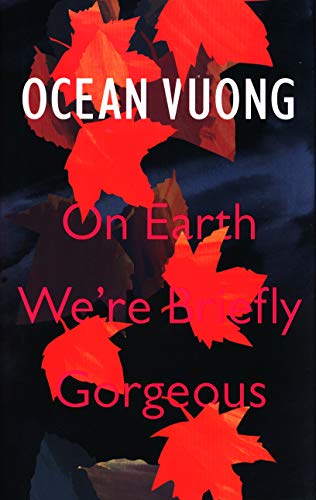
Ocean Vuong, On Earth We’re Briefly Gorgeous (Jonathan Cape 2019)

The protagonist narrator of this novel, known to his intimates as Little Dog, is a Vietnamese-American Gay man, and this is his portrait of the artist as a very young man. The text is cast as a letter addressed to his mother. He tells her the story of his childhood, including quite a bit of abuse he suffered at her hands and his understanding that that abuse was part of the aftermath of the US-Vietnam war. He tells of his relationship with his grandmother, her mother, and what he knows of her love story with a US serviceman. And he relates his teenage experiences of sex. Given the sometimes excruciating detail about young gay male sex (excruciating both physically and in its turbulent emotional ambivalence), clearly this is not a letter he really expects his mother to read.

Ocean Vuong has won big prizes for his poetry, and parts of this book read as prose poetry. I don’t mean that some parts of it defy any attempt to extract a simple prose meaning, though there are a couple of moments like that. I mean, among other things, some images, as of buffalo running over a cliff or monarch butterflies making their vast annual journeys or Tiger Woods putting in an appearance, do a lot of work. And there are rhapsodic sections that don’t bother with conventional sentence structures, but take the reader with them in not bothering. For example, there are six pages in which Little Dog, sings (that’s the only word for it) about Trevor, the first object of his troubled but reciprocated desire. Here’s a little of it:

Trevor going fifty through his daddy’s wheatfield. Who jams all his fries into a Whopper and chews with both feet on the gas. Your eyes closed, riding shotgun, the wheat a yellow confetti.

Three freckles on his nose.

Three periods to a boy-sentence.

Trevor Burger King over McDonald’s ’cause the smell of smoke on beef makes it real.

The Vietnam War, growing up Gay and Vietnamese in working-class Hartford, Connecticut, the ravages of the OxyContin epidemic, dementia: the book deals with difficult and sometimes tragic lives. But the writing is sharp and rich and, in the end, celebratory.

My favourite scene is the one where Little Dog comes out to his mother in a Dunkin’ Donuts: ‘I don’t like girls.’ The conversation that follows is not astonishingly original (‘Are you going to wear a dress now?’ ‘They’ll kill you, you know that.’ ‘When did all this start. I gave birth to a healthy, normal boy.’ But then:

When I thought it was over, that I’d done my unloading, you said, pushing your coffee aside, ‘Now I have something to tell you.’

My jaw clenched. This was not supposed to be an equal exchange, not a trade. I nodded as you spoke, feigning willingness.

‘You have an older brother.’ You swept your hair out of your eyes, unblinking. ‘But he’s dead.’

And a whole terrible part of his mother’s life is revealed to him. So I need to modify my description of the book as a portrait of the artist as a young man: it’s a portrait that includes an extraordinary openness to the generations that gave rise to the young man.

November Verse 2 & Judith Brett’s Coal Curse

November verse 2: 
First a paddock, now a quarry.
Ride on sheepback, ride in coal-cart
all the way to– Well I'm sorry,
who knows where? It takes a cold heart
not to quake when science gives notice
not to quail when Trump is POTUS,
not to dump Adani's deal,
not to see shit just got real.
Impervious to rhyme and reason,
evidence and sound advice,
our governments have, for a price –
praise be, and Kyrie eleison –
bent the knee to fossil fuels
like autogenocidal tools.

Which is a response to:


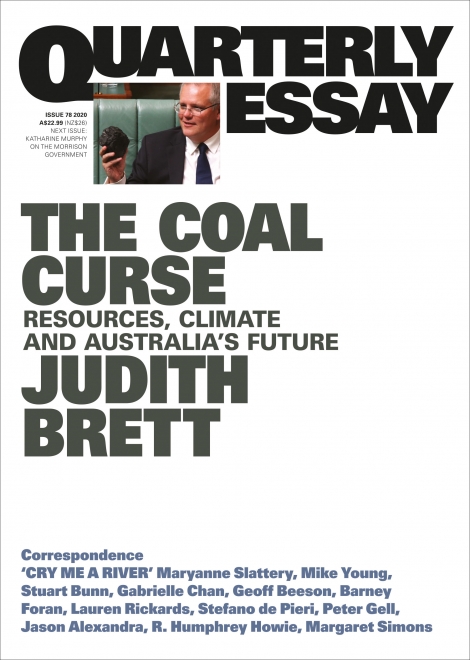
Judith Brett, The Coal Curse: Resources, climate and Australia’s future (Quarterly Essay Nº 78, 2020) – and correspondence in Quarterly Essay 79

Judith Brett’s The Coal Curse is in part an update of Guy Pearse’s Quarterly Essay Nº 33, Quarry Vision (here’s a link to my recently-retrieved blog post about that). Much has changed in the decade between the two essays: the climate emergency has become more obviously pressing, community and business support for renewable energy has increased hugely, there’s much more scepticism about the future role of coal and gas in Australia’s economy in business circles (except, of course in the coal and gas industry). Dispiritingly, little has changed in the federal government’s hand in glove relationship with the fossil fuel industry, and the issue has become even more politicised, more enmeshed in culture wars.

This essay, Judith Brett writes in the introductory section, ‘is about the history of Australia as a commodity-exporting nation and its political consequences’:

Economic history is unfashionable nowadays. Economists focus on the modelling and management of the present and historians are more interested in stories and experience, and in uncovering diversity and neglected voices. Economic history is dry and hard to narrativise. But how a country makes its living can explain a lot.

(Page 8)

I didn’t find this essay dry at all. Judith Brett writes with wonderful clarity. Every now and then she throws in a wry aside, an amusing factoid or a startling anecdote, but you’re never at risk of getting lost in a welter of detail or a barrage of polemic.

Here’s her argument in brief:

  1. Australia is a trading nation. We have a small population, so exporting enables our companies to grow by reaching larger markets.
  2. There has always been a divide between the export of commodities – wool until the 1950s, minerals since then – and manufactured goods. The first makes a lot more profit but employs many fewer people.
  3. Because minerals export, especially coal and gas recently, is so profitable, it draws resources away from other exports and manufacturing.
  4. With the minerals boom, our manufacturing sector has pretty much collapsed.
  5. World markets for coal are decreasing dramatically as the rest of the world addresses climate change. Australian governments have been successfully captured by the fossil fuels lobby, and have not responded to the challenges of reality, as opposed to many in business and overwhelming public opinion.
  6. Paraphrasing wildly now, if something doesn’t change dramatically soon, we’d better kiss our backsides goodbye.

Actually, Brett isn’t as pessimistic as that. But when she quotes an LNP Senator from Queensland saying what an honour it has been ‘to represent the Australian mining sector’ (page 62), she leaves the reader in no doubt that some politicians forget that they are, as she puts it, ‘our risk managers of last resort’.


As we expect in the Quarterly Essay, the correspondence on The Coal Curse in QE 79 is civil, nuanced and challenging. Andy Lloyd, who worked for Rio Tinto for 23 years, offers the equivalent of a ‘not all men’ argument, which blurs some of the edges of Judith Brett’s argument but makes no substantial difference. The other correspondents tend to emphasise the hopeful elements of the essay, pointing to promising activist strategies, actual developments in the business sector that indicate fossil fuels are heading for oblivion and the Australian government are likely to be left floundering behind the main game.

Stephen Bell, professor of political economy at the University of Queensland, articulates a key question that always lurks behind discussions of this sort:

Who reads this kind of history? Mostly, people already agree that coal is causing environmental devastation and the coal lobby is far too powerful. And almost certainly not those who have drunk the Coal-Aid, unless their aim is to lampoon it and its author, as the Murdoch stable is wont to do. This is the crisis of Australia’s intellectual life: the apparent impossibility of generating a constructive rational dialogue about anything in general, and about coal in particular.

(QE 79 page 128)

Martin Luther King Junior said, ‘The arc of the moral universe is long, but it bends toward justice.’ We’d better hope the arc isn’t too long.


The Coal Curse is the 19th book I’ve read for the 2020 Australian Women Writers Challenge.