Category Archives: Books

Simon Armitage’s Flit

Simon Armitage, Flit (Yorkshire Sculpture Park 2018)

FLIT.jpg

This handsomely produced book of poems and photographs (mainly taken by the poet) was published to coincide with a small exhibition at the Yorkshire Sculpture Park featuring a selection of the photos and a video of Simon Armitage reading some of the poems.

The Yorkshire Sculpture Park is brilliant: Henry Moore sculptures and sheep happily coexist in the fields, in wooded areas you stumble on Andy Goldsworthy’s extraordinary land art, an Ai Wei Wei Iron Tree stands outside a chapel, and there are any number of special exhibitions, including, when we visited in early May, the Simon Armitage room and Chihara Shiota’s Beyond Time, which fills a small building with floating memories of its past identity as a chapel.

hangingtree

Part of Andy Goldsworthy’s Hanging Trees. Photo by Penny Ryan

IMG_6897

Henry Moore, Two Large Forms and sheep. Photo by Penny Ryan

Back to the book. The YSP website describes it like this:

The fully illustrated publication comprises 40 poems by Armitage, who was poet in residence at YSP throughout 2017, its 40th anniversary year. […] Rather than writing a direct commentary on the Park, he has redefined it as its own country, the little known Ysp (pronounced eesp). Letting his imagination run wild, Armitage has mapped an elaborate, alternative reality that melds fact and fiction, creating a fanciful existence for both YSP and the poet himself.

The key word of that is ‘fanciful’. At least for this reader, the book hardly relates at all to the experience of the Park. Less than a quarter of its photos show any of the sculpture – most are of the park’s buildings old and new or of its woods and water, some with odd images collaged into them: a Vietnamese fisherman sitting on the roof of a shed; a paddle-steamer on one of the streams. The photographs are beautiful, and so are the poems, but for me the conceit falls flat – my main response to the Ysp poems (a queue that lasts for months, the legend of a great drought …) is impatience. I guess what I wanted, to use the words of the website, was ‘direct commentary on the Park’.

All the same the individual poems are a good read. I’ve heard Simon Armitage read on the radio, and am glad to have got to read some of his work on the page.

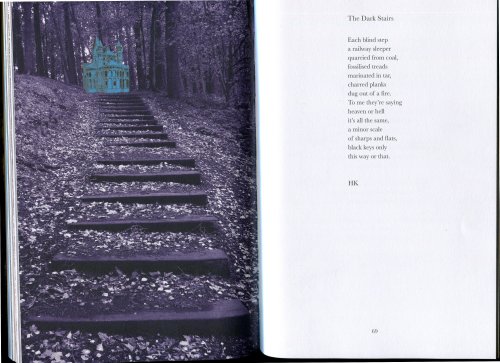
Here’s a spread that includes ‘direct commentary’ on a sculpture (an ekphrastic poem, to use the technical term):
steps.jpg

On the left is a photograph of David Nash’s ‘Seventy-One Steps’, with the image of an odd temple-like building fancifully, and to my mind awkwardly, inserted. In real life you encounter this sculpture as you walk through the woods, and if you weren’t on the alert you might just walk on the steps without realising they were a work of art, though you would probably register that they are a lovely piece of work.* What you can’t see in the photo is that the dark, hefty oak steps rest on 30 tonnes of coal which will gradually erode. (The work was originally called The Black Steps, but it has already changed enough that it has been renamed.)

On the right is ‘The Dark Stairs’, presented as a translation of a poem by Armitage’s invention, ‘Ysp’s most famous poet, HK’. It’s a 14 line response to the sculpture, the short lines themselves a bit like steps.

[Inserted later: I realised that the text is hard to read in that image, so here’s the poem in full:

The Dark Stairs

Each blind step
a railway sleeper
quarried from coal,
fossilised treads
marinated in tar,
charred planks
dug out of a fire.
To me they’re saying
heaven or hell
it’s all the same,
a minor scale
of sharps and flats,
black keys only
this way or that.

The more I look at this poem, the stronger it feels. Where Seamus Heaney’s poem ‘Polish Sleepers’ spells out the dark associations of railway sleepers by invoking the Holocaust, Armitage (ventriloquising HK) invokes elemental forces of fire and fossilisation, and perhaps the spectre of global warming, and does exactly the thing that I had hoped for from the book as a whole, finding words that help name the feelings evoked by the work.


*One of the joys of the Park is that this is true of a number of the sculptures: you could easily miss the Andy Goldsworthy piece above if you didn’t happen to look over a low stone wall, and there’s a brass sculpture that looks for all the world like the exposed roots of trees.
Elisabeth Åsbrink’s 1947

Elisabeth Åsbrink, 1947: When Now Begins, translated by Fiona Graham (2016, translation 2017)

1947.jpg

I try to assemble the year 1947 into a splintered whole. This is lunacy, but time does not leave me alone.

I have a personal interest in the year 1947: it’s the year when I began. In my early 20s, before there was an Internet to make the task stupidly easy, I spent a little time drawing up a list of big events that happened in that year. I didn’t get much beyond the civil war in China, the new constitution in Japan, the establishment of the 40 hour week in Australia and a list of births and deaths.

Elisabeth Åsbrink’s project of assembling the year ‘into a splintered whole’ is much more ambitious than that, and has produced a hugely readable, enlightening and disturbing book. It progresses through the year, month by month, in tiny sub-chapters. From these splinters a number of narratives emerge. We see the beginnings of the Muslim Brotherhood and a new significance for the term jihad, the rise of new white supremacist nationalism from the ashes of Nazism and Italian Fascism, the consolidation of Soviet domination of eastern Europe, the birth of the United Nations Genocide Convention, the role of the powerful western nations in setting up Israel to be a focus of conflict in its region, the cavalier and callous role of Britain in the partition of  India and Pakistan. A number of personal dramas play out: Simone de Beauvoir and Nelson Algren begin their passionate relationship, and she starts work on The Second Sex; Eric Blair aka George Orwell drafts 1984; Primo Levi, Paul Celan, Thomas Mann, Nelly Sachs shine a literary light on the horrific recent past.

Between June and July is a chapter entitled ‘Days and Death’, 17 pages of the author’s family history, in which her personal connection to the events she narrates becomes clear. It’s a terrible story of loss at the hands of the Nazis and of mysterious, almost miraculous escapes, of resilience and heroism and devastation. 1947 doesn’t seem to play a pivotal role there, but this is where it becomes obvious that the book is much more than an extended and scholarly version of my youthful doodling. It’s not that Åsbrink has set the year 1947 as a structural constraint on her project. There are plenty of excursions into 1947’s past to make its present comprehensible, and into its future to spell out consequences that could not have been known at the time, such as the nakba and the conflict in Kasmir. So the excursion into 200 years of family history is simply – or complexly – another part of the overall attempt to make sense of the world of ‘now’.

Probably every reader will have something from their own private 1947 that didn’t make the cut. I missed the beginnings of the US/Vietnam War and developments in China and Japan, and accept stoically that Australia rates just two passing mentions (though who knew there was an Australian on the UN committee set up to make recommendations on Palestine). And it may be that another writer would have picked a different year to mark ‘when now began’ – 1968 or 1793 perhaps. But this is an extraordinary, accessible book that shines a brilliant light on our times.

Robert Seethaler’s Whole Life

Robert Seethaler, A Whole Life, translated by Charlotte Collins (first published in 2014, translation 2015)

life.jpg

‘You can buy a man’s hours off him, you can steal his days from him, or you can rob him of his whole life, but no one can take away from any man so much as a single moment.’

If this slim book is any guide, I really should read more German fiction. It tells the life story of a simple working man in a mountain village. He has moments of quiet joy, and small achievements, and he stumbles. He is brutally treated in his childhood, is a conscript in World War Two and a prisoner of the Soviets long after the war is over, and has his share of violent tragedy. He keeps his integrity and his dignity, and though it’s true that his life is made up of moments, it’s also true that he has a whole life.

I only know about six words in German, so I can’t comment on the accuracy of the translation. But I can say that it read smoothly and is beautiful English prose. The quote at the top isn’t typical: mostly the book’s characters are pretty inarticulate, but this statement was more or less blurted out by the manager of a construction company when he was hiring the protagonist. It could have been a clunky insertion of a thematic statement, but in Seethaler’s (and Collins’s) hands, it is like a magical realist moment where the character momentarily becomes an oracular figure – without causing a ripple in the flow of the narrative.  And the book is full of such joys.


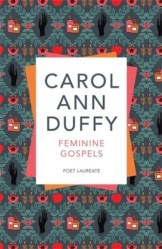
Carol Ann Duffy’s Feminine Gospels

Carol Ann Duffy, Feminine Gospels (2002, Picador 2017)

gospels.jpgThis book is on the curriculum in UK schools, and that is definitely a good thing: its wholehearted focus on female experience is a welcome corrective to the existing gender imbalance. The surreal, shaggy-dog story form of most of the poems – a shopping woman accumulates huge quantities of stuff, goes broke and eventually metamorphoses into a shop; a character named Beauty becomes a series of celebrated women, from Helen of Troy to Diana Spencer; one girl’s unstoppable giggling in class infects the whole school, leading eventually to the school closing its doors as all its teachers leave to follow their dreams – provides plenty of scope for classroom dissection and discussion. And there’s much joy to be had in the way the words sound and work on the page.

I’d better give a warning to any students who stumble on my blog looking for help with an assignment. I’m a seventy-something man from Australia who likes to read and to write something about everything I read. I would probably fail the A Levels.

I’ll stick to my rules and single out just one poem. There is handful of wonderful, memorable and readily memorisable lyrics at the end of the book, of which I especially liked the love poem ‘White Writing’ and the elegiac ‘Death and the Moon’. But the poem that struck me most forcefully on second reading is ‘History’, not actually a tall-story poem, but a close relative. You can read the whole thing here – it’s not long.

The poem begins with a picture of an old woman ‘not a tooth / in her head, half dead … smelling of pee’. who is a personification of History. There follows a list of events she has witnessed, and from a particular Eurocentric/Christian sample of world history:

She’d seen them ease him down
from the Cross, his mother gasping
for breath, as though his death
was a difficult birth, the soldiers spitting,
spears in the earth;

——————————been there
when the fisherman swore he was back
from the dead; seen the basilicas rise
in Jerusalem, Constantinople, Sicily; watched
for a hundred years as the air of Rome
turned into stone;

——————————witnessed the wars,
the bloody crusades, knew them by date
and by name

I love ‘the air of Rome / turned into stone’ as a way of capturing the transformation of the fluid, liberatory Jesus movement into a hard, authoritarian institution, and then the way that transformation segues to the wars and crusades.

There’s a bit of a leap in the next bit:

Bannockburn, Passchendaele,
Babi Yar, Vietnam.

These are not crusades, three of them aren’t even wars. Bannockburn (1314) was an important victory against the English for Duffy’s native Scotland, and the rest are emblematic moments of violence in the 20th century: the battle of Passchendaele (1917) of the First World War (and incidentally the subject of Paul Ham’s book that won the Douglas Stewart Prize for Non-Fiction this year); the massacre of Babi Yar (1941), the Second World War and the Holocaust; and the Vietnam War (1955–1975), known in Vietnam as the American War, a dominating feature of the first 20 years of Duffy’s life. If the poem had been written a few years later, it might well have included George W Bush’s invasion of Iraq and the rise of Isis.

The slide from religion to mass violence is then repeated in the next section, this time in relation to the suffering of individuals: the old woman has witnessed the deaths of martyrs and of murderers, and then ‘the dictator strutting on stuttering film’. Finally, in a heartbreaking return to the Holocaust, she has seen

——————————how the children waved
their little hands from the trains.

 So far, so rich in possibilities for classroom explication and discussion! (Not that there’s anything wrong with that.) Then the poem ends like this, and it’s the ending that makes me love it:

—————————————————-She woke again,
cold, in the dark,

——————————in the empty house.
Bricks through the window now, thieves
in the night. When they rang on her bell
there was nobody there; fresh graffiti sprayed
on her door, shit wrapped in a newspaper posted
onto the floor.

So far, History has been imagined as a feeble, weary old woman, worn down by the burden of witnessing the horrors of the Christian era, and especially of the twentieth century. The reader thinks he (in my case) gets it. But now it turns out it’s more than that: she is being actively harassed and humiliated. It’s hard to pin these final lines down to a specific allegorical meaning. The old woman is a personification of History, but who are the thugs who are attacking her, and what is signified by the bell, the graffiti and the shit through the letterbox? In a way it doesn’t matter: the sudden, visceral power of the final image takes the poem to a whole different level.* It’s no longer asking for polite applause, but doing what we always hope poetry will do, changing the way we see and feel about the world, or at least helping us to see and feel with more clarity and precision. It makes me want to leap up and shout, ‘That’s what the Trumps and Duttons and Bolts and Devines and Kennys are doing with their lies and half-truths: they ring History’s doorbell and run away before she can answer. And they shove shit through her letterbox!’

Thanks, Carol Ann.
———
* This could be an idiosyncratic response on my part, due to my mother-in-law having dog shit pushed into her letterbox during the American/Vietnam war. But it is my response.

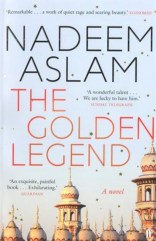
Nadeem Aslam’s Golden Legend

Nadeem Aslam, The Golden Legend (Faber & Faber 2017)

legend.jpgThis novel includes the standard disclaimer. It is a work of fiction: not only are all its characters, events and organisations creations of the author, but not even any resemblance to persons, events or organisations is intended.

I’m sure that’s technically correct, but the book’s power derives from the pervasive sense that the Pakistan in which its characters live is at heart an accurate representation of the actual Pakistan, that the terrible world of murderous religious intolerance, both of the Muslim majority against the tiny Christian minority, and of militant Islamists against both Christians and other Muslims, is not too far from reality. Certainly the events that have disastrous impacts on all the main characters have close parallels in the real world: US drone attacks that maim children and worse, sexual violence resulting in death virtually ignored by the authorities, behind the scenes machinations that enable crimes committed by US diplomats to go unpunished, the atrocities committed by Indian military in Kashmir, suicide bombings..

What the book does is make these forces painfully real by showing how they work in the lives of a small group of people. By contrast, there are characters for whom Islam is a sustaining and life affirming force, in particular a gentle imam, who always carries a set of beads in one hand and a bulky ‘book of sins’ in the other. One of the beads gives delight to the children of his village – Christian as well as Muslim – because it contains a tiny image of a holy Muslin shrine and a magnifying lens through which to look at it. And there is a book compiled by the father of one of the characters, nearly a thousand pages long, that is

an acknowledgement and celebration of the countless ideas and thoughts that had travelled over the ages from one part of the planet to another. It outlined and examined how disparate events in the history of the world had influenced each other, the hidden or forgotten contributions that one set of humans had made towards the happiness and knowledge of another. Traditions and histories had always mingled, and nothing in the East or the West was ever pure.

The book is destroyed by a man from the Pakistani military, and the main characters spend the rest of the book reassembling its pages and sewing them back together with gold thread, reading excerpts as they do so. Through this device the horrors of the current sectarianism are interspersed with reminders that, for example, Dante had ‘in all probability’ read of Muhammad’s journey to Paradise and Hell before he wrote The Divine Comedy, and that over centuries the relationships between Muslim and non-Muslim worlds have been mutually respectful, cooperative and productive.

And through all this there’s a love story, a chase, poignant family stories.

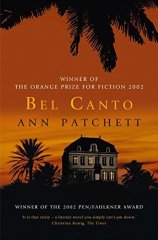
Ann Patchett’s Bel Canto

Ann Patchett, Bel Canto (Fourth Estate 2002)

belcanto.jpgThe logical book to read after Ann Patchett’s Truth and Beauty would have been Lucy Grealy’s Autobiography of a Face. But travellers can’t always be choosers, and Bel Canto was in our luggage.

I knew nothing about the book except the little Ann Patchett said about it in Truth and Beauty, namely that it was her breakthrough book. I hadn’t even read the back cover blurb. If you plan to read it, I recommend that you do likewise. I’ll try to give as little way as possible in this blog post.

As the book opens, a world famous opera singer has just finished singing and, members of the audience believe, her accompanist has risen to kiss her, when all the lights in the room, including candles, are extinguished. The performance is in the home of the vice president of a small unnamed Latin American country, part of a birthday dinner for a Japanese businessman, a prospective investor in the country. The sudden darkness is caused by a group of guerrillas who are there to kidnap the country’s president. A hostage situation ensues.

If, like me, you come to this narrative with a real siege in mind – like the one in Martin Place where two hostages were killed – you may find the subtly comic tone uncomfortable. Luckily, some way into reading the book I watched the first Die Hard movie on TV, and this turned out to be a much better context for my reading experience. Set against Bruce Willis’s heroics and Alan Rickman’s urbane, ruthless villainy, there’s something wonderful about Patchett’s focus on the unheroic, unvillainous, and mostly un-urbane relationships within the besieged building. It’s not exactly a humanised case of multiple Stockholm Syndrome, nor is it a benign reimagining of Luis Buñuel’s The Exterminating Angel, but it has elements of both those, as well as a meditation on the role of art, a multi-dimensional love story, a political tragedy and many other things.

It completely won me over.

Ann Patchett’s Truth and Beauty

Ann Patchett, Truth and Beauty: A Friendship (2004)

truth.jpgI probably wouldn’t have read this if not for the exigencies of travel. Because we both find reading books on screen unsatisfying (though the Emerging Artist can read what she calls junk), we’ve done the old fashioned thing on this trip – taken books we both wanted to read. When the EA was browsing in a fabulous London bookshop and spotted two Ann Patchett books she hadn’t been able to find at home, they were more or less automatically added to my To Be Read list. This is the first.

It’s a memoir about Patchett’s friendship with writer Lucy Grealy. Lucy had a rare form of cancer when she was very young, and had her jaw surgically removed. A good bit of her life from then on was dominated by seemingly endless rounds of reconstructive surgery, most of it experimental and none of it completely successful. Apart from anything else, Truth and Beauty is a persuasive recommendation of Lucy’s 1994 memoir, Autobiography of a Face, which is now on my To Be Read list. Truth and Beauty is in fact much more than that: it’s the story of an intimate friendship between women; of a relationship between writers (Ann and Lucy met at the Iowa Writers’ workshop, and their careers – as a poet and a fiction writer respectively – progressed in close parallel); of a brilliant woman living with tremendous gusto, and at the same time battling the sense of unlovability and ugliness internalised from the social response to her appearance; of women friends rallying around someone’s crisis; and a lot more. It’s rich, passionate, intimate – especially so through the inclusion of a number of Lucy’s letters to Ann, which enable us to hear her own unmediated voice.

Lucy’s sister Suellen Grealy wrote an article for the Guardian excoriating the book soon after it was published – in 2004, two years after Lucy’s death from an accidental heroin overdose. At this distance, it’s clear that the real subject of the article is the way the family’s grief is complicated and in some ways intensified by their sister’s public profile – in a painful echo of the way Lucy herself had to deal all her life with people who felt they knew her, first because of her appearance and later for her creative achievements.

Especially in the book’s last quarter, as Lucy’s life is clearly heading for tragedy, I was reminded of Helen Garner’s The Spare Room, not in any of its particulars, but in the way both books capture something about women caring for each other in crisis.

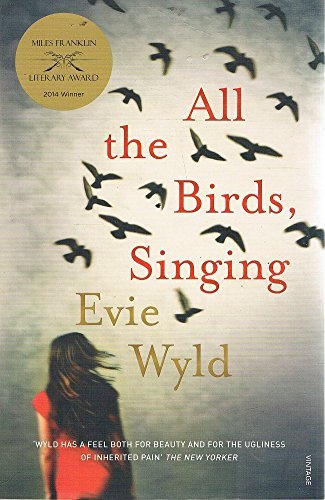
Evie Wyld’s All the Birds, Singing

Evie Wyld, All the Birds, Singing (Vintage 2013)

wyld.jpg

My copy of All the Birds, Singing announces on the cover that it won the Miles Franklin Award in 2014. As I read the first chapter, which is set in a generic British countryside, I wondered about that prize, given the insistence in past years that the Miles Franklin winner had to be set in Australia. The first paragraph of the second chapter put my questioning to rest:

We are a week from the end of the job in Boodarie. I’m in the shower at the side of the tractor shed watching the thumb-sized redback that’s always sat at the top of the shower head. She hasn’t moved at all except to raise a leg when I turn on the tap, like the water’s too cold for her.

Then, as if Boodarie and the redback aren’t enough to signal that we are now in rural Australia, the next paragraph lays it on thick:

The day has been a long and hot one – the tip of March, and under the crust of the galvo roof the air in the shearing shed has been thick like soup, flies bloating about in it. […] The first stars are bright needles, and in the old Moreton Bay fig that hangs over the tractor shed and drops nuts on the roof while I sleep, a currawong and a white galah are having it out; I can hear the blood-thick bleat of them. A flying fox goes overhead and just like that the smell of the place changes and night has settled in the air.

The novel continues in alternate chapters. On an unnamed British island, the protagonist has a small sheep farm, and someone or something is killing her sheep. In Australia, some years earlier, she is a lone woman shearer, with a dark secret in her past. On the island, she has to deal with a series of men who refuse to take her story of a sheepkiller seriously. In Australia, the telling moves back in time through a series of unfortunate incidents, mostly involving physical and sexual abuse by men.

It’s a good read, but I have to tell you that if, like me, you prefer a book that sets up a mystery to arrive at a solution to that mystery, you will want, like me, to throw this one across the room when you reach the final pages.

All the Birds, Singing is the fifth book I’ve read for the 2018 Australian Women Writers Challenge.

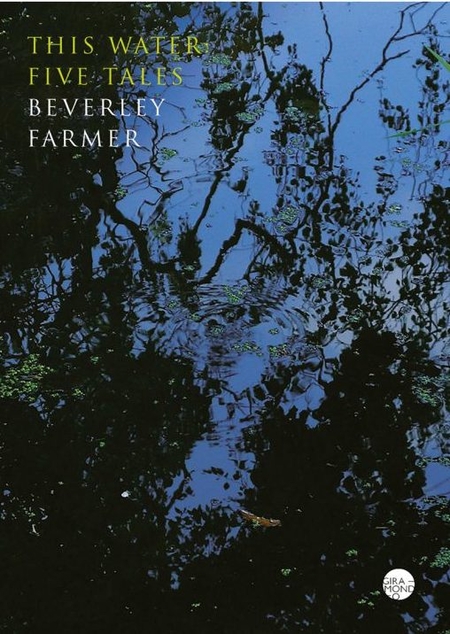
Beverley Farmer’s This Water

Beverley Farmer, This Water (Giramondo 2017)

5tales.jpgThis Water is Beverley Farmer’s tenth book. Her first, the novel Alone, was published in 1980. Her short story collection Milk won the Christina Stead Prise for Fiction in 1984. She was shortlisted for the Miles Franklin Award in the 1990s, and in 2009 she received the Patrick White Award, given each year in November to an Australian writer ‘who has been highly creative over a long period but has not necessarily received adequate recognition’.
As Alexis Wright said in her acceptance speech for this year’s Stella Prize, ‘any book is nothing less than a monumental achievement’. To have written book after book as Beverley Farmer has done, with just enough recognition from those who bestow cultural credibility, is beyond monumental.

I haven’t read any of her earlier work, apart from an essay or perhaps two in the late lamented Heat, but I suspect that This Water represents something like a Late Style. There’s something about its five stories that signals a grand indifference to fashion or indeed to how any reader might judge them. They are:

  • ‘A Ring of Gold’, which features an old white woman living alone (though surrounded by other people) in coastal Victoria, long after the death of her husband and her only sustaining relationships being in memory and with the natural world. I thought of this as a kind of Portrait of the Artist as an Old Woman, only deliberately leaving out the art-making
  • ‘This Water’ and ‘The Blood Red of Her Silks’, two tales in the mode of Celtic stories of princesses and curses. Unlike the magnificent tellings of such stories for young readers by the late Ruth Manning Sanders, or for that matter Hans Christian Andersen’s ‘The Wild Swans’, these – especially the second, much longer one – leave their folk origins to tell challenging adult tales (adult in the sense of grappling with difficult ideas)
  • ‘Tongue of Blood’, a monologue from a figure from Ancient Greek tragedy
  • ‘The Ice Bride’, the longest of the tales. With motifs and structural elements from fairy tales – especially “Bluebeard’ and ‘Beauty and the Beast’, and perhaps a gender-reversed ‘The Snow Queen’ – this is a deeply creepy, dream-like fantasy. I haven’t read Fifty Shades of Grey, and I imagine that this is infinitely better written, but the abject dependence of the female protagonist on her ‘Lord’ made me think of that book.

None of the characters in any of the tales has a name.

I can’t say I loved the book, but it’s beautifully written, uncompromising in its commitment to exploring aspects of women’s experience, and strong enough that when ‘light year’ is referred to as a measure of time (‘Our dreams are like the stars. What we see is light years ago.’) my irritation was forgotten within a couple of pages. If you plan to read just one of the stories, I recommend ‘The Blood Red of Her Silks’.

This Water is the fourth book I’ve read for the 2018 Australian Women Writers Challenge. I gratefully acknowledge that my copy is a gift from Giramondo.

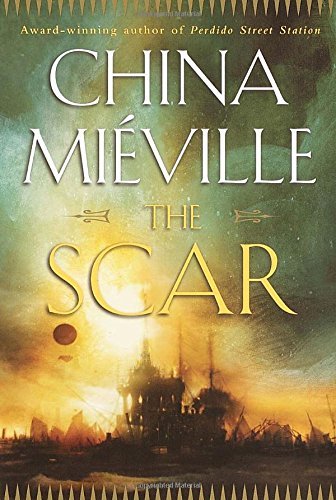
China Miéville’s Scar

China Miéville, The Scar (Del Rey Books 2002)

scar.jpgThis was another gift from the Street Library gods. A couple of pages into it, I realised that it was set in the same world as China Miéville’s Perdido Street Station, which I read many years ago. It’s not a sequel. As far as I recall (which I admit isn’t far) no characters have made the transition from the earlier book, but it packs a similar narrative punch and is populated by a similar range of fantastical creatures who engage in the same blend of steampunk science and magic (thaumaturgy) in the same teemingly complex universe (which I hope never gets made into a CGI-based movie).

The story involves an immense sea monster that is tamed and/or drugged into towing on huge chains a pirate city made up of hundreds of lashed-together vessels small and large. It features sentient beings known as the anophelii, whose chronically famished females attack any creature with blood in its veins and suck it dry in seconds, and whose males, whose mouths resemble anal sphincters, live lives of weirdly passive abstraction. It includes, not necessarily in order of importance, vampir (sic) bureaucrats, cactus people, probability mining (I won’t try to explain), fabulously bloody sea battles, a sweetly tragic love story (not of the romantic variety), a vast crack in the universe, and a charming account of the process of learning to read.

I read somewhere that a secret of good fantasy writing is to give the reader cool stuff now, and then cooler stuff later – that is, not to have a terrific climax preceded by a hundred pages of so-so build-up. The Scar is profligate with cool stuff.

I could go on, but I’ll finish off with a taste of Miéville’s prose (I don’t think it’s a spoiler to tell you that the characters are descending in a tiny deep-sea vehicle):

After uncountable minutes, the darkness outside was momentarily broken, and the crew gasped as time returned to them like an electryc [sic] shock. Some living lamp was passing them by, some tentacular thing that inverted its body with a peristaltic wave, enveloping itself in its luminescent innards and shooting away, its austere glimmer snuffed out.
Chion ignited the lamp at the bathyscaphos’s front. It stuttered on, its phosphorous glow casting a cone of light. They could see its edges as clearly as if they were marble. There was nothing visible in the lamp’s field except a soup of minute detritus, particles that seemed to eddy upward as the Ctenophore plunged. There was nothing to see: no ocean floor, no life, nothing.That crushing emptiness they had illuminated depressed them more profoundly than the darkness. They descended unlit.

The book may not be to everyone’s taste, but I found it full of delights.