This morning we managed to get to the beach. We got there before the Nippers.
November verse 14: A swim at Clovelly

Seven thirty, from Clovelly
Road, the sea's a silver sheet.
Once there, rub sunscreen on the belly,
back and shoulders, then the sweet
and icy plunge. Today no gropers
show themselves to interlopers
such as us, but one bold gull
dive-bomb swoops us, for the thrill.
And now the beach is full of nippers,
energetic, pink-clad, young,
reminding us that we belong
to boundless life. Ah, flat-white sippers,
once more dry and clothed, we sing
our farewell to another spring.
I have written this blog post on the land of Gadigal and Wangal of the Eora nation, after visiting Bidjigal land and water. I acknowledge Elders past and present of all those clans, and welcome any First Nations readers.
We were reminiscing about the good old days before plastic when one of my weekly jobs was to burn household rubbish at the bottom of our back yard. I confessed how I was fascinted then by the way books burned – they needed a lot of help. My niece, fabulous writing workshop leader Edwina Shaw, said, ‘That’s a poem.’ And indeed it is:
November verse 13:My Fahrenheit 451 For Edwina
A boy, I loved to watch the pages curl, turn black then red, ignite. I'd sit beside the flames for ages poking while the sparks took flight. A book is not an easy burner – someone needs to play page-turner. Of all the jobs they gave this boy, the rubbish-burning was his joy and phone directories delighted. I know they say that if you start by burning books, then like a cart behind a horse, you'll soon be sighted burning people. It's not true. At least, I pledge, I'll not burn you.
I have written this blog post on the land of Gadigal and Wangal of the Eora nation. I acknowledge Elders past and present of all those clans, and welcome any First Nations readers.
Aargh! It’s the 26th November and I’ve only written 11 stanzas. That means I have to write three stanzas in the next four days. The Emerging Artist says it doesn’t matter because it’s just a self-imposed deadline. But she wouldn’t say that if she had an exhibition looming. So here goes (with links).
November verse 12:Getting it done
Of course I've plenty of excuses: dental work and days of pain, books to read, a brace of nieces come to stay (like welcome rain), a partner with a foot disabled needing help from couch to table, launches, lunches, work for pay, dishwasher broken, games to play, and all those podcasts to attend to – Lydon, Runciman, Aly and Scott, Prokhovnik, LRB. A partial list that's mostly see-through. Mass distraction rules our age. Make that my subject. Fill the page.
Now that wasn’t so hard, was it?
I have written this blog post on the land of Gadigal and Wangal of the Eora nation. I acknowledge Elders past and present of all those clans, and welcome any First Nations readers.
I’m currently reading The Melancholy of Resistance by the 2025 Nobel Proze in Literature laureate, László Krasznahorkai, in a brilliantly readable translation by George Szirtes. I expect I’ll write about it some time next month, after my Book Group meets. For now, I just want to say that I’m loving it, and I want to make one of my November stanzas from a passage in it. Mr Eszter is an old man who has given up on life, rarely leaves his house or even his bed. My stanza is taken from a splendid passage where he goes on at misanthropic, nihilistic length.
November verse 11:After László Krasznahorkai
The world will always disappoint you. Full of banging, screeching noise, the sounds of struggle all about you. Barracks for unruly boys, uninsulated, draughty, dreary – no rest for the sad or weary. That's our lot. Sweetness and light are just a distant dream, all right? We're masters of the self-deceiving endless fever-burn of hope though all the evidence says Nope. Faith's just a matter of believing there could be another state – and music's just an opiate.
It’s funnier in Krasznahorkai’s prose. If you’re interested in the source material, it’s on page 121 of the 2016 Tuskan Rock Press edition. Here it is in small type:
The world consisted merely of ‘an indifferent power which offered disappointment at every turn’; its various concerns were too incompatible and it was too full of the noises of banging, screeching and crowing, noises that were simply the the discordant and refracted sounds of struggle and that this was all there was to the world if we but realized it. But ‘his fellow human beings’, who also happened to find themselves in the draughty uninsulated barracks but could on no account bear their exclusion from some notion of a distant state of sweetness and light, were condemned to burn forever in a fever of anticipation, waiting for something they couldn’t even begin to define, hoping for it despite the fact that all the available evidence, which every day continued to accumulate, pointed against its very existence, thereby demonstrating the utter pointlessness of their waiting. Faith, thought Eszter, recognising his own stupidity, is not a matter of believing something, but believing somehow things could be different; in the same way, music was not the articulation of some better part of ourselves, or a reference to some notion of a better world, but a disguising of the fact of our irredeemable selves and the sorry state of the world, but no, not merely a disguising but a complete, twisted denial of such facts: it was a cure that did not work, a barbiturate that functioned as an opiate.
I have written this blog post on the land of Gadigal and Wangal of the Eora nation. I acknowledge Elders past and present of all those clans, and welcome any First Nations readers.
On Friday I had a wisdom tooth removed. Then I had an extreme reaction to the antibiotics my dentist prescribed (don’t ask!). Early this morning, the dentist being closed and my regular GP not available, I made my way down the street to the medical centre at our local supermarket.
November verse 10: At the Marrickville Metro Medical and Dental Centre
We wait our turns and while we’re waiting
Wallabies up on the wall
are playing France. The wait's frustrating:
phones and earbuds keep us all
connected elsewhere – seeing, hearing
things that aren't the thing we're sharing.
One man tells a joke in Greek.
His friend laughs but she doesn't speak.
I've hardly slept, my face is aching,
reading hurts, my phone is dead,
and so I'm rhyming in my head.
No one's dying, no one's making
scenes the  movies would applaud.
We each wait til our name is called.
I was seen after an hour or so, the doctor was sympathetic and efficient, I was bulk billed and the replacement antibiotic has produced no ill effects.
Find your bag and water-bottle, remind them you don’t have a hat. Holding Poppa’s hand, ask what’ll happen if a pussy cat does battle with a lion or cheetah, what do you think would be sweeter, toast with honey and baked beans or ice cream made on submarines? In the car to get your sister, watermelon yes, peach no, swimming lessons – 'I won't go!' Then a confidential whisper: 'Will I see my mummy soon?' A normal Wednesday afternoon
I have written this blog post on the land of Gadigal and Wangal of the Eora nation. I acknowledge Elders past and present of all those clans, and welcome any First Nations readers.
Inspired by Filmworks, Brian Purcell’s book of poems about movies, here’s a little verse responding to Kathryn Bigelow’s recent movie, which was written brilliantly by Noah Oppenheim:
November verse 8: A House of Dynamite

Someone's screen reveals a missile
armed and launched from who knows where.
The world could end in eighteen minutes.
Can we stop it in the air,
find the lever, aim and pull it,
hit that bullet with a bullet?
Missed! The dot moves on the screen
towards Chicago. Better phone
your loved ones with a dire warning.
Only question now, too late,
is, how should we retaliate?
Idris Elba holds, that morning,
codings that could kill us all.
One day that could be Donald's call.
Sorry!
I have written this blog post on the land of Gadigal and Wangal of the Eora nation. I acknowledge Elders past and present of all those clans, and welcome any First Nations readers.
Last night I saw Colin Friels in the lead role of The True History of the Life and Death of King Lear and his Three Daughters at the Belvoir Street Theatre, directed by Eamon Flack. I don’t know the play well enough to tell if they fiddled with the text, but apart from the regendering of one character that created eddies of confusion, it’s a brilliant production that spoke to me powerfully. An interesting side note is that Goneril is played by Friels’s daughter Charlotte Friels.
So here’s a little verse:
November verse 6: After seeing King Lear at the Belvoir

Once in Balmain I saw Colin
skip with Charlotte hand in hand
up Darling Street, past shopping, strolling
midday crowds. You'll understand:
that father and his preschool daughter
provoked our wistful semi-laughter.
Would like them we all could play
with all self-consciousness at bay!
Last night once more they were together,
she the firstborn, he King Lear.
She flattered him, then with a sneer
she drove him out. The aging father
cursed her. After all that rage
do they still skip once they're offstage?
Added later: After I’d written that and pressed ‘Publish’ I saw that I have mentioned Colin Friels a couple of times previously on this blog. In August 2005 I actually blogged about the incident that features in the poem. I discovered that my memory of the incident differs wildly from what I recorded at the time. I have retrieve that blog post. It’s at this link.
I have written this blog post on the land of Gadigal and Wangal of the Eora nation who, as far as I know, never had deadly battles over inheritance of land. I acknowledge Elders past and present of all those clans, and welcome any First Nations readers.
David Adès ‘Bacha Posh’, which I blogged about yesterday, set me thinking about gender. I didn’t want to frame my little verse as a response to his, so here it is in a post of its own.
November verse 6: Gender

We learned the rules of gender early.
Sugar, spice and all things nice
were girls’, but boys were no way girly.
Slugs and snails, and at no price
the front end of a frisky puppy –
these were ours. Real boys are happy
we were told, with bats and balls
and vaulting horses, never dolls.
When we played at cops and robbers
what did girls do? Who can tell?
Drop the hanky, wishing well?
Girls were weepy, wimpy dobbers.
Boys were tough and didn’t cry.
That’s all true and pigs can fly.
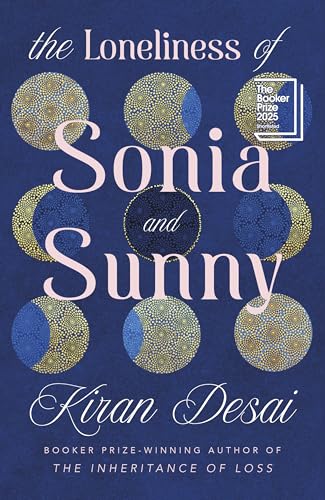
Before the meeting: This is a massive family saga that spans three continents, a romance, an Indian–US comedy of manners, and a magic-realist tale (though Sonia, a writer, is critical of that term).
All of the principal characters are caught, one way or another, in a tangle of Indian and US culture. The central difference, gestured towards in the book’s title, is the contrast between US individualism and Indian sense of belonging to a family and a community: loneliness and embeddedness, self-determination and obligation. When this plays out in comic mode, it works brilliantly. In the Indian scenes, again and again, someone is asked in shocked tones why they are alone.
As you’d expect from the title, the central narrative strand is a romance. True to the form of the romcom (no spoiler really) the protagonists Sonia and Sunny have sex at almost exactly the midpoint and then are separated, seemingly irretrievably. Integral to the romcom are family intrigue, corruption, violent murder, and a dispersed conversation about arranged marriage. I loved all that.
There’s another story jostling for the centre. This begins with an unconvincing episode of coercive control and develops into a kind of ghost story that more or less centres on a mystic talisman that Sonia has inherited from her grandfather. A European painter who has held Sonia in his thrall steals the talisman and makes it central to his art (yes, appropriation!). I found this strand unconvincing at the level of character, but there’s an interesting reflexivity to it as the artist keeps telling Sonia, an aspiring novelist, what she should and should not write: we are clearly being invited to read this book as a repudiation of his advice.
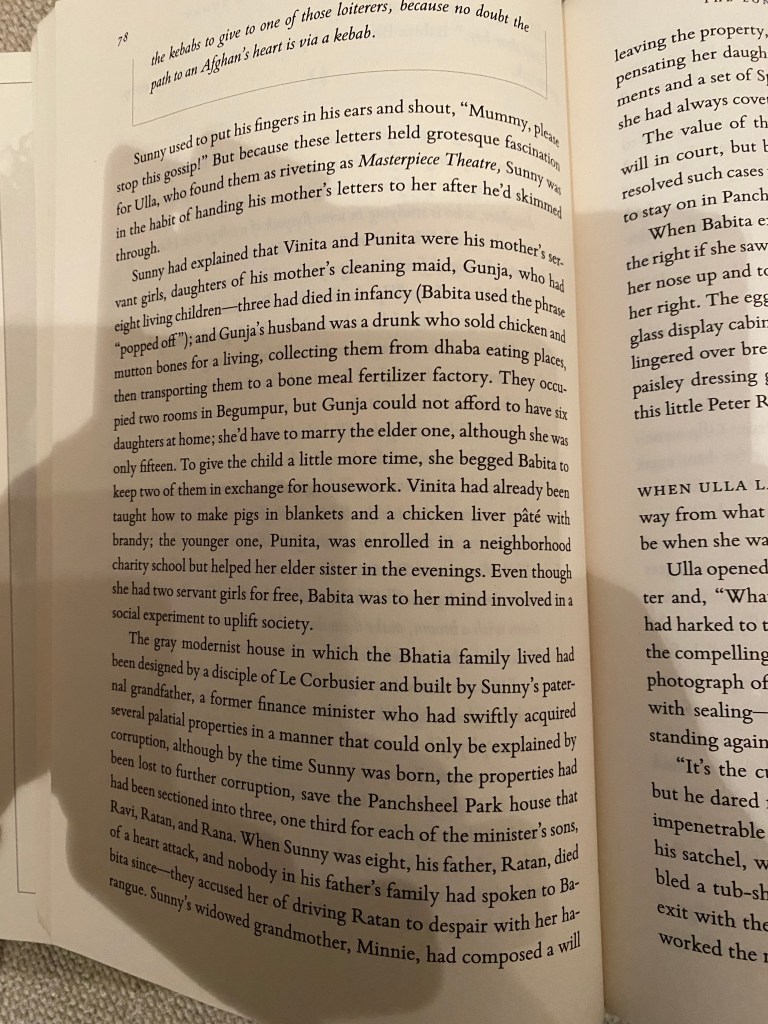
Page 78* is early in the book, part of Sunny’s narrative. He is a young man living in New York City in the late 1990s with Ulla, a white US woman. He’s intent on making it in the USA as a journalist, and embarrassed by his mother’s insistent claims on him. He can barely read her long letters (‘Mummy, please stop this gossip!’), and on this page he explains the context of one of them to Ulla (and, incidentally, to the reader):
One tiny thing I’ll mention in passing. The bottom paragraph describes Sunny’s family home as a ‘gray modernist house … designed by a disciple of Le Corbusier’. So much information is conveyed in those few words. First, the family comes from wealth. Second, they are to some degree westernised – their house is modernist. Third, the fact that the architect was a disciple rather than Le Corbusier himself suggests something about the limitations on the aspirations of colonised elites. And fourth, ‘gray’ is an example of the the North American spelling conventions used throughout (‘neighborhood’ later in the paragraph is another): that these spellings persist in the UK edition is not a mistake, but an enactment at the micro level of the way US culture has come to dominate the book’s westernised Indian characters.
Before that, there’s a paragraph of raw exposition:
Sunny had explained that Vinita and Punita were his mother’s servant girls, daughters of his mother’s cleaning maid, Gunja, who had eight living children – three had died in infancy (Babita used the phrase “popped off”); and Gunja’s husband was a drunk who sold chicken and mutton bones for a living, collecting them from dhaba eating places, then transporting them to a bone meal fertilizer tactory. They occupied two rooms in Begumpur, but Gunja could not afford to have six daughters at home; she’d have to marry the elder one, although she was only fifteen. To give the child a little more time, she begged Babita to keep two of them in exchange for housework. <snip> Even though she had two servant girls for free, Babita was to her mind involved in a social experiment to uplift society.
The fate of Vinita and Punita, known collectively as Vini-Puti, is to be significant much later in the book. But because it’s November*, rather than discuss further, here’s a little verse:
November verse 5:
So much in his mother's letter
needs to be explained. Just who
is Vini-Puti? Who is Ratty?
What's this kebab how-de-do?
Gunja, mother of six daughters,
trains two up to follow orders,
flee the confines of the slum,
work for free for Sunny's mum,
cook liver pâté soaked in brandy.
This is tragic seen up close:
the mum's small gain, the girls' great loss.
But this ain't Hamlet, this is Sunny.
Vini-Puti serve their turn
like Rosencrantz and Guildenstern.
After the meeting: We discussed The Loneliness of Sonia and Sunny along with Arundhati Roy’s Mother Mary Comes to Me. I was astonished when the discussion of this book kicked off with one person saying she hated it and gave up at the 40 percent mark (she’s a Kindle reader). Nothing happened, she said. And that included Sonia’s harrowing emotional enthralment to the bizarrely irrational western artist. Probably needless to say, others disagreed.
Of the three of us (out of five) who had read the whole book, I liked it the best. For all three of us the first 40 percent (I make that about 260 pages) was what we enjoyed most. We had different versions of why it became less enjoyable: perhaps there’s a forced assertion of Indian ways of story-telling, a cultural repudiation of the western mode of the earlier parts; perhaps the talismanic object is too sketchily realised to carry as much narrative weight as seems to be intended; perhaps the book is just too long.
I persist in my opinion, shared by one other Clubbie, that it was a good idea to pair this with Mother Mary Comes to Me. Both books have domineering, eccentric mothers. The protagonists in both are secular Indians appalled at the rise of Hindu nationalism and the BJP – the Demolition of the Babri Masjid mosque looms in the background. Both explore myriad ways in which cultural differences can be negotiated by people from a globally non-dominant culture. Both have main female characters steeped in classic English literature.
We had an excellent dinner, including a dessert that fell flat on the floor when it was taken from the oven, but was delicious anyhow.
The group met on the land of Gadigal of the Eora Nation, and I have written this blog post on the land of Gadigal and Wangal. I acknowledge Elders past and present of all those clans, and welcome any First Nations readers.
* My blogging practice is to focus on the page that coincides with my age, currently 78, and in November I write fourteen 14-line stanzas in the month. which means incorporating one into most blog posts.



 Me fail? I fly!