Category Archives: LoSoRhyMo

November Verse 10

This 14-liner may be over-compressed. You probably need to know that I spent my childhood in Innisfail in North Queensland, in an area that was settled in the 1870s after ‘punitive expeditions’ ‘dispersed’ the Mamu people who had lived there for tens of thousands of years.

November Verse 10: Mentioning the war
You said, ‘There’s no one on the planet
whose childhood was not touched by war
and if tomorrow we should ban it
we’d still need centuries or more
to rid our minds of its infection:
domestic violence, grief, abjection,
powerlessness, hate and dread.
Our silence gels it all,’ you said.
‘Not so,’ I thought. ‘For generations
my farming forebears bore no arms.
My early life knew no alarms,
the War had been in distant nations.’ 
Yet no one spoke, no one could face
the way we came to own that place. 

November Verse 9

November Verse 9: Breakfast
While monks on waking go to chapel,
my morning rite is to make juice
from beetroot, carrot, ginger, apple,
celery each day to unloose
what needs unloosing, supplemented –
so ailments may be circumvented –
by multi-probiotic pills
and others for existing ills.
And then, before a cup of java,
there’s sometimes muesli, mostly toast
that’s spread with jam, and, not to boast,
the jam’s from cumquat and guava
grown on our trees and made by me.
This is our daily Glory Be!

November Verse 8

November Verse 8: Haircut 
They meant it nicely: ‘It’s so fluffy!’
‘Einstein!’ ‘Kramer!’ ‘Snow on top!’
Skype’s corner pic made me look scruffy.
Time at last to go the chop.
Up Enmore Road to Con the barber,
best haircut this side of the Harbour:
‘Good morning, sir. What’s it for you?’
‘Short.’ ‘Short on top?’ ‘Yes, number two.’
So clippers, scissors, cut-throat razor
go to work and soon I’m shorn –
ears, nostrils, eyebrows smooth as lawn.
My head’s now ordered but, rash gazer,
wipe your eye, this state won’t last
the summer out. Hair grows too fast.

Southerly 76/1 & November Verse 7

Elizabeth McMahon, (nominally) David Brooks and (actually) Hannah Fink (editors), Southerly Vol 76 No 1 2016: Words and Music
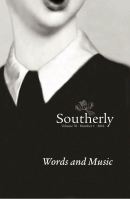
s761.jpgSoutherly is the journal of the English Association, Sydney. It generally includes a number of articles of interest to the semi-mythical ‘general reader’ as well as refereed papers meant mainly for academics. This music-themed issue is happily skewed toward those of us who identify with the semi-mythical.

The guest editor, arts writer Hannah Fink, has prevailed on a number of music professionals to write about their art and craft, and their relaxed and illuminating essays form the heart of the journal. Lyricist Hilary Bell’s ‘My Life in Lyrics’ starts out as a charming showbiz memoir and develops into a lucid communications of lessons she has learned about writing lyrics for musical theatre, winning points from me by referring to Stephen Sondheim’s magisterial Finishing the HatComposer Phillip Johnston’s ‘Wordless! Music for Comics and Graphic Novels Turns Time Into Space (and back again)’ may go into too much detail about the creation of a collaborative work with comix artist Art Spiegelman but I for one certainly hope to see the work some day. Jazz player and radio program host Dick Hughes, in ‘Jazz at the Pearly Gates’, imagines a number of brilliant jazz performances that might have happened, and allows us painless enjoyment of his great erudition.

Among the other non-fiction, there’s much to enjoy. David Brooks in ‘Herd Music’ speculates that music may have its deep origins in sounds like those a flock of grazing sheep might make. Joseph Toltz gives us a glimpse of compassionate research with Jewsih Holocaust survivors, in a number of anecdotes about the first music a number of people remember hearing after liberation.

There are short stories. Gareth Hipwell’s ‘Whatever Was Eating Whatever It Is That’s Eating The Trees’ is a brief celebration of a the way a man of an older generation has with the language. Colin Varney, whom I think of as a writer for children, definitely has mature readers in mind in ‘Zigazig-uh’, in which the narrator is a love song keeping a slightly snarky eye on the effect it has on a select group of humans.

And there’s poetry by Jill Jones (‘The Glass’), Matthew Wallman (two poems from ‘Inland Sea Poems’, a sequence about explorer Charles Sturt), Partrick Jones (‘Buladelah-Boomerang Point holiday song cycle’, whose odd typography has the welcome effect of slows one’s reading right down), Luke Fischer (the ekphrastic ‘Madonna of the Goldfinch’), and a wealth of others.

I usually skip reviews of books I haven’t read, but those of Toby Fitch’s The Blooming Notions of Other & Beau and Chris Edwards’s’s Sonata , books of deliberate mistranslation from French and German respectively, inspired me for today’s November verse: a ‘translation’ of a stanza chosen at random from Pushkin’s Eugene Onegin, which is in Russian, which I can’t read even though I’ve happily been attempting to write Onegin stanzas for years now. It turns out to be harder and more fun than I expected. Here is what I’ve managed, a nonsensical shadow of the achievement of those books and others like them:

November Verse 7: Worse than Google Translate
Go near me, freshen my loo, charm me.
Soak crusty gore, use a cigar.
Speak sharply, mutiny, rush army.
Nah! Ptoo! Play on your guitar.
You Lib boy – yes, no! – you prop-odour,
Squeeze on, stretch it, you true goader.
See nigh a blush – cute? Nay, bizarre.
Eschew the prozac. No lay star
Brought cake to puke-home-selling – eye it!
Chill as I darn your pulley, boy;
let it upskill your foxy toy.
Do line your socket, pests will try it.
Tada! Shoe, mat and solo way
You spell. Be small VE, not Che.

For anyone interested and/or capable of reading Russian, here’s the original, Book 7, Stanza 1 (and you can click here for more):

Гоними вешними лучами,
С окрестных гор уже снега
Сбежали мутными русьями
На потоплённые луга.
Улыбкой ясною природа
Сквозь сон встречает утро года;
Синея блещут небеса.
Ещё прозрачные, леса
Как будто пухом зеленеют.
Пчела за данью полевой
Летит из кельи восковой.
Долины сохнут и пестреют;
Стада шумят, и соловей
Уж пел в безмолвии ночей.

Saga 6 & November Verse 6

Fiona Staples (artist) and Brian K Vaughan (writer), Saga Volume Six (Image Comics 2016)

163215711X.jpgThe continuing adventures of bi-speci-al Hazel and her family.
Hazel is now in kindergarten in prison, with her wings bound so she can pass as a purebred member of her father’s horned species. Her parents are reunited and searching for her. Her grandmother is taking to prison life with gusto, getting tattooed and making friends. The cute but lethal Ghüs and Friendo are protecting the exiled former Prince and his little son. The Will is hallucinating and out to avenge his arachnid lover’s death.

There are a pair of web-footed closet gay journalists, Petrichor the glamorous horned trans woman prisoner, and innumerable extras.

Vaughan and Staples spin a great yarn, and the series benefits from being the work of a single artist. We don’t have to constantly adjust to different renditions of the characters, and can enjoy small felicities such as the sense that furry little Ghüs has wandered in out of a different comic.

The sex and violence continues to put the series in the Adults-Only category, though the nudity and sex scenes are a lot less grotesque and more joyful  than in previous instalments. It’s painful to think it’s likely to be a year before Volume 7 arrives.

And because it’s November here’s a little verse (with a link to information on Fredrick Wertham’s Seduction of the Innocent, which made alarming assertions about the dangers of comics in 1954):

November Verse 6: On a frame from Chapter 32 of Staples and Vaughan’s Saga
Ghost Who Walks, friend of Bandar,
pirates’ foe, Diana’s love,
some say racist propaganda:
back then I treasured you above
all other comics. I was seven
when a nun intent on heaven
and panicked by Fred Wertham’s book,
took my Phantom ‘for a look’.
She gave it back a full week later
embarrassed that she couldn’t tell
how it might pave my way to hell.
Her ghost today might well berate her
younger self. She would not bless
this bare post-coital tenderness.

November Verse 5

First an embarrassing memory, and then a slightly less embarrassing piece of verse.

The memory: in 1970 I was an English Honours student at Sydney University and had no idea how ignorant I was. James McAuley, then one of the Grand Old Men of Australian poetry, had a new book out, Surprises of the Sun. One of its poems, ‘In the Twentieth Century’, begins: ‘Christ, you walked on the sea, / But cannot walk in a poem, /Not in our century.’

To my mind he was clearly mistaken, so I wrote him a letter, in which I pointed out his error and as proof transcribed the second stanza of Leonard Cohen’s ‘Suzanne’, which begins, ‘Jesus was a sailor and he walked upon the water’.

McAuley didn’t reply, and presumably the letter itself has long since ceased to exist, but my brain has refused to eliminate the memory.

And the verse:

Verse 5: … about it all again
No drunken midnight choir sang me to
sleep. I heard no secret chord.
The room filled up with one mosquito,
and no sweetness was restored.
Adam’s long since left the garden.
Home he’s gone without a hard-on.
Break the bugle, skin the drum –
democracy is yet to come.
He’s danced us to the end of living,
leans no longer for Suzanne
or sea-and-shoreline Marianne.
Say goodbye to Leonard leaving.
So much light came through his cracks
and gave our griefs their music tracks.

Overland 224 and November Verse 4

Jacinda Woodhead (editor), Overland 224 (Winter 2016)

o224.jpg Overland is always a stimulating read. Among this issue’s offerings I am particularly grateful for:

  • Jeremy and the jeremiads by Richard Seymour, which discusses the ruthless and blatantly dishonest treatment of Jeremy Corbyn, the first radical socialist leader in the Labour Party’s history, by the British press – and not just its reactionary bits. As Seymour says, ‘the Corbyn moment has shown us … just how openly interventionist the majority of the media becomes when official opposition threatens to become a force for more radical change.’ Not just the Murdoch press, then.
  • The limits of compassion by Gerhard Hoffstaedter, which explores Malaysia’s response to the flood of people seeking asylum. It’s not that Malaysia is a beacon of light in this matter, but the scale of the problem there makes the panic and harshness here look even more shameful.
  • ‘Just violations’ by Alex Griffin (not online yet), which offers a historical context for Australia’s offshore detention centres. Japanese prisoners were held on Manus until 1953, and an Australian war crimes courts sat there, implementing the dubious War Crimes Act, in 1950 and 1951: ‘Australia could satisfy domestic interest, escape serious censure from its allies and strengthen its position in the Pacific, all while using the bodies of foreign nationals as bargaining chips in a oerverted and heavily weighted judicial situation.’

There’s also Alison Croggon’s column on her personal experience of depression, Ben Eltham spelling out how out of touch Australia’s political class is with the realities of most people’s lives, Giovanni Tiso on the pitfalls of using social media and the Web in general for political organising, with some interesting history for those who don’t remember Usenet.

No issue of Overland would be complete without the finalists of at least one prize. This one gives us the Victoria University Short Story Prize. The winner, Broad Hatchet by Julia Tulloh Harper, is a convincing bush tale with a neat gender twist.

There’s a poetry section. A new overall design means that the poetry is no longer printed in a light colour on a light background, and as a result can be enjoyed without eye strain. Zoë Barnard’s chilling ‘Impulse’ and Michael Farrell’s weird ‘Solve a problem and it grows two heads’ are the two poems that grabbed me the most.

And because it’s November, a verse. It may not be great but it rhymes:

November Verse 4: To Overland and their ilk on Eight-eleven
Unhappy land that needs a hero.
Duterte, Hitler, Donald Trump,
elected (unlike Stalin, Nero)
masters of the campaign stump
who feed on people’s desperation,
fan the myths of race and nation,
harness hate, despair and fear.
A heedless will for change is here.
We do need change. The seas are rising.
The profit motive hurts us all
and holds our governments in thrall.
I’m grateful for the organising,
analysing work you do.
It gives me hope we’ll make it through. 

Helen Garner’s Everywhere I Look and November Verse 3

Helen Garner, Everywhere I Look (Text 2016)

1925355365.jpgI’ve recently been surprised to hear a number of people refer to Helen Garner as ‘one of our great writers’. My surprise doesn’t come from disagreement. It’s just that hers isn’t writing that invites one to bow down in the presence of greatness. She’s less a Great Dane (or Grande Dame) making magisterial pronouncements than a terrier who keeps on at her subject until it yields some truth, her truth. She passes judgement often enough, and definitely enough, but not dogmatically, and not looking for a stoush either, but ready in case one comes along. A striking feature of Sotiris Dounoukos’ movie of Joe Cinque’s Consolation is the absence of the book’s persistent questioning – so when the end titles announce that, against the strongly implied judgement of the previous 90 minutes, one of the real-world characters was exonerated by a real-world jury, one tends to simply distrust the movie. When the book calls that verdict into question, you can disagree, but you can’t honestly dismiss it out of hand: the judgement has been honestly, and I would say humbly, worked for. (Perhaps its relevant that some of the harshest critics of Garner’s The First Stone refused to read it, or so I’ve been told.)

One of the pieces in this collection is titled ‘While Not Writing a Book’. That could have been a working title for the collection as a whole. It and a couple of others, including ‘Before Whatever Else Happens’, are presented as excerpts from the writer’s diaries/notebooks: overheard snippets, chance encounters, family moments, brief reflections. Another writer might have called them flash fictions or prose poems. Other pieces are more sustained: the product of a week locked away with CDs of Russell Crowe movies; reviews; sketches from the courts; wonderful pieces on her friendships with Jacob Rosenberg, Tim Winton and Elizabeth Jolly; glimpses of family life with grandchildren and, once, a dog; a revisit to her relationship with her mother; reflections on the ukulele, the ballet, suburban life; and more, enough to keep her readers interested between This House of Grief and whatever big thing may happen next.

Everywhere she looks and listens, from conversations about farting with small children to a teenager who has bashed her newborn baby to death, Garner finds stuff for her mind to grapple with, and she knows how to communicate the grappling with grace and vigour.

And now, because it’s November, a versification of one of the diary entries (see page 85 for the original):

Verse 3: At a conference
Supreme Court Judge and Helen Garner
chatted over tea and dip.
‘My home,’ the judge said to the yarner,
‘was once the scene of Monkey Grip,
your novel, and we’re renovating.’
‘My novel, and some devastating
and elating life. But how
do those old rooms look to you now.’
He listed them: ‘… and one so dinky
my daughter’s desk was there before.
It’s soon a bathroom, nothing more.’
‘The one with wooden shutters?’ Inky
flash from hippie days divine:
‘That tiny room was [humbly] mine.’

AWW2016Everywhere I Look is the twelfth book I’ve read as part of the 2016 Australian Women Writers Challenge.

November Verse 2: At a reading

Verse 2: At a poetry reading
Tonight’s star reads with great sonority
poems of country, beasts, trees, birds,
with great if pained superiority
over those who use not words
but guns on feral, sick or wounded
animals, whose lands are bounded,
cut by fences which (truth!) he
declares offensive. Glory be!
His passion shames my mammal-eating,
planet-warming life. It shakes
my donsie tricks, my black mistakes,
my use of coal-fired power for heating.
And yet I wish that he could tell
that other humans are not hell.

There’s a line in there that’s stolen from the great Robert Burns. You can read the poem it’s from here

November Verse 1

It’s November and once again, in solidarity with NaNoWriMo participants, I’m taking on a quantity-is-what-matters-and-hang-the-quality project: 14 Onegin stanzas in the month.

I was in Canberra on Halloween night. There wasn’t a lot of trick-or-treating going on in Civic, but as our small group emerged from a pleasant Sri Lankan meal we witnessed what may have been a Halloween-inspired moment.

Verse 1: Spirit of place
It’s nine. We’ve eaten. Frost tomorrow.
The street is still except for these
ebullient young. I’d like to borrow
half their cheer. It’s twelve degrees,
which doesn’t damp down their endorphins:
two young men as sleek as dolphins,
to win a dare or act the fool,
surf naked in the square’s staid pool.
Emerging, one is towelled and shaking.
The other, threatened with a phone,
sprints laughing round the square alone
and wet, all modesty forsaking.
It’s Halloween. No ghosts. No fright.
The body owns this town tonight.