Ferdia Lennon’s Glorious Exploits at the Book Club

Ferdia Lennon, Glorious Exploits (Fig Tree 2024)
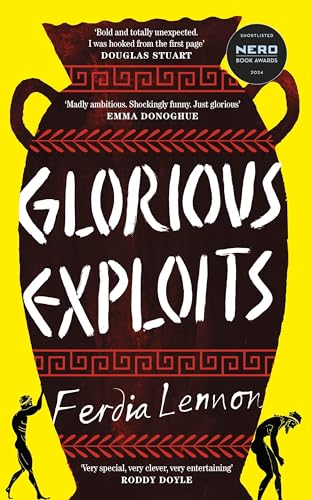
Before the Book Club meeting: I’ve recently been reading a lot by Irish writers who travel beyond their native shores. What Happened to Nina? by Dervla McTiernan is set in Vermont. The Narrow Land of Christine Dwyer Hickey’s novel is Cape Cod, Massachusetts in the 1950s. Sean Whiteside’s eminently readable translation made Wolfram Eilenbecker’s The Visionaries available to English readers from 1930s Germany. Now Ferdia Lennon’s Glorious Exploits goes even further afield in space and time. It’s set in Sicily in the fifth century BCE, during the Peloponnesian War.

Athens has invaded Sicily and been soundly defeated. A large number of Athenians are imprisoned in a quarry outside the city of Syracuse (this really happened). Some of the prisoners are given slightly better conditions if they can quote lines from Euripides (this also really happened). Two unemployed potters, Lampo and Gelon, stage a double bill of two Euripides tragedies, Medea and The Trojan Women, performed in the quarry by Athenian prisoners (this is made up). The Syracusans, including Lampo the natrrator, have Irish accents (why not?).

The novel, Ferdia Lennon’s first, has been a big success. You can read the Observer review here, and Kirkus Reviews here. Apart from saying that I enjoyed it, laughed out loud a number of times, was shocked at the shocking moments and came to like and care about the characters, I’ll stick to page 78*, whose action is neither at the quarry with the Athenian actor-prisoners, nor at the pub with the Syracusans, but at the docks.

On this page Lampo meets the collector, a man of great wealth that is almost certainly ill-gotten. Gelon has gone alone to the collector’s ship to negotiate a deal on a pile of armour stripped from Athenian corpses. At the start of page 78 Lampo has told the collector’s piratical crew that he’s there to see his friend, and that he’s unarmed.
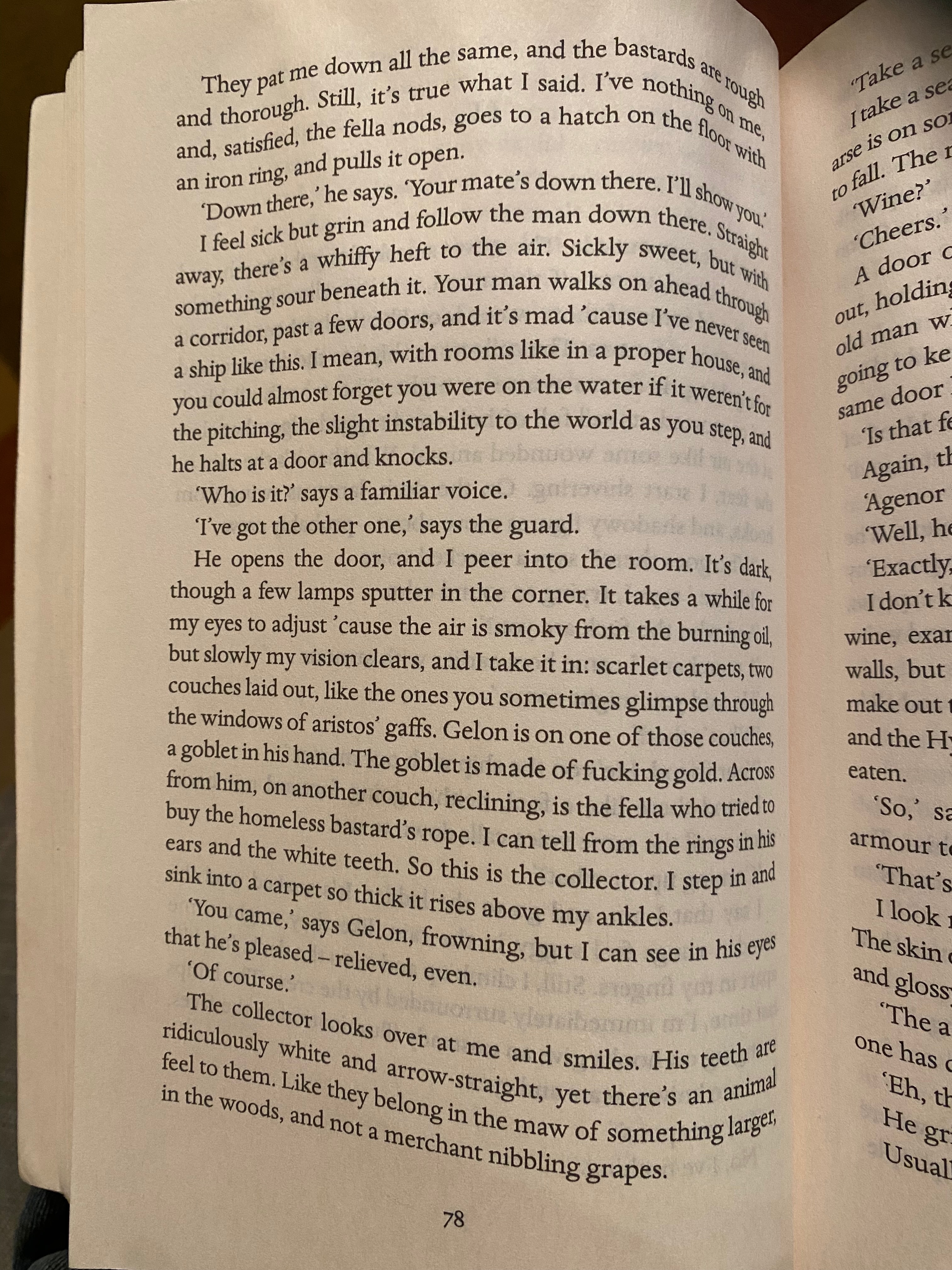
They pat me down all the same, and the bastards are rough and thorough. Still, it’s true what I said. I’ve got nothing on me, and, satisfied, the fella nods, goes to a hatch on the floor with an iron ring, and pulls it open.
‘Down there,’ he says. ‘Your mate’s down there. I’ll show you.’
Straight away, there’s a whiffy heft to the air. Sickly sweet, but with something sour beneath it. Your man walks on ahead.

There’s no attempt at faux-antique or heroic-Greek prose here. It’s straight into the ‘bastards’, ‘fellas’, ‘mates’ and ‘your mans’ of contemporary Irish vernacular. And, as everywhere in this novel, there’s a lot to smell. I don’t know if a specific source of the smell is being suggested, but there’s a clear metaphor: the collector, as we are about to see, is urbane and courteous, but with something ominous beneath the urbanity. At the end of the page, his teeth provide another metaphor:

The collector looks over at me and smiles. His teeth are ridiculously white and arrow-straight, yet there’s an animal feel to them. Like they belong in the maw of something larger in the woods, and not a merchant nibbling grapes.

If I’d set out to write a plot summary, I might easily not have mentioned the collector. He has a function in the plot – I don’t think it’s a spoiler to say that he provides financial backing for the production, and later a potential means of escape for some characters. But there are at least two other things to notice.

First, he has a sadistic, ghoulish quality. There’s the bloodstained armour he’s buying from our heroes. Then on this page Lampo recognises him as ‘the fella who tried to buy the homeless bastard’s rope’ – referring back to a homeless man’s story of a threadbare length of rope he treasures as his only memento of childhood, which he refuses to sell it a vast sum to a stranger we now know to be the collector. (The rope later turns up on the collector’s wall, leaving the reader to deduce that it was taken from its owner by force.) So his involvement highlights the macabre dimension of Gelon and Lampo’s project. Gelon’s desire to stage plays by the great Euripides is surely a good thing, fuelled by his passionate love of high Greek culture, and the potters and their performers develop relationships of mutual respect and even affection. Their art gives them respite from the horrors of their situation. But for the other Athenian prisoners that situation is unchanged, and even for the performers there is only the briefest respite.

There’s another thing. The collector’s name is later revealed to be Tuireann, a name he shares with a figure from Celtic mythology. At a literal level this might suggest that he has come to Sicily from far-off Ireland. But I think it’s a little authorial joke. If the language of the book is Irish, why not give one of the characters an Irish name?

I had to do a web search on “Tuireann” to get that joke (if it is one). It’s the kind of book where there are plenty of things to look up if the spirit moves you. The Peloponnesian War and the two plays by Euripides are the big ones. Did it add to my enjoyment that I saw an amateur production of The Trojan Women in Darlinghurst four decades ago? Probably. Would I have felt the lack if I hadn’t? I doubt it.


After the meeting: We discussed this book alongside Han Kang’s We Do Not Part and apart from the person who had read only 10 percent of it, we all enjoyed it a lot more. The ten-percenter said she had stopped reading because of time constraints, but I wouldn’t be surprised if some readers put the book aside after the terrible brutality that comes in the first couple of pages.

One of us had been to Syracuse and visited the quarry, though the guide didn’t talk about the imprisoned Athenians. None of us had felt the need to read up on Ancient History – the book doesn’t depend on specialist background knowledge. Two of us had heard Ferdia Lennon speak at the Sydney Writers’ Festival, so could add a little bit of news about him and what went into the making of the book.

I can’t talk about the way the book ends, but it’s probably OK to say that it’s with a kind of coda. When someone said she loved the ending, two of us thought she meant the bitter-sweet, though mostly bitter, conclusion of the main narrative. Once we were reminded of the actual final moments of the book, we agreed. The other person who had got that far disagreed. She thought it was unnecessary and a bit of a stretch. ‘The whole book is a stretch’, three of us replied in unison.


The Book Club met in Gadigal land, close to the great harbour Warrane. I wrote this blog post beneath a cloudless sky on land of Gadigal and Wangal of the Eora nation. I acknowledge their Elders past present and emerging, and gratefully acknowledge their care for this land for millennia. I welcome any First Nations readers of this blog.


* My blogging practice is focus arbitrarily on the page of a book that coincides with my age, currently page 78.

We Do Not Part with Han Kang at the Book Club

Han Kang, We Do Not Part (2021, translated e. yaewon & Paige Aniyah Morris, Hamish Hamilton 2025)

Before the Book Club meeting: Han Kang was awarded the 2024 Nobel Prize in Literature, so her most recent book to be translated into English seemed a good choice for the Book Club.

The book falls into at least three parts. (Spoilers ahead.)

Part One: The narrator, who is experiencing suicidal depression, receives an urgent request from a friend, Inseon, to come to her in hospital. When she arrives, she finds Inseon has done a terrible injury to her hand and is receiving frequent, excruciatingly painful treatment, graphic descriptions of which are interspersed with a history of their friendship and their artistic collaborations. Inseon asks the narrator to go to her house on the remote island of P– and feed her pet bird, who will otherwise die.

Pat Two: The narrator makes the arduous journey to Inseon’s house, the final stage of it on foot through a blizzard. When she arrives, the bird is dead. Though she herself has barely survived her ordeal, she immediately buries the bird out in the snow.

Part Three: While the ghost of the bird casts flittering shadows around the walls, Inseon turns up, with an uninjured hand. Evidently she is some kind of supernatural projection of the living person still back there in the hospital, though the narrator suspects at one stage that both she and Inseon are actually dead. Anyhow, Inseon guides the narrator through a number of documents that record a terrible massacre committed during the Korean War, apparently with US connivance, and the decades-long attempt by surviving relatives to have the massacre acknowledged.

At the level of narrative, I didn’t understand the book. When the exhausted narrator goes back out into the snow to bury the bird without even putting on warm clothes, I nearly stopped reading, and from then on my disbelief remained unsuspended. But as the story of the massacres emerged from the piles of documents, I was glad to be learning about a part of history I’d been completely ignorant of. On the other hand, given that the information is embedded in an unabashedly unrealistic narrative, I’m left not knowing how much of the massacre story is itself fiction. In effect, then, the book is a signpost pointing its readers to the need for further research.

WIkipedia has a minimalist entry about the Sancheong–Hamyang massacre of 7 February 1951, in which 705 civilians were killed, 85% of them women, children and elderly people. The files concerning the massacre, Wikipedia confirms, were not found until February 2006. That is the emotional heart of this novel: I have no idea how the story of the injury, the blizzard and the dead bird fit together with it.


The meeting:

I wasn’t the only one perplexed by this book. We were pretty well unanimous that we wouldn’t recommend it to friends, even though there is some beautiful writing in it. We were divided on the question of whether we would want to read anything else by Han Kang,

The narrator’s ordeal in the blizzard, we all agreed, is compelling.

One valiant soul found rich metaphor in the account of Inseon’s injury and treatment: her severed fingers represent the divided state of Korea and the painful injection every three minutes suggests that the process of reunion will involve sustained, painful work. My literal-mindedness at first rebelled at such a reading, but maybe it’s there for readers with a Korean cultural background, who I expect are also better equipped for the ghost-not-ghost parts of the narrative.

I wasn’t the only one who had done some research into the history that is the subject of the book’s final movement. Whereas I had looked up a single Wikipedia entry, S– had read a number of articles on the Korean War – but, she said, she ended up more confused than when she started

We discussed this book along with Ferdia Lennon’s Glorious Exploits. Both books build fictions around historical events, but no one felt compelled by Glorious Exploits to study up on the Peloponnesian War.


The Book Club met on Gadigal land. I wrote the blog post on Wangal and Gadigal land where just now the sun is shining from a cloudless sky and the wind has died down. I gratefully acknowledge the Elders past and present who have cared for this beautiful country for millennia.

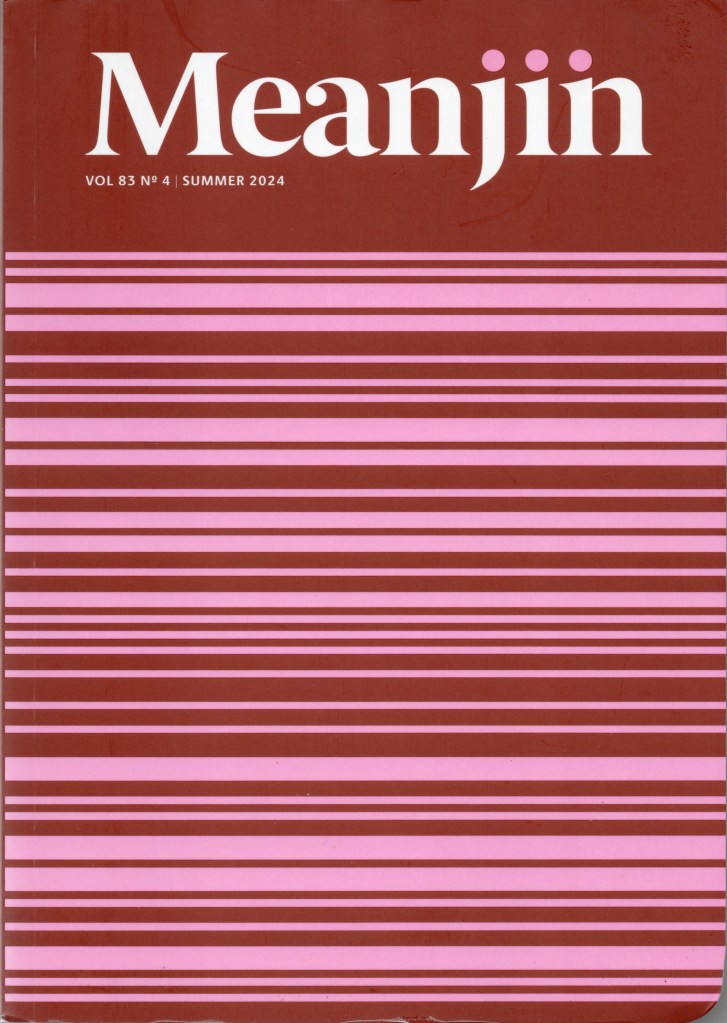
Journal Catch-up 30: Meanjin Summer 2024

Esther Anatolitis (editor), Meanjin Vol 83 Nº 4 (Summer 2024)
(links are to the Meanjin website: some but not all of them are available to non-subscribers)

I’m usually at least three months behind in my journal reading, so I don’t expect the journals to comment on the day’s headlines. So it was nice serendipity, on the day I read a piece in the Guardian about bulldozers moving in on a tent city in Moreton Bay Council Area, to read ‘The tent village at Musgrave Park‘ by Lillian O’Neill, which addresses a similar fleeting community in south-east Queensland with curiosity, empathy and (this is Meanjin after all) erudition.

Other essays have a more general but no less pointed timeliness:

Meanjin has a number of regular features:

  • Even before the contents page, there’s ‘The Meanjin Paper’, an essay by a First Nations writer: it this issue it’s ‘Sing for the Black: From Act to Treaty‘, in which singer-songwriter Joe Geia talks bout his art, particularly his show From Rations to Wages to Treaty
  • Australia in three books‘: Shakira Hussein discusses three books about Meanjin/Brisbane – by David Malouf, Melissa Lukashenko and Ellen van Neerven
  • Interview: ‘All colour and light’, an interview with Gerald Murnane, eccentric and elusive as ever
  • ‘The Year In…’ This issue has ‘… Poetry‘, not a survey, but discussion of a very few favourites by Graham Akhurst & Shastra Deo.

There are short fictions, memoir, book reviews and poetry. To name just one of each:

  • Your heart sir‘ by Grace Yee is in the poetry section, but to my taste it’s the best short story in the journal, about the sudden death of an old man and the dementia of his widow
  • Seven Snakes‘ by Carrie Tiffany isn’t in the memoir section, but it is a kind of memoir, in which the author, a park ranger, tells of seven encounters with snakes and one, more toxic, with a male manager.
  • How Novel is the Novel Prize?‘ by Maks Sipowicz, a review of It Lasts Forever and Then It’s Over by Anne de Marcken and Tell by Jonathan Buckley, joint winners of the 2022 Novel Prize, includes reflections on the function of prizes and awards in the literary ecosystem – and wonders if perhaps the prize should have gone to books of less obvious appeal
  • @ClanC #overflow‘, a lovely parody of Banjo Paterson written by Ian Simmons, whose bio says he ‘has been writing bad teenage poetry for almost five decades’, introduces some much-appreciated levity.

There’s much more in the journal’s 191 pages. I’ll give the last word to Maks Sipowicz. He was referring to literary prizes. I think the words apply just as well to literary journals:

As readers, we can only collectively benefit from the spotlight falling onto more challenging texts


I wrote this blog post on the cloud-covered, windy land of Gadigal and Wangal of the Eora nation. I acknowledge their Elders past present and emerging, and gratefully acknowledge their care for this land for millennia. I welcome any First Nations readers of this blog.

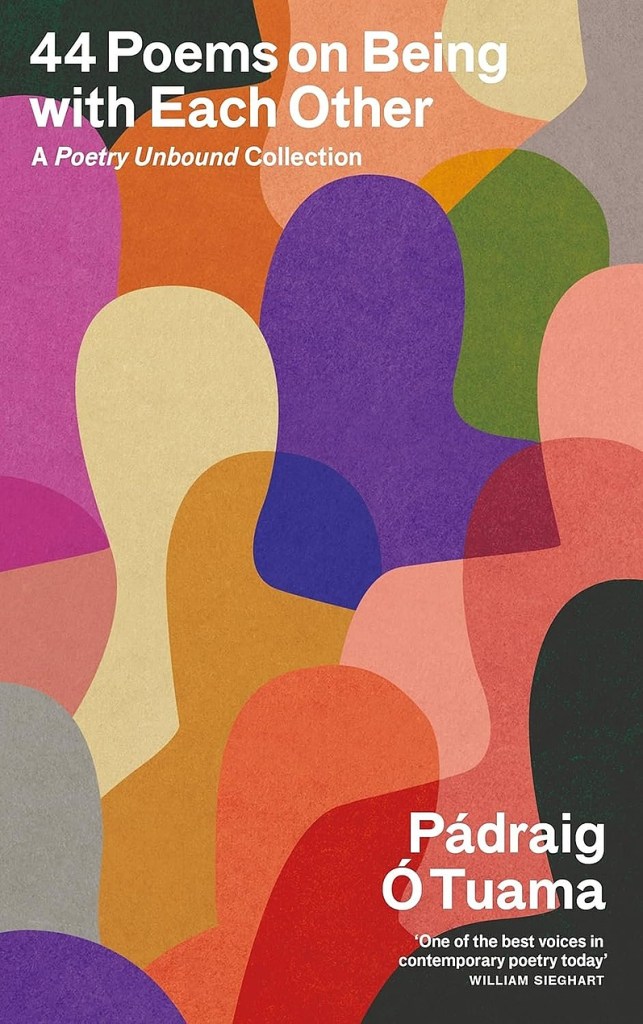
Pádraig Ó Tuama’s 44 Poems

Pádraig Ó Tuama, 44 Poems on Being with Each Other: A Poetry Unbound Collection (Cannongate Books 2025)

Books are risky gifts. I’m very glad the friend who gave me this one took the plunge.

It’s a collection of 44 poems, with commentary. I stumbled across an online review that said something like, ‘The poems are excellent, but I could have done without the commentary. It would probably be helpful for people who are learning how to read poetry.’

With all due respect, that person needs to have another look. It’s true, all 44 poems in this anthology are excellent, but the commentary isn’t there to help the ignorant (though it might do that): Pádraig Ó Tuama is a warm, charming, reader companion. Rather than assuming his readers are incompetent, needing to be instructed in the art of reading, he tells us how he reads poems himself – bringing to them his own history, knowledge and concerns, and by implication inviting his readers to do likewise. In a time when so much writing about poetry comes from the more esoteric corners of academia, his is fresh, conversational, smart, humble and completely engaging.

The anthology is an offshoot of the podcast, Poetry Unbound, and follows its format. First there’s a single page, printed white on black, in which Ó Tuama sets up a context with a personal anecdote or a reflection on life or literature. Then there’s the poem, followed by several pages of discussion. Ó Tuama finishes each podcast with a second reading of the poem, which readers of the book are of course free to do. I love the podcast, and I love the book.

Ó Tuama isn’t out to create a canon of ‘best’ poems. He may have what Trumpians would call an undeclared DEI agenda. Most of his poets are from non-mainstream groups of one kind or another: LGBTQI+, Native Americans, African heritage and other People of Colour, people with disabilities. A couple of poems are translated from other languages. But it’s far from being an exercise in box-ticking inclusiveness. There’s a clue in the book’s title – these poems are gathered from a wonderfully diverse range of poets, and together they create a sense of what it is to be together on this planet.

If I were to stick to my practice of writing about page 78*, I’d now look at the discussion of the shortest poem in the book, written by its most mainstream poet – ‘The Uses of Sorrow’ by Mary Oliver. But instead, I want to go to pages 310 to 315. The poem is ‘The Change Room’ by Andy Jackson. It’s the book’s only Australian poem, but my reason for focusing on it is that I already know it well, and have discussed it in this blog. Here’s a link where you can read the poem and, if you want, my discussion of it. (For those who don’t click: the poem consists of seven three-line stanzas and a two-liner. The poem’s speaker has three encounters at a swimming pool: a young child asks about his physical shape, a woman admires his tattoos, and a man chats with him in the shower after his swim.)

Ó Tuama’s introductory page, just 11 lines, tells us how the poem is personal to him. ‘Where do you carry shame in your body?’ he begins. And he ends:

The story of my body’s relationship to my own body – and the bodies of others – is a poem that’s asking for my attention.

You wouldn’t know from this that ‘The Change Room’ deals with disability or marked physical difference. Ó Tuama approaches it, as he does all the poems, from the standpoint of a shared humanity – a ‘being together’.

After rereading his discussion just now, I had another look at my blog post (here’s the link again), and I like the conversation we’re having.

We both discuss the rich ambiguity of the title of the book the poem comes from, Human Looking. Ó Tuama adds a reference to the tagline of Andy Jackson’s website, which includes the phrase ‘a body shaped like a question mark’, and relates that to the children’s questions in the poem. He pays close attention to the language:

In ‘The Change Room’ we read of nostrils, skin, tattoos, gaits, swimming, floating, showering, nakedness, proximity, speaking: all parts, functions and experiences of the body, all vehicles for body language, all ways in which the body is in conversation with itself and others.

Both of us puzzled over the poem’s last line, ‘Speaking, our bodies become solid.’ On rereading my blog post I quite like what I wrote about it, even if my reference to the Latin Mass may be a bit idiosyncratic. Here’s what Ó Tuama writes, to give you a taste of his prose:

‘Bodies’ here are held in a plural pronoun ‘our’. Why have they become solid? Were they not before? Were they fluid, or see-through, or gaseous? Perhaps solid is meant as the antonym for unreliable. The final stanza is composed only of two lines, in comparison with the seven tercets that preceded it. The missing third line of the last invites, perhaps, buoyancy, nature, exchange, consideration among all the bodies in, and reading a poem about, ‘The change room’. The poem asserts a shameless body-knowledge it establishes for itself.

I love the way he draws our attention to the precision of the language, and then the way, like Andy Jackson’s missing last line, he opens out to possibilities, rather than closing down on a particular reading.

I recommend this book, for yourself or as a gift to someone who likes a bit of poetry – for the poems, and for the companionship of the editor.


I wrote this blog post on land of Gadigal and Wangal of the Eora Nation, under an almost cloudless sky and feeling the chill from a mildly bitter wind. I acknowledge the Elders past and present of this country, never ceded.


My blogging practice is focus arbitrarily on the page of a book that coincides with my age, currently page 78.
 

Sydney Writers’ Festival 2025: My day four, part two

The young woman who was my neighbour at the launch of Ritual was just at the festival for the one day. She said she planned to go to ‘all the Palestinian sessions’. My next two sessions would have been on her radar.


1 pm: Peter Beinart: Being Jewish After the Destruction of Gaza

Peter Beinart is a New York journalist, commentator, substacker, and professor of journalism and political science.  He was in conversation with ABC journalist Debbie Whitmont.

He began by saying that he hoped there would be people in the packed room who disagreed with him. If there were any such, he made no attempt to placate them, but left us in no doubt about his views. He spoke fast (and at times furious), so please don’t take this as a summary of his whole presentation, but here are some things I jotted down.

The Jewish community in the USA and elsewhere is painfully divided over current events in Israel-Palestine. He begins his book Being Jewish After the Destruction of Gaza with a letter to a former friend: speaking from a position of love and Jewish solidarity, he says that something has gone horribly wrong, that the current action of Israel is a profound desecration, the greatest spiritual crisis of Judaism since the Holocaust.

There has been a great sustaining story for Jews. They are the world’s perpetual victims. In line with that narrative, Hamas’s horrific attacks on 7 October 2023 are seen in the context of the Holocaust and, before that, the centuries of pogroms and persecution. But placing the attacks in that narrative is to dehumanise Palestinians. To understand 7 October we need to look to different analogies – the example he gave was of a group of Native Americans who broke out of virtual imprisonment to perform a horrific massacre. In the case of 7 October, the Israeli Jews weren’t a marginalised group – it was horrible that they were killed but they were members of the oppressing group.

The narrative behind the creation of Israel is that Jews need a safe place. But supremacy does not make you safe. In South Africa it was widely believed that the relinquishment of white supremacy and Apartheid would lead to a bloodbath because whites would no longer be protected from the armed resistance. It didn’t happen(whatever the current president of the USA might say). Similar fears in Northern Ireland proved to be illusory. When structures of supremacy were taken down, the violence pretty much ended.

Yet the fear persists. Jewish Israelis fear to visit Gaza or the West Bank – while going to hospitals where there are many Palestinians among the doctors and nurses. Rather than argue, one needs to ask, ‘What are the experiences that led you to that belief?’

The answer is partly that the Holocaust is not ancient history. There are still fewer Jews in the world than there were in 1939. He is not suggesting that we should forget the past, but it matter what stories we tell. In his early 30s he went (as a journalist, I think) to spend time with Palestinians on the West Bank. Nothing in his life had prepared him for the brutality and terror he witnessed there. He realised then that the story of the persecution of the Jews was not the only story, and not the main one to tell in Israel-Palestine.

Among some circles there is a new definition of what it means to be a Jew. To be a real Jew, you must unconditionally support Israel. This, he says as an observant Jew, is a form of idolatry – the worship of something human-made. States are meant to support their citizens. Under this new definition, the state of Israel is to be worshipped: it’s not a relationship of support but of adoration. Likewise there’s a new definition of antisemitism that includes anti-Zionism: this would mean that any support of Palestinians is antisemitic. Again he quoted Edward Said, ‘Palestinians have been denied permission to narrate.’ This would make that denial absolute.

In fact, Jews are disproportionately represented in pro-Palestinian activities in the USA. These are not ‘self-hating’ Jews, but Jews acting in keeping with longstanding cultural values.

The last sentence of my notes: ‘Jews need to be liberated from supremacy.’


4.30: Plestia Alaqad: The Eyes of Gaza

Plestia Alaqad is a young Palestinian woman who has defied the lack of permission named by Edward Said. On 6 October 2023, a recent graduate, her application for a job with a news outlet in Gaza was rejected: local journalists weren’t needed. On 9 October, after the Hamas attack on Israel and the beginning of Israel’s response, she received a call saying things had changed. So she began an astonishing period of reporting. (At least, this is what I gathered from this conversation; the Wikipedia page tells a slightly different story.) For six weeks, she published first-person eye-witness accounts as Israel’s attacks on Gaza became more intense. She also published her diary on Instagram, giving millions of followers what Wikipedia calls ‘an unfiltered glimpse into the harrowing realities of life under siege’. And she wrote poetry. Her book, Eyes of Gaza, is a memoir built from her Instagram diaries.

At the beginning of the session, Sarah Saleh stepped onto the stage and sat beneath the huge screen to tell us who Plestia Alaqad was. Being completely ignorant, I assumed Plestia Alaqad was about to be beamed in from the Middle East, like Ittay Flescher and Raja Shehadeh. In fact, she is currently living in Australia, having left Gaza in November 2023 in fear for her family’s safety. Sara was alone on the stage so her guest could make an entrance: our applause was accepted, not by a stereotypically dour, hijab-wearing Palestinian refugee, but by a glamorous, vivacious, long-haired young woman.

The entrance wasn’t just a nice piece of theatre. Like Flescher and Shehadeh, she sees her work as being in large part to counter the dehumanisation of Palestinians – and she made us see her as human. This is why she writes about shopping as well as the outright horrors. ‘People don’t expect to see me shopping. They want to donate clothes to me.’

‘I knew how to be a journalist,’ she said, ‘but not how to be a journalist in the middle of a genocide.’

‘You have to deal with the genocide,’ she said, ‘and then you have to deal with the media’s treatment of it.’ Once she had come to public notice, mainstream journalist wanted to hear from her. She told us of one interview, with an Israeli news outlet I thnk, where the interviewer kept asking her leading questions, wanting her to say something like, ‘Kill all Jews.’ But this is not her position, and she referred constantly to the perpetrators of atrocities specifically as the IDF, not even ‘the Israelis’ in general. The interview was not published.

Children in Gaza grow up afraid of the sky.

About her book, she said, ‘I want people of the future to not believe that this book is non-fiction.’


5.30: Anna Funder, Closing Address: Bears Out There (click for podcast)

It was a hard transition from Plestia Alaqad to the formalities of the festival’s closing address. The CEO Brooke Webb (wearing a Protect the Dolls t-shirt), Artistic Director Ann Mossop and the NSW Minister for the Arts John Graham each spoke in justifiably self-congratulatory mode. What remains tantalisingly in my memory from all three speeches is an unexplained image of Jeanette Winterson being pursued by three stage managers. Apparently it was funny and made sense, but I guess you had to be there.

Anna Funder’s speech was terrific. The bears of its title came from an incident in her childhood. At a campsite in a Claifornian redwood forest, she needed to go to the toilet. Her mother, who was breastfeeding little Anna’s baby sister, told her to go to the toilet block by herself. When she came back and said she couldn’t go alone because, ‘There’s a bear down there,’ her mother, like the mother in Margaret Mahy’s classic children’s book, A Lion in the Meadow (it’s me, not Anna Funder, making that comparison), told her to stop making things up. The third time little Anna came back she was accompanied by a burly man who wanted to know who kept sending this small child to the toilet block when there was a bear there.

She went on to offer a range of perspectives on that story. Her mother told it often as a humorous story against herself as a neglectful mother. It could be read as showing the importance of the kindness of strangers. And so on.

I’m writing this at least ten days after the event, from very scanty and mostly unreadable notes, but where the story landed in the end was to make an analogy with the work of a writer, to go to places where there are bears – in Anna Funder’s case, the world of secret police, patriarchy, and like that. In these days, with the advent of AI under a global surveillance oligarchy, we need to recognise the importance of human beings writing and reading, daring to go where the robots cannot.

For the podcast of this address, clink on the title above. [Added later: An edited version was published in the July 2025 issue of the Monthly.]


And that’s it for another year, bar the events scheduled outside the week in May and of course the podcast series (I’ll add links to them as they appear). The Festival had an official blogger, Dylin Hardcastle. You can read his blogs at this link.

The small fraction of the Festival that I saw was terrific. At least four people, from different perspectives, spoke of the importance of countering the dehumanisation of Palestinians. There were lots of Readers against Genocide t-shirts, but any fears that there would be displays of antisemitism proved to be unfounded. There were wonderful poetry events – curated as part of the First Nations program, featuring a spectacular international guest, launching a landmark anthology of Muslim poets. I missed the intimate poetry sessions that were a feature of the Festival when it was held at the Walsh Bay wharves. Maybe next year we could have Pádraig Ó Tuama, or Judith Beveridge, or Eileen Chong, or a swag of poets from Flying Islands, Australian Poetry, or Red Room.

I gained new insights into books I’d read, and was tantalised about books I hadn’t. I’ve come away with a swag from Gleebooks, and have added to my already vast To Be Read shelf. I’ve already read a book by Raja Shehadeh from the Newtown library and am part way through a book by Emily Maguire.

Normal blogging will resume shortly.


The Sydney Writers’ Festival took place on Gadigal land. I have written this post on Gadigal and Wangal land, where the days are growing shorter and colder beneath, at this moment, a cloudless sky. I acknowledge Elders past, present and emerging and warmly welcome any First nations readers of this blog.

Sydney Writers’ Festival 2025: My day four, part one

The final day of the festival dawned clear and not too cold. We had another early start, not for fun and games this time, but for a line-up of three journalists and an academic to ruminate about Trump 2.0.


10 am: Trumpocalypse Now (Link is to the podcast)

Barrie Cassidy makes hosting a panel discussion look like the easiest thing in the world. This conversation just flowed. The formidably well informed and articulate panellists were Peter Beinart (of whom more later), Nick Bryant (author of When America Stopped Being Great and The Forever War), and Emma Shortis (Director of the Australia Institute’s International & Security Affairs Program). Mostly they were in furious agreement about the meaning of Trump’s re-election..

Peter Beinart kicked things off by saying that the USA has been a multiracial democracy only since 1965 when the Voting Rights Act was passed – forms of racial and gender supremacy are much more deeply rooted than democracy. Nick Bryant agreed with this in the manner of someone whose thunder had been stolen. Emma Shortis chimed in the we have to shelve our assumptions of normal order. And we were off.

I can’t tell you who said what, but what follows are some of the main points that made it into my scribbled notes (and that I can decipher).

If Trump had been in Europe he would have led a minor party. But the USA has only two parties, and there is a culture of extreme partisanship. The Republican Party’s elite had been delegitimised in the eyes of the Republican base, among other things because of its engagement in the wars in Afghanistan and Iraq. Trump rode in on that wave of distrust – it wasn’t a hostile takeover.

They discussed the tariffs, the need for a co-ordinated response to Trump by the USA’s allies (not going to happen), and what Albanese should do (get out of AUKUS – not going to happen), and more. ‘We’re ripe,’ Peter Beinart said, ‘for a massive insurgency in the Democratic Party.’ It could happen.

Barrie Cassidy asked why Gaza didn’t become a campaign issue. I thought for a minute he was referring to the Australian election, but he meant in the USA. The answers were interesting. Again, I’m not sure who said what.

To get power in the Democrats you have to build a career on ultra-caution about the Middle East. Biden won against Trump in 2016 because he presented himself as the loving grandfather who cared about people’s suffering. But when he refused to extend that love to babies in Gaza he lost a lot of support. He didn’t listen to that response, and nor did Kamala Harris. When, more recently, Trump used accusations of antisemitism as justification for his attacks on free speech, the Democrats had already ceded that ground by their support of a conflation of antisemitism and anti-Zionism. To be against Israeli actions in Palestine (in both Gaza and the West Bank) is not to be antisemitic. Some Jewish students may feel uncomfortable but that is fundamentally different from being unsafe. In fact, the pro-Palestinian demonstrations on campus and elsewhere in the USA are full of Jewish students. Peter Beinart quoted Edward Said: Palestinians have been denied permission to narrate.

Which provides a segue to my next session, an hour later.


12 noon: Ritual (Link to podcast be added if/ when it is available.)

Ritual is the first anthology of poems by Muslim-Australian writers. This was its launch

The session started with dramatic solemnity. Three women walked quietly to their chairs and somehow we knew not to applaud. A prayer was read in Arabic, Country was acknowledged, the suffering of Palestinians named. You could have heard the proverbial pin drop.

The session alternated between readings by poets included in the anthology and conversations between Winnie Dunn, general manager of Sweatshop Literacy Movement, as facilitator, and the two editors of the anthology – Sara M. Saleh (performance poet, and educator and human rights lawyer of Palestinian, Egyptian and Lebanese heritage) and Zainab Syed (Pakistani Australian with a scary range of skills and accomplishments to her name).

The book was conceived as a celebration of the diversity of Muslim Australians. The editors didn’t just put out a call for submissions and then choose from what came in the mail. They organised a retreat, and followed it up with community building events – a Muslim First Nations woman, Eugenia Flynn, had input, and a Muslim poet from the USA provided mentorship. But part way through the project, the Hamas attacks on Israel and the ensuing genocide in Gaza changed the literary landscape. Poetry became a refuge.

At the start of the session, Sarah Saleh told us that heartbreaking and enraging events in Gaza were threatening to steal the joy of the occasion from her. Zainab Syed was in Pakistan when the conflict over Kashmir erupted. They were both resolved not to give in to the dark. Zainab reminded us that the great poet Rumi wrote in a time of great horrors, and from one perspective his poetry is a protest against erasure. ‘As ritual, as prayer, as inheritance, poetry can be a sovereign record of our whole selves.’

The poems that were read, like the poets who read them, were marvellously diverse. I was too engrossed to take notes. It’s an anthology worth buying.


The Sydney Writers’ Festival took place on Gadigal land. I have written this post on Gadigal and Wangal land. I acknowledge their Elders past present and emerging.

Sydney Writers’ Festival 2025: My day three, part two

My Saturday morning was topped off with a session at noon, then one in the late afternoon.

12 pm: The Wood and the Trees (I’ll add a link to the podcast when/if it is released.)

This was a chat among three non-fiction writers who are passionate about the environment, and especially trees: Sophie Cunningham (This Devastating FeverCity of Trees), Inga Simpson (Where the Trees Were and Understory) and Ashley Hay (Gum). Aashley Hay was there as facilitator and said very little about her own work, though Inga Simpson at one stage acnowledged her as an important influence on her own writing.

The conversation ranged widely over the science and poetry of trees, trees as intimate companions and as culturally significant beings, trees under threat from climate change and capitalist rapacity. Forest bathing was mentioned, but not explained.

Ashley Hay kicked the session off by asking each of the others for her first memory of trees. Their answers were terrific, but I confess that the main effect of the question was to send me ricocheting off to memories of my own: there are at least a dozen individual trees that were important to me as a child, ranging from the solitary pawpaw tree that grew right next to our verandah to the guava tree in the far cow paddock that I felt was my own personal discovery. I did pay attention to what the writers were saying, but what I took from the session was this powerful blast of nostalgia.

There is currently a hunger for information and thinking about trees, we were told, and for trees themselves, perhaps because the climate crisis is threatening them. A list of recent books emerged. I guess I share that hunger as I’ve read at least some of the books. Honourable mention went to Peter Wohlleben’s The Hidden Life of Trees (link to my blog post), Suzanne Zimard’s Finding the Mother Tree (on my TBR shelf), and Richard Powers’ The Overstory (my blog post again). And there’s Sophie Cunningham’s instagram account Sophie’s Tree of the Day, which I would definitely be following if I used Instagram. And the same goes for US poet Ada Limón’s ‘You Are Here‘ project.

The Nutmeg’s Curse by the superb writer Amitav Ghosh was quoted. Leonard Woolf was a tree enthusiast, and one of Virginia’s last diary entries was about his trees. We were told about the miraculous survivor trees of Hiroshima and Nagasaki.

The session ended with someone – I think it was Ashley Hay – reading us the Adrienne Rich poem ‘What Kind of Times are These?’ You can read the whole poem at this link. Here’s the last stanza, rich with implication about why this was an important session to have at a writers’ festival in 2025:

And I won't tell you where it is, so why do I tell you
anything? Because you still listen, because in times like these
to have you listen at all, it's necessary
to talk about trees.

I was reluctant to go out again after a couple of hours in the comfort of home. But duty called, and I dragged myself up the hill to attend possibly the only solo poetry reading of the festival, the only African heritage person to top a bill. It turned out to be THE BEST EVENT OF THE FESTIVAL:

4.30 pm Lemn Sissay: Let the Light Pour In

After a disembodied voice acknowledged that we were on Gadigal land, Lemn Sissay burst onto the stage in a mustard yellow suit to a huge burst of applause – evidently the room was filled with fans, some of whom may have attended workshops he had led earlier. He made a physically huge show of lapping up the applause, and his energy didn’t sag for the whole hour.

What to say about what followed? He began with a comment that any event is open to a number of interpretations – and told us of a moment when another festival guest had assumed he was a taxi driver. Now you might take some meaning out of that, he said (Sissay is Black), but maybe he was just waiting for a taxi. Then, moving on, having raised and disowned the racism interpretation, he muttered cheerfully, ‘I hate him anyway.’

The first poem he performed is a long narrative, ‘Mourning Breaks’, which was accompanied by projections of dramatic stylised drawings. Disarmingly, he stopped after a couple of stanzas – ‘I’m not happy with doing it like that’ – and started over. It’s a gruelling poem in which a man hangs from a branch on the face of a cliff, refusing to let go. Sissay has uploaded a performance, without the images, at this link – if you watch it, stay to the end because it’s got a killer last line.

As we were recovering, he did some fabulous comedy about poetry readings: If you came here with a friend, and were thinking, ‘How much more of this do I have to sit through?’, if you were thinking, ‘I know a bit about poetry readings, and he should have started with something light to warm us up,’ if you came with a friend and were thinking, ‘This relationship is doomed,’ …. all I can say is, ‘I’m sorry.’

The rest of the session focused on his most recent book, Let the Light Pour In (Canongate Books 2023). He has written about trauma, he told us, including a play adaptation of Benjamin Zephaniah’s novel Refugee Boy, and work about his own difficult childhood growing up in care. But this is not a book about trauma. For 13 years, he wrote a poem every morning – they had to have four lines, and the second and fourth had to rhyme. Many of them were crap. This book contains the best of them, and he read us some wonderful ones, interspersed with chat that was a brilliant illustration of the line from Terry Pratchett quoted in an earlier session: ‘The opposite of funny isn’t serious, the opposite of funny is not-funny.’ Lemn Sissay was very funny, and also very serious.

He showed us a photo of one of his short poems taking up the whole of a man’s arm. He showed us the website of a marriage celebrant who featured one of his poems (‘Invisible kisses’, a kind of response to Kipling’s ‘If’). He asked if anyone in the audience had used that poem at their wedding. One person had. He then said he was suing all those people. (In response to a question at the end of the reading, he reassured us that of course he wasn’t suing anyone, and spoke interestingly about the way the internet and AI are changing the nature of copyright and intellectual property.)

Some poems he tossed off. Some, especially one that went right over our heads, he carefully explained (it was a joke poem that hinged on spelling of ‘yacht’). Some he lingered over, performed a number of times to allow them to settle in. One of those, he said, he wrote for young mothers who gave their babies up for adoption (not, he said, ‘abandoned’ but heroically gave the babies a chance of a better life):

Remember you were loved 
I felt your spirit grow
I held on for the love of you
And then for love let go

Then, he told us, a friend of his asked him to read this poem at her wife’s funeral – the poem took on a whole other meaning, still profoundly moving. ‘All poetry,’ he said more than once, ‘is an emotional witness statement.’ He also said, ‘There is no one way to do a poetry reading.’ He could have added, ‘There’s no one way to be a survivor of care, a University Chancellor, a literary prize judge, an OBE.’


The Sydney Writers’ Festival is happening on Gadigal land. I have written this blog post on Gadigal and Wangal land. I acknowledge their Elders past present and emerging. It’s still raining.

Sydney Writers’ Festival 2024: My day three, part one

Saturday 24 May, the weather relented a little. The Emerging Artist and I usually do the Sydney Morning Herald quiz in bed in the morning. Today we went to Carriageworks to do it as a communal affair.


10 am: The Good Weekend quiz

Quizmaster Brian Yatman was interviewed by Benjamin Law about how he goes about creating a quiz. The only tidbit I remember is that any question involving Dolly Parton comes from Yatman’s wife. Then we got down to it, a special literary quiz written especially for this audience, with prizes.

The EA and I resisted instructions to form a team with up to three others, and scored 18 out of 25, a decent score. But the two top scoring teams were at 23 or so – we left during the tie-breaker because we didn’t want to add to a ragged start of our next session. If it had been a more intimate affair I might have queried our score. In response to a question about what four books had in common – the only one I remember is Jane Austen’s Persuasion – we said that each of them was the last one written by its author. The ‘correct’ answer was that they were all published posthumously. The EA insists that our answer was also correct, and I’d be prepared to argue that case. So maybe we scored 19.

But without pause to draw breath:


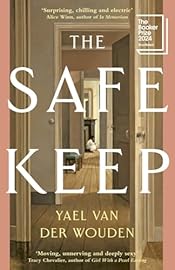
11 am: Yael van der Wouden: The Safekeep

This is another book I’ve read and blogged about (link here). Yael van der Wouden was in conversation with Claire Nichols, presenter of The Book Show on the ABC.

The first thing I have to report is that, if Claire Nichols is to be relied on, the pronunciation of the author’s family name is very close to Fun de Vow-dun. The second thing is that van der Wouden is as much a debut novelist as last night’s panellists. She’s experiencing the first of everything: she’s never been this far from home, she doesn’t know anyone here, she hasn’t talked about herself to rooms full of people before. She’s relieved that she didn’t win the Booker because that would have meant far too much time away from her loved ones.

Apart from that the conversation, or at least my scribbled notes from it, covered four main topics.

First, language. It’s an obvious subject to raise in relation to a book written in English by a Dutch writer. It turns out that English is van der Wouden’s first language. Her mother spoke Hebrew, her father spoke Dutch, and they used English to communicate with each other. She was born in Israel and moved to the Netherlands when she was ten years old. As a result she is ‘proficient in a chaos of three languages’. English is for writing, Dutch is for doing tax returns, etc.

Second, the narrative about World War Two in the Netherlands. In the mainstream version, the Resistance looms large. Only resistance fighters were celebrated on Remembrance Day – it wasn’t until the 1960s that Jews, Roma and other groups were included. The narrative has been changing thanks to the work of many scholars. It’s now generally recognised that the resistance to the Nazis wasn’t as significant as in, say, France, and that seventy-five percent of the Netherlands’ Jews were ‘despatched’, very few returned after the war, and of those many didn’t stay. The novel sits squarely among attempts to retrieve the real story.

Third, sex. In my blog post about the book, I said, ‘At times I felt like averting my eyes, as if I was intruding on intensely intimate moments.’ van der Wouden would have been pleased to read that, as she said that in writing the now famous sex scenes, mainly in Chapter 10, she wanted to make the reader aware that they were a voyeur. When Claire Nichols asked how she did that, she said some interesting things. First, erotic writing only works as a continuation of what has gone before it: in this case the long build up of repressed desire in her main character, Isabelle, at first experienced by her as disgust. The emotional content matters. In writing the sex scenes, she swings between the haptic (things to do with touch), something more abstract, something emotional, then back to the haptic.

Asked about the difference between good and bad sex scenes, she said it’s all about intention. Putting on her hat as creative writing lecturer, she told us that unless the aim is to be funny, the writer needs to commit fully, not lean into comedy or grossness. Surprisingly, she went on to say that it doesn’t work to borrow from your own sexual experience. I think her point was that if you do that you skip the work that needs to happen to take the reader with you. As I don’t have any immediate plans to write erotic scenes, I may not have paid close enough attention to these instructions.

The conversation ended with some reflections about being shortlisted for the Booker Prize, incuding a lovely anecdote about meeting one of her literary heroes at the Booker ceremony and not recognising her. The conversation went like this: ‘Good luck.’ ‘Thank you.’ ‘I’m Sarah.’ ‘Nice to meet you.’ ‘Waters.’ Yael cries.


I went to two more sessions on Saturday. I’ll write about them in my next post.


The Sydney Writers’ Festival is happening on Gadigal land. I have written this blog post on Gadigal and Wangal land, 45 minutes walk away, where the memory of ancient wetlands is currently very strong and the dark is coming earlier every night. I acknowledge their Elders past present and emerging, and welcome any First Nations readers of this blog.

Sydney Writers’ Festival 2025: My day two, part two

By the end of the festival I was suffering from information overload. I plan to blog about every session, but it may take a little longer than I’d like. I’m writing this on Tuesday – about last Friday.


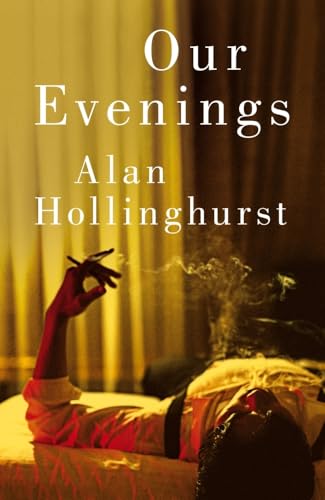
2 pm: Alan Hollinghurst: Our Evenings

Hollinghurst appeared on stage, the very picture of an urbane British novelist, in discussion with British journalist Georgina Godwin. (Georgina’s brother Peter is also a guest at the Festival – I didn’t book for any of his sessions but was enthralled by his conversation with Sarah Kanowski on ABC Radio, which – serendipitously – I listened to while walking home from the festival.)

The conversation focused on Hollinghurst’s novel Our Evenings, which I’ve read and blogged about (at this link). The conversation flowed and Hollinghurst had a lot of interesting things to say. I’ll just mention a couple of them.

GG’s opening question was about first-person narration. After talking about its advantages and limitations as he had found them in his first novels, Hollinghurst said that though he will never write a memoir, he realised that he wanted this book to read like one. He won’t write an actual memoir because he doesn’t really know who he is – and when the audience laughed at that he thanked us for our kindness but said it was true. (I just reread my blog post about Our Evenings and see that our book group felt that one of the main things about its protagonist David Win is that he doesn’t really know who he is. It looks as if we were onto something.)

Hollinghurst wanted a character who was like him but with at least one undisguisable difference. His main character / narrator, David Win, is mixed race Burmese and British. Hollinghurst wouldn’t have dreamt of giving David, say, Caribbean parents, which would have entailed a massive feat of the imagination. As it is, David (or Dave, as I’m pretty sure Hollinghurst called him throughout the conversation) never knew his Burmese father – he is brought up in a completely white environment with just mementoes – a photograph, some items of clothing. He never visits Burma/Myanmar, and knows no more about it than a white English novelist who does some online research. But the difference is real, and perhaps just as much as class and sexuality it’s a driver of the plot.

The other thing I want to mention came up in response to a question. There were no questions from the floor, but Georgina Godwin harvested them from an online platform. Someone asked what it was like to have progressed from being a queer novelist to being a British novelist. Hollinghurst said that probably happened with the Booker Prize for The Line of Beauty. It’s not that he stopped writing on queer themes – there’s plenty of same-sex desire and deed in Our Evenings – but he never wanted to write for a niche audience. He wanted to be part of the general conversation. This interested my partly because of how it chimed with what First Nations poet Jazz Money had said in an earlier session: that as an Indigenous queer woman it was only after her first book was well received that she realised she had the gift of responsibility – in effect, the responsibility to be part of a general conversation.

Oh, he read to us, and it was great to be reminded of how beautifully he puts words and sentences together.


7 pm: Raja Shehadeh: Chronicling Palestine

While we were waiting for this session to begin, with Australian Abbas El-Zein (whose Leave to Remain I blogged about a while back, at this link) sat in darkness on the stage. Curious about the two athletic looking young men sitting next to me, I asked what had attracted them to the session. ‘That’s our dad up there,’ one of them said. ‘And we love Raja Shehadeh,’ the other added, and recommended especially his book, We Could Have Been Friends, My Father and I.

Then the giant screen came alive and Raja Shehadeh was beamed in from his home in Ramallah in the West Bank. He is a lawyer and the founder of the Palestinian human rights organisation Al-Haq. He’s also a prolific writer. In this conversation, Abbas el-Zein asked him about three recent books:

  • We Could Have Been Friends, My Father and I (2023). After his lawyer activist father was murdered, his mother wanted him to deal with the boxes of papers he left behind; when he eventually looked in the boxes he learned a lot. He said, ‘I did what I never did in his lifetime. I came to terms with his suffering.’
  • What Does Israel Fear from Palestine? (2024) This began as a lecture on the Naqba delivered in Japan
  • Forgotten: Searching for Palestine’s Hidden Places and Lost Memorials, due for publication later this year, written with his wife Penny Johnson. Its seed was when they came across a plaque in the west Bank commemorating the death of a group of Egyptian soldiers in the 1967 war. Who knew Egyptian soldiers had been there? he wondered. What other forgotten pieces of the Israel-Palestine story were told in such neglected monuments?

His writing, he said, has been an effort to show what really happened in the past as opposed to the romantic versions accepted by younger generations. Yet, as the settlements are eating up land on the West Bank, there is urgency in the present that he also must address.

The central question in his work is, How can these two nations live together after this? What he means by ‘this’ has grown ever more momentous. But there is no other way. What is happening now is destroying the state of Israel just as surely as it is destroying the lives of so many Palestinians in Gaza.

As at many moments during this Festival, I thought about Kathy Shand , who retired as Chairman of the Festival board just before this year’s program was announced, probably because of concerns over the way Israel-Palestine issues were being platformed. If she got to hear this session, she might have regretted her departure.


8 pm: Big Beginnings (I’ll add a link to the podcast if/when it is released.)

This was a fun session. A dour irishman, an urbane mixed-race Englishwoman and a flamboyant Melbourne man who lives in Athens, each dealing with and perhaps reeling a little from the success of a first novel.

Madeleine Gray (whose own first novel, Green Dot, made a splash last year) chaired the panel with cheerful authority, leading them down a clear path of well-constructed questions: What were the circumstances in which you wrote the novel? What was your path to publication? Where did the idea start? What role does humour play? Who were your big influences, including those you only realised after the book was finished? What’s your research process? What’s the weirdest thing that’s happened since publication?

We learned:

Dominic Amerena (I Want Everything) was earning money while he wrote the book by doing medical trials – the book is partly a revenge for those precarious times. It was a struggle to write but once he submitted it, it was a dream run. The book is an inside-publishing mystery-scandal, and began with Dominic being fascinated by the number of Australian literary hoaxes – he rattled off a list of five from Ern Malley to The Hand that Signed the Paper. What is so Australian about them, he wondered. The Whitlam era features in the novel, and in his research he discovered stories about ‘men’s rights terrorism’ of the time – which he found a way of squeezing in.

Kaliane Bradley (The Ministry of Time) had lost a job in publishing because of Covid and though she got a new one she was working from home, knew no one in the new office and felt very precarious. She submitted the manuscript under a pseudonym because she is known by agents and editors. Once it was accepted, she had to do six rewrites over a year. The seed of the book was a photograph of ‘a sexy dead guy’ – a member of a lost polar expedition of 1845. She wanted to bring him back to life, to amuse herself and her friends. In the rewrites she had to think about literary genre tropes – elements of romcom, sci-fi, spy thriller. The word mash-up came to mind. She won me when she proclaimed her love of Terry Pratchett, and quoted him: ‘The opposite of funny isn’t serious. The opposite of funny is … not funny.’

Ferdia Lennon’s (Glorious Exploits) was teaching at a university near Disneyland in London when Covid gave him time to write the book. He’d long been obsessed with Ancient Greece, and had read a line in an ancient historian saying that Athenian prisoners-of-war kept in appalling conditions in Syracuse would be given extra food if they could produce a quote from Euripides. (I’ve just read the novel, and can tell you that’s pretty much how it starts.) In his research, he tried to suss out what it would have felt like to be there: he visited the quarries where prisoners were held.

We were well entertained for an hour.


The Sydney Writers’ Festival is happening on Gadigal land. I have written this blog post on Gadigal and Wangal land, 45 minutes walk away, where the memory of ancient wetlands is currently very strong and the dark is coming earlier every night. I acknowledge their Elders past present and emerging, and welcome any First Nations readers of this blog.

Sydney Writers’ Festival 2025: My day two, part one

Friday, and there’s a pile of umbrellas just inside the main entry to the Carriageworks.


23 May, 11 am: Songstress Poetica (Link to be added when/if podcast is released)

This was a charming hour with four First Nations women from this continent and a distinguished Emirati poet and scholar. It was in part a master class in relationality as the Indigenous women found many points of warm connection – shared Irish heritage, similar experience with singing, sharing of language, appreciation of each other’s work.

In the chair was Dr Alethea Beetson, a Kabi Kabi/Gubbi Gubbi + Wiradjuri artist who has, she said, many slashes in her work résumé, but works mainly in music.

Aunty Kerry Bulloojeeno Archibald Moran, ‘matriarch and medicine woman of Silver City Aboriginal Reserve – the Mission or Mish – on Anaiwan gooten country, Armidale’, sat in the middle, in splendidly colourful clothes and white ochre face paint. In striking physical contrast next to her was Dr Afra Atiq, an Emirati spoken word poet and scholar, dressed in magisterially flowing black. On the other side were two young writers (note that from my perspective anyone under about 50 is young) – Wiradjuri poet Jazz Money (most recent book mark the dawn) and Gunai woman ‘who rarely stays in her lane’ Kirli Saunders (most recent book Eclipse).

Each of the panellists spoke about her relationship to music. None of them owned up to playing a musical instrument, or even singing well, though Auntie Kerry said she always sang in response to the music of the bush that is always here if you listen. Kirli Saunders quoted her mother , ‘Birds in the bush, Babe, birds in the bush,’ meaning that when one bird needs to pause to draw breath the others will carry the song: it’s not all about individual effort in a choir, or in life.

Speaking about her own work, Aunty Kerry said she was inspired by what she reads in books – she produced two from her tote bag, one of which was Granny Duval by Sue Pickrell. She walks in the shadows of other people, she said, and when she reads when becomes the characters, just as in the bush she becomes the kookaburra, magpie, echidna. She performed a poem based on the story in Granny Duval.

Jazz Money spoke of the tension between the impulse to speak and the need to be heard. When she wrote her first book, she had no thoughts of publication. With her second book, she felt th gift of responsibility. As a queer Aboriginal woman, it was something new to expect her voice to be heard. Before she read her poem, ‘ember‘ (you need to scroll down at the link), she said that it was iportant inwith that responsibility not to focus on struggle: ‘The horrors of colonisation are such a tiny part of our story.’ She aims to be part of legacies of joy.

Kirli Saunders took up that theme, saying that though she writes about the stormy places, it’s often in the moment when the storm has passed and the smell of petrichor is everywhere. She performed ‘In the before time’, a poem/dance from the performance piece she is currently developing.

Afra Atiq reminded us that in her work is not reclaiming anything that has been lost, but is part of a continuing tradition, to which she has responsibilities. She performed a poem from her book, Of Palm Trees and Skies. The poem, whose title as best I could scribble it down was ”Six minutes that may be erased today’, was inspired by an art installation in which a mechanical device drew images and then erased them after six minutes. It’s a breathless poem that ends (the line breaks are my guess):

We write because we must
we erase because we think we should.

After the session, these extraordinary women stayed on the stage and generously posed to have group photos taken by a number of intrepid audience members.


12.30: Q & A with Jeanette Winterson in the Patrons Lounge

Thanks to a generous friend, I was a guest at this bonus event. Jeanette Winterson stood on a tiny stage in the Patrons Lounge and answered questions for a little over half an hour. Though some questions came from the munching and sipping patrons, Radio National’s Kate Evans served as excellent stooge, asking questions that elicited a lively story about the origins of Winterson’s first book, Oranges are Not the Only Fruit, including the role played by Australian Dale Spender; reflections on the influence of the Manchester of her childhood on her prose (evidently in Manchester, people talk to strangers in the street in staccato, irreverent humour); and about the importance of reading to enable people to broaden their horizons past the confines of their one short life, and to learn how to express themselves in ways without which the main alternative would be violence

I had a break for lunch, and am now having a break from blogging. The afternoon will be another post


The Sydney Writers’ Festival is happening on Gadigal land, where on this day the ground was doing its best to soak up a lot of water. I have written this blog post on Gadigal and Wangal land. I acknowledge their Elders past present and emerging, and welcome any First Nations readers of this blog.