Sam de Brito’s Lost Boys and the Book Group

Sam de Brito, The Lost Boys (Picador 2008)

lost boysBefore the meeting: Sam de Brito, a Sydney newspaper columnist and blogger, died in October. I don’t know if any of us in the book group had read his columns or his blog, but we decided to read his only novel, The Lost Boys, to honour his passing. It turns out there’s not much honour in it.

It appears to be about a man who, having spent his teenage years drinking, smoking dope and preoccupied with sex and peer-group status, hasn’t changed much in his thirties and hates himself for it. Mysteriously, given the almost total lack of reflectiveness in any of the characters, he also seems to be a writer. For Sam’s sake, I devoutly hope this isn’t substantially autobiographical. I couldn’t bring myself to read the whole thing. I wanted to lay it aside after ten pages but persevered for 60, and seeing no sign of any change, threw in the towel.

Here’s a sample from the post-schoolboy era:

Andrea just watches as we pass the bong around.
– You don’t smoke, Andrea? I ask.
–Not really, not any more, she says. – When I used to live in Indonesia we smoked so much and the stuff you get there, it really had a kick, let me tell you, but the stuff you get here, it’s full of chemicals, it’s not like what we used to get when I lived in Indo.
Fuck, I guess she wants me to ask her about Indonesia, but I can’t be bothered. I’m pretty ripped, so all I can manage is  – Yeah?
– Oh yeah. Once we had this bag of heads, it was like this big.
She makes the shape of it with her hands. Big bag. I nod. She’s got a story to tell. We let her tell it.
– And we smoked joint after joint after joint. No one smokes cones in Indo. And we must have smoked like half of this bag and we were so off our faces we could barely talk.
She starts laughing at the memory. Chong smiles. I wonder if I’m missing something.
–And then we all had these incredible banana smoothies and the next thing we know its morning. All of us fell asleep, just like that. We were so off our faces.
She laughs again. I wait, then realise that’s the story.
Fuck me, chicks really need to go to storytelling school. The first thing they need to learn is it has to have a point of difference: a funny ending, some sort of killer twist. A joke or line. A piece of wisdom.

To be fair, I’m confident that the reader is meant to recognise the sexism there for what it is. To be equally fair, that doesn’t make it any less yukky (or, given the number of excellent books by women I’ve read recently, any less bitterly ironic). But the reason I quote this passage (from page 39) is that it signals that somewhere in the 360-odd pages ‘some sort of killer twist’, even a ‘piece of wisdom’, might emerge from the bleak hedonism of the narrative.

That signal wasn’t enough to keep me reading. Given that the friends who constitute the lost boys of the title are Christian Brothers old boys, perhaps there is an implied piece of wisdom: don’t send your children to Christian Brothers schools if you want them to have any moral compass or cultural ballast. (I spent two unhappy years in a Christian Brothers school myself, but I don’t endorse that message.)

At the meeting:
It was our last meeting for the year. We each brought a wrapped book from our shelves at home and each took one of them home. In addition to this, one chap, who turned 60 this year, brought a number of scrolled slips of paper on which he had printed short poems that, he said, represented the state of his soul this year. We each chose one and then read them out amidst some hilarity and some reflective chat.

We did discuss the book. Not many had finished it. One of the finishers said that he had started out reading it as thinly fictionalised memoir, but about half way through began to think of it as a moral tale: a warning of the dangers of too much drugs and alcohol. Another had been to the same school, drunk when under-age at the same pub, recognised some of the characters. Another said that the book captured for him the way men who have been friends in adolescent sometimes maintain the friendship even though some have gone on to have successful careers while others remain trapped in their adolescent anomie. From each of these I got a sense of the book as almost a tragic documentation of something that’s all too real, a poignant ‘There but for fortune’.

We met in a restaurant, and though we had booked a separate room, water damage from the recent storms meant there were a number of other tables nearby. This meant that any readings from the book had to be bowdlerised. One memorable passage involving a graphic description of coprophagy read by the professional actor kept its power even when bowdlerised, and made me think that perhaps this book would be better heard in company than read on the page: language which on the page is just revolting becomes when read aloud the verbal equivalent of a scene from a Hollywood gross-out comedy.

Magda Szubanski’s Reckoning & Tim Winton’s Island Home

Magda Szubanski, Reckoning: A Memoir (Text 2015; Bolinda audiobook read by Magda Szubanski)
Tim Winton, Island Home: A Landscape Memoir (Hamish Hamilton 2015; Bolinda audiobook read by David Tredinnick)

9781925240436.jpg We listened to Reckoning on a car trip fromSydney to Brisbane and then part of the way back. It’s hard to imagine a book better suited to such a trip.

Magda Szubanski, a superb comedian as the fat, unloved but ever optimistic Karen in Kath and Kim, and the bustling farmer’s wife in Babe, here comes out as a complex, thoughtful person with quite a lot to say and the ability to say it well. I particularly admire her way with similes. As you’d expect of a celebrity memoir, it gives us the background story on a number of her well-known and much-loved parts, as well as her more obscure commercial and critical failures. Unsurprisingly, it goes into her family history, but though there are elements of celebrity-misery-memoir in the story that emerges of a depressed mother and a rigid, disciplinarian father, the narrative transcends that category to become something much more interesting.

There are many strands. Possibly the most interesting is Magda’s quest to understand her father. She tells us at the start that he was a teenaged assassin, an ally to Jews who put his own life at risk, and a member of the Polish resistance during World War Two. A key element of her own life story is her gradual uncovering of the details and significance of that, and of its implications for how he related to his own children. There’s also her struggle with weight, and the agonising story of her coming to terms with her sexuality, of coming out to her family, and then to the world is a revelation. (That is to say, I vaguely remember that when she came out my response was something like, ‘That’s interesting – Oh look, something shiny!’ For her, it was a major decision: she had to face the possibility that her career and any number of important relationships would go down the drain, and she also had to face head-on the internalised version of the vicious oppression that comes at Lesbians and Gay men.)

Magda Szubanski reads this audio book, and I recommend this as a way of receiving it. Perhaps it would be funnier read on the page: there’s plenty of wit, but Szubanskidoesn’t play for laughs. She does, however, do the voices: her father’s Polish accent (‘Ach, Maggie’), mother’s soft Scottish burr, her own childhood pipe, and any number of show-biz types (her impression of Mark Trevorrow is uncanny).
—-

islandhome.jpgWhen we’d finished Magda’s book, we moved on to Tim Winton’s Island Home. Sadly, we lasted only about 40 minutes into it, and even that was a struggle. The book itself is interesting. Winton writes about the meaning of the land in Australian sensibilities: we have more geography than culture here, he says; the long Aboriginal custodianship of the land has had a very different impact from the ubiquitous naming and taming of Europe, and the last two centuries have not erased that.

The book is interesting, and I hope to read it some time. But my companion and I found David Tredinnick’s reading intolerable. He did that thing of not trusting the words to do the work, but injecting emotion and significant intonations. The effect was to constantly draw attention to the words rather than to what they were trying to say. You could tell that Winton was struggling to articulate something, but it was being read to us as pronouncements of wisdom from on high. I see from Bolinda’s site that David Tredinnick is a frequent reader for them. I hope this performance isn’t typical.

Added later:
aww-badge-2015Reckoning is the twentieth book I’ve read for the 2015 Australian Women Writers Challenge.

November rhyme # 14

Better late than never. At least the event that inspired this happened in November:

Rhyme #14: Dinner 
From canapes to mango cheesecake
conversation didn’t flag.
(Two teenage boys sat mute – like, please make
this weird food go. It makes me gag.)
A window shows the inner working
of lab mice. There’s no one smirking
that a boyfriend in North Bay
was hit by two cars. Who can stray
down George Street in a hypo stupor
or drop unconscious in a pool
while holding baby? The Art School
exhibition’s still on – super!
Records from ASIO. Oh my!
Too much man sex in London Spy.

And so ends my task of 14 rhymes for November for 2015. I told the emerging Artist (formerly the Art Student) that I was thinking of keeping the doggerel  up, if at a slower rate, as a regular thing in the blog. Tactfully, she said people really like my prose. So normal functioning will resume shortly.

November Rhyme #13

OK, this is a fridge door poem I made earlier, but since the object it describes is once again being exhibited I’m passing it off as done today

as+for+living+II+web

As for Living III, by Penny Ryan. Photo by Kate Scott

Rhyme # 13: Piece in an exhibition
A broken ribcage from some broken
evolutionary line?
But these  aren’t bones – too glibly spoken!
That’s no knotted ridge of spine.
This work displayed in art school stairway
is not by some apprentice Yahweh,
nor did the wondrous Burgess Shale
a woven life like this unveil.
And yet it speaks of some great sorrow,
something beautiful that’s lost,
A world bereft, left with a ghost.
Perhaps a warning for tomorrow
unless we act, lives we hold dear
will be as if they never were.

Rumi in Strathfield and November Rhyme #12

IMG_1447

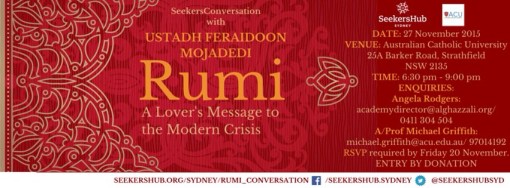
On Friday evening at the Australian Catholic University, two Muslim scholars sat with an audience and discussed the great 13th century Persian poet Mevlana Rumi.

Ustadh Feraidoon Mojadedi, an Afghani scholar who now lives in the USA, was in conversation with Imam Afroz Ali, of the Sydney Seekers’ Hub, a place of Islamic learning.

They spoke of Rumi as a great spiritual teacher, not just for Muslims, but for all humanity. Ustadh Feraidoon Mojadedi wears his enormous erudition lightly, and had us laughing even as he explained the complexity and depth of Rumi’s vision. He argued that what non-Persian readers need is more, better commentary rather than translation, because all translation is misleading. There’s much more to Rumi than you would gather from the quotes you see on Facebook.

I went along for a number of reasons, but mainly because a friend gave me a copy of The Essential Rumi decades ago which has remained, literally, a closed book. I’m also aware that my ignorance of Islam can’t be a good thing in the age of Corey Bernardi and Donald Trump.

Well, I know a tiny bit more about Rumi, and I’m planning to go to another event next week. But possibly more significant is how the evening altered my sense of Islam.

The relaxed, affectionate  relationship of the two scholars was in sharp contrast to images I have from movies.

In question time, it was women who asked all the questions – so much for the notion that women are silenced in Islam.

And most interestingly we were all invited to join the sunset prayer part way through the event. I’m not at all religious, but I’d joined in the Our Father at an Anglican ceremony the previous day. I checked with a number of people and joined the prayers. I did a lot wrong: I hadn’t arrived in an abluted state, I didn’t take my shoes off, I joined a line that turned out to be the women’s line, and I’m pretty sure I failed to follow all the standing and kneeling correctly (though my Catholic youth and childhood was some preparation for that). And of course I didn’t understand what was being said by the prayer leader. But there is something profound in joining a group of people who humbly bow repeatedly in the face of the mystery of the universe, and I returned to the lecture with an extraordinary sense of our shared humanity. Which was also the content of much of the talk.

So I went to the event expecting a literary evening, and found something quite different.

I’ve set myself a task of writing a 14-line rhyme with each blog entry in November (originally inspired by those people who write a whole novel in November – not sweating over quality, just getting the words out). Here goes for this one:

Rhyme #12: On joining sunset prayers
I bow, I kneel, I touch my forehead
to the grass. I have no God:
no disrespect, I take these borrowed
gestures (like my childhood’s nod
at Jesus’ name, or genuflection)
not to seek some Power’s protection,
but to say: The world is vast,
my time here comes and goes so fast.
Right now I humbly pay attention
to what is deepest in my heart:
my loves, my challenges, the part
I choose to take past good intention.
We bow, we stand, we’re flesh and bone
and mind. We’re none of us alone.


November Rhyme # 11

I’m having to produce a 14-line stanza a day if I’m to meet my quota. This is a true story:

Rhyme #11: Intimations
Between the ATM and Woollies,
death brushed my shoulder, had a word.
The voice was not a schoolyard bully’s,
but soft, you’d almost say it purred:
‘You’ll lose all this, perhaps not tomorrow,
but time runs out – beg, steal or borrow
makes no difference, you’ll be gone
as silent as a babe unborn.’
A baby sucked juice from a bottle.
A tricep showed a red-inked rose.
The checkout chaps had wispy moes.
The air outside was drenched in wattle.
The dog snapped at a passing fly.
One day all this will say goodbye.

November Rhyme #10

This weekend the United Nations Climate Summit begins in Paris. The huge march through the rues and boulevards that had been planned has been cancelled because of the risk of mass murder, but all over the rest of the world people will gather in a massive display of concern about climate change. The Sydney event starts at 1 o’clock, in the Domain.

The ‘People’s Climate March team’ emailed me suggesting I share a post of theirs on social media. The post was fine, but I realised that my real challenge is to say something from my own brain. So, at the risk of seeming to trivialise the issue, Sunday’s March is the subject of today’s little rhyme. It turns out that my own brain is full of fragments of other people’s wisdom.

Rhyme #10: Three days before the People’s Climate March
There’s no such thing as a human being,
there’s only humans and everything else:
stars that pull from beyond our seeing,
myriads living in our cells.
The human race has disunited,
Earth’s love for us gone unrequited,
who favour empire, comfort, gain,
and make the whole world our domain.
Saint Francis called the fire his brother,
water his sister. Was he wrong,
or was there muscle in his song?
This time we have is like no other:
last week is gone, next year’s too late,
what we do now decides our fate.

November Rhyme # 9

A versified excerpt from a conversation (I use the term loosely, as it was a bit hard to get a word in at the time). The title is not a misprint. No prize but much admiration for the first to decipher it:

Rhyme #9: Memento Moro
‘The kids today have no idea.
You must know, you’re about my age.
They think it was all Germaine Greer,
fat Elvis, punk, glam rock – no beige.
The seventies, in these confected
histories were cool, protected
from the darkness of our times:
all showbiz, glitz and fashion crimes.
I tell them of Brigate Rosse,
Baader-Meinhoff, Patty Hearst,
the Shining Path: there was a thirst
for violence then. It wasn’t glossy.
Look, where the light of memory dims,
at Lord Mountbatten’s scattered limbs.’

November Rhyme #8

Not everything that happened at Gleebooks yesterday morning would fit into fourteen lines:

Rhyme #8: Selling books.
I hauled some books – one case, two boxes,
unloved, unread, or loved but old –
bright-eyed, tail bushy like a fox’s
to where they said, ‘Books bought and sold.’
Alas! The man said, ‘Wilfred Owen?
No poems unless by Leonard Cohen!
Though your books may be a cut above
Dan Brown, Dan Steele or Eat, Pray, Love,
they mostly fail to pass my muster.’
The reject pile grew mighty high.
‘You don’t want this one. Nor do I.
Rooster once, now feather duster.’
He shot them down, my flock of ducks
and bought four books for twenty bucks.

November Rhyme #7

Friday was Sydney’s second hottest November day on record. I went for a walk with two friends from my teenage and young adult years that I’ve recently renewed contact with.

Rhyme # 7: 
Three old men in shorts went walking
out in November’s hottest day –
walking, talking, and some gawking
as we passed by Lady Bay
where brave souls bared all to the weather,
bodies turning slow to leather.
We reached South Head, its ocean breeze,
the Gap, and ancient friendship’s ease.
The times we shared, the years we’ve travelled
different paths, loves won and lost,
lessons learned, and bridges crossed,
the histories that we’ve unravelled:
we talked, and round our old men’s noise
we felt warm ghosts of teenage boys.