Tim Parks on not finishing

Tim Parks has an article on the NYRblog with an interesting take on the virtues or otherwise of not reading books to the end, including books one likes. I do usually finish books I like, but I found his discussion of plot interesting, including this:

Yet even in these novels where plot is the central pleasure on offer, the end rarely gratifies, and if we like the book and recommend it to others, it is rarely for the end. What matters is the conundrum of the plot, the forces put in play and the tensions between them. The Italians have a nice word here. They call plot trama, a word whose primary meaning is weft, woof or weave. It is the pattern of the weave that we most savor in a plot — Hamlet’s dilemma, perhaps, or the awesome unsustainability of Dorothea’s marriage to Casaubon — but not its solution. Indeed, the best we can hope from the end of a good plot is that it not ruin what came before. I would not mind a Hamlet that stopped before the carnival of carnage in the last scene, leaving us instead to mull over all the intriguing possibilities posed by the young prince’s return to Elsinore.

Hat tip to 3quarksdaily.

Jennifer Maiden on Poetica

Radio National’s Poetica was dedicated to Jennifer Maiden on Saturday (to be repeated on Thursday evening). It can be heard at this link:

Pirate Rain

Alice Parkinson and William Zappa read a number of poems from Pirate Rain lucidly (though words like insouciant and equinoctial tripped up the former’s tongue, and the line breaks do something on the page that it seems might be impossible to replicate in reading aloud), and there’s some commentary from the poet, which helps with the George Jeffreys / Clare Collins poems (which on this hearing sound to me like part of an ongoing novel). Maiden talks about the way fiction allows her to come closer to her own self than a lyrical poet–persona would.

Margaret Coel’s Eagle Catcher

Margaret Coel, The Eagle Catcher (©1995, Berkley Prime Crime 1996)

It think it was Julius Lester who named Margaret Coel  as one of  his favourite crime writers. And Tony Hillerman has provided a cover quote for this paperback: ‘Shouldn’t be missed … a master!’ I love Lester’s writing, and Hillerman’s, so these recommendations carried weight with me.

This is the first of the Wind River Reservation Mysteries, also known as the Arapaho Indian Mysteries, and I put it down to teething problems that it’s a bit clunky in places, a bit obvious as a whodunnit and a bit predictable in its climactic scene. But I’m not sure I read crime novels for the puzzle any more, if I ever did, or for the fine writing or innovative plotting. Often it’s the milieu that counts: Ian Rankin’s Edinburgh, Henning Mankell’s Sweden (but not Africa), Tony Hillerman’s Dinee. That, and the appeal of following a detective – whether it’s Lord Peter Wimsey or Sam Spade – through a series of reassuringly similar mazes. This book has the Arapaho reservation in Wyoming, which bears a strong resemblance to Tony Hillerman’s Navajo reservation in New Mexico, but does have a life of its own, and a pair of detectives – a tall redheaded Jesuit and a Arapaho woman lawyer – who offer a multitude of possibilities: a definite mutual attraction that each of them has to suppress, and a hint at the end that their collaboration will continue.

And then there’s the no-pressure history lesson about contact between whites (Niatha) and Arapaho, and the easy-to-take introduction to aspects of Arapaho culture.

Excellent for reading on the plane.

Thrill Seekers live

The Art Student and I are in Brisbane, wagging it from our Sydney lives to cheer for my niece Edwina Shaw whose book Thrill Seekers had its Australian launch at The Avid Reader last night.

I’ve blogged about the book before. It’s published by Ransom in the UK as part of their Cutting Edge series for reluctant teenage readers, and it’s pretty strong stuff. The promo on YouTube gives you some idea of its credentials to be part of something called Cutting Edge – lots of booze, drugs, sex, risk taking and rock and roll. Its final image of a wide-eyed, possibly terrified boy gives a glimpse of the book’s heart:

Though the book is grim and cutting edge, the launch was cheerful. A huge crowd crammed into Avid’s courtyard in the warm Brisbane evening (unlike Sydney, Brisbane has been having a summer) to be greeted by a slide show of Edwina and friends being young in the 80s. Jeff Cheverton, CEO of Queensland Alliance for Mental Health, kicked things off with a short talk in which he wondered aloud if Douggie, the boy in the book who is diagnosed with schizophrenia, might have had a less cruel experience if he and his friends had had a language for what was happening, and if there had been places then as there are now (though he seemed to say only two in Queensland) where young people who are losing it could go for support without being taken into the embrace of the medical model. Or words in that general direction – I didn’t take notes and I have a sieve for a memory.

Venero Armanno gave an elegant launch speech. He was at pains to say that while a great strength of the book is that it draws on the writer’s experience, it would be a mistake to see it as biographical, and especially so to see the alcoholic mother of the novel’s dangerously acting-out teenagers as in any way representing the author’s mother. The possibility of readers’ leaping to such an assumption has caused a lot of grief during the book’s long gestation, so the clarification was welcome. All the same, in other places the line between history and fiction are a little blurred. The book is dedicated to Edwina’s younger brother, whose life had a lot in common with that of the tragic fictional Dougie, and it’s his photo that ends the YouTub promo. I asked the elegant young man and successful artist sitting in front of me if he was a model for any of the characters. ‘Oh yes, he said, ‘I’m the one from a sugar farm who used to kill cane toads with his bare hands.’

Edwina spoke, and read a short passage, of which the emotionally charged last line caught her off guard, and she had to struggle to finish. Which must say something about the power of the book: she must have read that passage a hundred times in the writing-rewriting-rewriting-editing-proofreading process, but it still has that power for her.

And then she signed and signed and signed.
20120309-200156.jpg
Because Ransom is a tiny publishing house, Edwina is handling the Australian marketing and distribution herself. Her website gives regular updates on where it’s available.

Reading Annie Dillard

Annie Dillard, The Writing Life (1989, Harper Perennial 1990)

I started reading this three or four years ago, but the opening sentences put me right off:

When you write you lay out a line of words. The line of words is a miner’s pick, a woodcarver’s gouge, a miner’s probe. You wield it, and it digs a path you follow.

When I picked it up again – because it’s short and I was reading a big and sometimes tedious book I didn’t want to carry around with me, because it was by a woman and the VIDA figures are always at the back of my mind, because I’d started a little project to which the idea of the line of words as a tool couldn’t have been more apposite – I had trouble remembering why those lines that so threw me.

It’s a wonderful book, perfect for reading in small doses, not because it’s difficult but because so much of it cries out to be meditated on. I read it on the walk to the swimming pool (four minutes) and to the local shops (three minutes).

Annie Dillard writes about her life as a writer – the materiality of it, and a stunning range of metaphors for the process of writing: inchworms climbing blades of grass, aeroplane acrobats, a typewriter erupting like a volcano (this one had a whole short chapter to itself), a man rowing against a powerful current but getting to his destination eventually because the tide changes. There’s a pungent exposition of the role of scheduling, and a lot of whingeing raised to the level of the sublime. It’s not a how-to book, but it is deeply encouraging, even for people like me who are unlikely ever write a book.

On theatre blogs etc

Belvoir Street hosted a forum this afternoon about blogging and theatre criticism. There were two bloggers, two newspaper reviewers and the theatre writer from Time Out, who seemed to occupy a kind of in-between space – he has a word limit and a consumer guide brief, but there is a comments section.

Toward the end of the question time I felt a tremendous urge to grab one of the mikes and say some very interesting things. Luckily I’ve seen what happens when other people act on such urges (in case you’ve been spared the experience, I’m talking about those tedious types who talk about themselves to a hall full of people who are there to talk about something else). But this is my blog, so I’ll say my interesting things here.

One of my fondest memories of my eldest brother is walking home – it took nearly two hours – after seeing a preview of Steve J Spears’ The Elocution of Benjamin Franklin, talking our heads off. We thought the play had tremendous potential, Gordon Chater was wonderful, and the production was very interesting. We both agreed, though, that it missed the mark: the structure didn’t work, the morality was muddled, it tipped over into squishy self pity. Such a pity, we told each other. The pleasure with which I recall that walk, that conversation, that connection with my brother, is in no way dimmed by the fact that everyone else in the world saw it differently: the play went on to be a huge success, including a long season in New York.

By contrast I went to the Sydney opening night of The Rocky Horror Show with a newspaper theatre critic. We both enjoyed the show, but after we’d exchanged brief post-show comments, I realised that further discussion was being forcefully discouraged. She needed to focus, husband her responses, keep her next day’s review free of contamination.

In my mind these two evenings are emblematic of the difference between blogs and newspaper reviews: the former are about communication, connection, passion, excitement; the latter carry the burden of privileged speech – a readership with little or no right of reply, a position of influence that may of course be completely illusory.

Mostly these days I get my theatre criticism from blogs – Alison Croggon who sadly lives in Melbourne but made the trip up for today’s forum, and Kevin Jackson in Sydney, who sadly wasn’t there. Though I have profound respect for their ability to articulate and contextualise their experiences of theatre, I invariably argue with them, and occasionally even press send.

[I started writing this on my phone in the Belvoir foyer between the forum and the afternoon session of Babyteeth, and accidentally uploaded a fragment. Apologies to M-H and anyone else who got the fragment.]

Frank Moorhouse’s Cold Light

Frank Moorhouse, Cold Light (Vintage 2011)

This book came highly recommended by what seemed like the whole world, and I can see what people admire, even enjoy about it.

It’s a rare thing, a novel whose main character lives consciously and deliberately as part of the great historical narrative of her time. Edith Campbell Berry engages with ideas, faces political realities, and tries to wield influence for the good. In the first chapters she has returned to Australia in the early 1950s. She has a hand in the design of Canberra – in fact, her intervention seems to be crucial to the decision to go ahead with Walter and Marion Griffin’s plan for a lake. Through her brother and his partner she is a close-up witness to the Communist Party’s response to Bob Menzies’ failed attempt to ban it, and then to Khrushchev’s revelations about Stalin and the invasion of Hungary. She dines at Menzies’ table, and chats with Whitlam soon after his election in 1972. She works with the International Atomic Energy Agency and is again close to the action when secrets about the English atomic tests in Western Australia leak out. At her death she is a special envoy in the Middle East for the Whitlam government.

Edith is no cardboard cutout. Through all these years, she has to contend with assumptions that women’s place is not among those wielding power. Failing to gain official positions, she bluffs her way past public service obstacles and procedures, works her connections, takes advantage of gossip that she is some kind of spy. Her sexual experiences, and sexual might-have-beens, are unconventional and complex. Possibly the most attractive thing about the writing is the sense that Frank Moorhouse is discovering things about her as the novel progresses. Ambrose, Edith’s husband at the start of the book and the love of her life, is a cross-dresser, and I couldn’t resist the notion that this is a metaphor for the way the author slips into Edith’s skin and clothes – including on occasion her underclothes. Be that as it may, there’s a strong sense of Edith as someone Frank admires and loves, someone who exists independently of him. I didn’t need to be told that there was a real woman somewhere in the background (as Frank told Stephen McCarty at Ubud and on Slow TV a while back – it’s towards the end of the clip). It does feel at the end of the book that one has read the story of a life lived for its own sake and not to enact a writer’s world view. That’s really something.

But, you know, I can’t say I enjoyed the book. It’s the third volume of a trilogy and maybe I should have read the other two books first. As it was, there seemed to be an inordinate amount of recapping, an awful lot of ‘As you know, Bob’. I expect that if I’d read the other books, these would have been less irritating, and I might have had greater tolerance for Edith’s frequent ruminations because of a clearer sense of them perhaps as charting her mental journey. She ruminates on her ideal capital city, on the nature of love, on the lessons to be learned from the League of Nations. I’ve got nothing against rumination, but I couldn’t find anything wise, witty or provocative in Edith’s – I don’t think I’ve ever been so bored in a book that I still wanted to keep reading.

And then there was the sense that Moorhouse had done a huge amount of research and couldn’t bear to let some of it go even though it didn’t quite serve the story. I can enjoy info dumps: my love of Neal Stephenson is partly due to the way he drops in great wads of information, and if Barbara Hambly’s Free Man of Color groans under the weight of her research into the New Orleans society of its time, it is the groaning of a table laden for a feast. But for whatever reason – perhaps because Moorhouse often presents his information as a character’s reveries or as even less plausible conversations – I wondered if the Readers Digest Condensed Version might be a better book. There’s an extremely poignant moment a bit past the novel’s midpoint, where Edith and Ambrose have parted, perhaps forever. And just as she – and the reader – have a moment to absorb the full import of the event, along comes this conversation with her driver:

‘How long will it take the Major to reach London?’ he asked, making conversation.
‘About fifty hours, plus the time from Canberra to Sydney.’
‘Many stops?’
‘Darwin – Singapore – Calcutta– Karachi – Cairo – Rome. I’d rather not talk, Theo.’
‘Of course, ma’am.’

Your mileage may differ, and I hope it does, but for me that was a case Frank the Irritating Researcher interrupting Frank the Passionate Story-teller. When Edith returned to her reverie, the moment for this reader had been lost.

I didn’t hate the book. I did learn from it. I do admire it. I’m glad I read it. It was a slog.

Daytripper, the comic

Fàbio Moon & Gabriel Bà, Daytripper (Vertigo, 2011)

20120224-180529.jpgThis is the last of the comics I was given at Christmas. It’s another beautifully compressed gem I’ve read in counterpoint to Frank Moorhouse’s slow Cold Light. Its hero is a newspaper obituary writer, and – skip the rest of this paragraph if you hate spoilers – each of the 10 original comics collated here tells a different story of his death, each occurring at a different age, and each ending with a paragraph or two from his obit.

Bà and Moon are described in the blurbs as twin brothers from Brazil, and though I couldn’t find an acknowledgement that the book was first published in Portuguese, it is set in Brazil, and it has a Latin-American magic realist feel to it – not fantasy as such but a way of seeing the actual world as magical. The art is beautiful without pretending to be other than comic-book art. The cumulative effect of the narrative(s) is a profound meditation on the fragility of life – or not so much the fragility as the conditionality: we all knowingly or unknowingly have frequent brushes with death, so the life we have now is something of a miracle.

The book isn’t perfect. In the final section, these two young men try for a vision of acceptance of death by an old man, and (in my not-yet-as-old-as-the-protagonist opinion) manage only a romantic empty gesture. So according to Randall Jarrell’s definition of a novel as ‘a prose narrative of some length that has something wrong with it’, this is a graphic novel. It’s an excellent one.

Fàbio Moon & Gabriel Bà have a blog in English.

Dory Previn

Dory Previn died on Valentine’s Day.

It seems appropriate when writing about her to move into too-much-information mode, so let me say that I first heard her music after a sexual embarrassment. My companion got out of bed, turned on the light, put an LP on the stereo and played  ‘Don’t Put Him Down’ from Mary C. Brown and the Hollywood Sign.

I can’t say that it relieved my chagrin, but it did make me a fan.

There’s an obituary in today’s Sydney Morning Herald, truncated from the Guardian, and a much more comprehensive and better informed one in the New York Times. Both the Herald and the Times mention Joby Baker, her husband since 1986, but neither tell us anything she did since she married him. The full Guardian obituary does mention Planet Blue (a musical protest against the invasion of Iraq, which you can download from the link) and her two volumes of autobiography. Astonishingly, one of the bits that the Herald omitted was her collaboration with Andre Previn in 1996, surely something that gives shape to a story that otherwise is a parable about the dangers of psychiatric drugs.

She did a long interview with Bernadette Cahill in 2005, in which she comes across as a bit scattered, but very much alive. It’s in two parts here and here.

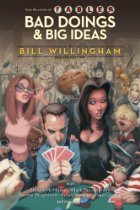
Bill Willingham’s Bad Doings and Big Ideas

Bill Willingham (writer and artist), and Mark Buckingham, Zander Cannon, Duncan Fegredo, Peter Gross, Paul Guinan, Nico Henrichon, Adam Hughes, Phil Jimenez, Michael Wm Kaluta, Jason Little, Marc Laming, Shawn McManus, Linda Medley, Albert Monteys, Kevin Nowlan, David Peterson, Paul Pope, Eric Powell, Ron Randall, John Stokes, Jill Thompson, Daniel Torres, Bernie Wrightson (artists), John Costanza and Todd Klein (letterers), Bad Doings and Big Ideas: A Bill Willingham Deluxe Edition (Vertigo 2011)

As I continue on my intermittent re-entry into the world of comics, which I abandoned at roughly 12 and came back to in my late 50s, it’s the non-fiction that I respond to most, and after that – oddly, since I don’t care for it in non-graphic narratives or movies – it’s fantasy-horror. Or maybe it’s not so odd, as it was Neil Gaiman’s epic Sandman that re-piqued my interest.

This hefty hardback full of horror was a Christmas gift, and one that gave me a lot of pleasure. Bill Willingham, I gather from his entertaining interstitials here, is a writer and artist best known for a series of comics called Fables. This is not that. It’s a collection of Other Stuff, including a number of adventures of minor characters from the Sandman universe. I don’t know what the uninitiated would make of these, with their injokes and unexplained walk-ons, but the stories stand up by themselves, especially the 60 or so pages of Thessaly the witch (the second half of which I read in its own book, also a gift, a while back).

The opening story, Proposition Player, is the longest (130+ pages) and most interesting. Willingham tells us it was the first thing he wrote for Vertigo, having been an artist with them for some time. It must have been quite a debut: the hero starts out working for a casino and ends up through a series of poor choices and successful gambles as the most powerful God (capital intended) in the cosmos. The gambles are much grander than Pascal’s bet, and I wonder if the story’s cheerful blasphemy does more damage to the cultural authority of established religion than the humourless argumentation of, say, Richard Dawkins.

I’m currently leading a double life as a reader. In one life, I’m reading a number of huge books, and in the other a whole lot of smaller ones as counterpoint. When I was reading Reamde, which is great fun but far too big to lump around in a shoulder bag, I read poetry books and literary journals, physically but not intellectually light. Now I’m a third of the way through Frank Moorhouse’s Cold Light, not as physically weighty as Readme, but quite a slog – the slogginess doesn’t make me want to give up on the book, but it does make me cry out for something lively to relieve the pain. Bad Doings and Big Ideas was perfect for the part. And I have a couple more Christmas present comics that are also looking good.