Two!

Last night the Hardware Gallery in Marrickville opened its fifth annual collaboration with The Sydney Gallery School. (The Gallery School is aka Meadowbank TAFE – threatened as are all TAFEs by a recent not much publicised COAG discussion paper. But this is post about good things in the present, not the whittling away of the public good in the near future.)

The collaboration is an exhibition entitled Rabbit Proof, featuring work by second and third year printmaking students at TGS and artists affiliated with the Gallery. It’s a charming exhibition, with more rabbits than anyone would care to poke a stick at, with Hopping Hare Alexis those who wanted alcohol. One of the prints is by her who is known here as The Art Student. At the end of the launch, only two works had sold two prints, and hers was one of them! Soon I really will have to drop the Student part of her nom de blog.

If you go to the Gallery website, you can see photos of some of the prints, including hers, ‘The Landing’, which plays around with one of the famous paintings of Cook’s landing at Botany Bay. You’ll recognise it when you see it.

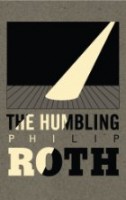
The Humbling of Philip Roth

Philip Roth, The Humbling (Jonathan Cape 2009)

I love Philip Roth’s prose, the way it seems to just flow directly from somewhere inside him, like lava or blood, yet always with extraordinary control of nuance. I haven’t read enough of his novels to know if The Humbling is representative of what he’s writing these days, but I do hope it’s not. I also hope the book isn’t a fictionalised representation of his current state of mind. Simon Axler, the hero, is a great stage actor who has suddenly lost his ability to act, and the agony of his loss is conveyed with such poignancy that it’s hard not to think Roth has been there, or has at least fantasised such a loss for himself.

What does a great artist do in such a situation? Well, first he doesn’t kill himself, then he commits himself into a psych hospital, then he’s discharged and after a while either kills himself or doesn’t (he does make a clear choice, I’m trying not to be too spoilerish). And that’s the whole story. Except for the second act where he falls in love with a much younger woman and has lots of increasingly exotic sex with her.

I believed in the despair. I accepted the falling in love. The specifics of the sex felt like an older man working hard to imagine how the young folk these days do stuff, what with all that queer theory and non-binary approach to gender they’re always going on about. Or maybe I was just embarrassed.

The Nobel Prize for Literature is to be announced in a couple of days and Philip Roth’s name is being mentioned again. If he gets up it won’t be on account of this book, but maybe it will cheer him up.

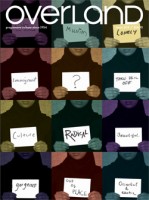
Overland 204

Jeff Sparrow, editor, Overland 204, Spring 2011

At a time where the terms of Australian political debate are set by the self-styled ‘centre-right’ Australian to the extent that vehemently anti-Communist Robert Manne is seen as left wing, everyone who’s more socialist than Ghengis Khan should subscribe to Overland. It has been appearing regularly for more than 50 years as a journal of ‘progressive culture’, unashamedly of the left from its beginnings, creating a space where dissenting voices can be heard (arguing with each other as often as not), and staying for the most part readable by people (like me) who wouldn’t know Althusser from a hole in the ground. Unlike the Australian, it has no Rupert Murdoch to prop it up. You can read most of every issue online. The point of subscribing is to help sustain it.

In this issue, in no particular order:

  • ‘The birthday boy’, a short story from an early Overland updated and retold in sequential art (ie, as a comic) by Bruce Mutard. While the story here stands on its own merits, I’d love to read the original, by Gwen Kelly, so as to follow the process involved in the updating (who were the 1955 equivalents of 2011’s Sudanese students, for instance?). I couldn’t find it on the Web. Maybe I’ll make a trip to the State Library …
  • John Martinkus, in ‘Kidnapped in Iraq, attacked in Australia’, tells the story of his capture and release by Iraqi insurgents in 2004 and the attacks on him by the then Foreign Minister and rightwing ‘journalists’. There’s nothing new here – I wrote to Alexander Downer’s office at the time and received a boilerplate reply – but it’s very good to be reminded of this shameful moment just now when Downer has been on the TV denouncing David Hicks again and one of the ‘journalists’ has been wailing about free speech after being held to account by a court
  • an interview with Afghani heroine Malalai Joya. I was glad to read this after attending a crowded meeting in Marrickville Town Hall where the acoustics and sight lines made her incomprehensible and invisible to me. The interview gives a sharp alternative to the mainstream media’s version of what’s happening in Afghanistan and it’s a great companion piece to Sally Neighbours’ lucid ‘How We Lost the War: Afghanistan a Decade on from September 11‘ in the September Monthly
  • some splendid, almost Swiftian sarcasm from Jennifer Mills in ‘How to write about Aboriginal Australia‘: ‘First, be white. If you are Aboriginal, you can certainly speak on behalf of every Aboriginal person in Australia, but it is best to get a white person to write down what they think you should be saying.’
  • Andy Worthington’s When America changed forever and Richard Seymour’s What was that all about? reflecting on the damage done to democracy in the USA and its allies by the ‘war on terror’
  • Reading coffee‘, a short story by Anthony Panegyres that reminds us of anti-Greek violence in Western Australia during the First World War (and is also a good oogie boogie yarn)
  • Ellena Savage’s ‘My flesh turned to stone‘, which I may have misunderstood (it quotes Lacan, and refers at one point to gender-based torture, which may or may not be how the academies nowadays refer to torture of women), but seems to be putting the eminently sensible proposition that terrible experiences have lasting after-effects on individuals and communities, and expecting people to just get over them isn’t realistic
  • A number of poems, coralled off together in a section up the back, printed in white on pale green, which is either a cunning way of making us read the poems slowly or a case of a designer for whom readability isn’t a priority. The ones that spoke most to me are Jill Jones’s ‘Misinterpretations /or The Dark Grey Outline‘ and John Leonard’s ‘After Rain‘. Jill Jones discusses the former on her blog here. You may have to be fascinated by swallows to enjoy the latter – which is very short – as much as I did, but who isn’t fascinated by swallows?
  • Peter Kirkpatrick’s ‘A one-man writer’s festival’, a hatchet job on Clive James’s poetic aspirations. I found myself asking why. The poor bloke’s got cancer. Leave him alone.

I didn’t read everything, which is pretty much a hallmark of the journal-reading experience. You can skip things because of an annoying turn of phrase on the first page (as in a reference to Sydney’s western suburbs as perceived as ‘some bloody hell, beginning somewhere around Annandale’ – Annandale! I doubt if that would have got past the editors in a Sydney-based journal). You might be put off because something looks too abstract, or promises a detailed discussion of a book you plan to read. Or you might be pre-emptively bored by anything about publishing in the digital age, even while admitting the subject is important.

I read this Overland in a grumpy post-operative state. And enjoyed it.

In praise of bricks and mortar bookshops

Last night, slightly stir crazy from four days of post-seroplasty languor, I went with the Art Student to a book launch at Gleebooks. The happy hour we spent there makes me realise all over that buying books online (not that I do it that much) strips away a whole wonderfully human dimension of the book-buying experience.

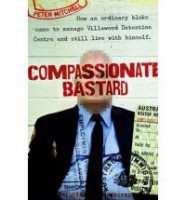
The book was Compassionate Bastard by Peter Mitchell. Upstairs at Gleebooks was crowded with a marvellous combination of family, friends and colleagues of the author, and almost as many again with no personal connection. The launch managed to have an intimate feel and at the same time be the kind of thing that should have been filmed and put up on Slow TV or whatever. [Later addition: Peter Mitchell turned up in the comments to say that all three speeches were videoed, and can be watched on his website.]

Ian McPhee, Minister for Immigration in the Fraser government in the early 1980s, launched the book, and John Menadue, head of the Department of Immigration then and later, spoke. Peter Mitchell, who is a poet in another incarnation, went to work for the Department of Immigration in 1990, getting ‘a real job’. He became Director of the Villawood Detention Centre until he resigned in 2003 – so he was there as the bipartisan agreement on immigration and refugees was torn apart by John w Howard, and the new harsh and inhumane treatment that persists until now was ushered in.

I won’t try to summarise what was said. Enough to tell you that it was incredibly heartening to be in a room with three men who have had close-up experience and responsibility for thinking about policy on refugees and asylum seekers, who are scathing about by the focus group driven debate that dominates the subject these days (they named no names later than Howard, but they didn’t need to), who have been thinking deeply about the subject. They didn’t make huge claims for the book – but they did a great job of selling it to us as a well-written, often funny and sometimes heartbreaking collection of stories that show us the human dimension of Australia’s mandatory detention policy.

Ian McPhee said this book was an excellent companion read to Carina Hoang’s The Boat People and David Marr and Marian Wilkinson’s book about the Tampa episode Dark Victory. He said that the Greens are the only ones in Federal Parliament who have a credible, humane, practical position on refugees.

Some snippets from John Menadue:
‘Mandatory detention does not deter. It only punishes.’
‘I think we can get back to decency, but we’re a long way from it now.’
‘The decency of Australian people is not shown by opinion polls, but with leadership it will re-emerge.’

John Menadue mentioned (with appropriate apologies, the Centre for Policy Development, which has developed a paper with the self-explanatory title, A New Approach: Breaking the Stalemate on Refugees & Asylum Seekers. There’s a meeting in the Sydney Town Hall on 13 October to discuss this paper.

Edwina Shaw’s Thrill Seekers

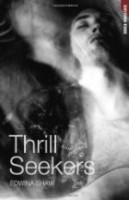
Edwina Shaw, Thrill Seekers (Ransom 2011)

This is a Cutting Edge title – part of a ‘gritty’ Young Adult series from Ransom Publishing UK. A gang of Brisbane children progress from mucking around in Oxley Creek to more risky adolescent thrills. In what might seem a standard children’s or YA literature trope, the father of the main characters dies in the first chapter, and their mother is pretty much lost in grief and alcohol. In what follows the young people go more and more out of control. There’s an awful lot of flagon wine (‘goon’) and marijuana, a range of other drugs, quite a bit of violence, some awful sex and a lot of wretchedness. The most vulnerable character goes horrifyingly, dangerously mad*. At the end there is a glimmer of hope.

That might make it sound like one of those ‘problem’ books for young readers that periodically stirs up the moral panic merchants. And maybe it is, but it’s a book with a lot of integrity. It treats its difficult subject matter without romanticising it, and without moralising. It resonated strongly with elements of three excellent books I’ve read recently: the dangerous play of Watch Out for Me, the heartbreak of After Romulus, the drugs and risk taking of The Life (blog entry to come when the Book Group meets), and the madness/psychosis/mental illness of all three.

Really, though, I can’t even pretend to write a sensible review, because the author is my eldest niece. It’s not that I worry I’ll seem nepotistic, and it’s absolutely not a matter of being tactful – as in, ‘I’m sure the target audience will love it.’ I can say up front that it’s a terrific book. But you know, even though Edwina is a mature woman, mother of two, teacher of yoga, blogger, disciplined writer, wise and warm lender of support to other writers including myself, she is still inseparable in my mind from the person whose exultant joy at being able to crawl I had the privilege of sharing more than forty years ago, and even though I know this book is fiction my avuncular heart recoils from following that cheerful little girl into these dark places.

Versions of some of the chapters have been published as short stories. You can read some of them online here and here. That last one didn’t make it into the book, and confirms my sense that, if anything, the world of the book has grown less harsh on its transition from book for general readership to a YA title.
——
* I’m deliberately saying ‘mad’ rather than ‘mentally ill’ or whatever . Raimond Gaita writes with characteristic acuteness about this kind of language in After Romulus (pages 71 to 74). Referring to the lines from King Lear, ‘Oh, let me not be mad, not mad, sweet heaven! Keep me in temper; I would not be mad!’ his discussion ends:

Lear’s cry is not heartrending because he suffers ‘social stigma’. And it would not move us as it does had he said, ‘Oh, let me not fall into bipolar disorder.’

Edwina’s story of Douggie includes the social stigma, but it also takes us into, using Gaita’s words again, ‘the unique terror that the word madness conveys’.

Not interesting yet …

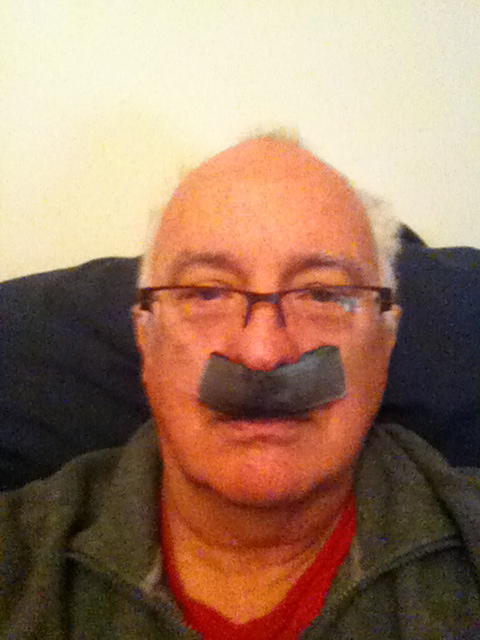
… but just in case it turns out to be a story later, here’s a photo of me last night:

I was home from an outing to the Sydney Day Surgery where very nice ENT surgeon went inside my nose and removed some polyps (which, as seen on a big screen, filmed by fibre-optic telescope, resembled giant slugs that wouldn’t have been out of place in a Doctor Who episode). While he was there, he opened up the entrances to my sinuses (procedure known as Functional Endoscopic Sinus Surgery), straightened my septum, trimmed my turbinates (Seroplasty).

It was a remarkably pleasant experience. Andy, the surgeon, operates on children as well as adults, and his bedside manner couldn’t be better. For example, when I made the decision t0 have the surgery rather than live with recurrent sinus infections and chronic stuffy nose, he said he not only approved the decision, but was personally glad because it’s his favourite procedure. It’s hard to imagine a better way to inspire confidence without undue solemnity.

I had one moment of terror before the event: I heard a male voice introduce himself as ‘the anaesthetist’ to someone in a bed the other side of a curtain from mine, and go on cheerfully, ‘I’ll just wheel you into the other room and give you something to pop you off to sleep and you’ll be right as rain in no time!’ I contemplated calling the whole thing off. But the gods of medicine were smiling on me. A completely different man arrived a little later, introduced himself as John, explained that his colourful headcloth was so as to be less intimidating to the children he’d been anaesthetising earlier, answered my questions about the anaesthetic in a sensible and almost intelligible manner.

The theatre was a cheerful, busy place with plenty of colourful headcloths. I’d been there less than a minute before I became first drowsy and then  … came swimming back into consciousness in another room hearing an interesting conversation about work visas. Then there was an awfully long wait, during which I amused myself composing clerihews of which I remember only one:

Tony Abbott
‘s grab at
being prime minister
is looking more and more sinister.

Some cheese and tomato on biscuits, a glass of lemonade, visits from John and Andy, instructions from the Polish nurse (who was amused rather than offended when I thanked her by saying ‘Spasibo’, which it turns out is Russian, and very different from the Polish ‘Dziekuje’), and the Art Student drove me home.

I have to wash my nose out four times a day, and it’s not all pleasant in there, but so far I haven’t had any pain at all. I’m told my nose will swell up and look horrible in a couple of days. If it’s interesting enough I’ll post another photo.

Normal book blogging will resume shortly.

Robert Manne and the Australian

Robert Manne, Bad News: Murdoch’s Australian and the shaping of the nation (Quarterly Essay N0 43, 2011)

These days I keep up with the Murdoch commentariat mainly at second hand, most regularly by way of the delightfully caustic Loon Pond, where someone identifying as lapsed Catholic ‘Dorothy Parker’ from Tamworth holds a satiric mirror up to their venomous name-calling, impassioned defence of the rich and powerful, and self-serving illogic.

I guess everyone knows what kind of beast the Australian is, though it’s striking how reluctant people are to say so in public. On the Book Show just last week, for example, someone said that it was perceived ‘rightly or wrongly’ to be right wing, and Chris Mitchell, editor-in-chief, describes it as centre right. Robert Manne’s essay grasps that nettle and at the same time demonstrates that people have good reason to be cautious in calling a spade a spade in this matter. He has done a careful analysis of a number of case histories: its impassioned promotion of Keith Windschuttle, an amateurish historian with an agenda, to a major player in Australian culture wars; its unremitting support for the invasion of Iraq, and complete failure to acknowledge having got so much wrong; the bullying of Media Watch and the ABC until Australia’s only major non-commercial source of news and opinion was running scared; the bizarre attack on science and reason in its coverage of climate change; its elevation of itself to key political player in first supporting and then campaigning against Kevin Rudd; and, most appallingly of all, its sustained attacks on individual tweeters, one for correctly reporting a negative public comment from a former Australian employee, the other for what was manifestly a joke that would have been cleared up by a simple apology if the Australian hadn’t made it the subject of no fewer than five front page stories.

I had to stop reading every now and then to go out and get some fresh air.

This wouldn’t matter so much in, say, the Green Left Weekly, though I doubt of the GLW would ever be so vicious in attacking someone who wasn’t a high-profile millionaire. But Rupert Murdoch controls a huge percentage of the Australian print media, and the Australian is his heftiest newspaper. I learned in this essay that at some press conferences in Canberra more than half the journalists are from the Australian, that the members of what Robert Manne calls the political class read it without fail, that it is influential out of all proportion to its actual circulation.

People who depend on the Australian for their national and international news in print (and it is after all the only major national newspaper we have) need to read this essay. As always, Manne’s writing is lucid, his tone judicious even at his most combative – and he does get combative. I believe there have been no fewer than eight vigorous replies in the newspaper. I read only one, and if the others distort Manne’s arguments as blatantly as that, it’s all the more important that readers of the Australian read the actual essay.

Strikingly, one line of attack has been to say that Manne is arguing for censorship, for closing down debate. Yet Paul Kelly, the Australian’s editor-at-large, pulled out of a scheduled debate at Melbourne’s Wheeler Centre last week, and no one from the Australian could be found to stand in for him. So actor Max Gillies read the bulk of Kelly’s published response. You can see the Slow TV of the ‘debate’ here. You can read Manne’s ‘deconstruction’ Kelly’s published response on Manne’s blog, here. I have no idea why Kelly and the rest declined a debate, but if my arguments had been taken apart so very deftly I would probably remember a previous engagement too. All the same, it’s a bit rich to accuse someone of wanting to shut down debate and then refuse to engage in a debate with them outside the protective confines of Rupert Murdoch’s flagship. Even more striking is the Australian‘s report on the Australian‘s no-show – at this point I weaken and give you a link: the journalist seems to be suggesting either that this was an excellent prank on the part of Kelly and Co, or that it would have been completely unreasonable to expect Kelly and/or others to actually face the big bully, who threatened to use reason at them.

This must be the most vigorously discussed Quarterly Essay yet. I wonder what editor Chris Feik will do for the correspondence section in the next issue. I imagine he will need to allow some space for the Australian‘s apologists (though they may well decide to ignore that opportunity as well). I hope he will also find space for comment along the lines of Tad Tietze post on the Overland blog, which while appreciating Manne’s careful accumulation of evidence, goes on to offer interesting observations from a left perspective.

360 Killer video

Another video with one of my creative sons behind the camera:

joanne burns’s amphora

joanne burns, amphora (Giramondo 2011)

In the question time at a poetry session of this year’s Sydney Writers’ Festival a member of the audience complained that ‘most modern poetry’ is deliberately obscure, doesn’t use rhyme or rhythm, and is generally not reader-friendly. He might have had Joanne Burns in mind: apart from infrequent commas and an occasional dash or semicolon she mostly eschews punctuation, she rarely writes metric verse (presumably what the questioner meant by ‘rhythm’), she uses big words, makes frequent reference to other poets and (in this book at least) religious arcana, and she often wanders down trails of seemingly random association. But, you know, spend a bit of time with her poems and chances are you’ll come away feeling oddly refreshed.

For example, the third of amphora‘s seven sections, entitled ‘streamers’, is described in a subheading as ‘a series of koannes’. I imagine everyone knows what a koan is – or at least, like me, knows that ‘What is the sound of one hand clapping?’ is one. Almost idly, I went to Google to check my initial assumption that ‘koanne’ was an alternative spelling. Apparently not, said Mr Google. Then I realised that the word was a playful invention, combining the poet’s first name with the zen challenge to the rational mind: so the reader is given fair warning to expect some kind of idiosyncratic almost-sense, not to struggle to make sense, but to let the non-sense play around in one’s brain. Some of them work brilliantly:

you miss the bus
before it arrives how easy
to change the lightbulb

(Incidentally, the lack of punctuation here doesn’t really cause difficulty; it just slows the reading down.)

I found the whole book engaging, but it was the second section, ‘soft hoods of saints’, that spoke to me: a Catholic child’s perspective on stories of the saints nostalgically recalled, overlaid with adult erudition, mashed up with high and low cultural references and approached with a wry, mostly affectionate, probing intelligence. From ‘haggle’:

saints show us who we aren’t. impossible to imitate. our prayers too fast. impatient. saints and their trust in their god. slow and endless. wearing belief like soft hoods. invisible protective. we can only gawk at their images, legenda. in the holy cards many saints are accompanied by floral arrangements. flowers. do saints have flaws. once they are officially saints surely all flaws must hit the floor to be swept away in the giant hagionic broom

This is fun, but something serious is happening as well.

My blog posts about the books I’ve read don’t pretend to be responsible reviews. If you want to read an excellent, exploratory discussion of amphora, I recommend Martin Duwell’s review posted on 1 June this year.

The wolf and honeybee draw near

The Wolf and Honeybee cafe is no longer a promising cloud on the horizon. It’s overhead and looks ready to send the welcome rain to a parched land (well, the land isn’t really parched, but it will be nice to have the cafe open.)

This slideshow requires JavaScript.