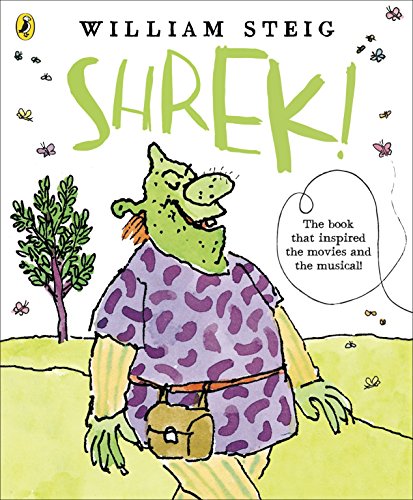
We recently watched the original Shrek movie with our grandchildren, and all four of us enjoyed it. Both our children were adults in 2001 when it was made, and grandchildren were a long way off, so I hadn’t seen the movie before, though though I’d seen clips. Nor had I been drawn into the rest of the Shrek franchise – half a dozen movies, a Broadway musical, a theme park beside the Thames. But I was aware that behind it all was a book by the great children’s author-illustrator William Steig.
When we told our six-year-old, a voracious reader, about the book she was interested, so we borrowed a copy from the library.
The six-year-old read it, said she had enjoyed it, then put it aside. I read it to the four-year-old, he said he enjoyed it, but didn’t demand an immediate reread.
I think it’s a case of the movie adaptation of a book making the book unreadable – not in the sense that it’s a difficult or unpleasant experience, but that the much broader, louder, and sentimental effects of the movie make the sly, deadpan humour and linguistic charm of the original almost impossible to discern. For example, in the movie, Shrek’s love interest starts out as a stereotypically beautiful princess, and when (spoiler alert!) she turns into an ogre she still has a degree of feminine cuteness. The love interest in the book is hideous on first encounter and remains hideous: we are never invited to see past her or Shrek’s surface ugliness to their inner beauty and goodness. Steig’s book doesn’t lose its nerve. The central joke, that the hero and then his love interest have no redeeming qualities, holds firm, and the book trusts its readers to get it. We quite like that they are pleased with themselves and each other, but we don’t have to like them at all.
That reversal of conventions and the absence of reassurance are what make the book fun.
The pages of our library copy aren’t numbered, but by my count, this is page 7:
As you can see, William Steig’s Shrek has none of the movie Shrek’s gross charm. He’s just gross.
A witch has sent Shrek on a quest to find the princess he will wed. On the previous page he has encountered a peasant scything a field. The peasant has uttered a few lines of verse about his unconsidered life, and now this.
The rhyming wordplay – Pheasant, peasant … pleasant present – is typical of the joyful use of language throughout the book. The unconscious peasant, blue in the face where on the previous page he was a healthy pink, didn’t cause any evident distress in our young readers. I think they got the joke. It’s typical of Steig’s respect for young readers that he doesn’t spell out how the peasant lost consciousness. (We love Steig’s Doctor De Soto and Sylvester and the Magic Pebble for their similar tact.)
I wrote this blog post in Gadigal Wangal country. I acknowledge Elders past, present and emerging for their continuing custodianship of this land, over which their sovereignty has never been ceded.
* My blogging practice is generally to focus on the page that coincides with my age, currently 77. For short books like Shrek, I am stuck with page 7.
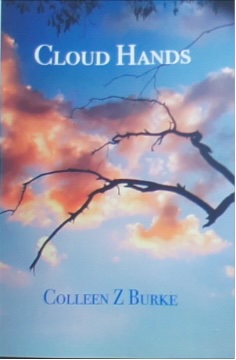
Cloud Hands is Colleen Z Burke’s thirteenth book of poetry.
As in those of its forerunners that I’ve read, its typical poem is a short, impressionistic snapshot of landscape, or especially skyscape, mostly in the inner-west Sydney suburb of Newtown. As snapshots, these poems are mostly embedded in a specific moment, a specific circumstance, so we often get a sense of the life of the person taking the shot, and of the broader context.
There are also memories of a working-class childhood. ‘Each Way’, about gambling as part of the family’s way of life, begins, ‘Minor crime was woven / into our lives just like / the salty tang of the sea.’ (I can relate: my own family of origin wasn’t working class, but my farmer father, like Colleen Burke’s, was a patron of illegal SP bookies.)
There are a three poems (‘Illusion’, ‘A nefarious enterprise’ and ‘A magnet’) recalling youthful romance. Colleen’s partner was Declan Affley, the folksinger who accompanies Mick Jagger’s terrible rendition of ‘A Wild Colonial Boy’ in Tony Richardson’s 1970 movie Ned Kelly. Though it is many decades since he left us, he is still a vibrant presence in these poems.
There are people-watching poems, incidents from inner-suburban life, comments on the news, snippets of science and social history. Covid and the bushfires of 2019–2020 loom large. Climate change and environmental degradation threaten to sour the joys of the natural environment.
This is a collection that bears witness to a persistent practice of paying attention – to the world, to history, to life.
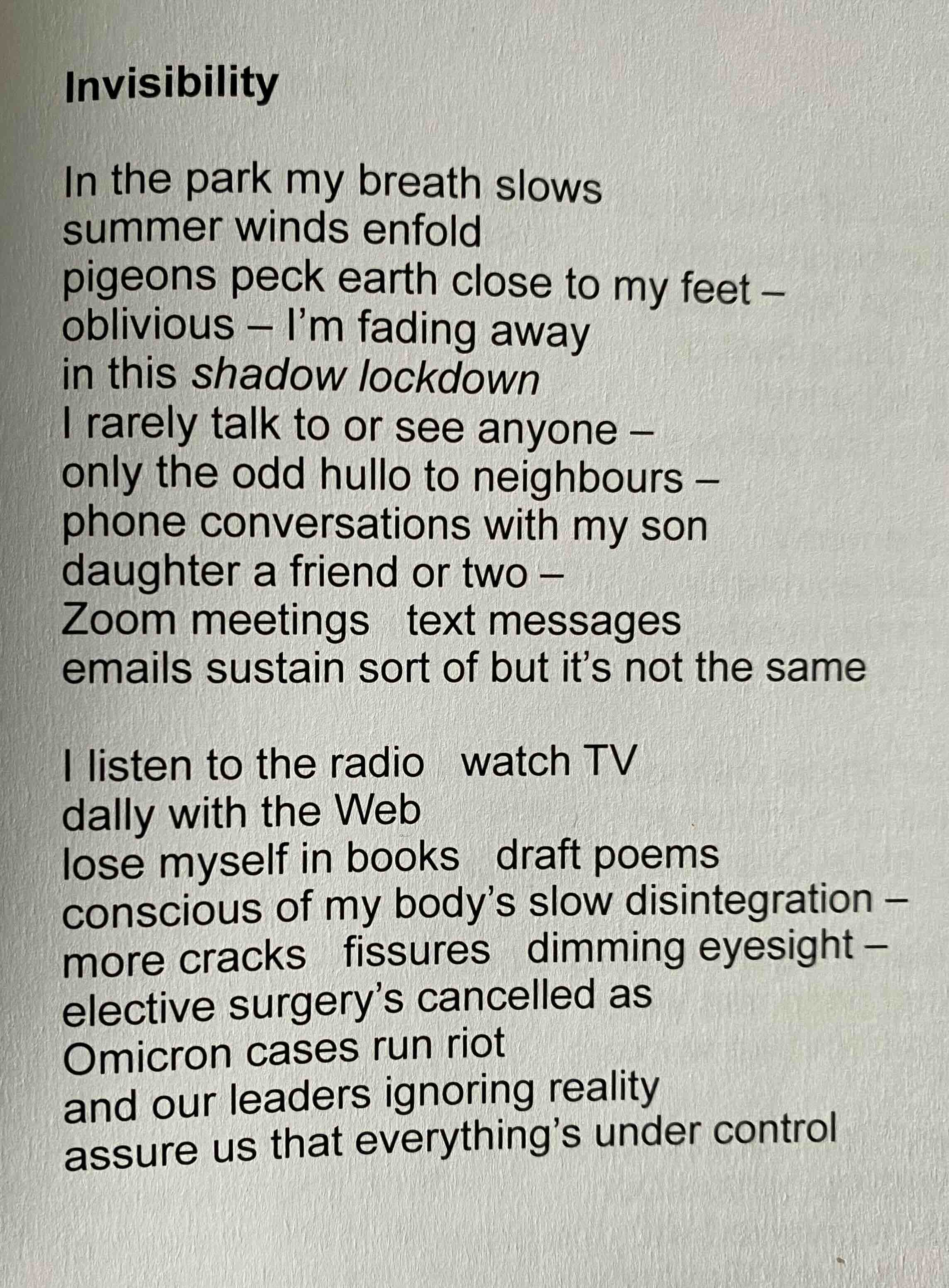
Page 77* is ‘Invisibility’:
Yes, page 77 of the last book I read had a pigeon poem too. But here the pigeons are oblivious rather than chatty, and the despair in the poem is not worn lightly.
This poem is a great example of the value of slow reading. At first quick reading, it’s a straightforward cry of the heart from the dark days of January 2022, when the Omicron variant of Covid was on the rampage in Sydney. In case you need reminding, there were no official restrictions on movement at that time, but Australia had moved from having a remarkably low level of serious illness and death from Covid to having among the highest. The assistance to individuals and businesses from the Federal government had largely dried up, and the Prime Minister of the time was trumpeting a business-as-usual message. Here’s a link to Mike Secombe on that nightmare in The Saturday Paper.
So this poem is, perhaps, an unremarkable record of how one woman suffered in that time: she has minimal contact with other people, she fills her time with solitary activities, and her age-related health issues go unattended to. Like most of us, she finds fault with the Morrison government’s handling of the situation.
That’s all there. But, interestingly, after I started writing this blog post I had a number of conversations that kept sending me back to the poem. One person spoke about a gobsmacking experience using the (I think) Apple Vision Pro goggles – it was as if he was in the room with a musician, could almost touch her. Someone else is reading Naomi Klein’s Doppleganger, and described her account of people involved in the riots of 6 January losing track of the difference between the gaming world and the actual world where there are consequences. Burke’s ‘sort of but it’s not the same’ stops feeling like a banal statement of the obvious and takes on a profound resonance. The poem expresses one woman’s feelings in a specified circumstance, but it sends ripples out well beyond it.
The other thing I noticed as I sat with the poem, or had it sit with me, is the part played by the pigeons. The poem begins, like many of Burke’s poems, with a moment of relaxation in the park – the breeze, pigeons, the earth, her breath slowing down. Then, with the word ‘oblivious’, it turns to the poet’s inner turmoil. The pigeons might have provided a calming anchor, their obliviousness an invitation to pay attention to the present moment. But it was not to be. Skip to the final lines, and the notion of obliviousness returns to round out the poem with ‘our leaders / ignoring reality’. The poem’s speaker is invisible to the pigeons who are engrossed in pecking the earth. She is also invisible to the political leaders who deny that the coronavirus is out of control. The tension between the pigeons’ focus on reality and the political leaders’ wilful ignoring of it is what holds the poem most satisfyingly together.
You can read my blog posts on some of Colleen Z Burke’s previous books here, here, here and here, and on her memoir The Waves Turnhere.
I wrote this blog post in Gadigal Wangal country, where I believe Colleen Z Burke also lives. I acknowledge Elders past, present and emerging for their continuing custodianship of this land, over which their sovereignty has never been ceded.
* My blogging practice, especially with books of poetry, is to focus on the page that coincides with my age, currently 77.
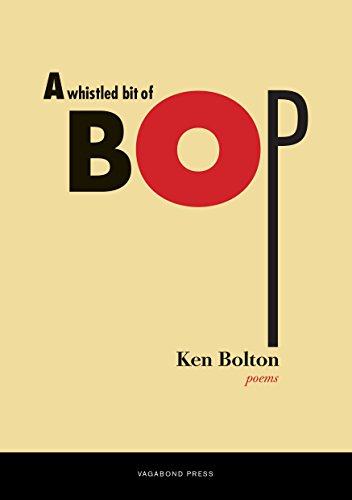
I recently heard a British podcaster describe Louis MacNeice as ‘a highbrow ordinary bloke.’ The implied combination of approachability and erudition struck me as a spot-on description of Ken Bolton in these poems.
As the book’s biographical note tells us, Bolton is a prolific art critic and journal editor as well as a poet. As if to emphasise his intimidating high-browness, the back cover blurb speaks of poetic abstraction and lists members of a ‘pantheon’ who appear in the poems: a timid reader who wasn’t sure who Ashbery or Berrigan are (note the use of second names only – the highbrow equivalent of Cruise and Nicholson), or had never heard of F T Prince or Peter Schjeldahl, might quail.
It’s true that the poems fairly bristle with erudite references. But when one turns to the endnotes for help, here’s part of what they say the second poem in the book, ‘Europe’:
As with many of these poems there are references to art – to Winckelmann, Mengs, Jacques-Louis David – but as the joke is that they are so little thought of now it would be perverse to explain them here.
I stopped worrying about my ignorance, and started getting the joke.
In these poems, an ordinary bloke hangs out in cafes people-watching, or stays up late writing to his adult son on the other side of the planet, broods about friends alive and dead, meditates on art and poetry, and (so it generally feels) somehow lets the flow of his mind find its way onto the page. It’s a lively, questioning, self-conscious and sometimes self-mocking mind. You really don’t need to know who Winkelmann is to have fun reading ‘Europe’. Probably it’s more fun for better educated readers, but that’s not a reason to be intimidated.
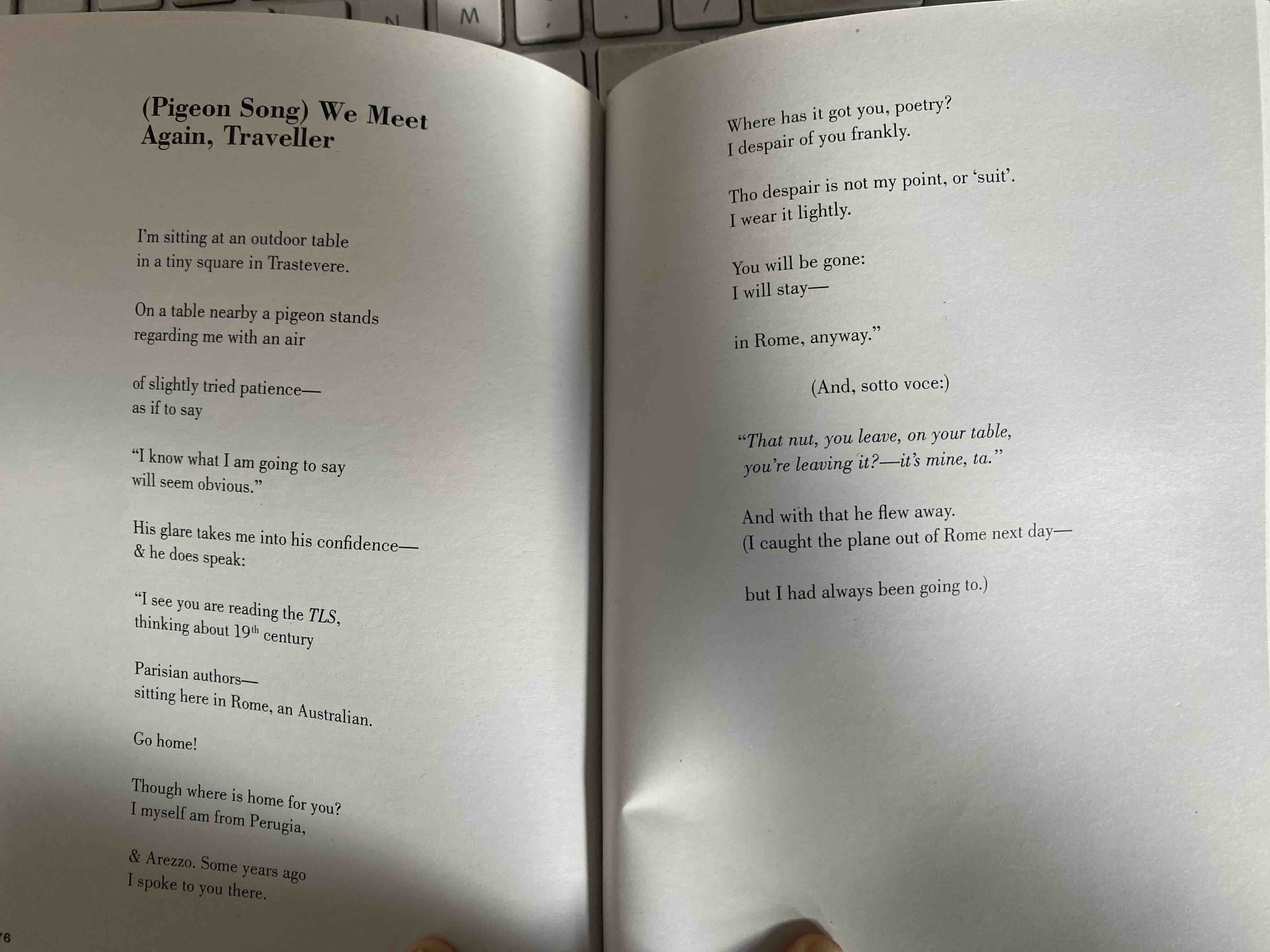
I loved the whole book, but I’ll keep to page 77*. It’s the right-hand side of the spread containing ‘(Pigeon Song) We Meet Again, Traveller’ which, by sheer good blogging fortune, is the shortest poem in the book. Click to enlarge this image:
Not strictly part of the poem, there’s an endnote:
Pigeon Song: a white pigeon with reddish brown flecks on it & around one eye. Strangely the bird had no accent, & spoke in English.
It’s a quietly comic poem in which an Italian pigeon questions an Australian poet about his life choices, after which both pigeon and poet do what they would have done if the conversation hadn’t happened. I hope I won’t make it any less enjoyable by doing a little ‘slow-reading’. With a lovely light touch, it airs some serious issues.
First the title. Its complexity is explained by yet another endnote: the words in brackets, ‘Pigeon Poem’, were a working title, and ‘We Meet Again, Traveller’ is the title finally settled on. Showing his working in this and other ways is one of the things I love about Bolton’s poetry: he lets the reader in on his process. Apart from the title, there’s not a lot of that in ‘We Meet Again, Traveller’. The comic endnote makes up for that absence a little: it implies that the fantasy is based in a real-life moment, and suggests that Bolton may have considered having the pigeon speaking in Italian or with an accent, but – happily – rejected both options.
The action of the poem takes place, typically, in an intellectual ambience. Bolton is sitting at a cafe table in Trastevere, a cool part of Rome that’s home to four or five academic institutions, where sitting at a table reading a literary journal wouldn’t stand out. (As even middlebrow ordinary blokes know, the TLS is the Times Literary Supplement.)
But there’s nothing rarefied or highbrow about the pigeon. Who among us, sitting alone at an outdoor table, hasn’t felt judged by a beady-eyed pigeon (or ibis if you live in Sydney)? This particular judgmental pigeon voices something of the complex unease of being a settler Australian poet, deeply meshed in European culture with an unresolved relationship to the actual land where one lives:
I see you are reading the TLS,
thinking about 19th Century

Parisian authors –
sitting here in Rome, an Australian.

Go home!
London, Paris, Rome, Australia, past and present: it’s complex. I’m reminded irresistibly of a music hall ditty I loved as a child (and which, as a complete irrelevance, I once heard the late Dorothy Hewett sing):
Why does a red cow give white milk
when it always eats green grass?
That's the burning question.
Let's have your suggestion.
You don't know, I don't know, don't you feel an ass?
Why does a red cow give white milk
when it always eats green grass?
The pigeon then asks a key question with characteristic Boltonian (Boltonic?) lightness of touch.:
Though where is home for you?
If you are so immersed in European culture, is your home in a physical location or in a less tangible ‘place’? As in the music hall song, the burning question goes unanswered.
The pigeon knows where its home is, though it too has travelled. Then:
and Arezzo. Some years ago
I spoke to you there.
This may be referring to an earlier Bolton pigeon-poem that I haven’t read, or to a time when he visited Perugia in real life, perhaps to study at the Università per Stranieri. (Decades before Duolingo, Perugia was often mentioned among Australians of a certain age and education as a place to go to learn Italian.) The content of that earlier conversation, whether the subject of an earlier poem or not, was evidently the Bolton’s poetic aspirations:
Where has it got you, poetry?
I despair of you, frankly
But then, having dipped by pigeon-proxy into the well of settler-anxiety, self-doubt and possible despair, the poem returns to lightness. (I’ll just note in passing that I don’t understand the word ‘suit’, or why it’s in inverted commas – any help welcomed in the comments.) The pigeon, dropping its role as cultural challenger, asks the question that’s actually on any judgemental-looking pigeon’s mind. And both pigeon and poet fly away, as they were both going to anyway.
The poem consists of eighteen stanzas, most of them couplets. I can’t say much more than that about the form, except it’s good to notice the use of rhyme in the last third of the poem: stay, away, sotto voce, away, day. Reading those lines aloud, the rhyme creates a sense of relief that the awkward conversation is over: things flow easily. The pigeon’s sotto voce couplet about the nut and the final line both depart from the rhyming flow, suggesting that bird and poet both now exit the staged conversation.
I wrote this blog post in Gadigal Wangal country, where it is my great joy to live, as a settler Australian who tries to remain aware of unceded Indigenous sovereignty. I acknowledge Elders past, present and emerging for their continuing custodianship of this land.
* My blogging practice, especially with books of poetry, is to focus on the page that coincides with my age, currently 77.
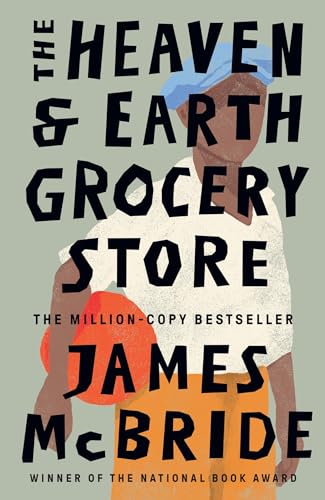
Before the meeting: Though this is the first book by James McBride that I have read, he has featured in this blog before, as the author of The Good Lord Bird, one of the Emerging Artist’s best five books of 2014 (link here). That book won the USA’s National Book Award. According to his Wikipedia entry, The Color of Water, a 1995 book about McBride’s African American and Jewish family history and his relationship with his white mother, is widely regarded as an American classic.
The Heaven and Earth Grocery Store is his sixth novel, set in 1925, mainly in Chicken Hill, a ‘ramshackle neighbourhood’ of the Pennsylvania city of Pottstown (Pottstown exists in real life; Chicken Hill not so much as far as I can tell). The store of the title is run by Chona, a Jewish woman, whose husband Moshe runs a neighbourhood theatre. As most of the Jews leave Chicken Hill for more salubrious neighbourhoods, Chona and Moshe remain and, swimming against the tide of their times, continue to serve and welcome the presence of their African American neighbours (always ‘Negroes’ in this book). At the heart of the book is a celebration of friendship and alliance between Jews and Blacks, plus a significant Italian or two.
The book runs to 381 pages, so page 77* occurs at about the one-fifth point. If a conventionally structured Heaven and Earth Grocery Store film were to be made, I imagine that the events on this page would come much earlier, at the 10 percent mark, when the Inciting Incident is due. The set-up has been established: a death has been foreshadowed; we’ve met Moshe and Shona and the main African American couple, Addie and Nate, who work in the shop and the theatre respectively; we’ve seen the theatre and the grocery store in action; we know the story of Chona’s chronic illness and disability; we’ve met the book’s villain, Doc Roberts, who comes from ‘good white Presbyterian stock’ and marches every year with the Ku Klux Klan. It’s time for the first turning point.
Nate has told Moshe about his ten-year-old nephew, Dodo, who recently started working in the theatre. He was made deaf by an accident, and his mother has died.
Nate’s brow furrowed and his old hands moved up and down the broom handle slowly. He said softly, ‘Me and my wife’s got him.’
Moshe looked down at the floor a moment, embarrassed. It rarely occurred to him that he and Nate shared one commonality. Neither of their wives could bear children. They had worked in the theater all day side by side for twelve years but rarely discussed their wives or matters of home.
Their relationship is already changed by this conversation. The distance imposed by their histories is being bridged. The rest of the conversation introduces the book’s main external action.
‘Well, I think that’s fine,’ Moshe said. ‘You can run things as you like.’
Nate’s brow furrowed. ‘A man from the state come to the house last week. Says he’s gonna carry Dodo off to a special school over in Spring City. Dodo don’t wanna go to no special school. He’s all right here with us.’
Moshe’s heart quickened. He felt a request coming, but Nate continued. ‘The man says he’s coming back to fetch him next week. I’m wondering if you might let me slip Dodo into the theater here tonight, just for a few days till the man goes away. The boy’s quiet. Can’t hear nothing. Won’t be scared or make no noise. He can work good, clean up and so forth.’
‘For how long?
‘Just a couple of days till the man’s gone.’
Knowing where this passage occurs in the book, you would almost certainly guess – correctly – that those few days will expand, and the small favour will balloon into something that changes all their lives. As it turns out, when Moshe tells Chona the situation, she insists that they take Dodo into their own home, and he becomes a much loved member of their family until, in spite of their careful strategies to keep him hidden from the authorities, he is taken from them to a ‘special school’, which is in fact a prison-like institution for people deemed insane. Doc Roberts is key to that removal.
The second half of the book is given over to plans to free Dodo. Relationships between Jews, Blacks and poor Whites flourish. Nate’s back story emerges from the shadows and the man who we first meet as the genial, ageing employee shows a dark side that leads to the book’s one shocking moment – shocking because the reader, or at least this one, cheers on a terrible act of violence.
Doc Roberts and his ilk are embodiments of callous, racist, antisemitic hypocrisy and not much else. There’s a subplot to do with water supply to the synagogue that had me wondering why it was there at all until at the very end it joins the main plot to lead to the death mentioned on the first page. (Not really a spoiler.)
The meeting: We discussed this book along with Elif Shafak’s There Are Rivers in the Sky. We seem to be developing a tradition in the Book Club of having a dedicated nay-sayer at each meeting. This month’s nay-sayer said she had had read this one first, and felt it was built from hackneyed tropes with nothing fresh to offer. Then she read There Are Rivers in the Sky, and revised her view upwards. Our non-finisher had the reverse view – based on a small taste of each book, this one was much less gripping.
Such faint praise aside, we had an animated discussion. One person’s bug turned out to be another’s feature. For example, Chona’s neighbour Bernice was once her best friend but they have been estranged for decades, yet when she asks for help in concealing Dodo from the authorities, Bernice is willing to put herself on the line. One person saw this as inconsistency in the character; another saw it as reflecting the nature of the community – solidarity trumping personal animosity.
There’s a sequence in which two young disabled men – one deaf and the other with severe cerebral palsy – work out a way to communicate. ‘Unbelievable!’ someone said. ‘But brilliant!’ someone else replied. It turned out they both meant pretty much the same thing.
Our Book Club meets on the land of Gadigal and Bidjigal, looking out over the ocean. I wrote this blog post further inland in Gadigal Wangal country, where I am priivileged to live. I acknowledge Elders past and present for their continuing custodianship of this land.
* My usual blogging practice is to focus on the page that coincides with my age, currently 77. Sometimes, as here, it’s a crucial page.
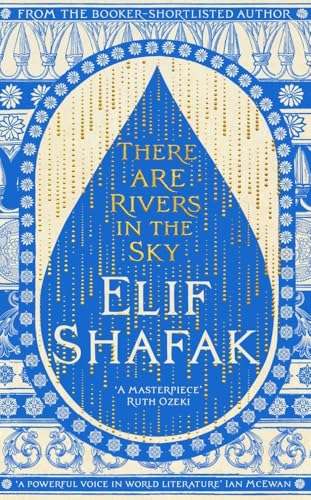
Before the meeting: I’m glad I read this novel. I am much better informed now on the history of the Yazidi people, and about the unearthing of the Epic of Gilgamesh in the mid 19th century.
After a short opening chapter featuring the tyrant Ashurbanipal in ancient Nineveh, the narrative follows three distinct threads, which remain separate until the final, very short chapter.
There’s Arthur, full name Arthur King of the Sewers and Slums, a fanciful version of the amazing George Smith who decoded the cuneiform script of ancient Mesopotamia, translated the Epic of Gilgamesh and travelled to Nineveh in the mid 19th century. There’s Narin, nine years old at the start, living in south-east Turkey in 2014, child of a shrinking and beleaguered Yazidi family. And there’s Zaleekhah, a 30-something hydrologist in the throes of a break-up in 2018, who we first see renting a houseboat on the Thames.
A number of motifs occur in each of the stories, so that they resonate with each other even there is no evident narrative connection: images of lamassus, the protective spirits of ancient Nineveh who have bearded human heads and lions’ bodies; pieces of lapis lazuli; cuneiform script, on clay tablets or in tattoos; references to TheEpic of Gilgamesh; and above all water. The book begins:
Later, when the storm has passed, everyone will talk about the destruction it left behind, though no one, not even the king himself, will remember that it al began with a single raindrop.
That raindrop has no causal impact on events, but the identical drop, having lain dormant in the water table, floated in the ocean, wafted about in clouds, turns up again at crucial moments of each narrative, as a snowflake or ocean spray or another raindrop. That conceit, and the way the narrative frequently pauses for mini-lectures – on hidden rivers, the industrial revolution, Yazidi culture, Napoleonic archaeology, etc etc – meant I spent a lot of time being irritated. The fourth wall is forever being broken, either by a mention of water (at least four times there are sweating necks, or a character introduces herself by saying her name is short for an Irish word for water) or by what reads like a piece of undigested research.
Page 77*, it turns out, has some fine examples. Zahleekha has just stepped into her houseboat for the first time. First there’s the water, with heavy-handed metaphorical significance. She drinks a mug of water ‘in one draught’, and:
It tastes earthy and slightly metallic, with an aftertaste of iron. The flavour has less to do with its intrinsic qualities than with its biophysical environment, the set of conditions that brought it about. Water hardens in adverse circumstances, not unlike the human heart.
Then comes the lecture, preceded by a moment of backstory:
Out of nowhere a memory surfaces – the words Uncle Malek uttered the day she had graduated from university with honours. I’m so proud of you, habibti. I want you to be very successful. Remember, people like us cannot afford to fail.
‘People like us’ … immigrants, exiles, refugees, newcomers, outsiders … Too many words for a shared, recognisable sentiment that, no matter how often described, remains largely undefined.
Children of uprooted parents are born into the memory tribe. Both their present and their future are forever shaped by their ancestral past, regardless of whether they have any knowledge of it. If they flourish and prosper, their achievements will be attributed to a whole community; and, in the same way, their failures will be chalked up to something bigger and older than themselves, be it family, religion or ethnicity.
Then, after a little more along the same lines, Zahleekhah sits down and after a moment starts to cry. But rather than allow the reader space for empathy, the narrator sweeps in with her insistence on water as ubiquitous and rich with symbolic meanings:
A tear falls on the back of her hand. Lacrimal fluid, composed of intricate patterns of crystallised salt invisible to the eye. This drop, water from her own body, containing a trace of her DNA, was a snowflake once upon a time or a wisp of steam, perhaps here or many kilometres away, repeatedly mutating from liquid to solid to vapour and back again, yet retaining its molecular essence. It remained hidden under the fossil-filled earth for tens if not thousands of years, climbed up to the skies and returned to earth in mist, fog, monsoon or hailstorm, perpetually displaced and re-located. Water is the consummate immigrant, trapped in transit, never able to settle.
Again, I’m glad I read this book. But I was annoyed a lot of the time while reading it.
After the meeting: We read There Are Rivers in the Sky along with The Heaven and Earth Grocery Store by James McBride. There were five of us, well-fed by the time we got to the books. We began with confessions: only one person hadn’t read either book, and she had read ‘about 35%’ of this one. She spoke eloquently about what she liked in what she had read – mainly the evocation of polluted, foul-smelling mid-19th century London – which makes me think it’s probably a good idea to have someone in any group who hasn’t finished the book.
Of those who had read to the end, we had a range of responses. One enjoyed it, only peripherally put off by the telling-not-showing and heavy-handed deployment of the leitmotifs. Onehad been enthusiastic abut the book because she hoped it would have interesting things to say about Gilgamesh and appreciated much about it, but was disappointed and disliked being lectured at. And the other just found the book tedious, would rather have read a non-fiction treatment of the history and persecution of the Yazidi, couldn’t feel any of the characters as more than made-up figures to allow the plot to move. And there was me (see above).
We all agreed that the most interesting thing in the book was the character of Arthur. Born in abject poverty, his photographic memory and a series of Dickensian coincidences (one of them featuring Charles Dickens) led him to interesting places, and fixation on a book about Nineveh as a way of dealing with the pain of brutal beating led to a grand obsession that gave The Epic of Gilgamesh to the modern world. I now want to find out more about the real-world George Smith, but I’m very happy to have Arthur in my mental world as distinct from him.
I wrote this blog post in Gadigal Wangal country, in a place where wetlands have been drained, but the river is recovering health, is home to a marvellous variety of birds, and is a great place for catch and release fishing (one day the fish may be edible again). I acknowledge Elders past, present and emerging for their continuing custodianship of this land.
* My blogging practice is to focus on the page that coincides with my age, currently 77.
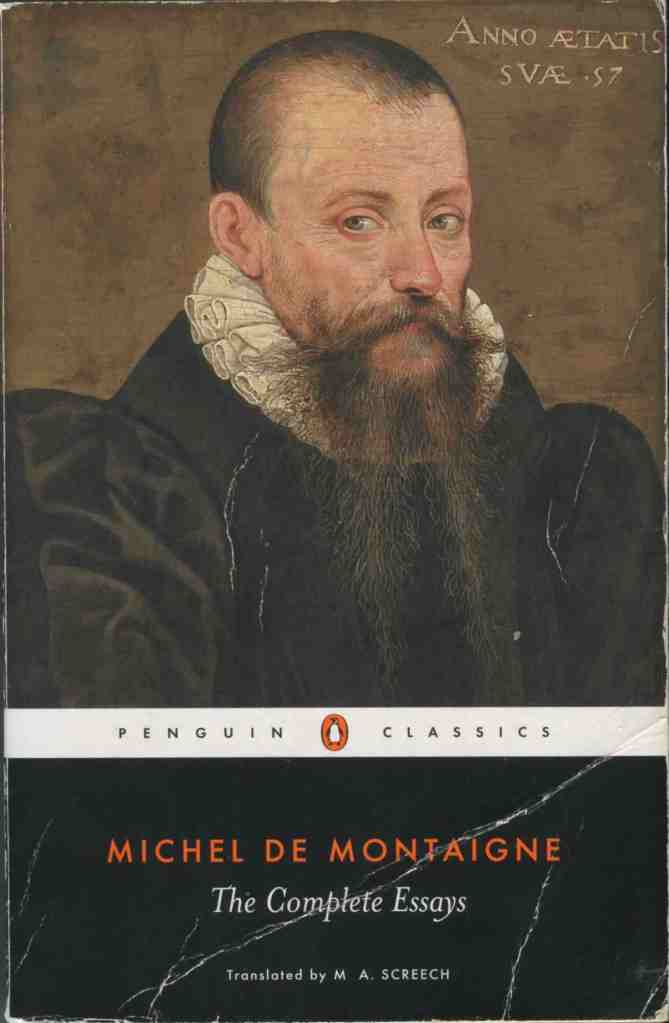
Michel de Montaigne, The Complete Essays (Penguin Classics 1991, translated by M. A. Screech) – part way through Book 2, essay 17, ‘On presumption’ to part way through ‘On the resemblance of children to their fathers’
These aren’t so much progress reports as monthly snapshots from my reading of Montaigne’s Essays four or five pages a day. Last month I was part way though ‘On presumption’ and enjoying his unflattering self-portrait. That essay became even more fabulously self-deprecatory, including this (on page 730):
As for music, either vocal (for which my voice is quite unsuited) or instrumental, nobody could ever teach me anything. At dancing, tennis and wrestling I have never been able to acquire more than a slight, vulgar skill; and at swimming, fencing, vaulting and jumping, no skill at all. My hand is so clumsy that I cannot even read my own writing, so that I prefer to write things over again rather than to give myself the trouble of disentangling my scribbles. And my reading aloud is hardly better: I can feel myself boring my audience. That apart, I am quite a good scholar! I can never fold up a letter neatly, never sharpen a pen, never carve passably at table, nor put harness on horse, nor bear a hawk properly nor release it, nor address hounds, birds or horses.
Last month I snuck a look into the future and predicted that this month I would be writing about ‘Three good wives’. Fortunately I don’t have to spend time on that essay, as its version of a good wife is one who will kill herself when her husband dies. Did I mention that some of Montaigne’s views and attitudes can be pretty repulsive? The essay after that, ‘On the most excellent of men’, is hardly less repulsive: his three excellent men are Homer, Alexander the Great and Epaminondas, and in all three cases, including Homer, he seems to regard military skills as the main criterion for excellence. He also seems to take Alexander the Great’s PR at face value. (I shudder to think that essayists a thousand years from now will speak of Donald Trump as the greatest president ever.)
Today, however, I have started on the final essay of Book II, ‘On the resemblance of children to their fathers’, which is surely one of those that have endeared Montaigne to readers for nearly 500 years
Typically, the proclaimed subject of the essay is nowhere in sight in the first couple of pages. Instead, he reflects on the nature of his work and on changes that have happened in his life over the eight years he has been writing essays.
I think it’s true that Montaigne invented the essay form, and these paragraphs give a charming insight into how he went about it.
All the various pieces of this faggot are being bundled together on the understanding that I am only to set my hand to it in my own home and when I am oppressed by too lax an idleness. So it was assembled at intervals and at different periods, since I sometimes have occasion to be away from home for months on end. Moreover I never correct my first thoughts by second ones – well, except perhaps for the odd word, but to vary it, not to remove it. I want to show my humours as they develop, revealing each element as it is born. I could wish that I had begun earlier, especially tracing the progress of changes in me.
It’s probably that spontaneity and the possible vulnerability that goes with it, that makes the essays so alive even all these years later. Maybe I should be less judgemental about essays like the one on good wives – he may have thought differently on the subject on another day.
But that’s enough about the work. He needs to tell us about his health:
Since I began I have aged by some seven or eight years – not without some fresh gain, for those years have generously introduced me to colic paroxysms. Long commerce and acquaintance with the years rarely proceed without some such benefit I could wish that, of all those gifts which the years store up for those who haunt them, they could have chosen a present more acceptable to me, for they could not have given me anything that since childhood I have held in greater horror.
I’m roughly 30 years older than Montaigne was when he wrote that. Though I’m in reasonably good health, I recognise his impulse to tell the world about his bodily ills. As I turn the page, he moves on to one of his recurring topics: when it makes sense to kill oneself (see essay on good wives etcetera). Happily, he is leaning towards staying alive:
After about eighteen months in this distasteful state, I have already learnt how to get used to it. I have made a compact with the colical style of life; I can find sources of hope and consolation in it.
That’s a good thing for his readers, as there was a whole third book to come.
This blog post was written on Gadigal-Wangal land, where understandings of the universe beyond Montaigne’s imaginings were developed millennia before the Ancients he so loves. I acknowledge the Elders past, present and emerging of Gadigal and Wangal of the Eora Nation.
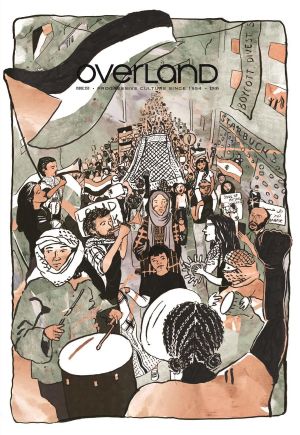
Evelyn Araluen and Jonathan Dunk (editors), Overland 253 (Summer 2023) (Some of the content is online at the Overland website – I’ve included links)
This Overland begins with a trio of generational contrasts.
First, gen x-er Brigid Rooney, Associate Professor of English at Sydney University has an article on the late Professor Elizabeth Webby in which, though she describes herself as a friend of her subject, she maintains a serious academic distance where you can feel a more personal tone struggling to assert itself.
Second, baby-boomer John Docker, also an Associate Professor at Sydney Uni, has a review article on a book about Sydney’s New Theatre. He begins with a convincing account of himself as a non-theatre person, and one, moreover, who is strangely ill at ease when he visits the current site of the New Theatre, which is about ten minutes by car from the suburb where he currently lives. Amusingly self-indulgent, but it might have been better to reject the commission.
In the third item, Dženana Vucic, self-identified as a millennial, has a piece about Sailor Moon, a manga serial that was big in her 1990s childhood and I’m sorry to say of very little more interest to me after reading her article than it was before – though I enjoyed the complex irony in which she pretended to claim a deeply anti-capitalist message in the show.
After that, things get serious with ‘Prison healthcare as punishment‘ by Sarah Schwartz, a gruelling article which begins with the grim statement that an Aboriginal woman ‘passed away on the floor of a prison cell on 2 January 2020, after days of crying out for help.’ It continues, ‘Three years later, a Coroner found that if she had received the healthcare she needed, she would not have died.’ It’s a penetrating look at the way for-profit prison healthcare in Victoria and other Australian states leads to terrible outcomes, especially for First Nations people. A year after the coronial findings mentioned in its first paragraph no one had been held accountable for the neglect.
Of the poetry, curated by Toby Fitch, ‘Water under the bridge‘ by Jeanine Leane stands out. Among other things, it looks at the way different generations of First Nations people have responded to colonisation. The title phrase takes on a telling ambiguity:
that there were names in the river
that were not just water under a white man's
bridge
Fiction editor Claire Corbett has gathered four excellent, diverse short stories. ‘Parliament‘ by Simon Castles is a sketch of young love and protest on the lawns of the new Parliament House in Canberra in 1988. Anna May Samson, currently starring in the dreadful Australian spin-off of Death in Paradise, packs a complex set of relationships into a very few pages in ‘Summer work‘. ‘Hot season‘ by Anna Quercia-Thomas is a post-apocalyptic pastoral vignette. In ‘At first, nobody died‘ by Nasrin Mahoutchi-Hosaini the protagonist, herself an immigrant, is on vacation from her work as a counsellor of ‘boat people’.
It took me a long time to read this journal. It wasn’t for lack of interest.
I wrote this blog post in Gadigal Wangal country, where the weather is swinging back and forth between a nurturing warmth and a chilly wind that murmurs in the casuarinas. I acknowledge Elders past and present for their continuing custodianship of this land.
On the latest edition of the Minefield, Waleed Aly, formidable intellect that he is (no irony intended), made a brief statement about poetry (which you can find at 8’07’’ of the audio at this link).
I was going to write a rebuttal, but instead, here’s a little poem:
Poetry is something we don't do
After Waleed Aly
Poetry is something we don't do.
It's just not part of our repertoire.
People could get through their entire
lives without encountering
it in a meaningful way.
It's not valued.

If we put it in a newspaper –
that used to happen but
would be very strange now —
people would skip and just imagine
what sort of business it would do
in an online newspaper. It has been
part of every civilisation
throughout history and yet
it's an art form we are doing
away with.

It's inherently alienating to
a modern audience. In order
to get someone to  engage
with poetry you have to get them
to read or listen to a poem
and that feels like a bridge
too far.

It's an effort, it's not what we do.
I could make you listen to a song,
I could get you to watch a documentary,
I could get you to read a novel, at a pinch
I might get you to read non fiction
and analysis, but a poem?

It's for people on the fringes,
overly artistic in spirit though
perhaps not in talent.
[Snigger from Scott]

Close your eyes and imagine a poet:
what you see has got nothing to do
with the rest of us.
Even painting or sculpture have more
presence, even if it's in caricature.
So what is the point of poetry?

It's an art form we are doing
People skip and just imagine
It feels like an effort
It's for people on the fringes
It feels like a bridge
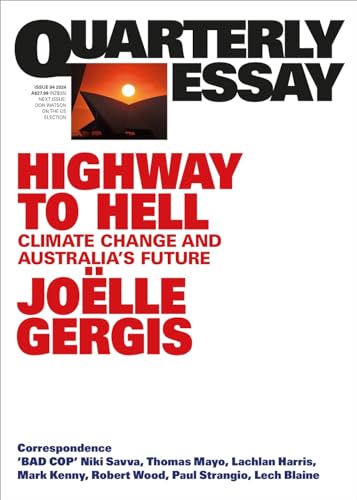
I’ve worn a Peter Dutton mask with devil horns in street theatre outside Anthony Albanese’s office. I’ve asked awkward questions at the AGMs of fossil fuel companies, scripted by Market Forces. I’ve participated with gusto in Move Beyond Coal‘s campaign targeting banks that provide financial backing to new coal mines. I joined the People’s Blockade of the coal port of Newcastle last November and plan to join again this year. Do I need to read ONE MORE BOOK on climate change?
Well, yes, I do. I had pushed out of my mind the terrible events of Summer 2021–2022. I even wrote about Judith Beveridge’s poem ‘Choirwood’ as if it offered some kind of hope after those fires (at this link). After reading Joëlle Gergis’s essay, the poem is still brilliant, but it feels like so much whistling in the dark.
Joëlle Gergis is one of the 234 lead authors of the most recent IPCC Report. She is a climate scientist who, she tells us in this essay, has become so frustrated at the way the reality of climate change is downplayed or ignored by those in power that she quit her job as an academic scientist to become a public advocate. I’d say she has become a Cassandra warning of the dangers, except that Cassandra was doomed to be ignored, a fate I hope will not befall Joëlle, for all our sakes.
After noting the relief of seeing the end of the denialist Morrison Government (remember ‘Labor’s war on the weekend’, and ‘Don’t be afraid, this is carbon’?), the essay tackles the current situation – better, but a long way from hopeful. Here’s a key paragraph, on page 7:
The scientific reality is that, regardless of political spin used to justify the continued exploitation of fossil fuel reserves, the laws of physics will keep warming the planet until we stop pumping carbon into the atmosphere and begin cleaning up the mess. The situation is too far gone for renewable energy alone to save us. Pinning our hopes on carbon capture technology to justify the continued burning of fossil fuels is a disastrous gamble the world can’t afford to take. So, as this fateful moment approaches, we need to take an honest look at the government’s climate policy and realistically assess the situation we are in. Are the climate wars really over, or has a new era of greenwashing just begun?
As she goes on to say what the laws of physics are up to and to outline a range of future scenarios, she begs us: ‘Please, don’t look away. Thee isn’t a moment to waste.’
I won’t try to summarise the science, but if you’re looking for a solid, accessible presentation, I doubt if you’ll find a better one anywhere. It’s a gruelling read, from which my main takeaway is that I need to grieve for the corals of the Great Barrier Reef that thrilled me as a child, for the thousands of cattle and millions of wild animals that have died and are yet inevitably to die as the planet heats up, for the vast tracts of forest, including rainforest, that have already been devastated. I need to grieve and I need to treasure what remains – and be prepared to fight for it.
After a blistering account of carbon offsets and carbon capture and sequestration (CCS) in a chapter headed ‘Chasing Unicorns’, she asserts that we know what needs to be done, but such is the power of the fossil fuel lobby that Australian governments won’t do it. True, there has been significant movement in State governments, and outside of government. But it’s pretty grim, when the main message to the reader about what can be done is to stress the importance of voting in the next federal election.
Almost any paragraph from this essay is worth quoting and pondering. On page 47*, there’s this:
To its credit, the Albanese government has tried to support Australia’s emergence as a renewable energy superpower. [She lists an impressive number of initiatives taken since the ALP’s election win in May 2022.] While these are all steps in the right direction, the challenge is not to undo all of this good work by allowing the interests of the fossil fuel industry to co-opt the process and weaken real progress towards reducing global emissions.
Rather than ‘net zero’, the goal must be to achieve ‘real zero’, which can only happen once we stop burning fossil fuels. In fact, the science tells us that around 60 per cent of oil and gas reserves and 90 per cent of coal must remain unextracted if warming is to be limited to 1.5°C. There is no way around having to eventually face this scientific reality.
But instead of facing facts, in December 2023, the federal government caved in to lobbying from the oil and gas company Santos.
The correspondents in Quarterly Essay 95 mostly agree with and amplify the arguments of the essay. There’s an excellent piece by David Pocock, who is probably the parliamentarian that Gergis meets with early in the essay. He describes his shock as a senator now for a little over two years to see how ‘policy is consistently shaped by political considerations ahead of evidence and research’. Often he says, politicians ‘are not looking for genuine, long-term solutions, but for the next opportunity to back their opponents into a corner’.
A stand-out exception to the generally supportive tone is a grim piece by Clive Hamilton. He’s not the only correspondent to describe Joëlle Gergis as operating on an ‘information deficit’ model: if only people, including those in power, had correct information they would do the right thing. Scientists have been trained to look for solid, verifiable facts and to base their actions on what they find. But it’s a mistake to assume that that’s how people in general function. Hamilton dismisses the essay’s hope as wishful thinking, argues that nothing Australian governments do can have much impact on climate change, and generally sees the outlook as bleak:
After two decades of research into the psychological, social and political complexities of persuading people to recognise and act on the science of climate change, it’s wearying when another scientist comes along convinced that it’s only a problem of someone with authority communicating the facts. I’d be more energised if Gergis, as an IPCC lead author, had written an essay arguing that it’s time for a campaign of industrial sabotage.
I would love to know how Joëlle Gergis responds to Clive Hamilton. Sadly, no response from her is included in QE 95. Maybe in Nº 96? Or maybe she’s already out there like the main character in the movie Woman at War.
I wrote this blog post in Gadigal Wangal country, where it is my great joy to live. I acknowledge Elders past and present for their continuing custodianship of this land.
* My usual blogging practice is to focus on the page that coincides with my age, currently 77. But as this Quarterly Essay runs to just 72 pages including notes, I’m looking at page 47, the year of my birth minus 1900.
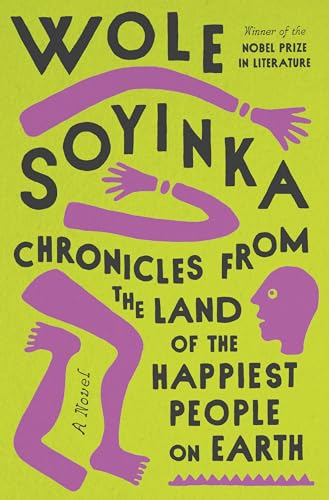
Before the meeting: This is a strange book. It’s a satire set in contemporary Nigeria. With Boko Haram atrocities in the immediate background, the country is rife with corruption. I’m pretty sure that if I knew more about Nigeria’s history and its current politics the book would reveal more of itself to me as a devastating, possibly despairing denunciation of Soyinka’s homeland. As it was, I enjoyed it pretty much as a child would enjoy Gulliver’s Travels – as a fantastical tale. I’m sorry to say, though, that I enjoyed it a lot less than I enjoyed the story of Lilliput as a child.
Almost half the book is taken up with setting the scene in magisterial, ironic tones. There’s a charlatan religious leader, a deeply venal and media-savvy Prime Minister, an awful lot of sarcastic hoptedoodle about national festivals and awards. It takes a long time for a central narrative thread to become clear. (Arguably, the over-all shape isn’t revealed until the last page, so what follows is possibly a spoiler of the first magnitude.) Four young Nigerian men form a strong bond when at university in Europe, agreeing that they will each contribute in a major way to their homeland. They become respectively a doctor, an engineer, a financial wizard and a public relations genius. In the book’s present time, one has gone missing, one runs foul of the government and becomes inexplicably catatonic, one has been nominated to a prestigious position in the UN, and the fourth, who I think of as the book’s central character, is a surgeon whose work patching up the survivors of Boko Haram attacks has earned him one of the country’s top honours.
The rubber hits the road at last when the surgeon discovers a monstrous commercial-culinary trade in human body parts, and the narrative finally develops a forward momentum as he and his engineer friend pit themselves against the shadowy figures behind the trade.
But just as that narrative seems to be getting somewhere, the book swerves off into interminable machinations to do with a bombing, and questions of transporting a body between Austria and Nigeria. The main story is finally resolved in an ultra-perfunctory way, with a lot of loose threads left hanging. There’s a ‘surprise’ revelation on the last page that is about as surprising as having hot water come out of a tap marked H.
The story is told with tremendous gusto, but for much of it the writer seems to care less about telling it than with having angry, satirical fun. I found myself thinking of Edward Said’s posthumously published essay, On Late Style, which we read in the Book Group a while ago (link here). He wrote of the artists who create in the late style:
The one thing that is difficult to find in their work is embarrassment, even though they are egregiously self-confident and supreme technicians. It is as if having achieved age, they want none of its supposed serenity or maturity, or any of its amiability or official ingratiation. Yet in none of them is mortality denied or evaded, but keeps coming back as the theme of death which undermines and strangely elevates their uses of language and the aesthetic.
This book is supremely unembarrassed by its own excesses and absurdities. It certainly doesn’t aspire to serenity or seek attempt to ingratiate itself with authorities, or with readers. And it is full of mortality.
At page 77*, we’re still being given the general set-up. It’s part of the engineer’s back-story, explaining how he ‘succumbed’ and agreed to work for the government:
It did not take too long to discover – with some chagrin, he would reveal to his ‘twin’, the surgeon Kighare Menka – that there was a strong work ethic in control, indeed a pervasive hands-on ethic, near identical to both theirs, with unintended literalism, just a slight slant – a prime ministerial finger in every pie!
His friendship with the surgeon Kighare Menka is the heart of the book. Here it’s invoked so that we know both men share a perspective on the Prime Minister’s corruption, and that they share an enjoyment of the ponderous wordplay that pervades the book.
The next paragraph is a good example of the narrative style. Bisoye is the engineer’s wife:
Only the twenty-million-dollar question remained: How long would he last? Thus came the pact with Bisoye – first three months, I’ll stick it out, no matter what. Agreed? After that, a choice of his single-malt whisky, always a different brand, for every month survived, plus a night out followed by a bed in, no holds barred. The nation never knew how much it owed to the blissful athleticism of the couple, and Duyole did come close to earning a full case of Islay malt, Collector’s Reserve – just one bottle short of a full case. In the display cabinet he conspicuously left a gap in the row of twelve, a silent accusation of Bisoye’s ungenerous spirit. Was it his fault he completed the task so far ahead of time?
This mock-pompous style characterises most of the narrative. A man of integrity decides to do research for a corrupt government, and to report honestly on what he finds. But he’s a man with a sense of humour and a zest for life. Like him, the narrative refuses to be drawn into hand-wringing over the corruption. It barely gets to the specifics of that corruption – saving its fire for the (hopefully) imaginary trade in human flesh. It is happy to assume the reader doesn’t need details of the realistic stuff and gives us instead the ‘blissful athleticism’ of our heroes, the opposition.
While that paragraph may fill out the engineer’s character a little, one can’t help but feel that it’s just there because the author was having a good time. Not that there’s anything wrong with that. On the contrary. But I’m not surprised to learn from the WhatsApp conversation before the meeting that most people failed to persevere to the moment when the story proper gets started.
After the meeting: There were eight of us, and we met in a pub in Balmain. Two of us had read the whole book. All but one of the others had no intention of finishing, most having given up after a hundred pages or so.
Interestingly, the person who had read about a third was the book’s keenest supporter. I don’t take notes, and I have a terrible memory, but he said something like, ‘I was irritated, intrigued, amused, horrified, perplexed, enlightened, admiring. I kept seeing parallels with news from the US in the bizarre corruption, and the dominance of bogus religion. The back story of the religious charlatan fascinated me, and I want to know what becomes of him.’
I think he was on the cusp of the moment when the character who fascinated him pretty much drops out of the story, to make a functional comeback very late in the piece. He had barely even met the surgeon Kighare. But it was excellent to be reminded that up to a certain point you think you’re reading a book where a number of strands are kind of coming together.
Someone had read that Wole Soyinka wrote the book during Covid lockdowns in two stretches of 32 days. Maybe that was just a first draft.
Someone said that they kept wondering if they’d missed something, as for instance when a character last seen entering a meeting turns up a couple of chapters later in a catatonic state, but the writing was so elliptical that they couldn’t be bothered to go back to check if there was some explanation. (No one could remember if we are ever told what happened to him. I suspect the author made a mental note to go back and flesh it out, and then forgot about it.) I think that means it’s a book that asks a lot of the reader at the sentence level, without generally offering much in return.
Someone said it might have been better in the original Nigerian. I think his point remains valid even though the book was written in Nigeria’s official language, which is English. Nigerian writer Ben Okri wrote a review for the Guardian, which I’ve found since our meeting (link here). Given how negative we all were about the book, it’s only fair that I quote from that review (though I must not that ben Okri gets a number of key plot points wrong in this review):
There are many things to remark upon in this Vesuvius of a novel, not least its brutal excoriation of a nation in moral free fall. The wonder is how Soyinka managed to formulate a tale that can carry the weight of all that chaos. With asides that are polemics, facilitated with a style that is over-ripe, its flaws are plentiful, its storytelling wayward, but the incandescence of its achievement makes these quibbles inconsequential.
Our conversation turned to other, happier things: the recent local council elections and the pleasure a couple of us had had in helping a young person vote for the first time; parenthood after 40 years; the relationship of the Bauhaus to the Arts and Crafts movement; another book group where they don’t set a date until everyone has read the book (shudders all round!); a spectacular alcoholic episode from the life of Mary McKillop (now a saint); the unmarked site of Hitler’s bunker; Rugby League (the Roosters, and the Jets at Henson Park); some swapping of notes about streaming shows. The food was excellent, though the emerging Artist could teach the pub a thing or two about caponata.
I wrote this blog post on the land of Gadigal and Wangal. I acknowledge Elders of those Nations past, present and emerging for their continuing custodianship of this beautiful land.
* My blogging practice is to focus on the page that coincides with my age, currently 77.




 Me fail? I fly!