For science

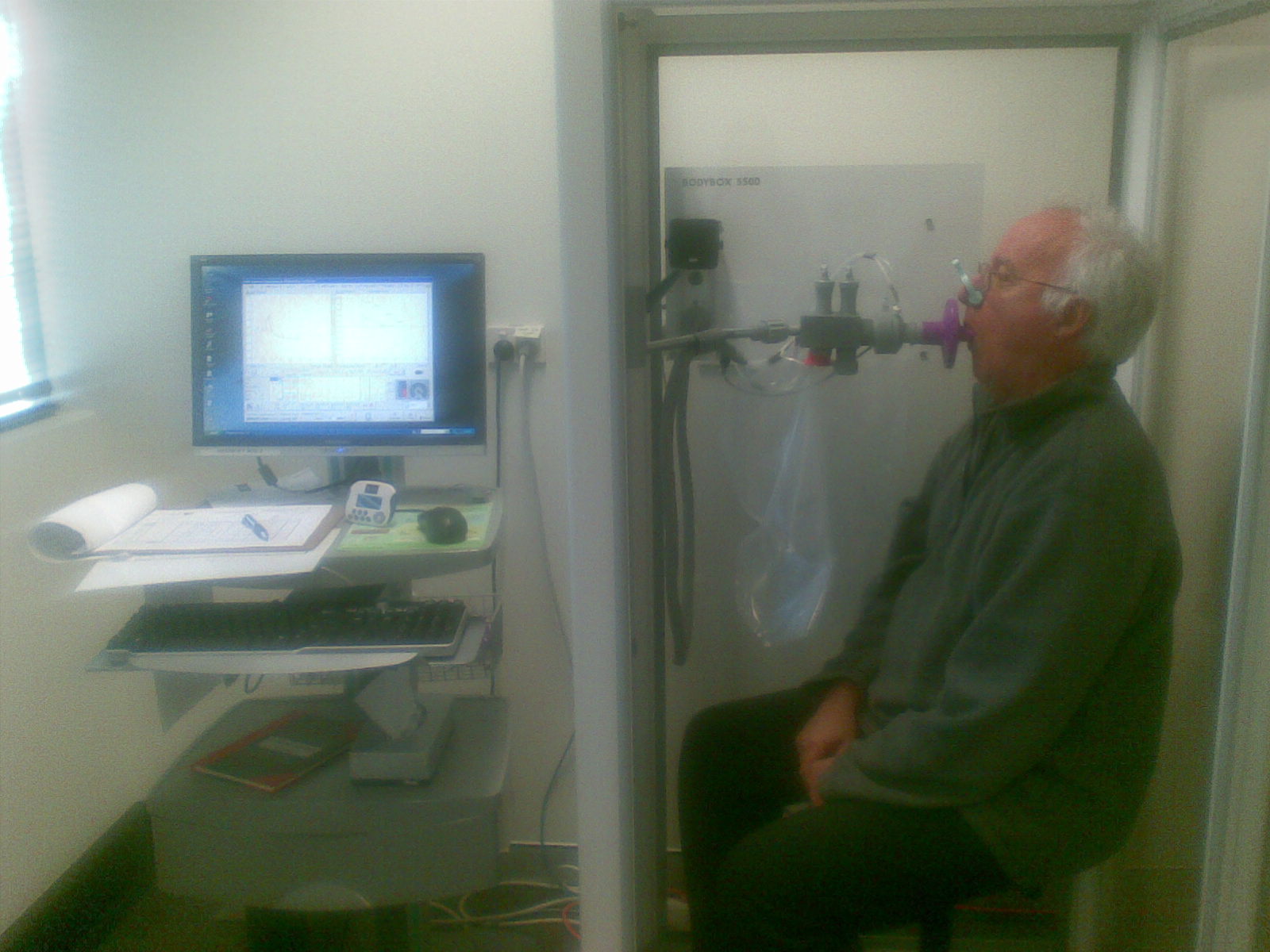
I’m mildly asthmatic, and every now and then lend my body to science. Today I spent a couple of hours in a high-tech environment doing mildly undignified things – mainly breathing into various gadgets.

Jess, the charming PhD student who told me what to do and harvested the data I generated, kindly agreed to take this photo for you, dear reader. I am in an airtight cabinet called, I think, a Body Room. There were no body bags in sight.

I for one welcome our new double X overlords

As pointed out in the comments over at Still Life with Cat, if you live in a certain part of the city of Sydney you’ve got this:


Lord Mayor


State representative


State Premier


Federal rep


Prime Minister


Governor


Governor General


Monarch

Savour the moment.

Oh, and be careful out there! Remember what happened to the last elected official who picked a serious fight with the mining companies.

The Book Group’s Race of a Lifetime

Mark Halperin and John Heilemann, Race of a Lifetime: How Obama won the White House (Penguin 2010)
Before the Book Group meeting:

This book’s US title is Game Change, with the subtitle Obama and the Clintons, McCain and Palin, and the Race of a Lifetime. This is snappy and gives a fair idea of the book’s contents. So why the change to a lame and inaccurate title for this British edition? Maybe it was revenge on the US for renaming J K Rowling’s first book Harry Potter and the Sorcerer’s Stone.

The authors say in their introduction that they set out to give ‘an intimate portrait of the candidates and spouses who (in our judgement) stood a reasonable chance of occupying the White House’ after the 2008 election. They conducted more than 300 interviews with more than 200 people between July 2008 and September 2009, while memories of the election campaign were still fresh, and produced a book bristling with direct quotes from behind the scenes. I wouldn’t describe much of it as intimate in any real sense, but it’s got a kind of gossipy fascination. The Obamas, the McCains, the Edwardses and especially the Clintons are all big characters, and all have marriages that have had to withstand unbelievable strain. Todd Palin gets mentioned quite a bit, but doesn’t become a character in his own right, and not a lot of ink is spent on Sarah Palin herself – though what there is of her is even more bizarre than the press suggested at the time.

I don’t know that the book does much to deepen the reader’s understanding of the US political system in general or the 2007–8 election campaign in particular. The main take-home message seems to be that you don’t have to be some kind of sociopath to run for President or Vice-President of the United States, but it helps. Miraculously, Barack Obama doesn’t seem to be one. One does weep for US-style democracy, at least as seen through the lens of political journalism. I found myself empathising with the widespread fear of democracy in mid nineteenth century Australia, expressed in 1853 by John Plunkett, Attorney General of the colony of New South Wales:

All serious convulsions are carried out by demagogues; as a boiling cauldron throws its scum to the top, so in all social convulsions unworthy persons will be sure to get to the top, and betray the people for their own selfish purposes. The people left to themselves, and uncontrolled, will be hurled on to ruin by the ruffians who make them their dupes.

(Quoted in Peter Cochrane, Colonial Ambition, MUP 2006, p 379)

Not that ruffians and demagogues prevailed in 2008, but one gets the impression that without ruffianly behaviour and demagoguery, and certainly not without being able to deal with lashings of both, no one could ever become Potus.

Kate Jennings’s Quarterly Essay, American revolution: The fall of Wall Street and the rise of Barack Obama, though not an insider’s account, probably casts more light on the issues at stake in the campaign and is almost as thrilling a ride. I do feel an itch to read an account as candid and thorough, and occasionally lurid, as this about an Australian election. Sadly, I doubt if even Tony Abbott, for all his lycra and chest pounding and people skills, could equal any one of a score of moments in this rip-roarer.

After the meeting:

Tonight we were five, then six and eventually seven, the last arrival being delayed by an argumentative accountant and a locked car park. The conversation folded back on itself a number of times, with recaps and revisitings. Most of us, I think, had found the book interesting, though a number hadn’t been able to finish it – the apparent weighting of the scales towards Obama was a factor (either the Clintons are actually really weird or the journalist/authors decided it was good ‘narrative’ to portray them that way), an absence of politics-tragicality on the part of the non-finishers was another: do we really care about advice from yet another aide that was disregarded by yet another candidate? As an innovation tonight was also discussed an article – on climate change – and though none of us was ardent about the article, the juxtaposition emphasised the way the book favours personality above policy and implies that the US democratic process does likewise. I think its true to say we were all shocked and awed by the sheer amount of money spent on presidential campaigns.

The fact that the ABC had been reporting a leadership challenge in Canberra meant the book’s holding power was tested. Once the conversation veered – even lunged – towards a debate about Rudd and the intense stupidity of the NSW Right of the ALP, who are largely responsible for Rudd’s losses in the polls and now (I’ve learned since coming home) have decided to dump him, none of us was wildly enthusiastic to get back to the book.

Mollie news

Mollie is in a bad way.

It’s been months since she could walk. She has been using a wheelchair, sitting up at her spot in the dining room for a good part of each day, and being wheeled to and from her room. At Christmas Carols last year, the former manager of our institution noticed that she seemed uncomfortable in the chair and instructed – right there, right then, with ‘The Little Drummer Boy” banging on over the PA system and hundreds of elderly people being herded in all around us – that a sheepskin pad to be put under her, as a precaution against pressure sores. As it turned out, the precaution wasn’t enough, and somehow she managed to develop a large, ulcerated sore on her bottom. A tiny sore, even a red spot, is a signal for complete bed rest for a couple of days. By the time this one was noticed, Mollie had to go to bed indefinitely. Several weeks  and multiple courses of antibiotics later, the sore is showing no sign of ever healing. Presumably because of the pain, Mollie pretty well stopped eating for a while and though she is eating again now (we’re told), she is shockingly thin, and spends most of her time sleeping. She is now being given morphine for the pain, so she may be in a narcotic trance rather than actually sleeping.

On the weekend, Penny noticed that Mollie’s skin had a yellowish tint to it. Imagining that this could be a sign of something seriously wrong with the liver, she spoke to the chief nurse. When she said that her brother was in Europe and couldn’t get back in less than a fortnight, ‘Oh,’ said the nurse, ‘two weeks should be all right.’ This was the first indication from the nursing staff that death might be in the air. ‘How long would he be away if he didn’t interrupt his trip?’ the nurse asked next. When Penny named a date later in July, she responded with an ominous, sympathetic twist of the mouth.

She hardly vocalises at all now, and her facial expressions are hard to read, but she looks you full in the face, grasps your hand firmly, and sometimes reaches up to stroke a visitor’s face.

From the family archives: skills

Not really from any archive, but from my mother’s letters, here’s this gem. In 1972, when my nephew Matthew was five years old, my mother was told of the following conversation – not (‘of course’) by any of the protagonists. The only background you need to know is that Matthew and his family had Oxley Creek flowing past the back of their Brisbane home, and there was a little rowboat pretty much permanently moored at the bottom of their yard

Matthew: Daddy, I can  swim.
Michael (Matthew’s father): How do you know? It’s winter and the pool is empty.
Matthew: I fell out of the boat.

My mother’s comment: ‘Thank God he could swim, eh?’

A neighbourhood encounter involving Emily Dickinson

When I came home on Monday evening from a long weekend away, I found a small mystery in the room where my desk lives: three poetry books in a pile on the floor. Who could have taken the selected Du Fu, the selected Emily Dickinson and the Shambala anthology of Chinese poetry from the shelves? Surely not the Art Student, who is a staunch hater of poetry (unless, she says, it was written by me)? Perhaps she was looking for something to console a sick friend. Unlikely. Then I remembered she had pulled a muscle in her back  and been in pain all Saturday, barely able to sit at her desk. The books on the floor weren’t reading material at all, but a tool for an Alexander Technique Lie-Down. Apparently they were efficacious, because by the time  I arrived the back pain had gone.

Since the Emily Dickinson book had made is way into my hands, I decided to take it for a walk the next morning. The day was brilliant, cloudless, cool and pleasantly humid.  The third poem in the book is about spring, but it chimed beautifully with my Sydney-early-winter-induced mood:

The morns are meeker than they were –
The nuts are getting brown –
The berry’s cheek is plumper –
The Rose is out of town –

The maple wears a gayer scarf –
The field – a scarlet gown –
Lest I sh’d seem old fashioned
I’ll put a trinket on!

As I strolled past a friend’s house, by this time carrying a bulky plastic bag of dog poo as well as my book, the friend happened to be in her front yard. ‘That’s charming,’ she said.

I chose to interpret her as referring to the book. ‘Yes,’ I said. ‘I studied Emily Dickinson at uni but I’ve hardly looked at this book since.’

‘I love her,’ said my friend.

‘Listen to this,’ I said, and read her the poem.

‘She could have been writing about today.’

And we went our ways, me with the dog, her to her garden, wearing invisible Dickinsonian trinkets

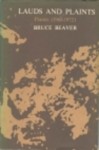
Bruce Beaver, Lauds and Plaints

Bruce Beaver, Lauds and Plaints (South Head Press 1974)

I was going to start this off by reminiscing about two occasions on which I’d met Bruce Beaver. But some dim recollection made me go trawling back through this blog and confirm that I would have been fogeyishly repeating myself. If you want the reminiscence, it’s here.

I must have bought this book in 1974, the year it was published, but have no memory of it. Maybe I tried to read it fast and so didn’t really read it at all. Whatever, I enjoyed it hugely this time around: there’s a lovely ode on Arthur Stace, Sydney’s ‘Eternity’ graffitist:

oooooeternity

I knew it was here already surrounding
ooooousooooadding to subtracting from
oooooour moments

crossing and dotting our Is and lives
oooowith its big beautiful script looping
oooovolute

that was before I learned of the commonest
ooooagony of allooootime’s rape of
oooothe timeless

as I watched the generations of dogs
ooooexcreting religiously over it
oooothe myriad

leather soles taking a little of it
oooowith them into homes shops
oooooffices

and the closest thing to sanctuaries
ooooof grass stone leaf sand
oooowave-lapped

rockooooout of the streets and into
ooootheir lives blindly underfoot
ooooalways

A series of poems marks a week’s separation from his beloved, of which you can read one at the Poetry International site. There’s an elegy to a 98 year old Manly character, two powerful pieces about a door in his family home, and all through the book an engrossing play of mind – reflective, chatty, impassioned, anguished, erudite.

Excuse me if I now say something that has been glaringly obvious to everyone else, but reading these poems I finally twigged that when a poem lacks all punctuation apart from line breaks and occasional larger spaces between words, it’s not necessarily trying to be obscure, ambiguous or even generally annoying. It may be trying to slow the reader right down. At least that’s the effect in these poems. They can’t be read fast. Nor is it generally possible to coast along on their sonorousness – too many latinate words and unsonorous sibilants. Reading them is a constant process of deciphering, of immersion, allowing the meaning to make itself known, and as such is tremendously pleasurable.

David, Kevin, Rage. So?

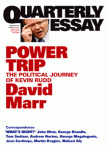
David Marr, Power Trip: The political journey of Kevin Rudd (Quarterly Essay 38)

In Quarterly Essay 36, Mungo MacCallum explored the miasma of myth and collective emotion that, he argued, accounted for Kevin Rudd’s popularity. Rudd’s recent plummet in the polls suggests that the popularity may actually have been based on more concrete factors, such as his promising stand on global warming, but the essay was a good read nonetheless. Two issues further on, the series once again addresses (I nearly said ‘attacks’) the Rudd phenomenon. David Marr asks not what we see in Rudd, what we hope of him, what he stands for, not centrally whether his leadership is effective or his policies correct, but ‘Who is he?’ It’s a fair enough question. There is something oddly impersonal in his media persona, a sense not so much that he’s hiding something as that he doesn’t know how to show himself. There have been baffling moments, especially his odd, televised disregard for Kristina Keneally.

The question is fair enough, but I’m not sure the answer gets us anywhere much. A cruel short version would be: ‘Kevin Rudd yelled at me when I told him he was an all round disappointment, so now I know that rage is at his core.’ David Marr writes well, and he marshalls biographical facts into a coherent story, sifting through the hostile and hagiographic scuttlebuck alike, for which much thanks. But in the end, the essay is unsatisfying. His strategy of beginning with Rudd’s use of expletives about the Chinese at Copenhagen and ending with a moment when Rudd sets his diplomat’s blandness aside and tears strips of the writer (in private, quietly, in response to provocation) may be structurally satisfying, but the conclusion that anger is Rudd’s ‘juice in the machine’ is a wee bit tenuous. Perhaps I identify with Rudd, as a mostly mild-mannered Catholic man from rural Queensland who uses four-letter words and gets cranky when personally attacked. I imagine David Marr himself swears occasionally and has the odd tantrum – at least I hope he does for the sake of his mental equilibrium.

Tellingly, Kevin Rudd’s response, as reported by the ABC,  was a verbal shrug: ‘Commentators, writers, analysts – they will draw their own conclusions.’

But a distinctive feature of the Quarterly Essay series is that it promotes discussion. No doubt all manner of responses will be aired in Nº 39. Here, the title essay accounts for roughly two thirds of the book, leaving the remaining 40 odd pages to discussion of Waleed Aly’s essay last quarter on conservatism. As a first, a number of voices from the neo-right have appear in these pages, many of them doing their usual polemic attack on straw men. Jean Curthoys (not from the right) suggests that Aly really needs a dose of social democracy. Martin Krygier’s piece makes me decide that if I ever make him cross I’d better lay low. And Aly responds to all comers with precision, grace and – in one or two cases undeserved – respect.

Diana Wynne Jones is very ill

Just in case there’s a Diana Wynne Jones fan who reads this and hasn’t heard from elsewhere: this most wonderful of fantasy writers has cancer and has chosen to stop chemotherapy treatment and may have only months to live.

If you send her an email message (‘no questions please’) at <meredithxyz at googlemail dot com> it will be printed out and posted to her. I have this news from Kate Nepveu at Tor’s blog, who had it from Ansible and a DWJ fan site.

Isle of Joy

Don Winslow, Isle of Joy (1996, Arrow Books 2008)

Here’s more genre fiction in print form instead of the more congenial moving pictures, this time a spy thriller of sorts. Apart from a prologue, the action takes place in New York City in the last week of 1958. It’s not a meticulously recreated period piece: someone talks about exchanging bodily fluids fairly early on, so anachronism-haters are warned off, and though the list of shows on Broadway is almost certainly correct, it remains just that, a list. The main character goes into a theatre showing Orson Welles’s A Touch of Evil, but there’s no sense that either he or the author has seen any part of the film.  It’s not a period piece, but it does play around tittilatingly with the historical record. A  charismatic, womanising New England Catholic senator who is about to run for president against Richard Nixon is having an affair with a big-breasted blonde Hollywood actress. Though the Senator’s name is Joe Keneally and the actress is Marta Marlund, we know who we’re talking about. Or we think we do until about the half way point …

It’s a solidly constructed murder–intrigue–espionage machine that’s a bit too slow to get going and shows its workings a bit too obviously. The characters are mostly functional rather than interesting in their own right, there’s some unconvincing unconventional sex, and a tedious, incomprehensible football match that makes me appreciate all over again the brilliance of Jasper Jones‘s cricket match. It’s probably a book for committed fans of the genre. I don’t go much beyond Le Carre, and this didn’t make me want to change my ways. On the other hand, I didn’t feel like throwing it across the room, and the complex threads of the second half of the book were enough to keep me reading when I should have been asleep..