Dog Ear Cafe Launch

Last night we went to another brilliant launch at Gleebooks: Rachel Perkins doing her first book launch,  of Andrew Stojanovski’s first and he says only book, Dog Ear Cafe. It was a surprisingly intimate affair. Many members of the author’s family were there, including a couple of charming twin nieces who were just tall enough to reach the snack foods, and relaxed enough about the surroundings to keep up a sweet background noise during proceedings.

Stojanovski lived at Yuendemu in Central Australia for 11 years, and was part of the Warlpiri community’s successful campaign to wipe out petrol sniffing there. As he said, all through his time in the Centre Aboriginal elders would say, ‘Don’t write a book about this.’ They were sick of whitefellas blowing in, spending a bit of time there, and then going away and making a quid or getting jobs by writing anthropological or other treatises about them. But then, toward the end of this time there, one friend said to him, ‘You should write a book about this.’ The idea was that he should write a history or a manual to show other whitefellas how they could be useful. When he told a young friend – a former sniffer and active participant in the regeneration of the community – about the idea, the young friend said no one would read a history/manual, he should write it like an adventure with all the funny and dramatic incidents left in.

Rachel Perkins did a lovely job as launcher. She was there as an Aboriginal Big Name who could give the book her blessing, of course,  but she let us know from the start that she had a friendship with the author dating back decades – she communicated her pleasure (and relief) in the excellence of the book, he affection for Andrew, and her own deep appreciation of the creativity, resourcefulness and above all compassion of the people of Yuendemu. Given that it’s been in the news recently as a place of violence and lawlessness, this was a refreshing perspective from one who has strong connections there.

So much of this launch was heartening. Andrew Stojanovsky told poignant stories (he cradled a glass of red wine under his nose, to illustrate the habitual posture of a petrol sniffer). He explained the benefits for Aboriginal communities in having white people there to perform functions that would be rendered extremely difficult if not impossible by the complex demands of avoidance and can’t-say-no kinship obligations. He relayed many conversations with friends young and old at Yuendemu. In one of these he was talking to a Warlpiri man about the challenge of making friendships between whitefellas and Warlpiri. He said that sometimes it felt as if there was a Grand Canyon between the two. The old man said, ‘Yes, but I see tightropes across the canyon.’

Inevitably, I thought of Seven Seasons in Aurukun, my niece Paula Shaw’s account of a much shorter time in a remote Aboriginal community. Rachel Perkins spoke of the importance of books by whites that move beyond the anthropological or ethnographic perspectives to portraying individual people – Paula’s book does that. And Andrew Stojanovsky described the conditions endured by school teachers when the community was still home to petrol sniffers – as Aurukun was during Paula’s time there – and commented that it was no surprise that few teachers managed to stay more than two years.

Dog Ear Cafe has already been reviewed by Will Owen in North Carolina. He would have enjoyed the launch. We bought a copy.
More about the plaque

Someone got back to me from both councils yesterday.

There’s no mystery about the plaque down by Johnston’s Creek. ‘Oh, you mean the one honouring Jack Mundey,’ the man from Leichhardt Council said.

I gleaned a little more background by searching for ‘Jack Mundey’ on the Council’s web site. A local resident Joe Mannix proposed more than 12 months ago that a plaque be erected and its unveiling be a way to honour Mundey on his 80th birthday in October last year. The proposal was approved, but evidently there was a delay, as the actual unveiling happened earlier this month, eleven months behind schedule. In a Council handout dated Thursday 16 September, Mayor Jamie Parker wrote:

Last Saturday, Council officially unveiled a plaque to remember the 1972 Builders Labourers Federation Green Ban which joined with resident action groups to stop approved expressways carving up Glebe, Annandale and Lilyfield.
ooooThese actions demonstrated the combined power of union and resident actions in effectively defending local communities. The ill fated freeway project was as much about ‘slum clearance’ as it was about building a network for container movements from the port.
ooooA national treasure, Jack Mundey is 81 years old, and we were delighted to have him attend the function at Smith & Spindlers Park on Saturday.

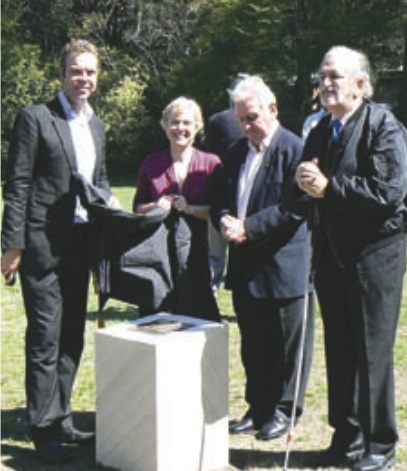
There was a photo:

Jamie Parker, Verity Firth, Jack Mundey and Joe Mannix officially unveil the plaque

The man on the phone mentioned, as the Mayoral message didn’t, that there were plans to screen Fig Street Fiasco, a community video about the struggle made by Tom Zubrycki. I don’t know if the screening took place, but there’s a dramatic clip at the link that makes my friends’ dreams of violence seem less bizarrely unrealistic.

The caller from the City of Sydney said they hadn’t heard of the plaque in ‘what we call the Cardigan Street Park’ until they received my email. So that leaves us with the vandalism  scenario. The City of Sydney doesn’t have a register of plaques, though it is on a To Do List somewhere. He recommended that I write to the Lord Mayor asking that the plaque be restored, and said that would lead to action of some sort. I’ll do that, and hope to report back in a while.

History acknowledged

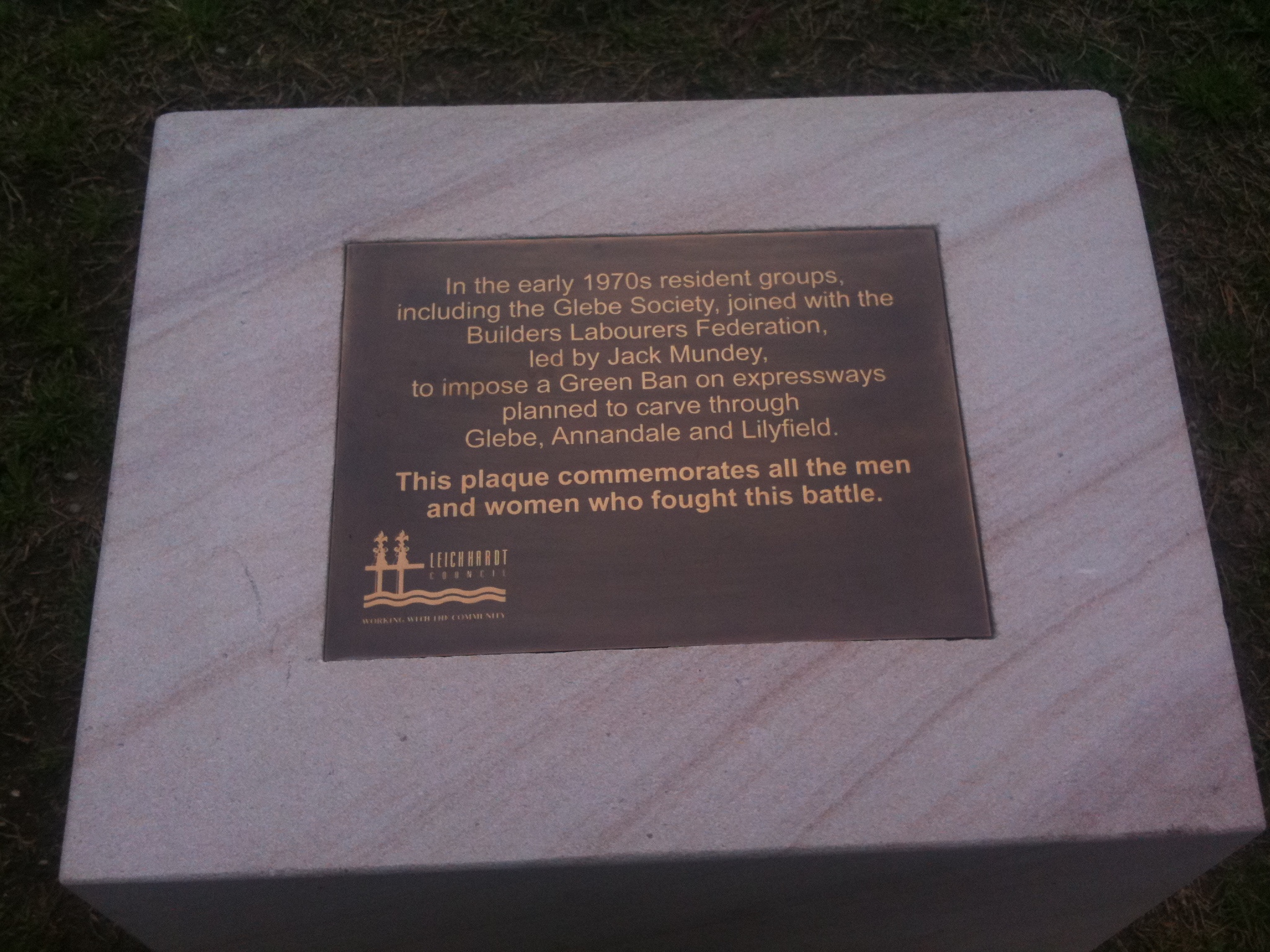
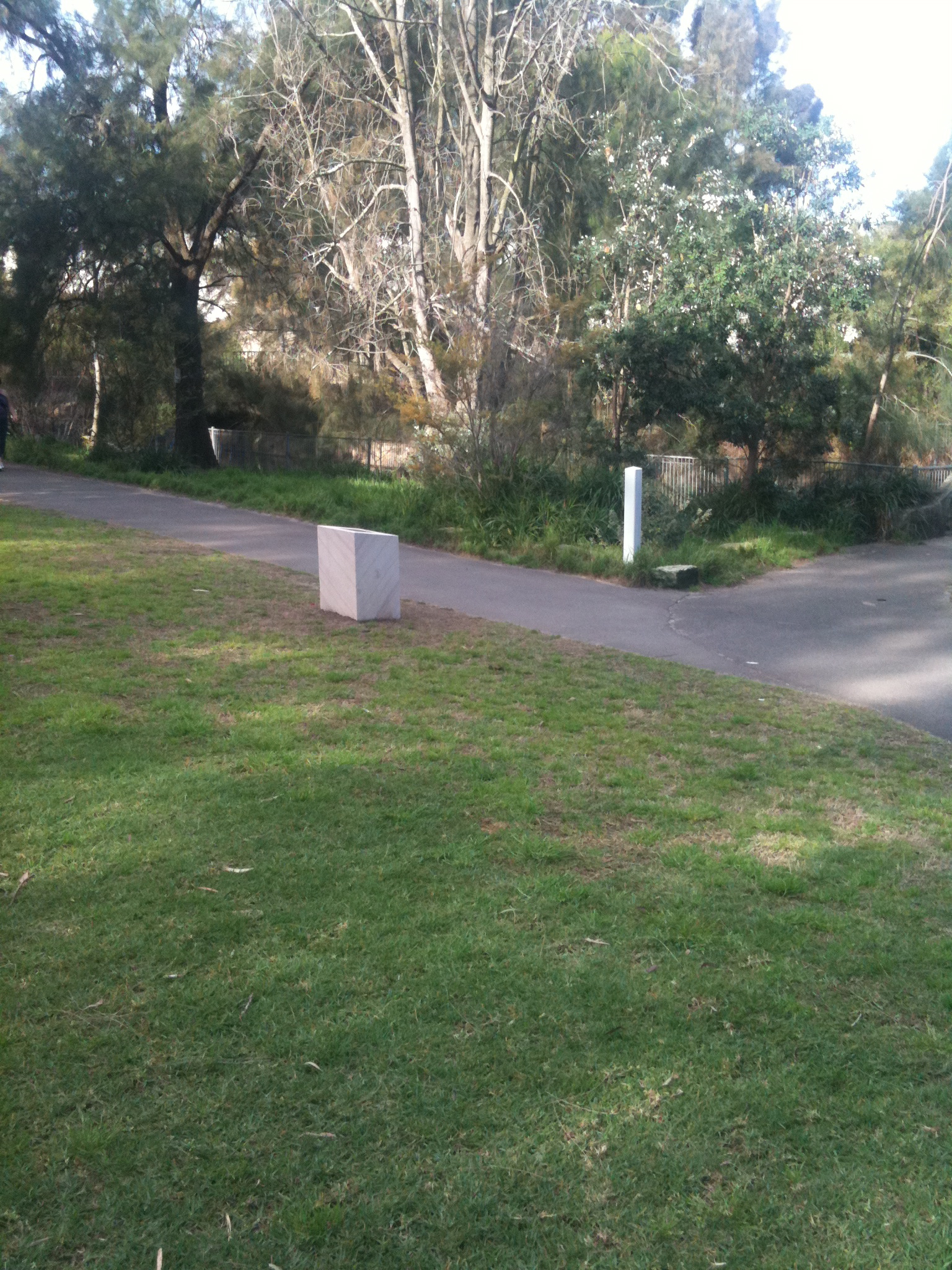
In a little strip of green not far from Harold Park Raceway, near where a bridge crosses Johnson’s Creek, a new object appeared the other day: a squat, squarish thing beside the path,  looking more than anything like a cardboard carton fallen off a passing truck – or given its distance from any road, perhaps from a helicopter. On approach, it turned out to be a block of sandstone with a plaque on top.

Over the logo of Leichhardt Municipal Council, the plaque explains itself:

In the early 1970s resident groups,
including the Glebe Society, joined with the
Builders Labourers Federation,
led by Jack Mundey,
to impose a Green Ban on expressways
planned to carve through
Glebe, Annandale and Lilyfield.
This plaque commemorates all the men and women who fought this battle.

Well, I’m chuffed to be commemorated, and so I’m sure are the rest of the raggedy coalition of anarchists, Maoists (who created a poster showing a US flag as highway ploughing through tiny houses, because of course the expressway was a product of US capitalism’s relentless pursuit of profit), students fresh from the Vietnam Moratorium demos, out of work actors, etc, who joined the ‘battle’ with the starchy Glebe Society and the fabulous BLF. In those heady days I remember overhearing a conversation between a Philosophy Lecturer and an Eng Lit Honours student deciding not to blow up the beginning stages of the expressway because although they had it in their hearts to do it, they lacked the practical knowledge of high explosives. Inspired by something someone had read about successful protests in San Francisco, we built an adventure playground in a little park in Darling Street, Glebe, though as far as I know very few children actually availed themselves of our crude constructions. perhaps these are the kinds of reasons why we are being commemorated rather than honoured.

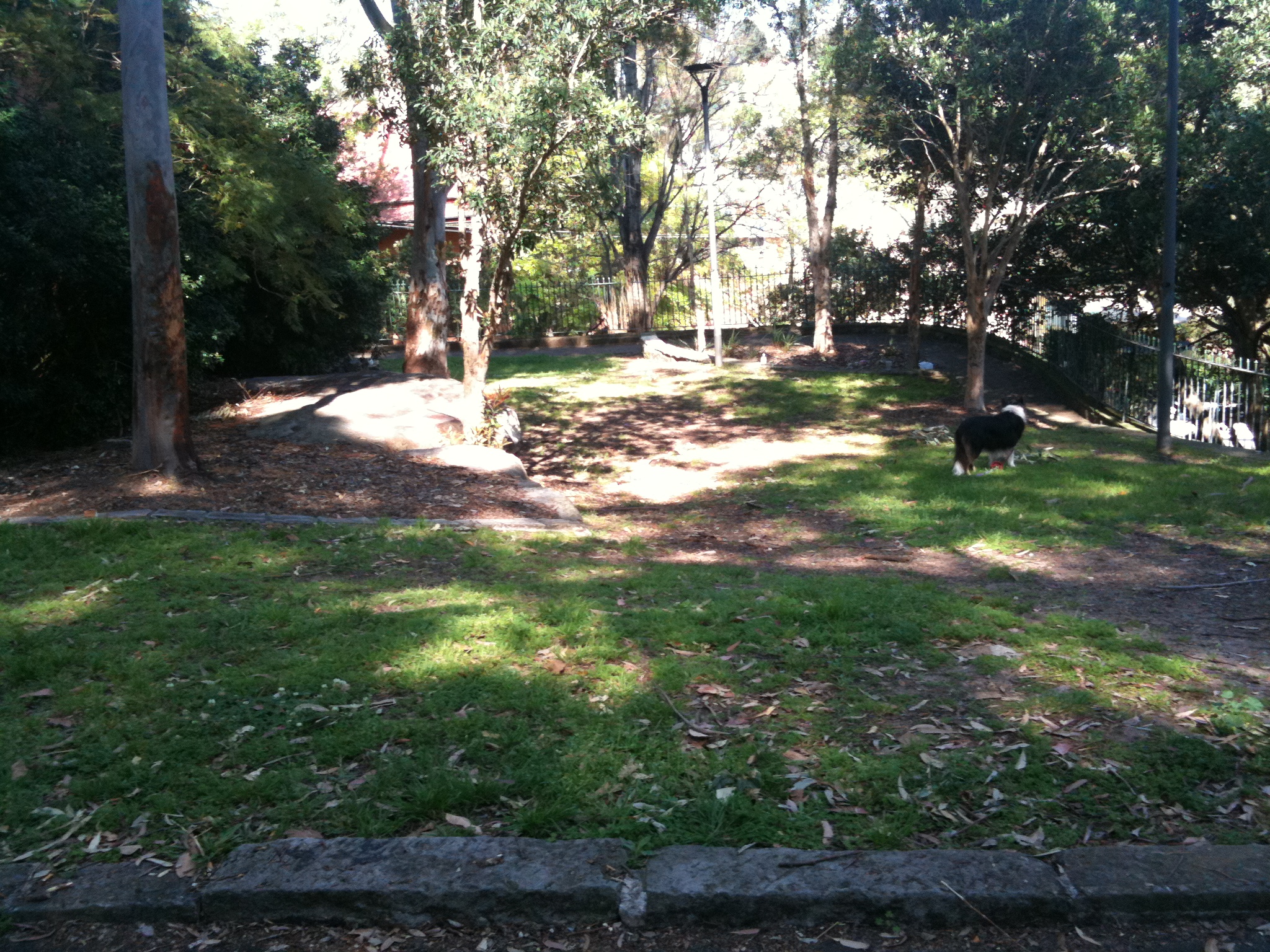
But why in this park? And why now? Isn’t there already a site-appropriate plaque in Glebe that gives more detail? This morning I took the dog to visit that pleasant little park, between 77a and 79 Darling Street.

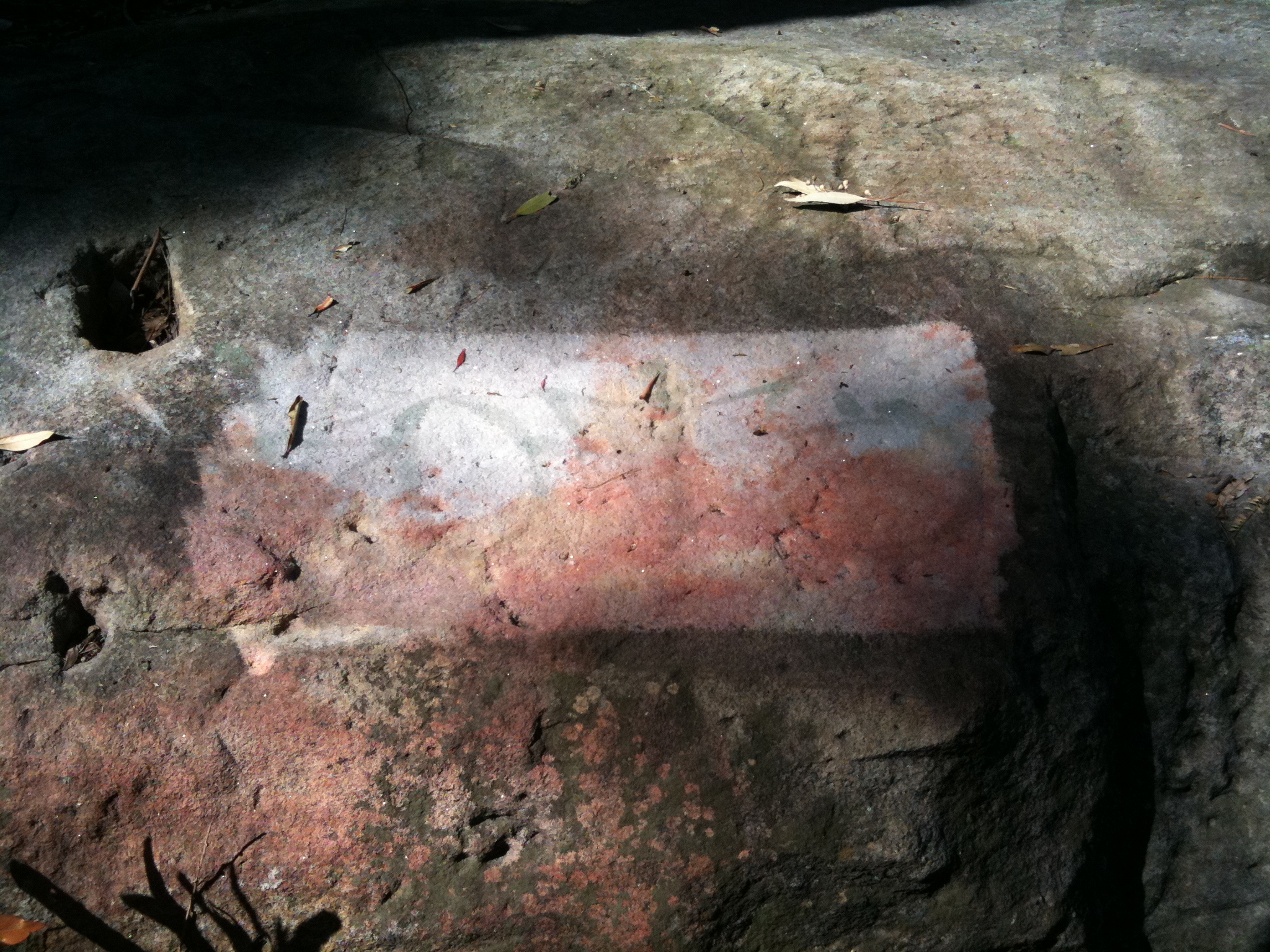
and found this:

Yes, a pale patch of rock where once a plaque had been. Was this was the work of vandals or the result of Glebe being taken over by the City of Sydney? Did the Councils talk to each other? Is the new plaque some kind of replacement for the stolen/removed one? I’ve phoned Leichhardt Council and emailed the City of Sydney Council. The latter’s web site promises a reply within 14 days.

To be continued …

Eliot Weinberger, list virtuoso

Eliot Weinberger, Oranges & Peanuts for Sale (New Directions 2009)

Eliot Weinberger is a poet, translator (most eminently of Octavio Paz from Spanish and Bei Dao from Chinese), literary critic (though he denies it), essayist (one of his essays – perhaps more accurately classified as a prose poem – was published in Heat Nº 5), anthologist (his 1993 anthology American Poetry Since 1950 was a bestseller in Mexico), editor. This book collects 28 pieces written on commission and first published between 2001 and 2009: introductions to other people’s books and to his own poetry translations and anthologies, reviews, magazine articles, contributions to anthologies and talks given at conferences. He ranges far and wide, and is always interesting, often illuminating, sometimes funny. Topics include EB White, Emily Dickinson, Susan Sontag, the changing face of Chinese poetry in the US since Ezra Pound, China in 2005, the failure of US literati, poets in particular, to engage politically under Reagan, the relationship of photography and anthropology (they’re siblings), a number of poets I’ve not heard of who are now high on my To be Read list, translation (I will never trot out the phrase traduttore traditore again), George Bush, the Iraq War, Barack Obama. And there are a couple of pieces – one on the colour blue, another on peanuts and oranges – that approach an abstract condition.

Weinberger is a great list maker. Often when I come upon a list in a piece of prose, I’m tempted to skip, feeling that it’s enough to know that many and various things were packed into the car, or growing in the garden, without having to read the name of every one of them. Weinberger’s lists don’t tempt in this way: he’s a list virtuoso, delighting in what he calls ‘strange conjunctions’. The longest piece in this book, ‘Things I Heard about Iraq in 2005’, delivers literally on the title, listing news reports, rumours, quotes and statistics, a paragraph (mostly beginning ‘I heard’) per item, and few paragraphs longer than 10 lines, without analysis, commentary or argument. The effect – partly a result of sheer accumulation, partly of masterful juxtaposition – is devastating.

Most of the lists in this book are integrated into more conventional essays. Take, from many possible examples, this list of biographical detail on David Rafael Wang, scholarly collaborator of William Carlos Williams:

Wang, also known as David Happell Hsin-fu Wand, was born in China – a direct descendent, he claimed, of Wang Wei – escaped to the US after the revolution, and became surely the only Chinese-American who was both a neo-Nazi white supremacist (and a member of the seedier circles around Pound in St Elizabeths) and a Black Panther (in Oakland in the 1960s). Among other things, he was also a stodgy professor, active in the academic bureaucracy; a bisexual boxing and martial arts fanatic who had long talks about poetry with Muhammad Ali; a poet (‘in the Greco-Sino-Samurai-African tradition’) and friend of many of the Beat and Black Mountain poets; a translator of Hawaiian and Samoan oral poetries, included in the Rothenberg Technicians of the Sacred anthology; and a possible suicide (at a MLA convention) who some people believe was murdered.

Let me try for a list of my own.

In ‘Postcard from China’, describing the familiar types found at poetry festivals, surely with himself in mind: ‘the polymath, equally at home discussing the latest American poetry or Shang Dynasty numismatics.’

In ‘Where Was New York’, a trenchant criticism of E B White’s version of that city: ‘New York is a city of outsiders where no one is a foreigner because everyone is a foreigner.’

In ‘Kenneth Cox’, quoting Cox describing Allen Upward, but could easily be describing his own effect on the reader: ‘an almost continuous sense of intellectual elation.’

In ‘Susan Sontag’ – a non-hagiographical tribute written after her death: ‘A famous writer with numerous friends and varied interests, she became, as is often the case, bogged down in ephemera and favours: speeches, statements, responses; program notes for performances of dance, theatre and opera; short texts for art catalogues; something on grottoes for House and Garden; something on Don Quixote for the Spanish Tourist Board.’

In ‘Anonymous Sources (A Talk on Translators & Translation)’: ‘cultures that do not translate stagnate, and end up repeating the same things to themselves.’ And later in the same essay, after explaining that the verses of the Quran known in English as the Satanic Verses, are known as gharaniq (the birds) in Arabic, so that when the title of Rushdie’s book was translated literally into Arabic it was generally read as meaning that some or even all of the Quran was written by Satan, which would be blasphemy enough, whatever was in the novel itself:

[T]he Japanese translator, Hitoshi Igarashi, an Islamic scholar, was stabbed to death in his office at Tsukuba Unversity in Tokyo. As far as I know, Rushdie has never made an extended comment on Hitoshi Igarashi. It would take another kind of novelist – Dostoevsky perhaps – to untangle the psychological, moral and spiritual meanings and effects of the story of these two: the man who became the most famous writer in the world at the price of what seemed, for some years, to be life imprisonment, and the anonymous man who died for a faithful translation of an old mistranslation, paying for the writer’s mistake.

He talks about ‘identity politics and its nerd brother, theory, who thought he was a Marxist but never allowed any actual governments to interrupt his train of thought’. He describes The New Yorker as having a style whose sentences are pathologically rewritten ‘until every article, whether a report from Rwanda or a portrait of a professional dog-walker, sounds exactly alike, driven by domestic similes and clever turns of phrase that mix colloquial speech with unexpected similes.’ I could go on, but you get the idea.

Not every piece in the collection is brilliant – one or two struck me as clever-dicky or obscure. On the whole, though: Best. Birthday Present. Ever.

WordPress automatically generates a list of possibly related posts, but so much in this book touches on things I’ve blogged about recently, I thought I’d compile a small list of my own. I’ll write his essay title, then my blog post title:

• ‘The United States of Obama’ – The Book Group’s Race of a Lifetime
• ‘Inventing China’ and ‘The T’ang’ – Shambhala Chinese Poetry
• ‘Postcard from China’ (‘in China, the US is Little Brother’) – Quarterly Essay 39: China Powers On
• ‘Poetry Is News’ – Narkiness and Trouble (both Jennings and Weinberger decry ‘theory’ – one of them is more entertaining than the other)

Wasted launch at Gleebooks

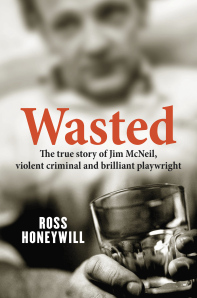
Tonight we went to hear Bob Ellis launch Ross Honeywill’s Wasted, the true story of Jim McNeil, violent criminal and brilliant playwright. There wasn’t a huge crowd – after all it’s nearly 30 years since Jim McNeil died,and his four plays haven’t had a production on a main stage for a long time. But it was a great launch, and looks like a very interesting book

1wastedJim McNeil (1935–1982), according to the Gleebooks web site, quit school at thirteen. Despite his love of reading and philosophy, as a teenager he lived among thugs and thieves. (When we showed him a draft biographical note for one of his Currency Press books in the 1970s, he crossed out the word ‘criminal’ referring to his early milieu and replaced it with ‘knockabout’.)  In 1967,  shot a policeman during an armed robbery. He was convicted and began a seventeen-year prison sentence. In Parramatta maximum-security prison he joined a debating group known as the Resurgents. Though he’d never seen the inside of a  theatre he wrote one-act plays for the group to perform: The Chocolate Frog and The Old Familiar Juice. These plays were given productions at the Nimrod Theatre in Sydney, were a big success, and were published by The Currency Press (the first book I ever copy-edited). He wrote another, full-length play, How Does Your Garden Grow, and part of a fourth, Jack, while still in prison, and then was released ten years early thanks at least in part to lobbying by members of Sydney’s theatre scene. As Ellis said tonight, people were imagining him as being like other badly behaved writers like Brendan Behan, but he was something else altogether. Once he was released he never wrote anything decent again, and his life was a slow descent into violence, alcohol-related illness, and eventually death.

I hesitate to say I knew Jim, but I did visit him in Goulburn Gaol with my then boss, Managing Editor of Currency Press Katharine Brisbane, and he came to  our office more than once after his release. I remember one memorable lunch when he and Peter Kenna, author of A Hard God, told anecdote after anecdote in fierce competition, to our great entertainment. I wasn’t there when, in response to some imagined insult, he broke a bottle on the edge of the kitchen table and threatened to use it on Philip Parsons, Katharine’s husband – but I heard the story from the horse’s mouth the next day. Katharine said she laughed and said, ‘Oh Jim, put it down,’ and he did.

Katharine was there tonight. So were a number of others who knew Jim, including David Marr, who gave him a roof on his release from prison. Ellis also shared a flat with him for some time. Bob Ellis read a piece that sounded as if he had written it soon after McNeil’s death, conveying his charm, his brilliant use of language (‘Dustbin of the Yard here. How are ya, Bobby?’), the ever hovering possibility of violence, and his chaotic alcoholism. Then he read from Wasted, and there was no doubt we were talking about the same man. I’d rate it just about the most moving launch I’ve ever been to. It didn’t turn away from Jim’s truly ugly qualities (Honeywill said that the thing that most surprised him in researching the book was how very violent Jim had been – a far cry from the charming ratbag one would wish him to have been). But there were people who loved him, and still hold a tender place for him. A number of people from the audience told anecdotes, both about his charm and his dangerousness. His story was one of redemption through discovering the life of the mind in prison, then returning to the damned space, almost by an act of will. It made me think – and someone may have said this – that the damage inflicted by the prison system runs very deep: he had lost the ability to make the kind of quotidian decisions necessary to a decent life. Ellis did say that imprisonment has been an experiment in dealing with criminal behaviour, and it has failed.

The School Magazine on RN’s Hindsight

I received a text message yesterday afternoon: ‘You’re famous!’

Yes, the Hindsight program on The School Magazine went to air and my voice has now been heard by the vast multitudes who listen to the ABC on a Sunday afternoon, and the rest of the world can hear it on Thursday 16th at 1 o’clock in the afternoon. You can download it or listen to it here. My earlier post said it was scheduled for next Sunday – it was moved forward.

Lorena Allam, the producer, did a marvellous job. I expected her to use a couple of seconds of my semi-coherent ramblings, but it turns out there’s an awful lot of me in it, and she made me sound reasonably intelligent. Of course there are a dozen omissions, but since the program focussed on the period from 1950 to about 1980, it would have been a big ask to give Duncan Ball, Tohby Riddle or Joanne Horniman more than a passing mention, or to squeeze in a mention of Geoffrey McSkimming, Margrete Lamond, Kim Gamble, Di Bates, Judy Ridge, to mention only people who have worked for the magazine, let alone the writers who were first published there. And Oh, the poets!

But have a listen. There’s some lovely stuff there. I particularly like the way much is made, correctly, of Patricia Wrightson and Lilith Norman as formidable figures, and then Cassandra Golds, remembering herself as an opinionated 11 year old, says she had no time for them at all.

Added later: Joanne Horniman has written a blog post giving the long version of a major incident in the magazine’s history that was mentioned briefly in the program. It’s at http://www.secretscribbled.blogspot.com.

And later again: Another grace note from Joanne Horniman here.

The Swamp Thing

Alan Moore, Steve R. Bissette and John Totleben, Saga of the Swamp Thing (Vertigo 2009)

I’m not a horror aficionado, but my younger son knew I enjoyed and admired other Alan Moore comics. He gave me From Hell for my birthday, and this for Father’s Day.

Having read it, I’m still not a horror fan. Demons and monsters aren’t my bag unless they’re funny like Bartimaeus, theological like Milton’s Satan, or … actually, there are quite a lot of exceptions. Still, I respond too literally to things like children becoming autistic as a result of major trauma and then institutionalised and preyed on by stray demons, and when a plot hinges on some plants speeding up their production of oxygen at night, I want to give a lecture on the difference between plant respiration and photosynthesis. Maybe pedantry protects me from the horrors of the unconscious mind.

Still, Alan Moore is a story-telling genius. In 1982, he – and illustrators Bissette and Totleben – took over the Swamp Thing comic series created ten years earlier by Len Wein and Bernie Wrightson. They collaborated on something like 45 issues – this book collects the first eight of them, of which the very first busies itself tying up loose ends from the previous 19 issues, and the second redefines the nature of the eponymous monster. So we are plunged in medias res, but know we won’t be given the detail of what went before. We can tell something is being rebuilt, not quite from the ground up, and forward impetus is well established.

This book interested me as early work by the creator of Watchmen which, like Neil Gaiman’s  Sandman, won my engagement by sheer brilliance. I don’t feel compelled to read on here, though anyone with a love of horror would certainly be hooked.

Quarterly Essay 39: China powers on

Hugh White, Quarterly Essay 39: Power Shift: Australia’s Future between Washington and Beijing (Black Inc Sept 2010)

As with every Quarterly Essay, I turned first to the back of this issue for correspondence on the previous one. Timing was unusually poignant in this case: QE38, David Marr’s Power Trip, came out just days before its subject Kevin Rudd was ousted from power; the responses to it here were mostly written when the election campaign of Julia (‘the ouster’) Gillard was foundering, and I read them just after hearing that she will be leading a minority government. There are no fireworks in the correspondence: a couple of journalists add corroborating anecdotes about Rudd’s leadership style (David Marr describes these as symptomatic of ‘a new, and welcome, spirit of indiscretion’; I read them as a bit of a pile-on). Kerryn Goldsworthy deftly despatches whole swathes of attack on the essay and dispenses a little relevant information about literary forms while she’s at it. James Boyce corrects and enriches David Marr’s understanding of Dietrich Bonhoeffer and his probable significance for Rudd. In responding, David Marr replies almost entirely to criticisms that were made elsewhere: perhaps it would have been polite to give those critics the right of pre-reply here (he quotes Sylvia Lawson and Allison Broinowski and gives them a one-word reply: rubbish).

From David Marr’s Power Trip to Hugh White’s Power Shift. Appropriate as the title would have been for an essay on the recent election, we have to wait for QE40 for George Megalogenis to give us that (Power Brakes?). This one is about something other than personalities and politics as horse race:

Our leaders, and by extension the rest of us, are assuming that Asia will be transformed economically over the next few decades, but remain unchanged strategically and politically. It is an appealing assumption because the past forty years have been among the best times in Australia’s history, and it has been easy to believe that American power would continue indefinitely to keep Asia peaceful and Australia safe. That has been a cardinal mistake.

Perhaps the assumption is also appealing because its obvious knee-jerk alternative is a revival of Yellow Peril rhetoric. Tomorrow When the War Began (John Marsden’s series of YA novels and now a film based on the first book) demonstrates, incidentally, that the complacency Hugh White sets out to prick hasn’t been absolute, but it does give strength to his arm in seeking to get people to think about Australia’s relationship to China rather than explore violent fantasies, however earnestly packaged.

While Kerryn Goldsworthy says, quite correctly, on page 85 that an essay can be ‘an expedition into the unverifiable: memories; theories; hitherto unexplored veins of subject matter or uninhabited point of view’, this one proceeds with the logical clarity (though not the  soul-destroying aridity) of a PowerPoint demonstration. ‘Since 1788,’ he says, stating the obvious but unsettling truth, ‘Australia has always enjoyed a very close and trusting relationship with the world’s strongest power, and we just take that for granted.’ Well, not for much longer – and we need to think about this. The main history of our times, he proposes, may not be in the place that’s getting the most attention:

The day-to-day management of the [US–China] relationship gets a lot of detailed attention, but presidents and other senior figures avoid substantial analysis of America’s long-term intentions towards China. One reason is 9/11. For almost a decade, America’s political leaders have convinced themselves that a small group of fugitives on the run in Pakistan poses a bigger challenge to America’s place in the world than the transformation of the world’s most populous country. Future historians will find that hard to explain.

To be fair to White’s argument, he goes on immediately after this to acknowledge that Barack Obama signalled that the blinkers were coming off after his visit to China in November last year. All the same, Muriel Rukeyser take a bow.

It’s a very interesting essay, which I recommend as an antidote for the personality-preoccupied, narrative-driven writing that accounts for most political commentary in our newspapers these days.

Cheap at a fraction of the price

Having got as much of my work done today as I could manage I listened to a Guardian podcast, which mentioned that Seamus Heaney has a new book out, and it’s topping  the best seller lists in the UK. I went browsing to see if it’s available in Australia. One bookshop says it will be here 14 September, but they all agree you can’t buy it in Australia yet. Mostly prices are around the $30 mark. The Co-op Bookshop offered this spectacular anti-bargain:

Not only free delivery, but also a members’ discount $54.55. Who could resist?

Narkiness and trouble

Kate Jennings, Trouble: Evolution of a radical: selected writings 1970–2010 (Black Inc 2010)

I was looking forward to this book. Kate Jennings and I have a lot in common. We both hail from rural Australia, had diffident but dependable fathers, were skinny when young (she still is), did Arts at Sydney University in the 1960s. We both hate alcohol culture. We’ve both had people with Alzheimer’s in our lives. We were never part of the same set, but had friends in common. We met at least once, when one of those friends had us both to dinner, possibly with ill-conceived match-making intent. (I have only the vaguest memories of that meal, not much more than being pleasantly surprised to find that the formidable Kate was a country girl.) As I’ve mentioned before, I was there for her famous speech to a Vietnam Moratorium crowd on Sydney Uni’s front lawn in 1970, I also vividly recall her tremulous presence at Balmain Poetry Readings in the 70s. Both the front lawn speech and the poem I remember most clearly, ‘Couples‘ (‘couples make me guilty of loneliness, insecurity, or worse still, lack of ambition’), are included in this volume.

Apart from one essay, perhaps in The New Yorker, I didn’t read anything more of Kate’s writing until her 2002 novel about Alzheimer’s and Wall Street, Moral Hazard, her 2008 book about her dogs, Stanley and Sophie, and her recent essays in The Monthly, all of which I enjoyed. Trouble, a selection in lieu of memoir, looked like an opportunity to fill the gaps: how did the rage-filled, nervy radical feminist of the 70s become the consummately urbane, confident New Yorker?

If you’re looking for a review, stop reading now, because I gave up just after the halfway point. Jennings describes herself as prickly and graciously acknowledges that Chris Feik of The Monthly and Quarterly Essay ‘gently moderates [her] frequent immoderation’. But it wasn’t lack of moderation or prickliness that got me down. I diagnose at least a mild case of expat syndrome: I’ve grown older and regret my youthful foolishness, you’ve grown older and have mended your immoral ways, expats have grown older and think they were once foolish and immoral because of the immutable culture of their native land. The essays and interstitial pieces pour scorn on Australian feminists (so trapped in ‘theory’ and waffle), on Australian drunks (so representative of all Australians and so unregenerate), on Australian poets (so caught up in ‘infinitely ridiculous poetry wars’, and while she’s on the subject, one side of those wars is historically ignorant and engages in ‘appallingly damaging’ games of Chinese whispers) and, with no obvious sense of the irony, on the Australian proclivity to pour scorn (her word is derision).

She complains that an essay making sweeping statements about what’s wrong with Australian feminism was ignored (‘Clever tactic to silence criticism’), but since the essay names no names, quotes no quotes, and seems to be broadly ignorant of Australian socialist feminism, the Women’s Electoral Lobby, Women Behind Bars and lord knows how much else, I suspect the silence was embarrassed rather than clever.  She complains that her poem about Martin Johnston led to disapprobation being heaped on her, and that unnamed persons (a weaselly passive voice implies that it was the entire corpus of Australian poets) referred to her as the ‘execrable Jennings’, but an angry response shouldn’t have surprised her given that the poem virtually accuses unnamed people of taking ghoulish delight in Martin’s slow suicide by alcohol,  and if anyone used the phrase ‘execrable Jennings’ in public they managed to keep it hidden from Google. A former lover once threatened to sue her for a portrayal of him which she claims was a caricature that no ordinary readers would give a fig about identifying with any actual person. The story in question, included in this book, seemed to me a nasty piece of work that might as well have conte à clef as a subtitle: you don’t have to be a member of any in crowd to recognise Helen Garner (incidentally one of the people who don’t exist in Jennings’s version of Australian feminism). Poor Kate, always being misunderstood.

I could multiply examples of annoying moments:

The chief characteristic of Australian feminism is a proud  combativeness, best illustrated by the refrain of a song popular in the first days of the movement: ‘I’m a shameless hussy and I don’t give a damn.’

It may be nitpicking, but the song, as I remember it and confirmed by 30 seconds of research, goes like this:

We're shameless hussies and we don't give a damn
We're loud, we're raucous and we're fighting for our rights
for our sex
and for fun
and we'll win.

Proud combativeness? I would have thought the tone was more like rowdy optimism. And KJ’s slip from plural to singular is surely indicative of something.

By the time I reached page 174 I realised the book wasn’t fun any more. On that page Jennings says a friend ‘complained that he had to keep backtracking to figure out what was going on’ in a detective novel she  is enthusiastic about, and I caught myself reading that as a sneer at her friend’s philistinism. Almost certainly it was nothing of the sort, but my cumulative annoyance had reached a level where I was reading with half my mind on the lookout for the next annoying thing. I even started cavilling at an occasional turn of phrase, and that had to be me not Kate, because she writes beautiful, concise prose. This book and I needed some space from each other. I may go back to it, but for now I’m going to read Alan Moore’s Saga of the Swamp Thing. Sorry.