Dog Ear Cafe

Andrew Stojanovski, Dog Ear Cafe: How the Mt Theo Program beat the curse of petrol sniffing (Hybrid Publishers 2010)

Despite the subtitle, this is not a how-to book, but nor is it straightforward memoir. The author lived for more than 10 years at Yuendemu, a Warlpiri settlement in Central Australia. He worked for a number of different employers during his time there, but from the first months he saw his job as being to fill the whitefella (Kardiya in Warlpiri) functions in the campaign against the petrol sniffing that was devastating the young people, and imperilling the future, of the community. A number of qualities equipped him well for the job: he was young, and evidently possessed huge amounts of energy; he had studied anthropology, and was open to cultural differences; he had a deep seated, quasi spiritual yearning to know Indigenous Australia intimately as a way of understanding his own Australian identity; he wanted passionately to make a difference in the world. The book is as much his personal story as the story of the program.

Stojanowski says somewhere in the book that he has written it to fill his obligations to the people he worked with, so other people can learn from the Mt Theo success. I imagine any whitefella planning to work in a remote Aboriginal community would find useful information here: how to make sense of cultural attitudes and practices that derive their rationality from hunter-gatherer ways, and to come to see their counterparts that might seem like they’re simply rational as rooted in millennia of agriculture; the importance of non-violence if a white worker is to keep the confidence and trust of a traditional Aboriginal community; a little on the workings of Warlpiri skin-name system; how indispensably useful it is that a whitefella has ‘diplomatic immunity’ from the intricate web of avoidance and can’t-say-no obligations that bind initiated Warlpiri adults; that what a distant, bureaucratic perspective might see as ’empowerment’ can look like abandonment when seen up close; and much more.

The book is very readable. Its potential usefulness is fleshed out in wonderful anecdotes – yarns in fact. There are dramatic confrontations with young people out of their minds on petrol fumes, privileged visits to significant cultural sites, one or two ceremonies lyrically described, revelatory conversations with old men and women, places where Warlpiri and whitefella senses of humour are a perfect match. We get a richly textured picture of what it’s like to be a whitefella living and working closely and respectfully with Warlpiri people – elders and young people – in a Central Australian community. Stojanovski married soon after moving to Yuendemu, and his two daughters were born during his time there. He gives an unsparing, though tactful, account of the strain that his heroic dedication to the work placed on his marriage. I would have loved a chapter in which his wife told her story. As it stands, it’s hard to tell how much she was an equally heroic member of team Stojanowski, and how much a sufferer of collateral damage – though it’s fairly clear there were elements of both. I would also have liked a chapter from Peggy Nampijimba Brown, the old woman who challenged cultural norms by undertaking to look after other people’s children at Mt Theo, without whom nothing could have happened – but the detail of whose story Stojanovski can’t tell us. Those, of course, are other books.

In the shadow of the Howard–Brough–Rudd–Gillard–Macklin Intervention, which gives the message that Indigenous communities in the Northern Territory are so dysfunctional that only military force can bring order, and in the more specific shadow of recent headlines about payback violence and exile from Yuendemu itself, this book is a challenging source of genuine light and realistic hope. It’s also a ripping good read.

Brian Aldiss’s Hothouse

Brian Aldiss, Hothouse (1962, Baen Books 1984)

What a luxury to read a book where a child dies  horribly in the first couple of pages, where the earth’s temperature has risen to the point where almost all mammals are extinct and small groups of humans cling to a precarious existence, where women lead those human groups and the men are protected and pampered because reproduction depends on their survival, and where none of these things is weighed down by real-life concerns about child protection, anthropogenic global warming or hegemonic patriarchy. Hothouse was first published in 1962 (and a year earlier as a five-part serial in a science fiction magazine), when gender politics and ecological anxieties were dots on the horizon for most people, and it was possible to approach in a spirit of joyful play subjects that are now matters for earnest, urgent and often acrimonious discussion.

You can’t argue with a book that rewrites the laws of physics to allow vast spider-like plants to tether the moon to the earth with silken cables. You can’t get too gloomy over a dying Earth scenario that involves incredibly [sic] vicious vegetable species with names like killwillow, trappersnapper, wiltmilt or oystermaw.  You can only sit back and enjoy the ride when human intelligence is explained as the product of symbiosis between ape-like mammals and a ratiocinative fungus.

This book won a Hugo when it was first published. It’s listed as one of David Pringle’s Best 100 Science Fiction Novels since the Second World War. It’s a wildly inventive odyssey in which the hero Gren meets more evolutionary monsters than any one story has a right to. There’s plenty of terror, romance and comedy, much physical and moral heroism, enough philosophy to keep the mind engaged, and a pinch of charming bawdry.

I was at boarding school in 1962,  thirsting for genre fiction and making do with what slim pickings the school library had to offer. Hothouse and the 14-year-old me were meant for each other. We’ve met up nearly 50 years too late, but that’s much much better than never. I’ve just read on the Official Brian Aldiss Web Site that Penguin republished it in 2008 – may it bring joy to myriad  readers, of whatever age.

At the checkout

At the  greengrocer’s today, one of the other checkout staff called to the young woman who was scanning my carrots, ‘Mercedes, what country do you come from?’ She called back, ‘Chile!’ My guess was that the exchange was drawing attention to her Latin American background, exotic in this context where most staff are Italian, Lebanese, or from a range of east or south-east Asian countries.

I looked over to where the question had been lobbed from, and recognised the customer. ‘The customer over there is a writer,’ I said. ‘Maybe he wants to give your name to a character in one of his stories.’

She looked interested at that possibility, but she didn’t ask the writer’s name.

Happy hundredth birthday, Arthur Boothroyd!

Today is Arthur Boothroyd’s hundredth birthday. Yesterday he came home from hospital, where he had been because of a chest infection. I posted about Arthur a couple of years ago. Here’s part of what I said then:

Yesterday afternoon Penny and I were walking the dog when we met Arthur coming the other way. Arthur lives three doors down from us. He’s in his early 90s and dealing with encroaching dementia and increasing frailty, but regularly walks to the park and back. When you encounter him on one of these walks he will make conversation from a small supply of stock phrases — about the weather, how lovely the park is, and not a lot else. Yesterday, his mode of progress along the footpath made me fear for his safety: he was tottering, as if the only thing that stopped him from falling forward with each step was act of putting out a foot for the next step. We stopped to say hello, and he put both hands on Penny’s shoulders, leaning in close to her. She asked if he needed help to get home, but he pooh-poohed the idea, even while prolonging the contact for the purpose, it seemed to me, of catching his breath and keeping his balance. After a little while, he asked, ‘Do I know you?’
…..
[Arthur] had been, in the 1950s and 60s, the main illustrator for The Australian Women’s Weekly: in those years, the AWW published short stories and historical features, and as often as not it was Arthur who provided the pictorial elements. He also illustrated a number of children’s books then and into the 90s. I googled him – “Arthur Boothroyd” minus everything that brings up a British audiologist of the same name — and discovered only a handful of references: the most common is to the booklet published to mark the opening of the Sydney Opera House, which he illustrated.

It’s not that Arthur is forgotten, or that he is without honour among the confraternity of illustrators. I mentioned him to a children’s illustrator the other day, just his first name, and she said, ‘Do you mean Arthur Boothroyd? I admired his work so much when I was starting out. He was what I wanted to be!’ He is known and loved by long-term Annandale dwellers. More than one person in our block cooks meals for him. But of all the people, both children and adults, whose visual imagining of Australian landscapes and histories were profoundly influenced by his Women’s Weekly work and his children’s books, how many have even heard of him? A select few artists become household names and get headlines when a work is sold for a million dollars. The great majority fade away, and their work too fades. I think the least we can do is let them lean on us in the street to keep their balance and regain their breath.

Happy birthday, Arthur!

Imara Savage directs Sam Shepard

Full disclosure: I was thrilled to attend this preview night of Imara Savage’s production of Fool for Love Downstairs at Belvoir Street, not because I’m passionate about the play – I was underwhelmed by the London production in 2006, and before that by Robert Altman’s 1985 film – but because I’ve known Imara all her life and nearly half mine, and have always appreciated her fine sense of the theatrical.

The production uses the tiny space downstairs at the Belvoir to great effect: a man and a woman in a seedy motel room, with another not-quite-real older man sitting up at the edge of the audience with a guitar. It’s claustrophobic and intimate. All four actors are brilliantly cast and perform brilliantly. Instead of the rockstar glamour of Juliette Lewis or the Hollywood iconicism of Sam Shepard and Kim Basinger, the main actors, Emma Jackson and Justin Stewart Cotta, give us a May and Eddie who are worn down by life, can’t live with each other, can’t do without each other, struggle with their compulsive need for each other: there’s no celebrity charisma to confuse the issue. Terry Serio as the older man with the guitar is spot on, and Alan Flower, innocent bystander, is a perfect foil for the destructive passions of the rest.

I’ve seen Sam Shepard done badly, without a feel for the music of his language, and it just grinds on incomprehensibly. This Fool for Love isn’t one of those occasions: there’s a point where Eddie delivers a very long monologue that could bring the play to a crumbling halt, like the verbal equivalent of an explanatory flashback. As performed by Justin Stewart Cotta, with Alan Flower a captive audience, it’s mesmerising. I wasn’t surprised to read in the program notes that Stewart Cotta is an accomplished musician.

You know how when an Australian cast does a US play, there’s often a dreadful unease about the accents, as if you can feel the gears grinding to keep them in place? There wasn’t a hint of that here.

It was a preview, and there was a technical hitch that involve the theatre filling with smoke and the smell of cordite. We had an unscheduled interval. It’s a sign of the strength of the performances that the spell wasn’t broken. This is a magnificent hour and a half of theatre.

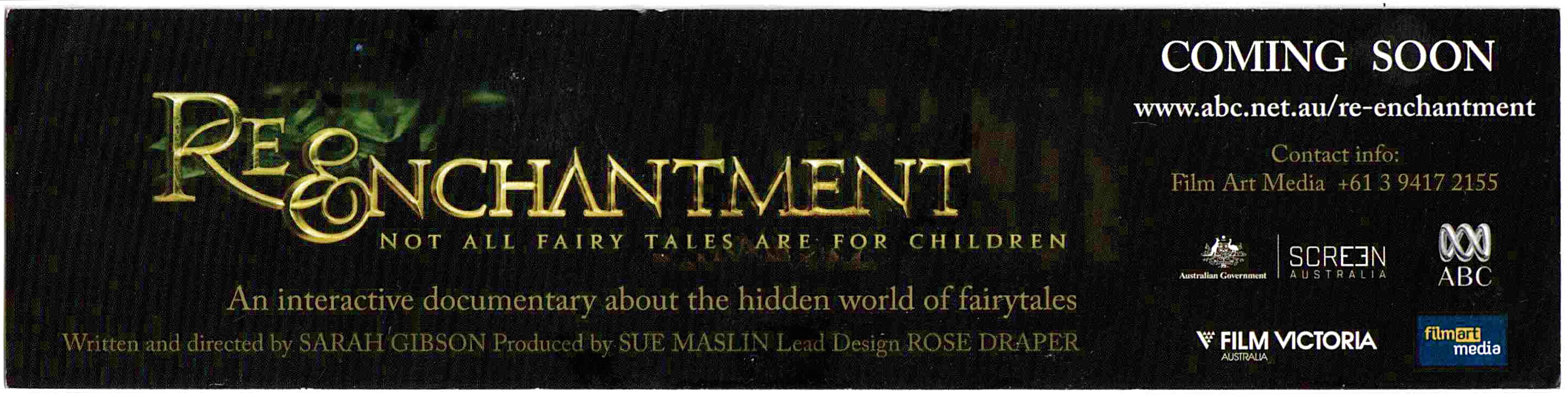
Coming soon to ABC on the web

An exciting bookmark: Re-enchantment, coming soon to abc.net.au/re-enchantment (the link isn’t dead, it’s just not live yet). It’s an interactive documentary about the hidden world of fairytales by Sarah Gibson. If you haven’t heard about it before, you heard about it first here.

Heat 23, Overland 200 and Asia LR 17

The ‘dead white male’ critique of Western Civ […] did not lead, as many of us had hoped, to a new internationalism, but rather to a new form of nationalism that emphasised hyphenated Americans. Chinese-Americans and Chicanos were now part of  the intellectual universe, which was fine as far as it went, but Chinese and Mexicans were still excluded. Multiculturalism was, and is, not very multicultural at all.
(Eliot Weinberger, ‘The Post-National Writer’ in Oranges and Peanuts for Sale)

I’ve just read three literary journals whose roots lie respectively in a rejection of Australian xenophobia, in Communism with its commitment to internationalism and in a mission to publish Asian writing in English. Although we don’t do hyphens in quite the same way as the US, it seems reasonable to see how these journals stack up against Weinberger’s complaint.
***

Ivor Indyk (editor), Heat 23: Two to Go (September 2010)
This issue of Heat is atypical in not including any work in translation. Multicultural themes are addressed, but very little attention is paid to the world beyond our shores. There’s not even any travel writing, unless you count Vanessa Berry’s ‘Dark Tourism: Three Graveyard Tales’, in which the author visits two graves and strolls in a London cemetery (in a piece that might have been more accurately titled ‘Mildly Crepuscular Travels with my Mum’).

Turkish born, ethnically Greek Melburnian Dmetri Kakmi’s ‘Salam Cafe and the Great Burqa Debate’ might seem to fit Weinberger’s description of Clayton’s multiculturalism pretty well – a non-Muslim man joins the argument about what Muslim women should or shouldn’t be allowed or made to wear. But he puts the lie to that pigeonholing by acting as a conduit for Muslim points of view, drawing on his childhood memories of Turkey and his time as a student in Istanbul, and discussing burqa-related artworks by Muslims Shadi Ghadirian (a woman) and Kader Attia (a man, whose ‘Kasbah’ was shown in this year’s Sydney Biennale).

Weinberger’s aspersions might also seem to apply to Michael Mohammed Ahmad’s story, ‘The Hat Dance’, the piece that comes closest to the kind of hyphenation he dislikes. But this account of a dust-up in an extended family living in Western Sydney is so gloriously exuberant only some kind of Diversity Bean-counter could fail to relish it.

Of course, Heat doesn’t claim to fill a hypothetical Diversity Quota in every issue, and there’s no reason it should. Its characteristic approach to fostering diversity is by presenting crosscultural encounters, an approach I’m fairly sure Weinberger would approve of. Kakmi’s piece is an example of that approach. So is Michael Atherton’s portrait of Harry (christened Charalambos) Vatiliotis, who lives in the Sydney suburb of Croydon and makes classical violins in the manner of Stradivere, each one a unique work of art. Cassi Plate quotes from letters of Costas Tachtis, Greek novelist who lived for some years in Australia, and his friend Carl Plate, an Australian artist: ‘The letters,’ she writes, ‘take us into a cosmopolitan world within the heart of what is often assumed to be parochial 1950s Sydney.’ Maybe cosmopolitanism is a better word than diversity for the thing that Heat does so well.

Cosmopolitanism can incorporate voices from elsewhere, and also bring a sharp eye to bear on the local, as Peter Doyle’s fascinating ‘Bashful City: Sydney’s Covert Criminality‘ does to photographs from the archives of Sydney’s Justice and Police Museum.  It can also include intensely place-specific writing like  Mark Tredinnick’s review of  Judith Beveridge’s most recent book of poetry, in which, incidentally, he compares her to a shark and a Philip Marlowe thug, and convincingly means both as compliments.

I do worry about Heat‘s copy editing and proof reading. There’s curiousity, practicing (though correct Australian usage practises elsewhere), an umbilical chord. Someone is heard cluttering in his garage. In Robert Adamson’s delicately poised ‘The Coriander Fields of Long Bay Penitentiary’, a with is repeated over a line break – I know it’s poetry, but that’s just a mistake. One article has this near the beginning: ‘It is one of the great dividers between the civilised among us: those of impeccable taste.’ I wasn’t interested enough in the article’s subject – taxidermy – to endure whatever came after that.
****

Jeff* Sparrow (editor), Overland 200 (Spring 2010)

The first issues of Overland, published in 1954,carried the slogan ‘Temper democratic; Bias, Australian’, hardly a promise of cultural diversity or cosmopolitanism. But as a project of the mainly Communist Realist Writers’ Group, the journal had a commitment to internationalism. Surprisingly, there’s not a lot of that in this anniversary issue, unless you count a deference to Europe and the US. Not that there’s necessarily anything wrong with that: for instance, Alison Croggon’s ‘How Australian Is It?‘ talks with her characteristic clarity and generosity about the way much of our theatre has opened out to the world, freed from constricting preoccupations with national identity but distinctively Australian all the same. On the other hand, when Clive Hamilton characterises the Australian as an agent of ‘the Republicans’ war on climate science’, he implies – perhaps intentionally – that in this matter Australia is humiliatingly no more than an arena in which US battles are being fought. There’s a fair whack of ‘theory’**, enough to create a gnawing sense of Australia as a site for the application of theory developed elsewhere – no sign of Raewyn Connell’s Southern Theory here. (The most theory-rich piece, Alwyn Crawford’s ‘Permanent Daylight‘, which deals with the intimate connection between capitalism and anorexia, is nevertheless compelling reading because of a ballast of passionate personal testimony.) Christos Tsiolkas is the Literary Big Gun of this issue, with a short story about the market in European art, but I found it unreadable (that is to say, I couldn’t tell what the story was trying to do, whether it was a spoof or something else very dull). There’s no non-European voice, and little interest in non-European culture: one piece, by a non-Muslim, quoting no Muslim voices, uses the Western burqa debate as a springboard for theoretical reflections on the visibility or otherwise of women in the West; Jacinda Woodhead gives us an attractive profile of Melbourne rapper-comedians Fear of a Brown Planet (there’s a wonderful YouTube clip of one of them here); Kabul is mentioned in one article, but it’s in a quote from an organisation aimed at creating a market for US cosmetics there.

So Weinberger’s kind of internationalism isn’t overwhelmingly evident in Overland. The three outstanding pieces, in fact, aren’t even particularly multicultural. Chris Graham does a demolition job on Noel Pearson in ‘Telling whites what they want to hear‘. Graphic novelist Bruce Mutard re-tells a story from Overland 1: the story is ‘Nine O’clock Finish’ by John Morrison, a marvellous socialist realist writer, and the resulting 8-page comic is to weep. Janette Turner Hospital’s short story ‘Weird People’ is a tour de force centred on the captain of a tourist boat that takes mainly US tourists out to look at humpback whales off the coast of New South Wales – I suppose it could be read as a protest against our cultural client-state identity.

In Overland, though less so than in Heat, proofreading is a worry: ‘haute bourgeois’, the Communications Minster, and at least one article written in an academic style that apparently defeated all attempts to wrangle it into English.

* In a classic example of Mruphy’s law, when I first put this up, I misspelled Mr Sparrow’s first name – immediately after whingeing about someone else’s poor copy editing. I’ve fixed it now
**  Writers referred to include Ariel Levy (North American liberal feminist), Nina Power (British philosopher and feminist), Mark Fisher (British cultural theorist), Guy Debord (French theorist), Sheila Rowbotham (British feminist historian), Edward Said (the exception that tests the rule and finds that it holds up), Naomi Baron (US linguistics professor).

****

Stephen McCarty(editor), Asia Literary Review 17 ([Northern] Autumn 2010)
It’s a telling confirmation of Weinberger’s generalisation that the ALR’s web page header reads ‘Asia Literary Review – Asian American writing’, apparently promising US-ers that they can read it without danger of encountering anything genuinely foreign. Happily, it’s a false promise.

From the beginning, there’s no doubt that we’ve left the leisurely contemplation of anti-grand abstractions far behind. US-expat journalist Robbie Corey Boulet kicks off with a report on the first case tried – in 2009! –  by the tribunal set up to deal with ‘those most responsible’ for the crimes of the Pol Pot regime. Itself a fine combination of court-reporting, historical background and interviews with people still looking for answers about their murdered relatives, it is followed a few items later by a suite of poems by Peauladd Huy whose parents were murdered by that regime and who now lives in the USA. And it finds a grim echo at the end of the journal, in an excerpt from Frank Dikötter’s Mao’s Great Famine, which draws on archival sources to explore the terror and violence of the Great Leap Forward (‘at least 45 million people worked, starved or beaten to death’). There are other pairings, including a story and a photo essay about floods in the Philippines. A good bit of the ALR probably amounts to armchair dark tourism – much stronger medicine than the piece wearing that label in Heat.  The one actual piece of travel writing – about Mount Merapi, a Javan volcano –  has enough disastrous loss of life for the darkest tourist sensibilities.

There aren’t many laughs, but there’s plenty of wit and imagination: ‘Youth-in-Asia‘,  a story set in Korea by Canadian Ron Schafrick, delivers on its punning title; Priya Basil’s ‘Losing Their Religion‘ is a quietly entertaining memoir of religious conversion and un-conversion that spans three continents; GB Prabhat’s ‘The Silencer‘ gives us a clever inversion of  celebrity stalking.

There is no Australian presence, apart from two full-page ads, for the Melbourne Writers Festival (featuring a Hokusai wave) and Heat (‘Australia’s only international literary journal’) respectively.  Insert your own ironic comment.

One sentence leaps out to meet my eye.  Jonathan Watts, an English journalist, moved from Korea to Beijing in 2003. His interviewer James Kidd tells us:

The signs of conspicuous pollution made an immediate impression: a keen runner, Watts found himself wheezing after a short jog; a father, he was alarmed when his two daughters were not allowed outside during breaks at their Beijing school. It was China that taught him to fear for the future of the planet.

I’m not sure I can afford to keep up my subscriptions to all three of these journals. I was thinking of letting my subscription to Asia Literary Review lapse – but it’s teaching me to think in terms of the whole planet

Quack at the Griffin

I love the theatre in Nimrod Street, Darlinghurst, now known as the SBW Stables – it gave us Flash Jim Vaux and Hamlet on Ice, Gloria Dawn in  A Hard God and Reg Livermore in The Tooth of Crime, John Bell’s productions of Measure for Measure and The Removalists. It’s the kind of intimate theatre where Jane Harders as a loose woman from early colonial Sydney could proposition a nerdy young man in the front row and have that young man fall in love with her forever. When the Nimrod moved out, I followed them to Belvoir Street, though I have seen any number of good things at the Stables in the intervening years. I didn’t see Holding the Man there, but I wish I had because it was obviously intended for a more intimate space than the Drama Theatre in the Opera House

We expected to be the oldest people in the audience for Griffin Theatre’s Quack last night. The publicity mentioned zombies, and surely zombies are for the young. But no, the 22-person audience was as silver-haired as Belvoir Street on a Sunday afternoon.

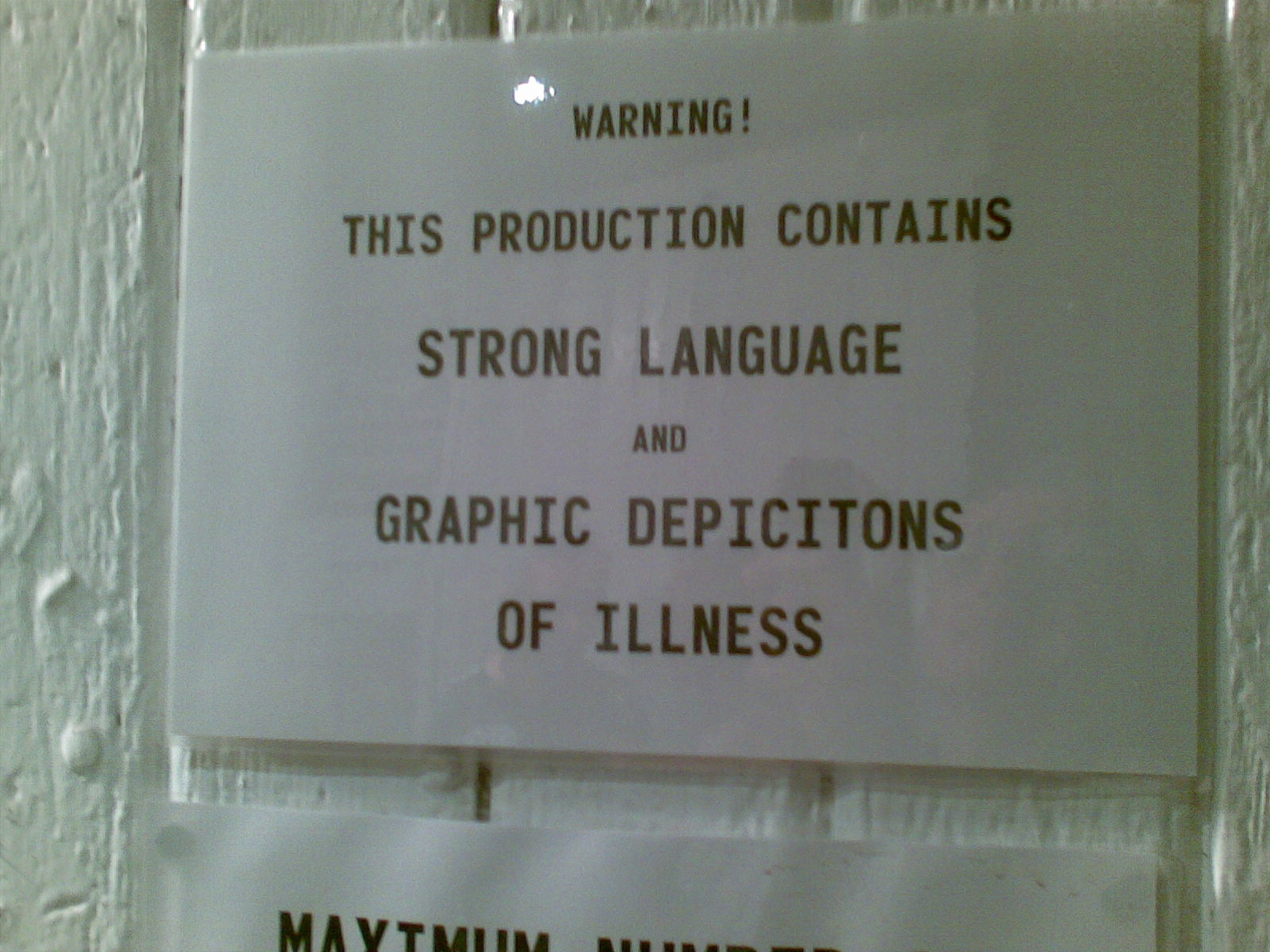
There were signs in the recently refurbished foyer, warning of strong language and ‘DEPICITONS OF ILLNESS’. Just before the curtain at the foot of the stairs was pulled aside for us to ascend, a young man invited us to sit as close to the front as we wanted, but to be aware that during the graphic depictions (not depicitons after all) of illness, bodily fluids would be sailing around the space … all water soluble so nothing really to worry about. We sat two rows from the front; some less brave souls sat in the very back row.

Aimee Horne as Fanny, complete with creepy contact lens

The show itself? I don’t think I can do better than the description on the Griffin web site: ‘a romantic historical western drama noir exploitation comedy. With zombies.’ I would add, though, that there are musical interludes, beautifully sung by Aimee Horne, and a strong satiric thread. As everybody knows, zombies must never be read as symbolic. A zombie is a zombie is a zombie. But when you have the old doctor in a town saying he just wants everyone to be relaxed and comfortable, and the young doctor who seeks to replace him singing the praises of hard work and then delivering enraged diatribes involving copulating rats, you begin to realise that the non-undead characters have intentional similarities to actual politicians.

Most of the actual zombie action happens offstage (hard to do the Zombie Apocalypse with just four actors), and though there was much that was gruesome, most of it was described rather than enacted, and what was enacted was mostly comical. I confess there were a couple of non-zombie scenes when I had to close my eyes and control my gag reflex. But the couple of splashes of fluid that landed in my hair didn’t worry me at all.

This show could have been a disaster. Instead, as far as my companion and I are concerned it was a great success. And neither of us is particularly drawn to zombie movies (though we did both love Peter Jackson’s Brain Dead on DVD). It felt like a chaotic romp, but playwright Ian Wilding, twice winner of the Patrick White Prize, clearly knew what he was doing. Director Chris Mead and the cast – Jeanette Cronin, Charlie Garber, Chris Haywood, Aimee Horne –  get the silly-OTT mode just right. The set – red velvet curtains and a dangerously sloping wooden floor – and the howling sound design are brilliant.

It’s only on for another week. It deserves more than 22 bums on the seats each night. More than 22 people a night deserve to have this much fun . If you’re in town, go!

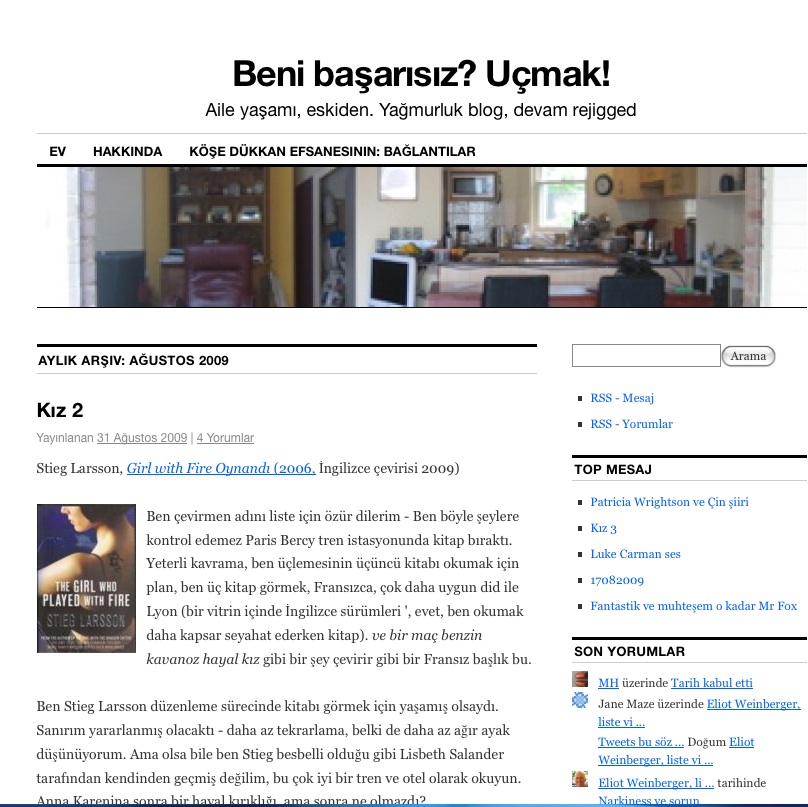
I’ve been published in Turkish

Well, only by Google. But I did enjoy this:

A Puppet Show for George Street

Wednesday night, Yuendemu at Gleebooks. Last night Java on George Street. Or close enough to justify the alliteration.

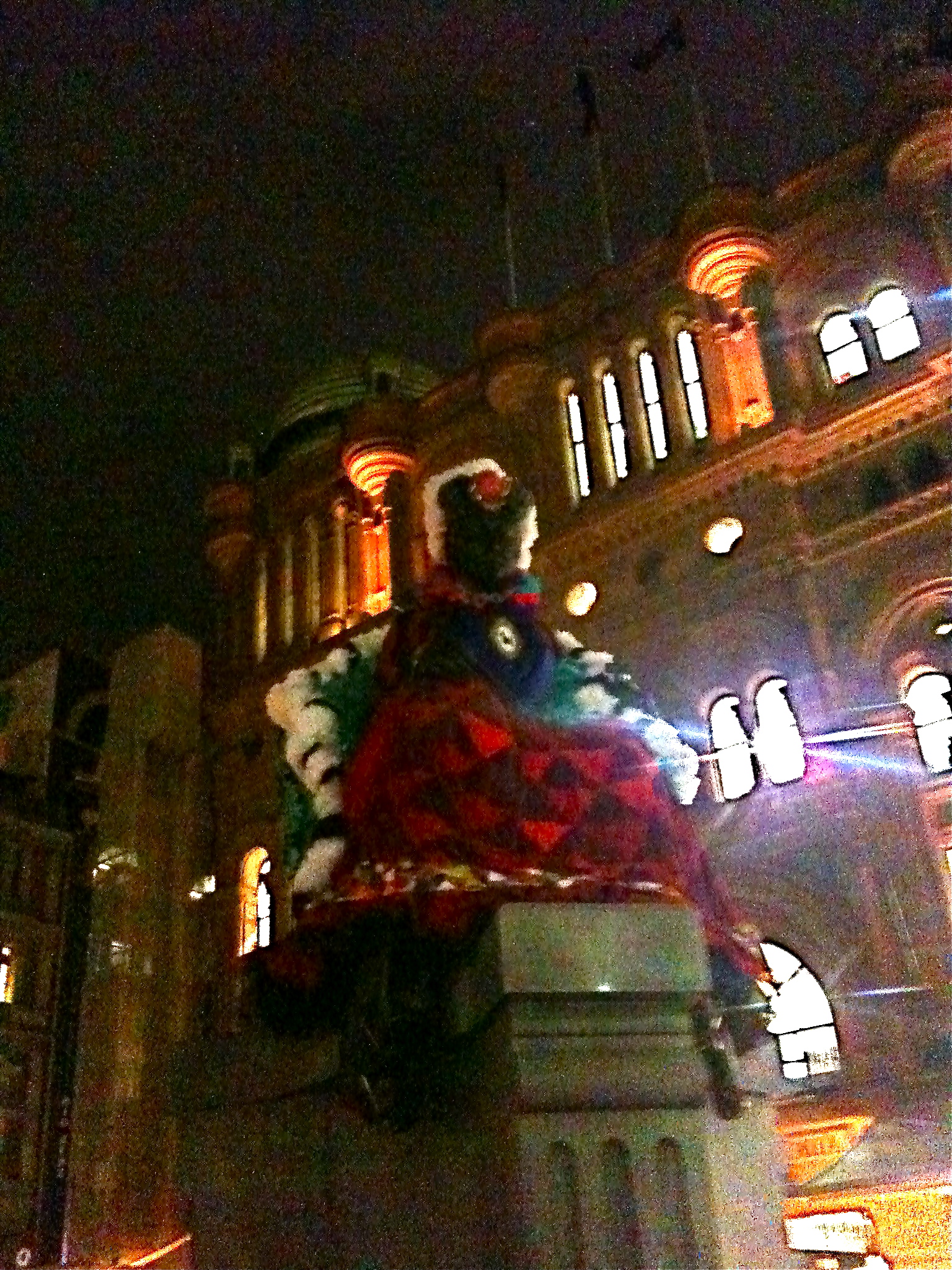
It’s Art and About time in Sydney, and among other things our civic sculptures are dressed for the occasion. Here’s Queen Victoria near the QVB, taken on my iPhone and then manipulated out of almost total blackness on iPhoto. She’s wearing a bright red quilted skirt, a white fuzzy bonnet, and, among other things, a huge cameo brooch with a dog on it slung round her neck.

Queen Victoria

Around the corner from the Queen, a number of exhibitions opened in the artist-run Gaffa Gallery last night. The one that had drawn us, and turned out to be the most interesting, was a solo exhibition by our young friend and neighbour Jesse Cox. (All but one of the others were photographic shows, with a lot of photoshopping, and about equal amounts of restrained elegance and garishly exuberant montage.)

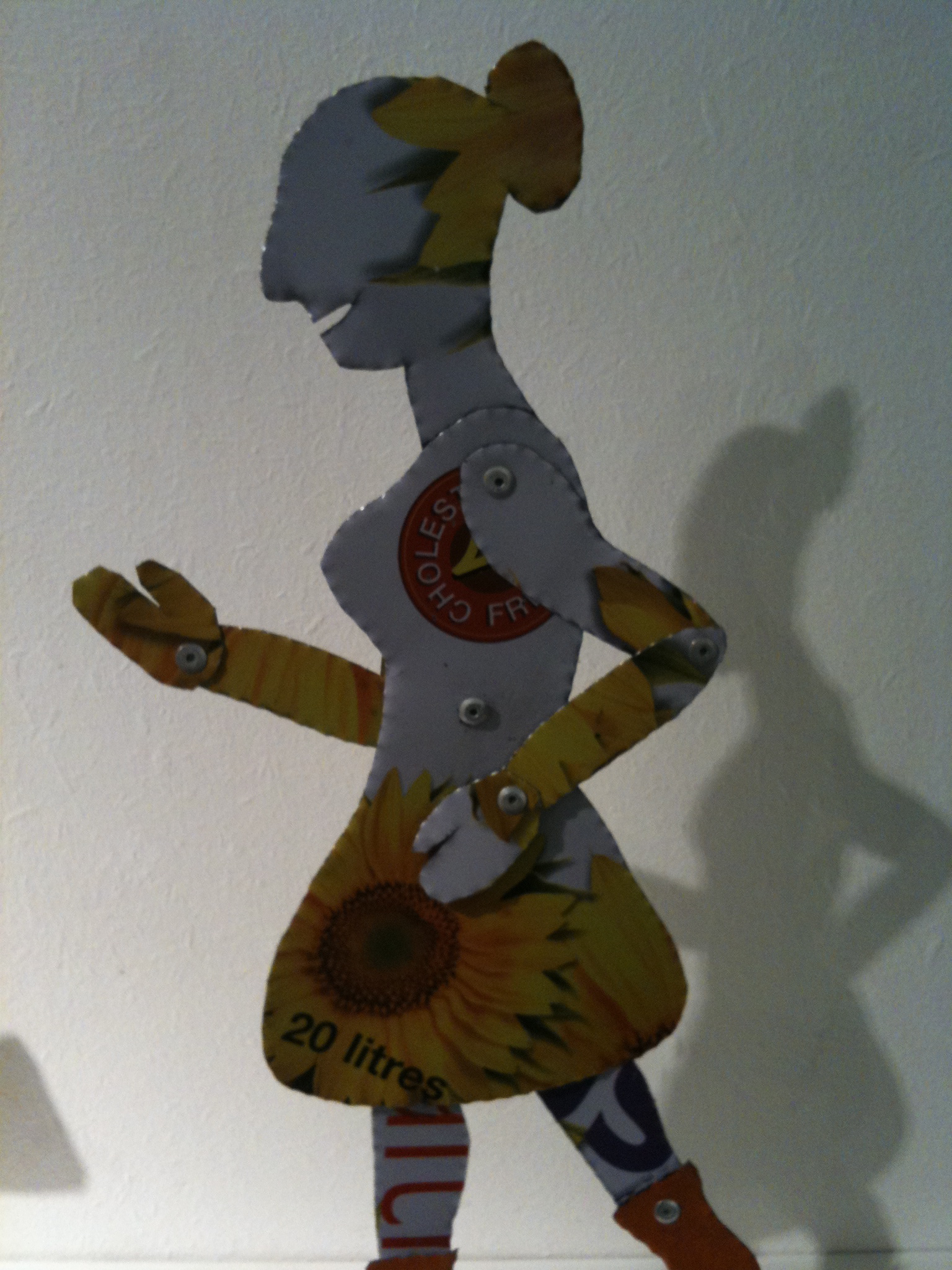
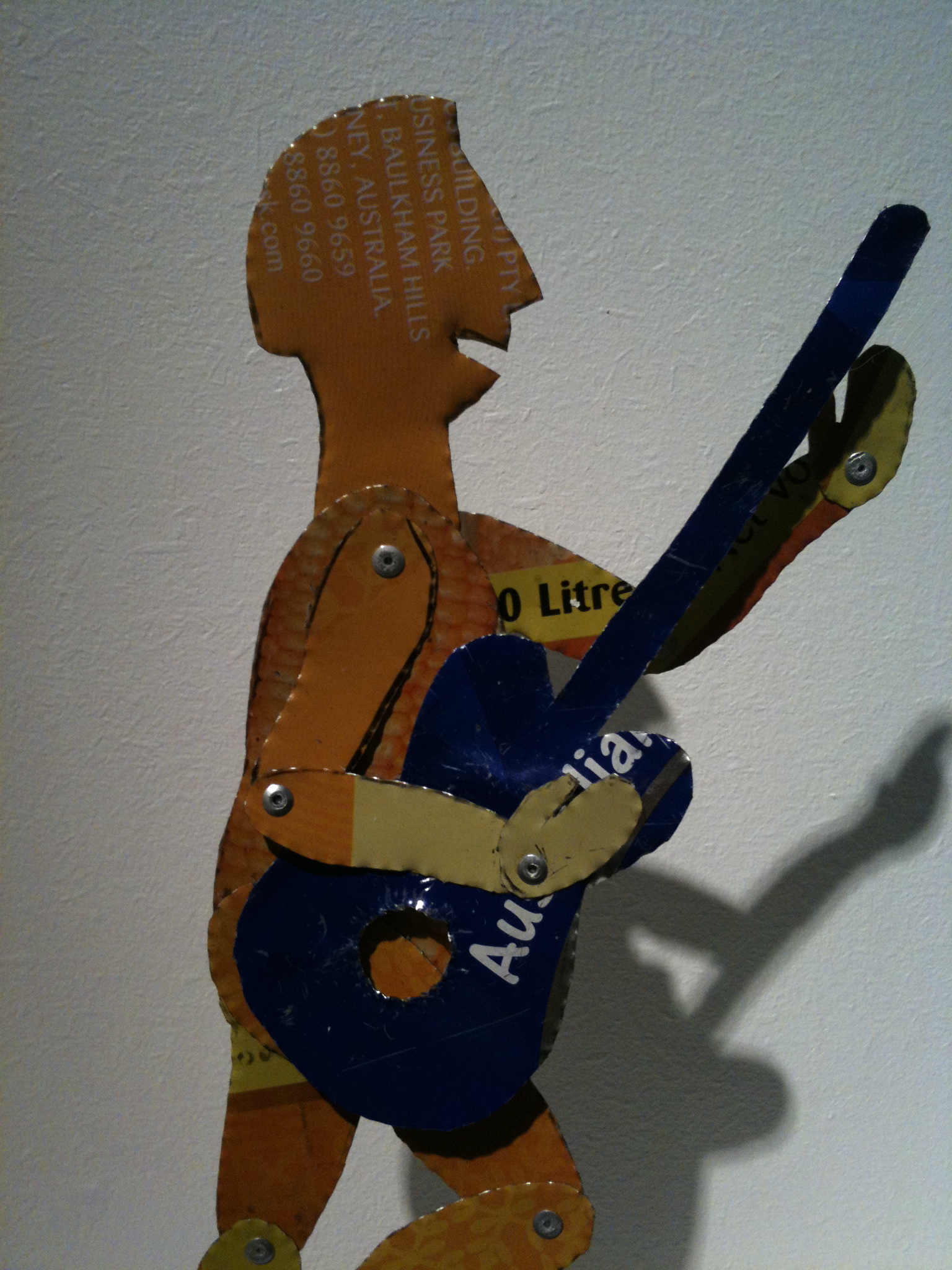
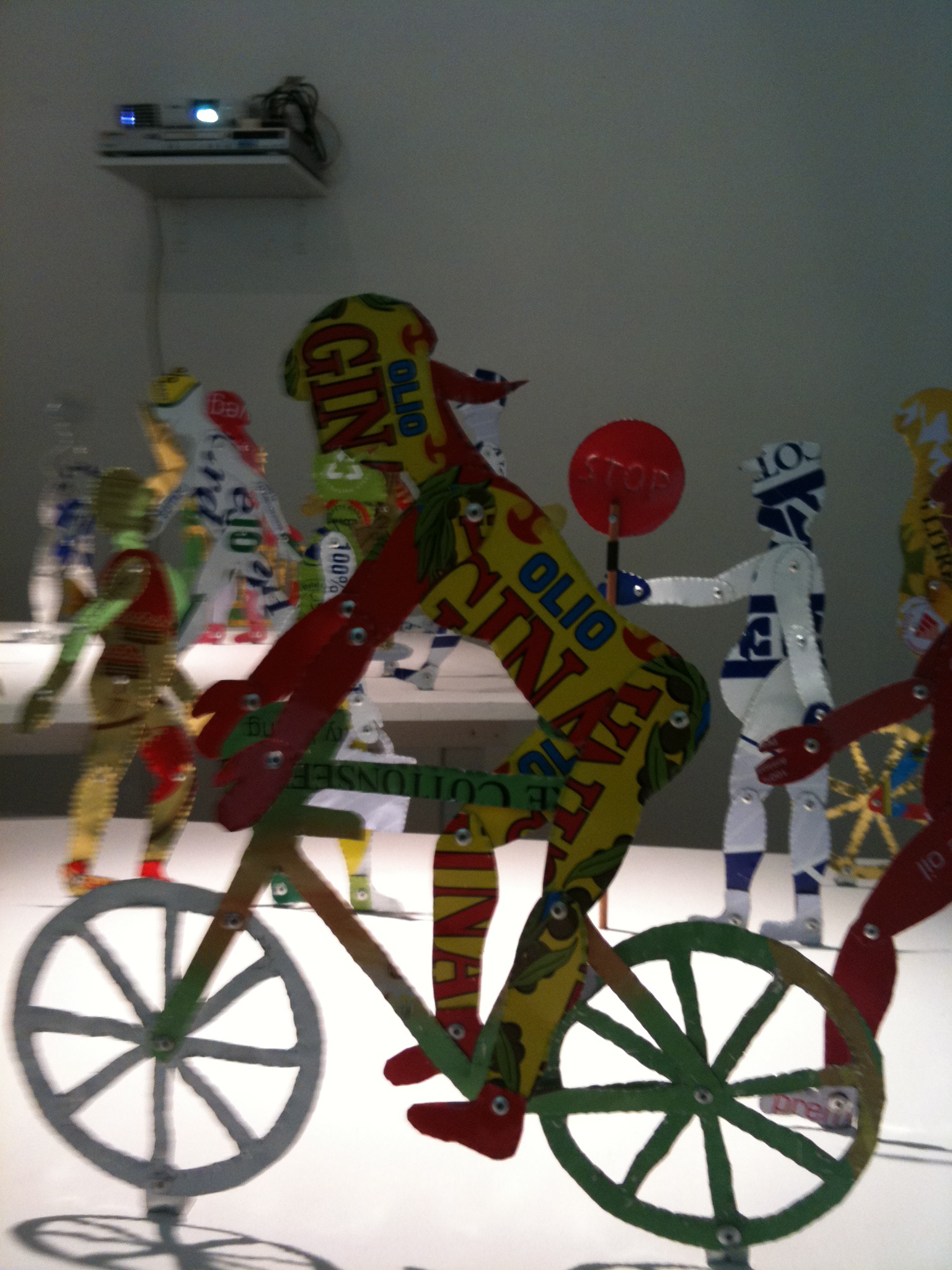
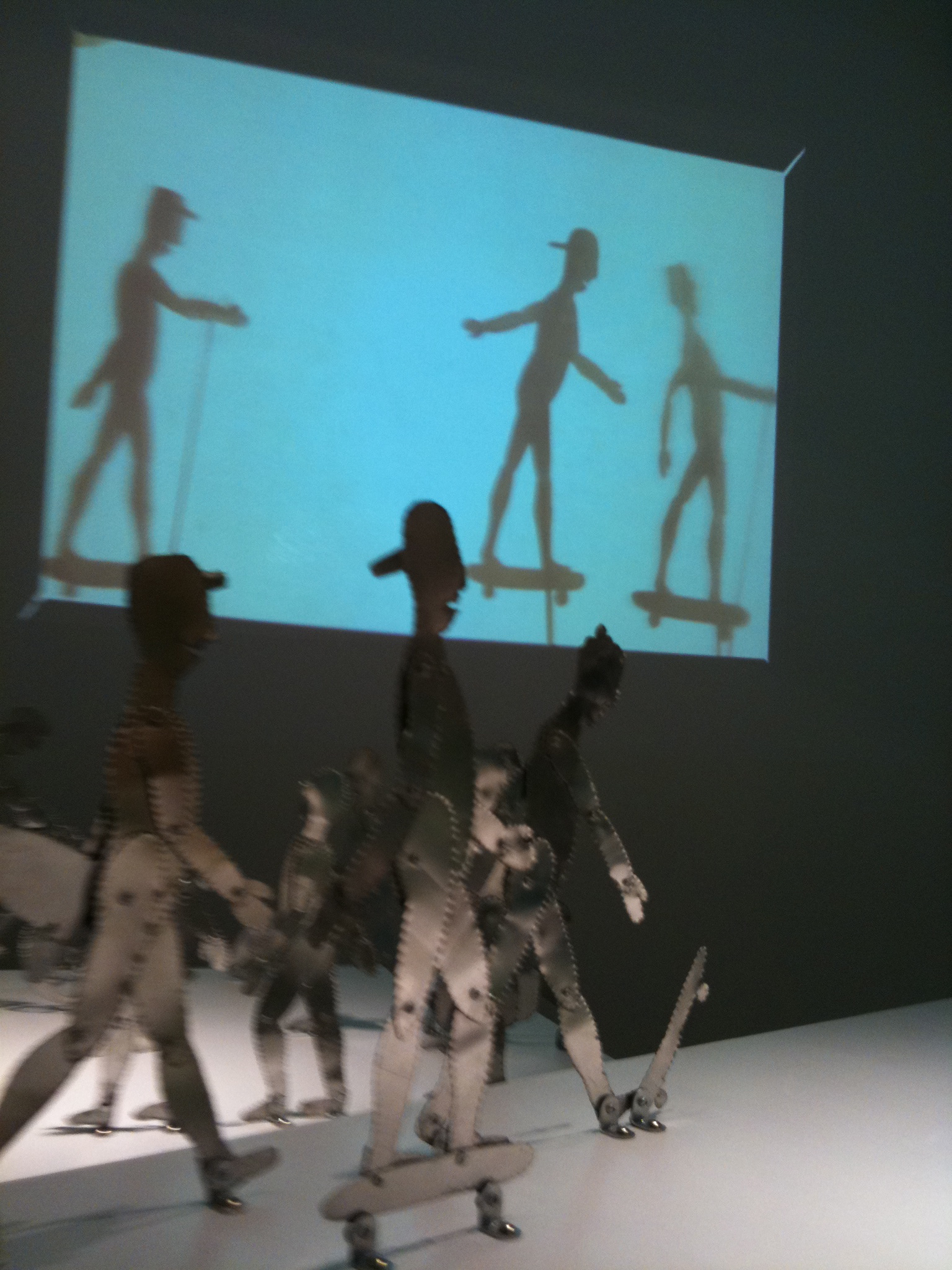
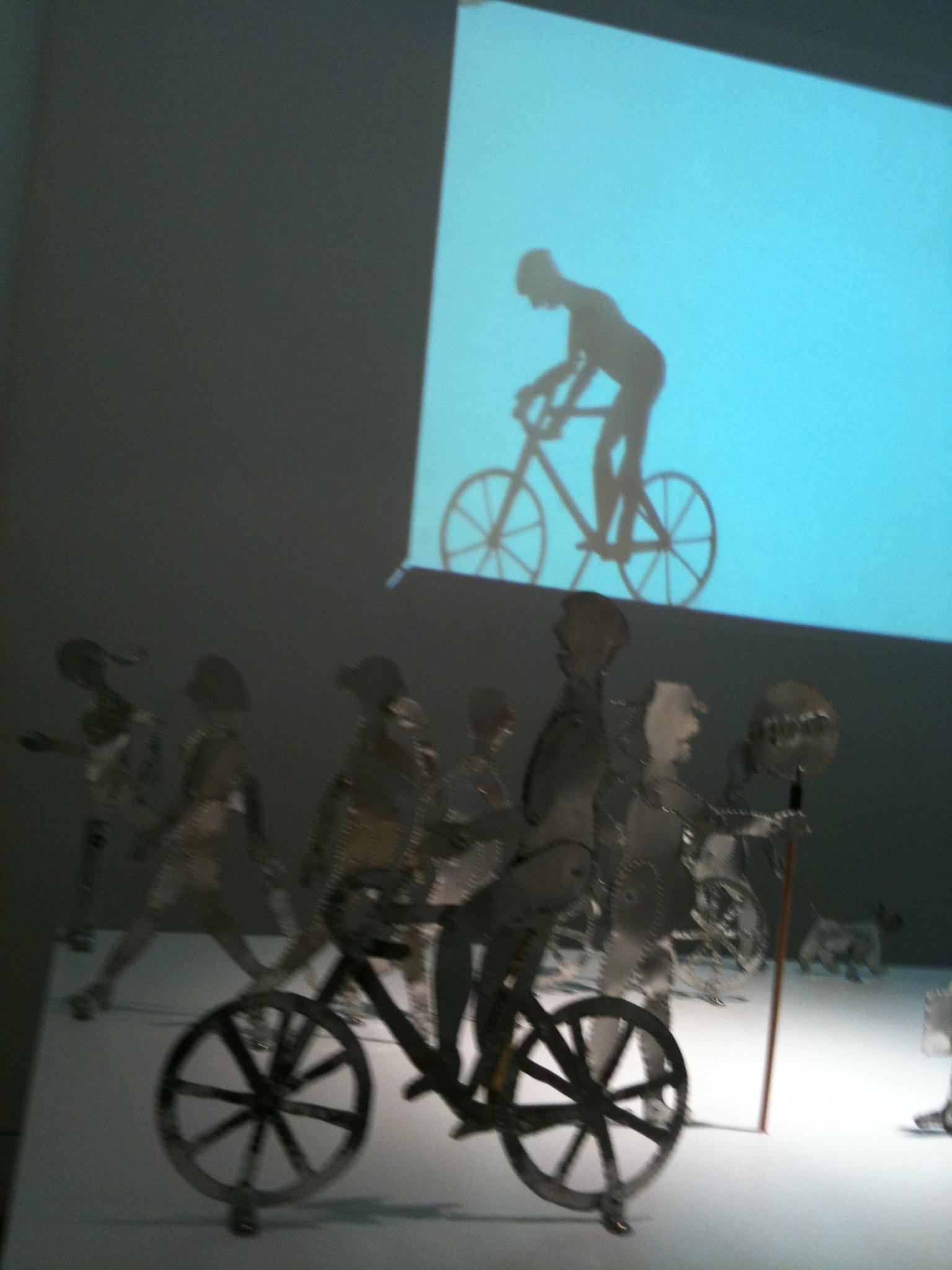
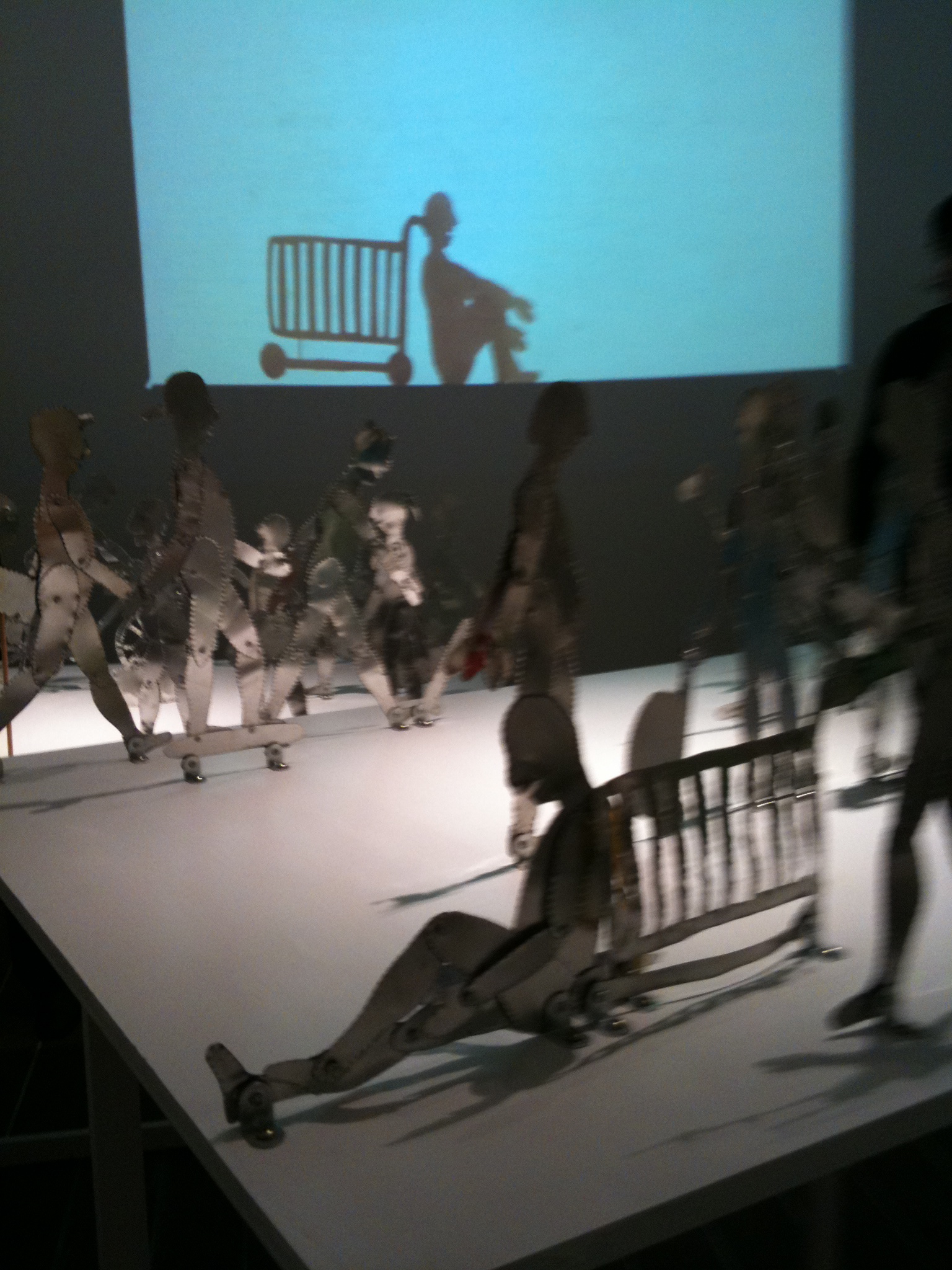
Jesse’s exhibition, A Puppet Show for George Street, is two rooms full of shadow puppets made from used oil drums scavenged from nearby restaurants. There are bicyclists, figures carrying briefcases, umbrellas, mobile phones, walking dogs, riding skateboards, wheeling shopping trolleys – two-dimensional figures cut from old tin with rivets at the joints. There’s some appealing verbal wit – the fat man walking a dog has ‘Cholesterol” printed all over him; one of the kissing lovers has a Heart Foundation tick on his chest. But the main charm is the way it refers to Javan Wayang Kulit.

As someone said, as we watched the video loop of the puppets in action, we half expected that at any moment a dragon would appear.

The other non-photographic exhibition is ‘PARK/PARK‘, a record of an event on Park(ing) Day earlier this year. According to the Park(ing) Day web site, it is ‘an annual, worldwide event that inspires city dwellers everywhere to transform metered parking spots into temporary parks for the public good’. This particular transformation involved a cardboard cut-out car and similar tree – the artists sat in the car until the meter expired, sipping tea.

All four exhibitions are open until 5 October. Art and About is all over town until 24 October.