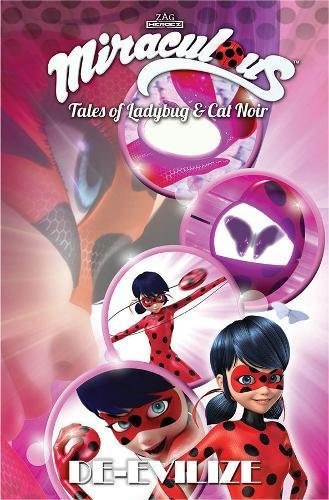
I was in Kinokuniya, the place I usually go for comics, and I thought it might be nice to seek out the book version of Miraculous, a TV show my six-year-old granddaughter enjoys.
What can I say? In short, if you’re interested in reading a Miraculous comic, I recommend that you look at the fine print above the bar code on the back cover and hope for a line that includes the text, ‘Volume 1 TPB’. I didn’t know to do that.
I’m not a librarian, but I do generally look on the title page of a book for its official title, and on the imprint page for publication details. This book has neither. By reading the fine print – some of it very fine – and consulting Duck Duck Go, I found out that:
Miraculous: Tales of Ladybug and Cat Noir is a series title
This volume, De-evilize, collects numbers 19 to 21 of the comic series, and is the seventh such collection
The three comics were published in 2017
I imagine that each comic issue represents one episode in the TV show. The episodes, named for the featured super-villains, were ‘Kung Food’, ‘Gamer’ and ‘Reflektra’
The show appears to have originated in France, though Korea was the first country to screen it
There is no indication on the book that this is a translation from a French text, although the action takes place in Paris, and street signs are in French
•Nowhere does the book mention its country of origin. It was printed in Canada but, as far as I could tell from Duck Duck Go, the publisher Action Lab Entertainment is a US company
Naming the author/s of this book is a complex matter: the series creator is Thomas Astruc; comics adaptation is by Nicole D’Andria; each of the three ‘chapters’ is written by a different pair of writers.
Starting in Book 7, you’re thrown into the middle of bewildering adventures in which two French teenagers (Marinette and Adrien) become superheroes (Ladybug and Cat Noir) through the agency of tiny supernatural creatures. There are magic gadgets called Miraculouses. There’s a bad guy named Hawk Moth who has little pet moths called akumas which he uses to turn disgruntled people into supervillains. Ladybug and Cat Noir do battle with the supervillains, eventually extract the akumas and restore order. The de-akumatised supervillains return to being the friends or benign relatives of Marinette and Adrien. There’s pleasantly complex teenage romantic tension, and familiar high school politics.
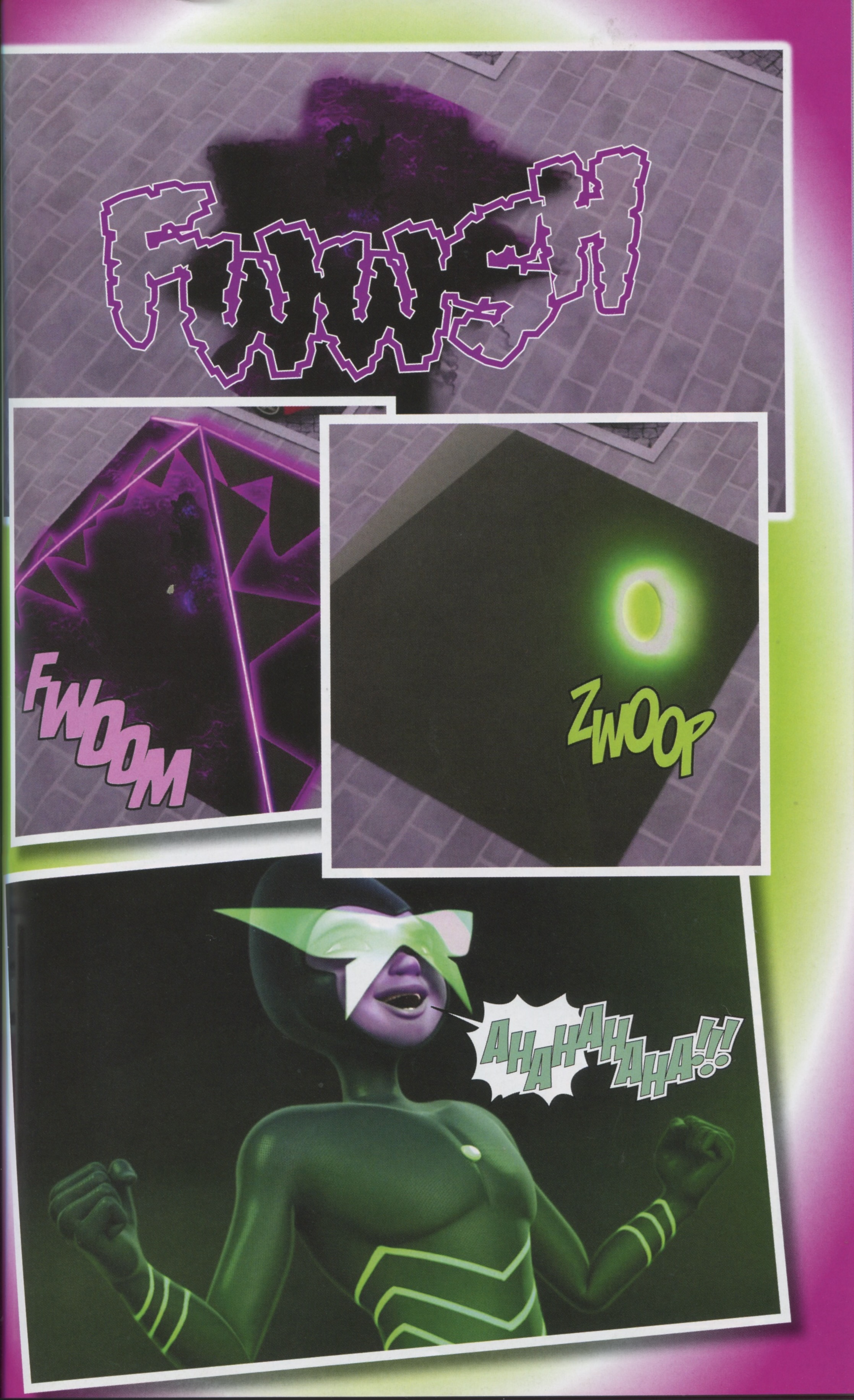
In this volume it’s pretty much exact the same story three times, so by the end of the second story I had got the general gist, even though, especially in the fight scenes, I couldn’t tell from the images what was actually going on. And I didn’t much like the computer-generated images. I ought to give you a little taste Here’s page 77*, in which the gentle boy Max is transformed into supervillain Gamer:
I haven’t read this book with either grandchild, but I’ve had fun dropping the catch cries ‘Spots on!’, ‘Claws out!’, ‘Lucky charm!’ and ‘Cataclysm!’ into the conversation.
I wrote this blog post in Gadigal Wangal country, where it is my great joy to live, where the days are getting warmer and the winds are strong. I acknowledge Elders past, present and emerging for their continuing custodianship of this land.
* My blogging practice is to focus on the page that coincides with my age, currently 77.
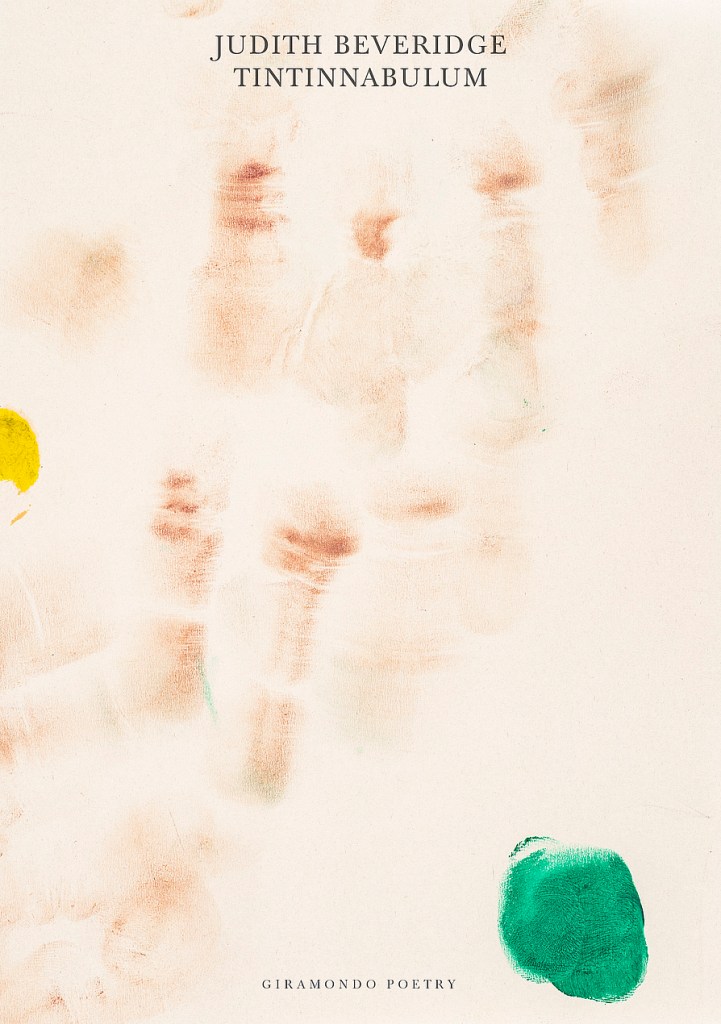
As a rule on this blog I focus on the page of a book that corresponds to my age. There’s a lot I could write about Tintinnabulum (it’s a very rich collection from one of Australia’s brilliant poets), but let’s see what happens if I skip any general discussion and go straight to page 77.
Page 77 is the second page of the poem ‘Choirwood’, the last poem in the book, which gives its name to the book’s final section. Earlier sections have dealt with the animal and human world, including a fair amount of death, danger and cruelty. So when the fourth section arrives with ten poems celebrating the natural world, it feels like the final stage of a broad conversation. Celebration has the last word:
I wouldn’t be unhappy if you stopped reading this right now, clicked on the image, and let the poem go to work on you. The speaker goes for a walk in the bush near her house one early morning and pays attention to what she sees and hears, inviting us to join her in rich, descriptive language, and then taking us further into contemplating the unseen, unheard wonders of the universe. There’s a play of metaphors to do with religion, commerce and art. It’s a gorgeous celebration of the natural world, expanding from the back yard to the cosmos.
It’s a thing about poetry that what the reader brings is an important part of how a poem works. So rather than discuss the poem line by line. I’ll tell you what I bring to it – and also some places it takes me to.
First a snippet of personal history. In early 1965, after finishing high school, I was training to be a member of a Catholic religious order. I was a postulate, the step before becoming a novice. We would rise hideously early each morning summer and winter, wash in cold water (as the wood-fired boiler wasn’t lit yet), and gather in the chapel for prayers, meditation, Mass and more prayers. All that before an eight o’clock breakfast. I was terrible at meditation – it was too easy to nod off – but loved the communal prayers, especially the call-and-response reading of psalms. I loved the bloodthirsty psalms and the whingey ones, but most of all I loved the exuberant songs of praise. This poem brings to mind a specific psalm-related memory.
There were terrible bushfires that year, and as a community of 50 or so able-bodied young men we became volunteer fire fighters. I had my turns at going out, but on this occasion I was not one of the 20 or so who had been away all night lugging their backpack sprays. Those of us who had stayed behind were in the chapel as usual when we heard the truck loaded with wearily noisy, charcoal-stained novices roaring home up the hill outside. We didn’t pause, but surely we put a little extra gusto into the resounding verses of Psalm 148. I don’t have the actual, almost singable English version we used, but here is a bit from the Jerusalem Bible:
Let earth praise Yahweh: sea-monsters and all the deeps,
_____fire and hail, snow and mist, gales that obey his decree,
mountains and hills, orchards and forests
_____wild animals and farm animals, snakes and birds,
all kings on earth and nations, princes, all rulers of the world,
_____young men and girls, old people, and children too!
No lie, we were chanting about fire praising God when that truck drove past the chapel windows.
Since that moment, any poetic celebration of nature – and ‘Choirwood’ is one – carries for me the whiff of bushfire smoke and the paradoxical joy, even exhilaration, of being young and helping to fight the fire.
It’s not odd that I should think of the psalms: the poem itself is not explicitly religious, but it has plenty of religious references – the title, the St Andrew’s Cross spider as a martyred apostle, a mandala. It’s even possible that the poet had Psalm 148 in mind. Thinking of bushfire, on the other hand, is pure idiosyncrasy …
… except …
… there’s this in the book’s acknowledgements:
The poem ‘Choirwood’ was commissioned by Judith Nangala Crispin in 2022 for the Judith Wright Regeneration Road Trip.
I looked up the Regeneration Road Trip (it has a webpage here, a facebook page here, and the album of its poetry reading for sale at this link). Organised by a group of artists who lived between Canberra and the Far South Coast of New South Wales, it took place over 10 days in September–October 2022. According to the website, that In the wake of the terrible destruction caused by bushfires the previous year, the organisers:
came together to try to find a way to help voice the emerging tidal wave of feeling and give back to the communities which are hurting. Rather than focusing on what was lost, the project began to unearth and celebrate the deep connection between the people and the landscapes, animals and plants of this special region.
So if you know its origin story, ‘Choirwood’ itself carries a whiff of smoke.
Without the origin story, there is no word in the poem of all that destruction. There has been enough of that earlier in the book, perhaps – there’s no need to name the thing being negated, the ‘what was lost’. But a closer look reveals a hint. A note tells us something that a better-read reader might have spotted off their own bat:
The phrase ‘madrigal field’ is from Denise Levertov’s poem ‘Clouds’.
That refers to the lines where the poem’s perspective widens out:
____________________________I give thanks
too for the forces and interactions running
beneath it all, the flowing, spinning, changing
dynamics, the 'madrigal field' choiring everything
into existence.
(By the way, notice how all those ‘ing’ words create a sound equivalent to the constant motion being described.) Especially when read in connection with the poems final lines, the ‘madrigal field’ is a wonderfully resonant phrase that suggests the mediaeval notion of the music of the spheres, and so invokes a sense of the awe-inspiring, beautifully ordered universe. But the knowledge that it is taken from ‘Clouds’ by US poet Denise Levertov (which you can read at this link) suggests a more nuanced reading. In that poem, the speaker is faced with the recent death of a loved one (or perhaps only a chilling intimation of their death). She forces to her mind a ‘vision of a sky’, that at first appears as a grey mist, but when looked at intently reveals ‘radiant traces’ of green. Only then ‘a field sprang into sight’:
a field of freshest deep spiring grass
starred with dandelions,
green and gold
gold and green alternating in closewoven
chords, madrigal field.
Perhaps, the poem goes on, death’s chill is ‘a grey to be watched keenly’.
I can’t say I understand Denise Levertov’s poem, but her ‘madrigal field’ is a synesthesian (synesthetic?) vision of a grassy field, quite different from Judith Beveridge’s cosmic concept. Comin from ‘Clouds’, however, it keeps its emotional connotation: the field is what you see when you turn away from death / the premonition of death / destruction, and look ‘keenly’. ‘Choirwood’ is full of keen looking and listening. This, it suggests ever so subtly, can be an important part of coping with catastrophe.
I am grateful to the Giramondo Publishing Company for my copy of Tintinnabulum.
I wrote this blog post in Gadigal Wangal country, where it is my great joy to live. I acknowledge Elders past, present and emerging for their continuing custodianship of this land.
Spell the Month in Books is a linkup hosted on Reviews From the Stacks. We’re invited to find a book title, on a given theme, that starts with each letter in the month’s name, make a list, and share the link. It’s a nice way to look back over one’s reading.
This month, the theme is Back to School. Reviews from the Stacks is a Northern Hemisphere blog, where the theme is seasonally appropriate – but it’s full of possibilities for us in the planetary south as well. Here I go. Links on the book titles are to my blog posts.
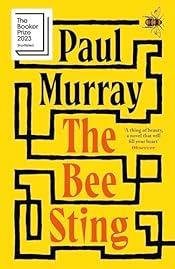
The Bee Sting by Paul Murray (Hamish Hamilton 2023). Two of this book’s characters, a generation apart, have their lives transformed when they leave their home in rural Ireland to go to university in Dublin.
Edenglassie by Melissa Lucashenko (University of Queensland Press 2023). It may be stretching it a bit, but this novel, along with a lot of First Nations writing, amounts to an invitation to unlearn some Australian history, to go back to school and develop a different, richer understanding of our past. In this case, it’s the early history of what is now south-east Queensland. Sue at Whispering Gums has an excellent review.
Praiseworthy by Alexis Wright (Giramondo 2023) is another example of First Nations writing that amounts to an invitation to go back and learn different ways of looking at the world. At its heart there’s a mad scheme to cope with climate change by using the donkeys that roam wild in the Northern Territory. There are clouds of butterflies and a boy who lives in a whale’s skeleton. You see the world differently once you’ve read it.
Small Things Like These by Claire Keegan (Faber & Faber 2021) actually centres on a school. It’s hardly more than a short story, in which an Irishman faces a huge moral challenge when he discovers that terrible things are being done in the convent school just outside his village.
DeepEconomy: The wealth of communities and the durable future by Bill McKibben (Henry Holt 2007). For me at least, this book was a tremendous learning experience about economics and the environmental crisis. In my 2007 blog post I described it as ‘a substantial, reasoned, systematic move towards an alternative way of thinking about these things’.
Madeline (Ludwig Betelmans 1939). How good it was, recently, to go back to this book, which I must have first read when I was at school, or perhaps when nieces and nephews were. ‘In an old house in Paris that was covered in vines …’
Blue Mars (Kim Stanley Robinson, 1996) Kim Stanley Robinson’s Mars trilogy is a terrific yarn. It’s also an education in the scientific, engineering, social and political challenges that would face an attempt to settle on Mars. I first encountered the word katabatic, among many others, in these books.
Cold Enough for Snow by Jessica Au (Giramondo 2022). The section in this slim book where the narrator goes to university and encounters a whole new world struck a chord with me, even more so than the similar experience described in The Bee Sting, because this one happens in Australia.
Voice of Reason: On Recognition and Renewal by Megan Davis (Quarterly Essay 90, 2023) is another piece of First Nations education, in this case about the recent referendum on an Indigenous Voice to Parliament. Especially in the face of the No campaign’s ultimately successful slogan, ‘If you don’t know, vote no,’ the schooling provided by this essay was salutary and continues to be.
Michel de Montaigne, The Complete Essays (Penguin Classics 1991, translated by M. A. Screech) – end of Book 2 Essay 12, “An apology for Raymond Sebond’ to part way through Book 2, essay 17, ‘On presumption’
The month has flown by, and it’s time for another progress report on my project of reading Montaigne’s essays, four pages every morning. Two friends have sent me examples of Montaigne cropping up in their own reading: the first has just started reading Amor Towles’s A Gentleman in Moscow, and was reminded of my project when the confined Count finally gets to read Montaigne; the second forwarded me Nicholas Gruen’s weekly newsletter for the 18th of August, which includes Montaigne’s essay ‘On a Monstrous Child’. I’m not alone in reading him.
It’s taken much more than a month, but I’ve now finished ‘An Apology for Raymond Sebond’. Whether from shrinking attention span, lack of interest, or the nature of the essay itself, I happily confess that I had trouble following its argument. It went on and on, endlessly quoting ancient philosophers, repeating itself, and proclaiming radical scepticism. I thought it was about to discover the scientific method, but no, it seemed to end up saying you can’t trust reason or the senses, but – implied rather than stated outright – you can always trust the revealed Word of God. I’m glad that one is behind me.
Today I’m part way through ‘On Presumption’. Having discussed in the preceding essay the relative worthlessness of reputation (‘glory’) compared with actual virtue, in this one Montaigne begins by saying that one’s opinion of oneself is similar to glory – prone to wishful thinking and no real indicator of one’s real worth. He’s now in the middle of a generally unflattering – and I think intentionally funny – self-portrait. He loves poetry, but is a terrible poet. He loves fine writing but:
There is nothing fluent or polished about my language; it is rough and disdainful, with rhetorical arrangements which are free and undisciplined. And I like it that way, by inclination if not by judgement. But I fully realise that I sometimes let myself go too far in that direction, striving to avoid artificiality and affectation only to fall into them at the other extreme. … Even if I were to try to follow that other smooth-flowing well-ordered style I could never get there. (Page 725–726)
False modesty? Maybe not. It does read as a genuine attempt to describe his own writing.
Beauty, he says, is the ‘first sign of distinction among men’, and height is the only quality that determines manly beauty, but his own ‘build is a little below average’. In one of the passages that makes reading him such a pleasure, he lists the qualities that don’t count:
When a man is merely short, neither the breadth and smoothness of a forehead nor the soft white of an eye nor a medium nose nor the smallness of an ear or mouth nor the regularity or whiteness of teeth nor the smooth thickness of a beard, brown as the husk of a chestnut, nor curly hair nor the correct contour of a head nor freshness of hue nor a pleasing face nor a body without smell nor limbs justly proportioned can make him beautiful. (Page 729)
Having just told us that only height matters, he implies the counter argument: he’s at least a bit sorry that men who look good and don’t smell bad aren’t regarded as beautiful. Not that he attributes those qualities to himself. He says his build is ‘tough and thickset’ and describes (in Latin, possibly quoting someone) his bristly legs and tufty chest, etc.
So this isn’t so much a progress report as a snapshot of where I’m up to when the blog post falls due. I just flicked forward 120 pages to see that next time I may be talking about an essay entitled ‘On three good wives’!
This blog post was written on Gadigal-Wangal land, where understandings of the universe beyond Montaigne’s imaginings were developed millennia before the Ancients he discusses. The weather is warming up alarmingly early. I acknowledge the Elders past, present and emerging of the Gadigal and Wangal Nations,.
Abdulrazak Gurnah, winner of the Nobel Prize in Literature in 2021, was a wonderfully urbane guest at this year’s Sydney Writers’ Festival. In the session I attended he spoke mainly about his 2021 novel, Afterlives, but talked a lot about that book’s relationship with the much earlier Paradise. (Added much later: you can listen to the podcast of the conversation at this link.)
We read Afterlives a while ago in my all-male Book Group, and had a wonderful discussion of it. Now my predominantly female Book Club is tackling the earlier novel.
Before the meeting:Paradise is a long way from languishing in the shadow of Afterlives. Its action unfolds in the same part of East Africa, beginning a couple of decades earlier, in the years leading up to the First World War.
The book begins with a boy named Yusuf looking forward to receiving a customary gift of money from Uncle Aziz when Aziz’s brief visit comes to an end. There is no gift, and instead the boy is taken away with the uncle. Then he realises that he is not going back to his family and soon learns that he has been given to Aziz, who is not actually his uncle, as surety against his father’s debts. He has become little more than a slave in the merchant’s household.
The story unfold from there. There’s adventure, involving an arduous, perilous expedition into the unknown. There’s romance, where intimate moments, perhaps even a kiss, may be snatched in dark corners of a walled garden. There’s a gallery of rich, exuberant characters – Khalil, an older boy in a similar state of bondage to Yusuf; an older woman, infatuated by Yusuf’s beauty, who harasses him to the amusement of onlookers; an ancient gardener who long ago refused his freedom when actual slavery was abolished; a formidable, scarred man who organises Aziz’s trade expeditions and has a reputation as a sexual predator on young men; Aziz himself, a formidable commercial operator who remains calm in the most extreme situations.
Meanwhile, European powers are colonising East Africa. They are mostly peripheral, offscreen characters who threaten to destroy the whole world experienced by the main characters. German soldiers appear twice, once at roughly the midpoint and then again at the very end. Both times they function as a deus ex machina: the first time their unexpected arrival saves Aziz and his expedition, including Yusuf, from a vengeful tribal chief, but the incident leaves a nasty sense of something unresolved; the second time they provide the book’s final moment, which left me staring into space for a long time.
The book was only transated into Swahili – the official language along with English of Gurnah’s home nation Tanzania (known as Zanzibar back then) – after he was awarded the Nobel Prize.
After the meeting: At this meeting we discussed Annie Ernaux’s Une femme / A Woman’s Story along with Paradise, an odd pairing which meant we had two quite separate discussions.
All but one of us enjoyed this book a lot, and the dissenting voice meant we had an interesting conversation. The main character, she said, is completely passive: things just happen to him, one after another, and especially on the gruelling trade expedition that takes up a good slab of the book the bad things are repetitive. The book only becomes interesting once Yusuf is back in town and a powerful woman, in a complex way, is lusting after him. Though others were able to point out that Yusuf was constantly taking initiatives – a surreptitious excursion to town just for fun, offering unauthorised help to the ancient gardener, etc – I was struck by the similarity of this observation to what someone in my other Book Group said about the main character in Afterlives: because of the constraints on the characters, they don’t have the space to attend to their inner lives. When I tried to articulate this thought, someone said something beautifully concise and wise about the way trauma can alienate a young person from their own experience. Sadly I didn’t write it down, but to my mind it captured beautifully the way Yusuf does indeed move from one thing to the next, having no real say about the direction of his life, and no ability to form coherent thoughts about it.
I realised in the course of the discussion that the story is full of references to Joseph / Yusuf in the Hebrew Bible and the Quran, in particular the episode of Potiphar’s wife / Zuleikha. I just read a version of the Quran story on Wikipedia, and the parallels are even closer than I thought. It makes me wonder what other references may be hovering around this eminently readable tale. Joseph Conrad’s Heart of Darkness comes to mind. (Gurnah’s Gravel Heart includes a retelling of Shakespeare’s Measure for Measure, set in modern East Africa.)
We discussed the final paragraph, which I’d love to expand on here but, unlike some surprise revelations (see my blog post on Wole Soyinka’s Chronicles from the Land of the Happiest People on Earth, coming in a month or so), it really is a surprise.
Being of a certain age, we said goodnight a little after 10 o’clock.
I wrote this blog post in Gadigal Wangal country, where it is my great joy to live. In particular right now the days are getting warmer, the sun is rising earlier and setting later, and whenever I walk out my door I see tiny lizards scurrying for cover. I acknowledge Elders past, present and emerging for their continuing custodianship of this land.
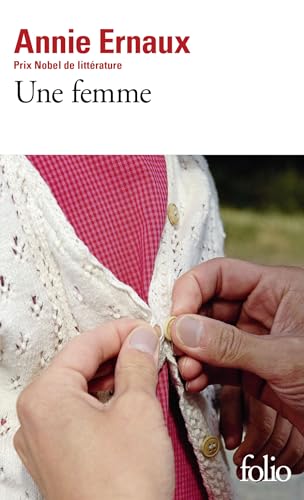
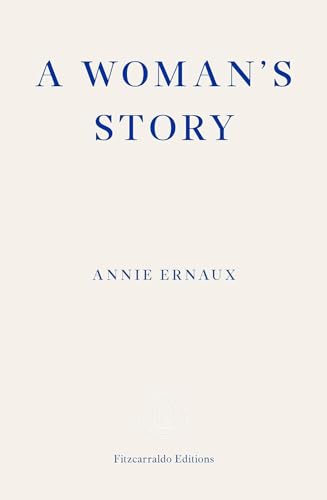
Annie Ernaux, Une femme (Editions Gallimard 1987) —–, A Woman’s Story (translated by Tanya Leslie 1991, Fitzcarraldo Editions 2024)
Before the meeting: The press release announcing that Annie Ernaux had won the Nobel Prize in Literature spoke of:
the courage and clinical acuity with which she uncovers the roots, estrangements and collective restraints of personal memory.
Every word of that is well chosen. Ernaux revisits her own life story in every book, pitting her ‘personal memory’ against what she finds in old photographs and diary entries, constantly questioning and challenging herself. She makes most other autobiographies / memoirs seem at least a little glib and self-serving.
I read Une femme / A Woman’s Story in both French and English. I could do this because it’s a short book – 60 pages in English, 95 in French. Apart from an opportunity to flex my rusty French, I was motivated by the way the English title departs from the original. Une femme is literally ‘A woman’. Calling it A Woman’s Story is a tiny change, but it significantly shifts the meaning. I wondered if similar shifts happened in the body of the book. (I think they do, and I apologise in advance for the way this blog post gets bogged down in the details of translation – fascinating to me, but maybe not to you!)
A Woman’s Story / Une femme does tell the story of a woman: Ernaux’s mother. But actually there are three stories. There’s Ernaux’s reconstruction of her mother’s life: her youth, her time as a shopkeeper in an impoverished part of France, her marriage, her ageing, and at last her dementia and death. There’s the story of Ernaux’s relationship with her, including the times that she lived with her and her family, and at the very end a brilliantly concise statement of what, after the initial intense grief, her mother’s death meant for her. And there’s the story of writing the book, begun in April 1986, very soon after her mother’s death, and finished in February the following year. This is a book in which une femme writes about une femme, and either could lay claim to the book’s French title.
I love this book. It reaches tendrils into parts of my own life that could do with a bit of ‘courage and clinical acuity’. I find Ernaux’s sheer dogged determination to find truthful words completely engrossing. In one of several moments when she steps in to tell us about the process of writing, she says:
When I speak of her, my first impulse is to ‘freeze’ her in a series of images unrelated to time – ‘she had a violent temper’, ‘she was intense in everything she did’ – and to recall random scenes in which she was present. This brings back only the fantasy woman, the one who has recently appeared in my dreams, alive once more, drifting ageless through a tense world reminiscent of psychological thrillers. I would also like to capture the real woman, the one who existed independently from me, born on the outskirts of a small Normandy town, and who died in the geriatric ward of a hospital in the suburbs of Paris. The more objective aspect of my writing will probably involve a cross between family history and sociology, reality and fiction [la jointure du familial et du social, du mythe et de l’histoire] … I would like to remain a cut below literature.
(Page 17)
That is to say, don’t look for fine writing here. Look for a serious attempt to see the reality of this woman’s life and how it was interwoven with Ernaux’s own.
My practice of looking at page 77 is a good way of giving you a flavour of the book, and of some of the issues that must have faced Tanya Leslie, the translator.
On page 77 of the French edition, page 51 of the English, it’s the early 1970s. Ernaux’s mother, now a widow, has sold her business and abandoned her life as a shopkeeper. She has moved to Annecy at the other end of France to live with Ernaux and her young family. She isn’t thrilled with her new life: she is no longer a significant part of a community. Her life has shrunk. ‘Now she felt she was a nobody’ / ‘Elle ne se sentait plus rien.’ She was proud of the life Annie had made for herself, but felt uneasy with the middle-class life that now surrounded her.
I ought to say that after my partner’s father died, her widowed mother became a much bigger presence in our lives, after a time spending a couple of nights a week living with us and then moving in full time. We didn’t have the class difference that Ernaux describes, but this page resonates powerfully, and I am in awe of the way the writing reaches for a deeply respectful understanding of the mother’s point of view:
Living with us was like living in a world that welcomed her and rejected her at the same time. One day she said angrily, ‘I don’t think I belong here.’
The transition from the generalised to the particular in those two sentences is typical Ernaux. In the French, it’s slightly different:
C’était vivre à l’intérieur d’un monde qui l’accueillait d’un côté et l’excluait d’un autre. Un jour, avec colère: « Je ne fais pas bien dans le tableau. »
There are three departures from a literal, word for word translation. First, there is no ‘us’: it’s all about the mother. Second, the English has tidied up the second sentence and given it a verb – ‘she said’ – which is not there in the French. There’s a lot of that in the book. The French text sometimes reads like quick notes: no need to spell out who was speaking etc. The English tidies it up, with the effect that what in French feels rough and raw becomes in English a more polished, considered text. And third, what the mother says has been softened: the tentativeness of ‘I don’t think’ is an insertion, where the French just has an angry statement of fact: ‘I don’t belong here.’
The rest of the page, in English:
And so she wouldn’t answer the phone when it rang next to her. If her son-in-law was watching football on television, she would make a point of knocking on the door before entering the living room. She was always asking for work – ‘Well, if there’s nothing to do, I might as well leave then’ – adding with a touch of irony, ‘After all, I’ve got to earn my keep!’ The two of us would argue about her attitude and I blamed her for deliberately humiliating herself. It took me a long time to realise that the feeling of unease my mother experienced in my own house was no different from what I had felt as a teenager when I was introduced to people ‘a cut above us’. (As if only the ‘lower classes’ suffered from inequalities which others choose to ignore.) I also realised that the cultural supremacy my husband and I enjoyed – reading Le Monde, listening to Bach – was distorted by my mother into a form of economic supremacy, based on the exploitation of labour: putting herself in the position of an employee was her way of rebelling.
And in French:
Donc elle ne répondait pas au téléphone quand il sonnait près d’elle, frappait d’une manière ostensible avant de pénétrer dans le salon où son gendre regardait un match à la télé, réclamait sans cesse du travail, « si on ne me donne rien à faire, je n’ai plus qu’a m’en aller» et, en riant à moitié, « il faut bien que je paye ma place!». Nous avions des scènes toutes les deux à propos de cette attitude, je lui reprochais de s’humilier exprès. J’ai mis longtemps à comprendre que ma mère ressentait dans ma propre maison le malaise qui avait été le mien, adolescente, dans les « milieux mieux que nous » (comme s’il n’était donné qu’aux « inférieurs » de souffrir de différences que les autres estiment sans importance). Et qu’en feignant de se considérer comme une employée, elle transformait instinctivement la domination cultureIle, réelle, de ses enfants lisant Le Monde ou écoutant Bach, en une domination économique, imaginaire, de patron à ouvrier: une façon de révolter.
You can see what the translator had to wrestle with. She breaks two long sentences into shorter ones. I can’t tell if this is her way of making the text more elegant, or if it’s a difference in the way the languages work. And domination must have given her nightmares: ‘supremacy’ isn’t a dictionary equivalent, but it’s surely eccentric to describe reading Le Monde as an act of domination. Yet maybe that eccentricity is exactly what Ernaux intended – certainly ‘economic supremacy’ makes less sense than ‘economic domination’.
This is one place where I was happy I had read the French as well as the English. I didn’t understand the bit in brackets about the ‘lower classes’ until I read the French, where, rather than the ‘others’ choosing to ignore inequalities, they consider some différences to be unimportant (and yes, différences translates as ‘differences’, no inequality necessarily implied). Le Monde is just a newspaper to Ernaux and her husband, and Bach is pleasant to listen to. For the mother, they are markers of cultural superiority. A smaller oddity of the translation is that whereas the French insists that the ‘cultural supremacy’ / domination culturelle is real (réelle) and that the ‘economic supremacy’ / domination économique is imaginary (imaginaire), the English lets the word ‘distorted’ carry that distinction. On top of that, leaving out the word instinctivement, it seems to me, makes the mother seem much more calculating, and perhaps makes Ernaux less patronising. I don’t think Ernaux wants to blame her mother, or spare herself, in this way.
After I’d written that last sentence I noticed a moment in the previous paragraph that struck a chord with me. One of the things Ernaux’s mother has to do to conform to the household’s lifestyle is, in English:
‘observing personal hygiene’ (blowing the boys’ noses on a clean handkerchief).
That’s unremarkable, just one more detail in the list of things she has to adapt to. The original French is:
avoir de l’« hygiène » (ne pas moucher les enfants avec son propre mouchoir).
A literal translation of the phrase in brackets is, ‘not to blow the children’s noses with her own handkerchief’. They say a translation can never be complete, but still I allow myself to mourn the loss of this tiny, graphic image of grandparent–grandchild intimacy forgone in the name of upward mobility, and lost to the English text for who knows what reason: perhaps handkerchiefs themselves are so repugnant to modern Anglo sensibilities that sharing them is unspeakable.
After the meeting: In the Book Club, we traditionally discuss two books. This book was paired with Abdulrazak Gurnah’s Paradise (linkto come added later). I think the reason for the pairing was that they’re both by Nobel laureates. At the start of our discussion, an astute person pointed out that they both feature shops (the mother’s shop in Ernaux’s book, and two different shops where Gurnah’s protagonist worked). That’s about where the similarities began and ended. Our evening – or at least that part of it not taken up with excellent food and even more excellent conversation about life, physical afflictions, travel plans and so on – was split neatly into two parts.
As you’d expect, my having read the book in both languages was met with eye rolls, but there was general recognition that the difference was substantial between blowing a child’s nose on a clean handkerchief and not blowing it on one’s own handkerchief.
We had a very interesting discussion of a passage where Ernaux describes her aim as to set aside her own emotional memories about her mother (how she felt when she was angry etc) and tell the story from her mother’s point of view, but says that she finds those emotions breaking through anyway. I think we agreed that this, far from being a failure, is one of the things that makes the book so rich.
One person out of the five of us didn’t care for the book. Reading it, she couldn’t see any reason why Annie Ernaux would have been given the Nobel. Those of us who had read a number of her books tried to articulate our reasons for holding her in high esteem, but maybe it’s a matter of taste. What I/we saw as minimalism, for example, she saw as sketchiness.
One person spoke of the way the book had inspired her to try to write about her own childhood, focusing on specifics rather than a broad narrative. The exercise had led to interesting insights into her early life. We had a brief but interesting conversation about how for ‘our generation’ in Australia (we range from a couple of weeks short of 70 to a couple of years beyond 80), as for Annie Ernaux, there was a shift in class – ‘upward mobility’ – that hadn’t been so widespread in previous generations. This shift was due in part to increased access to education – so we did the Australian equivalent of listening to Bach and reading Le Monde.
It might seem that that conversation was of the same order as travel plans and medical reports, but I think it’s a quality of Ernaux’s books – not just this one – that they prompt readers to reflect on their own lives.
Ali Cobby Eckermann is a Yankunytjatjara woman. Her mother and grandmother were taken from their families when very young as part of the government policy. She herself was also taken. Raised by a loving German-heritage family, she found her way back to her First Nations family as an adult, after years of searching.
I first met her poetry in Black Inc’s Best Australian Poems 2009, edited by the late Bob Adamson. In his introduction, Adamson said of her wonderful dramatic monologue ‘Intervention Pay Back’ that it made ‘a new shift in what a poem might say or be’. You can read it in the Cordite Review at this link. Two poems by her, also dramatic monologues, were included in the special Australian issue of the Chicago-based Poetry journal in May 2016. They can be read on the Poetry Foundation website: ‘Black Deaths in Custody’ here and ‘Thunder Raining Poison’ (on the effects of the Maralinga atomic tests on traditional APY lands ) here.
I haven’t read her memoir, Too Afraid to Cry (Ilura Press 2013), or her first verse novel, His Father’s Eyes (OUP 2011). But I can tell you that her second verse novel, Ruby Moonlight (Magabala Books 2012), which deals with the aftermath of massacre, is brilliant (my blog post here). Of her verse I have read the chapbook Kami (Vagabond Books 2010) and Inside My Mother (Giramondo 2015, my blog post here), which are both filled with the intensities of re-uniting with her Yankunytjatjara kin and culture, and the loss of her birth mother soon after finding her.
All of this work has enormous power, and has garnered many awards in Australia and elsewhere.
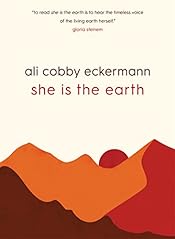
She Is the Earth, which arrived eight years after her previous book, is a different kind of writing.
It’s described on the title page as a verse novel. There are no characters apart from an unnamed narrator, and no clear events apart from her meandering through an Australian landscape. Any movement is internal. But the book is meant to be read as a single text rather than a collection of short, untitled poems.
At first, I thought it was an imagined story of pre-birth existence, in which the narrator moves towards being born, taking on substance in the world. But that didn’t seem to work and in the end, I gave up on trying to find a narrative, and just went with the flow.
The flow is far from terrible, and the language is never less than gripping, but I don’t know what to say about the book as a whole. I can refer you to better minds than mine.
Here is part of what the judges had to say when the book won the Indigenous Writers’ Prize at the 2024 NSW Premier’s Literary Awards (go to this link for their full comments):
Ali Cobby Eckermann writes in a poetics of self-emergence in which the spectral is made solid through an eloquent economy of language and lifeforms. Each word of this verse novel is deeply considered and rich with meaning, forming as a whole a narrative which is sometimes gentle and sometimes sharp, both beautiful and terrible, and always profound in its exploration of healing, hope and the earth. Each word reads as a gift to the reader.
I recommend Aidan Coleman’s review in The Conversation (at this link). He discusses the book as an example of minimalism, and says interesting things about its recurring images, and even about the developing narrative:
The speaker in these poems is both child and mother, pupil and teacher. References to children and motherhood abound. Initial images of disconnection, anxiety and trauma give way, in later sections, to wholeness and calm.
But the journey is not linear: hope is present from the earliest sections and trauma haunts the closing pages. Healing is presented as an ongoing process that is projected beyond the poem.
[Added later in response to Kim’s comment: Kim on reading Matters had a very different, and more attuned response than mine. You can read her blog post at this link.
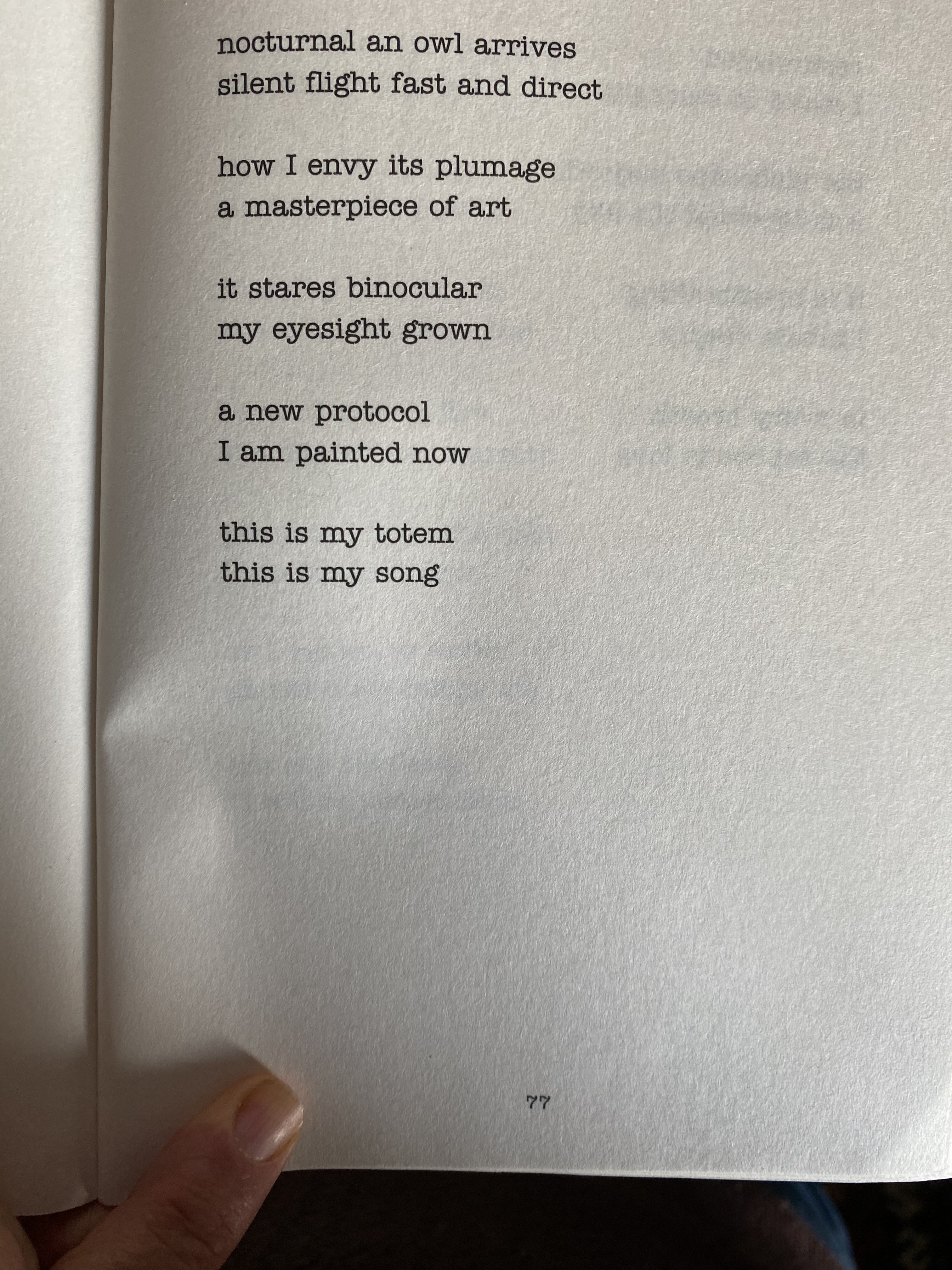
Page 77* occurs toward the end – there are 90 pages in the book. Piggybacking on Aidan Coleman’s reading, I can see it as a moment of consolidation, of identity firming up in the landscape:
The pleasure of these lines doesn’t depend on their function in the broader narrative. The owl arrives; the narrator admires it; their eyes meet, and there is a moment of identification with the bird; the ‘masterpiece of art’ of the bird’s plumage somehow transfers so that the narrator is painted. The final couplet pulls all that together.
In the wider scheme, that last couplet resolves more than the preceding eight lines. Up to now, the narrator has been full of yearning and unease. Here she seems to find peace:
this is my totem
this is my song
‘Totem’ takes the hint of identification in the comparison of eyes a step further. There’s something about finding a place of belonging, of deep affinity, of being at home in the world. Once that’s found, there’s the possibility of singing, of having one’s own song.
The first word on the next page is ‘resurrected’, and a couple of pages further on my favourite lines in the book:
I am a solo candle
inside a chandelier

this is the wisdom
I need to succeed.
I still can’t say I understand what’s going on at any given moment in this book. But maybe that’s OK.
I wrote this blog post in Gadigal Wangal country, where it is my great joy to live. I acknowledge Elders past, present and emerging for their continuing custodianship of this land.
* My blogging practice, especially with books of poetry, is to focus on the page that coincides with my age, currently 77.
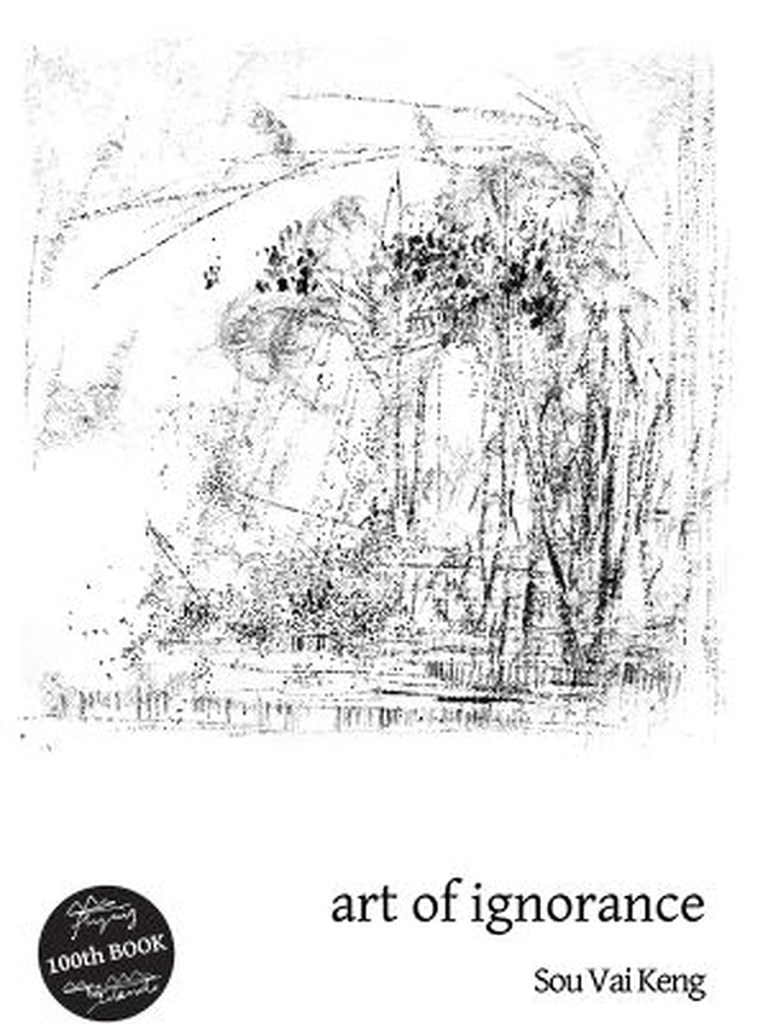
art of ignorance is the last of the small but substantial books I took with me on my recent fortnight in North Queensland. Like the others, it’s part of the Flying Island Pocket Poets series.
It’s a bilingual book – that is, each poem appears first in English then in Chinese. As there is no mention of a translator, I assume Sou Vai Keng wrote both versions. She also created the generous number of elegant drawings that intensify the book’s relaxed, contemplative feel.
A note tells us that all the poems were written in mountain areas in Germany and Switzerland between 2014 and 2018. Reading the book felt like sharing the experience of immersion in those mountains with someone with sharp eyes and a seriously playful mind – there’s not a lot of explicit description, things are seen in close-up, sometimes with a touch of surrealism, there are tiny fables and fantasies.
The opening line of the title poem could stand as an eight-word statement of the book’s prevailing mood:
the butterfly does not know the French call it papillon
Page 77* is a good example of how the book works: English on the left, Chinese on the right, with a delicate drawing in the middle (I’m sorry my tech skills aren’t up to showing the drawing without it being sliced in half by the gutter):
The poem starts with sweet whimsy:
she believes she is a tree
The rest of the first stanza elaborates: to be a tree is to ‘live on blessings from heaven’ in the form of rain and dew, and not to need anything else. A different poem might have mentioned roots and connection with other trees by way of the complex underground tangle of fungi. It might have mentioned birds’ nests, or arboreal animals, or fruits and flowers. But not this one. Here the character, like certain ascetics in the early Christian tradition, and in Chinese tradition as well I think, is opting out of active social life, choosing solitude and passivity in relation to a world she assumes to be benign.
But society intervenes. If she was ‘mean and nasty’, she could vanish, but her version of opting out is ‘a lovely idea’. It’s an idea that, by implication, the passers-by find attractive but not permitted. It’s ‘lunacy’. The poem is a parable of sorts, in which a character indulges for a moment a yearning to be stable and self-sufficient like a tree, only to be drawn back gently to the reality of human connectedness and instability:
out of sympathy and solidarity
people drag her away from where
trees stand firm and strong
and from now on she has to
roam and rove around
together with other
rootless nuts
The final word, far from offering a neat resolution of the poem’s conflict, raises more questions. What does it mean to equate humans with nuts? Nuts as opposed to sane, stable beings; nuts as fruits, insubstantial compared to the tree; nuts as bearing the possibility if one day taking root and developing into something more like trees? She is dragged away from her wistful belief, but at the very last moment the poem opens up to the possibility of her fantasy somehow becoming real.
It’s a fine example of the way Sou Vai Veng’s poem’s twist and turn beneath apparent simplicity. I enjoyed the book a lot.
I wrote this blog post in Gadigal Wangal country, as the days are warming up, the worms are fat and busy in the earth, the adolescent magpies are developing their adult colours. I acknowledge Elders past, present and emerging for their continuing custodianship of this land.
* My blogging practice, especially with books of poetry, is to focus on the page that coincides with my age, currently 77.
Michel de Montaigne, The Complete Essays (Penguin Classics 1991, translated by M. A. Screech) – part of Book 2 Essay 12, “An apology for Raymond Sebond’
Since my last Montaigne report, I’ve been faithful to my four pages of Montaigne each morning except for two breaks – one for a fortnight and the other just a weekend. The book is too heavy to take on a plane, and travel tends to disrupt routines like this one.
Five weeks ago, I had just started reading the longest essay in the collection, ‘An apology for Raymond Sebond’. Today I still have 60 odd pages of that essay to go. As I have only the vaguest idea of who Raymond Sebond was, or in what way Montaigne is attempting an apology, I’ll spare you any attempt at a summary, and just give a couple of snapshots.
Having declared himself to be a sceptic (as opposed to a dogmatist), Montaigne sets out to establish the limits of human reason. He piles on example after example of ancient philosophical versions of God, products of the ‘fierce desire to scan the divine through human eyes’. Arguing that if reason were able to determine the nature of God, then these versions would tend to some kind of agreement. Having established that this isn’t what happened, he (at least in M. A. Screech’s translation) drops his dignified mode of discourse altogether and exclaims:
So much din from so many philosophical brainboxes! Trust in your philosophy now! Boast that you are the one who has found the lucky bean in your festive pudding!
That’s on page 577. I’ve now reached page 625. In those 48 pages he has explored (and deplored) the limitations of reason in understanding even the world of nature or the human mind itself, and has been cheerfully insulting of many ancient writers whom he clearly admires enormously (including describing Plato as sometimes ‘silly’). Now he is going on about how philosophers can’t reach any agreement about the immortality or otherwise of the soul. He has reached the transmigration of souls:
the received opinion … that our souls, when they depart from us, go the rounds from one body to another, from a lion, say, to a horse; from a horse, to a king, ceaselessly driven from one abode to another.
And he’s having quite a lot of fun with it, citing the Epicureans’ objection:
What order could be maintained if the crowds of the dying proved greater than the number being born? The souls turned out of house and home would all be jostling each other, trying to be first to get into their new containers! They also ask how souls would spend their time while waiting for their new lodgings to be got ready.
Having added some lines of Latin poetry, he then goes on:
Others make our souls remain in the body after death, so as to animate the snakes, worms and other creatures which are said to be produced by spontaneous generation in our rotting flesh or even from our ashes.
In short, I’m enjoying this essay as a kind of romp in the history of philosophy. As a settled atheist who thinks my mind is a function of my body, I have a kind of museum-piece interest in a lot of the arguments. I was taught at school that until a certain point in European history people relied on the authority of, I think it was Aristotle, for their knowledge of the world. We knew from Aristotle how many teeth a human had, and only at a certain stage did it occur to people to look in each other’s mouths and count for themselves. As I read this essay, it feels as if I’m seeing that change happen before my very eyes, and it’s riveting. (Mind you, I think the essay itself is going to end with a declaration that Christian revelation is the ultimate source of Truth, but both things can be happening at once.)
To be continued.
This blog post was written on Gadigal-Wangal land, where understandings of the universe beyond Montaigne’s imaginings were developed millennia before the Ancients he discusses. It’s raining again, and my compost bin is alive with worms. I acknowledge the Elders past, present and emerging of the Gadigal and Wangal Nations,.
For some years now, Toby Davidson has been organising an annual reading from the works of Australian poet Francis Webb.
This year it’s on again:
Saturday 31 August 2.00–4.00pm Chatswood Library 409 Victoria Ave Chatswood It’s a free event, but you can go to eventbrite to reserve a place.
Here’s what the Willoughby Council website has to say::
Come along to hear how this ‘poet’s poet’ astonished his own generation and many more since. You’re invited to join MC Dr Toby Davidson, editor of Webb’s Collected Poems, for an afternoon celebrating the works of North Sydney poet Francis Webb (1925-1973) who spent some of his early years in Willoughby.
This annual gathering sees poets, scholars, community members and representatives from Webb’s former schools St Pius X College and CBHS Lewisham read and discuss their favourite poems by this local prodigy who combined his visionary talent with an eye for social justice. Gwen Harwood once wrote ‘I think Webb is unmatched … wonderful Webb!’
Come along to hear how this ‘poet’s poet’ astonished his own generation and many more since
I am one of the poets, scholars and community members. I’d love to see some of my regular – or even one-off – readers there!








 Me fail? I fly!