Between Us

This looks like an interesting venture in community arts/oral history, from the Think + DO Tank in Bankstown.

BETWEEN US

Are you the keeper of a story that should be shared?

BETWEEN US is a place to record a story that matters to you, your family, your friends, or your community. It can be about anything at all. You make the recording with someone you trust .

We help you to prepare to tell your story in a way that will give others listening pleasure.

And help you to make a recording that you can share and hand on, and on, and on …

How women should live their lives

This piece from yesterday’s Herald includes a fairly shocking glimpse of Kevin Rudd unplugged: ‘Rudd rolled his eyes and in a terse voice lacking any sense of irony remarked that [completing a PhD] is the “excuse” that “all” young women are using nowadays to avoid starting families.’

Penny had a strikingly similar encounter yesterday.

I haven’t mentioned this before, but after 37 or so years in the workforce – as an activist for women’s health, childcare, community health, and a consultant on those and similar fields – Penny is taking a year off to do a Graduate Diploma in Fine Art. Yesterday she ran into an older woman, a feminist public intellectual, whom I will call Lilith. When Penny told Lilith what she was doing, Lilith said (in a striking verbal echo of the Prime Minister): ‘In these gloomy times it’s not surprising that so many people are withdrawing from activism.’ She went on, ‘I’ll keep plugging away.’

Usually I’d follow an anecdote like that with a number of one-line comebacks thought of too late. In this case, though, Penny opened her mouth to talk about the work she’s still doing for asylum seekers etc, but Lilith had actually moved away, her assumptions about the role of art untroubled by the evidence.

Serendipity

Penny is reading Art and Propaganda in the Twentieth Century by Toby Clark and loving it. Every now and then she can’t contain herself and insists on reading bits out to me. This, for instance:

[Fascists] openly rejected rationalism as the arid and soulless outlook of bourgeois modernity, and described their movement as a cult of action and passion free of doctrinal rules. Thus the French fascist Robert Brasillach spoke of fascism not as a theory but a ‘poetry’ of faith and emotion, and Mussolini declared: ‘I am not a statesman, I am more like a mad poet.’ In the book Mein Kampf, … Adolf Hitler … stated that a leader could not gain followers by mere explanation or instruction; these have never moved the masses, he argued: ‘it is always a devotion which has inspired them, and often a kind of hysteria which has urged them to action.’

Now I’m not wanting to call anyone a Fascist, but it’s hard not to see some relevance to current Australian Federal politics. Doesn’t the Opposition spokesman on finance sometimes sound just a little like a mad (and not very good) poet? And how about Tony Abbott as fostering a cult of action and passion, and portraying the Government’s methodical approach to policy as arid and soulless: let’s be photographed in lycra and talk about a Great. Big. Tax. On. Everything rather than apply something approaching thought to the dominant issue of the day. Mind you, at the risk of agreeing with Hitler even a little bit, a little passion from the PM wouldn’t go astray. Even though I’m wearing my ‘Join the Kevolution’ t-shirt as I type this, the idea of devotion to Kevin Rudd seems more deeply ironic than ever. His habitual way of talking to us isn’t even as animated as ‘explanation or instruction’ – more like footnoting and indexing.

I’ve been mentioned!

I may be easily thrilled , but thrilled I am. I’ve been mentioned in a review – Tim Howard’s review of Going Down Swinging No  28 in the July–August 2009 issue of the Australian Book Review.

In case you can’t read it, the bit that thrills me is this:

[Lisa] Greenaway and her co-editor, Klare Lanson, share a taste for free verse; their selections include pithy and expansive poems. Jonathan Shaw’s ‘Correspondence’ is a concise, sardonic jab at historical amnesia and bureaucratic impotence.

And I don’t even know Tim Howard!

Lukewarm turkey

Schopenhauer and Richard Flanagan staged a virtual intervention and made me realise I have a problem. I don’t know about acknowledging a higher power and all that, but I’ve decided to Cut. Down. On. My. Reading. Habit.

So, I resolved, there’ll be no more reading before the sun is over the yardarm. I’ll take the dog on her morning walk bookless.

Yesterday was the first day of this desolate new regime. I left American Rust beside my bed. As I was packing the plastic bags, I caught my addictive brain thinking, ‘Maybe I could just slip the anthology of Chinese poems in as well.’ Resisting that temptation, I then had to stop my hand from picking up the Asia Literary Quarterly of its own volition, and then the Monthly. But I got out the door with no printed matter about my person, had a very pleasant walk and on my return actually managed to engage with my current writing project sufficiently to get some words on paper.

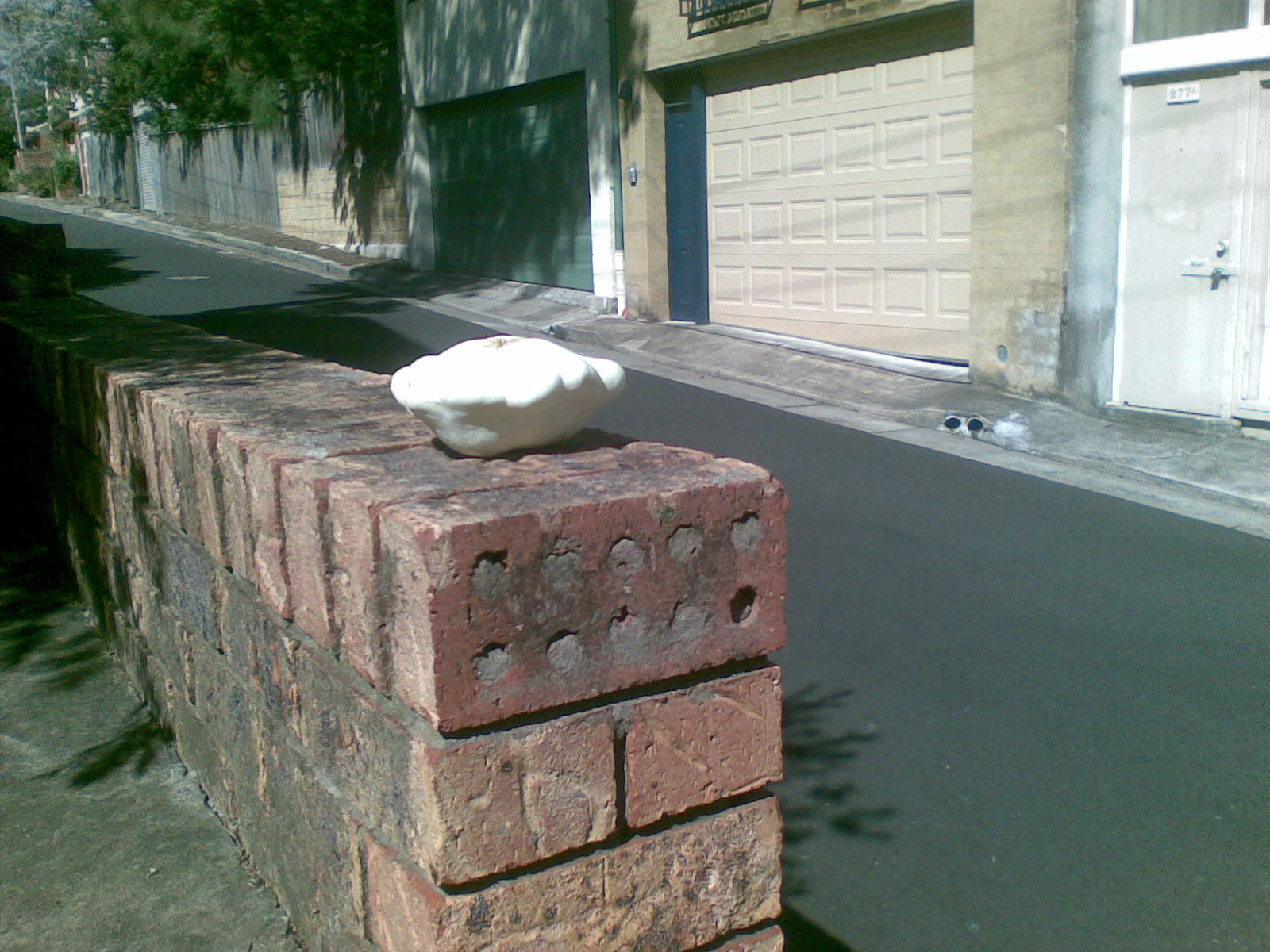
And I got to notice odd things around the suburb, like this big button squash put out to ripen in a back lane, for all the world like a pumpkin in a French village:

I still allow myself to read on the afternoon dog-walk. Yesterday we went on a 30-page excursion.

Wanting

Richard Flanagan, Wanting (Knopf 2008)

Even though I’m addicted to print, or perhaps because I am, I approach most books with a kind of resentful suspicion. It’s as if I’m projecting onto the book an anxious feeling that Schopenhauer might have been right when he said, in the essay ‘Thinking for Oneself’:

Reading is thinking with some one else’s head instead of one’s own. … Nothing is more harmful than, by dint of continual reading, to strengthen the current of other people’s thoughts. These thoughts, springing from different minds, belonging to different systems, bearing different colours, never flow together of themselves into a unity of thought, knowledge, insight, or conviction, but rather cram the head with a Babylonian confusion of tongues; consequently the mind becomes overcharged with them and is deprived of all clear insight and almost disorganised.

I came to Wanting with my normal ambivalence, plus an extra burden of suspicion, because the only other novel by Richard Flanagan to have entered the cram in my head was the abysmal Unknown Terrorist. I was willing to give this one a go because he writes compelling non-fiction, and the earlier, terrible novel was set a long way from his native Tasmania, in a place he clearly loathed and equally clearly didn’t know at all well, whereas this one is largely back in Van Diemen’s Land. Book Clubbers recommended it (that’s the Book Club, where we swap, not the Book Group, where we discuss). I took it home and eventually opened it up.

I wish I could say my suspicion evaporated within a couple of pages, but I can’t. A Protector of Aborigines, Charles Dickens, Lady Jane Franklin (widow of Sir John Franklin, Governor of Van Diemens Land and explorer) are introduced to us in a series of clunkily expository scenes. That would be all right, but the clunkiness comes with lashings of heavy irony – the narrative voice is unpleasantly insistent that it knows better than the Presbyterian Protector, and really really wants us to know it doesn’t share the genocidal racism of all the white characters. Maybe things would improve once the story got under way, I thought. But there were other discouraging signs. On page 14, to pick the most striking example, the Presbyterian Protector, in 1851, sings some lines from ‘Lead Kindly Light’. That’s unlikely, I thought, given that the hymn was written by high Anglican John Henry Newman, no friend of Presbyterians. Fifteen seconds with Google revealed that though Newman wrote the words of the hymn in 1833, it wasn’t until 1857 that someone put them to music. So it’s not only unlikely, it’s a straightforward anachronism. And I don’t think that’s just nitpicking. If the novel, having already repeatedly pronounced judgment on this character, doesn’t care enough about him to know what hymns he would or even could have sung, why should I trust anything it says about any of its characters?

I did read on. But by page 55 I realised I was motivated entirely by some weird sense of obligation. There was no pleasure. I didn’t believe a word. I put the book back on the shelf. It may be very good. It may fully deserve the awards and critical praise it has attracted. It may successfully mirror the terrible anguish that accompanied the belief that Tasmanian Aboriginal people were about to die out, as an author’s note says it aims to do. It probably is a moving meditation on the conflict between reason and desire or some other Significant Dichotomy. I’ll never know. And I probably won’t bore you ever again with blog entries on Richard Flanagan’s work.

Our baskets and Awaye

Almost exactly a year ago I mentioned that we’d acquired three beautiful woven baskets. The artist, whose name I omitted to mention then, was Jim Walliss, a white man from down Nowra way. Yesterday onABC’s Awaye he received an honorable mention in a program about Boolarng Nangamai Aboriginal Art and Culture Studio in Gerringong, near Nowra. The Awaye link in the last sentence gets you the audio. Here’s the relevant bit, where Steven Russell, weaver, painter and print-maker is talking to Nicole Steinke from the ABC:

Nicole Steinke: How did you start with the weaving, because you’ve said you really love the weaving?
Steven Russell: It started back in TAFE, in 2000, when I first started TAFE. We were taught by this old fella, a whitefella –
NS: Is that Jim Walliss?
SR: Jim Walliss, yeah. He’s a pretty good weaver himself, and he told us stories about the Aboriginals and what they did. He showed us a lot, and we just took off from there and ran with it and haven’t looked back since. I’m just thankful for Jim, for knowing him, and teaching us something that should have been passed down by our ancestors, and which wasn’t.
NS: So was there a sharing there that went on?
SR: Yes, it was sharing, and he was honoured to teach us. He taught us a lot of things about weaving and styles of weaving. He taught us our traditional weaving and that’s something that we’ll cherish for the rest of our lives, and we’ll pass it on to our kids.

So our beautiful little baskets have some sweet connections.

More Glass family reading

J D Salinger, Raise High the Roofbeam, Carpenters & Seymour: An Introduction (1963, Bantam 1965)

What a rich vein the Glass family were for Salinger! I laughed out loud a lot during ‘Raise High the Roofbeam, Carpenters’, at one level a classic New Yorker comedy of manners, and I was hypnotised by the convolutions, involutions, circumvolutions of ‘Seymour: An Introduction’ as Buddy Glass is still coming to terms (coming to words?) with his relationship to his numinous elder brother a decade or so after his suicide.

‘I am an emotional creature’

Yet another video link, this time to a fabulous TED talk by Eve (‘Vagina Monologues’) Ensler, ‘Embrace Your Inner Girl’. You may find the beginning bits about the girl cell a bit oogie boogie, but do persevere: it’s a metaphor. I couldn’t find a way to embed it, sorry!

Eve Ensler: Embrace your inner girl | Video on TED.com.

Cromwell & Tucker

In this video Alastair Campbell, former mover and shaker in the British government, talks to fabulous film critic Mark Kermode about the In the Loop character said to be based on him.

I don’t know about you, but I was both amused and chastened.

Here’s a thought. Could it be that Malcolm Tucker in In the Loop and Thomas Cromwell in Wolf Hall are really the same character seen through different lenses?