A neighbourhood encounter involving Emily Dickinson

When I came home on Monday evening from a long weekend away, I found a small mystery in the room where my desk lives: three poetry books in a pile on the floor. Who could have taken the selected Du Fu, the selected Emily Dickinson and the Shambala anthology of Chinese poetry from the shelves? Surely not the Art Student, who is a staunch hater of poetry (unless, she says, it was written by me)? Perhaps she was looking for something to console a sick friend. Unlikely. Then I remembered she had pulled a muscle in her back  and been in pain all Saturday, barely able to sit at her desk. The books on the floor weren’t reading material at all, but a tool for an Alexander Technique Lie-Down. Apparently they were efficacious, because by the time  I arrived the back pain had gone.

Since the Emily Dickinson book had made is way into my hands, I decided to take it for a walk the next morning. The day was brilliant, cloudless, cool and pleasantly humid.  The third poem in the book is about spring, but it chimed beautifully with my Sydney-early-winter-induced mood:

The morns are meeker than they were –
The nuts are getting brown –
The berry’s cheek is plumper –
The Rose is out of town –

The maple wears a gayer scarf –
The field – a scarlet gown –
Lest I sh’d seem old fashioned
I’ll put a trinket on!

As I strolled past a friend’s house, by this time carrying a bulky plastic bag of dog poo as well as my book, the friend happened to be in her front yard. ‘That’s charming,’ she said.

I chose to interpret her as referring to the book. ‘Yes,’ I said. ‘I studied Emily Dickinson at uni but I’ve hardly looked at this book since.’

‘I love her,’ said my friend.

‘Listen to this,’ I said, and read her the poem.

‘She could have been writing about today.’

And we went our ways, me with the dog, her to her garden, wearing invisible Dickinsonian trinkets

Bruce Beaver, Lauds and Plaints

Bruce Beaver, Lauds and Plaints (South Head Press 1974)

I was going to start this off by reminiscing about two occasions on which I’d met Bruce Beaver. But some dim recollection made me go trawling back through this blog and confirm that I would have been fogeyishly repeating myself. If you want the reminiscence, it’s here.

I must have bought this book in 1974, the year it was published, but have no memory of it. Maybe I tried to read it fast and so didn’t really read it at all. Whatever, I enjoyed it hugely this time around: there’s a lovely ode on Arthur Stace, Sydney’s ‘Eternity’ graffitist:

oooooeternity

I knew it was here already surrounding
ooooousooooadding to subtracting from
oooooour moments

crossing and dotting our Is and lives
oooowith its big beautiful script looping
oooovolute

that was before I learned of the commonest
ooooagony of allooootime’s rape of
oooothe timeless

as I watched the generations of dogs
ooooexcreting religiously over it
oooothe myriad

leather soles taking a little of it
oooowith them into homes shops
oooooffices

and the closest thing to sanctuaries
ooooof grass stone leaf sand
oooowave-lapped

rockooooout of the streets and into
ooootheir lives blindly underfoot
ooooalways

A series of poems marks a week’s separation from his beloved, of which you can read one at the Poetry International site. There’s an elegy to a 98 year old Manly character, two powerful pieces about a door in his family home, and all through the book an engrossing play of mind – reflective, chatty, impassioned, anguished, erudite.

Excuse me if I now say something that has been glaringly obvious to everyone else, but reading these poems I finally twigged that when a poem lacks all punctuation apart from line breaks and occasional larger spaces between words, it’s not necessarily trying to be obscure, ambiguous or even generally annoying. It may be trying to slow the reader right down. At least that’s the effect in these poems. They can’t be read fast. Nor is it generally possible to coast along on their sonorousness – too many latinate words and unsonorous sibilants. Reading them is a constant process of deciphering, of immersion, allowing the meaning to make itself known, and as such is tremendously pleasurable.

David, Kevin, Rage. So?

David Marr, Power Trip: The political journey of Kevin Rudd (Quarterly Essay 38)

In Quarterly Essay 36, Mungo MacCallum explored the miasma of myth and collective emotion that, he argued, accounted for Kevin Rudd’s popularity. Rudd’s recent plummet in the polls suggests that the popularity may actually have been based on more concrete factors, such as his promising stand on global warming, but the essay was a good read nonetheless. Two issues further on, the series once again addresses (I nearly said ‘attacks’) the Rudd phenomenon. David Marr asks not what we see in Rudd, what we hope of him, what he stands for, not centrally whether his leadership is effective or his policies correct, but ‘Who is he?’ It’s a fair enough question. There is something oddly impersonal in his media persona, a sense not so much that he’s hiding something as that he doesn’t know how to show himself. There have been baffling moments, especially his odd, televised disregard for Kristina Keneally.

The question is fair enough, but I’m not sure the answer gets us anywhere much. A cruel short version would be: ‘Kevin Rudd yelled at me when I told him he was an all round disappointment, so now I know that rage is at his core.’ David Marr writes well, and he marshalls biographical facts into a coherent story, sifting through the hostile and hagiographic scuttlebuck alike, for which much thanks. But in the end, the essay is unsatisfying. His strategy of beginning with Rudd’s use of expletives about the Chinese at Copenhagen and ending with a moment when Rudd sets his diplomat’s blandness aside and tears strips of the writer (in private, quietly, in response to provocation) may be structurally satisfying, but the conclusion that anger is Rudd’s ‘juice in the machine’ is a wee bit tenuous. Perhaps I identify with Rudd, as a mostly mild-mannered Catholic man from rural Queensland who uses four-letter words and gets cranky when personally attacked. I imagine David Marr himself swears occasionally and has the odd tantrum – at least I hope he does for the sake of his mental equilibrium.

Tellingly, Kevin Rudd’s response, as reported by the ABC,  was a verbal shrug: ‘Commentators, writers, analysts – they will draw their own conclusions.’

But a distinctive feature of the Quarterly Essay series is that it promotes discussion. No doubt all manner of responses will be aired in Nº 39. Here, the title essay accounts for roughly two thirds of the book, leaving the remaining 40 odd pages to discussion of Waleed Aly’s essay last quarter on conservatism. As a first, a number of voices from the neo-right have appear in these pages, many of them doing their usual polemic attack on straw men. Jean Curthoys (not from the right) suggests that Aly really needs a dose of social democracy. Martin Krygier’s piece makes me decide that if I ever make him cross I’d better lay low. And Aly responds to all comers with precision, grace and – in one or two cases undeserved – respect.

Diana Wynne Jones is very ill

Just in case there’s a Diana Wynne Jones fan who reads this and hasn’t heard from elsewhere: this most wonderful of fantasy writers has cancer and has chosen to stop chemotherapy treatment and may have only months to live.

If you send her an email message (‘no questions please’) at <meredithxyz at googlemail dot com> it will be printed out and posted to her. I have this news from Kate Nepveu at Tor’s blog, who had it from Ansible and a DWJ fan site.

Isle of Joy

Don Winslow, Isle of Joy (1996, Arrow Books 2008)

Here’s more genre fiction in print form instead of the more congenial moving pictures, this time a spy thriller of sorts. Apart from a prologue, the action takes place in New York City in the last week of 1958. It’s not a meticulously recreated period piece: someone talks about exchanging bodily fluids fairly early on, so anachronism-haters are warned off, and though the list of shows on Broadway is almost certainly correct, it remains just that, a list. The main character goes into a theatre showing Orson Welles’s A Touch of Evil, but there’s no sense that either he or the author has seen any part of the film.  It’s not a period piece, but it does play around tittilatingly with the historical record. A  charismatic, womanising New England Catholic senator who is about to run for president against Richard Nixon is having an affair with a big-breasted blonde Hollywood actress. Though the Senator’s name is Joe Keneally and the actress is Marta Marlund, we know who we’re talking about. Or we think we do until about the half way point …

It’s a solidly constructed murder–intrigue–espionage machine that’s a bit too slow to get going and shows its workings a bit too obviously. The characters are mostly functional rather than interesting in their own right, there’s some unconvincing unconventional sex, and a tedious, incomprehensible football match that makes me appreciate all over again the brilliance of Jasper Jones‘s cricket match. It’s probably a book for committed fans of the genre. I don’t go much beyond Le Carre, and this didn’t make me want to change my ways. On the other hand, I didn’t feel like throwing it across the room, and the complex threads of the second half of the book were enough to keep me reading when I should have been asleep..

Animal Kingdom

We’re largely giving the Sydney Film Festival a miss this year. Again. We had two disappointing years in a row a while back, and now the Writers’ Festival seems to have filled the need for a bit of festive culture as winter comes on. What’s more, the big hits of each year’s festival mostly turn up in the picture theatres pretty soon anyhow. I do miss the fabulous State Theatre picture palace, especially that moment where a guest director steps out onto the stage and gasps at the sheer OTTness of it all.

Tonight my Movie-Going Companion was otherwise engaged, so I set off to the Palace Theatre in Norton Street, which is palatial only in name, for a 6.45 screening of David Michôd’s Animal Kingdom. At ten past seven, the lights hadn’t dimmed. People in the front rows started a slow clap, but it didn’t develop any steam, though there were mutterings – a movie starting 25 minutes late is a rarity in these fast turnover days. A young man stepped out into the space in front of the screen, walked up to a microphone that was standing there minding its own business and started complaining abut the traffic. ‘I’m in such a state,’ he said. It took me an hour to get here from Bondi. But you don’t really want to know about that.’ He was right of course. But who was he? ‘I really am all jittery. Maybe I should just sit down.’

‘It’s all right,’ called out a woman’s voice from the now darkened auditorium. ‘We’ve all been there. Take a minute to calm down.’

‘Thank you,’ said the man at the mike, who looked a bit like he’d been sent by Central Casting to play a hipster in a Tina Fey sitcom, only with an Australian accent. ‘Thank you. I can feel the sharing.’ And the chance to deploy some benign irony seemed to restore his equilibrium. ‘But really, it took so long to get here, and I don’t just mean the traffic. I finished the first version of the script for this in 2000.’ Now we knew he was David Michôd.

When he left film school and heard that Lantana and other films had taken ten years to get made, he thought those people must have been weird But now he understands. He thought this script was ready to shoot in 2000, and told us to be glad that we weren’t about to watch a movie made from that script. You just keep chiselling away, a bit here, a bit there. You try to get someone to direct it and are gracefully rejected. And then you make it, and expect every screening to be the one where people hate it. ‘Please don’t let this be the one,’ he pleaded in conclusion. ‘Please like it.’

He fuffled around putting the mike away and walked out through the audience.Whether by design or by chance he had charmed us to pieces.

The lights went down, the movie came on without any ads, and there was no point at all trying to reconcile all that self deprecation with the confident story-telling that followed. All the performances were marvellous: the marvels included Ben Mendelsohn better than I’ve ever seen him, and Jacqui Weaver as a personification of the wolf mother: protective of her cubs and heaven help anyone who threatens them.

I came home one satisfied punter.

Dennis Hopper does Rudyard Kipling

… on the Johnny Cash show. (via Harriet the Blog)

I don’t known what Rudyard would have thought of the little improvisations – I guess they were the young Hopper’s way of laying claim to the poem as his own.

Closer than it looks

Some months ago my elder son was invited to join the Aid Flotilla that was being planned to bring humanitarian aid to Gaza. He would take a camera and make a documentary. The idea appealed to him. His mother said that if he was going to do something like that it needed to be in a cause he was willing to die for. In the end he didn’t go, partly because he had other commitments he couldn’t responsibly shuck off.

He and I didn’t exactly discount  his mother’s warnings, but we did think she was being a bit melodramatic. After all, it was a humanitarian mission.

And then today, this:

Israeli forces have attacked a flotilla of aid-carrying ships aiming to break the country’s siege on Gaza.

More than 10 people were killed and dozens injured when troops stormed the Freedom Flotilla early on Monday, the Israeli military said.
…
The Israeli military said four soldiers had been wounded, one of them seriously, and claimed troops opened fire after ‘demonstrators onboard attacked the IDF Naval personnel with live fire and light weaponry including knives and clubs’.

Free Gaza Movement, the organisers of the flotilla, however, said the troops opened fire as soon as they stormed the ships.
….
Al Jazeera’s Ayman Mohyeldin, reporting from Jerusalem, said the Israeli action was surprising.

‘All the images being shown from the activists on board those ships show clearly that they were civilians and peaceful in nature, with medical supplies on board. So it will surprise many in the international community to learn what could have possibly led to this type of confrontation,’ he said.

Suddenly the Middle East feels awfully close to leafy Annandale.

Sydney Biennale

Today the Art Student and I popped into town with a visiting Melburnian friend to stroll around the MCA for a couple of stimulating hours. It was our second excursion to the Biennale. We went out to Cockatoo Island a couple of weeks ago, but I didn’t make the time to blog about that, and to judge by the program we missed some of the most interesting things out there. We did see Cai Guo-Qiang’s Exploding Cars, walk on the shanty town rooftops of Kadia Attia’s Kasbah, and chortle uneasily at Shen Shaomin’s Summit. Today we were greeted at the door by two of Shen Shaomin’s bonsai works, which at first glance deliver much less punch than the realistic corpses of Communist leaders in Summit, but after we’d seen half a dozen of his tortured trees, even without being able to read the ideograms describing how they had been manipulated, we treated them with due respect.

The  walls of the first large room at the MCA are covered with big colour photographs, a hundred pairs of which one is a domestic space and the other a person standing back to camera. I imagine there are people who are capable of standing in this room and spotting the unifying motif. I looked up the program and told my companions and one or two other people – no one complained about the spoiler. (If you want to know more, you can click here.) The artists, Sun Yuan and Peng Yu, created the memorable Old People’s Home, which we saw in Tokyo last year.

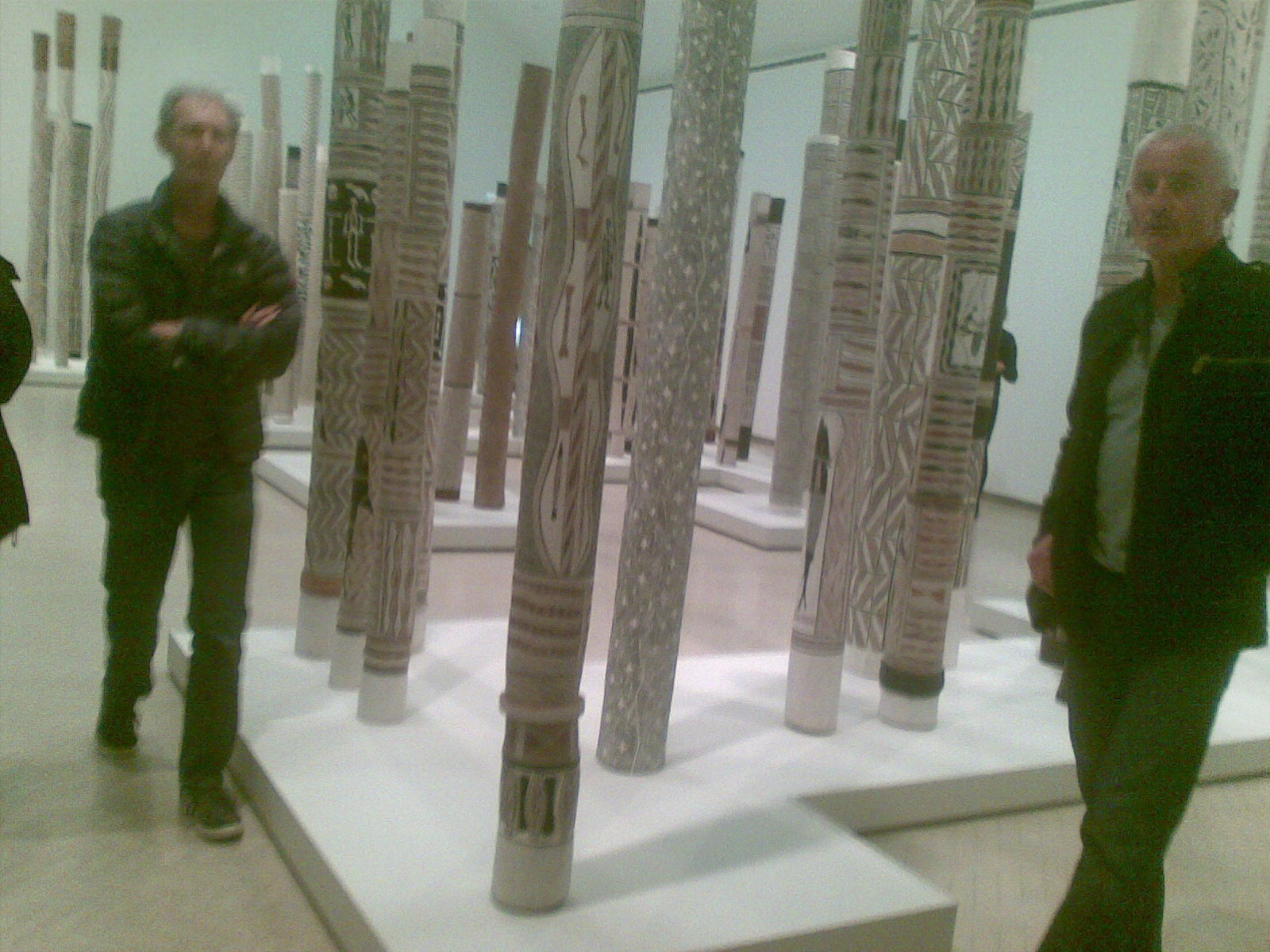
There’s far too much in this exhibition for one visit, or one blog entry. I was struck by the amount of Indigenous art – from Australia, of course, but also from New Guinea, the Arctic, the Americas and Europe. One large room on the top floor is devoted to 110 larrakitj (memorial poles) by 41 Yolngu artists from East Arnhem Land, and it’s a knockout. There’s brilliant trompe l’oeil, wonderful sculptural play, images reminiscent of the Mexican Día de los Muertos, shimmer to make your eyes water. A place to just stand and stare. I took my one phone photo there. It might give you some idea.
I tend to skip video installations in art galleries, and I saw at least two pieces today that confirmed my expectations of amateurish sound recording / acting / design, and did less than nothing for me. But Bill Viola’s Incarnation is totally magical. Two naked people walk towards the camera in slowmo, and it turns out that the graininess of the image is caused by a veil of water falling between us and them. They walk through the veil and are suddenly clear and in full colour. After a long moment, they turn around, go back through the water, and walk away until they vanish into the granularity of the screen. Araya Rasdjarmrearnsook’s video triptych is a delight of a different order. On each of three screens a life sized print of a famous nineteenth century European painting is set up in the open air in front of a group of Thai peasants, who sit with their backs to the camera and chat among themselves, mostly about the painting. We get subtitles. The naked woman sitting with clothed men in Manet’s Déjeuner sur l’herbe provoked quite a bit of anthropological speculation: ‘I suppose it’s cooler to go like that in hot weather’ ‘Is it a funeral custom?’ etc. Millet’s Gleaners and Van Gogh’s Midday Sleep were less mysterious, but there was much discussion of the exact nature of the crops and activities in each picture, the weather and the state of the fields. Not for these peasants our cringing sense of inadequacy when confronted with what we’ve been told is Great Art.

There was a lot else. Angela Ellsworth’s Seer Bonnets, beautiful to the eye, are made of pearl headed pins, thousands of them, all viciously pointing inwards to where the wearer’s head will be.  Louise Bourgeois has made fascinating sculptures from old clothes. Salla Tykkå’s video Victoria spends 10 minutes watching a waterlily bloom and grow, possibly in a greenhouse in Kew Gardens in London.

We had lunch in Glebe, and drove our friend to the airport less sure that Sydney is Philistine-ville. Then I realised I’d lost my wallet and will now draw up a list of all the cards I need to replace.

The burqa at Sha’s place

I haven’t really been following the ‘debate’ about the burqa. I guess I know what I think, and I’m a bit bemused by the way some unlikely people are coming over all feminist as an excuse to tell some women what to wear and do a bit of Islam-bashing while they’re at it. Mostly, the conversation has been about Muslim women, with not that many female Muslim voices being heard. I recommend that you read this blog entry by Sha of Sha’s place, a Sydney Muslim woman who doesn’t wear a veil. This paragraph gives you an idea of her point of view

In Islam, women are considered precious. A woman is allowed to dress as she pleases, adorn herself and satisfy her vanity but only in front of people that matter – her husband and her family. While the Burqa is more of a cultural significance, the colour, shape, cut varying in different countries, the basic ruling is to dress modestly. The idea is that a woman should value her own dignity and present herself in a manner that befits a lady of high morale and character. By adorning the burqa, the Muslim woman exercises her right to dress according to her religious and cultural values. She feels safe and protected. Not to mention the convenience of a Burqa. A quick  slip-in and she is ready to go anywhere without much worry of how her hair look like or what kind of dress or shoes she is wearing.

Read the whole thing, go on.