Corner Shop: development application

Here’s a sight that struck fear into my heart. After months of work, a development proposal has been lodged. Oh, as they say, noes! The whole thing has been skating on very thin ice and now it might be declared illegal.

09072009

But closer examination revealed that the proposal is to have the number of outside tables increased ‘from four (4) to twenty (20)’. Incidentally, since I was about eight years old, I’ve wondered why notices from local councils and similar organisations do that with numbers. My mother explained to me that it’s so people who have trouble reading the spelled out version will be helped by the numerical version. I wasn’t convinced then, and now it just looks like ornamentation to indicate officialness.

I wrote off to Council expressing my support.

I had a brief chat the other day with Rod, the proprietor, who is looking slightly less harried though possibly more panicked with each passing day. He’s now chasing up suppliers, and said he was confident the grand opening would happen before 12 August.

Exemplary journalism (irony alert)

Did anyone else notice in the 7.30 Report’s segment on parallel import of books last night the bit where the commentator said that on the one hand, those who argued for the lifting of restrictions said that the music industry had suffered no ill effects from the lifting of similar restrictions on importing CDs, and on the other hand those who argued the opposite said that there had been massive loss of jobs as a result of the change, and missed out the fairly obvious next step of telling us which of those two assertions was borne out by the facts.

This was the ABC, where ‘balance’ is now apparently valued above finding out the facts.

Wild animals

According to one strand of received wisdom, Alzheimers brings about a kind of regression: whereas a small child gradually learns skills such as walking, talking or handling cutlery, and builds mental models of the world, a person with dementia loses these skills in roughly the opposite order. In this model, my mother-in-law Mollie, who has almost completely lost the ability to read, walks with great difficulty and is rarely able to finish even a simple sentence, is almost back to infancy. The fact that as often as not she doesn’t have her teeth in might seem to confirm the impression. I don’t think it’s right.

Yesterday I dropped in for a short visit in the middle of the afternoon. She greeted me cheerfully, though not with any obvious sign that she knew me as more than a friendly stranger. After a mainly one-way conversation about the weather, I cast about and found a small picture book called Wild Animals to read to her. The book is exactly what you’d expect – photos of elephants, bears, cockatoos (in the Exotic Birds section), zebras, with a scattering of text. Mollie and I made our way through it, admiring the photos and occasionally referring to the text. Mollie was alert and responded with interest to everything I had to say. She singled out an ocasional word in a heading – Birds she could say; Owls she pointed to, and asked (‘That, that…?’) for help. When we came to an image of a bat, she traced the outline of its wings with a finger, saying, ‘Lovely.’ ‘Good,’ she said a number of times, and when I replied, ‘Beautiful,’she smile in a gratified way.

And you know, extremely limited as the conversation was, it was a conversation. I wasn’t conducting a kind of learning session in reverse, a test of her powers of cognition. We found a place where we could share the world, person to person, no big deal, enjoying each other’s company and pushing the dementia to the side for a moment, rather than having it the subject. I think Penny does this with Mollie all the time.

Not the Blue Mountains

Mark Tredinnick, The Blue Plateau: a landscape memoir (UQP 2009)
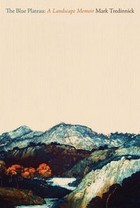
4541 As well as being a poet and writer of personal essays, Mark Tredinnick teaches writing in both creative and business contexts (not that I think business is never creative, but you know what I mean). I went to one of his Sydney Community College courses a couple of years ago, and not only got a boost for my writing but also was introduced to contemporary nature writing – Mark had us read passages from some of the great American practitioners, did a non-pushy but in my case successful sales job on The Land’s Wild Music, his book about them, and talked about his own longterm project, a memoir about the Blue Mountains. At the Sydney Writers Festival this year, beside stacks of his Little Red Writing Book and  Little Green Writing Book, there was the memoir, The Blue Plateau, in print at last.

You don’t have to scratch far in non-Aboriginal Australian literature before you come across the idea, usually accompanied by an element of yearning, that people live in close mutuality with the land they inhabit. It could hardly have been otherwise – the first settlers were discovering a new nature. Barron Field had fun describing a kangaroo

Nature, in her wisdom’s play,
on Creation’s holiday

and it probably makes sense to read a lot of Henry Lawson’s stories as exploring the deep interconnection of humans and environment – as in the oddly bathetic final sentence of ‘The Bush Undertaker‘:

And the sun sank again on the grand Australian bush – the nurse and tutor of eccentric minds, the home of the weird, and of much that is different from things in other lands.

Not to mention Judith Wright and all those poets who wrote about the landscape of the mind (‘South of my days’ circle, part of my blood’s country,/rises that tableland’ etc).

Mark Tredinnick is consciously part of a different tradition. Just as Patrick White decades ago revolted against ‘the dreary, dun-coloured offspring of journalistic realism’ which he saw as dominating Australian literature, looking instead to European models, Mark T looks to North American models. I know this, not because I’ve read any of them, and not just from the enthusiasm of The Land’s Wild Music, but from references embedded in the text – explicitly to Barry Lopez, in a nod and a wink to James Galvin, and perhaps by a mention of bell peppers where someone writing in an Australian tradition might have said capsicums or red peppers. The book offers a wealth of stories, mainly of three families – two who lived in the region for generations, transformed it in big and small ways by their labour, and were transformed by it; one who came as an immigrant and found home there. Actually make that four families, the fourth being the author, his partner and children: their stay in a place up on the ridge by Katoomba, and Mark’s attempt to belong there, is a central narrative thread. Many of the stories are classic bush yarns – miraculous escapes from bushfires, lives lost from flood and rockfalls. That is to say, they have the subject matter of classic bush yarns: they are told in elevated, mellifluous language, rich with simile and, especially, personification, a very far cry from the tightlipped, sardonic discourse we have come to think of as typically Australian. I wouldn’t want to give the impression that the book is a tapestry of yarns in the manner of Joseph Furphy’s Such Is Life, though in more high-falutin language. True, like Furphy’s fabulous book, it lacks a straightforward linear structure. But it is a very different beast: self-described as something that has been eroded, leaving only fragments of its whole, it is indeed fragmentary, to be read, I think, almost like a book of poetry. Some of the “poems” are ten pages or more long. The narrative of Les and May Maxwell stretches through the whole book like a backbone. There are many outcrops of observation, reflection or anecdote that are barely a paragraph long.

(A newspaper review on the weekend lamented the absence of Indigenous people, except ‘obliquely’. And it’s true that no Indigenous person appears as a character. But one of the distinctive features of The Blue Plateau is the way the Gundingurra people are a constant, though abstract, presence. Perhaps this is a book that’s easy to skip. And that’s every reader’s right, but one that, when exercised, makes it hard to be an accurate reviewer.)

Improbably, the opening paragraph reminded me of Terry Pratchett’s descriptive writing. I thought at first that to mention this would be to make fun of Mark Tredinnick’s elevated style. But that ain’t necessarily so. On reflection, I think it’s fair to say that my favourite fantasy writer manages to slip brilliantly lyrical writing past our defences by taking the mickey, Mark’s lyricism is full frontal, dares us to laugh, and restores the mickey to readers who are timid about lyricism in their prose. Here are a couple of excerpts from The Blue Plateau and bits of Terry Pratchett. See if you can tell which is which.

It’s early September, the driest month of the year, and the valley is rolling over into summer. The sun has been out all day, and now what’s left of it has fallen into the valley and is lying there on the yellow grasses like whisky in a glass.

The sun rose slowly, as if it wasn’t sure it was worth all the effort.

[The] soft yellow light of dawn flowed over the sleeping landscape like the caress of a gentle lover or, as some would have it, like golden syrup. It paused to fill up valleys. It piled up against mountain ranges. When it reached [placename here], it built up in heaps until it finally crashed in great lazy tsunami as silent as velvet, across the dark landscape beyond.

The valley is a woman who likes  a bath, and she likes to smoke while she lies there. She breathes down the sky, and she lets it travel through her body, and she holds it a long time, and then she breathes it out again, heavy with desire and complaint.

Me on Annabel on Malcolm

What might have been a blog entry grew up to be a paid review.

Sydney Ideas: Margaret Levi

I’ve been slack in my self-imposed duty to be a blog of record – that is, to keep you informed about what I get up to by way of going out to stuff in the evenings, often stuff you won’t hear about from the newspapers. Could it be that newspapers are dying because they don’t report on events like Tuesday night’s lecture in the Sydney Ideas series, A Challenge to the Hip Pocket: Evoking Commitments to Social Justice by Margaret Levi. After all, there were nearly 50 people at the Seymour Centre to hear her (the myriad other people seemed to be there for a children’s show in one of the other theatres).

All limp attempts at irony aside, it was a really interesting hour.

Professor Levi is joining the US Studies Centre at Sydney University and there was a sense that a fair whack of the audience was made up friends and colleagues from there. In acknowledging this, she looked around cheerfully and expressed the hope that there were new friends in the audience as well. Unusually for a visitor from the US she was remarkably well informed about things Australian, casually dropping John Howard’s name and referring affectionately to the Wharfies , the BLF and Australians’ love of acronyms, at least when talking about trade unions.

Her talk, which is promised to appear on the web soon – here – addressed the question: what is it about the culture and organisation of some trade unions that has their members willingly take on broader goals than the preservation of wages, conditions and so on? What was it about the BLF that made the Green Bans possible? How come the Wharfies (and the Longshoremen on the West Coast USA) went on strike to prevent pig iron being sent to Japan inthe 1930s after the invasion of China? In other words, she said, it’s the Lenin question, from his What Is to be Done? How does one induce workers to look beyond economist self-interest to broader, in Lenin’s case explicitly revolutionary, goals?

I didn’t take notes, but her answer boils down to a couple of things: genuine commitment to democracy in the union (or other organisation), not necessarily in the sense of rotating the main leadership, but in having plenty of openings for membership to have their say, and having had their say to determine policy; membership given accurate information about the world; opportunities for discussion. She’d given a talk at (I think) the MUA recently, and afterwards an old man approached her to say that back in his days on the wharves he didn’t have much time for Communism, but when the Communist leadership told them what the Dutch were doing in Indonesia, and that Dutch ships were passing through Sydney, he and the membership were outraged and willing to take action: they didn’t have an ideological position, but they stopped the Black Armada.

This stuff isn’t taught in history classes. It’s clearly not a huge crowd-drawer. But you know, there was something very sweet about being addressed by a US academic who didn’t shudder when she used the word ‘Communist’, and who responded with respect to questions from the floor from men who I’d guess were old truckdrivers. In fact, one of those men spoke at some length about the importance of workers getting together to talk about their situation, to learn from each other, about how email was no substitute. When he’d wrestled what he wanted to say into some kind of rough question as per the chair person’s instructions, Margaret Levi said, ‘That wasn’t a question. It was a statement, with which I agree.’ She got a laugh, but it was at no one’s expense.

My Place on our street: Mr Malaprop

As I passed the filming site just now, in the almost dark, they’d all but finished packing up. I had a short chat with the security guy. Excerpts:

Don’t let anyone tell you they don’t work hard. They’re here at five every morning…. You’ll like it when you see it.

Yes, I really liked the book.

If you read books you’ll have read Mayo’s Last Dancer. We made that last year. With Bruce Beresford, from Growing Miss Daisy.

I want to read that book, and see that movie: waltzing for the dressing, and raising a flower child.

Thank you for listening.

Once Were Radicals

Irfan Yusuf, Once Were Radicals: My years as a teenage Islamo-fascist (Allen & Unwin 2009)

Once Were RadicalsOver the years, I’ve regularly resolved to rectify my appalling ignorance about Islam. My bookshelves bear witness to my good intentions with a smattering of titles like The Complete Idiot’s Guide to Islam (though I don’t have that precise book) and What’s Wrong with Islam, and none of them have I ever read.

Enter Once Were Radicals. Perhaps it was the hint of B-grade horror movies in its subtitle that made it seem accessible, or perhaps it was the ludicrous cover image of the author – dark-skinned, bearded and brandishing an automatic weapon, but wearing a boxing kangaroo T-shirt, one cricket pad and a Gen-X smirk in front of a bullet-pierced rifle-range target. Whatever, this is book broke through my worthiness barrier.

Irfan Yusuf, Pakistani Muslim from North Ryde, former member of the Liberal Party, old boy of St Andrew’s (Anglican) Cathedral School, blogger (in fact, the book has its own blog), winner of the Iremonger Award for Writing on Public Issues the year my niece Paula Shaw was runner-up, has written a kind of demotic Apologia Pro Vita Sua, an extended episode of Pizza with political Islamic writings in place of bongs.

The comparison to the Apologia isn’t as far-fetched as it might seem. Compare John Henry Newman’s opening words

I cannot be sorry to have forced Mr Kingsley to bring out in fulness his charges against me. It is far better that he should discharge his thoughts upon me in my lifetime, than after I am dead.

to the way Irfan Yusuf begins his acknowledgements:

Believe it or not, the first person I’d like to thank is the former US President George W. Bush for popularising the clumsy term ‘Islamo-fascist’.

Both writers take personally the insult – of untruthfulness and terrorist tendencies respectively – to their religion, and respond with what Newman described as ‘draw[ing] out the history of [his] mind’:

I will state the point at which I began, in what external suggestion or accident each opinion had its rise, how far and how they were developed from within, how they grew, were modified, were combined, were in collision with each other, and were changed; again how I conducted myself towards them …

In Yusuf’s case this is a history of growing up as a middle-class immigrant in Sydney, revisiting Pakistan a number of times as ‘an Aussie kid’, gradually learning to distinguish among the interpenetrating religious heritages of his South Asian ‘uncles’ and ‘aunts’,  going to Muslim youth camps, learning parts of the Koran by rote in Pakistan and at home, reading books given him by his Wahhabist aunt, toying with conversion to Christianity, engaging passionately with Islam in a number of ways in his teenage years, and in the end achieving an impressive equilibrium. He is given a copy of The Protocols of the Elders of Zion, but his parents remove it deftly before he can read any of it; he reads The Satanic Verses, and his mother objects because it might interfere with his studies.

As one who was deeply involved in Catholic matters in my teenage years, I could relate to young Irfan’s trajectory, including the bit that involved learning by heart slabs of text in a language he didn’t understand. Even though I’d be hard pressed to name withy any confidence even one of the authors who attracted him to political Islam, the sheer complexity of his reading is in itself instructive: everybody knows there’s not just one Islam, but following the teenage Irfan’s quest made the complexity of Muslim cultures tangible, almost tasteable.

The Pizza connection: Once Were Radicals is at times very funny, with plenty of a specifically Australian quality of ethnic self-mockery. Yusuf impresses on us early in the book that his mother is highly educated, and that she made a calculated decision to speak Urdu in the home so that her children would not lose the language of their cultural heritage, and there’s no disrespect in his lampooning of her heavily accented English in the rest of the book. Lakemba’s Sheikh Hilaly features in one or two scenes whose comic effect couldn’t be further than the pot-shots taken at him by journalists and aspiring satirists: he treats a young bikini-clad Australian woman with friendly courtesy, and tells his astonished teenage charges:

Ostraalyan beebul goodh, nice friendly beebul. Wee Muslim fighth thoo mush. Vee should lurrn from za Ostraalyan beebul how show respect.

All of this is pretty much what I expected of the book after hearing the author speak at the Sydney Writers’ Festival. I didn’t expect to be moved to tears. It’s against my religion to tell how a book ends, but I can tell you that for me this one did end in tears.

This needed saying

From one of my favourite political blogs, A Tiny Revolution, some belated but incisive reflections on ‘humour’ about Michael Jackson and by extension other tormented celebrities:

Anybody who runs for President, much less does what it takes to win, is just as weird as Michael Jackson was. They simply hide it better. Here was a guy so terrorized by his father that he’d vomit at the sight of him; a guy whose talent robbed him of his own childhood; a guy who spent the rest of his life mutilating himself and possibly mistreating others in an utterly doomed attempt to find release from his pain. Apportion the blame however you like, but what the hell is funny about that? The moment you stop to think about it–for one second–it no longer becomes fodder for humor. So when we laugh at a Michael Jackson joke, we should know: that’s not laughter, that’s keeping yourself dead inside.

Read the whole post.

Corner shop: Foreshadowing

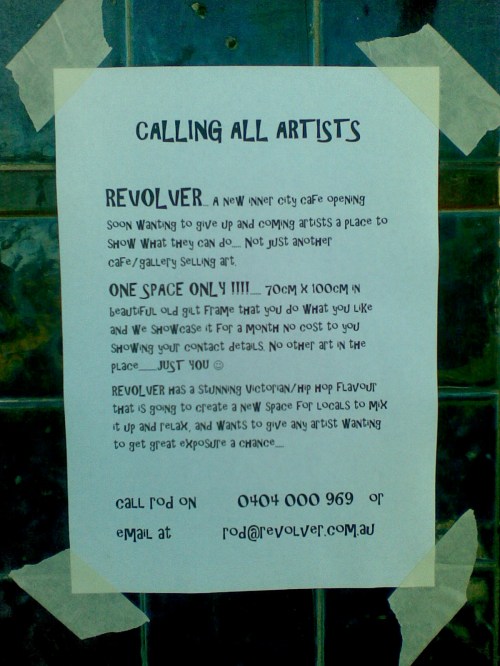
A little glimpse of what may be in store in the store:

callingartists

Transcription:

CALLING ALL ARTISTS

REVOLVER … a new inner city cafe opening soon wanting to give up and coming artists a place to show what they can do … Not just another cafe.gallery selling art.

ONE SPACE ONLY!!!! … 70cm x 100cm in beautiful old gilt frame that you do what you like and we showcase it for a month no cost to you showing your contact details. No other art in the place … just you 🙂

REVOLVER has a stunning Victorian/Hip hop flavour that is going to create a new space for locals to mix it up and relax, and wants yo give any artist wanting to get great exposure a chance …

Call Rod on [see image above] or

Email at rod at revolver dot com dot au

Brought to you as a community service