November verse 6

6. On the Belvoir Street Theatre production of
Mikhail Bulgakov's The Master and Margarita

Pontius Pilate chats with Jesus
Satan's crew puts on a show
of magic that astounds and pleases.
Heads are torn off – it's Moscow
in Stalin's time, plus naked witches,
lots of bodies without britches.
One leaps out into the street
bold as brass but less discreet.
'The worst sin is to be a coward.'
The man who wrote this rampant tale
risked more than just a night in gaol.
A message for us all post-Howard:
be bold, have fun, don't hesitate, 
and if you write poems they don't have to rhyme or scan.

November verse 5

In honour of the flâneur elements of Kim Cheng Boey’s lovely book The Singer, I’ve written a walk-to-the-shops stanza. It turns out this isn’t the first of these I’ve done. An 2020 foray is here.

5. A walk to Marrickville Metro
Jacaranda, bouganvilly,
Roses, jasmine, bottlebrush,
strelitzia, gymea lily,
solo lorikeet in a rush:
most days I trudge past ignoring
all this colour, see just boring
ads for things that no one needs
and concrete broken up by weeds.
Grey hoodie man gesticulating
talks to god or to his buds. 
Woman's headset booms and thuds.
The cool youth by the pool are skating, 
young ones climb and swing and twist.
I pass by with my shopping list.

Kim Cheng Boey’s Singer

Kim Cheng Boey, The Singer (Cordite Press 2022)

There’s so much to love in this book.

I was inclined to love it sight unseen. I’ve been delighted by Kim Cheng Boey’s readings in past years when the Sydney Writers’ Festival had room for local poets. He co-edited (with Michelle Cahill and Adam Aitken) the excellent 2013 anthology, Contemporary Asian Australian Poets. He has written insightful reviews of one of my favourite poets, Eileen Chong, and had a walk-on role in one of her poems. This is the first of his books that I have read.

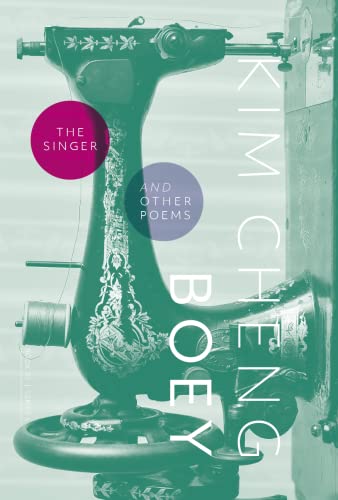
When I got my copy direct from Cordite Press – I tried at least three bookshops – I loved it for the cover alone. You expect the title The Singer to refer to the poet, perhaps in an attention-seeking way, but then you tilt the book and see the cover image clearly: it’s a Singer sewing machine. (My mother didn’t call her labour-saving devices the washing machine, the vacuum cleaner or the sewing machine, but the Hoover, the Electrolux and the Singer.) It’s a brilliant title: yes, poetry is like song, but it’s also craft.

And page by page, I kept on falling in love. There’s a Preface in which Kim Cheng writes of the different ‘weight’ of his poetry-making over time:

When I was younger, poetry carried me posthaste, high on the fuel of experience and freshness of thought, from initial impulse to final form. In middle age the roles are reversed – I am the mule, the porter, learning the weight and heft of the poem so I can carry it long-distance – over months and often years.

‘Perhaps,’ he continues, ‘the change occurred the moment I became a migrant.’ He migrated to Australia from his native Singapore in his early 30s, in 1997. Since then he has continued to take part in Singapore’s literary and cultural life as well as that of his adopted home. The book’s three parts can be read as tracing this geographical movement over time. The first, ‘Little India Dreaming’, has five long prose poems full of the smells and sights and sounds of a remembered Singapore childhood, including the title poem. Here’s a small extract to give you a feel for it:

You almost pray to the Singer, its dark cast-iron hull, to 
carry your mother's song. You pray for the treadle to 
stir, for the finished dress to be unstitched, its seams 
unpicked so the dress can materialise again from the 
chalk outline. You take the birthday outfit out of the 
wardrobe of forgetting and become the five-year-old 
wearing your mother's love.

The second section, ‘The Middle Distance’, is introduced with a quote from Louis Mac Neice, ‘This middle stretch / Of life is bad for poets.’ Each of its five poems is set in places other than Asia or Australia., and it’s tempting to see an unsettled, midlife quality to them.

The seven poems of the third section, ‘Sydney Dreaming’ – to simplify appallingly – lay claim to Australia as a place that can be called home.

My arbitrary blogging practice of looking at page 76 has once again given me a gift. That page occurs near the end of the book, in ‘Sydney Dreaming’, the title poem of the third section.

I love this poem (I know I’m using that word a lot, but it can’t be helped). In it the speaker walks around inner suburbs of Sydney, haunted by the tales and memories of other cities and ghosts of Sydney past. If it was terrible, banal rubbish, I might still have loved it because I have walked every step that the poem follows. I too lament the disappearance of second-hand book shops in Pitt Street. I know the painted up man with the didgeridoo in the Central tunnel, as well as the old Chinese man ‘scraping a dirge on his erdu’. Chinatown, Broadway, Glebe Point Road, Gleebooks, all lovingly named and recognisable. Then Darlinghurst Road, the wall, the Holocaust Museum, Macleay Street. The poem made me want to go for a long walk.

And it’s a terrific poem. Here are a couple of stanzas from page 76 – the walk down to Woolloomooloo from Kings Cross:

You follow the bend and the view opens to the ivory cusps 
of the Opera House and the dark arch of the bridge over the silver-glazed
azure scroll of the harbour, the sky burnished gold in the last exhalations of the sun.

Soon the flying fox formations will rise from hangars of Moreton Bay figs
in the Botanic Garden, and weave arabesques around the halo 
of the spanning arches of the Coathanger. You remember seeing this even
before you arrived, memory in the image, image in memory,

the sky and the harbour dyed incarnadine in the first postcard 
you ever received from a childhood friend settled in a new life

Notice that it’s in the second person: ‘You follow the bend.’ The poem’s speaker isn’t just telling the reader about a walk he has taken, he is inviting us to walk with him – which is especially effective for readers who have in fact walked in those places. The long lines have a leisurely, strolling feel: no hurry, no need to reach any rhyming points or keep to any metric timetable. The conversational tone and language creates a companionable feel.

Then the register shifts, as the poem enters its final movement.

You follow the bend and the language opens to ‘ivory cusps’ and ‘silver-glazed azure’ and ‘burnished gold’ and ‘exhalations of the sun’. That’s such a Sydney moment – any Sydneysider arriving at Circular Quay train station will have had their phone-absorption interrupted by the exclamations of tourists seeing the Bridge–Harbour–Opera House scene for the first time. Rounding that bend in Woolloomooloo has a similar breathtaking effect, and the language responds.

Then two things happen. First, the speaker asserts that he belongs here by looking forward in time: he knows that the flying foxes will soon fill the sky and enjoys anticipating the spectacle (still with the elevated language, ‘arabesques’ and ‘spanning arches’). Second, he knows that he hasn’t always belonged, and memory asserts itself. He had seen this sight in a postcard long before seeing the actual thing. I’m reminded of those passages in Proust about how the reality inevitably falls short of the anticipated image. That’s not how it is here, but there’s a strange unreality nonetheless – ‘memory in the image, image in memory’ – the present moment is a palimpsest. The whole poem revolves around that interplay of past, present, anticipated future and imagination. The whole walk is experienced as a palimpsest.

I’m restraining myself from quoting the lines that come next, because it’s getting close to the poem’s stunning conclusion, and even with poetry spoilers are an issue. Enough to say that the Bridge is transformed effortlessly from that spectacular postcard image to a terrific metaphor for the poet’s status in the midst of an ever-changing life of exile, belonging, and longing.

As a footnote: the title ‘Sydney Dreaming’ might be a worry. I don’t read it as claiming any of the First Nations meaning of the word ‘Dreaming’. In the course of his walk, the poet-flâneur passes a number of First Nations people: the man in the Central tunnel, and a real or imagined group of dancers in Woolloomooloo. The latter are mentioned after the speaker has been lost ‘in a dream of home, almost’: his dream is definitely lower case, and carefully distinct from that other, deeper, ancestral Dreaming.

The Singer won the Kenneth Slessor Prize for Poetry earlier this year (click here for the judges’ comments). Maybe it’s so hard to find in the bookshops because it sells out as soon as it hits the shelves. I hope so. Anyhow, especially but not only if you live in Sydney or are part of a Chinese diaspora, see if you can get hold of it. Did I mention that I love it?

November verse 4

Today, instead of a rhyming stanza, here’s a list puzzle poem, which I couldn’t bear to keep to 14 lines:

4. A long way from the loneliest
Beatles song
Adam Driver movie
Route
Holmium
Paris
Sexy
End of the span
Lutetium
Maidens in paradise
Prime
Tungsten
Rhenium
Trombones
Sunset Strip
Mardi Gras

Added later: I’ve been told that as a puzzle this is just too hard. If you highlight the sentence after the next full stop, you will see a clue. Think numbers: One is the loneliest number. Big things happened in Paris ’68 etcetera. Lutetium is number 71 on the periodic table of elements. .

November verse 3

Today my body cried out for a verse of lamentation:

3. Coughin'
Ask how I am, and I'll say, Better
than I was, but hardly well.
My voice is rough, I hawk and splutter – 
so much sputum to expel.
A punchline pun my dad told often:
'Someone stop this bloody coffin!'
Prostate cancer saw him off,
not his endless smoker's cough.
I'm two years older than he lasted.
Minds my age see lack of breath
as one more harbinger of death,
but I know this is just a blasted,
blooming virus that's a pain –
I'll soon be tissue-free again.

November verse 2

For today’s verse, I listened for iambic tetrameters while watching TV last night. The first one I heard would be my first line, and the next would be my last. Old People’s Home for Teenagers gave me ‘I read so much stuff in the papers’ and a news item about Gaza yielded, ‘The last thing anybody wants.’ All I had to do was write 12 rhyming lines to go between them. I’m a bit alarmed at what the process dredged up from my mind:

2. The papers
I read so much stuff in the papers.
Who can tell what’s fake or true 
or if it matters? Story shapers
bang the drum for red or blue –
the way Big 'bacco did for smokers –
talk to win, play hocus-focus.
'Save the dolphins,' Dutton cries
transparently. The planet fries
but he's PM, or so he's planning.
Once I thought God would provide,
but God is now claimed by the side
of short-term greed. It's time for fanning 
flames of truth, wake from this trance:
the last thing anybody wants

November verse 1, 2023

It’s the second day of November and I have to get to writing verse. This is my 14th year of taking on the challenge to write 14 14-line poems in November, in what I’ve called LoSoRhyMo – Local Sonnet Writing Month – before I learned that my favoured verse form is not a sonnet, but an Onegin stanza. You can browse 20 screens of past efforts here, or you could even buy one of the five little books I’ve made out of them – here.

Today I’m taking as my starting point Waleed Aly and Scott Stephens’ discussion of the recent referendum result on The Minefield, though I’ve only listened to their opening salvoes, so my verse doesn’t actually engage with their thinking.

Here goes, with a bag of mixed metaphors and apologies for the Kipling reference:

November verse 1: Yes and no
Yes means yes, and No means something
else, just not the offered thing.
True, Yes is narrow, No's a thumping
choir too many voices sing, 
to drown out Yes's one voice, crowing,
snarling, weeping croc tears, lowing 
pride-like, herd-like, chewing cud
of victory, and tasting  blood.
But Yes can watch its hopes lie broken,
stoop, and build with worn-out tools
a new flame as the old one cools.
Not just the Woke have now been woken:
gauntlet's run and gauntlet's thrown,
to be picked up. A seed is sown.

Thrity Umrigar’s Space Between Us

Thrity Umrigar, The Space Between Us (©2005, Harper Perennial 2007)

Bhima is a domestic servant in Mumbai – or Bombay, as she calls it. She has been with the same Parsi family for decades. She can’t sit on the family’s furniture, and physical contact is avoided, but she and the woman of the house – Sera, whom Bhima cannot think of without the respectful suffix ‘-bai’ – have formed close bonds. Bhima is the only person in whom Sera has been able to confide about her husband’s violence, and Sera has paid for the education of Bhima’s granddaughter, Maya.

When the novel opens, Bhima is living with teenage Maya in a hut in the slums. We gradually learn that Maya’s parents died of AIDS when she was seven years old, that Bhima’s husband left her decades ago in tragic circumstances, that Sera’s husband has recently died. In the present, Sera’s daughter is pregnant and her relationship with her charming husband is a bright spot in everyone’s lives. To Bhima’s shame and fury, Maya is also pregnant, and the action in the novel’s present revolves around the father’s identity.

It’s Thrity Umrigar’s tribute to ‘the real Bhima’, who was a servant in her wealthy Parsi childhood home in Mumbai. But having established the bonds of affection and mutuality between the two families, the book turns, and becomes a brilliant study of the way relationships can be close and strong but in the end tragically vulnerable to social norms and structures.

I read this book after The Secrets Between Us, a sequel published 13 years later. This isn’t something I’d recommend. On the one hand it was interesting to see passing mention of Parvati, a major character in the second book, to have the stories of Bhima’s husband and daughter dramatically realised, and to come to a fuller understanding of the ending of the second novel. But the major thunderclap reveal of the identity of the man who got Maya pregnant comes as no surprise, and it was odd to know better than all the characters when there was very little foreshadowing.

A strong point in both books is the way they enact the fine detail of changing culture. Sera, like Thrity Umrigar, is Parsi, and the book’s version of traditional Parsi culture probably didn’t win it any friends among older Parsis. In one of the book’s many flashbacks, soon after Sera marries, she and her new husband move in with his parents, and what follows is a classic mother-in-law nightmare. Banu Dubash, the mother-in-law, insists on traditional Parsi practices, specifically those built around the idea that a woman is impure when he has her periods. Reluctantly, Sera accepts that she must eat meals in her room until her periods are over. Although she is Parsi herself, she has no idea of the extent of her assumed impurity, and walks through the room where Banu is praying, provoking a deafening shriek and a torrent of abuse. Freddy, Sera’s kindly father-in-law, comes running in from the dining room. This is on page 76:

‘Oh, Freddy, thank God you are here,’ Banu said dramatically. ‘help me, darling, help me.’
Freddy looked distraught. ‘Banu, what is it, will you speak? Is it your heart?’
‘No, no, nothing like that. Just that this whole house will have to be purified now. Sera walked across the room while I was praying and she is having her monthly cycle, you see. Still, without any consideration, she interfered with my prayers.’
Sera blushed. Before she could speak, Freddy raised his voice. ‘You and your superstitious vhems and dhakharas. Crazy woman, you are. Harassing this poor child, scaring her for no good reason.’ He grew even more angry. ‘And worst of all, you’ve ruined my enjoyment of my music. A new Mozart record I’d just bought, and now your hysterical faras has made me miss the best part.’ He flung a sympathetic look at Sera and then stomped out of the room.
Banu narrowed her eyes and flashed Sera a look that made her heart stop. ‘See what you’ve done, getting my Freddy all upset?’ she said, careful to lower her voice so that it didn’t carry into the next room. ‘Is that why you entered my house, to create friction between my husband and me?’
Sera felt dizzy, as if she had drunk four beers one after the other. She took a step toward Banu and reached out to touch her hand. ‘Banu mamma, I don’t know what happened–’
‘She touched me,’ Banu screamed. ‘Deliberately, on purpose, she touched me with her impure hands. ‘Oh, God, what kind of daakan has entered my house, to make me miserable in my old age?’
This time, Gulab, the Dubashes’ servant, came into the living room. She took one look at the situation and pushed Sera toward her bedroom. ‘Baby, you go in your room for a while,’ she said authoritatively. ‘Go on, I will calm Mummy down.’

I love the way the non-English words are given without italics or explanation. I couldn’t find ‘vhem’, ‘dhakara’ or ‘faras’ with a quick web search, and I’m happy to have them be untranslatable – or rather to be left to make my own rough translations: ‘panics’, ‘idiocies’ and ‘ruckus’, perhaps? And I love the way that each of the four people in this scene are in a different relationship to traditional religious practice. The pragmatic Gulab is probably, like Bhima, Hindu. Freddy is European in his musical tastes. Sera is part of the modern world and completely unprepared for Banu’s fanatical attachment to – in her understanding – antiquated practices. But mostly what I love is the vividly realised drama of the moment, the brilliant use of dialogue.

I came across these books thanks to the Emerging Artist’s practice of plucking books with non-Anglo author names from the shelves of our local library. It’s a life-enriching practice

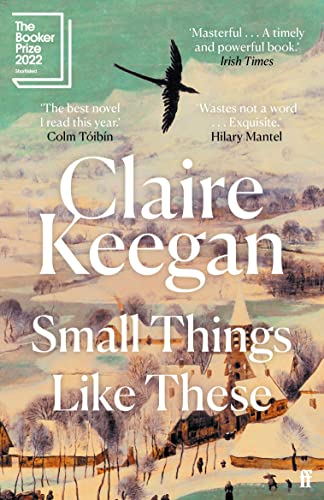
Claire Keegan’s Small Things Like These

Claire Keegan, Small Things Like These (Faber & Faber 2021)

I first became aware of Claire Keegan through The Quiet Girl (An Cailín Ciúin), an Irish-language film based on her short story ‘Foster’. I saw the film at the 2022 Sydney Film Festival, and was blown away by its portrayal of a small girl’s escape from a terrible situation. The final moment, which I won’t describe because of spoilerphobia except to say that a single, ambiguous word is spoken, is one of the most powerfully moving I’ve seen. The acting (especially Catherine Clinch as the girl), the cinematography (Kate McCullough), the direction (Colm Bairéad) and the script (by Colm Bairéad, closely following Claire Keegan’s prose) are all brilliant. I still haven’t read ‘Foster’ but I was delighted to be given Small Things Like These on Father’s Day.

It’s a tiny book – just 117 pages. It’s set in a small Irish village. Its action takes place over a few days in late December in the time not so long ago when the Catholic Church dominated the lives of most Irish people. Bill Furlong, the coal and timber merchant, is being run off his feet in the pre-Christmas rush. The son of an unmarried woman, he and his mother were able to thrive in spite of the stigma thanks to the patronage of a wealthy Protestant woman – a situation that has uncanny echoes in the Thrity Umrigar books The Space Between Us (which I’m currently reading) and The Secrets Between Us (my blog post here). He is devoted to his wife and five daughters.

A shadow is cast over this benign scene by two pages that precede the beginning of the text proper. First there is the dedication: ‘to the women and children who suffered time in Ireland’s mother and baby homes and Magdalen laundries’. Then, on a page to itself, there is an excerpt from The Proclamation of the Irish Republic, 1916, which declares that the republic resolves, among other things, to cherish ‘all of the children of the nation equally’. Having a rough knowledge of the Magdalen laundries (Wikipedia entry here if you need to look it up), I was prepared for a little book of horrors.

Claire Keegan is a finer writer than that. There is horror, but not the jump-scare, demon-rising-from-the-grave kind, or even the Hanya Yanagihara A Little Life kind. Just outside the village there’s a ‘training school’ for girls of low character and an associated laundry, which ‘had a good reputation’. When Bill delivers a load of coal there on Christmas Eve, he comes upon a young woman who is obviously being abused, and he isn’t reassured by the nuns’ attempts to, well, gaslight him. It’s a small village, and the whispers say that no one can challenge the Church. Aware that his own mother could have found herself in the young woman’s situation, Bill faces a dilemma.

So the book hinges on a small chance encounter, a small crisis of conscience for an ordinary man, who many would say is leading a small life. The title can be read as the beginning of a sentence: Small things like these … pose big moral challenges / … can change the way you see the world / … can disrupt oppressive institutions / …

This blog generally looks at page 76. I might have preferred to talk about the page when Bill sits down to a cup of tea with the Mother Superior, or one of the pages where the abused girl talks to him. But page 76, it turns out, illustrates beautifully the way Claire Keegan tells her story.

It occurs at about the three-quarter point. We have been told very little of what’s happening in Bill’s mind. He doesn’t talk about what he has seen. Perhaps he can’t – he’s a working class Irishman of his era. But his wife, Eileen, can tell he’s ‘out of sorts’. The family go to Mass on Christmas morning. Bill stays back near the door when Eileen and their daughters walk down the aisle and slide into a pew, ‘as they’d been taught’. We’re not told if Bill usually stays by the door, or if this is a sign of new alienation. What follows could easily be a simple description of Irish villagers arriving for Mass in a past era (not all that dissimilar to Mass in the North Queensland town where I was a child in the 1950s):

Some women with headscarves were saying the rosary under their breath, their thumbs worrying through the beads. Members of big farming families and business people passed by in wool and tweed, wafts of soap and perfume, striding up to the front and letting down the hinges of the kneelers. Older men slipped in, taking their caps off and making the sign of the cross, deftly, with a finger. A young, freshly married man walked red-faced to sit with his new wife in the middle of the chapel. Gossipers stayed down on the edge of the aisle to get a good gawk, watching for a new jacket or haircut, a limp, anything out of the ordinary. When Doherty the vet passed by with his arm in a sling, there was some elbowing and whispers then more when the postmistress who’d had the triplets passed by wearing a green, velvet hat. Small children were given keys to play with, to amuse themselves, and soothers. A baby was taken out, sobbing in heaves, struggling to get loose from his mother’s hold.

This may feel like an exercise in nostalgia. But it’s not like, for example, the moment in Robert Dessaix’s Arabesques where he ‘realises’ that the lives of simple Portuguese women at Mass ‘had been redeemed, not by understanding, not by seeing Truth face to Face, but by being gathered up into the Church’ (my blog post here). Neither Bill Furlong not Claire Keegan, observing this gathering, projects visions of redemption onto it. This is an insider’s view. We are told people’s names. We can guess why the freshly-married man is red-faced, we recognise that different people make the sign of the cross differently (I love ‘deftly, with a finger’), there are class differences, children and babies need to be dealt with. It’s a picture of a community coming together that anyone of a certain age with an Irish-influenced Catholic childhood will recognise.

But it’s a critical insider’s view. Bill has a fresh distance because of his moral dilemma, Claire and the reader have perspective created by the seismic shifts in Irish culture since the time of the novel. This is a picture of a surveillance state, benign enough you’d think, but any small divergence from the normal – a sling, a new hat – is noted. It’s characteristic of Keegan’s writing that none of the divergences noted by the gossipers has any moral weight attached to it – we’re left to imagine for ourselves how that would go. We haven’t been told in so many words (this isn’t a Hollywood movie, after all) that Bill is mulling over what to do or not do, but as he looks over this scene, we feel with him the coercive pressure to conform, to accept the authority of the Church, not to rock the boat. The baby, ‘sobbing in heaves’, has to be removed – his mother’s hold is unescapable. Small things like these accumulate so that we understand the pressure Bill faces.

The whole book is a marvel.

Thrity Umrigar’s Secrets Between Us and the Book Club

For years, I’ve been part of a Book Club where no one can spend more than 30 seconds talking about any book. We would eat, return books borrowed at previous meetings, each offer three books which we describe and score out of 10, then – in an order determined by a card draw – borrow up to three books each.

Over time, as most of the Club’s six members made the move to electronic books, the original idea of lending books we had enjoyed got muddied. We struggled on, meeting less frequently, two thirds of us buying books specifically so as to offer them at the Book Club.

At last we bit the bullet and agreed to try all reading the same book and discussing it. Our first title is:

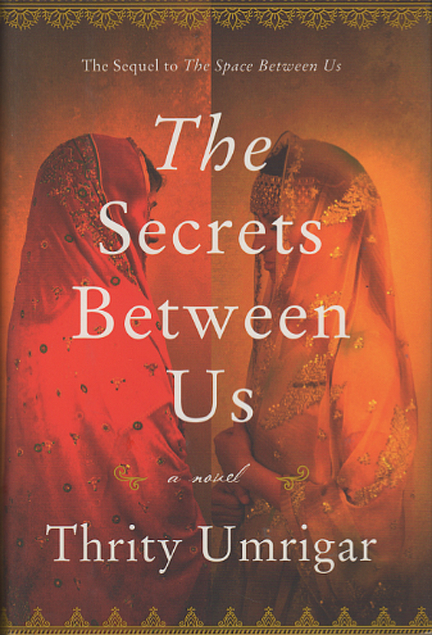
Thrity Umrigar, The Secrets Between Us (HarperCollins 2018)

Thrity Umrigar emigrated from India to the USA when she was 21 years old. Since then, among other things, she has written a number of novels in English. The Secrets Between Us revisits characters from her second novel, The Space Between Us, which was published 12 years earlier, in 2006. I’m writing this without having read more than a couple of pages of the earlier novel (I managed to get hold of a copy, but it arrived too late for the meeting). Though the second novel makes frequent reference to events from the first, I didn’t feel I was missing anything.

Before the meeting: Other demands on my time mean that this has to be brief.

It’s a terrific novel set mainly in the slums of Mumbai, featuring a brilliant gallery of women characters. It begins with Bhima, who is living with her granddaughter in a hovel in the slums. For many years she was employed in a Parsi household, virtually a member of the family, but expelled when she, correctly and necessarily, accused one of the family members of wrongdoing. She has been abandoned by her husband, and her daughter and son-in-law have died of AIDS. She makes a precarious living and enables her granddaughter to attend college by finding domestic work with a number of wealthy women.

In the course of the novel, Bhima’s life is transformed by two unlikely friendships. One is with Parvati, a woman who is even poorer than she is, who was sold into prostitution as a girl but now, as an old woman, is hideously disfigured by a growth under her chin and survives by buying and selling half a dozen shrivelled heads of cauliflower each day and sleeping on a mat outside a nephew’s apartment door, for which she pays rent. The other is with Chitra, a young Australian woman, the lover of one of Bhima’s employers, who was born in India but cheerfully disregards the rigid requirements class, caste and heteronormativity.

At the risk of reducing the book to a single paragraph, the significance of the title is spelled out in an exchange between Bhima and Pavarti. Bhima was initially shocked when she realised that Chitra and her lover aren’t just good friends, but as she comes to know them and appreciate Chitra’s generosity of spirit, she is then shocked when neighbours call them ‘a very bad name’. Here’s a quote from the conversation that happens after Bhima learns about Parvati’s background as a sexual slave, and meets her former employer who tells her how she suffers from lying about Bhima’s revelations. The lump that’s mentioned is the unsightly growth under Parvati’s chin:

‘Why do we aIl walk around like this, hiding from one another?’
Parvati’s thumb circles the lump in a fast motion as she ponders the question. ‘It isn’t the words we speak that make us who we are. Or even the deeds we do. It is the secrets buried in our hearts.’ She looks sharply at Bhima. ‘People think that the ocean is made up of waves and things that float on top. But they forget – the ocean is also what lies at the bottom, all the broken things stuck in the sand. That, too, is the ocean.’

(page 243)

The book’s story could be seen as a process of bringing those broken things to the light, and at least sometimes making them whole again.

After the meeting: We were a bit tentative about the Book Club’s new MO. We ate a pleasant dinner first, with barely a mention of the book until we moved to comfortable chairs. Conversation started out a little stiffly. Someone actually read out the questions for book groups at the back of her e-book, but we realised we absolutely didn’t want to go down that route.

The main question that got tossed around was how seriously to take the pair of books. The second book (which is the one I’ve read) has some extremely improbable benign elements, including – spoiler alert – a happy ending which may be the set-up for a third book, or not. The relative ease with which characters transcend the rigid barriers of class and custom, one person felt strongly, moves the book into the genre of fantasy, or perhaps mark it as prettified for the US mass market.

Not everyone agreed. Sure, things happen that are extremely unlikely, but they are within the realms of possibility, and the good fortune of the main characters allows the situation from which they (or at least some of them) escape to be seen more clearly by contrast. There’s no pretence, for example, that Lesbians are universally embraced by Hindu society, or that there is any kind of safety net for the poor.

Whether it’s an airport novel or a serious work of art, we all enjoyed it. All except me had read and enjoyed both books. I’m now well under way with the first one, and it’s a curious experience reading some of the harsh judgements expressed in its opening scenes, knowing that they’re based on wrong assumptions.

We agreed to carry on as a Book Discussion Club.