Winter reads 1: Angie Contini’s fierCe

I’m away from home for two weeks to escape the worst of Sydney’s winter, and have brought a number of physically small books with me. I’ll blog briefly about each of them, focusing as usual on page 76. Here’s the first.

Angie Contini, fierCe (Flying Island Books, Pocket Poets Series 20023)

fierCe is part of Flying Islands’ series of more than 90 hand-sized books of poetry. It’s a striking little book – its poems are accompanied on almost every page by exuberant collages.

The collaged images come mostly from the vegetable kingdom and from classic and Renaissance art. I recognise, for example, the ancient Greek statue of Laocoön wrestling the snake, some Hieronymus Bosch, some Botticelli. The overall effect is of decorative tumult, with plenty of naked bodies and flourishing mushrooms, as in the cover (to the left), which sadly is the only one in colour.

The poems are also tumultuous, but here the nakedness is emotional, evoking what a note on the inside front cover calls eco-despair, plunging into dark places and, in the final sections, emerging from them. The four sections are: ‘eCo-propheCieS’, ‘dISencHantMEnt’, ‘rEsiliEnce’, ‘timE’, ‘Re-enChantmeNt’ and ‘tranSformations’. (The unorthodox use of capitals is restricted to these headings and the book’s title. As far as I can tell, it’s arbitrary, a generally unsettling device, perhaps echoing the tumult of the collages.)

There are many wonderful things in the book, especially the poem ’body’ in the final section, which looks back at the ‘rabid waltz’ of an eating disorder.

My plan to focus on page 76 hit an obstacle: the page is blank. Page 77 is also blank, except for the word ‘Re-enChantmeNt’, the title of the fifth, second-last section. So, on to page 78.

Beneath a row of what I take to be dancers on an ancient Greek frieze, there’s this small poem:

old soul
come with your wind 
into this wake
wearing thistles and gauze 
make me a feeler again

The poem is a turning point in the book. Having emerged from ‘the bleakness of ‘timE’, we pivot towards ‘Re-enChantmeNt’, that is, a recovery of magic and meaning. This poem is an invocation opening the section. It could almost be a response to the old Anglican hymn:

Breathe on me, breath of God,
fill me with life anew.

Both hymn and poem use the metaphor of wind/breath for inspiration. But where the hymn addresses the Christian God and asks for new life, drawing on the scriptural sense of new life in the spirit, the poem has to define, or at least suggest, the object and purpose of its invocation.

I take the ‘old soul’ to be a kind of Jungian Self, one’s deeply unified humanity, transcending the circumstances and accidents of time and place. It manifests here ‘wearing thistles and gauze’. Once I got past the image of James Thurber’s ‘I come from haunts of coot and hern‘ cartoon thrown up by my recalcitrant mind, I realised that this line brings into focus the relationship between the book’s images and words. ‘Gauze’ signifies the clothes of the classic dancing figures, and ‘thistles’ stand in for the natural world, not always comfortable but sometimes beautiful: so the line, and the images, suggest a reaching for stability in nature and in the long history of art. [Added later: I asked a couple of friends who hadn’t read the book, or this poem, what the phrase ‘thistles and gauze’ suggested to them: thistles, they said, are likely to sting, and gauze can be used as a bandage. Fair enough, I thought, the old soul is aligned with nature that can both hurt and help recover. That works too.]

There are two more words that stand out: wake and feeler.

Without the context of the book as a whole, wake is open to two meanings. It could place the poet in the disturbed aftermath of something, metaphorically the passage of a large vessel. Or the poet could be about to sing at an event held after a death. In context, the latter feels more likely: there have been poems of depression and anxiety, of despair: this word powerfully suggests that those states have led to a kind of death.

Re-enchantment is to be a kind of resurrection: ‘Make me a feeler again.’ I love that line. It reminds me of the wonderful lines from George Herbert’s ‘The Flower‘:

After so many deaths I live and write;
         I once more smell the dew and rain,
And relish versing.  

Angie Contini is calling on her old soul to restore her to that condition. The opposite of despair isn’t hope, but feelingness, aliveness. On a day when the premier of New South Wales has announced that measures to reduce this state’s emissions won’t work, when we’re told that the Gulf Stream may be about to fail, and the Antarctic ice has failed to regenerate this winter, the temptation to go numb is strong – this little poem is timely as a reminder of the emotional work that needs to be done.


I’m grateful to Flying Islands Books for my copy of fierCe.

Journal Catch-up 20

My current practice of focusing on page 76 when blogging about books serves me well when the subject is journals. It helps to resist the pull to go on at tedious length about the whole contents.


Alexandra Christie (editor), Heat Series 3 Nº 8 (Giramondo 2023)

This is a fabulous issue of Heat. A clutch of ‘animal poems’ by Judith Beveridge would have justified the cost of the magazine. ‘Mourning a Breast’ by the late Hong Kong writer Xi Xi, translated by Jennifer Feeley, is an excerpt from a yet-to-be-published novel that includes, among other things, a gruelling account of breast surgery and some fascinating reflections on different Chinese and English translations of Madame Bovary. Send Me a Sign? is a charming essay on Henry Handel Richardson and spiritualism by Cameron Hurst (this one can be read on the Heat website).

Page 76 occurs in the short story ‘Shopping’ by Katerina Gibson, whose collection, Women I Know, won the Christina Stead prize this year. Like Xi Xi’s narrator, the protagonist of this story is interested in translation. She works at a writers’ centre where she is in love with her boss. The story is like an elegant tapestry of twenty-something lostness and finding a way: her work; her relationships, both those at work and her initially unromantic sex life; her compulsive overspending on clothes and her general angst/anomie. I loved it, especially for a key turning point where she reveals her compulsion to a friend and instead of running a mile he laughs and says, ‘But you don’t seem crazy at all.’ (Sorry for the spoiler!)

This seems an appropriate place to mention Giramondo’s promising new online initiative, Re:Heat. It’s a bi-monthly newsletter in which a current contributor to Heat Series 3 encounters an item from the archives. The first of the newsletters features an article by Josephine Rowe on ‘Alive in Ant and Bee’ by Gillian Mears, which was published in Series 2 Number 13, in 2007. You can read Gillian Mears’ piece here, and Josephine Rowe’s response here.


Evelyn Araluen and Jonathan Dunk (editors), Overland 250 (Summer 2022)
(Some of the content – less than in the past – is online at the revamped Overland website, and I’ve included links)

Great editors think alike. Overland is also launching a series in which current writers respond to items from the archives, in their case as part of the print journal. Jordana Silverstein kicks it off with a response to a 1988 story by Lily Brett, which is republished in the journal. Neither piece in online yet, but both are interesting.

At the other end of a readability spectrum is the issue’s first article, ‘Structures don’t go out onto the streets? Notes on John Tranter’s radical pastiche‘ by Louis Armand, which must be the ultimate in poetry insider talk, making no concessions to readers who don’t know their Jacques Lacan from their Ern Malley. Definitely for the spectacularly well read.

Other articles are more accessible and, to me at least, infinitely more interesting: Dallas Rogers on early colonial maps as instruments of colonialism, Jeff Sparrow on elite capture of identity politics, Fiannuala Morgan on colonial literature and bushfires are all worth reading. That’s all before we get to the poetry and fiction sections.

The twelve pages of poetry include the runners-up in the 2022 Judith Wright Poetry Prize (the winner was published in the previous issue). Of these, ‘Camperdown grief junk’ by Wiradjuri poet Yeena Kirkbright spoke most to me in its tour of the Camperdown Cemetery, so beloved of poets. Cameron Lowe’s prose poem ‘Ribbons’ ten pages later also spoke to me. Having just gone on about line breaks in a recent post, I found this phrase just a little squirm-making:

in the rear view mirror there were the back slappers, as usual, jerking off over line breaks.

I’ve been told.

There are 23 pages of fiction, ranging from grim to dystopian, all interesting. The story beginning on page 76, ‘Song and dance’ by Sik Chuan Pua is at the grim end of the spectrum, taking us inside the mind of Clara O’Brien, once a celebrated pianist who is now struggling with physical and mental incoherence in an institution of some kind. Right from the start, the story deftly maintains a double perspective: what Clara sees and what the reader understands in play with each other. It’s no spoiler to say that the story builds towards the word ‘Parkinson’s’. That condition, or something close to it, is there in the first non-bold sentence of this:

She was forty-seven when it began
Her head is locked towards the timber casement windows. Beyond the glass, a lake spreads out. A breeze rattles the shutters. It could be morning. Or late afternoon.
Look, a mysterious orange hue appears. What a hoax, for lakes should be blue as ink. Someone has been up to mischief. Someone has dumped such obnoxious colour, contaminating the lake, transforming beauty into farce. Will someone please restore the lake to its natural colour?

This is Overland‘s 250th issue. Long may it thrive.

Anthony Joseph’s Sonnets for Albert: page 76

Anthony Joseph, Sonnets for Albert (Bloomsbury Poetry 2022)

I bought a copy of Sonnets for Albert after hearing Anthony Joseph’s brilliant chat with Felicity Plunkett at the Sydney Writers’ Festival earlier this year. The Albert of the title is the poet’s father who was mostly an absence during his childhood in Trinidad, where he was raised by Albert’s mother, who loved both of them. My blog post (here) on the Festival conversation gives some of the detail – and also some of Joseph’s interesting observations about the sonnet form and the relationship of Caribbean writers to the English language.

Almost every poem in the book is a sonnet. They don’t constitute a biography in verse, but skip about chronologically, from a childhood memory, to Albert’s final illness and death, to his period in New York City as a reverend. Some have a rich Caribbean music to them. Others are in effect prose poems, though they preserve the sonnet’s 14 lines with a turn in the middle.

It’s a terrific book. Albert emerges as a fascinating, charming rogue. The poet’s complex feelings for him, including deep affection, and grief at his death, are alive and contagious on the page.

Anthony Joseph lives in the UK, and the book is shot through with the expat’s love of his homeland. When I heard that he was from Trinidad, I mentally adjusted that to the nation’s name, Trinidad and Tobago. But the poems themselves are clear: he comes from Trinidad; Tobago is a different island and to have one’s father live there is to have an absent father.

Page 76 is ‘P.O.S.G.H. I’, the first of two poems whose titles are the initials of the Port of Spain General Hospital (so it’s not just Sydney people who refer to hospitals by their initials – I live in walking distance of R.P.A.H.):

Shakespeare or Petrarch might not have recognised this as a sonnet. There’s no rhyme scheme, no formal metre, not even an obvious division into eight- and six-line sections. But it has its own music, which becomes clear if you read it aloud: in the first couple of lines, for instance, the echoing sounds in ‘hope to hold’ and ‘flirts with the nurses’ demand to be read slowly and liltingly. And the effect of the long lines becomes clearer when you read this poem alongside ‘P. O. S. G. H. II’ on the facing page. I won’t push the publisher’s tolerance by quoting that poem as well, but it deals with a later, more ominous hospital experience with Albert (called ‘the big man’ in both poems) and is made up of short lines, with dialogue, and a suggestion of Creole – ‘He eat up all the joy’.

There’s a leisurely, reflective feel to this poem, and emotive suggestions emanate from its long lines like smoke. A whole web of family relationships is evoked.

It begins with Albert:

Having caught his first heart attack, the big man 
gives me hope to hold, says he feels good enough to leave.
He flirts with the nurses. He is in hospital, on Charlotte Street,

A lot is conveyed and suggested in that first line. That it was his first heart attack means that others were to follow, and though heart attacks aren’t contagious, the word ‘caught’ suggests that this one made ‘the big man’ vulnerable to more. As the sentence continues over the line break, the second line pulls back from these grim implications: there’s hope.

When my own father – a very different man from Albert – was close to death, a nurse came each day to wash him and make him comfortable. He too flirted – he joked about the lengths he’d had to go to to have a beautiful woman scrub his back: it’s a thing between men of a certain age and generation and women who care for them. It may not mean the man has recovered, but it’s a sign that he’s in good spirits. In the context of the rest of the book, we know that for Albert (unlike my father) it’s also a sign that he’s back to his disreputable normal, and there’s a hint that the poet’s relief is mixed with exasperation at the flirtiness. Attention turns away from Albert, to the hospital and the memories it evokes:

the hospital that always smells of burnt milk and disinfectant.
That same hospital of first consciousness, where I visited 
my grandfather after his blackout and sickness - in 1977 - 
after stopping with my grandmother on Gordon Street corner, 
to buy the old bull peanut punch and Mopsy Biscuit.

That ‘always’ tells us a lot. This is a familiar place, as the rest of the poem spells out. ‘First consciousness’ could mean many things – perhaps even birth – but it certainly implies that the hospital has always been part of the poet’s world. In a beautifully compressed way, this line and what follows evoke key points of his family story. ‘My grandfather’ appearing after a line break enacts a kind of swerve away from the present to a moment in the past, to another sick man. It’s implied that his grandfather’s illness had some of the same unstated emotional impact as his father’s current illness, an implication reinforced by the way ‘the old bull’ echoes ‘the big man’.

My web search didn’t tell me anything about Mopsy Biscuit, and peanut punch may be either a popular Guinness-based drink for adults with rumoured aphrodisiac qualities (hmm, ‘the old bull’?), or a children’s drink, depending on where you look. Either way, the memory is essentially benign – the poet was 11 in 1977 and buying treats is what stands out in his memory of that event.

Right on cue at the end of line eight, the sonnet turns. The hospital is not always a place of healing or relatively carefree visits:

The hospital of windows from where I watched blue smoke 
rise from the morgue and turned away from my mother's bed 
to catch my evening flight. Two days later she blinked hard 
into cancerous death.

I try not to use words like enjambment and caesura, but wow, cop the enjambments and caesuras in these lines! That is to say, notice how the sense flows over the line breaks, and breaks sharply in the middle of lines, and how the echoing hard D sounds at the end of the second and third lines intensify those effects.

Another, heavier memory is stirred. The poet is older, visiting from elsewhere (Anthony Joseph moved to the UK in his early 20s). His mother is barely a presence, and when he turns away from her it’s with a bleak premonition of death in the blue smoke. There’s no hope to hold this time, and though both the flight and the death occur midline, they both have a feel of finality.

But the poem continues:

into cancerous death. That same ex-colonial hospital 
by Memorial Park where my father once lifted me onto his shoulders, 
so I could see the carnival pass.

I love the way this poem is so firmly rooted in a place. The word ‘hospital’ rings like a chime – five times in 14 lines. The hospital is precisely situated, on Charlotte Street, opposite the corner of Gordon Street, by Memorial Park, and its architecture and history are evoked in the one word ‘ex-colonial’.

The poem ends with another turn, a kind of equivalent to the couplet that ends a classic sonnet. It’s as if after going on a short tour of the family – grandfather, grandmother, mother – we come back to Albert and can remember him, without the distancing irony of ‘the big man’, as ‘my father’. Loss is prefigured by the first heart attack, but there’s also a loss that happened long ago: the ‘once’ when his father lifted the poet on his shoulders is gone. It’s no coincidence that Memorial Park is mentioned here: this last moment of the poem has an elegiac feel to it. He was alive. He was my father. He lifted me on his shoulders. The carnival is over.

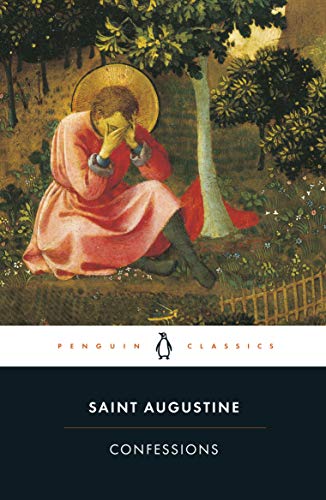
The Confessions of Saint Augustine, first report

Saint Augustine, Confessions (approx 400 CE, translated by R S Pine-Coffin 1961, Penguin Classics edition): pages 1–110, from beginning to end of Book V

If St Augustine invented the literary form of autobiography, he did it by accident. The impression I have so far is that in Confessions he is telling the story of his life as a teaching device. The message seems to be that humans depend on the mercy of God for everything, from mother’s milk to the ability to read. Secondary to that, humans are born sinful. So far at least, quite a lot of his ink is spilled in arguing with the Manichees, and a lot of that argument is pretty opaque to the casual reader, by which I mean me.

Still, it’s quite a thing to spend 10 minutes or so each morning in contact with a mind that was alive nearly two millennia ago. Two moments grabbed me in the very early chapters.

In writing about his early schooling, even while saying he was a wicked child (for wanting to play rather than study!), he argues against against harsh physical punishment as a teaching tool. After saying he hates Greek but likes Latin, he explains that he learned Latin from his mother and nurses, and Greek from his stern school teachers. He generalises:

This clearly shows that we learn better in a free spirit of curiosity than under fear and compulsion.
hinc satis elucet maiorem habere vim ad discenda ista liberam curiositatem quam meticulosam necessitatem.

(1:14)

A little further on, after arguing that the innocence of childhood is a myth, he comes face to face with Jesus’ apparently contradictory view in Matthew’s Gospel, and offers this bit of ingenious argumentation:

It was, then, simply because they are small that you used children to symbolise humility when, as our King, you commended it by saying that the kingdom of heaven belongs to such as these.
humilitatis ergo signum in statura pueritiae, rex noster, probasti, cum aisti: talium est regnum caelorum

(1:19)

If I’m just going to quote the bits that stood out for me from amid the theologising, I can’t go past this wonderful paragraph about friendship:

We could talk and laugh together and exchange small acts of kindness. We could join in the pleasure that books can give. We could be grave or gay together. If we sometimes disagreed, it was without spite, as a man night differ with himself, and the rare occasions of dispute were the very spice to season our usual accord. Each of us had something to learn from the others and something to teach in return. If any were away, we missed them with regret and gladly welcomed them when they came home. Such things as these are heartfelt tokens of affection between friends. They are signs to be read on the face and in the eyes, spoken by the tongue and displayed in countless acts of kindness. They can kindle a blaze to melt our hearts and weld them into one.

(3:2)

I had expected confessions to loose living. So far, the main wickedness he confesses to is his adherence to the Manichean heresy. He does mentions a de facto wife, but when he goes from Carthage to Rome, he doesn’t tell us if she comes with him.

This morning, his career as a teacher of literature has led him to Milan, where he is deeply impressed by the lectures of (Saint) Ambrose. He finally makes a break from the Manichees. He’s impressed by ‘the academics’, but doesn’t throw in his lot with them. Nor does he embrace the Catholic Church (which is R S Pine-Coffin’s translation of catholica ecclesia, and fair enough, though the capital letters may be a bit misleading), but he becomes a catechumen, which I understand to mean he sees himself as under instruction.

To be continued.

Larry Niven’s World out of Time: page 76

Larry Niven, A World out of Time (©1976, Orbit 1977)

It had been a while since I read something that was just good fun, and I turned to my Spec Fic TBR shelf to fill the lack. This yellowing Bookmooched copy of A World out of Time reminded me of the pleasure of Larry Niven’s Ringworld books, of which pretty much the only thing I remember is that I enjoyed them. It practically leapt into my hands.

And now that I’ve read it I don’t have much to say beyond that it is indeed fun. There are whizz-bang planet-shifting fusion engines; there are sex scenes that would barely raise a vicar’s blush these days but were probably titillating for 14-year-old boy readers in 1977; there are chase scenes, theory about the nature of empires, cool improvised weapons, cute mutated animals, scary mind manipulation, and a plot that’s full of unexpected twists. It’s not ‘hard’ science fiction like Kim Stanley Robinson, or weird like China Miéville, or space opera like Star Wars, but it’s got elements of all of them, and it zips along.

It begins, ‘Once there was a dead man.’ People who opted for cryogenics in the 1970s (‘corpsicles’) are revived as slave labour a couple of centuries later; that is, their personalities are harvested and implanted in the bodies of condemned criminals whose brains have been wiped. Our hero, Corbell, is one of the revived corpsicles. The totalitarian government of the future (‘the State’) assigns him the task of piloting a spacecraft on a round mission that is planned to take hundreds, even thousands of years.

The RNA conditioning that enables him to learn his interstellar pilot craft in a matter of days also modifies his brain so he identifies as a servant of the State. But he manages to rebel and takes off instead to visit the black hole at the centre of the galaxy, where he will almost certainly die, again.

I don’t think it’s too much of a spoiler to tell you that, with the reluctant help of his State-loyalist computer Peerssa and the wonders of speed-of-light travel, Corbell survives. My arbitrary policy of focusing on page 76 once again bears fruit, as on that page he has just arrived back on a much-changed Earth not thousands of years but roughly three million years into the future. (Maybe one reason I found the book so refreshing is that though the Earth’s temperature is mostly unbearably hot in that distant future, the global heating didn’t happen in the 21st or even the 24th century and wasn’t brought about by anything as mundane as carbon emissions. Ah, the innocence of 1976 future-imaginings!)

On page 76, while Peerssa is orbiting the Earth in their interstellar spacecraft, Corbell has found what looks like a dwelling in a devastated landscape. It made me think of the house at the end of Antonioni’s 1970 movie Zabriskie Point, except this appears to be a single bedroom looking out over the desert. Corbell tells Peerssa that he can’t find a door, and after they decide that it’s unlikely that the roof is meant to lift off or that the entrance is underground:

‘I’ll have to break in,’ he said.
‘Wait. Might the house be equipped with a burglar alarm? I’m not familiar with the design concepts that govern private dwellings. The State built arcologies.’

I had to look up ‘arcology’. It’s a portmanteau word combining ‘architecture’ and ‘ecology’, meaning, according to my phone dictionary, a city built according to a system of architecture that integrates buildings with the natural environment. Peerssa means something slightly different: the State’s arcologies were integrated ecologies of their own, with little attention to the natural environment. I love a book that makes me learn about such concepts.

‘What if it does have a burglar alarm? I’m wearing a helmet. It’ll block most of the sound.’
‘There might be more than bells. Let me attack the house with my message laser.’
‘Will it–?’ Will it reach? Stupid, it was was designed to reach across tens of light-years. ‘Go ahead.’
‘I have the house in view. Firing.’
Looking down on the triangular roof from his post on the roadway, Corbell saw no beam from the sky; but he saw a spot the size of a manhole cover turn red-hot. A patch of earth below the house stirred uneasily; rested; stirred again. Then a ton or so of hillside rose up and spilled away, and a rusted metal object floated out on a whispering air cushion. It was the size of a dishwasher, with a head: a basketball with an eye in it. The head rolled, and a scarlet beam the thickness of Corbell’s arm pierced the clouds.
‘Peerssa, you’re being attacked.’

Peerssa doesn’t have much trouble repelling the attack, and Corbell gets into the house. Though the washing machine plays no further role, both it and the room’s doorlessness foreshadow the kind of challenges Corbell is to face.

This is now the world out of time of the title: apparently deserted, with faint signs of active energy that are almost certainly just machines that have somehow continued to be active long after their human creators and users have died out. The question I had at this point was: ‘If there are no humans left, and the remaining three quarters of the book is to be a Robinson-Crusoe story, how can it stay interesting; and if there are humans, how can they with any degree of plausibility have survived in the devastation that Earth has become?’ At page 76, the real subject of the book is about to become a little more visible: it takes its time showing itself, and when it does, well, it’s fun.

Saul Griffith’s Wires that Bind

tl;dr: This is a review of a book that argues that a future that isn’t devastated by climate change is possible. If you can’t bear to read one more thing about global heating, you might like to listen to Saul Griffith talk to ABC’s Richard Fidler at this link.

Saul Griffith, The Wires that Bind: Electrification and Community Renewal (Quarterly Essay 89, 2023)
– plus correspondence in Quarterly Essay 90

In the late 1960s at Sydney University, when someone from Engineering took the microphone at an anti-war rally, you could be sure he (they were always men) would speak for the forces of reaction. So there’s a frisson of pleasure for me in reading Saul Griffith’s visionary account of an electrified Australia where fossil fuels are kept in the ground, communities thrive, a new kind of politics has replaced the current toxicity, women’s leadership is acknowledged, and global warming is slowing dramatically. It’s visionary, but suffused with an engineer’s practicality, not to mention a baker’s dozen of complex charts.

If you’re tempted to despair about global heating – and who isn’t? – you’d do well to read this Quarterly Essay. It doesn’t offer blind optimism or hope based only in philosophy, but charts a feasible path to a desired outcome. It covers much of the same ground as the 2021 Quarterly Essay on the same subject, Getting to Zero by Alan Finkel, also an engineer. But where Alan Finkel had been scientific adviser to the Morrison government and seemed, to me at least, to be concerned not to antagonise that do-nothing bunch of deniers, delayers and obfuscators, Saul Griffith comes from playing a role in creating Joe Biden’s Inflation Reduction Act, and is co-founder of community organisations Rewiring America and Rewiring Australia.

In my blog post on Finkel’s essay, I said:

I was heartened to read Finkel’s lucid, careful, methodical argument that the challenge of the climate emergency can be met – with difficulty, but successfully, and without significant sacrifice (‘No trade off, no dichotomy. Prosperity and low emissions.’). I was also uneasy. Surely something has to change as well as our technology. There was a herd of elephants in the room.

Saul Griffith also seems to offer a way forward that doesn’t involve significant sacrifice, but he does address other elephants. Ordinary householders are at the centre of his argument. We don’t have to see ourselves simply as consumers of whatever is on offer from government and profit-driven businesses; if we act together we can become hugely effective agents for change. One simple thing we can do is to decide that, whenever a household item that depends on fossil fuel needs replacing, we opt for something electrical – an induction stovetop, an electric vehicle, heat pump, and so on. And we can see that our electricity comes from renewable sources. His local postcode, 2515, is making great strides as a community to becoming electrified in this way. If we all did this, without significantly pushing the speed of replacement of devices, we would all be electrified by 2040.

He argues that this electrification would result in cheaper energy and cheaper travel – the expense is all in the initial purchase. Government intervention will be needed to make it possible for less wealthy households to make the shift.

There’s a lot more to his argument. I can’t say I followed it all; some of the more technical bits mystified me; and the economic arguments are out of my league. But having had as an article of faith that technical solutions to global heating exist and all that’s needed is the political will, I’m heartened to read solid argument to back up my sometimes tenuous faith.

My current practice of looking at page 76 can give you a glimpse of how the essay works at a granular level.

The page is in the section ‘Planes, Trains and Automobiles’, which deals with transport (or transportation as he says, reminding us of his years in the USA). The section includes some envelope pushing – every parking space to have a solar roof, small electric aeroplanes with a 500-km range using today’s battery technology, etc. It also lays out some basic facts. The use of cars and trucks ‘for moving us and ourselves around’ is currently the second largest source of CO2 emissions. The switch to electric vehicles (EVs) is under way, but it’s not a panacea. Cars need not only to go electric (and run on renewably sourced electricity); they also need to be smaller, lighter and slower in order to reduce the environmental damage they cause, including the damage to roads. Griffin produces some interesting figures comparing the emissions per passenger of our most efficient public transport system – Melbourne trams – and a light EV with two passengers: the EV comes out ahead. But that’s not so with heavy vehicles.

Page 76 is mostly the subsection with the title ‘Tax the tyres’. It begins with hard facts:

Australians use about 50 million litres of petroleum products per day, We spend $35–50 billon per year importing foreign oil. The government collects 49 cents per lire, after the various exemptions that are granted (thereby subsiding fossil fuels and emissions), which amounts to around $14 bilion per year. About half of that goes to road building and transportation projects. Even so, it is not enough to pay for all our roads, and councils have to pay for much of this from their rate base.
Reforming how we pay for roads is a gnarly political problem that I think we must have some honesty about. Low-income people commute further, often in less efficient cars, and often for work. The crux of the political problem is that those who can least afford to pay for transport pay the most, and fuel excise exacerbates that problem.

Then he takes us on a brief excursion into utopian imaginings:

I would like more kids to walk to school on dirt paths through forests breathing clean air and learning about ecosystems as they do so. I’d like to fly electric aircraft more and have fewer ecosystem-damaging roads.

He may have utopian leanings, and it sometimes feels as if Damon Gameau’s delightfully optimistic movie 2040 is playing in the background (he does mention it once), but he comes beck to the practical problem:

But with all that, I am not going to deny that roads are useful and we need good road infrastructure. …
If you study road wear, it turns out that the damage to a road is proportional to the square of the weight of a vehicle. A ute will do about seven times as much damage as a passenger car, mostly because of the extra weight. If you were designing systems to pay for our road infrastructure, it would be most scientifically done by charging by the weight of the vehicle and the number of kilometres it travels.

Which calls attention to what may not be an elephant in the room, but is maybe a thorny devil. How do these necessary changes get paid for? ‘If you were designing … it would be most scientifically done by’ indeed. The next paragraph is in some ways characteristic of the essay as a whole. In his acknowledgements, Griffith says it ‘would not have been written without community’ and lists a number of people on whom he relied ‘to contribute long passages’. In this passage, he present an idea that came from the audience on his book tour:

An audience member came up after a talk and suggested what we should do is tax the tyres, which would have the same effect. Heavier cars doing more kilometres go through more tyres faster. It would be a way of taxing the system that pays for roads, which would push the system to evolve to smaller, lighter vehicles. That would be a good thing.

I hope it’s evident from that little bit that the essay is multifaceted, trying ideas on like an essay in the classical sense of the term, having a bit of fun, and offering insights and proposals that could have a profound impact.


As usual with the Quarterly Essay series, the correspondence in Nº 90 fleshes out the subject beautifully. It was excellent to note the absence of people wanting to deny the science, or others pushing for nuclear power as Peter Dutton is doing in the headlines as I write this.

For just one example, Christine Milne posed a question that had been niggling me:

Can the Earth afford the transition to renewables if it is embedded in the linear business-as-usual, take-make-dispose model of unlimited consumerism and economic growth? There cannot be infinite growth on a finite planet.

Griffith’s response is worth reading. To paraphrase and crudify his argument: to transform the economic system would take too long – you can’t make an omelette without breaking eggs and this omelette is too urgently needed to worry too much about eggshells.

The passage that stands out for me in Griffith’s response to correspondents is this exemplary piece of self-criticism:

Guilty of boostering, addicted to carrots, I have avoided the hard discussion of regulations with teeth. Perhaps my time in the Land of the Free softened me or made me frightened of things that might be conceived as infringing on personal liberty. … To be very clear, it is in the interest of the energy transition to have a phase-out date for all fossil-fuelled machines, and the sooner the better. Governments are scared of the headlines around mandates and bans, but that is what is actually needed, not eventually, but soon.

At the Sydney Writers’ Festival recently, Saul Griffith said that someone described his earlier book Electrify as a brilliant piece of guerrilla policy-writing. The book went on to play a role in developing major climate-change legislation in the USA. I don’t know if it’s all completely practical or if it addresses the social issues adequately or accurately, but the thought that this isn’t just someone having good ideas on the sidelines but solid policy proposals backed up by substantial experience at the community level is surely grounds for hope

Ronnie Scott’s Shirley: page 76

Ronnie Scott, Shirley (Hamish Hamilton 2023)

Ronnie Scott has played an important role in Australian culture over some decades, not least as founder of the literary magazine The Lifted Brow. So it’s only fair that his novels (Shirley is his second) should be reviewed with respect. It’s not that I don’t respect the book, but I’m definitely not part of its intended readership, so I don’t know that anything I have to say will be of much use.

You can read thoughtful and mostly laudatory reviews in the Sydney Morning Herald (Giselle Au-Nhien Nguyen), the Guardian (Bec Kavanaugh), the Newtown Review of Books (Jessica Stewart) and Australian Book Review (Morgan Nunan), to give just a sample.

It’s a novel set firmly in Melbourne, Collingwood to be precise, mostly among people involved in the food industry, with unconventional familial and sexual relationships, as the bushfires of 2019–2020 are coming to an end and Covid-19 is taking hold. The unnamed female narrator (who is not the Shirley of the title – that’s a house) tells the story after Melbourne’s many Covid lockdowns. By about page 20 when the narrator does something of a sexual nature that seems to defy the laws of physics, I was reading without much pleasure. A passing, and to me incomprehensible, mention of people licking themselves, a few pages later left me pretty thoroughly alienated,. Nevertheless, I persisted. There’s a twist at the end that reveals a shape in what until then had seemed to be fairly pointless meanderings. For my taste that was far too little far too late, but my taste is evidently an outlier – see list of laudatory reviews above.

Currently when blogging about books I have a policy of taking a closer look at page 76, chosen for the arbitrary reason that it’s my age. On page 76 of Shirley, the narrator has answered a knock on her apartment door and opened it to her affluent downstairs neighbour Frankie, a ‘famous condiment maven’. After a little chat, she yields to unspoken pressure and invites her in. Then, on this page, the narrator resumes the scrambled tofu she was cooking when Frankie interrupted her, while Frankie asks about it: ‘Wait, what have you put in that? Why does it look so much like curds?’

It was just the Safeway brand of melty ‘mozzarella’, and I’d stolen Meera Sodha’s method of pouring a base of neutral oil, frying off some spices, mixing in the ingredients that had to be actually cooked, and then crushing some silken tofu in my hands – splatting it, really – along with the ‘final’ ingredients that just had to be wilted and warmed; when I’d read that recipe, in East, I’d scrambled tofu before, but somehow I hadn’t realised that the tofu didn’t need to be cooked, that it could be honoured as a soft, pillowy additive.

Today was a bit different, as Frankie had interrupted me just after I’d crushed in the tofu, but I supposed it was fine, as I’d decided on impulse to cook a hash brown in the same pan, and parts of it had broken up as I’d initially over-microwaved it from frozen. Coming back to the pan, I noticed these parts were blackening and sticking, and I chipped them off and incorporated them with a wooden spoon.

There’s quite a bit of vegan cooking in Shirley, mostly with meticulous acknowledgement of the source of the recipes. Meera Sodha’s East, acknowledged here, is subtitled ‘120 Vegetarian and Vegan Recipes from Bangalore to Beijing’.

There’s a school of thought that any passage of a novel needs to do one or preferably all of three things: move the plot forward, deepen our understanding of character, and develop theme or themes.

On first reading, nothing much happens on this page, but revisited when you’ve read the whole book, it astonishingly can be seen to do all three things.

In terms of plot, Frankie’s visit occurs almost exactly at the novel’s one-quarter mark. In conventional movie structure, this would be time for the second turning point, sometimes known as the Change of Plans. Indeed, Frankie’s moving into the narrator’s intimate space marks a major shift: Frankie is actively cultivating the narrator, for reasons that will be revealed much later. No doubt more sensitive readers pick up a weird vibe here that only gets weirder as the pages turn. (I was cleverly seduced into thinking it was all just part of a general weirdness.)

The narrator has already been established as a vegan foodie. This passage reinforces that aspect of her character, shows it in action. We learn more about Frankie too: this is the first time we see her outside of an environment where she is ‘the boss’. Here and on the next couple of pages, we see her as, well, a bit of a manipulator: praising, professing interest in what is after all pretty mundane, offering to help …

As far as thematic development goes, a key strand of the book is the narrator’s relationship with her mother, and her attention to the physical detail of food is in contrast to her celebrity-cook mother’s approach, which is mostly showbiz. Interestingly enough, the narrator silently judges Frankie a couple of pages later as ‘an entrepreneur by temperament but a cook only through opportunity and trade’. That is to say, bit the narrator’s mother and Frankie lack her authenticity around food.

The narrator’s veganism, made concrete here, has an important thematic value. I took it, disparagingly, to be part of the book’s inner-city cool vibe. But it’s more than that. It contrasts to a frequently mentioned photo, unexplained until the last pages, of the narrator’s mother holding a knife and spattered with blood. It’s a key piece of character rooted in plot.

So a lot is happening under the bland surface of page 76. For my taste, here and in the rest of the book, it’s all too far below the surface. Maybe on second reading I’d be alert to the subterranean shifts elements. But I don’t want to reread it. Its cultural terms of reference are largely alien to me. I know anything about vegan cookbooks. I don’t know any of the songs the characters listen to. I barely know West Brunswick from Fitzroy. I’ve never heard of Zachary Quinto. Celebrity cooks aren’t part of my internal pantheon, even ironically. Perhaps most importantly, it’s been a long time since I was dealing with the hopes, despairs and confusions of my 20s.

Your mileage may vary.

Zheng Xiaoqiong’s In the Roar of the Machine: page 76

Zheng Xiaoqiong, In the Roar of the Machine, translated by Eleanor Goodman (Giramondo 2022)

True to the promise implied in its name, the Giramondo Publishing Company invites its readers to travel widely. In the Roar of the Machine takes us into the world of migrant workers in China – that is, the mostly rural poor who have moved to large industrial centres to live and work creating what has been called an enormous floating workforce that, to quote Eleanor Goodman’s introduction, ‘comprises one of the largest human migrations in recorded history’.

Zheng Xiaoqiong, born in 1980 in Sichuan province in western China, moved when she was about twenty to an industrial city in Guangdong province on the south-east coast where she has been a factory worker ever since. Partly for her own mental health, partly to bear witness, she wrote poetry about her experiences, and soon gained a degree of fame – though in China as in most of the world, fame for a poet is a relatively modest affair. She has published a number of books of poetry and essays, and won prestigious literary prizes.

Eleanor Goodman is a poet in her own right and has translated a lot of contemporary Chinese poetry. including Iron Moon: An Anthology of Chinese Workers Poetry (2017), which has been described as ‘a fervent testimony to the horrific, hidden histories of the 21st century’s working-class’. That description could equally apply to In the Roar of the Machines. (You can read a fascinating interview with Eleanor Goodman on the Poetry International website, at this link.)

Two things I think I know about classic Chinese poetry: it often works through a series of images, and it often deals with exile. Both those things are true of this book. In many of the poems, the alienating effect of factory work is conveyed in an accumulation of images. In these lines, chosen more or less at random, from ‘Industrial Zone’, the harsh lights of the factory are contrasted with the moonlight of the mid-autumn festival, and the phrase ‘disk of emptiness’ carries a huge weight of nostalgia for home, family, community:

The fluorescent lights are lit, the buildings are lit, the machines are lit 
exhaustion is lit, the blueprints are lit ...
this is a night on an endless work week, this is the night of the mid-autumn festival
the moon lights up a disk of emptiness

I often struggle with poems in translation from Chinese. Almost every poem in this book grabbed me and held me hard.

There are four sections, each comprising poems from one of Zheng’s books: ‘Huangmaling’ (2006), ‘Poems Scattered on Machines’ (2009), ‘Woman worker’ (2012) and ‘Rose Courtyard’ (2016). A ‘Finale’ contains a single longer poem, ‘In the Hardware Factory’.

The third section, ‘Woman Worker’, is a collection of passionately feminist poems. The poem on page 76 is ‘Hu Zhimin’ (胡志敏), one of its portraits of individual women. (Right click on the image to embiggen.)

It might be worth noting that the poem becomes a lot easier to follow once you realise that, instead of conventional punctuation marks, it signals breaks in meaning or pauses for breath by longer spaces between words and by line breaks.

Hu Zhimin
These days I'm immersed in this enormous era
I'm weak, powerless __ smothering a vigorous life 
in vast denial and ignorance

This sets the tone, leading us to expect a story that will expand on what it is about the ‘enormous era’ that makes the poet weak and powerless. We’re invited to expect her ‘vast denial and ignorance’ to be contradicted in what follows.

It’s nerdy of me, but because every translation is at best an attempt (or so my high-school Latin teacher used to say), I like to compare different translations. I found Zhou Xiaojing’s version of this poem on the Poetry International website (link here). I won’t do an extended comparison of the two – except to say that I think Goodman’s generally has a better feel for what works in English – but here’s Zhou’s version of the opening lines:

These years I am immersed in an immense era
feeling weak and frail     allowing youthful life to be
covered by gloomy negations and ignorance

I prefer Goodman’s first line and a half, as Zhou’s ‘immersed’ / ‘immense’ echo falls pretty flat. But I stumbled over Goodman’s ‘vigorous’ – how can a life be both vigorous and smothered? – and I had trouble with the literal meaning that the poet was smothering her own life. Zhou’s ‘youthful’ resolves my momentary confusion, and the poet is no longer actively stifling herself but allowing herself to be covered/smothered by external forces. Of course, ‘vast denial’ beats ‘gloomy negations’ hands down, though they do mean different things, and ‘gloomy negations’ may be more accurate.

I’m guessing that anyone who understands Chinese would know from the poem’s title that it is about a particular woman. She now makes her entrance:

her death brought the era's wounds with it 
along with men wrangling for compensation 
her brothers and parents _ her corpse ignored 
no one grieved _ no one wept
just the icy numbers of compensation to keep her company
Hu Zhimin: twenty-three years old _ dead from alcohol poisoning

That’s the skeleton of the story, arriving at last at the woman’s name. But what are these ‘icy numbers of compensation’ that displace grieving and weeping? Having raised that question, the poem holds off answering it until the final lines. For now, it continues its broad movement from the general to the specific:

I have a clear memory of her
my one-time colleague _ who was reduced to a hotel
prostitute _ her innocent smile _ loud talk
worldly experience _ she told me she'd seen
too much of the so-called truth of life _ standing
in the doorway to reality _ such as desire and flesh
she wasn't too shy to discuss her profession
and her plans for life _ in her town there were many
young women who took up the ancient profession
young newlyweds _ sisters _ sisters-in-law
going in together _ to Nanjing _ or down to Guangdong
in hair salons _ gloomy buildings _ she was quite pretty
in hotels _ fancy places _ a happy expression
on her face

So much is conveyed in by piling on these images. This is personal: Hu Zhimin had worked in the factory with Zheng. We have glimpses of her at work as a sex worker: ‘innocent smile’, ‘quite pretty’, ‘a happy expression on her face’. There’s a hint of shame in ‘she was reduced’, but at the same time, Hu Zhimin didn’t try to hide what she was doing and the poem opens out to show us the ‘many young women’ have taken the same course. Their reasons for doing so aren’t named, and I suppose the poem allows the reading that these women took up sex work as an embrace of ‘desire and flesh’ or as a way of earning an income like any other, but I think it’s implied that harsh economic reality was their motivation, and there was an element of degradation in the work.

Then, back to the personal connection:

on her face _ we rarely met _ we had
the same background _ belonging to two
different worlds _ this city _ this moment
two people meeting and parting in life's arbitrariness
each hurrying off in her own direction

Both women came from small towns and migrated to ‘this city’ at ‘this moment’, but one of them left factory work for sex work, the other found a way to poetry. It’s a ‘there but for fortune’ moment.

I found the next words problematic:

and was fate somehow changed

Zhou Xiaojing’s translation came in handy for me:

not knowing what fate would bring

In Goodman’s translation, the line could be a question – did some mysterious force change their respective fates – but it’s hard to tell what’s actually being said. Zhou’s version is clearer: we are still with the two young women at the moment of parting ways, each ‘hurrying off in her own direction’ (or in Zhou, ‘each going her own way in a hurry’), and these words throw forward to the announcement at the end of the line, ‘she’s dead!’ Maybe Goodman’s opaqueness is more accurate than Zhou’s clarity, but I’m happy with the clearer version.

and was fate somehow changed _ 'she's dead!'
a man from her village told me _ then described
how she died _ he said she sent so much money home
said her family home was expensive _ her own brothers used 
her body to make money _ to buy a house in the village and open a shop 
he said after she died _ her brothers didn't even come
to bring her ashes home _ she couldn't be buried in her family plot 
she had sold her body _ she was dirty _ she'd ruin the fengshui of the family home 

That’s the real tragedy. There’s no need to repeat that she died young of alcohol poisoning. Now we learn that her sex work was a means to create prosperity for her family back in the village. Though here it names only her brothers, we remember that the opening lines names the parents as well. They ‘used / her body to make money.’ But now that same body is treated as unclean, and left without the proper treatment of the dead.

We’re left with the image of a family home carefully ordered to be in harmony with the universe, but we know that this order has been achieved by the cruel exploitation of a family member that led to her early death. We’re thrown back to the opening line, ‘These days I’m immersed in this enormous era’. Hu Zhimin’s story sends ripples outward: the family home’s fengshui is corrupted by their callousness, the prosperity of China as a whole is built on suffering like hers, and – wider still – capitalism as a system destroys lives.

All that, and yet there’s an immediacy to the poem – we feel the pain of the poet’s loss and her indignation on her friend’s behalf.

Beginning the Confessions of Saint Augustine

I’ve become attached to the practice of reading a few pages of a classic text first thing in the morning. À la recherche du temps perdu kept me busy for nearly two years. The Iliad and The Prelude followed. Then Middlemarch, which I finished a couple of weeks ago. Now that I’ve stopped missing Dorothea, Will, Celia, Lydgate and even Rosamond, it’s time to move on to my next morning project.

Over the protests of the Emerging Artist, who has barely tolerated my occasional morning chat about Middlemarch (I say occasional; she says far too frequent), I’ve decided to tackle St Augustine’s Confessions next. I hereby resolve to keep any enthusiasms to myself, or at least not inflict them on my nearest and dearest.

This is a book that has been around in my life for a very long time, but it hasn’t occurred to me until now to actually read it. Good Counsel College in Innisfail – which I attended aged 9 to 13 – had the Latin motto, Tolle lege, which translates as ‘Take up and read’. Regardless of what personal meaning it might have had to students – it has pretty much become my life’s motto – we were told that the phrase came from a moment in the life of Saint Augustine: when he was living a dissolute life in the fleshpots of Egypt he heard an angelic voice telling him to pick up and read a book he saw lying on a window ledge. The book was a Christian Bible, and the text that he read in obedience to the voice turned his life around. I guess I’m about to find out if that story comes from the Confessions, and if it does, how much of my childhood recollection is true to what the man himself wrote.

I’ve garnered other bits of information about Augustine and this book over the years. That’s one of the things that makes a book a classic: you don’t have to have read it to know a thing or two about it.

I feel as if I’ve always known that Augustine lived a debauched pagan life while his Christian mother wept and prayed for his conversion. His prayer is famous: ‘Lord, make me virtuous, but not yet.’

At one stage of my life his injunction, ‘Ama et fac quod vis’ (‘Love and do what you will’) was a welcome antidote to the rule-bound Catholicism of my childhood.

Augustine invented the concept of original sin, the blight of many young Catholic lives – though James Carroll, in Constantine’s Sword, an excellent book about anti-semitiism in the Catholic Church, argues that for Augustine the concept was about embracing human imperfection rather than condemning us as innately evil.

I’e bought a copy of the Penguin Classics edition, translated in 1961 by the wonderfully-named R S Pine-Coffin, and I’ve found a Latin text on line in case I decide to be linguistically adventurous. I’ll report back in a month …

Benjamin Gilmour’s Paramédico: page 76

Here’s another post where I talk about a book with a focus on page 76 – chosen because it happens to be my age., but also because I remember someone saying that flicking to a page in the 70s (they may have suggested page 73) was a good way of checking out a book before buying

Benjamin Gilmour, Paramédico: Around the World by Ambulance (Pier 9, 2011)

If you were to judge Paramédico by its bullet-punctured, blood-spattered cover with its photo of an ambulance nosing through an impossibly dense crowd, you wouldn’t be wildly off the mark. To write the book, Benjamin Gilmour spent a number of years’ annual holidays from the NSW ambulance service working in ambulance services all over the world. Gunshot wounds and huge, virtually impenetrable crowds do feature.

But the cover gives no clue to much of the book. Gilmour abandons his holiday plans in Thailand to help treat survivors of a tsunami. He attends elderly people dying in the back streets of Venice. He wakes in fright in outback Australia. In the longest chapter, he explores two different ambulance systems that serve the urban poor of Pakistan. Everywhere he gives vivid accounts of injuries and illnesses the ambulance workers encounter, of the workings of the different systems: some have doctors in the ambulance, for instance, while in others the vehicle exists entirely as a transportation service for the dead as well as the living. It’s a kind of travelogue with a paramedical theme.

The main thing not hinted at by the cover – and as far as I recall not part of Gilmour’s 2012 documentary of the same name – is the book’s intensely personal nature. As paramedic and occasional interviewer of key people, Gilmour is always at the centre of the action. There’s a sense of jeopardy, not just in the proximity to gun violence or the hair-raising races through the streets of London and South African townships with sirens blaring, but in the ways the ambulance staff of various countries let off steam. The book’s comedy brings home the reality that ambulance workers put their bodies on the line: they do it not only in their work, but also in their play. Gilmour has fun mocking his own modesty when expected to sauna naked in Iceland, and plays up his terror of a Mexican initiation ceremony that involves having alcohol poured on his chest and set alight.

On page 76 he’s in Macedonia at the midsummer feast of Saint Nicholas. Even though his crew of four are on duty, they celebrate the feast in the traditional way, visiting a series of friends through the night, joining briefly in a feast at each stop. The page begins soon after they arrive at their first destination, the home of Igor, an ambulance worker on his night off:

Igor puts a strong hand on my shoulder, bangs a small glass down in front of me and fills it from a bottle of crystal-clear rakija inside of which is a miniature wooden ladder, as if inviting me to climb in.
‘Drink! Drink! Drink!’ Igor shouts at me.
Everyone is looking my way, at the foreign guest about to taste their rakija. It is customary in the Balkans to sample a family’s home brew after entering a house and, if one values one’s life, declaring it the best brandy one has ever tasted. Any reservations I have about drinking on shift are subdued by the fact that Sammy [the driver] and nurse Snezhana Spazovska also have a fully laden glass of rakija in their hands, while Dr Aquarius is savouring a mixture of red wine and Coca-Cola known as bamboos.

He drinks, and offers appropriate words of appreciation. The party breaks into approving applause, someone plays the accordion, and then:

Everyone is in fine spirits.
We have been at Igor’s for fifteen minutes when Dr Aquarius – now finishing off her second glass of bamboos – says we should keep rolling. This is not so we can return to our area for work but instead to visit the next home for another round of everything we have just ingested. We get up, offer our thanks and leave.

You get the picture. The visiting and partying continue, Gilmour suffers, and the reader is amused by his bruising journey on a loose stretcher in the back of the speeding ambulance. Then, in one of the moments that makes the book truly memorable, the crew that we just saw carousing is called to the home of a Roma woman who has died. When they arrive on the scene, the dead woman’s sister begins to sing:

Everyone listens intently. Everything is surreal. Quiet grief pours out of each person here. So moving is the sister’s song, my heart is hurting for the woman I never knew. On a card table nearby, tears belonging to Dr Aquarius fall onto the death certificate. She tries her best to dab it dry with her sleeve. In this moment the dead lady is everything and Saint Nicholas is nothing. Nurse Snezhana Spazovska, Dr Aquarius, Sammy the driver; it’s the longest I’ve seen them stay on scene. Never could I imagine that these hardened Macedonian medics on hearing this seemingly endless song would become so sad and – God forbid – weep. Nor could I imagine the gypsies of Shutka would appreciate our presence like they do now, our willingness to stay and listen, to give the most valuable gift a medic can give a patient – the gift of genuine feeling.

(Page 81)

Benjamin Gilmour spoke at the recent Sydney Writers’ Festival. As I mentioned in my blog post about his Curiosity Lecture, I was instrumental in publishing some of his poems when he was a teenager. Since then he has made at least two movies besides Paramédico: Son of a Lion (2007) and Jirga (2018), the latter dealing with a former Australian soldier returning to Afghanistan to submit to the judgment of a tribal court, a jirga. (Here’s a link to the Guardian review, which also describes the conditions in which the film was made, significantly more hair-raising than the adventures in Paramédico).

It’s quite a body of work, one that has involved going to places where most writers and filmmakers fear to tread. Let this be a lesson: if a teenager presents you with a handful of poems with titles like ‘An ode to a snake charmer (from his snake)’, encourage them. You don’t know what might they might do next.