Kit Kelen’s Poor Man’s Coat

Kit Kelen, Poor Man’s Coat: Hardanger Poems (UWAP 2018)

As I think about this book of poetry, the word ‘immersive’ comes to mind.

‘Hardanger’ in the subtitle is not an uncompromisingly hostile state of mind but a place, the Hardanger Fjord in Norway, where Kit Kelen evidently spent some time and, it seems, let the place generate poems in him.

These lines appear on the book’s title page:

the forest is the poor man's coat
keeps off the worst wind's bite

step in – let other worlds elapse
follow the trail of light

They offer an explanation and an invitation. The first line explains the title in what sounds like a folk saying, which in another context could be a lament for the poor man’s exposure to the elements, but here asserts that forest provides protection. We are invited to step into the book, as into a forest, for an alternative to whatever other worlds we inhabit. The book is offered to us as respite. That’s where my sense of immersion comes in: poem after poem offer glimpses of restorative calm, mostly in the Norwegian landscape. It’s the closest thing I’ve found in a book to walking in the bush.

Not that it’s all cosy, and far from humourless. As in ‘sweet’ (page 100):

sit zazen
and you'll draw mosquitoes
from the thinnest air

There are poems about death as well as poems describing the view of the fjord from a mountain top; poems of autumn and winter as well as summer; a lot of rain. The poet spends time in the small town of Ålvik, visits museums in larger centres, and riffs on the gravestones in a local cemetery. There’s often a sense of language not being quite up to capturing the experience of being in nature: sentences trail off, though we usually more or less know how they would have ended; or they miss their opening words. It often feels easy, throwaway, as if the poem just happened, the thought or feeling or spectacle effortlessly caught on the wing. But, of course, that’s the apparent ease of a virtuoso.

Though these are overwhelmingly poems that respond to a place, I found myself brooding on the small section of ekphrastic poems – that is, poems responding to paintings. They raise the interesting question: can you really appreciate such a poem if you haven’t seen the painting it refers to? Like the poems of place, there are three elements present when you read the poem: the words on the page, you the reader, the place or work or even referred to – and the ghost of the poet who put the words together. With poems of place, at least the ones in this book, you don’t need to have been there to appreciate the poem. (Just like you don’t need to have been in love to enjoy Robert Burns’s ‘A Red, Red Rose’.). Take the poem ‘the fjord like laid paper’, whose title doubles as its first line, which begins:

the fjord like laid paper

a ship rules a line
the only thing straight
in all the world turning

If you’ve stood and looked out at the fjord on such a calm day, you will read that differently from someone – like me – who has never been to Norway. For me, it primarily conjures up an image; for you, perhaps, the main thing is the simile/metaphor. Either way, the effect of the poem is to bring a vivid image of the fjord to mind, and I don’t feel any need to fly to Norway in order to understand the poem. (I do feel an impulse to go and see the places for myself, but that’s a different matter.)

When the subject s a painting, though, it’s a bit different. Take ‘Cowshed Courting’ (page 148), which refers to a 1904 painting by Nikolai Astrup that hangs in the Bergen Museum:

If you read this without seeing the painting, you’re left pretty much groping in the dark. I’m grateful that Kelen has named the painting in his title rather than calling the poem something like ‘After Astrup’, and I’m grateful for the internet, because it was no trouble at all to find an image of the painting online.

The opening lines have typical Kit-Kelen syntax:

fin de siècle light they caught then
we still breathe – it's unnatural

A conventional phrasing might be, ‘They caught a fin de siècle light then, which we still breathe, even though it’s unnatural.’ But the syntax serves a purpose: it reflects the process of seeing the painting. You begin with a general impression to do with the quality of the light, which makes you realise that this painting belongs to a particular era (fin de siècle, the end of the 19th century); next you have a sense of the painters of that time – no more specific than ‘they’, because after all this isn’t an art history essay; but having seen it as belonging to its own time, you realise that this painterly light still feels to us as familiar as the air we breathe – familiar but all the same artificial / ‘unnatural’.

The artifice has a purpose, as the viewer’s eye finds the figures on the left, and the brightest spot of colour in the image:

the colour's captured
a passion in the cowshed
rose cheeks and have you in my arms
deep pockets of brandy for inspiration

From the woman’s cheeks, the eyes travel over the figures. The poet projects himself into the image, identifying with the male figure and reading the bottles in his pocket as ‘inspiration’. (A different viewer might see those bottles in a less benign light, but that’s not this poem, or at least not foregrounded here.)

Then we’re taken on a tour:

never mind the pong
someone's peeping from the loft

A vague look to the right of the courting couple – yes, we notice that there are steaming heaps of cow poo all over the floor of the shed. Then we travel clockwise up to the top of the frame, and oh, there’s a creepy voyeur – a peeping tom – unnoticed until now. If the poem was a sonnet, this would be the volta, the turn. A poet less sure of his effects might have inserted a line space here, to mark the discord. But we move on without comment:

no glass but spring shines through the window
past which dung's piled – verdure and ordure

Only now do we come to the geometric focus of the painting, the window through which we can see a dung heap and beyond it some vague greenery. This is the source of that light we first noticed, and there’s an ambivalence to it: dung and greenery, ponginess and light. The assonance (if that’s the word) of ‘verdure and ordure’ reminds us that these things are intimately connected.

Our eyes travel down to rest on the middle of the image – the row of cows’ rear ends, and the unswept floor.

hear it ringing from the rear of each
and the floor steams unswept

Astrup doesn’t show the cows decorating the floor (surely ‘ringing’ is the politest term ever used for the sound of cows shitting), but Kelen gives us an aural equivalent what he shows, just as the earlier ‘pong’ has given us an olfactory one.

In the last line, our eyes travel back to the figures:

days are barefoot now

There’s a sense of completion as the poem finishes its circuit of the painting, from the woman’s cheek to her feet. With characteristic apparent ease, it has introduced a number of pairings: the pong and the ringing; the passion and the peeping; the verdure and ordure; the man fortified with brandy and the woman barefoot and vulnerable; then and now. That last pairing has a lovely complexity to it: in the opening lines, ‘then’ is the time of Astrup and ‘still’ is our time; ‘now’ in the emphatic position as the poem’s last word may refer to the changing seasons implied by the mention of spring in line 9, or it may again be contrasting the time of the painting with modern times when courting doesn’t have to happen in secret in cowsheds, but the whole day – the world outside the window – can be barefoot, open to intimacy.

The poem has made me look closely at the painting, and I may well read it differently from Kelen. In fact, by naming the peeper and then moving on quickly, the poem almost invites an argument. But in Kelen’s reading, or at least in my reading of Kelen’s reading, the painting, and so the poem, celebrate the way love can thrive in unlikely circumstances, and not be tarnished by prurient attention to it. The peeping tom is noticed and then ignored. The dung helps the greenery to grow. The poem gives shelter from ‘winter’s worst bite’. I don’t know that I could have understood any of that from the poem without reading it with the image open beside it.

Having written all that, I really should show you the image as well:

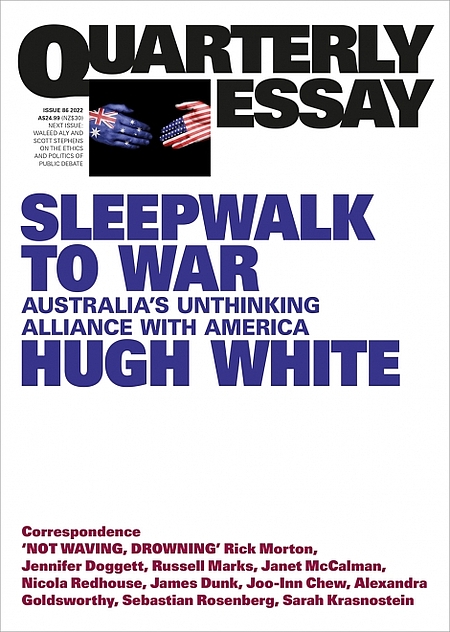
Sarah Krasnostein’s Not Waving, Drowning

Sarah Krasnostein, Not Waving, Drowning: Mental illness and vulnerability in Australia (Quarterly Essay 85, 2022)
– plus correspondence in Quarterly Essay 86

Sarah Krasnostein doesn’t explain the title of this Quarterly Essay. It may be a straightforward inversion of the name of a Melbourne band, but I read it as referring to Stevie Smith’s most famous poem, ‘Not Waving but Drowning’, which begins:

Nobody heard him, the dead man,   
But still he lay moaning:
I was much further out than you thought   
And not waving but drowning.

You can read the whole short poem at this link.

The essay centres around the harrowing stories of three young people whose behaviour no one could have mistaken for cheerful waving, but who received attention from public institutions that left them immeasurably worse off. It’s pretty much a catalogue of horrors, with some glimmering hope to be found in the Victorian government’s commitment to act on the recommendations of the recent Royal Commission into Victoria’s Mental Health System.

Krasnostein avoids defining what she means by mental illness. It’s a bit like what a US supreme court justice said about pornography: ‘I can’t define it but I know it when I see it.’ As well as diagnoses like schizophrenia or – predominantly – various personality disorders, her use of the term comes close to encompassing homelessness, addiction, racism, marginalisation, responses to climate change, and suicide, or even simply vulnerability to the prison and mental health systems. This imprecision may be a feature rather than a bug. The essay is concerned to discuss mental illness from wider perspectives than the purely clinical, and boundaries between it and other forms of oppression are in their nature fluid.

She speaks of the profoundly destructive and destabilising effect of colonisation on the minds of settlers as well as First Nations people. She relies on Erving Goffman’s theory of stigma. She draws on Jung and Freud, and on recent thinking about systems change. She goes into some detail about the interface of criminal law and mental illness diagnoses. And in the middle of it there is the terrible vision of young people’s lives being ruined.

It’s a powerful and timely essay, but I found much of Krasnostein’s argument hard to follow. For example, I didn’t understand the logic by which a diagnosis of borderline personality disorder meant that a person who burned down a lot of buildings wasn’t an arsonist (though I get that punitiveness isn’t a reasonable response). Elsewhere, in an apparent non sequitur, a section begins, ‘I am thinking what it means to remember,’ and goes on to talk about stigmatisation of marginalised groups. Or there’s a beautifully written paragraph about a Trumpian demonstrations in Melbourne that seems to be there because the demo happened while the essay was being written.

More than any other Quarterly Essay, I’m glad of Black Inc’s practice of including correspondence in the following issue. This correspondence helped me understand what the essay was saying.

There are responses from journalists, historians, a psychiatrist, a criminal defence lawyer, and people who have worked in prisons and mental health institutions. Several of them mention their own experience as clients of the mental health system, as Krasnostein does in the essay. Taken as a whole, along with Krasnostein’s generous response, they illuminate the essay beautifully and extend its reach. To finish, here’s a quote from Joo-Inn Chew whose bio tells us she ‘works in general practice and refugee health in Canberra’, that gets to the heart of the essay (I like the way Joo-In Chew writes of wounds, addictions and diagnoses rather than conditions or illnesses):

Behind each wound, each addiction, each diagnosis is a person and a story, and beyond that a web of cultural and economic power which shapes everything, from the start people get in life, to how they express distress and whether they seek help, to how they are treated by front-line services and social institutions. Not everyone knows what it is like to feel safe and free in Australia. Every one of us can take stock of where we are in the web, how we use the power we have and how we recognise the common humanity of people around us. We can normalise our own vulnerabilities and use our power well. I thank Sarah Krasnostein for an essay which invites us to do just that.

(QE 86, Sleepwalk to War, page 123)

Charmian Clift’s Mermaid Singing

Charmian Clift, Mermaid Singing (©1956, in a single volume with Peel Me a Lotus, HarperCollinsPublishers 2001)

According to their standard biographies, Charmian Clift, her husband George Johnston and their children Martin and Shane left London in 1954 to live on the Greek Island of Hydra and write full time.

But between London and Hydra, there was Kalymnos, where they lived for most of a year writing a novel together. The publication of the novel, The Sea and the Stone aka The Sponge Divers, meant they could move to the more hospitable island of Hydra.

Mermaid Singing is Charmian Clift’s account of their time on Kalymnos. Though I’ve read several of George Johnston’s novels and have my eyes on Nadia Wheatley’s selection of Clift’s newspaper columns, Sneaky Little Revolutions (NewSouth 2022), this is the first of her books I have read.

It starts out as a charming, chatty account of a modern Australian family, fresh from expat life in London, arriving on Kalymnos seeking respite from hectic big-city life. They are met with enormous hospitality. The young, blond children are taken to the hearts of the community. Cultural differences are perplexing, and often hilarious to both sides.

Mermaid Singing was published the same year as a book I loved as a child, Gerald Durrell’s My Family and Other Animals, a memoir of Durrell’s time with his family on Corfu in the 1930s. The opening chapters of Mermaid Singing remind me strongly, not so much of that book – which is written from a child’s point of view – as of the TV series The Durrells. Like The Durrells, these opening chapters make rich comedy out of the visitors’ shock at the condition of the house they have rented, and the locals’ only half comprehending attempts to make them welcome and comfortable. The Durrellesque comedy continues with escapades like one involving a ruined toilet, and there’s even a pet rabbit: the locals struggle to grasp that the children’s pet isn’t intended to eventually become food, and their attempts to console the children when it dies made me laugh out loud.

The book moves well beyond comedy. The treatment of the rabbit’s funeral, insisted on by the distraught Martin and Shane, is a good example. It goes from high comedy to this:

By the time we reached the top of the stairs the procession was fifty strong, and all across the mountain slope dark figures were flitting among the scattered houses, converging on us. The children clustered close about Martin and Shane suddenly began to chant softly. Behind us a woman took up the chant and tossed it, shrill and unexpected, down the massed moving line.

The ludicrous reason for the procession was lost and forgotten. We were caught in something else, an old rite the meaning of which had melted in a time lost long ago but the form of which was part of that dim race memory we inherit at our births. That wild cry of lamentation was not for a stiffening rabbit. It was for Tammuz dead, or the springing red flowers where Adonis’ blood was scattered, or a woodland king torn on the sacrificial oak. Straining and stumbling on the loose boulders we toiled up the dusk-wreathed mountain. The chanting rose deep and sad from a hundred throats, and a boy with a torch (or a lantern or a candle or a blazing cypress brand) moved to the head of the line and led us on. High over the noble rock that soars above the town one star hung in the great blue night. I thought perhaps we were climbing to reach it.

(Page 109)

The book moves well past the comedy or the romance of cultural difference. The Johnstons get to know people, and to understand something of the realities of life in that traditional Greek community whose survival depends on the dangerous work of collecting sponges from the sea floor, work that is disappearing as synthetic materials replace sponges in many of their uses. They develop real relationships of mutual respect and affection. The chapters on gender politics – one on the women’s lot, and one on the men’s – are brilliant. For the women, there’s the everyday indignity of being referred to as gorgonas and the appalling toll taken by seemingly endless childbearing. For the men, there are months away at sea each year where ‘their daily lot is danger, hardship, privation’.

It’s basically a travel book, with rich and/or amusing descriptions of landscape and local customs. But it’s more than that. Through it all, George and Charmian are working on their novel, and keep a parental eye on their children. Even for its first readers, part of the appeal must have been in the element of memoir. Nearly 70 years after publication, when we know that George went on to substantial fame with My Brother Jack (1964), that the Johnstons’ time on Hydra has an almost mythic status (as in Nick Broomfield’s 2019 documentary Marianne and Leonard), that Charmian became an enormously popular newspaper columnist, that the charming little boy went on to write brilliant and challenging poetry, and that all their lives were to be touched by tragedy, the book is filled with astonishing light.

A personal note: Martin Johnston and I were born in the same year. I knew him when we were in our 20s, and was in awe of him as a poet. It’s tempting the read the book’s final image as somehow prophetic. The family have been swimming with two of their local friends and helpers. A blue boat with a tan sail arrives and is being hauled to shore by some children. They call to Martin to join them:

He turns his head slowly towards the boat and the other children. Slowly he goes towards them, almost reluctantly, the kelp trailing forgotten from his hand, looking back over his shoulder as he goes, as though he is watching for something … or listening …
[…]
If I stay for a moment, only a moment, perhaps I might hear it too – that one rare mermaid, singing.

(Page 211–212)

Added later (14 July 2022): Fran Munro has pointed out in a comment that Charmian Clift’s biographer Nadia Wheatley recently appeared on Caroline Baum’s Life Sentences podcast, where she talks interestingly about Mermaid Singing and Kalymnos. The relevant part of the conversation, if you’re interested and have limited time, runs from 20’45” to 27’28”.

A tiny footnote on Frank Moorhouse

Frank Moorhouse died last week, after making a huge contribution to Australian literature and to the lives of Australian writers. Many thoughtful and informative pieces have been published. In case you’ve missed them altogether, I’ll just mention Julianne Lamond’s piece in The Conversation and the most recent Monday Musing in the Whispering Gums blog.

What I haven’t seen mentioned in any of the recent articles – or anywhere else, for that matter – is that in the late 1960s, before the publication of his first collection of stories, Futility and Other Animals, he wrote a series of sketches for the student paper Honi Soit under the general title ‘Around the Laundromats’. From memory they featured a big lazy cat, and each piece featured a conversation in a laundromat. Frank lived in what he came to call ‘the Ghetto of Balmain’, but I’m pretty sure some of these encounters happened in the laundromat opposite my flat in Glebe. One of them featured the young woman who was my girlfriend at the time, whom he called ‘the English Student’ or something of the sort.

I wonder if anyone has dug those sketches out, and if they would be worth reprinting, perhaps as a small book.

The Iliad: Progress report 7

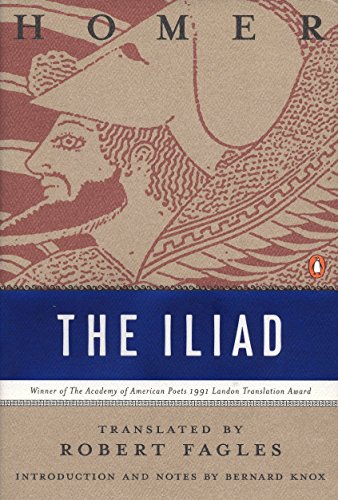
Homer, The Iliad (translated by Robert Fagles, ©1990, Penguin 1998)
Book 17 line 50 to Book 19 line 161

For seven months now I’ve started most days reading two pages – roughly 70 lines – of The Iliad.

Reliably, I come across references to it during the rest of my days, the kind of passing remarks that would otherwise go unnoticed. This month, for instance, in Charmian Clift’s Mermaid Singing (blog post to come), Charmian and her husband George have just discovered the pleasures of seafood on the island of Kalymnos, especially palamethes, ‘a sort of mackerel plentiful off the Anatolian coast, sliced and grilled like steak and served hot with oil and lemon juice or cold with a
thick garlic sauce’. George says something ironic about British seafood, then:

Pass the palamethes, there’s a good girl, and I’ll write you an Iliad!

Last month’s reading ended with Hector killing Achilles’ comrade Patroclus. I was completely unprepared for what a big deal that is. First there’s the struggle over Patroclus’ body. For hundreds of lines the Trojans try to drag it from the field to strip it of the Achilles’ resplendent armour, and also to dishonour the corpse as a kind of trophy. The Greeks, led by Menelaus, fight them off, determined to protect the body of this much-loved comrade. It seems that everyone loved Patroclus. When word is finally sent to Achilles of his death, Achilles’ grief is epic, and he is joined, first by the women who have been given to the two of them as booty, and then by a stream of sea nymphs. We’re left in no doubt that this is no ordinary death.

Thetis, Achilles’ immortal mother, persuades him not to re-enter the battle immediately. She goes to the blacksmith god Hephaestus and asks him to make new armour for her son. Homer takes 150 lines to describe the impossibly complex imagery he embosses on the shield.

And now, in Book 19, Achilles has just addressed the Greeks. He and Agamemnon have come as close as they can to mutual apologies – which isn’t actually very close. Agamemnon in particular blames it all on the goddess Ruin who. after all, has deceived even Zeus. Meanwhile, the Trojans have rejected the wise advice of Polydamas to retreat to within the city walls, and been persuaded by Hector’s heroic posturing to stay near the Greek ships where – we know – they will be vulnerable when Achilles returns to the battle. The end is in sight.

This month’s reading has shown me what all the fuss is about. This piece of millennia-old writing still has tremendous emotional power. I could quote any number of passages, but here’s the moment when Achilles learns of Patroclus’ death (Book 18, lines 25–40):

A black cloud of grief came shrouding over Achilles.
Both hands clawing the ground for soot and filth,
he poured it over his head, fouled his handsome face
and black ashes settled onto his fresh clean war-shirt.
Overpowered in all his power, sprawled in the dust,
Achilles lay there, fallen ...
tearing his hair, defiling it with his own hands.
And the women he and Patroclus carried off as captives
caught the grief in their hearts and keened and wailed,
out of the tents they ran to ring the great Achilles,
all of them beat their breasts with clenched fists,
sank to the ground, each woman's knees gave way.
Antilochus kneeling near, weeping uncontrollably,
clutched Achilles' hands as he wept his proud heart out –
for fear he would slash his throat with an iron blade.

And. really just to illustrate the virtues of the Fagles translation, here’s Alexander Pope’s version of those lines:

A sudden horror shot through all the chief,
And wrapp’d his senses in the cloud of grief;
Cast on the ground, with furious hands he spread
The scorching ashes o’er his graceful head;
His purple garments, and his golden hairs,
Those he deforms with dust, and these he tears;
On the hard soil his groaning breast he threw,
And roll’d and grovell’d, as to earth he grew.
The virgin captives, with disorder’d charms,
(Won by his own, or by Patroclus’ arms)
Rush’d from their tents with cries; and gathering round,
Beat their white breasts, and fainted on the ground:
While Nestor’s son sustains a manlier part,
And mourns the warrior with a warrior’s heart;
Hangs on his arms, amidst his frantic woe,
And oft prevents the meditated blow.

You have to admire the way Pope fixes improprieties related to sex and gender: the captive women are virgins, and Antilochus, Nestor’s son, is far too manly to weep. I had a quick look at other translations. George Chapman (1616) has Antilochus weeping with the women. Richmond Lattimore (1946) has: ‘Antilochos mourned with him, letting the tears fall’. A S Kline (2009) has him ‘weeping and groaning’. For now at least, I’m content to wonder what Caroline Alexander, the Iliad’s first female translator, does with this moment – Amazon are advertising the hardcover for $150+ dollars.

Anyhow, onward …

Honorée Fanonne Jeffers’ Love Songs of W E B Du Bois

Honorée Fanonne Jeffers, The Love Songs of W E B Du Bois (Fourth Estate 2022)

An African-American woman once told me about a research project in which she interviewed Black women in the US who were leaders in a range of fields. Among other things, she asked her subjects what internal obstacles they’d had to overcome to take leadership. Almost every one of them, she told me, had referred unprompted to the legacy of slavery. For someone like me – white, male, middle class, Australian – the US history of slavery was something belonging to the distant past. Not for those women.

The Love Songs of W E B Du Bois, a door-stopper of a novel at nearly 800 pages, has reminded me of that conversation. It tells the story of a young woman, Ailey, who grows up in a small town in Georgia in the second half of the 20th century, goes to a local college and eventually becomes a history scholar. Ailey’s story is inseparable from the stories of her family going back two generations – she is close, for example to her great uncle Root, a fair-skinned African-American who made it in academia when few Black people did; and we follow the tragic loss to addiction of her beloved older sister Lydia.

Then there are the ‘Songs’. These are sections interspersed among the chapters of the 20th century story, in which different, older stories are told in an almost shamanic voice. The Songs begin with the Native Americans who lived in the place where Ailey’s family town was to be built, and take us through the horrors of genocidal dispossession, and then the story of slavery as if unfolded in that place. As you read, you really want to believe that the author is indulging in Hanya Yanagihara–style suffering- spectacular, but this reader at least was convinced that the narratives were grounded in research.

There’s no mystery about the relationship between the narrative threads. They are both connected to the same place in rural Georgia. But when, thanks to Ailey’s historical research, they come together explicitly, the emotional effect is huge. Faulkner’s line, ‘The past is never dead. It’s not even past’ may have become a commonplace, but this book bring is vividly, viscerally home.

I’m not sure why W E B Du Bois is in the title. The great scholar and early advocate of civil rights for African Americans is definitely a presence. Each chapter is prefaced by a quotation from him, and each of the quotations is profoundly insightful about racism in the USA and elsewhere. Uncle Root met the great man in his youth. Characters discuss his writings. But he’s not a character, and I can’t see how the ‘Songs’ can be attributed to him – unless perhaps Honoré Fanonne Jeffers is implying that her own deep immersion in Georgian Black culture and history is due in some large degree to his influence.

It’s a good book to have read when Georgia is again in the news, and not in a good way, when Critical Race Theory is being attacked by legislators who, probably not knowing anything about it, are concerned that it will make white children suffer. This book is a graphic reminder where the much greater suffering has been, and still is. It’s also a riveting read.

Kit Kelen’s Book of Mother

Kit Kelen, Book of Mother (Puncher and Wattmann 2022)

Dementia is becoming a major theme of story-telling in the 21st century. I can think of four excellent movies without even trying, the most recent being Everybody’s Oma, which I’ve seen at the Sydney Film Festival since reading Book of Mother. In poetry, Hawaiian poet Susan M Schultz’s Dementia Blog (2008), among other things, vividly evokes the social life of a dementia ward.

The Book of Mother is a substantial addition to this writing. The back cover blurb describes it well – it reads, in part:

This book is an intimate encounter with dementia as lived experience. Words are an important way into the world and when we begin to lose them we find ourselves with fewer tools and fewer familiar signs to go by. Phrases lost and tip-of-the-tongue half-forgettings – loose threads like these belong to the everyday business of knowing who we are. They are also the nuts and bolts of Kit Kelen’s poetry. A long play record of memory and its tricks, one comes to and from Book of Mother with always some questions about who is talking to whom, about when we are where, about whether we wake or dream.

There are a number of poems about lost keys – emblematic of dementia’s multitude of minor frustrations, for both sufferer and carers/relatives – whose titles are almost enough: ‘the keys are gone again’, ‘no one else has put them anywhere mum’, ‘you have hidden them’.

At least three poems had me in tears. ‘everything will be taken from us’ is a lament that speaks to the grief that accompanies the gradual loss of a loved one to dementia. ‘she’, the longest poem in the book, celebrates the poet’s mother as an individual and as an archetype of all mothers. It begins:

she

who had supernatural powers
who knew what Christmas wanted
what naughtiness was and was not

she who said wait till your father gets home
she who was a step before
could spell every word there was
and we could add things up together

vale mum’, the final poem, is an elegy that includes this wonderful image:

like lost at the Easter show
and a voice comes over the air
says this is how it is from now
your mother – all mother – is gone

For me, the power of the book comes from the cumulative effect of poems where the language feels as if it’s falling apart, in counterpoint to a number of poems in which a very young person’s language is coming together. That is, along with poems that document his mother’s decline, Kelen gives us poems about his own dawning grasp of the world through language as a small child closely connected to his mother. That may sound like an imposed schematic, but it reads as organic: being confronted with the present situation, the mind naturally goes to the past. As a reader, I found the transition between the two kinds of poem disorientating in a way that adds charge to both.

I love this book. If I was to recommend a single poem, it would be ‘everything will be taken from us’. Sadly, it’s too long for me to quote here with a good conscience, and I can’t find it online, but if you happen on the book in a bricks-and-mortar bookshop, turn to page 75, and read this one, aloud if possible. It won’t take long, and it may inspire you to buy the whole book.

Meanwhile, here’s ‘in a waiting room’, a short poem that may give you a sense of the book’s shape-shiftiness:

This poem may take a little puzzling before it yields itself to the reader, but it’s not at heart a puzzle to be solved.

The title and first four lines are clear enough.

to make you happy
for your own good
because we love you
because I can't explain

We are in a waiting room, where someone is responding to a question, something like, ‘Why have you brought me here?’ Read in the context of this book, the lines could be spoken by the carer for a person with dementia or to a child. That is, it could be a poem about the poet’s mother, or one about a childhood memory. Or, perhaps more interestingly, it could be both. Either way, the lines give four different answers to the same question – the questioner, whether it’s a child who is unsatisfied with each successive answer, or the adult with dementia who doesn’t remember the previous answer, keeps on asking.

The next line maintains the ambiguity:

won't remember your hand was held

Anyone who has lived with or cared for someone with dementia will recognise the experience this neatly evokes. No matter how many visitors they’ve had, no matter how much hand-holding, they will still say none ever comes to see them, no one ever holds their hand. But equally the owner of the hand could be a child – in this book, the poet himself in memory – whose adult memory doesn’t include a hand being held. The omission of a pronoun at the start of the line is worth noting. Even though syntactically the line can’t be read other than, ‘[You] won’t remember’, by not giving us the ‘You’, the poem increases the shifting-sands feel.

Though I generally treasure clarity in writing, and see ambiguity as something to be avoided, it’s the double possibilities in these lines that I love. It could be either thing, which means that the two things are similar, which – in this context – suggests that when you relate to a person with dementia, your own hold on reality can begin to shift, or memories may surface of times when you were similarly dependent, confused or failing to understand. The poem takes the reader gently into that border state.

Then, there’s this:

in yellow light
dinosaurs confer
smoke clouds them
or at cards

After a moment’s pause (or, to be truthful, a couple of days), I read this as a description of the waiting room. Perhaps it’s wallpaper, or a painting – of dinosaurs in a cloud of cigarette smoke, playing cards? A google of “dinosaurs playing poker” comes up with plenty of images. It’s not hard to imagine one in a doctor’s waiting room. To repeat myself, though, the pleasure here isn’t in having solved a puzzle or deciphered a cryptic set of words to settle on a clear meaning. It’s in the state of mind before the image is understood. I suppose it’s analogous to the couple of minutes when you savour a weird dream before understanding that it’s just a rehash of something banal that happened the day before. More to the point, it’s like when you have a memory in the form of a striking image, and it takes a while to make sense of it by remembering its context.

here elephants trumpet about
giraffe pokes in a head

The weirdness continues. Perhaps it’s another painting on the wall. This could be a waiting room for either a child or a person with dementia. If a child, these are the details of the waiting room that stand out as interesting, and return as memories when you’re an adult poet. If a person with dementia, they are the disturbing and disorientating features of the environment.

stood by the fire
too close
to beginning

The first two lines here give the reason the person (whose hand may or not have been held) is in the waiting room. They have stood too close to a fire. Then the phrase ‘too close’ does double work, introducing the third line: he stood too close to the fire, and he was also too close to his own beginning, that is to say, too young. And with that line, the poem’s main ambiguity is resolved. This is a childhood memory.

peg in the board where everyone fits
that was my Day at the Zoo

Oh, the elephants and giraffe weren’t in a painting after all. They were part of a board game, Day at the Zoo. This last couplet has an air of finality, like the ending of a child’s composition. Almost smugly, the mystery of the images is cleared up. The memory is reclaimed in full. The ‘your’ becomes ‘my’. Read in the context of the whole book, there’s also a sense of relief: in this case, the weirdness, the things that aren’t understood, have been resolved.

Then you turn to the next poem, ‘forget a thing and it’s gone’, and we’re back to dealing with dementia.

In an earlier version of this blog, I tried to capture things that happened with language with Mollie, who was living with us and with dementia. This extraordinary book does that with wonderful compassion and love, as well as wit, precision and, I guess the word is delight.

Douglas Stuart’s Shuggie Bain

Douglas Stuart, Shuggie Bain (Picador 2020)

This is a Book Group book.

Before the meeting

Shuggie Bain is the story of a boy who grows up in poverty in Glasgow, the youngest of three children. His mother, Agnes, is an alcoholic who is brutally treated by her husband, Shuggie’s father, and then abandoned by him. Once a stunning beauty, she struggles to maintain appearances as she descends into increasingly desperate poverty, alienated from other women and sexually exploited, often violently, by men. From an early age, Shuggie takes on the burden of looking after her, protecting her and trying to make things better. The downward trend is reversed at times when Agnes joins AA, finds part-time employment and has a relationship with a decent man, but there is never any doubt about how her story will end, or that she will take Shuggie down with her. Through it all, Shuggie is singled out by adults and other children as different, not a proper boy – it’s a story of growing up gay.

The Wikipedia entry on Douglas Stuart gives an account of his childhood that could easily be a plot summary of the book. It’s surely no coincidence that ‘Shuggie’ rhymes with ‘Dougie’ (though maybe not in Australian pronunciation, if ‘Shug’ is short for ‘sugar’ as in The Color Purple), and the opening line of the acknowledgements refers to the author’s mother ‘and her struggle’. So the book presents itself as a fictionalised version of the author’s own childhood. As such it’s a valiant work of imagination, wrangling terrible experience into words. I admire it, I read it compulsively, I must have been moved by the horror because when I reached the book’s one moment of genuine tenderness I felt an extraordinary sense of a weight lifting from my mind, even though I knew it was only temporary. But …

… if I hadn’t been reading it for the book group, I would have stopped at page 37, where Agnes is beaten and raped by Big Shug. Really, do I need any more images of that sort lodged in my brain? I did read on, encouraged by the fact that the book won the Booker Prize in 2020, and I’m glad I did, but I found the insistence on the misery of Agnes and every other character in the book disturbing. I can explain what I mean by way of a tiny moment fairly early on. Agnes has regained consciousness after a night of drunkenness, destruction and violence:

Agnes wrapped her lips around the cold metal tap and gulped the fluoride-heavy water, panting and gasping like a thirsty dog. 

(page 72)

She has been beaten up, raped, and shunned. She has done appalling things in her drunken state. Now, the tone of this sentence implies, she has reached such a state of degradation that she drinks directly from a tap, and not only that, but the water has been fluoridated! Where I come from, you don’t have to be subhuman to drink fluoridated water from a cold tap. It feels as if the narrator, if not the book itself, has lost perspective, and I lose faith. It could be that this sentence is a momentary false note. After all, as Randall Jarrell said, a novel is a prose narrative of some length that has something wrong with it. But my uneasy sense that perhaps this was a work of Misery Porn persisted for the rest of the book, even while I engaged intensely with the characters.

Between reading the book and the Book Group meeting: I took the book, and my unease about it, seriously enough to do some counterpoint reading – that is, to read writing that deals with similar material from different points of view. Interestingly enough, the other reading led me to a better appreciation of Shuggie Bain.

1. Jimmy Barnes’s memoir Working Class Boy (link to my blog post here). The early chapters tell of a childhood in a family and community in Glasgow, where alcohol-fuelled violence is as prevalent as in Shuggie’s. Young Jimmy could easily have been one of the boys who terrorised young Shuggie.

They are different kinds of book, of course. Jimmy Barnes can expect his readers to know him as a rock star, and to read the memoir as his back story. As he tells it, the young Jimmy was able to escape from the violence at home, and he went pretty wild on drugs and alcohol himself. Writing as a grandfather, he repents the errors of his youth and writes with generosity and forgiveness of his parents.

The narrator of Shuggy Bain doesn’t have that kind of safe distance from the events he describes. The novel has a visceral immediacy. The account of Agnes’s degradation is told from a point of view not far removed from Shuggie’s own, so the reader is aligned with the helpless child bystander. If the narrator has any distance at all, I imagine it’s that of an adult Shuggie who has escaped Glasgow, and looks back in horror at what he witnessed and endured.

2. Wendy McCarthy on the ABC’s Conversations podcast describes her own response when she saw her father lying drunk in the gutter.

This boy said to me, ‘You know your father’s a drunk,’ and I said, ‘Yep,’ and just kept walking. I learnt something then: I’m not going to carry his shame.

(The link is here. The quote is at 14 minutes and 20 seconds.)

Wendy McCarthy was already at high school when that happened, and had had time to build her inner resources. Shuggie Bain is a novel about a child who didn’t have that chance, and who was caught in the vortex of his mother’s shame.

3. Kit Kelen’s Book of Mother (blog post to come). On the face of it, this poetry collection has nothing in common with Shuggie Bain. Mostly, it plunges the reader into the experience of living with the poet’s mother’s dementia. The son/poet-narrator is an adult, but the poetry captures a kind of mental vertigo that has a lot in common with the way Shuggie is drawn into his mother’s struggles. Comparing the books, I realised Shuggie isn’t just a dreadfully abused child, but he’s also a person of extraordinary heroism. When everyone else abandons Agnes or – in the case of Shuggie’s siblings – escapes her destructive gravitational pull, Shuggie stays, loving her and trying to make things better for her, until the bitter end.

After the meeting: We met in person, all but three who were respectively on the road with a theatrical production, visiting New York for major family event, and home with non-Covid sick children. As usual we ate well and eclectically. Among other things we discussed the role of table tennis for one of us in the process of retiring from regular work; the joy for another at having no income to declare as he too is in the process of hanging up his tools; and our shared relief at having a government that isn’t just about slogans, announcements and cruelty.

The Chooser kicked off conversation about the book by saying that if he’s known what it was about he wouldn’t have picked it, but he’d trusted his wife’s recommendation. I think we were unanimously glad he had, as the book provoked animated, and at times intensely personal conversation.

Many, if not most, had had to overcome initial reluctance that ranged from my own borderline prissiness to not wanting to dredge up memories of a major alcohol-related disruption in his own life.

A number of the chaps said they’d had to take breaks from reading it – one said a dull work on (I think) the energy grid was a perfect palate cleanser. One of the night’s three absentees texted that it was like Hanya Yanigahara’s A Little Life ‘but without the gratuitous violence etc.’ Another absentee sent us a long text part way through the evening, and encapsulated the general sentiment in his summing up: ‘In the end it was really good but hard going. I’m glad it’s over but glad I finished.’

A number of things were identified as having won us over. We agreed that it’s beautifully written – one man said he kept stopping to reread sentences for the sheer pleasure. It feels real – you believe that the author has experienced something close to Shuggie’s life. The narrative has a strong forward drive: as readers we share Shuggie’s hope that Agnes will snap out of the downward spiral, or at least we want it desperately even though we know it’s futile – and we keep turning the pages. The moments of lightness, tenderness and spirited resistance (there are more than the one I remembered) are beacons in the gloom. And we feel strongly for all the characters: Shuggie’s older brother Leekie won more than one heart, and (for me at least) Eugene, the one man who genuinely loves Agnes, tore my heart out when he became the unintentional agent of her destruction.

It’s a terrific book. Next meeting’s Chooser has been urged to choose something cheerful.

The Iliad: Progress report 6

Homer, The Iliad (translated by Robert Fagles, ©1990, Penguin 1998)
Book 14 line 408 to Book 17 line 50

For six months now I’ve started most days reading two pages – roughly 70 lines – of The Iliad.

I’ve been noticing how often I’m reminded of it in the rest of the day. For example, there was this clue in the Guardian cryptic crossword on 24 May:

26 Across Parliament, one about to give a long account (5)

Less explicitly but more substantially, there was the 17 May episode of the ABC’s Conversations in which Richard Fidler chatted with Historian Gwynne Dyer, who says, among other things:

The view of the world as a permanent battlefield … was almost universal until just about a hundred years ago. Everybody would have agreed with that view that winners win, losers go to the wall and everybody has to be prepared to fight to defend their turf, war is natural, recurrent, you have to be good at it if you want to survive. Everybody shared that view. It was institutionalised in our societies. One of the principle responsibilities of the state was to be good at fighting wars and to be good at fighting wars was glorious.

You can hear the podcast at this link.

Dyer doesn’t actually mention The Iliad in the podcast, but I was gratified to see that the cover of his book, The Shortest History of War, features an image of the Trojan Horse.

Clearly, in recoiling from the violence in The Iliad I’m a product of my age: according to Dyer, the 75 years of my life have been the longest period in history in which there has been no war between great powers. (And with a lot of luck that happy circumstance may last for my whole life and beyond.)

This month’s reading began with sizzling sex between Zeus and Hera, and takes us through the bloodshed on the battlefield that resulted, both from Hera’s intervention and from Zeus’ response when he discovers her deception. Led by Hector, the Trojans reach the Greeks’ ships and set fire to one. But then the main narrative thread kicks in and, while Achilles is still sulking in his tent, he allows Patroclus to put on his armour and lead the Myrmidons into battle, like wasps whose nest has been disturbed one time too many by idle boys. (One of the first things I knew about Homer was that he used similes. Now I shake my head in awe of how brilliantly he used them!)

Then Patroclus is killed, stabbed in the back by Euphorbus then finished off – with a graphically described spear thrust – by Hector. Among so many violent deaths, the narrative pauses over this one for an exchange of oratory. Hector derides Patroclus as having foolishly done Achilles’ bidding, and then, unlike in any other Iliad death as far as I remember, Patroclus speaks to his killer:

Hector! Now is your time to glory to the skies …
now the victory is yours.
A gift of the son of Cronus, Zeus – Apollo too –
they brought me down with all their deathless ease,
they are the ones who tore the armour off my back.
Even if twenty Hectors had charged against me –
they’d all have died here, laid low by my spear.
No, deadly fate in league with Apollo killed me.
From the ranks of men, Euphorbus. You came third,
and all you could do was finish off my life …
One more thing – take it to heart, I urge you –
you too, you won’t live long yourself, I swear.
Already I see them looming up beside you – death
and the strong force of fate, to bring you down
at the hands of Aeacus’ great royal son …
___________________________________Achilles!

That’s a pretty strong dying speech: ‘It was the gods who killed me, not you. And if we have to acknowledge I was killed by a man, let’s acknowledge the not-so-glorious Euphorbus. You came third. And You’d better watch yourself, because my pal Achilles will do you.’

That’s pretty much the end of Book 16, but as befits a major turning point, the narrative doesn’t move on in a hurry. Now Menelaus, who hasn’t exactly covered himself in glory so far, steps up and protects Patroclus’ body from the Trojans who try to strip its armour (armour, remember that was borrowed from Achilles). In the Iliad every death matters, but this one has matters enormously. Basically it matters because it’s the thing that brings Achilles back into the battle to turn the tide, but Homer has made sure we’re emotionally affected: we’ve seen Patroclus as a mild-mannered host, a close and affectionate friend, a healer and a man who weeps at others’ suffering. Only in his final movement we see that he is also a heroic warrior. That is to say, he’s a much more rounded character than most or even all the others in the story. And now he’s dead.

I expect Euphorbus will be killed in my next day’s reading, and I wouldn’t want to be in Hector’s shoes when Achilles hears what happened.

As a card-carrying pacifist I deplore the whole thing, and I can’t wait to see what happens next.

Five months of theatre-going in 1974

Warning: This may be of no interest to anyone on earth but me.

I’m currently going through old diaries and probably throwing them all out so no one else will have to. In 1974, when I was 27, I attempted to keep a proper day-by-day account. Much of what I wrote is either incomprehensible snippets of conversation, tedious accounts of share-house politics, cringeworthy expressions of twenty-something angst, complaints about work etc. But I made a note of every movie and every piece of live theatre I went to.

Between 1 June and 1 November that year I saw 26 movies, only two or three of them on TV, ranging from a Polish movie named Blanche (which I loved) via Tim Burstall’s Petersen (which I loathed) to a double bill of movies by Robynne Murphy and Gillian Armstrong (which I didn’t name, but the Armstrong one was probably One Hundred a Day).

In that same time I went to the theatre the same number of times – including multiple visits to more than one show. Here’s a list, that gives some idea of the liveliness of the theatre scene in Sydney at that time (with added extra trips to Melbourne and Brisbane), in the order in which I saw them:

  • Fair Go at the Q Theatre in Sydney (no other information)
  • Jack Hibberd, Peggy Sue at the Pram Factory in Melbourne
  • Rivka Hartman, The Psychiatrist and The Trapped Projectionist at La Mama, also in Melbourne
  • Shakespeare’s Pericles at the Melbourne Theatre Company
  • John Power, The Last of the Knucklemen at the Opera House
  • Barry Humphries, At Least You Can Say You’ve Seen It (twice)
  • Chekhov, The Seagull (the memory of which has been obliterated by the more recent production with Cate Blanchett and a dreadfully understated Noah Taylor at the Belvoir Street Theatre)
  • Joseph’s Troubles and Flight into Egypt, mediaeval Mystery Plays, probably at Sydney University
  • My Shadow and Me, a black and white minstrel show at NIDA, which I’m glad to report I hated
  • Pinter, Old Times, directed by Victor Emeljanow, which blew me away
  • Willy Young (now William Yang), Quartet, at Old Nimrod (now Griffin Theatre)
  • Brecht, A Man’s a Man, Sydney University Dramatic Society
  • Jack Hibberd, A Stretch of the Imagination at La Boite in Brisbane
  • Muriel (Alan Simpson, directed by Rex Cramphorne) at Jane Street Theatre (three times: I loved it)
  • David Lord, Well Hung – no memory at all
  • Dorothy Hewett, The Tatty Hollow Story, a reading at – I think – the Old Nimrod
  • Tim Gooding, A Bent Repose – again, no memory at all
  • Grant’s Movie at the Old Nimrod (I think), starring Jude Kuring, but I can’t find it on the internet to tell me who wrote or directed it.
  • The River Jordan by Michael Byrnes at the Pram Factory. It seems to be the only play he wrote, and I loved it
  • Kookaburra, Michael Cove at New Nimrod, starring 12 year old Simon Burke
  • The Chapel Perilous at the Opera House, directed by George Whaley

All that in five months, while working fulltime. Does anyone go to the theatre that much these days? Can any twenty-something afford it?