Mary Oliver’s House of Light

Mary Oliver, House of Light (Beacon Press 1990)
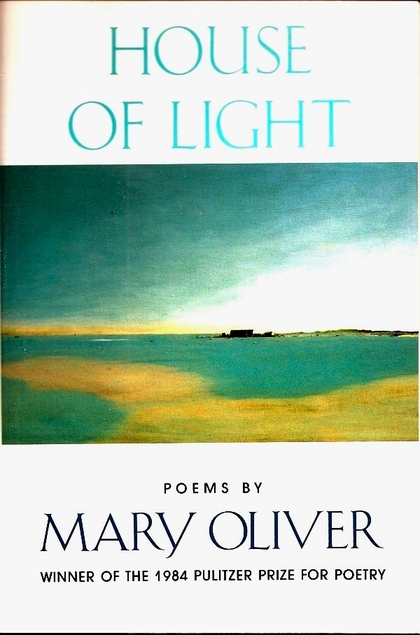
When Covid-19 was just a cloud on the northern horizon, I borrowed this book from a street library. Poems by Mary Oliver, I thought, are just the thing for the times ahead: she consistently holds out to her reader reminders of what it means to be alive and human on this planet.

Within days most street libraries had closed down.

So, what was this book that I may have risked lives to acquire?

For a start there’s a lot of death in it. Mary Oliver seems to have spent a lot of time outdoors, watching plants, birds and animals, though ‘watching’ might be too mild a word: the poems bear witness to a deep attention, contemplation, absorption.

The first poem in the collection, ‘Some Questions You Might Ask’, is a kind of manifesto: ‘Is the soul solid, like iron?’ it asks; then, ‘Who has it, and who doesn’t?’ and after considering the moose, the swan, the black bear and other animals, the poem ends:

What about the blue iris?
What about all the little stones, sitting alone in the moonlight?
What about the roses, and lemons, and their shining leaves?
What about the grass?

These lines dance on the edge of naffness. But they manage not to fall: they convey a strong sense of the speaker seeing these things, at least in her mind’s eye, with great clarity, and her pseudo-theological question, ‘Do animals have souls?’ comes to read as code for a joyful embrace of what she sees. That embrace is there in all these poems. Sometimes it has to be fought for, as in ‘Singapore’, which begins with the image of a woman washing something in a toilet bowl at an airport:

Yes, a person wants to stand in a happy place, in a poem.
But first we must watch her as she stares down at her labour

You can read that whole poem at this link to see for yourself where she goes from there. I think she pulls it off. (At this link, you’ll find a vehemently opposite view.)

You could think of Mary Oliver as a 20th century (and almost two decades into the 21st) devotional poet. That opening poem about souls certainly reminds me of primary classroom lessons from the nuns, and, for instance, ‘That Summer Day’ opens with a question straight out of the catechism I studied in primary school: ‘Who made the world?’ But there’s a difference. The poem doesn’t answer the question. It leaves it as an expression of awe, leaving hints of a creator God there in a take-it-or-leave-it way. The central lines of this poem are:

I don't know exactly what a prayer is.
But I do know how to pay attention, how to fall down
into the grass, how to kneel down in the grass

The poem is reaching for a way to express feelings that used to be attached to religious piety, but to free them from religious connotations. I think of Richard Dawkins writing about wonder without resiling even slightly from his militant atheism. Mary Oliver is similarly reclaiming wonder, though the line, ‘I don’t know exactly what a prayer is,’ carefully formulated to allow that she may know about ‘prayer’ as opposed to ‘a prayer’, indicates that she’s not oppositional, just going a different way. That poem ends:

Tell me, what is it you plan to do
with your wild and  precious life?

It’s an exhortation, not to be virtuous (the first poem of hers I read begins ‘You do not have to be good’), but to notice what it is to be alive.

I want to talk about death, though. Not just because of Covid-19, which I think of as a curtain-raiser for the hugely destructive climate-change crisis, but because it’s an insistent theme of these poems. The nature that they so closely and lovingly observe involves ruthless killing, but the death of the speaker, or death in general, is often evoked. Here is ‘The Terns’ (click on the image to enlarge, or read the poem at this link):

In the first 18 lines, the speaker is doing her usual thing, noticing the life in the wetlands near her home. The lines are filled with a birdwatcher’s delight. Then the lines

This is a poem
about death

come as a surprising twist. At first they seem to reach back and highlight the ‘little silver fish’, whose violent death has gone almost unnoticed. But that’s not where the poem goes:

about the heart blanching
in its folds of shadows because it knows
someday it will be
the fish and the wave
and no longer itself

I don’t think she’s offering the image of the terns vanishing under the water and then coming back as an almost mediaeval allegory for death and resurrection, though you might read it that way. As I see it, with these lines, the speaker’s mood intrudes into the poem. She’s not happy, and death is on her mind. It’s her heart that she imagines blanching, and she’s the one who knows she’ll be re-absorbed into the natural world, that her consciousness will cease to be.

But then:

this is a poem about loving
the world and everything in it

We might have expected ‘This is a poem about living’, but this small surprise carries the weight of the poem. It’s not offering a vision of life after death; the terns’ diving and rising don’t symbolise death and resurrection after all. The notion of being re-absorbed into the natural world can have in it a deep joy – it’s like that Sweet Honey in the Rock song, ‘Breaths‘ (If you don’t know it, click on the link). Re-absorption isn’t about being eaten by worms in the grave, or scattered as ashes, or even planted under a tree. In death, what remains of us will continue to be part of this dynamic universe.

To love ‘the world and everything in it’, including oneself, is a completely appropriate response to such thoughts. It’s a long way from, ‘Yea, though I walk through the valley of the shadow of death, no evil will I fear.’ I just read on Wikipedia that Mary Oliver dealt with a lot of abuse in her childhood. I think that’s what saves her poems from being glibly Life Affirming. There’s always a sense, as in this poem, that the affirmation is not so much made as won in the face of mostly unnamed contrary forces.
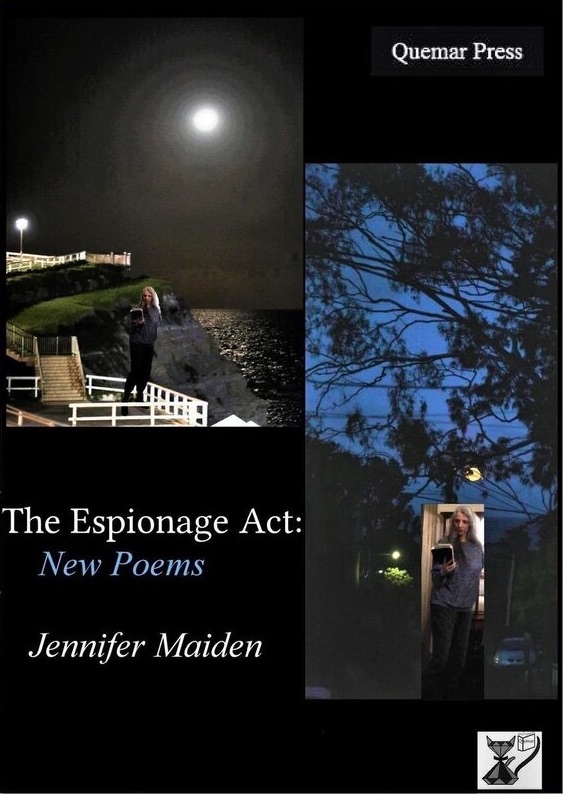
Jennifer Maiden's Espionage Act

Jennifer Maide, The Espionage Act (Quemar Press 2020)

In May 2019 Julian Assange was indicted on 17 counts of violating the USA’s Espionage Act. It’s the kind of event we’re used to reading about in journalistic language: what and why and when and how and where and who, though not necessarily in that order. You can click here to see how the New York Times reported it.

Jennifer Maiden’s books for the last decade or more have dealt with that kind of incident, but done it obliquely, in imagined scenes that usually begin with the ‘waking up’ of a historical or fictional character who is somehow connected with the news item. As Assange was taken from the Ecuadorean embassy in London, he was clutching a copy of Gore Vidal’s History of the National Security State: in the first poem in this book, ‘Resistance’, Vidal wakes up beside Assange in a London Magistrate’s Court. He does it again, in prison, in four more poems, in one of which they are joined by a newly awake Emma Goldman – who, we are told by Vidal, was sentenced under the same act in 1917 – and in another by Diana Spencer.

These are political poems, but no one would call Maiden ‘our protest poet’ as a recent headline did, reductively, the late Bruce Dawe. Her imaginary dialogues have a clear point of view, but they are exploratory rather than declamatory. In ‘Resistance’, for instance, Vidal’s ruminations are a means to inform the reader (or remind her, if she’s better informed than I am) that the magistrate presiding in Assange’s hearing ‘was the one who had / stopped a private prosecution of Tony Blair for war crimes’, and to remind us (or inform, etc.) of the circumstances of Assange’s removal from the Ecuadorean embassy. But Vidal does exist as a fictional creation, anxious to know if Assange liked his book, vain about his own quotability, dropping the occasional name from high society. Lady Diana wears the dress she was buried in to remind us ‘of the easiness with which one ignores murder’, but flairs the dress out, ‘actress-fashion’. In these poems, it’s as if Maiden puts two or more characters in dialogue to see what she thinks about something, but they are invariably more than just mouthpieces for ideas.

There are two other sets of dialogues in this book. In five poems, Maiden’s longstanding characters George and Clare converse, have sex, look after their toddler son, Corbyn. George chats on the phone to Donald Trump and a friend in the CIA. Three poems feature an Australian critic, who chats with Jackson Pollock and Brett Whiteley (in front of Blue Poles in Canberra), with Dorothy Wordsworth (and quotes to her the passage from her diaries that her brother drew on for his famous poem about daffodils), and with Gabriel Garcia Marquez (who doesn’t like the term ‘magic realism’).

There are other poems – one responds to a comment, reproduced on the back cover, that Maiden should be considered for the Nobel Prize; three feature her recent creation, a cute little marsupial named Brookings (after the Brookings Institution); one features Alan Turing; several ‘Diary Poems’, ruminate on the Federal Police raid on the ABC, on Jeffrey Epstein’s death in prison, on the Australian ‘poetry wars’, on the writing and reception of other poems in the book.

If there’s an overall subject, it’s the way reactionary politics infiltrates and influences the general culture, belittles creativity and promotes art that serves its purposes. And what it means to struggle against that influence.

It needs someone more learned than I am to talk about the formal qualities of the poems. I’ll just mention one thing. Have a look at the opening lines of the title poem, ‘The Espionage Act’:

Emma Goldman woke up uneasily in Belmarsh Prison Hospital.
She recognised the sharp shape of a reading Gore Vidal,
who was watching over Julian Assange, curled foetal
in a prison sheet not blanket, not at all
well, she thought, but fragile as an angel.
Death had made her even more maternal
and she had always been motherly, since a girl.
Vidal gave her his usual tough smile:
'I've really been expecting you for a while'

You could read this as prose that’s been interrupted by an occasional line break, but if you did you’d be missing a lot. You might not notice, but this is rhyming verse. All 56 lines of this poem end in ‘l’. Sometimes there’s a full rhyme like ‘smile’ and while’, or later ‘fall’, all’ and ‘recall’. Once you notice it, the effect is hypnotic, but even without your noticing it the lines have a wonderful musicality that pushes the narrative forward.

I’ve been reading and rereading this book for a while now. I’ve been learning about history (I think of Muriel Rukeyser’s repeated line, ‘Pay attention to what they tell you to forget’), making connections between things I’ve known and kept in silos in my mind, and questioning received versions of things, all with Jennifer Maiden’s insistent music in my ears.

A sampler of the poems from this book are online at the Quemar website, at this link, including ‘Resistance’, ‘Except’, ‘Brookings Gets A Helmet’, ‘George Jeffreys: 25: George Jeffreys Woke Up on Abu Musa Island’, ‘The Espionage Act’, ‘Diary Poem: Uses of Fear’, ‘Clare’s Dream’, ‘Brookings Tries Out Ubiquity’, ‘Diary Poem: Uses of Alan Turing’, ‘Diary Poem: Uses of Poetry Wars’, ‘What if all the village were vampires?’ and ‘Maximum Security’.

The Espionage Act is the sixth book I’ve read for the 2020 Australian Women Writers Challenge.

Tohby Riddle’s Astronaut’s Cat

Tohby Riddle, The Astronaut’s Cat (Allen & Unwin 2020)

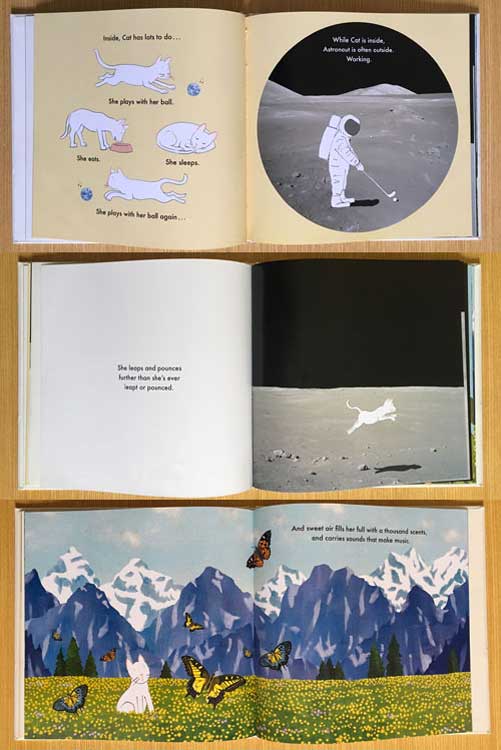
On Wednesday Tohby Riddle facebooked that he couldn’t have a launch for his new picture book because of the social isolation regime. I ordered a copy yesterday morning (Friday) from Gleebooks online. David Gaunt, Gleebooks head honcho, delivered a copy to my door yesterday afternoon – he said he was hand delivering books as a way of dealing with his anxiety. All three bricks and mortar Gleebooks are shut and their post-Covid survival is in doubt. So I’m writing this post about an utterly joyous book through a haze of proleptic grief.

The book is brilliant. It’s brilliant anyway, but it’s absolutely a book for our socially-isolating times.

The Astronaut’s cat is an inside cat. The text never mentions the moon, but that’s where she is. She likes to look outside but doesn’t want to go there. She dreams of going out to frolic in the low-gravity landscape, and then within the dream she dreams of going to live on the blue ball that rises over the horizon – and after all the stark moonscapes there are four full-colour spreads to make the heart sing. All this told in sparse, perfectly judged text.

Tohby has put a couple of his favourite spreads up on facebook (at this link). I’m assuming he won’t mind me putting them up here as well:

When I blog about children’s books, I label them as ‘Ruby Reads’. So that’s how I’ve labelled this one. While I expect toddler Ruby to enjoy it, I doubt if she’ll fall as intensely in love with it as I have.

Vale Bruce Dawe

Bruce Dawe died on Wednesday, aged 90. He was one of Australia’s most loved poets, and one of the most accessible. During the Vietnam War, his poems ‘Weapons Training’ and ‘Homecoming’ made a big impression on me.

This is one of his poems from the 1990s that strikes a chord with me as one of the privileged ones who has water to wash my hands, a home to stay in, and a faltering NBN to keep me in touch with friends.

You and Sarajevo
for Gloria

Hearing the sound of your breathing as you sleep,
with the dog at your feet, his head resting
on a shoe, and the clock's ticking
like water dripping in a sink
– I know that, even if reincarnation were a fact,
given the inherent cruelty of the world
where beautiful things and people
are blasted apart all the day long,
I would never want to come back, knowing
I could never be this lucky twice ...

Added later: Sue at ANZ LitLovers LitBlog has blogged at more length about Bruce Dawe, and there’s a write-up in the Sydney Morning Herald at this link.

Peter Hartcher’s Red Flag

Peter Hartcher, Red Flag: Waking Up to China’s Challenge (Quarterly Essay 76, 2019) – and correspondence in Quarterly essay 77)

My usual practice is to delay reading each Quarterly Essay until the next one arrives in my letterbox. Peter Hartcher’s essay on Australia’s response to China’s growing economic strength and political influence, published at the end of 2019, in pre-rona days, feels as if it comes from a past era. Of course, that feeling doesn’t completely reflect the reality, but the essay is looking at the China–Australia connection through a different lens from the one that tends to obsess us at the moment.

In a prescient moment, arguing that it’s unwise for Australian businesses to put all their export eggs in the China basket, Hartcher writes, ‘The thermal coal market is highly diversified globally. Other industries would have a harder time. Universities come to mind.’ However, he’s not talking about a possible crisis in which the Australian government bans flights from China. His concern is with the risk of the risk of a Chinese economic slump or, more central to the argument of his essay, the risk of Beijing using the trade connection as an instrument of political coercion.

The essay’s argument is easily summarised. Under President Xi Jinping, the Chinese Communist Party is in effect on a war footing with the rest of the world, using economic leverage and cyber weapons rather than military means, and with motives that are seen in China as defensive but by the rest of the world as aggressive. Australia has become increasingly dependent on trade with China and is still largely complacent about any threat. It’s not a matter of choosing China over the increasingly unreliable USA. ‘Whenever Australia is asked to choose between China and America, the ultimate answer must be that we choose Australia.’

The red flag of the essay’s title is both the Chinese national flag and the red flag of warning that Hartcher is raising.

Hartcher tells of a number of Australians who have been hit by the realisation that the Chinese government and its representatives seek to influence politics in Australia. In six of his cases, five – Joe Hockey in 2013, Stephen Conroy in 2016, Penny Wong, Bill Shorten and Richard Marles in 2017, Professor Feng Chongyi in 2016, and journalist John Garnaut in 2009 – resisted the Chinese overtures. The sixth case is Sam Dastyari, who famously fell from grace by departing from party policy on China’s actions in the South China Sea. In his response to correcspondence in QE 77, Hartcher clarifies his point: we know about these cases because the Chinese attempts to influence Australian policy were unsuccessful: we just don’t know about the successful ones.

He lists cases when China has used economic heft to influence the policies of other countries. ‘In the past ten years,’ he writes (p 43), ‘Beijing has imposed economic punishment on at least eleven countries. for a wide range of perceived offences.’ The connection between the crime and the punishment is often not made explicit, but a pattern has emerged. He lists countries ranging from tiny Palau and Mongolia to Canada and, finally, Australia.

He makes a number of recommendations, on immigration, on vetting politicians, on diversifying our trade relations, on defending our democracy. I’m in no position to comment on the rightness or wrongness of his analysis or his proposals, but I can accept his general argument that it’s not a good idea to be complacent.

Sadly the 35 pages of correspondence published in Quarterly Essay 77, Margaret Simons’s Cry Me a River, also predate Covid, apart from Peter Hartcher’s response, and that was clearly written before the serious economic consequences were becoming clear.

The correspondents all take issue with Hartcher’s argument. He relies too heavily on the words of a previous head of ASIO; his proposal to have ASIO vet potential MPs and senators is terrible – Hartcher agreed, but argues for a new parliamentary body to vet candidates; he mistakes Xi Jinping’s statements of intentions for inevitable achievements; he doesn’t allow for the disruptions to China and the rest of the world that climate change will wreak; he underestimates the strength of resistance as it stands; he misunderstands the complexity and diversity of Chinese-heritage and Chinese-born Australian citizens. One response, by Caroline Rosenberg, is a personal testimony from someone who came to Australia from China in her teens: she wishes she had been given this essay as a teen (though if she had been she wouldn’t have read it), because she was totally unprepared for the way the West saw China, and her, and this would have helped. I think, but I can’t be positive, that that is an incredibly subtle and polite way of calling bullshit.

The Book Group and Trent Dalton’s Boy Swallows Universe

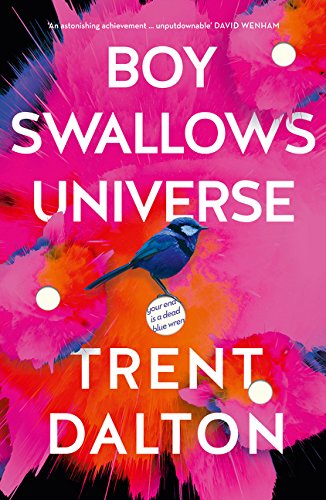
Trent Dalton, Boy Swallows Universe (Fourth Estate 2018)

Before the meeting: This was an unusual meeting of the Book Group, most obviously because it happened online, with participants spread from Bondi to Balmain, and less obviously because it’s the first time a book has been chosen that I’ve already read.

So for my pre-meeting take on the book, I’ll just point you to this link, and limit myself to saying that I enjoyed the book, and risked a visit to the supermarket to buy a bottle of sarsaparilla to flourish at the zoom screen.

After the meeting: As you would expect, we spent time checking how we were all going in our separate households. One of us reported the death of a friend in England. One made only a brief appearance because he is a health worker and exhausted, as well as putting himself at risk as an essential worker. Another has been working very long hours as his business adjusts to having most people working from home and he spends many hours every day in online meetings, which, he says, may actually be more productive than in-person meetings, but are exhausting. Several of us, me included, reported intergenerational tensions as people variously worried that others weren’t taking enough care or were annoyed by other people’s worry. A number spoke of the odd sense of having a relaxing time to do gardening and sit about and read, while outside – where you’re not allowed to go – terrible things are happening. I got the impression that many of us are addicted to Covid-19 news. There were no jokes.

We did get to the book. Without food to share or the possibility of fragmenting into small incidental conversations the whole thing was a lot less fun than we’re used to. It felt almost like an Eng Lit seminar – not that there’s anything terribly wrong with that. Most of us enjoyed the book. One chap said that generally if a book hasn’t grabbed him by page 72 he gives up on it; this book took until page 272, but then he decided to go with it and really had a good time. Some didn’t care much for the longish expository opening. (I think they were referring to the evocation of Brisbane suburbs, which I loved.) Another felt that the magic realism elements were the least successful, and I think we can look forward to an excellent film.

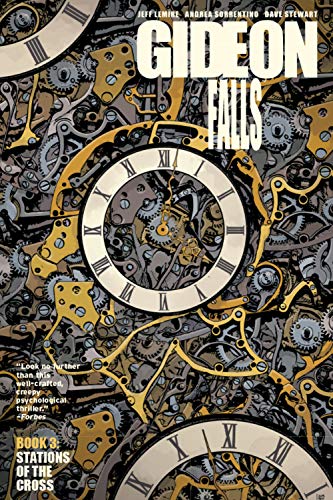
Lemire & Sorrentino’s Gideon Falls

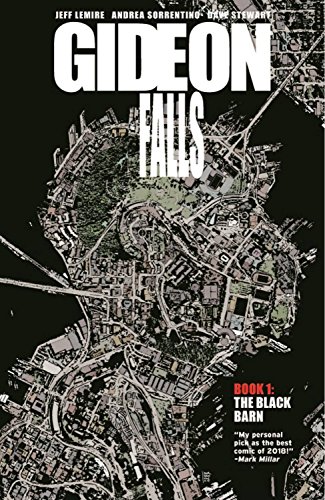
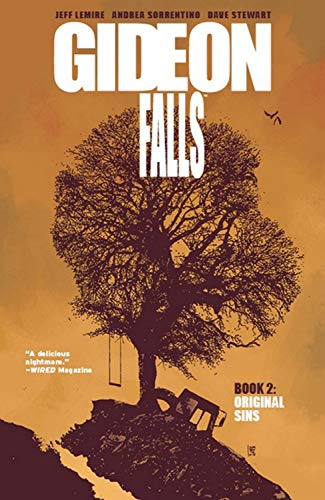
Jeff Lemire (writer), Andrea Sorrentino (artist) and Dave Stewart (colorist), Gideon Falls (Image Comics)
Volume 1: The Black Barn (2018, from issues 1–6 of the comic)
Volume 2: Original Sins (2019, from issues 7–11 of the comic)
Volume 3: Stations of the Cross (2019, from issues 12–16 of the comic)

These three books were a birthday present from my main comics supplier. I’m reading them promptly in order to lend them to him in this time of pestilence. It turns out this is a horror series, not something that appeals to me.

The first volume opens on an image of a young man in a surgical mask and rubber gloves looking at some roughly sketched garbage. Only a couple of months into the Covid–19 story, it takes an effort to realise that these accoutrements signify anything else besides sensible precautions against infection. But they do, though (not really a spoiler) we still don’t know what they do signify, beyond that the young man is a bit scary, by the end of the third volume.

Two story lines emerge in a fragmented and disorienting manner. A young man in psychotherapy for his obsession with garbage has troubling visions of a black barn that somehow embodies evil. A Catholic priest is sent by a bishop (whose face we don’t see) to a country town – Gideon Falls – to replace the parish priest who died recently, and behold he sees a black barn in gruesome circumstances on his first night there.

The stories progress in tandem, switching from one to the other without warning. There’s a section early on where the text bubbles and images belong to different stories. The effect is to unsettle the reader, slow him or her down, but also to suggest that the two plot lines are intimately interwoven, even though we don’t know how. In fact, even to the end of this first book, the two stories haven’t linked up. The young man’s therapist, who is a Buddhist and doesn’t believe in evil, comes to share his vision of the barn. The priest meets up with some locals who fill him in on the lore of the evil barn, and he finds himself inside the barn where his past wrongdoings come back to torment him. There is more death and bloodshed, though thankfully the artwork focuses more on the psychological fragmentation than the gore.

In the second volume the priest and the sheriff can’t remember their experiences in the barn, or even seeing the barn, but the aftertaste lingers on. Meanwhile, we learn more of the backstory of the young man, whose name is Norton – or is it? About the middle of this book the priest and Norton meet, inside the barn, which they have both separately reconstructed – either I didn’t read carefully enough or the impossible detail of how either of them did this was skipped. The intertwining images of them both at work are wonderful. The monster who inhabits the barn is revealed, up to a point, and we understand that the story is taking place in oddly dislocated time frames.

The third volume takes us into wild territory. There are crucifixions, visitors from the future, apparitions from the past, a gang of people wearing surgical masks, scary cockroaches, a satanic figure who is the heart of the book’s evil, something called the Pentoculus which suggests that there’s a sciency dimension to the horror … and a general sense that things are going to get a lot worse before they get better.

Because these books give no information about their creators apart from giving their names on the cover, I went to Wikipedia for the details at the top of this post. There I learned that a fourth volume, The Pentoculus, is due for publication in April, and a fifth, Wicked Worlds, in May. I may seek them out if my Supplier is interested, but otherwise, meh.

As a no-longer-practising Catholic I’m unimpressed by the use of Catholicism for horror purposes, but I guess it’s an established trope, dating back at least to The Exorcist. When I was young I believed in the devil as an evil force active in the world, and I remember moments of terror, mainly at night, related to that belief. But it was always completely outweighed by belief in the goodness of God. There were devils, sure, but there were also angels who were just as real. I guess in the 21st century it’s tempting for people who have lost any sense of a loving God to think there must be some diabolical force loose in the world. I prefer to look for more mundane explanations, even if sometimes – like when I see the President of the United States boasting abut the ratings he gets for his Covid-19 press conferences – there’s no explanation that will make the reality unscary.

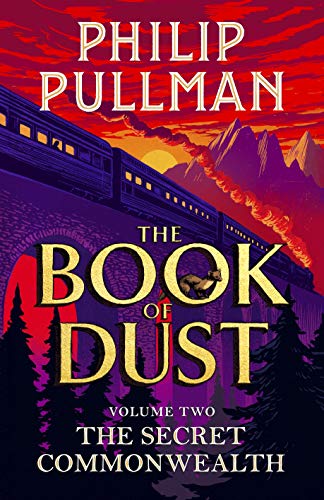
Philip Pullman's Secret Commonwealth

Philip Pullman, The Book of Dust Volume Two: The Secret Commonwealth (David Fickling Books 2019)

This is the fifth book featuring Philip Pullman’s wonderful Lyra Silvertongue (or Belacqua, take your pick). There was the His Dark Materials trilogy, which I loved to pieces, and which gave rise to a play, a movie and now, I’ve just discovered, a television series (click here for the IMDB entry). Then there was a small book, Lyra’s Oxford, which I missed. And now a second trilogy, The Book of Dust, of which the first book, La Belle Sauvage, was a prequel to the first trilogy and featured Lyla as a baby. The Secret Commonwealth leaps forward a couple of decades, and features events that take place some years after the end of the first trilogy, when Lyra is a twenty-year-old university student.

I wasn’t swept away by La Belle Sauvage (my blog post here). At least in the second part, it felt like a lot of colour and movement and not much interesting by way of plot or character development. The Secret Commonwealth is back on track. At the beginning, Lyla, now a student at Oxford, is at odds with her daemon Pantaleimon. For those who came in late (which I really don’t recommend: start with Northern Lights aka The Golden Compass), in this world a daemon is an animal who is somehow part of a human being. Daemons have names, they change shape frequently when their human is young but settle into a permanent creature around puberty. A daemon generally represents some essential element of its human’s character. To be separated from your daemon is extremely distressing, and most people don’t believe it is possible. To be quarrelling with him or her, as Lyla is when this book begins, is deeply disturbing.

So we’re off to a complex start. Lyla’s difficulty with Panteleimon is central to her personal life, but there are huge issues to deal with in the rest of the world. A version of the Catholic Church wields tremendous power, and though we are more or less in the present day it’s as if the Inquisition is alive and well. Organised religion, militant atheism, postmodern truthysim, religiously inspired terrorism all feature, in a plot of almost Le-Carré-esque complexity as we follow the separate adventures of Lyla, Pantaleimon and Malcolm Polstead, who is in undeclared love with Lyla, all of them being pursued by a fantasy version of the surveillance state.

Where His Dark Materials was intended primarily for a pre-teen or young teenage readership, this is definitely for older readers. I didn’t feel like an intruder as a 73 year old, but that’s not exactly what I mean. There’s some fruity swearing, and there’s one powerful scene of sexually-motivated violence that take it right out of the children’s section into the YA.

I remember how agonising it was to wait for the third book in the His Dark Materials trilogy – would Will really kill the Authority, and since the Authority seemed to be a name for the Judaeo-Christian God, what would that mean? The Secret Commonwealth, like all good second books in trilogies, also ends with a cliffhanger. Will the characters find each other, will they discover the secret behind the Men from the Mountains, fundamentalist terrorists, will Lyra escape the men who have tracked her down to the deserted village in southern Turkey, will the world be saved? But this time, without in any way implying that the book didn’t have me in its thrall the whole time, I can wait.

Rhymes

Regular readers of this blog know that I like to play with rhyming verse, and in particular that I’m in love with the Onegin stanza, which is like a sonnet but with shorter lines. The Emerging Artist (who incidentally has recently been working on a project to submit to a competition only to have the competition, which would have led to an open-air sculpture exhibition, cancelled) said I should put this recent sequence up on the blog. I didn’t write these with any intention of showing them around, so blame the EA if they displease. Of course if you like them, I’ll happily accept praise.

9 February
First drought, then fires, and now it's raining
night and day a steady thrum
with windy descant never waning:
bushfires gone now, floods have come.
Our balcony was strewn with ashes
then with red dirt. Now it splashes
inch deep and our thyme will drown.
The lawns are green that once were brown.
Raining, pouring, old man snoring,
how I loved rain when a boy
in Innisfail, a primal joy –
so definite, so life-restoring.
Now we're cooped up in our flat – 
warm inside. I'm fine with that.
10 March
Drought, fire, flood, and now this virus.
Covid-19 tops the bill.
Don’t touch your face, wash hands, require us
keep two metres from the till.
The papers preach self-isolation.
Norman predicts devastation.
Toilet paper shelves are bare.
Trump says we just shouldn’t care.
The Spanish Flu, AIDS, SARS, Ebola,
tiny predators en masse
toss us down a deep crevasse:
iPhones, cruises, Coca-Cola
promised lives of endless joy.
The gods think we’re a knockdown toy.
22 March
Hooray for social isolation.
Splendid? Truly, not so much.
On one side there's devastation,
on t'other six months without touch
of granddaughter or a movie.
Beach and gym closed, and all groovy
birthday parties now on line.
It's books' and Netflix' time to shine.
No more non-essential outings.
Work from home unless you're key
and key means nurses, teachers, see,
not the bankers, brokers, shouting
pollies. Oh, and not the arts! 
God save our isolated hearts!

Proust Progress Report 7: more about the Guermantes

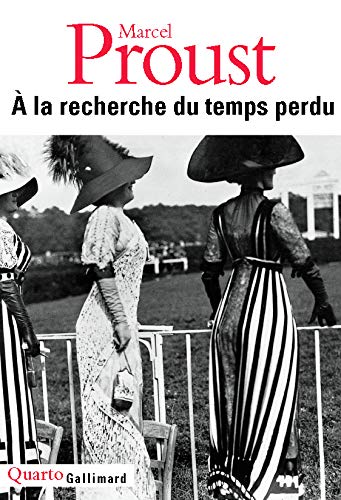
Marcel Proust, À la recherche du temps perdu (text established under the direction of Jean-Yves Tadié ©1987–1992): Le côté de Guermantes, seconde partie (originally published as a separate volume in 1921)

I’ve just realised with a shock that it’s time for my monthly Proust Progress Report.

A month ago I ended my post with the hope that the plot, such as it is, might move along soon. The opening page of the first chapter of Le côté de Guermantes Part Two offers hope, beginning with a plot summary:

Maladie de ma grand-mère. – Maladie de Bergotte.
Le duc et le médecin. – Déclin de ma grand-mère. – Sa mort.

In English:

My grandmother’s illness. – Bergotte’s illness.
The duke and the doctor. – My grandmother’s decline. – Her death.

What follows is a moving account of the final illness and death of the narrator’s beloved grandmother. Proust’s sharp, satirical edge is still there in his accounts of the various doctors and visitors of the sick. In particular, this intensely felt episode doesn’t overshadow completely the main concern of this book (or two books, depending on how you count them), which is the narrator’s relationships with the aristocratic Guermantes family and his acerbic commentary on them.

Albertine, with whom he fell into unrequited love in the second book but who no longer tugs at his heartstrings, turns up when he’s sick with grief and it seems she is now in love with him. I may have misinterpreted Proust’s opaque narrative at this point, but I think they have it off, and remain completely at cross purposes about what it means. The plot is definitely thickening.

But then we move on to the main game, and the forward impetus is lost. The duchess Mme de Guermantes, Oriane, with whom the narrator has also been in unrequited love and who also no longer pulls at his heartstrings – invites him to dinner. The plot of the next 100 pages or so can be summarised as: the narrator goes to dinner with a bunch of aristocrats.

The narrator is pretty much a fly on the wall. Every now and then someone speaks to him and he gets a word in edgewise, but he gives us a meticulous, detailed account of the witty, snarky conversation, so that the various personalities emerge sharply. Embedded in the narrative are essays on aspects of the culture and politics of the salons and of the aristocratic class.

When the narrator arrives at the Guermantes home – which is just across the courtyard from his own, though separated by a great social distance – he is greeted by the duke himself, who happily grants him his wish to be left alone in a room with some paintings by the great Elstir. When he tears himself away from the paintings (having given us a richly evocative analysis of them) he realises an hour has passed. A servant takes him to where the other guests are waiting to start dinner. The duke, aware as are all the guests that the narrator has the lowest status of anyone in the room, is at great pains not to make him feel he has inconvenienced anyone. So even though they have all been waiting to eat for at least forty minutes, he makes a point of introducing him to everyone individually, beginning with the Princess, the noblest person in the room. Only after a decent interval does he signal diffidently to the servants to announce dinner.

That tiny sequence is the occasion for a complex meditation on what you might call noblesse oblige, though that’s not a phrase Proust uses. These people who are in the highest social rank will never make a point of their status. In fact the way they demonstrate their superiority is by treating their inferiors (that is to say, just about everyone) with elaborate deference. It’s hard to explain the pleasure given by this essay – and a number of others, such as one on Oriane’s wit and social eminence. It’s something to do with paradox, and the tension between the infectious enthusiasm that Proust has for these people and his clear-eyed perception that they lead largely idle and trivial lives, and generally have appalling politics. And it’s laid out in sentences that you can get lost in, and then miraculously found again.

I’ve still got about a hundred pages of this book to go. The narrator has an appointment to meet the creepy M Charlus – Oriane’s brother – once he can make his excuses from the dinner, and that appointment hangs over the glittering dinner like a livid storm cloud. The title of next volume is Sodome et Gomorrhe, which raises the possibility that things are going to get a lot spicier.