Proust Progress Report 9:

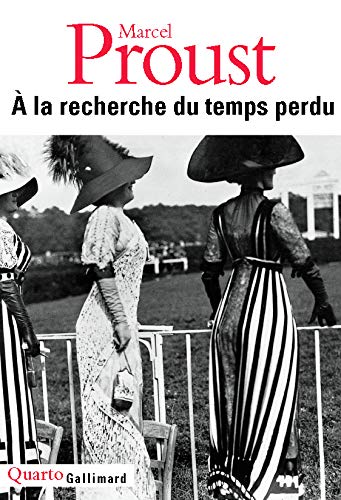
Marcel Proust, À la recherche du temps perdu (text established under the direction of Jean-Yves Tadié ©1987–1992): continuing Book 4, Sodome et Gomorrhe

I’ve been reading À la recherche du temps perdu for nine months now. Part way through this month, I decided to reduce my daily quota of five pages. Three pages were fun, and then the next two were a slog. So I’m now aiming for three pages a day, and expect to be reading Proust – still mostly without a dictionary and still with limited comprehension – well into 2021.

At about page 1320 I nearly threw in the towel – exasperated by the interminable salons and garden parties, the meticulous charting of the rivalries of various duchesses, princesses and other ladies, the intrigues of the idle rich and their shifting allegiances related to the Dreyfus case and antisemitism. If I wanted to read something in French, maybe I should shift to Montaigne … or Jules Verne, where something happens.

Then the narrator goes for a second time to the seaside resort of Balbec, and after an encounter with the manager whose malapropisms amuse him enormously and are carefully explained, he is knocked sideways by memories of his beloved grandmother, who was his companion on his earlier visit. He feels her loss intensely, and is stupefied by grief. Worse, a number of people – workers at the hotel, his mother, his servant Françoise – tell him of sacrifices his grandmother was making for him at a time when he was oblivious to her suffering. This whole section is just brilliant. Though Proust is as much the meticulous analyst of emotional processes as ever, here it feels like vivisection.

And then we’re back with tales of lust and disgust and linguistic oddities. The early parts of this book dealt with the world of Sodom, of male homosexuality. At Balbec, in the part I’m now reading, the narrator becomes obsessed with Gomorrah, the world of Lesbians In particular, he suspects Albertine of Sapphic desires. So far, there’s nothing more graphic than public kissing, tittering and indecent shouts:

elles passèrent enlacées, ne cessant de s’embrasser, et … poussèrent des gloussements, des rires, des cris indécents.

(page 1397)

This must be the kind of thing that gave French literature a reputation for being as good as pornographic in the early 20th century.

I the middle of all this there are a couple of pages where the narrator tells us about a couple of sisters from the country who are employed as messengers by a wealthy woman at the hotel. Having somehow – he doesn’t explain how – struck up a friendship with them, he gives us a blow by blow account of a conversation in his bedroom one morning where they mock him mercilessly. My impression is that a native French speaker would find great joy in their rustic language, but I enjoyed it a lot without that advantage. These two women, Céleste and Marie, are full of vitality and have no respect at all for the narrator’s poor health, social ambitions or writerly distinction. There have been other moments where Proust has taken the mickey, but this one shines.

I’m soldiering on.

Ruby reads 20: Lockdown?

In the mainstream narrative grandparents everywhere are pining for their socially distanced grandchildren. The Emerging Artist and I have meanwhile been quietly sailing against the current, with more contact than ever, pending our little one being rid of flu-like symptoms. She comes to our place three days a week, and our small collection of children’s books has been much called on. When Gleebooks at Dulwich Hill reopened recently, we fell on its non-virtual shelves with cries of joy and came away with arms full.

Here are some of the old and some of the new.


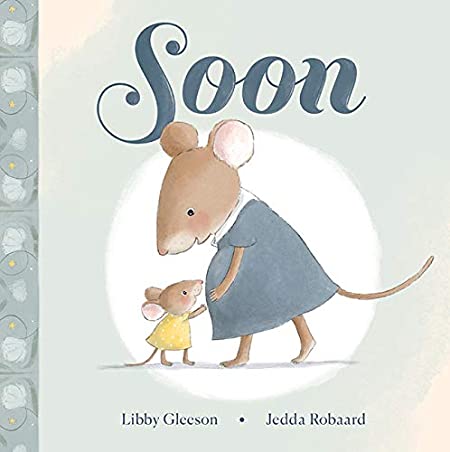
Libby Gleeson (writer) and Jedda Robaard (Illustrator), Soon (Little Hare 2020)

This is brand new and has already been requested/demanded many times. It may be a mistake to give a toddler who is obsessed with babies a book about waiting for a new baby to be born, but if so it’s a mistake that’s hard to resist. We wait, wait, wait. We clean, clean, clean. We paint, paint, paint. And just about all the mother mouse has to say on the subject is, ‘Soon.’ You don’t need me to tell you the ending, but I will say that it is emotionally very satisfying. Libby Gleeson’s incantatory text and Jedda Robaard’s calm, charged images make this a joy to read together. (The birth itself, like the devouring of the apple in Grug and the Big Red Apple, happens offstage.)


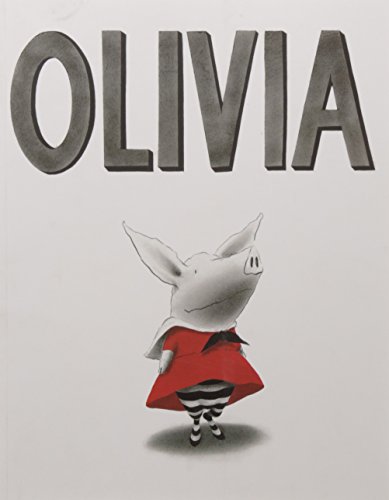
Ian Falconer, Olivia (Simon & Schuster 2000)

Olivia is a great artist and dancer trapped in the body of an anthropomorphised pig and the persona of a six year old girl. The back-cover praise from dame Joan Sutherland, Mikhail Baryshnikov and David Hockney, at least one of them written posthumously, are just one of the delights for adult readers. A 2 and a half year old seems to be delighted as well. Olivia argues, paints, dances, fusses about her clothes (which I’m glad to report are all bright red, no pink in sight), and is generally fabulous on pages with acres of white space.


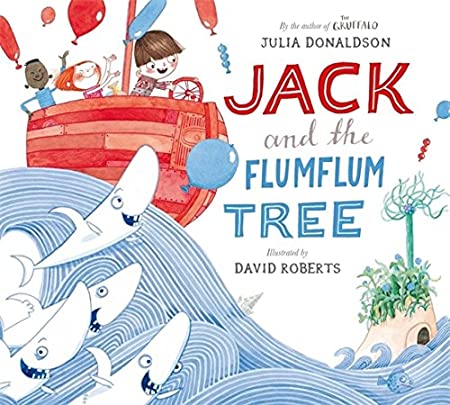
Julia Donaldson (writer) and David Roberts (illustrator), Jack and the Flumflum Tree (Macmillan Children’s Books 2011)

We may have gleaned this from a street library a while back. In it the enormously prolific Julia Donaldson teams up with illustrator David Roberts for a quest story. Jack’s granny has spots and the only cure is the fruit of the faraway flumflum tree. Jack and friends sail away, face many challenges in which the contents of a patchwork sack come in handy. It bounces along, and ends with a terrible pun. I think Ruby likes it because it’s got sharks in it, and they’re almost as interesting as the big bad wolf or a bear.


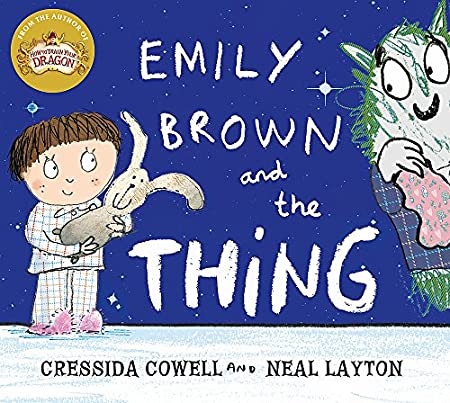
Cressida Cowell (writer) and Neal Layton (illustrator), Emily Brown and the Thing (Hodder CHildren’s Books 2007)

Cressida Cowell wrote How to Train Your Dragon, which I haven’t had the pleasure of reading yet. She has also created a whole series of Emily Brown books: in this one, Emily Brown and her old rag rabbit Stanley keep trying to go to sleep but are kept awake by a weird creature, a ‘Thing’, who demands that they perform great feats to help him. They perform the feats – retrieving his cuddly (we say ‘blanky’) from the Dark and Scary Wood, fetching a glass of milk from the Wild and whirling Wastes, and so on. In the end Emily refuses to pander any more, and everyone gets a good sleep. We love this one.


And now a couple more Julia Donaldson titles. Is anyone else finding that her books are multiplying like mice? Nice mice, of course.

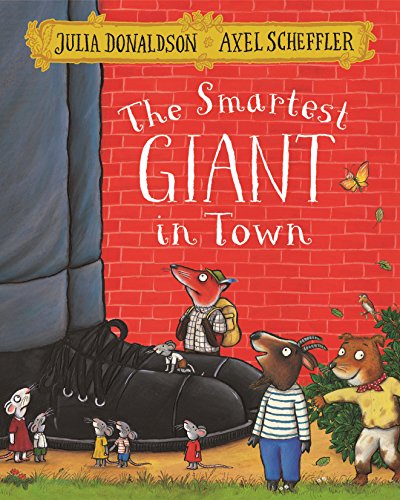
Julia Donaldson (writer) and Axel Scheffler (illustrator), The Smartest Giant in Town (Macmillan Children’s Books 2002)

Here Julia Donaldson is teamed up with Axel Scheffler, the co-creator of her most famous book, The Gruffalo.

This is a tale told in prose that allows the reader-aloud to burst into song at the end of each of its episodes. A scruffy giant wanders into town and buys a smart new outfit. Then, in fairytale rhythms, he gives one item of flash clothing after another away to animals in distress. In the end, he retrieves his scruffy old clothes from the garbage outside the clothes shop, and is reconciled to his scruffy status. But them the animals he has helped turn up and celebrate his kindness. This is amiable and charming. The text is beautifully honed, and the illustrations are full of unexpected joys – other giants can be seen among the rooftops and characters from fairytales pass the giant on the road without comment.


Meanwhile, the parents had felt the need for variation and bought a number of books online, among them:

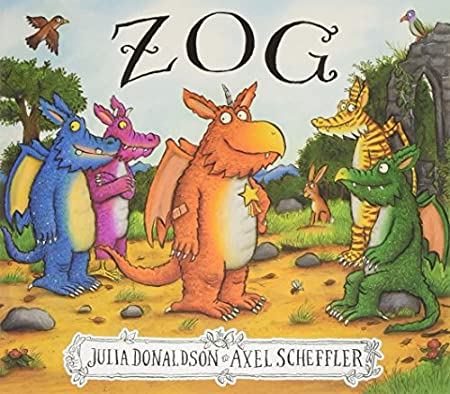
Julia Donaldson (writer) and Axel Scheffler (illustrator), Zog (Scholastic 2016)

Told in the bouncing rhyme that I think of as Julia Donaldson’s typical mode, and which is a lot harder to do than it looks, this one plays sweet variations on the dragon theme. As young Zog learns all the basic dragon skills he is helped out by a girl who happens to turn up just as he gets into trouble. When he has to capture a princess, well, guess who turns out to be one? And when a knight comes to rescue the princess, I don’t think you’ll guess what happens, but it’s a most satisfactory ending with a most satisfactory variation on the tale’s recurring refrain.


Besides the books, there’s the scooter, the dolls, the trampoline, the cooking, the painting, the songs and the athletic challenges – all making worthwhile the weariness come 6 o’clock


Soon is the eight book I’ve read for the 2020 Australian Women Writers Challenge.

SWF 2020 Day One

This year, because of viral matters, the Sydney Writers’ Festival has gone virtual. According to its website, more than 50 re-imagined sessions from the 2020 program will be presented as podcasts over the next few months. I don’t usually blog about podcasts, but since I’ve been blogging about the Sydney Writers’ Festival for 16 years off and mostly on, why not? I’ve made a monetary donation to help the festival through this crisis (and you can too, at this link). Here’s my bloggetary one, hopefully the first of several.

The first six podcasts were uploaded last Friday, all excellent. Here they are in my listening order, plus an earlier one that’s technically part of the Festival. The titles of the sessions here are linked to the Festival website where you can find the podcast..

Alison Whittaker: Opening Night Address: Alison Whittaker, described on the Festival website as ‘Gomeroi poet, essayist and legal scholar’, evoked the isolated condition in which she recorded her talk. She said her brief included a request to avoid talking about Covid-19 if it was possible, but she couldn’t find a way to avoid it. The theme of the Festival is Almost Midnight: she suggested that it’s now a minute past midnight, that we are living in apocalyptic times, but that First Nations Peoples have been doing that for 250 years. It’s a salutary talk, in which Whittaker pays tribute to many other First Nations writers who were scheduled to appear at the Festival.

Ann Patchett and Kevin Wilson: A Conversation with Friends: A free-ranging conversations between two US writers. Wilson first met Pratchett when he was beginning his postgraduate studies. She asked him to look after her dog for a time, and in that time she kept giving him books to read, which they would discuss, and it sounds as if they’ve been talking about the books they read ever since. It’s a warm, entertaining conversation with a lot of insight into how each of them approaches writing. I haven’t read any of his books, and just two of hers., but both were equally interesting to me.

Rebecca Giggs: Fathoms: I knew nothing about Rebecca Giggs’s book Fathom: The World in the Whale before listening to this. Nor had I heard of Sweaty City, an independent magazine about climate change and urban ecology, whose co-founding editor Angus Dalton is her interlocutor on this podcast. I learnt a lot about whales that I didn’t know I wanted to know. For example parts of whales’ bodies were used to make things and perform functions that are now being made or done using plastics, so the reason for the wholesale slaughter of whales in the nineteenth and early twentieth centuries; but now, in a terrible irony, many whales are dying because of the plastic that is polluting the oceans and ending up in their intestines.

Jess Hill: See What You Made Me Do: Jess Hill’s book about domestic and family violence won this year’s Stella Prize. Before listening to this I thought I might make myself read it in order to Be Good. It turns out that when Jess Hill was commissioned to write a long article on the subject many years ago she accepted without a lot of enthusiasm, but felt that she couldn’t let ‘the sisterhood’ down. As I listened to her describe in this conversation with fellow feminist writer and journalist Georgie Dent how her enthusiasm for the subject grew with her understanding of its complexity, I was similarly enthused. This is a terrific conversation.

Miranda Tapsell: Top End Girl: Miranda Tapsell talks with Daniel Browning from the ABC’s Awaye! about her memoir Top End Girl. Another terrific conversation. Mind you, I’d be delighted to listen to Miranda Tapsell talk about anything or nothing for as long as she wanted. How does a 31 year old women get to write a memoir? She says it’s because when she read memoirs by, for example, Judi Dench or Michael Caine, she was struck by how they struggled to remember details of their youth, so she decided to write about her youth while it was still fresh in her mind. But that’s just a typical bit of charming self-deprecation: in the course of the conversation, it turns out that the book is also something of a manifesto (DB’s term) for diversity of representation and acknowledgement of the presence of Aboriginal people in all aspects of the arts, in particular film. They discussed the movie Top End Wedding, and the process of getting cultural permissions. I especially loved that at the very end, Browning asked about the episode of Get Krack!n when she and Nakkiah Lui took over the stage, and she spoke of the huge privilege she was given there of speaking in a ‘raw, unfiltered’ way while also exercising her ‘comedy chops’ to the full. That was one of my Great Moments of Television, and I was delighted to hear that they both thought so too.

Return of the Sweatshop Women: Sweatshop is a Western Sydney Literacy Movement. Its Sweatshop Women is an anthology of short stories, essays and poems produced entirely by women of colour. This podcast, shorter than the others, consists of readings by five of its contributors: Phoebe Grainer, Sara Saleh, Sydnye Allen, Janette Chen and Maryam Azam. One of the joys of the Festival is being read to, and another is hearing from voices that are usually marginalised if not completely silenced. This podcast provides both joys. The readings are introduced by Winnie Dunn, general manager of Sweatshop.

If I was attending this Festival at somewhere like the Carriageworks (currently in dire straits thanks to governments’ decision that the arts aren’t eligible for Covid–related help) or Walsh Bay (currently being ‘redeveloped’), I’d be in the company of hundreds of other silver heads, and I’d skip more sessions than I attended. So I have any misgivings about not listening to Malcolm Turnbull in Conversation with Annabel Crabb, but there’s the link of you’re interested. (Full disclosure: I did listen to the first 20 minutes of this conversation, and MT’s urbanity and AC’s apparently genuine affection for him are seductive.)

I miss those hundreds of other bodies, the unexpected questions at the end of sessions, the catching up with old friends, Gleebooks’s groaning trestles, the coming out blinking into the sunlight after being taken to a whole new view of things. But in the absence of all that, I’m grateful for the existence of podcasts.

The Book Group zooming with Hwang Sok-yong At Dusk

Hwang Sok-yong, At Dusk (translated by Sora Kim-Russell, Scribe 2018)

Before the meeting: One of the many things I love about my Book Group is that a couple of chaps can be counted on, when it’s their turn to choose our book, to send us Somewhere Else. We’ve read challenging books from Indonesia, India, Japan, Poland, Russia .. the list could go on. This month, we’re in South Korea.

Like many novels these days, this one tells two separate stories in alternating chapters, and the links between the stories become apparent only towards the end. The reader is quietly tantalised by hints at the connection, and there are red herrings.

The protagonist of the first narrative strand, Park Minwoo, is a successful male architect nearing retirement age, who has been part of ruthless slum clearance projects and aesthetically hideous urban development. My reading was partly informed and enriched by knowing that I was in the virtual company of architects, a builder and a heritage consultant in the Group, but the ethical issues didn’t need that kind of help. Minwoo has our sympathy: the bulk of his story is taken up with his childhood in the slums, and his escape to a more affluent life through study and patronage; and with the way his childhood friends and, especially, sweetheart remained behind, mostly forgotten by him – until, in the opening paragraph of the book, a young woman hands him a slip of paper with a name and a phone number and the past comes back.

The other story, told in the first person, features Jung Woohee, a young woman who is scraping a living working the graveyard shift in a convenience store in order to pursue her ambition to become a playwright. She is befriended by a man slightly older than her, named Kim Minwoo. I was struggling with the Korean personal names and place names, and at about the time that we learned his name I went back to the start to draw up a list of characters and places: yes, there are two Minwoos, but the mother of Kim Winmoo laughs at the idea of any connection between the son of a poor single mother and a famous architect.

I know next to nothing about South Korean history and culture. Duck Duck Go was my friend, especially in Minwoo’s story, which includes passing references to a coup, martial law and a massacre – all background to his rising fortunes. And I recognised motifs from of Bong Joon-ho’s movie Parasite – I don’t think there’s any influence or borrowing in either direction, just that the movie and the book are about the same world: Woohee lives in a basement apartment like that of the poor family in that film; and like the daughter of the poor family, Minwoo earns some cash by tutoring the initially unresponsive son of a wealthy family.

The thematic relationship between the two narratives is powerful, particularly as embodied in the two Minwoos. One has become successful through projects that have destroyed communities but has been able to turn his back on the human suffering; the other has been led by poverty and need to be part of an eviction squad on just that kind of project. It’s an amazing achievement of the novel that we continue to see these characters as human and deserving our compassion, even while we see the horror of their actions. We take no joy from the fact that things don’t end well for either of them.

I think I’m missing something in the way the two narratives connect at the end. Avoiding spoilers, I’ll just say that it felt like a twist that lacked any pay-off at all. Possibly something is being said about generational cultural shift, or the role of the artist (is Woohee a representative of the novelist?), and maybe there’s something about gender, but it sailed past me. I’m looking forward to talking about it to a lot of little faces on my computer screen.

A word about the translation: Sora Kim-Russell manages to give us a very readable text in natural, flowing English, while at the same time not pretending that this is anything but a Korean story. Take this little passage from Minwoo’s childhood visit to the home of his poorer friend Jaemyung:

Their mother ladled up bowls of sujebi that she’d cooked in a large pot, while Myosoon carried the bowls from the kitchen to the table. Once Myosoon and their mother were seated at the end of the table, dinner began. Instead of the usual firm dough torn by hand, their sujebi was made with a runny dough that was scraped with a pair of chopsticks into a pot of boiling water; as you ate it, the dough flakes turned soggy and loose until you were basically eating flour porridge. The flour must have been of poor quality to begin with, as it was yellowish in colour, and the broth wasn’t made from beef or anchovy stock but was just plain water with a little soy sauce and sliced squash. It barely qualified as sujebi.

(page 56-57)

There’s a lot of explanation embedded in that passage that – I’m guessing – wouldn’t be necessary for a Korean reader, but the ignorant reader (such as me) is neither patronised nor mystified. Sujebi isn’t translated for us, nor is it italicised to mark it as ‘foreign’; but we are told what the yellowish hue of the dough signifies about the flour. I just looked Sora Kim-Russell and see that she’s won awards. I concur with the judges.

After the meeting: I felt our last meeting, our first on zoom, was like an EngLit seminar, by which I think I meant less convivial as well as less chaotic than our Book Group meetings usually are. If Wednesday’s meeting was seminarish, it was only to the good, because we had a wonderfully rich, and enriching, conversation about the book. This may have been helped by the unobtrusive labour of one group member who earns his living largely as a facilitator. In the past he has been mocked for his pleas that we have one conversation at a time. This week, no one mocked, and I think we all silently appreciated the way he made sure everyone had a fair bite of the conversational apple. So, apart from the chap who was called away because his daughter cut her hand badly (she’s OK now), it was a smooth and unchaotic event.

My hope that the architects etc would shed extra light on the book was dashed. Pretty much with one voice they said that the architecture was there as a metaphor (or metonym, maybe: the subject was the modernisation of Korea, and architecture was a way of talking about that.

One chap had read the book twice, and a number of us thought that was a smart move. It’s a short book, but there are many layers: the portrait of Korea, the romance, the interplay of the two narrative strands, and so on. Someone had given the book to a friend to read because he wanted to discuss it before we met. The friend described it as unsentimentally elegiac, a phrase that struck a chord in the group: Author Hwang does tell of a lost past, without romanticising it.

There was an interesting discussion of the ending, which I won’t even attempt to summarise here, partly because that would be spoileristic.

And as well as that, the important business of the evening: hearing about how we are all faring in these Covid–19 times. Some are busier than ever with their jobs, some suddenly out of work, some missing contact with their family, some living in uncustomary closeness with theirs, one man needing advice on a barber for a much-needed haircut, and so on. Have I =said I love my book group? Then I’ll say it again. (Also, someone mentioned my blog, so I have to be nice about them in case they turn up to read it!)

Ruby reads 19: Ancient favourites

People in their late 60s and older are generally avoiding contact with grandchildren these days, but the Emerging Artist and I are currently on grand-duty a couple of days a week, at least until the little one is cough-free and can go back to her childcare centre without fear of infecting anyone. (Note to any Covidgilantes reading this: We’re confident that her cough isn’t Covid-19, because we caught it from her and have tested negative.)

One of the many pleasures of grand-parenting this week has been renewing acquaintance with some much loved books, and encountering new (to us) variations on others. Here goes, with two Lynley Dodd books and three Allan Ahlbergs.

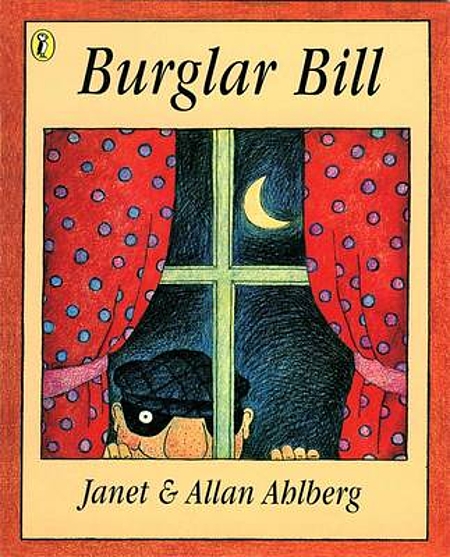
Janet and Allan Ahlberg, Burglar Bill (William Heinemann 1977)

Burglar Bill’s refrain ‘I’ll have that!’ became part of our family’s conversation. There’s something wonderful about the way he climbs in through windows and puts anything from a toothbrush to a can of beans into his sack. Spoiler alert: he takes home a box he finds outside a house, and discovers a baby inside it. Much merriment ensues as he tries to deal with the baby’s unstoppable crying.

It all turns out well (even bigger spoiler alert) when Burglar Bill is burgled by Burglar Betty who turns out to be the baby’s mother, both burglars decide to reform and end up marrying. But secretly we all just put up with the happy ending so we can have that wicked stealing in the first half. It may be a bit old for Ruby just yet, but she asks for it on repeat anyhow

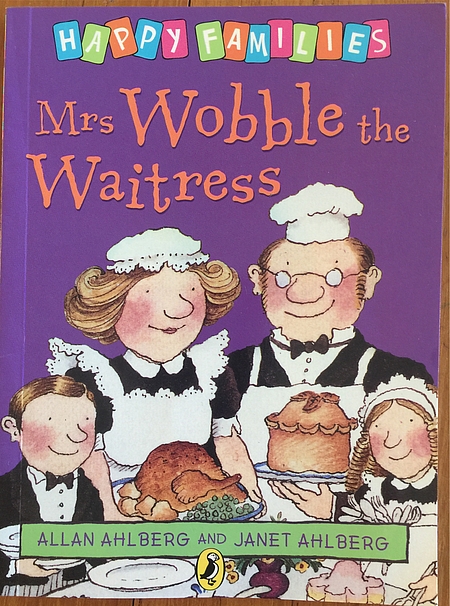
Janet and Allan Ahlberg, Mrs Wobble the Waitress (Puffin 1980)

I have Mrs Wobble the Waitress on order, but I wanted to mention it here because it was also a big hit with out young ones 30 or more years ago. It’s part of Allan Ahlberg’s Happy Families series – 20 books in all, many (most?) of them illustrated by his equally brilliant wife Janet Ahlberg. I don’t know if the Ahlbergs had the opening lines of Anna Karenina in mind when they named the series, but these happy families are definitely not all alike.

This book begins with a wonderfully inept adult – Mrs Wobble – whose clumsiness leads to her being fired from her job as a waiter. The family come to the rescue, and it all turns out well, but I confess that what has stayed in my mind is the book’s final line After the wobble family have set up their own successful restaurant, there’s an impending disaster: ‘Mrs wobble wobbled.’

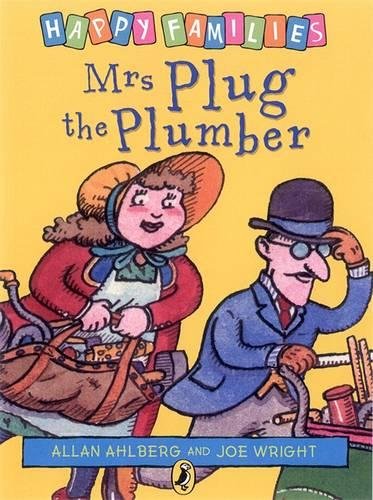
Allan Ahlberg and Joe Wright, Mrs Plug the Plumber (1980)

Mrs Plug the Plumber competes with Where the Wild Things for having the most neural pathways laid down in my brain. I read, ‘If a plumber was needed in the town, the people said, “Send for Mrs Plug!”‘ and I’m away. Mrs Plug is the mover and shaker. Mr Plug is the plumber’s mate, and Miss Plug and Master Plug are the plumber’s babies. Terrible things happen, and Mrs Plug rises to the occasion every time. Joe Wright’ illustrations, especially of the storm at sea, are brilliant, and the incantatory text is superb. Ruby loves this one, even including the somewhat scatological punchline. One small but significant pleasure for me is the appearance of Burglar Bill’s catchphrase, ‘I’ll have that’ in the scen where Mrs Plug turns the tables on a robber.

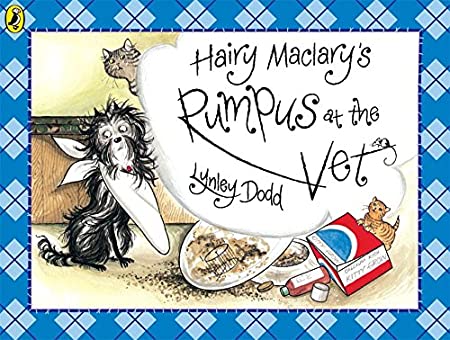
Lynley Dodd, Hairy Maclary’s Rumpus at the Vet (1989)

The first Hairy Maclary book, Hairy Maclary from Donaldson’s Dairy was published in 1983. According to Wikipedia the most recent, Scarface Claw – Hold Tight, appeared in 2017. Roughly 20 books in 35 years and as far as I know Lynley Dodd is still going strong and so are her gang of bouncily rhyming dogs and other animals.

Ruby has at least half the Hairy Maclary and Friends books. These are two of the four or five I enjoyed with her this week. Atypically, Hairy Maclary doesn’t have a starring role in this one: a cockatoo bites his tail in the vet’s waiting room, and there’s a chain reaction of disturbed animals: the dog, mice, budgerigars, kittens, a goat, an overwhelmed vet with her legs in the air. What more could anyone want? (Well, you could want the fabulously scary Scarface Claw to be lurking on the sidelines, an innocent bystander – and if you wanted that you wouldn’t be disappointed.)

Lynley Dodd, Hairy Maclary, Shoo (2009)

Hairy is centre stage in this one. It begins and ends with him playing with his friends, whose names (Bottomly Potts all covered in spots, and so on) have rung like a litany in some of the earlier books. But soon he jumps into a delivery van and is driven off in it. When poor Hairy Maclary jumps out of the van he is lost and every human he meets shoos him off. The lost dog’s panic is wonderfully rendered as comedy, but like all the best comedy the dark emotion isn’t completely extinguished. So the relief when he is found is huge.

Linley Dodd is a Dame Companion of the New Zealand Order of Merit. For having for so many decades paired evergreen, lively rhyming verse with precisely and lovingly portrayed dog behaviour, she richly deserves any honours she receives

NSW Premier’s Literary Awards Night

The NSWPLA night used to be a grand affair. Long before my time there was a bread-roll throwing affair when Morris West droned on too long in his acceptance speech. I got to be on the free list one year, then coughed up good money for a number of years after that, and one year I got to be the plus one of my shortlisted niece. It became less fun when it changed from being a full-blown dinner to a drinks and powerpoint affair, but I still followed it, at least on Twitter. (I dutifully blogged the event for quite a while, and if you really want to, you can plough through my blog posts for 2006, 2007, 2009, 2010, 2012, 2013, 2014, 2015, 2016 and 2017).

This year, thanks to the Great Leveller, SARS-Cov2, it was again possible to attend the whole event without stirring from home or spending a cent.

So here’s how it went:

After an elegant introduction by John Vallance, Chief Librarian, speaking to us from an empty Mitchell Library, President of the Library Council George Souris spoke from his home and introduced Gladys Berejiklian, who somehow found time off from crisis-management to record a short message. John Vallance then announced the winners without any frills apart from little speeches from a range of relevant politicians:

Multicultural NSW Award went to The Pillars by Peter Polites (Hachette Australia). Peter did a to-camera piece expressing gratitude to, among other things, his publisher’s bowties.

Nick Enright Prize for Playwriting: Counting and Cracking, S Shakthidharan and auxiliary writer Eamon Flack. The writer, the second from Western Sydney: ‘This award helps to weave this little story from Western Sydney into the tapestry of all the great Australian stories.’ Eamon Flack used his platform to contrast the ‘neglect and carelessness’ of current art policy with the years of policy that enabled Counting and Cracking to happen.

Betty Roland Prize for Scriptwriting: joint winners The Cry, Episode 2, Jacqueline Perske (Synchronicity Films), and Missing, Kylie Boltin (SBS). Kylie Boltin dedicated the award to her mother and grandmother. Her grandmother died yesterday.

Patricia Wrightson Prize for Children’s Literature: Ella and the Ocean, Lian Tanner, Jonathan Bentley (Allen & Unwin). Both author and illustrator spoke. She spoke of starting the book twelve years ago and then leaving it in the folder marked ‘Abject Failures’ for years. He, a humble illustrator: ‘Thank you for choosing me.’

Ethel Turner Prize for Young People’s Literature: Lenny’s Book of Everything, Karen Foxlee (Allen & Unwin). Karen said, ‘I want to use this platform to thank readers everywhere who continue to buy books in these times. I want to thank everyone who supports the arts.’

Kenneth Slessor Prize for Poetry: Enfolded in the Wings of a Great Darkness, Peter Boyle (Vagabond Press). Peter Boyle paid tribute to his late partner Debora Bird Rose (herself a great writer).

Indigenous Writers’ Prize: The White Girl, Tony Birch (University of Queensland Press). Tony Birch gave a shout out to ‘every Blackfella across Australia who is writing’.

Douglas Stewart Prize for Non-Fiction: from 136 entries, the winner was Tiberius With a Telephone, Patrick Mullins (Scribe Publications), a book about William McMahon. Patrick Mullins, looking scarily young, acknowledged his debt to writers and journalists whose work was important to his, and to the many people he interviewed.

UTS Glenda Adams Award for New Writing: Real Differences, SL LIM (Transit Lounge). SL LIM looked even younger, with pink hair and a soft toy, and plugged her coming book, which (I think I heard correctly) calls for the end of the family.

Fiction (Christina Stead Award): The Yield, Tara June Winch (Penguin Random House). Tara June Winch spoke of the centrality of language to human life. ‘It is a sacred thing,’ she said, in Wiradjuri. The Yield also won the People’s Choice Award and the Book of the Year. Tara June Winch got to speak again, and spoke of her esteem and fellow feeling for the other writers having a hard time just now. She asked the Federal Government to treat ‘our sector’ as our families do. ‘We can’t tell you the story of what is happening to our country now if the only thing on our minds is how to afford the next week’s rent.’ She hopes that our First Languages will be included in our schools’ curriculum.

That was it. It turns out that though I’d read a couple of the shortlisted books, I hadn’t read a single one of the winners, and had seen only one of the performances – the absolutely stunning Counting and Cracking.

You can watch the whole ceremony at:

I think of Mierle Laderman Ukeles

I’ve been thinking of Mierle Laderman Ukeles a lot in recent weeks. At the supermarket checkout, passing the post deliverer in the street, receiving a hand-delivered book from Gleebooks, putting the garbage out for collection, seeing a childcare centre that has stayed open, and especially when being tested for Covid–19 by a young man in a mask and a blue gown several sizes too big for him, I feel the urge to say, ‘Thank you for keeping us alive,’ and think of her.

Mierle Laderman Ukeles {Wikipedia entry here) has been the unsalaried artist in residence at the New York City Department of Sanitation since the late 1970s. I first heard of her when the Emerging Artist was doing her MFA and regaling me with stories of public art projects. One of them was Ukeles’ Touch Sanitation. In this performance art project, she spent eleven months in 1979–1980 visiting each of the New York Sanitation Department’s districts and shaking hands with every worker who would accept her handshake, roughly 8500 of them. She looked each worker in the eye and said, ‘Thank you for keeping New York City alive.’

The conversations didn’t stop there – she also listened to the workers, and documented their personal stories. There are some wonderful photos (for example, here, here, here and here).

Plenty of people have commented that in Covid-19 times the poorly paid, low-esteem jobs are being recognised as essential and offered more respect if not better remuneration. Artists help us make sense of our times. Mierle Laderman Ukeles did this major performance 40 years ago: it speaks directly to our circumstances now.

Natalie Harkin’s Archival-Poetics

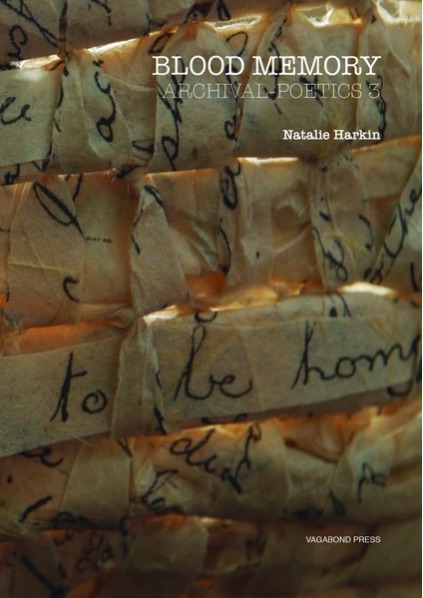
Natalie Harkin, Archival-Poetics (Vagabond Press 2019)

This is an extraordinary book. To quote from the eloquent and accurate cover blurb:

Archival-Poetics is an embodied reckoning with the State’s colonial archive and those traumatic, contested and buried episodes of history that inevitably return to haunt … Family records at the heart of this work highlight policy measures targeting Aboriginal girls from removal into indentured domestic labour

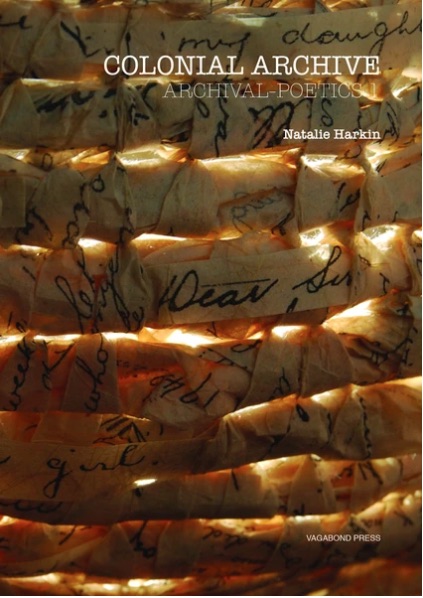
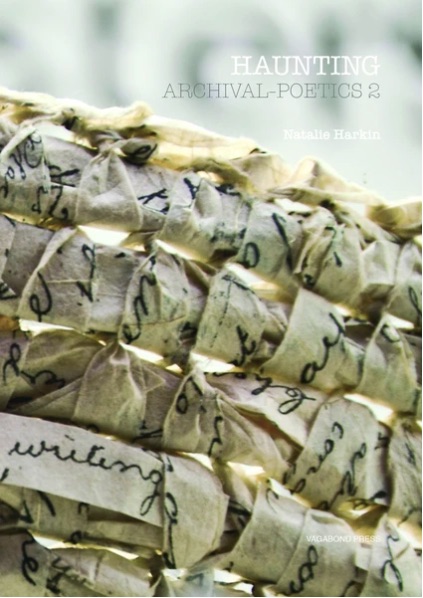
I like that word ’embodied’. There have been many books that are based on archival research, and more than a few that describe the process of archival research, including research into the history of the stolen generations and stolen wages. This book – actually three very slim books in a slipcase – takes the reader into the experience. The titles of the three books – ‘Colonial Archive’, Haunting’ and ‘Blood Memory’ – indicate the process of increasing immersion into the poet’s family history: first there are narratives to be read and decoded, then as the imagination engages further it is as if those young women are returning like ghosts from the past, and finally, a realisation that there is a deeper richer connection, a sense of belonging.

Archival-Poetics is categorised as poetry, and has deservedly won or been shortlisted for a number of poetry prizes. But, like African-American Claudia Rankine’s Pulitzer-winning Citizen, it pushes well past the generally understood boundaries of that category. There’s a lot of straightforward prose. Natalie Harkin writes of ‘an unassuming warehouse holding the State’s Aboriginal Records archives’ – the State, in this case, being South Australia, in Kaurna country. She reflects on the nature of memory, official records and oral history. There are excerpts from government documents, Aboriginal people’s personal letters, newspapers and women’s magazines. There are brilliantly apposite quotes from other Aboriginal artists (Julie Gough, Judy Watson, Vernon Ah Kee). French theory is invoked – and for what it’s worth, this is the first time I’ve read a Jacques Derrida quote that makes me want to read its source. And there are images of artworks, including the three cover photographs of a basket woven from torn up photocopies of letters from the archives.

A lot of the poetry lies in the juxtaposition of these elements. For example, page 28 of the second book, gives two would-be amusing anecdotes from The Australian Woman’s Mirror in the 1920s: vile, condescending references to Aboriginal girl servants. At the top of page 29, there’s a brief quote from the Australian Aborigines Progressive Association from the same time beginning ‘… girls of tender age and years are torn away from their parents’, and beneath that, this poem, as if a song is wrung from the archive reader’s heart:

APRON SORROW
apron-folds and pockets --- keep secrets
--pinned--- tucked-- hidden
------they whisper into linen-shadows-- that flicker-float with the sun 
------------– hung -
--------- limp on the breeze they sway
------------------------------------- a rhythmic sorrow.

There are ‘odes’ – rhyming poems, but laid out without line breaks, so that the reader is invited to slow down and unearth the verse form, in a process analogous to the way a researcher has to unearth information from impersonal bureaucratic language. Three austerely modern sonnets in ‘Hauntings’ tell three girls’ stories.

A series of prose poems, ‘Memory Lessons’, form a kind of philosophical backbone, with almost Proustian reflections on the nature of memory. The third book ends with a letter that begins, ‘Dear Nana’.

I hope that gives you some idea of this book. It contains hard truths about Australia’s history, and the conveys pain of unearthing them in their particularity. The form isn’t always easy for people not at ease with contemporary poetics, but it’s not difficult for its own cryptic-crossword-like sake. And it’s physically gorgeous – hats off to Michael Brennan of Vagabond Books for a brilliant design.

Archival-Poetics is the seventh book I’ve read for the 2020 Australian Women Writers Challenge.

Neel Mukherjee’s State of Freedom

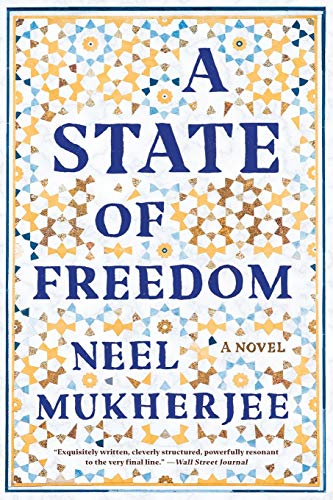
Neel Mukherjee, A State of Freedom (W W Norton & Co 2019)

Short stories don’t sell. At least, I believe that’s the prevailing wisdom among publishers. That’s probably why this excellent collection of short stories – or more accurately three short stories and two novellas – has been marketed as a novel. Still, if that’s what it takes to draw readers in, then why not?

All the stories happen in India, though they are five different Indias. An expat returns from the USA with his seven-year-old son, and takes him to see the Taj Mahal and Fatehpur Sikri; another expat, this one from England, visits his parents and gets to know their cook; a man from a poor village goes on the road with a dancing bear; a girl from another poor village is sent off to a life of domestic servitude in ever bigger and further away cities, while her best friend joins the Maoist guerrillas; a man suffering from asbestosis does dangerous construction work in a city far from his home village.

All the protagonists are dislocated. Some of them turn up as minor characters in another’s story: the bear man is the twin brother of the man with asbestosis, and both of them, having left home intending to send money back, have left their wives and children to fend for themselves. The cook in the second story has it in for another servant, who turns out to the the girl in the fourth story.

These are grim stories. The first starts out like a mini-travelogue, though one with a dark cloud over it, and ends with devastating heartbreak; in the second, what might have been a piece of food-tourism comes hard up against the desperation of the poor; and in the rest, the harsh inequalities of class destroy people’s lives. There’s a Reading Group Guide up the back of my copy, which I skimmed. These notes insist that this is a novel with a brilliant structure. Perhaps they’re referring to the way the stories are ordered as a descent into ever more desperate situations.

It’s a grim book, and a beautifully written one. There’s some romance, some intrigue, some terrible domestic violence and cruelty to animals, but also kindness and a glimmering promise that things might improve.

I’ve read it during the Great Covid–19 Lockdown, and am writing this with cold symptoms waiting in strict isolation for the results of a Covid test [test came back negative about six hours after I wrote that]. Without wanting to trivialise the situation of the character, here’s a passage that seems to speak to my current situation and may give you a feel for the writing, and also a sense of the irony in the book’s title. Milly, the protagonist, is working as a maid in Mumbai, and her employers have forbidden her to leave the apartment block:

It was not that she needed to go out – where would, could, she go, in this endless city, without knowing anyone? – but something so fundamental denied is that thing made disproportionately enormous, consuming, and she began to think of herself as a caged bird, defined by the fact of nothing except its imprisonment …

She experienced a new feeling, at night, of the kitchen walls inching forward slowly from all four sides to crush her, lying in the middle. Their hut in the village had been tiny and eight of them had to sleep together, huddled, but she had never thought of that as small. Besides, there was always the great open outside – fields, forests, groves, river bank. The idea of space of something small or big, something that could be reduced, had never occurred to her, not even on the train, in the general compartment so dense with people that the air had sometimes felt too thick to breathe. not even in that battery-cage had the thought ever crossed her mind that ‘this is too small’. Now, in a Mumbai flat bigger than any house she had ever known, she felt trapped and squeezed.

(Page 228)

Sound at all familiar?

My copy of A State of Freedom is a loan from my book-swapping club.

Proust Progress Report 8: The Cities of the Plain

Marcel Proust, À la recherche du temps perdu (text established under the direction of Jean-Yves Tadié ©1987–1992): The last 100 pages of Book 3, Le côté de Guermantes, seconde partie, and the first 80 pages of Book 4, Sodom et Gomorrhe

I’m reading À la recherche du temps perdu five pages a day, mostly without a dictionary and therefore with limited comprehension. Currently, as I’m making my way through seemingly endless accounts of more or less random encounters at a range of social events, I’m quite enjoying it moment by moment, but if there’s a forest I can’t see it for the trees.

The main thing in the pages that I’ve read this month is that M de Charlus has come into the foreground. He’s the close relative of the dazzling Oriane de Guermantes who visited the narrator’s bedroom at Balbec in the second volume, and creepily stroked his chin the next day (as I mentioned in my third progress report, here).

In Le côté de Guermantes, the narrator is invited to M. de Charlus’ home late at night, where he is taken completely by surprise by an angry tirade. Thinking the M. de Charlus is accusing him of slandering him, the narrator swears that he has never said anything that could have offended him. What follows, though deranged, is a fabulous model for how to respond to a faux apology of the ‘I apologise for any offence my remarks may unintentionally have given’ kind:

— Et qui vous dit que j’en suis offensé?» s’écria-t-il avec fureur … «Pensez-vous qu’il soit à votre portée de m’offenser? Vous ne savez donc pas à qui vous parlez? Croyez-vous que la salive envenimée de cinq cents petits bonshommes de vos amis, juchés les uns sur les autres, arriverait à baver seulement jusqu’à mes augustes orteils?»

(Page 1173)

In English (from this link, with one or two changes by me):

‘And who told you I am offended?’ he screamed in fury … ‘Do you suppose that it is within your power to offend me? So you do not know to whom you are speaking? Do you imagine that the envenomed spittle of five hundred little gentlemen like you and your friends heaped one upon another would manage to slobber even as high as my august toes.’

Sodome et Gomorrhe (usually called The Cities of the Plain in English, primly avoiding the suggestion of sodomy, though that suggestion is clearly intended by Proust) gets off to a riveting, though still Proustily longwinded, start with a revelation about M. de Charlus. A 21st century reader will have gathered, or at least suspected, that M. de Charlus is homosexual well before now. But it comes as a revelation to our narrator when he sees him in an erotic encounter – well, he hears the heavy-duty erotic bit through a wall; what he sees is a weird bit of strutting and flouncing that precedes it.

After this revelatory moment, Proust goes off on a mini-essay about homosexuality. Apart from conflating homosexuality and gender fluidity, his reflections about the psychic damage done by the need for secrecy has aged amazingly well. He draws a parallel to Jews and antisemitism: in both cases it’s possible to ‘pass’ and man do. He describes the way internalised oppression can lead men (so far he’s talking almost entirely about men) who are in the closet to penalise and exclude anyone who is openly gay. While it’s not clear whether he thinks Zionism is a good idea, he’s emphatically against the idea of a movement to rebuild Sodom as a homeland for ‘Sodomites’, because:

Or, à peine arrivés, les sodomistes quitteraient la ville pour ne pas avoir l’air d’en être, prendraient femme, entretiendraient des maîtresses dans d’autres cités où ils trouveraient d’ailleurs toutes les distractions convenables. Ils n’iraient à Sodome que les jours de suprême nécessité, quand leur ville serait vide, par ces temps où la faim fait sortir le loup du bois, c’est-à-dire que tout se passerait en somme comme à Londres, à Berlin, à Rome, à Pétrograd ou à Paris.

In English:

For, no sooner had they arrived than the Sodomites would leave the town so as not to have the appearance of belonging to it, would take wives, keep mistresses in other cities where they would find, incidentally, every diversion that appealed to them. They would go to Sodom only on days of supreme necessity, when their own town was empty, in the times when hunger drives the wolf from the woods; in other words, everything would go on very much as it does to-day in London, Berlin, Rome, Petrograd or Paris.

That gives you some idea of the delicate path he treads between serious and interesting analysis and satirical barbs.

But then he goes to another party and we’re back on the subject of the glittering high society that he partly despises and mostly is entranced by. In his newly illuminated state, he notices and remarks wickedly on a number of homoerotic currents. For instance, M. de Charlus makes a big fuss of the woman who is his brother-in-law’s latest mistress, even though everyone would expect him to snub her. The reason for this unexpected behaviour is not, as the narrator’s friend Robert de Saint-Loup, back in town for the evening, is convinced, because his uncle Palamède is a womaniser, but because, as the narrator has told us, the woman in question has two strikingly beautiful sons, whose beauty is reflected in their mother’s.

There’s more. There’s lots more. There are amusingly vicious character sketches, lyrical descriptive passages, surprising asides about the nature of memory, insights into human folly sharp observations about Dreyfusards and antisemitism and, just once so far, a direct address to the reader who the narrator (correctly) assumes wants him to cut to the chase and get on with the story. I’m once again reassured by Clive James’s remark that having read À la recherche in French he then read it in English to find out what he’d read.