Tag Archives: ABC

NSWPLA and NSWPHA Dinner

I didn’t expect to attend a NSW Premier’s Literary Awards Dinner this year. For a while back there it looked as if the awards might go the way of the Queensland equivalent, but the Liberal Party-approved panel’s unpublished report must have come down in favour of continuation, because here they were again last night, six months late, run by the State Library rather than the Arts NSW, charging $200 [but see Judith Ridge’s comment] for a book to be considered, and sharing the evening with the History Awards, but alive and kicking. And pretty special for me, because I got to go as my niece’s date, my niece being Edwina Shaw, whose novel Thrill Seekers was shortlisted for the UTS Glenda Adams Award for New Writing.

The dinner was held in the magnificent reading room of the Mitchell Library. Not everyone approved of the venue – I was in the Research Library in the morning when a woman complained very loudly that she had driven the four hours from Ulladulla only to find the Mitchell’s doors were closed for the day so it could be converted into a banquet hall. She must have been placated somehow because she stopped yelling, but there were other problems. None of the shortlisted books were on sale – Gleebooks had a table at this event for years [but see Judith Ridge’s comment], as the Library has its own shop, which wasn’t about to stay open late just for us. And library acoustics aren’t designed for such carryings-on: the reverberation in the vast, high-ceilinged room made a lot of what was said at the mike unintelligible at the back of the room. But those are quibbles. It’s a great room with happy memories for a good proportion of the guests.

Aunty Norma Ingram welcomed us to country, inviting us all to become custodians of the land.

Peter Berner was the MC. He did OK, but organisers please note: the MC of an event like this needs to be literate enough to pronounce Christina Stead’s surname correctly.

The Premier didn’t show up. Perhaps he was put off by the chance of unpleasantness in response to his current attack on arts education. The awards were presented by a trio of Ministers, one of whom read out a message from the Premier saying, among other things, that art in all its forms is essential to our society’s wellbeing. But this was a night for celebrating the bits that aren’t under threat, not for rudely calling on people to put their money where their mouths are.

The Special Award, sometimes known as the kiss of death because of the fate met by many of its recipients soon after the award, went to Clive James – whose elegant acceptance speech read to us by Stephen Romei necessarily referred to his possibly imminent death. He spoke of his affection for New South Wales, of his young sense that Kogarah was the Paris of South Sydney, and his regret that he is very unlikely ever to visit here again. He also said some modest things about what he hoped he had contributed.

After a starter of oyster, scampi tail and ocean trout, the history awards:

NSW Community and Regional History Award: Deborah Beck, Set in Stone: A History of the Cellblock Theatre
The writer told us that the book started life as a Master’s thesis, and paid brief homage to the hundreds of women who were incarcerated in early colonial times in the Cellblock Theatre, now part of the National Art School.

Multimedia History Prize: Catherine Freyne and Phillip Ulman,  Tit for Tat: The Story of Sandra Willson
This was an ABC Radio National Hindsight program about a woman who killed her abusive husband and received  lot of media – and wall art – attention some decades back. Phillip Ulman stood silently beside Catherine Freyne, who urged those of us who enjoyed programs like Hindsight to write objecting to the recent cuts.

Young People’s History Prize: Stephanie Owen Reeder, Amazing Grace: An Adventure at Sea
This book won against much publicised Ahn Do on being a refugee (The Little Refugee) and much revered Nadia Wheatley on more than a hundred Indigenous childhoods (Playground). It not only tells the story of young Grace Bussell’s heroic rescue of shipwreck survivors but, according to the evening’s program, it introduces young readers to the ‘basic precepts of historical scholarship’. It also looks like fun.

General History Prize: Tim Bonyhady, Good Living Street: The Fortunes of My Viennese Family
A member my book group rhapsodised about this book recently, comparing it favourably to The Hare with Amber Eyes. It’s a family history, and in accepting the award Bonyhady told us it had been a big week for his family because the lives of his two young relatives with disabilities would be greatly improved by the National Disability Insurance Scheme introduced by the Gillard government.

Australian History Prize: Russell McGregor, Indifferent Inclusion: Aboriginal People and the Australian Nation
This looks like another one for the To Be Read pile. Russell McGregor acknowledged Henry Reynolds and Tim Rowse as mentors.

After a break for the entrée, a creation in watermelon, bocconcini and tapenade, it was on to the literary awards:

The Community Relations Commission Award: Tim Bonyhady was called to the podium again for Good Living Street, but he’d given his speech, and just thanked everyone, looking slightly stunned.

The newly named Nick Enright Prize for Drama was shared between Vanessa Bates for Porn.Cake. and Joanna Murray-Smith for The Gift. Perhaps this made up to some extent for the prize not having been given two years ago.
Joanna Murray-Smith said she learned her sense of structure from the Henry Lawson stories her father read to her at bedtime. As her father was Stephen Murray-Smith, founding editor of Overland, she thereby managed to accept the government’s money while politely distancing herself from its politics. She lamented that her play hadn’t been seen in Sydney and struck an odd note by suggesting that the Mitchell Library and a similarly impressive building in Melbourne may have been the beginning of the Sydney–Melbourne rivalry: I wonder if any Sydney writers accepting awards in Melbourne feel similarly compelled to compete. Vanessa Bates couldn’t be here, so her husband accepted her award, with his smart phone videoing everything, perhaps sending it all to her live.

The also newly named Betty Roland Prize for Scriptwriting (and I pause to applaud this conservative government for honouring an old Communist in this way): Peter Duncan, Rake (Episode 1): R v Murray
Peter Duncan gets my Speech of the Night Award. He began by telling the junior minister who gave him the award that he was disappointed not to be receiving it from Barry O’Farrell himself, because he had wanted to congratulate Barry on the way his haircut had improved since winning the election. At that point we all became aware that Peter Duncan’s haircut bears a strong resemblance to the Premier’s as it once was. He then moved on to congratulate the Premier for instituting a careful reassessment of the Literary Awards and deciding to persevere with them. He expressed his deep appreciation of this support for the arts. (No one shouted anything about TAFE art education from the floor. See note above about this being an evening to celebrate the bits that aren’t under threat.)

The Patricia Wrightson Prize for Children’s Literature: Kate Constable, Crow Country (Allen & Unwin)
I hadn’t read anything on this shortlist, I’m embarrassed to confess. It looks like a good book, a time-slip exploration of Australian history.

The Ethel Turner Prize for Young People’s Literature: Penni Russon, Only Ever Always (Allen & Unwin)
Again, I hadn’t read any of the shortlist. But Bill Condon and Ursula Dubosarsky were on it, so this must be pretty good! Penni Russon’s brief speech referred to the famous esprit de corps of Young Adult writers: ‘You guys are my people.’

There was break for the main course to be served, and for about half the audience go wander and schmooze. I had the duck, the two vegetarians on our table were served a very fancy looking construction, only a little late. Then onward ever onward.

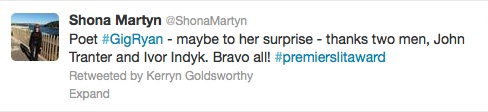
The Kenneth Slessor Prize for Poetry: Gig Ryan, New and Selected Poems
Again, I hadn’t read any of the shortlisted books, but wasn’t surprised that Gig Ryan won, as this is something of a retrospective collection. She speaks rapidly and her speech was completely unintelligible from where I was  sitting (like some of her poetry). However, someone tweeted a comment that got laughs from the front of the room:
tweet

The Douglas Stewart Prize for Non-fiction: Mark McKenna, An Eye for Eternity: The Life of Manning Clark
Another lefty takes the government’s money, and a good thing too.

The UTS Glenda Adams Award for New Writing: Rohan Wilson, The Roving Party (Allen & Unwin)
I know nothing about this book. Rohan Wilson is in Japan just now. His agent told us that when she asked him for an acceptance speech ‘just in case’, he emailed back, ‘No way I’ll win – look at the calibre of the others.’ The three writers on my table who were in competition with him seemed to think it was a fine that it had won:
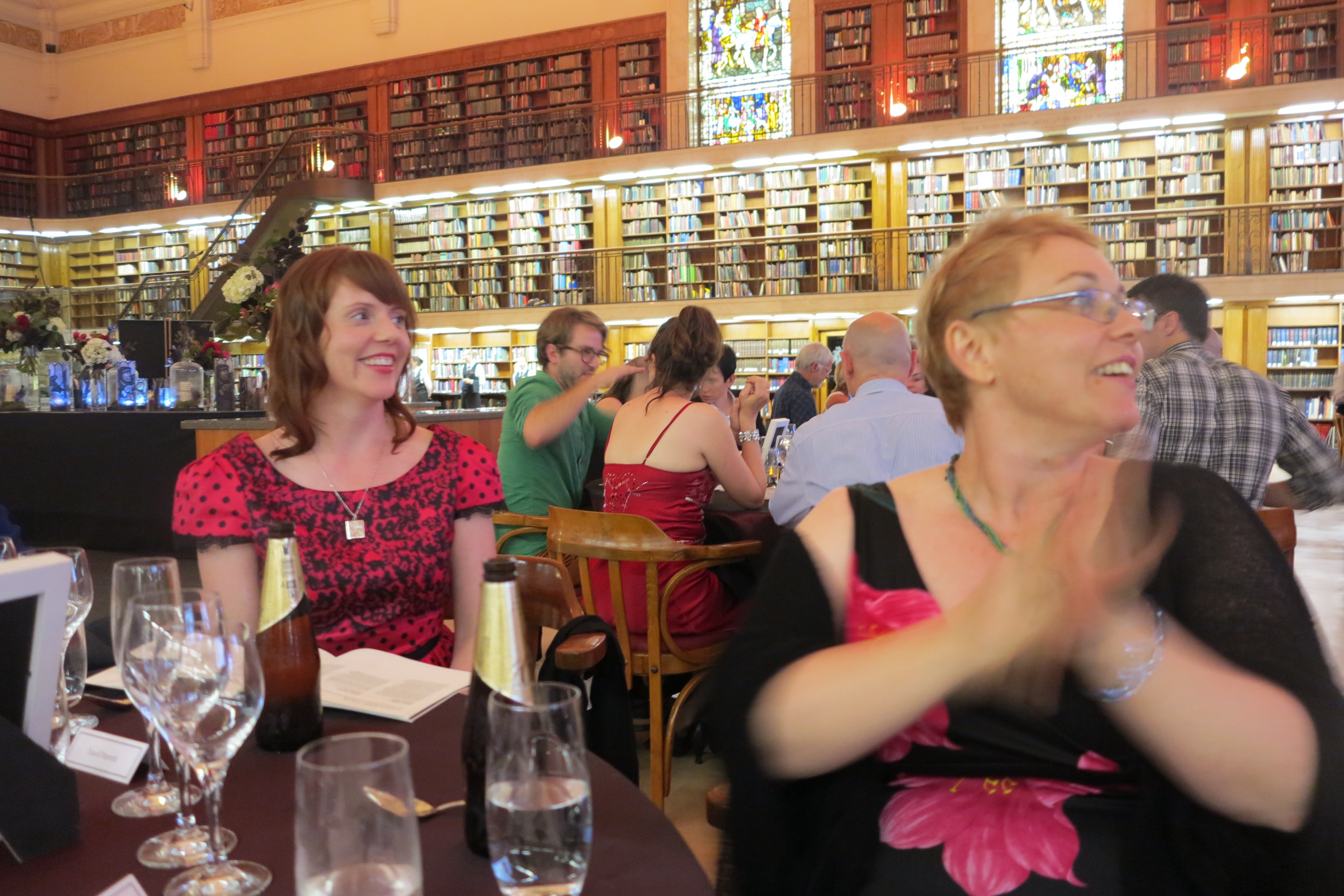
Favel Parrett and Edwina Shaw respond to not winning the UTS Glenda Adams Award for New Writing

Favel Parrett and Edwina Shaw respond to not winning the UTS Glenda Adams Award for New Writing

The Christina Stead Prize for Fiction was almost an anti-climax. It went to Kim Scott for That Deadman Dance. We had a small bet going on my table, and I won hundred of cents. Kim Scott’s agent accepted on his behalf.

There was dessert, layered chocolate and coffee cake, then:

The People’s Choice Award, for which voting finished the night before, went to Gail Jones for Five Bells. She was astonished, genuinely I think, and touched that her book about Sydney as an outsider should be acknowledged like this. I haven’t read the book yet, but I’m also a bit astonished, because what I have read of her prose is not an easy read.

Book of the Year: Kim Scott, That Deadman Dance. No surprise there!

No surprise, either, that the award to Clive James overshadowed all the others in the newspaper reports.

I believe that the judging panel for next years literary awards has had its first meeting. The dinner will move back to the Monday of the week of the Writers’ Festival, where it belongs.

Added later: Edwina has blogged about the evening.

SWF: A C Grayling, curtain raiser

‘The Private, the Public and the Line Between’, a lecture by A C Grayling

This was the start of my 2012 Sydney Writers’ Festival. I’ve become accustomed to starting the Festival with the Premier’s Literary Awards dinner, which is always a good night out, though the last two had become a bit corporate. This year the awards evening has been moved to later in the year (not, as feared by some, cancelled altogether), so my Festival begins with this 90 minute event at the Angel Place Recital Centre a month or so ahead of the Opening Address. I’m calling it a curtain-raiser because that ‘s how Peter Shergold (from the SWF Board) described it when introducing the talk, but really it was more of an advance scatterling.

A C Grayling is the very picture of an urbane philosopher. He spoke lucidly for an hour without notes, and fielded questions deftly and courteously. Sadly I slept for maybe as much as half the talk, so I’m not a reliable reporter. But I quizzed my four companions over dinner at the nearby Wagamama and my impression is that I didn’t miss a lot by dozing off. Basically, Professor Grayling told us, we are being watched by Internet corporations who track our online activities for commercial purposes, by government for security purposes, and by journalists for partly public interest and partly commercial interests, and that this isn’t a good thing. I have listened to his interview with Richard Glover on the ABC, which is an excellent 18 minutes of radio and includes everything that the $25 lecture had to offer, including the teasing references to the Professor’s impressive hair. What we got for our money was the sense of occasion, a chance to play Spot the Famous Person (both the Art Student and I saw David Marr and Annette Shun Wah, but some of our other companions hadn’t heard of either of them, which rather spoiled the thrill).

If the purpose of a talk by a philosopher is to prompt one to think, then this one was a big success for me. During the question time, Professor Grayling talked about a village in southern Italy where, when a husband and wife have a quarrel the woman runs out into the street and the couple proceed to shout at each other, while all the neighbours come to their doors and windows to listen. These people, he said, live with a strong sense of community but at the cost of losing their privacy. That raises a much more interesting question about ‘The Private, the Public and the Line Between’ than the question of intrusion by the state, corporations and the press. I would have thought that that kind of intrusion is obviously a bad and dangerous thing – and of course that it’;s a good thing to have the dangers pointed out. But don’t we then need to think carefully and precisely about what it is that we’re protecting. Are we protecting our right to be isolated individuals, to have secrets and present a conforming face to the world? Sure, those young people who give out far too much information on facebook or twitter may be laying themselves open to attack, but isn’t also worth asking if there’s not something utopian about that rather than simply foolish? That’s what I’d have liked to hear him talk about.

Jennifer Maiden on Poetica

Radio National’s Poetica was dedicated to Jennifer Maiden on Saturday (to be repeated on Thursday evening). It can be heard at this link:

Pirate Rain

Alice Parkinson and William Zappa read a number of poems from Pirate Rain lucidly (though words like insouciant and equinoctial tripped up the former’s tongue, and the line breaks do something on the page that it seems might be impossible to replicate in reading aloud), and there’s some commentary from the poet, which helps with the George Jeffreys / Clare Collins poems (which on this hearing sound to me like part of an ongoing novel). Maiden talks about the way fiction allows her to come closer to her own self than a lyrical poet–persona would.

Poetica and me

If you have no other pressing engagement at 3 o’clock in the afternoon on 29 October, or on 3 November, or both, you might do worse than listen to Poetica on the ABC. Poetica is broadcast every week at those times, but that particular program will include a reading of one of my poems, and I couldn’t be more thrilled. Beyond that, all I know is that the program is entitled Hearing.

Cate Kennedy’s taste of river water

Cate Kennedy, The Taste of River Water (Scribe 2011)

When Cate Kennedy read, marvellously, from this book at the Sydney Writers’ Festival, she described her poems as meditations through narrative, and that’s a nice description. Her poems generally have a narrative thread, whether it’s the story of the woman who wins second prize in a photography competition in ‘8 x 10 colour enlargements $16.50‘ or the moving hand of a baby at the breast in ‘Dawn service’.

Mostly this is no-frills poetry: very little by way of formal rhyme schemes, and even less prosodic adventure – no clever enjambement, uncanny syntax, esoteric allusion. Almost universally, the cadences and imagery are those of conversation, sometimes intensely intimate but always intelligent, generous and emotionally engaged. There’s an attention to fleeting moments, to things easily overlooked: a tight smile, a gesture accidentally caught on camera, a detail from a larger narrative, a parent’s childhood memory, a tiny act of wanton cruelty. These become the subject for meditation, their meanings explored. Many of the poems can be read as reflections on art and communication, though the immediate subjects range from the laying of a brick path to being caught in a rip, and include a locust plague coming to the city, a little girl dancing in a square of sunlight, or the auction of the contents of a deconsecrated church.

What I wasn’t prepared for was that the sixteen poems in the second section of this book constitute what Frank Moorhouse used to call a discontinuous narrative: each poem stands alone, but there are lines, even words (a throat-tightening ‘again’ in ‘Thank you’, for instance) that gain tremendous force from their place in the sequence. Although it’s in many ways a very different beast, I was reminded of Sarah Gibson’s wonderful short lyric film The Hundredth Room.

Cate Kennedy read some of the poems and chatted with Ramona Koval on the Book Show on 19 May. It’s worth a listen, but be warned that the conversation reveals quite a lot about Section 2. Not that there’s a twist to the tale or anything of the sort – but there’s something to be said for letting a narrative reveal itself to you rather than approaching it with foreknowledge.

Re-enchantment is live

Re-enchantment, an interactive website exploring the history and meanings of seven of the best known fairy tales that has been a very long time coming, was launched yesterday and is now live on the ABC, at http://re-enchantment.abc.net.au/re-enchantment.html. I’ve had a quick look at the finished product, and though I have seen various beta versions, I was blown away. It’s gorgeous to look at, and the content is intriguing. Even the mechanics – working out which sparkly or moving images to click on and seeing where they take you – are great, allowing staid old folk like me a chance to share the thrill we’ve witnessed over young gamers’ shoulders. Some bits are slow to load on my computer, but that’s a minor irritation.

I’ve just programmed my TV to record the interstitial shorts being shown on the ABC over the next couple of weeks. In case you want to keep an eye out for them as well, and bearing in mind that the ABC may vary its schedule in response to teh next natural or political disaster, they’re:

Episode 1: Ever After (ABC1 Sunday 6 March, 4.30 pm)

Fairy tales, sometimes called wonder tales, have existed for thousands of years before they appeared as children’s stories. Why have they continued to appeal to adults across continents and across cultures?

Episode 2: If the Shoe Fits (ABC1 Sunday 6 March, 10.30 pm)

Cinderella is one of most popular fairy tales. Why has it survived for over a thousand years?

Episode 3: Wicked Stepmothers (ABC1 Friday 11 March, 10.55 pm)

Fairy tales are full of evil stepmothers and wicked witches. Why have these negative portrayals of women survived?

Episode 4: Princess Culture  (ABC1 Sunday 13 March,  2.55 pm)

Are fairy tales responsible for our fantasies about princes and princesses?

Episode 5: Into the Woods (ABC1 Sunday 13 March, 10.30 pm)

Why is it that so many fairy tales take us into the forest?

Episode 6: Dark Emotions (ABC1 Friday 18 March, 10.55 pm)

Is it the dark side of fairy tales that makes them so valuable psychologically?

Episode 7: Beastly Husbands (ABC1 Sunday 20 March, 4.55 pm)

Animal bridegroom stories where a woman marries an animal husband exist in most cultures. Why have these stories been so popular?

Episode 8: The Forbidden Room (ABC1 Sunday 20 March, 10.30 pm)

The mystery beyond the door is a very familiar motif to modern audiences. What is the meaning of the forbidden room?

Episode 9: Fairy Tale Sex (ABC1 Friday 25 March, 10.55 pm)

Romance, princes and princesses are all associated with fairy stories, but what do they say about sex?

Episode 10: Re-imaginings (ABC1 Sunday 27 March, 10.30 pm)

Fairy stories aren’t relics of the past. They are constantly being re-interpreted in new ways by visual artists and writers.

Re-enchantment coming soon

No time to blog. No time to catch up with emails. Moving house. All is well. Probably.

I’ve just sat down to my email for the first time in days, and found notice that my friend Sarah’s brilliant, interactive web site, Re-enchantment, is to be launched in March. There’s a three minute trailer on the ABC site. I can’t embed it, sorry, but do click on the link.

The official launch will be at the Adelaide Film Festival at the Palace Cinema on Wednesday 2 March at 5.00pm –  a free event open to the public. The website will go live on the ABC that same day.

The Australian Centre for the Moving Image in Melbourne will host a two-day Re-enchantment Symposium on Thursday 10 and Friday 11 March 2011, called Fairy Tales Re-imagined: From Werewolf to Forbidden Room.

There will be Sydney launch on the evening of Thursday 24 March at the Surry Hills Library.

Preincarnate

Shaun Micallef, Preincarnate: A novella (Hardie Grant 2010)

Shaun Micallef is a comedian who affects a kind of supercilious gaucherie, a little like Stephen Fry without the erudition or the authentic blue-ribbon class credentials. I’ve mainly seen him on television, and been amused, though not enough to make me watch  Talkin Bout Your Generation, the TV game show he MCs, unless by accident.

This book was a Christmas present from a friend who doesn’t watch a lot of television and was enticed by the stylishly witty cover. I gladly accepted it as a challenge to my prejudices. Sadly, I gave up a third of the way through, my prejudices unallayed. There’s quite an interesting plot involving time travel, culminating (I peeked at the last couple of pages) in logically determined absurdities redolent of the climactic scenes of excellent farces. My problem was that the writing was constantly striving to be ‘funny’, interrupting itself with strenuous jokeiness or sketch-comedy interludes. For example, in a seventeenth century context:

Moray wore a parrot hidden under his vest during all his subsequent meetings with the Dutch émigré , and every conversation recorded by the parrot was later transcribed. It was an arduous process. The parrot had a learning difficulty and Moray would often have to trick Leeuwenhoeck into repeating entire conversations, sometimes fifteen or twenty times. eventually, enough evidence was amassed to establish a prima facie case.

It goes on with the parrot shooting himself out of guilt, and none of it moving the plot forward perceptibly. Funny, if you’re in the mood. Otherwise annoying.

Clive James doesn’t like to be thought of a comedian, and has said so in a number of places, including in an interview with Peter Thompson on ABC TV’s Talking Heads:

I’m not really a comedian and I don’t even tell jokes. If I do anything funny it’s because I’ve expressed something real in a very short space. The result is, if you make an article interesting enough on that level … So you’re saying something complex but some of it comes out funny, and you get this reputation as a comedian, then journalistically these two reputations get in each other’s road. ‘He can’t be serious because he’s funny,’ ‘He can’t be funny because he’s serious.’

I hope I’m wrong, but it looks to me as if Shaun Micallef has bought into that journalistic dichotomy, and opted for funniness at the expense of all else.

Coming soon to ABC on the web

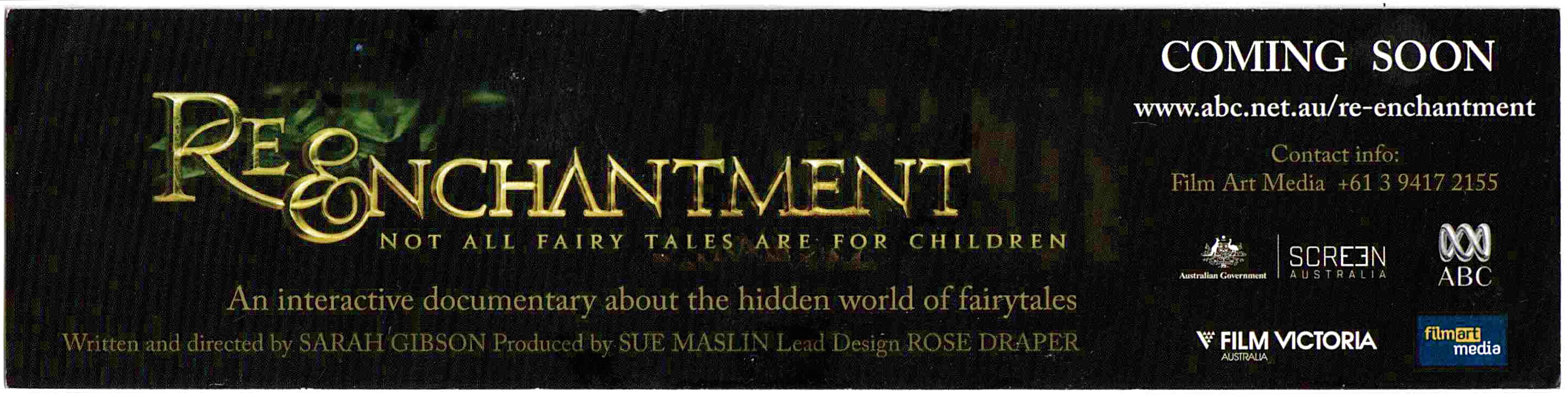
An exciting bookmark: Re-enchantment, coming soon to abc.net.au/re-enchantment (the link isn’t dead, it’s just not live yet). It’s an interactive documentary about the hidden world of fairytales by Sarah Gibson. If you haven’t heard about it before, you heard about it first here.

The School Magazine on RN’s Hindsight

I received a text message yesterday afternoon: ‘You’re famous!’

Yes, the Hindsight program on The School Magazine went to air and my voice has now been heard by the vast multitudes who listen to the ABC on a Sunday afternoon, and the rest of the world can hear it on Thursday 16th at 1 o’clock in the afternoon. You can download it or listen to it here. My earlier post said it was scheduled for next Sunday – it was moved forward.

Lorena Allam, the producer, did a marvellous job. I expected her to use a couple of seconds of my semi-coherent ramblings, but it turns out there’s an awful lot of me in it, and she made me sound reasonably intelligent. Of course there are a dozen omissions, but since the program focussed on the period from 1950 to about 1980, it would have been a big ask to give Duncan Ball, Tohby Riddle or Joanne Horniman more than a passing mention, or to squeeze in a mention of Geoffrey McSkimming, Margrete Lamond, Kim Gamble, Di Bates, Judy Ridge, to mention only people who have worked for the magazine, let alone the writers who were first published there. And Oh, the poets!

But have a listen. There’s some lovely stuff there. I particularly like the way much is made, correctly, of Patricia Wrightson and Lilith Norman as formidable figures, and then Cassandra Golds, remembering herself as an opinionated 11 year old, says she had no time for them at all.

Added later: Joanne Horniman has written a blog post giving the long version of a major incident in the magazine’s history that was mentioned briefly in the program. It’s at http://www.secretscribbled.blogspot.com.

And later again: Another grace note from Joanne Horniman here.