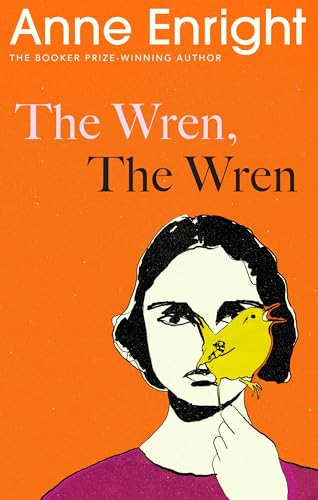
Anne Enright, The Wren, the Wren (Jonathan Cape 2023)
Before the meeting: Carmel and Nell are mother and daughter. They have a complex relationship with each other, and terrible relationships with men: Carmel’s father Phil, a middlingly successful, womanising poet; Nell’s coercive, rapey on-and-off boyfriend Felim; an endlessly boring man who comes into Carmel’s life for a time; and so on. It seems that Phil’s long shadow is responsible for their misery. Tess writes online copy for an influencer.
The first couple of pages of The Wren, the Wren had me enthralled as the narrator describes a psychological experiment conducted by Russell T Hurlburt, a real person (here’s a link). The experiment deals with the fact that we can never know what is happening in another person’s mind. Sadly, I hadn’t read much further when I realised I had no idea what was in Anne Enright’s mind when she wrote the book. I couldn’t tell what mattered to her about the story, and it gave me no reason to keep reading.
I did read on, motivated pretty much entirely by the need to avoid being scolded at Book Club like the people who hadn’t read Killing for Country at our last meeting.
Nell and Carmel have alternating chapters, except for one chapter narrated by Phil. As far as I could tell, Phil’s chapter is there for the purpose of including some hideous animal cruelty that neither of the women could have witnessed. The book is punctuated by his (in my opinion) tedious poems.
Anne Enright’s style is smooth and there are moments that give joy: Nell’s state of mind after the first time she has sex with Felim (the only time she enjoys it); some nice reflections on the naming of birds in Australia; conversations between Nell and Carmel that capture a fine balance between love and irritated mutual incomprehension. But as a whole, this is one of the least engaging books I’ve read. It may be that this is my internalised patriarchal attitudes taking over my reading mind. If so, please put me right in the comments.
Meanwhile:
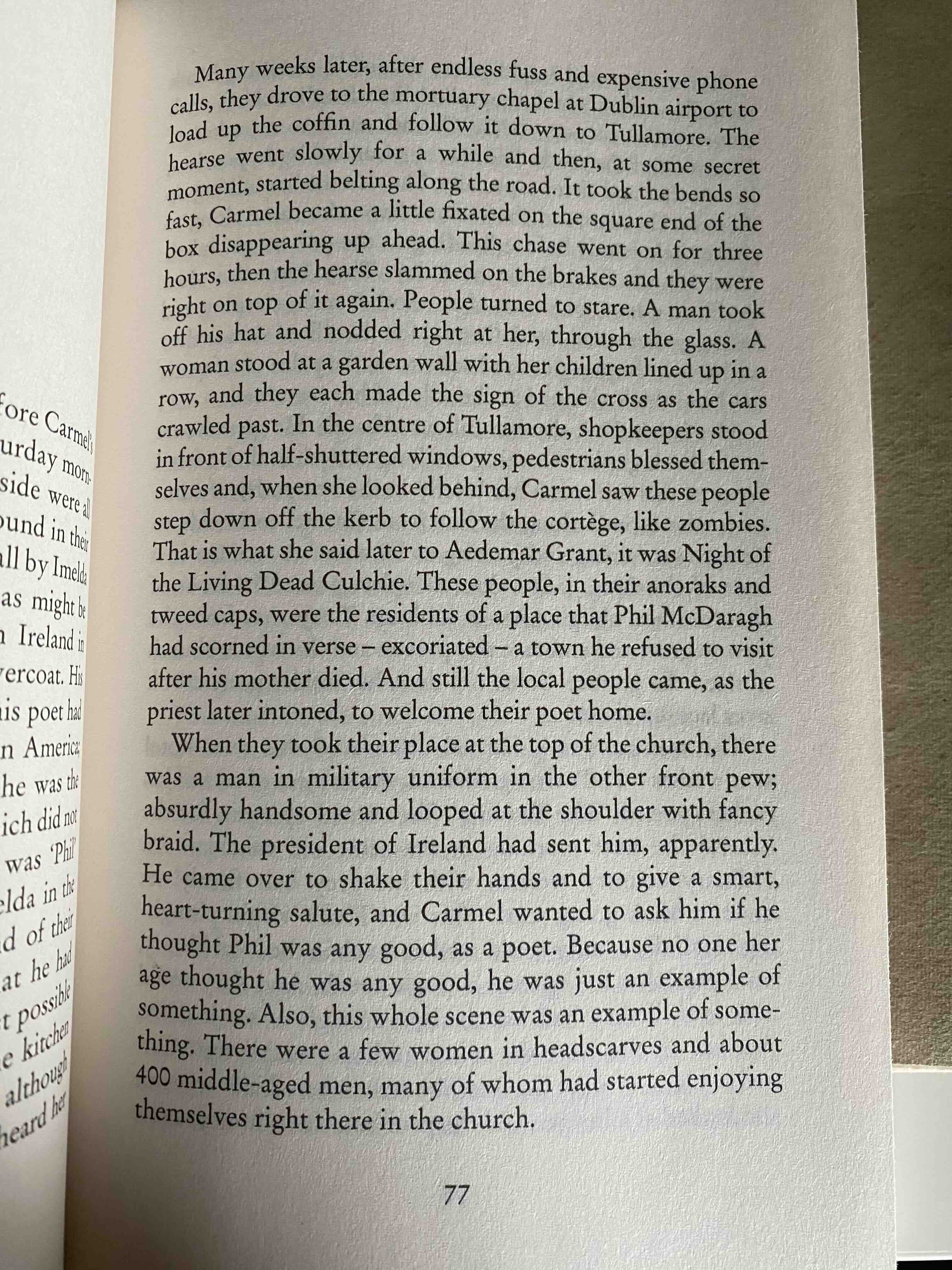
Page 77 is part of the description of Phil’s funeral. Though he was accustomed to slagging off his native town in USA talk shows, he had expressed a sentimental desire to be buried there. I suppose this page is darkly funny if you’re not as jaded with the book as I was. To me it just reads as cliché.
First there’s a bit of gratuitous dangerous-driving humour as Carmel is in a car following the hearse from Dublin airport where the body has been received:
The hearse went slowly for a while and then, at some secret moment, started belting along the road. It took the bends so fast, Carmel became a little fixated on the square end of the box disappearing up ahead. This chase went on for three hours, then the hearse slammed on the brakes and they were right on top of it again.
Then a bit of yokel humour. Or it may be a moment of pathos that segues into yokel humour. It’s a choose-your-own-tone paragraph:
People turned to stare. A man took off his hat and nodded right at her, through the glass. A woman stood at a garden wall with her children lined up in a row, and they each made the sign of the cross as the cars crawled past. In the centre of Tullamore, shopkeepers stood in front of half-shuttered windows, pedestrians blessed themselves and, when she looked behind, Carmel saw these people step down off the kerb to follow the cortège, like zombies.
That is what she said later to Aedemar Grant, it was Night of the Living Dead Culchie.
Then some joyless satire about the hypocrisy of public mourning ceremonies:
When they took their place at the top of the church, there was a man in military uniform in the other front pew; absurdly handsome and looped at the shoulder with fancy braid. The president of Ireland had sent him, apparently.
He came over to shake their hands and to give a smart, heart-turning salute, and Carmel wanted to ask him if he thought Phil was any good, as a poet. Because no one her age thought he was any good, he was just an example of something. Also, this whole scene was an example of something. There were a few women in headscarves and about 400 middle-aged men, many of whom had started enjoying themselves right there in the church.
That final sentence is probably a ‘comic’ invocation of the idea that the rural Irish are a mob of drunks.
I haven’t read anything else by Anne Enright*. On the strength of this book I’m unlikely to.
The meeting: In this Book Club, we discuss two books, possibly because if we just choose one it could turn out to be a dud. The Wren, the Wren was paired with My Friends by Hisham Matar. Both books start out with the notion that it’s impossible to know what’s going on in another person’s head. Both have a lot to do with fathers, and – as someone pointed out at the club meeting – both have protagonists who are lost.
No one told me I was completely wrong about The Wren, The Wren. There was general agreement that Carmel was more interesting than Nell, and no one cared for the book as a whole. We were all bemused by the praise heap[ed on it elsewhere, including its being included on the long list for the Booker. Two people had heard Anne Enright talk at the Adelaide Festival Writers’ Week. Evidently she was delightful, speaking a lot about the importance of poets and family in Irish society and not that much about the book. A friend of one of us had said it was a wonderful book: we surmised that this was because of its portrayal of coercive control – which I at least thought was as ordinary as Phil’s poetry.
My Friends is a much more interesting book and generated much more interesting conversation. I’ll write about it separately.
* Or so I thought. A couple of hours after pressing ‘Publish’, I discovered that I read The Green Road only a year ago, and to judge by my blog post (here) I loved it.



 Me fail? I fly!