Tag Archives: Bonny Cassidy

Journal Catch-up 21

Just two Heats in this catch-up.


Alexandra Christie (editor), Heat Series 3 Nº 9 (Giramondo 2023)

There are five items in this Heat, and I loved three of them. (The other two are pretty good as well.)

Bonny Cassidy’s ‘Memory Book’ is a poignant memoir of dealing with the shifting sands of her father’s dementia. ‘No one is responding in the way I thought they would.’

Ender Başkan has three poems whose energy and flow make me want to hear him perform them: ‘funk n wagnalls, collect the set’ is, among other things, a comic reflection on an immigrant family’s valuing of education; in ‘family holiday’ the poem’s speaker travels on the Spirit of Tasmania with small children; ‘erotics of bookselling’ is a fabulously unerotic string of phrases from the day of a bookshop employee.

The stand-out item is the late Antigone Kefala’s ‘Last Journals’, the third instalment in her series of journals. The first two were full-length books – Sydney Journals (2008) and Late Journals (2022, my blog post here). Unlike the entries in Late Journals, the entries here are dated, from 5 January to 19 September 2022. Antigone Kefala received the Patrick White Literary Award earlier in that September – ‘Everything comes in its own time,’ she writes, ‘but not in yours.’ She died on 3 December, less that 11 weeks after the final entry, which ends, ‘Drifting … Not an an ounce of focused energy …’

My blog custom is to single out page 76 for a closer reading. As happens surprisingly often, page 76 of this Heat is a useful lens through which to see the whole of Antigone Kefala’s piece. The page has three entries – for 3, 11 and 17 April – and they reflect a mind actively engaged with the world even while burdened with a sense that the end is near. There are acerbic comments on politics (‘Everyone knocking out Morrison … his own people, a pity they did not do it before’) and the weather (‘It will take some time to dry out, but the rain will start again soon’). She celebrates the publication of Late Journals, is visited by her publishers, and anxiously hopes for a mention in the press. She starts casting about for a new project (‘Looking about for a book to start translating something – this should give me a direction’). She mentions talking to a friend on the phone, ‘using the mobile so we could see our faces’, and comments, ‘These terrible transformations … who wants to see one’s face when talking on the phone …’

What emerges is a picture of a writer, committed to her work, immersed in a community, who faces the difficulties of ageing and the approach of death, not with calm or resignation but with something more like weary annoyance. Her entry for Monday 11 April ends:

Living is problematic, but dying is problematic too.


Alexandra Christie (editor), Heat Series 3 Nº 10 (Giramondo 2023)
This issue kicks off with ‘Life’s Work’ by Isabella Trimboli, a terrific, multi-faceted article on journals that ranges from her own practice to a five-hour cut of a movie diary. She’s specifically interested in ‘diaries from women who were not writers by vocation, that had never known true recognition, that wrote about themselves obsessively and with self-scrutiny’.

I confess that the rest of the journal didn’t sing to me.

One piece begins:

Simón entered my room and gave me a look.
Unconsciously, and then consciously, I pressed my body into a pose, breasts forward, ass to one side, and lifted the sheet, an invitation that suggested this was how I always lay before 10 a.m., like a steamed clam.

(Ellena Savage, ‘Bare Life’)

What follows isn’t terrible, but sexual intrigue in a shared house with a smattering of philosophy about Covid shutdowns isn’t my cup of tea. And I know it’s a lost cause, but that ‘ass’ – along with a ‘diaper’ elsewhere in the journal – gets my back up. It’s an Australian literary journal, do we have to use US language?

Another:

Someone did give birth to me. Why remains unclear. Maybe they wanted to be loved, or it just sort of happened.

(Harold Voetmann, ‘Common Room Rocking Horse’, translated by Johanne Sorgenti Ottosen)

Sorry, but I find that hard to take seriously, and it’s not funny.

Then there’s this:

The house had bricks the colour of runny shit and a linoleum floor that was so thin you could scrape a hole in it by pushing back your chair.

(Kat Capel, ‘Sightseeing’)

As you might almost guess, this turns out to be a story of unconventional sexual compulsions set mainly in a share house. I’m too old.

And then this:

This looking at myself, touching myself, it all started a long time ago. In nursery school, in fact, when I was five or six years old.

(Lin Bai, ‘The Light in the Mirror’, translated by Nicky Harman)

That’s the inauspicious opening of what turns out to be an extract from Lin Bai’s 1994 novel, A War of One’s Own, which, according the brief author bio (on page 76), ‘was an instant success and established her as a pioneer of women’s literature in China’. The Wikipedia entry on the novel doesn’t mention translation, so this may be the first time this writing has been translated into English. If so, hats off to Heat and Nicky Harman. But, quite apart from my distaste for extracts from longer works, I won’t pretend to have enjoyed it.
Bonny Cassidy’s Chatelaine

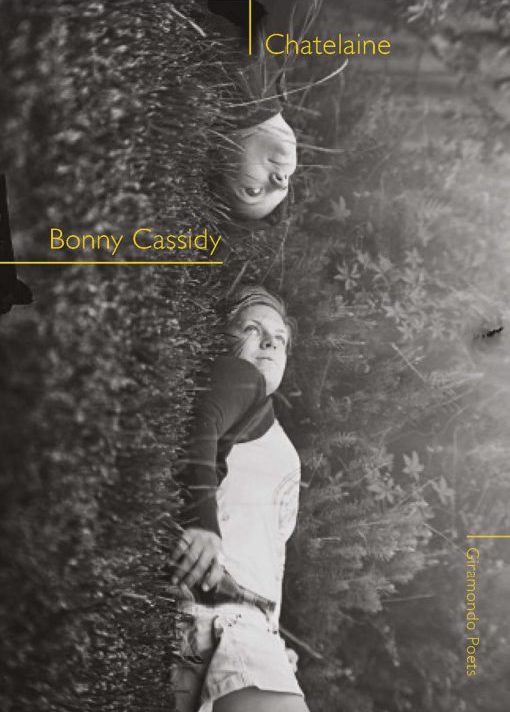
Bonny Cassidy, Chatelaine (Giramondo 2017)


Note: This blog post is not a review of Chatelaine, a book of poems by Bonny Cassidy, a well-regarded poet who leads the Creative Writing Program at RMIT. I’ve written it because of a self-imposed requirement to blog about every book I read. I don’t mean my ruminations to disparage the poetry, and certainly don’t want to discourage anyone else from reading it and enjoying it.


I once did a short course in signed English. Soon after I graduated, a visitor to my workplace showed us a hand-written note, ‘I’m deaf. May I use your photocopier.’ I greeted her confidently with the sign for hello – and was then at a complete loss as she started to chat with great animation while photocopying. I appreciated the eloquence of her signing and her facial expressiveness, and tried to look intelligent, even laughing at an anecdote about – possibly – a mouse. But my pulse raced, I broke out in a sweat, and I failed to understand anything she said, apart from hello and thank you.

My experience reading the poems in Chatelaine was something like that. The analogy isn’t quite accurate, though. If my Auslan had been up to it the deaf woman and I could have had a conversation, whereas I’m pretty sure that these poems are doing something other than invite the reader to a conversation. Here’s a for-instance:

Sink
this warning 
to our gully 
where the emus ram 
walls of uncoupled think. 
Under the easy homes and dread 
stem, drag the noisy secret 
the marble halls.

This reminds me of Noam Chomsky’s famous example of a sentence that is grammatically correct but semantically nonsense, ‘Colourless green ideas sleep furiously’, except that it doesn’t cohere grammatically either.

I needed help. The author’s note that came with my complimentary copy shed some light on what the poems are not doing:

The deceptive narrative of lyric poetry, for me, is reminiscent of mythic narratives of Australian settlement and also myths of femininity. I think this meeting point has something to say about what we believe to be credible, the blur between myth and events

That’s enticing. I like the idea of poetry that does away with deceptive and oppressive narratives. Or at least I thought I did.

The back cover blurb says of the book:

Its voices stalk across time and space inhabiting the genres of riddle, fragment, confession, lyric and ekphrasis, and returning to images of metamorphosis and position.

Again, that sounds exciting, but it didn’t help me read a single poem. Even a couple of poems that the Acknowledgements identify as ekphrastic (that is, responses to other works of art) remain stubbornly enigmatic – and perhaps would have even if the artworks they refer to had been identified.

I found a review by Anne Buchanan-Stewart in Plumwood Mountain (link here). It begins:

Bonny Cassidy’s Chatelaine is visceral, layered and driven by word constructs in an innovative lexicon of erotic topoi, ready to be open to contemporary interpretative potential – previously unworked.

I found myself echoing Prufrock: ‘I have heard the academic poets singing, each to each. I do not think that they will sing to me.’ But I did try to read the whole article. It included this:

– We usually want to understand, interpret, ascribe meaning to a poem and we usually want the words to tell us something, but perhaps it could be different.

– How?

– There is another way to get to the ‘it’ of the poem – through an encounter.  An encounter with the language ‘it’ self and its materiality. We can consciously put aside our search for meaning.

But if language doesn’t have meaning, I almost wept, is it still language? I went back to the book and read on, not trying to ‘understand, interpret, ascribe meaning’ but to ‘encounter’ the poems.

To cut a very long story short, I failed. I really did spend time with these poems. I had glimmerings of something, but I failed to encounter anything in them.

Not every book is meant for every reader. This one, beautifully designed by Harry Williamson for Giramondo, isn’t for me. There’s a sweet quote from ‘Ask’ by the Smiths as an epigraph, which I take as a reproach:

Nature is a language, can't you read?

Poetry May 2016

Robert Adamson (guest editor), Poetry, May 2016 (Poetry Foundation, Chicago)

This special Australian Poets edition of Poetry magazine was launched at the Sydney Writers’ Festival this year by the regular editor Don Share. Guest editor Robert Adamson spoke and a number of the featured poets, including several who were coopted from the audience, read to us. Who could resist buying a copy?

The magazine contains 28 poems by 20 poets, along with 18 beautiful photo portraits by Juno Gemes and two survey essays by Jaya Savige and Bronwyn Lea, plus a charming note on Robert Adamson by US poet Devan Johnston.

Where the articles, particularly Bronwyn Lea’s ‘Australian Poetry Now‘, struggle with the impossible task of giving the readership, presumably mainly from the US, an overview of the state of Australian poetry, the selection does something different: it’s personal, making no claims to be representative or definitive. It includes a wonderful variety in forms and concerns: narrative, lyric, prose poems, formal experimentation. The landscape and geography are well represented. There are cultural references – both to settler and Aboriginal motifs – that will set non-Australians frantically googling, but at least as much Biblical and classical reference.

It’s hard to generalise about a collection like this, and equally hard to single out individual poems. But here goes with a few:

  • Ali Cobby Eckermann has two strong, plain-speaking poems, ‘Black Deaths in Custody‘ and ‘Thunder raining poison‘, the latter an incantatory response to a work of art about the effects of atomic tests on traditional lands at Maralinga.
  • Samuel Wagan Watson’s prose poems ‘Booranga Wire Songs‘ and ‘A one ended boomerang‘ really sing.
  • The first poem in magazine, Bonny Cassidy’s ‘Axe Derby‘, which plays tantalisingly on the image of a woodchopping competition
  • Anthony Lawrence’s ‘My darling turns to poetry at night‘ is a richly complex villanelle, whose title doesn’t mean what you expect.
  • Jaya Savige has fun with mangoes and anagrams in ‘Magnifera‘.

(The whole magazine has been up on the Poetry Foundation’s website, and you may still be able to read it all on screen. All the links are to that website.)

Australian Poetry Journal, recent issues

Michael Sharkey (editor),  Australian Poetry Journal, Volume 5, Issue 1 (2015)
Bronwyn Lea (editor),  Australian Poetry Journal, Volume 3, Issue 1 (2013)

apj51

Australian Poetry Journal is a twice yearly publication of Australian Poetry Ltd, which describes itself, surely with a wistful edge, as the peak industry body for poetry in Australia. You don’t have to be a poet to join APL (the poetry industry includes readers), and membership fees cover a subscription to the journal.

This issue is attractively democratic. Award winners with many books on their CVs rub shoulders with people who have had poems published in newspapers and journals. I wouldn’t dream of singling any poems out as ‘the best’ but I do need to give you a taste of some. This is from Judith Beveridge’s ‘Clouds’:

Let blue skies stop their rhetorical grandstanding.
We know they’re filled with the breath of men cocked
and fettled by greed. One by one I call the clouds in.
A cloud for each child hungry, ragged, naked. A cloud

for all exiles whose voices can’t find a single raindrop,
whose eyes are stones that out-weather the past.
A cloud for those in war-ravaged places where shadows
terrorise doorways, and the old live between rubble
and crumbled bread.

Jeff Rich’s ‘Not getting things done’ deals with those to-do lists where some items just got moved from list to list, or projects dreamed of but never begun. The final lines bring it all home beautifully:

Whole careers, projects without plans.
Journeys of recovery and feats of weakness

Pile like chaos in the attic
Awaiting defeat

By distraction and habit and boredom and chance
Four deadly horsemen more real than the rest.

Fay Zwicky’s ‘Boat Song’ responds to the callous feral poetry of a Tony Abbott slogan with child-like rhyming that is anything but infantile. I’ll resist the pull to quote the whole thing:

Remote ideologies send bonnie boats
Like broken-winged birds to our merciful votes.

And we turned them away, yes we turned them away
As we went out to play
In our dead-hearted country, the bounteous place
Where neighbourly love puts a smile on each face.

Apart from the poetry, there are interviews – Paul Magee interviews Samuel Wagan Watson and Josh Mei-Ling Dubrau interviews Julie Chevalier; a personal introduction to Greek poet Tasos Leivaditis by his translator N N Trakakis; a review by Tim Thorne of eleven titles from Ginninderra Press – which expresses gratitude for the publisher’s ‘let a hundred flowers bloom’ policy while being unsparing of the blooms that aren’t up to scratch; a history of another small publisher of poetry, Black Pepper Press, by Margaret Bradstock, who paints a fascinating picture of the critical reception of a number of their books; and three review articles that I found illuminating, especially Bonny Cassidy on Spatial Relations, a two-volume collection of John Kinsella’s prose.

Bonny Cassidy begins her review, ‘It must be said, straight up, that this two-volume publication … is unlikely to attract the recreational reader.’ (And she might have finished it by saying that a smaller, more selective publication may yet bring Kinsella’s prose to a wide and appreciative readership.) I could have said, straight, up that while Australian Poetry Journal might not attract too many recreational readers, any who wander into its pages are likely to be pleasantly surprised.

1apj31Having been pleasantly surprised by Volume 5 No 1, I realised Volume 3 No 1 had been wallflowering on my bookshelf for a year. It turns out to be another treasure trove. I’ll just mention two very funny poems by Anthony Lawrence –  ‘The Pelican’, in which the eponymous bird snatches a Jack Russell puppy, flies off with it

clearly visible through the lit
_____transparent pouch beneath its beak

and swallows it in full view of a horrified human crowd, and ‘Lepidoptera’, in which a gift of butterflies to the speaker’s sister meets with a dreadful fate, with an implied analogy to the frequent fate of poems.

There’s  a section on the poetry of the late Philip Hodgins – an introduction by Anthony Lawrence and then a selection of poems, mostly in some way to do with farming life, and death. A section titled ‘Criticism’ includes, among others, David McCooey on Jennifer Maiden; Martin Duwell – always worth reading – on a book about postwar US poetry; and an essay by Stuart Cooke about stray animals in Central and South America, which I enjoyed but whose title suggests I missed the point: ‘A Poetics of Strays’.