Tag Archives: comics

Art Spiegelman’s Co-Mix

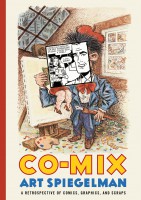
Art Spiegelman, Co-Mix: A Retrospective of Comics, Graphics, and Scraps (Drawn & Quarterly 2013)

co-mix

I remember the relief when I discovered in my 30s that my father really liked Gentleman’s Relish, which David Jones sold in fancy jars that were big enough to last from his August birthday to Christmas and then Christmas to the next birthday. The presents problem was solved. Forever.

I suspect my late-found interest in comics has brought similar relief to my sons. I’m not complaining.

This big, hard-cover book isn’t a comic as such. Sandwiched between Spiegelman’s scathing one page review in comic form of the Museum of Modern Art’s 1990 exhibition, High and Low: Modern Art and Popular Culture and an essay by Robert Storr about Making Maus, MoMA’s exhibition of Spiegelman drawings the following year, it’s a book-shaped equivalent of a retrospective exhibition.

It begins with early works that turned up in underground magazines and established publications, including Playboy. There are Mad-magazine influenced cards for a chewing gum company, and RAW, a graphic magazine Spiegelman ran with his wife, Françoise Mouly (who later became art director at The New Yorker). The early stuff tends to be satirical, surrealist, scatological, confrontingly sexual, but never stupid or bland.

Spiegelman is best known for Maus, the ground-breaking comic about his family’s Holocaust experience, originally published as two books, in 1986 and 1991. Co-Mix assumes its readers know that work (and if you haven’t read it, I recommend that you do), so reproduces only one page from it. But there are seven pages illustrating Spiegelman’s painstaking process of drawing study after study on the way to the final images. ‘In the time that other artists can draw forty pages,’ he’s quoted as saying, ‘ I can draw one page forty times.’

There’s a generous sampling of covers he did for The New Yorker in the 1990s, which segues into a section on In the Shadow of No Towers, the extraordinarily beautiful large-format book about his response to the terrorist attack on New York in 2011. In that book, Spiegelman represents himself sometimes in human form, sometimes with his mouse avatar from Maus, its pages are full of cartoon figures from an earlier era, and up the back there’s an essay and a number of beautifully reproduced comics from the early 20th century. The combination of 21st century New York angst, race and PTSD with Katzenjammer and earlier cartoonery feels completely right, but mysteriously so. There’s an illuminating comment here:

The classic comic strip characters, Spiegelman said, gave him aesthetic solace because they represented ‘vital, unpretentious ephemera from the optimistic dawn of the twentieth century … That they were never intended to last past the day they appeared in the newspaper gave them poignancy: they were just right.’

There’s a lot more, including children’s books, book covers, pages from his notebooks, lithographs, accounts of collaborations with a dance company and in musical theatre, and painted glass windows for New York’s High School of Art and Design.

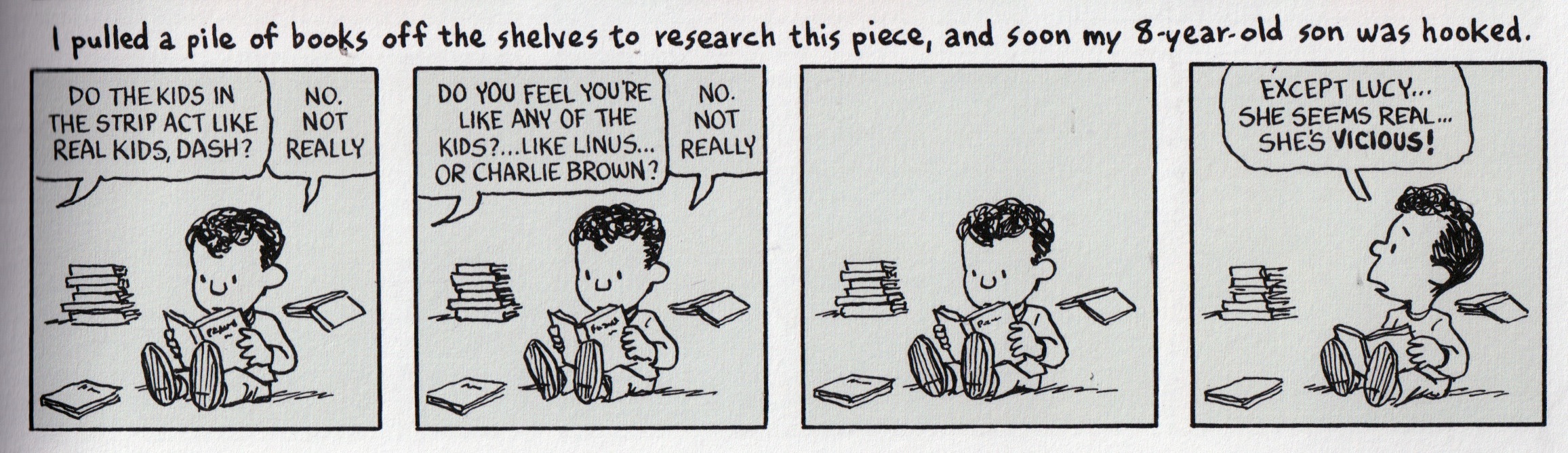
It’s all interesting, but the section titled ‘Comics Supplement’ is on a whole other level: 17 pages of complete comics from The New Yorker, one from the Washington Post and one from McSweeney’s. Here’s where you’re reminded why a Spiegelman retrospective makes sense. In particular, if you have a chance to browse though this book, flip to pages 72–81 for the generous, witty, deeply respectful tributes to Maurice Sendak (on the occasion of his death), Charles Schultz (on the occasion of his retirement, published five days before his death), and – again on the occasion of his death – Harvey Kurtzman, early editor of Mad magazine who made a cameo appearance, without being named, in another book I blogged about recently, Lawrence Lipton’s Holy Barbarians.

The copyright notice says I can reproduce ‘small portions for review purposes’ without needing written permission. Here’s a strip from Spiegelman’s three pages on Schultz:

spiegelman

Vaughan and Staples’ Saga

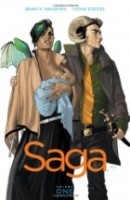
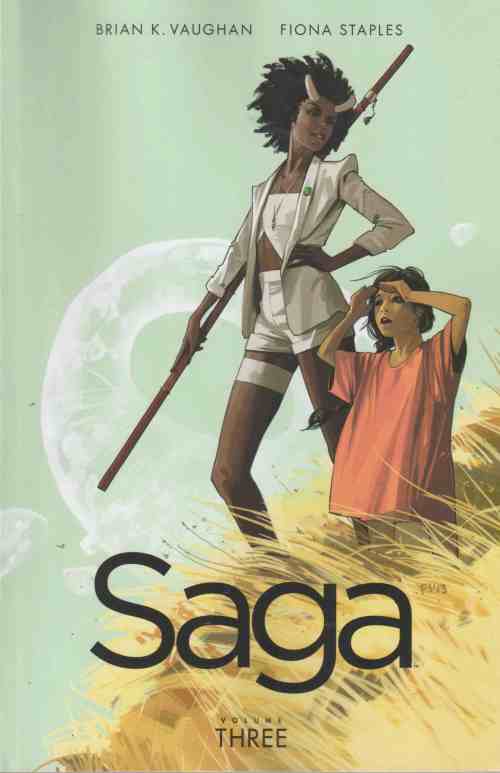
Brian K. Vaughan and Fiona Staples, Saga, Vol. 1 (Image Comics 2013)
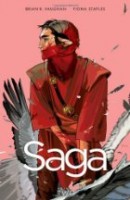
—————– Vol. 2 (Image Comics 2013)
—————– Vol. 3 (Image Comics 2014)

160706601716070669203SAGA


These are the first three volumes of the autobiography of Hazel, the child of a great romance between two people from different species. Her birth is something of a miracle, because no one was sure it was biologically possible – she is born with the beginnings of her mother’s wings and her father’s horns. More than that, the two species, originally from the planet Landfall and its moon Wreath, have been locked for centuries in bitter warfare that has spread to the whole galaxy. It’s an interstellar Romeo and Juliet in which the lovers don’t die, at least not before they’ve had a baby.

So it’s a mixture of science fiction and fantasy that wouldn’t be out of place as an extended Doctor Who narrative, though it includes a lot more physical and verbal grossness than would ever happen around the Tardis – male genitals can rarely have been portrayed as repulsively as in the images of the giant Fard in Volume 2, and the characters swear like troopers or inner-city hipsters.

Volume 1 begins with Hazel’s birth and ends with her paternal grandparents materialising on the young family’s organic, sentient spaceship, with a lot of bang-bang, kiss-kiss, magic and gore in between, as the lethal emissaries of several powerful organisations are out to kill Hazel’s parents and capture the baby.

In Volume 2, the chase continues. There are flashbacks to the parents’ courtship and the refreshingly frank conversation that followed hard on the moment of conception. Back in the present, the plot thickens when, among other things, Hazel’s father’s jilted fiancée joins forces with a mercenary named The Will, a planet turns out to be a giant egg (which hatches), and they visit someone who is either the wisest person in the universe or a hack romance writer.

By the end of Volume 3, Hazel – now a toddler – is miraculously still alive, along with her parents, her grandmother and her spectral babysitter. The cast of interesting characters, both allies and enemies, has expanded, as has the tally of dead bodies and ingenious monsters in their wake.

The first two of these books were a birthday present from a son who knows I’m interested in comics. I had misgivings. Having recently faced the fact that super-heroes are inherently boring, I was half expecting a similar epiphany about science fiction/fantasy comics. But no, these books are witty, warm, interestingly plotted, well-paced, and at heart sweet. (I say ‘at heart’ because the frequent nakedness, swearing and superficial cynicism do a good job of protecting the warm, soft, even idealistic core of the narrative.)

I also had misgivings about the art. But once you accept the demands of the genre, which evidently include a quota of garishness and bare flesh, Fiona Staples’ visuals are brilliant. I particularly like the way our heroine, Hazel’s mother, is lithe, tough, gorgeous, and fiercely maternal.

So I spent my own good money on the third book, which just arrived in Sydney’s Kinokuniya this week. Given that the story is narrated by Hazel in what sounds like a young adult voice, I imagine the series has another 20 or so years to cover. It’s coming out in monthly instalments, of which these three volumes cover the first 18. There’s an interesting interview with Brian K Vaughan on the Comic Book Resources site, which incidentally draws attention to a couple of details in Fiona Staples’ images that I hadn’t noticed, but that definitely move the story over into Mature Readers Only territory.

Joshua Santospirito’s Craig San Roque’s Long Weekend in Alice Springs

Craig San Roque, The Long Weekend in Alice Springs, adapted and drawn by Joshua Santospirito (San Kessto Publications 2013)

1lwas In 2004, an essay by Alice Springs psychologist Craig San Roque appeared in the formidably titled volume, The Cultural Complex: Contemporary Jungian Perspectives on Psyche and Society, edited by Thomas Singer and Samuel L. Kimbles and published by The Psychology Press in the UK. According to an author’s note, the 16-page essay, ‘A long weekend: Alice Springs, Central Australia

suggests that ancient, habitual, mythically reinforced psychic structures may be repeating themselves autonomously from a basic pattern, rather like a DNA system. Such patterns may be encoded into legends or hieratic dramas associated with specific sites and can be detected by analysing mythologised stories embedded in cultural sites, by analysing how a culture developed (and perverted) the use of primal tools and by noting what cultural groups do with human bodies, death, justice and sexual coupling.

Esoteric stuff, you might think, the kind of thing Jungians write for each other but that the uninitiated tend to see as elaborately, solemnly, eruditely fantastical. (I speak as someone who in his mid 20s read quite a bit of Jung’s writing about alchemy.)

A couple of years later a young psych nurse named Josh Santospirito worked with La Roque in ‘remote mental health in Aboriginal communities’. This was demanding, frustrating and confusing work at a place where ‘mainsteam’ Australian culture and Central Australian Aboriginal cultures meet at best uncomfortably. He articulated the central problem he faced in his work like this: ‘How can you begin to address mental health issues when Aboriginal cultural structure is so undermined?’ San Roque gave him his ‘Long Weekend’ essay, and though the essay offers no straightforward solution to that problem, Santospirito found it useful in his attempts to come to terms with his experience.

Among other things, Santospirito happened to be a once and future comics artist. (His web site is here.) As he meditated on the essay, he began drawing, and the drawings led in time to this book, which he published himself, and so made San Roque’s specialised writing both accessible and available to a general readership. Not that the book is an illustrated version of the essay, or a pictorial representation for illiterate readers. It’s an adaptation from one medium, the academic essay, to another, sequential art (aka comic book, or if that sounds juvenile to your ears you could call it a graphic novel, even though this is not a novel). To judge by the little I’ve read of the essay, it’s a very faithful adaptation.

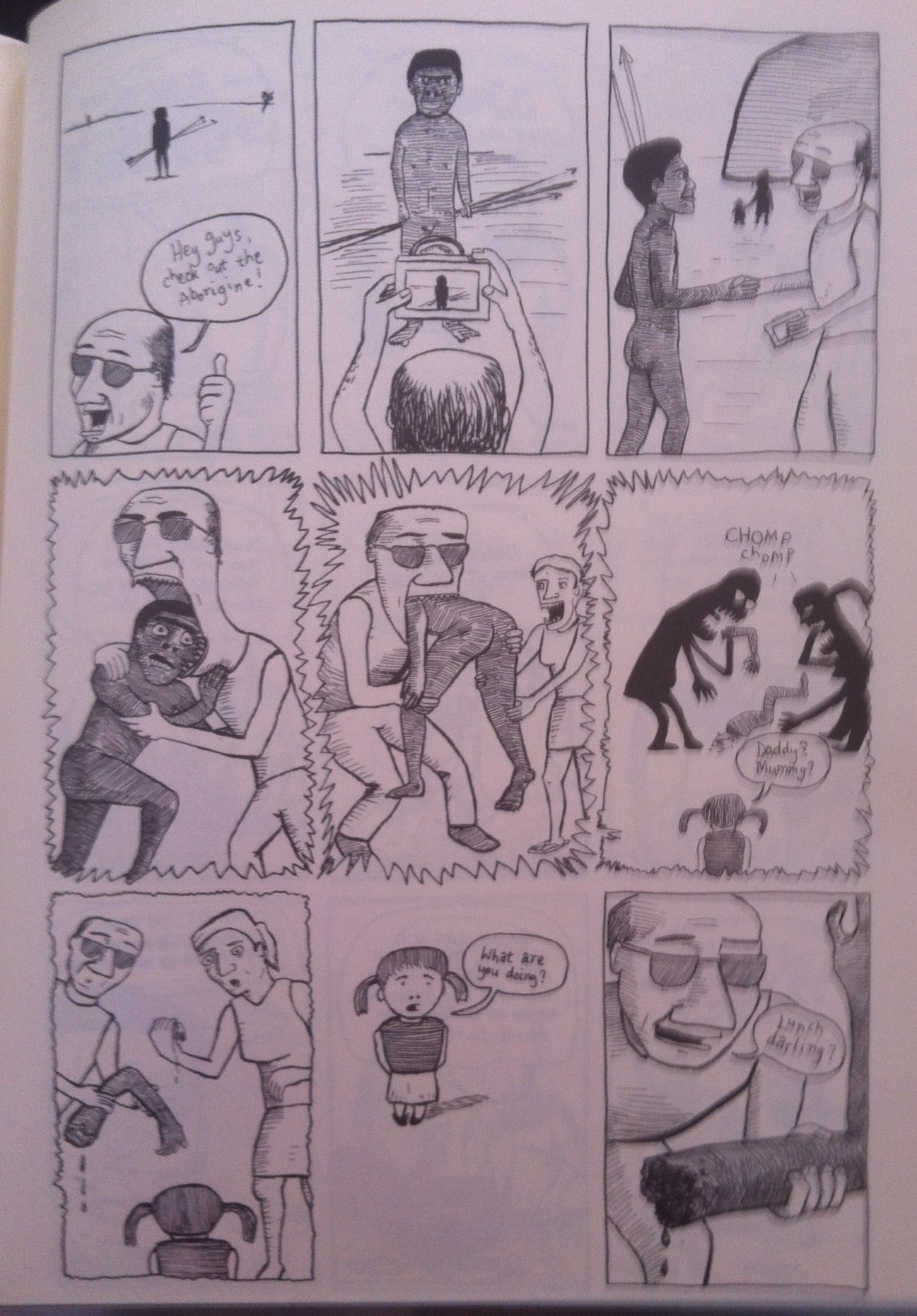
At the heart of the book is a search for something beyond individual aberration to account for so-called mental illnesses such as psychosis, substance abuse, violence and depression among Central Australian Aboriginal people. In crude, non-psychological terms, there’s a plain enough answer: they have largely been dispossessed and are on the receiving end of continuing dispossession – San Roque calls this cannibalism, which leads to one of Santospirito’s most compelling pages (especially the last two frames):

20140203-114233.jpg

The book is interested in what happens in people’s minds. ‘The tragedy here,’ according to the captions accompanying images of beer bottles,

is not about massive conflicts and brutal bloody invasion. The tragedy is about experiencing self-decomposition through the erosion of access to loving bonds with family, country and integrity of cultural practice.

All of this is lucidly articulated and graphically realised. At one point, San Roque speaks of the need ‘to analyse [his] own culture … to give up trying to understand Indigenous culture.’ ‘It isn’t my business,’ he says. ‘But the area of overlap between my culture and Aboriginal is indeed my affair. I live in it.’

That overlap manifests in a range of encounters over a long weekend: the Warlpiri people who come to town and meet in his yard, a young woman with a psychotic reaction to cannabis, a man who has killed his mother-in-law, mistaking her for his wife (‘What is in alcohol which makes me murder?’ ‘What is in your mind that lets you murder? And in such a manner?’ ‘What is in our brains that allows us to take axes to our sleeping women?’), a hunting expedition with some women and children, and so on.

Then comes the Jungian theorising. First, in looking to his own culture, San Roque goes to the epic of Gilgamesh and the descent into the underworld of the Sumerian goddess Innana. Not where most non-Indigenous Australians would look, I submit. But it’s a great story, and has the advantages of being unfamiliar to most readers (me included) and lending itself to some spectacular images. And there’s the speculation foreshadowed in the author’s note to the essay: that some places somehow contain certain dramas that the people who live there will inevitably play out over and over – the endless struggles in Iraq, for example, or the permanently brewing fights in Alice Springs, whose dreaming story involves a dogfight. It seems to me that having acknowledged that a ‘web of disordering complexes has evolved as a consequence of the psychopathologies of colonialism’, it’s odd to go looking for further explanation in mystical notions like this. Not only odd, but counterpoductive: if young men die in Lebanon because of something the air there, or people are forever scrapping in Alice Springs because they are bound to reenact the Dreaming story of the place, then there’s nothing to be done about it – and I don’t believe either of the authors of this book would agree with that conclusion.

With that misgiving, this is a beautiful, passionate, doubly intelligent book. It has become something of a self-publishing success story, and it deserves all the success it finds.

Alan Moore Unearthing Lost Girls

You know what I was saying the other day about superheroes? Well, same for pornography and illegible typographic design.

Alan Moore and Melinda Gebbie, Lost Girls (Knockabout / Top Shelf Productions 2012)

1lg

One of my sons gave me Lost Girls for my birthday. I knew enough about it to say as I tore the protective wrapping from the deluxe hardcover, ‘This is a rude book.’ I opened it at random and after a cursory glance showed the spread to my yum cha companions. ‘That’s not rude,’ someone said. ‘It’s pornographic.’ She was right. And there aren’t many spreads in the book that that’s not true of.

The eponymous lost girls are Wendy (as in Peter Pan and Wendy), Dorothy (as in The Wizard of Oz) and Alice (as in Alice in Wonderland), all grown up. They meet in a decadent European hotel just before the first World War and tell each other pornographic versions of their respective classic tales, then go on a seemingly endless series of sexual adventures. It’s a bit like a cartoon I remember from my early 20s that shows a crowd of Disney characters having an orgy. Only this goes on for, oh, 180 pages.

I can’t say I read it all, or looked at every image. I don’t know who would want to. I don’t understand why the brilliant story-teller Alan Moore and the fabulously talented artist Melinda Gebbie made the book in the first place. Evidently they married each other during the making of the series, so it can’t have been as off-putting for them as it was for me. If you want a proper discussion of the book, Tim Callahan discussed it as part of his Great Alan Moore Re-read on tor.com.


Alan Moore and Mitch Jenkins, Unearthing (Top Shelf Productions 2013)

1603091513

At the risk of incurring the wrath of truly hip commenters, I am now going to say that Unearthing also left me fairly cold. According to the back cover it began life as part of an anthology about London, and ‘evolved through a series of live performances and recordings’, before being published as this book. It’s a kind of biography of Steve Moore, a friend but no relation of Alan Moore, enmeshed with an account of Shooters Hill in South London, Alan Moore’s text and Mitch Jenkins’s photographs combined in a design phantasmagoria. I did read some bits: Steve Moore is an occultist who seems to use a lot of recreational drugs and have shared hallucinations with Alan on at least one occasion. The prose is overwrought, and in order to read it one has to variously read tiny print, decipher weird Gothic fonts, follow text presented in a spiral, distinguish pale type from an only slightly paler background, etc. And when the physical effort comes up with, for example,

The bookshelves there behind him are the hexagram with six unbroken lines, Chi’en, the Creative, are a doorway where the brilliance bleeds through from a next room that’s not there, a warren of such rooms stretching away above, below, on every side, a Hyper-London, an eternal fourfold town of lights. This is it, this is real, this lamp-glow that’s inside the world like torchlight through a choirboy’s cheeks, the mystical experience as Gilbert Chesterton’s absurd good news and it goes on for hours, goes on forever

I’m afraid I just lose the will to continue.


These books made wonderful birthday presents – beautiful, luxury objects, that took me well out of my comfort zone. I don’t know if either of them actually expanded my world, but they did make me wonder if pornography and occultism don’t have a function in common: to provide distractions from real issues in the real world. Lost Girls could even be read as saying as much in its last pages where (SPOILER ALERT) the motif of the poppy is transformed from a symbol of dreamy erotic surrender to an emblem of the carnage of war.

Daredevil, Batman and Sacco

Mark Waid, Paolo M Rivera, Marcos Martin, Daredevil (Marvel 2012)
Alan Moore, Brian Bolland, Batman: The Killing Joke (©2008, deluxe Edition 2012)
Joe Sacco, Journalism (Metropolitan Books 2011)

It’s roughly 40 years since alcohol touched my lips, and booze is right at the top of my list of Boring Conversation Topics, but I was recently held spellbound by a conversation about wine making. My dinner companion was infectiously passionate on the subject. He described the effect of a vineyard’s microclimate on the colour and taste of grapes, and so of wine, discussed the qualities of different grapes, told me about a famous episode in which Australian vintners who had thought for years they were producing merlot were informed by experts that their grapes were actually a variety of cabernet. Wine may be boring, but the minds that make it aren’t.

The experience helped me with a confusion about superhero comics: clearly many of them are created by brilliant people, and I’ve been bemused by my own lack of response. Neil Gaiman’s Marvel 1602? Technically, wow! Otherwise, meh. Joss Whedon’s Astonishing X-Men? Meh. Frank Miller’s Dark Knight? I couldn’t bring myself to read it because I’d been so repelled by the sensibility of Sin City. Superhero comics leave me cold, or worse: they embody an ethos I loathe, that divides the world into good guys and bad guys and offers vigilantism as the solution to the world’s problems. What I have finally realised is that I should no more enjoy even the very best of superhero comics than feel compelled to drink the finest of champagnes. I’m just not into the thing itself.

But I was given two excellent superhero comics for Christmas, so I was in duty bound to read them, and I did it with hope in my heart.
0785152385 Daredevil is a superhero with a disability: he’s blind, though all his other senses are of course incredibly acute, and he has one or two extras. He also suffers a lot – everybody, including other well-meaning superheroes, wants to attack him. He’s socially awkward and apparently sex-obsessed in a fairly harmless way. Apparently comics about him have been around for a long time, and this is a reboot. Much fun is had in finding ways to convey visually the world as perceived by a blind man. But in the end he’s a superhero, the story moves from violent confrontation to violent confrontation, and my world is not expanded by reading it.

1bkjAlan Moore and Brian Bolland’s The Killing Joke is by all accounts one of the great Batman comics, often mentioned in the same breath as Frank Miller’s The Dark Knight Returns, and in this ‘Deluxe Edition’ the colours are printed as Brian Bolland intended them to be. Alan Moore is a brilliant story-teller (his Watchmen is the exception among superhero comics that has kept me reading them until now), and this may be the first Batman story where it’s explicit that superheroes and supervillains are two sides of the same coin – both, in the Joker’s words, ‘had a bad day and everything changed’. But the hallucinatory world of this comic, though brilliantly created and with added ‘psychological’ complexity, is still at base, to me, boring and even obnoxious.

0805094865I was going to blog separately about the third comic I got for Christmas, Joe Sacco’s Journalism, but Sacco belongs here because he is a bit of a real-world hero. He takes his pencil and notebook into dangerous places, asks awkward questions and keeps his eyes open, then turns what he has heard and seen and thought into powerful journalistic comics (the language is problematic – comics in this context have nothing to do with comedy, but what else can you call them?).

I haven’t read his most celebrated book, Palestine, but his Footnotes in Gaza deals with a 1956 massacre – not a footnote to anything, but an exploration of deaths and beatings that usually remain mere footnotes to history. Journalism collects disparate shorter pieces, so it doesn’t have the same concerted power, but it shines a powerful light in a number of dark and dangerous corners of the world.

Endnotes to each of the six sections – ‘The Hague’, ‘The Palestinian Territories’, ‘The Caucasus’, ‘Iraq’, ‘Migration’ and ‘India’ – give brief accounts of first publication in Time, the New York Times, the Guardian Weekend and so on, managing to hint at the uneasy status of this kind of journalism. The last two sections, consisting of one longer piece each, represent a blow struck for respectability, the first being published by the Virginia Quarterly Review, described on its web site as ‘a haven—and home—for the best essayists, fiction writers, and poets’, and the second in the French magazine XXI, which Sacco says is ‘the publishing industry’s greatest champion of comics reportage’. (The Indian piece, ‘Kushinagar’, has appeared in the VQR since its publication in this collection, and you can read excerpts on the New York Review of Books site, here. Part of the other longer piece, ‘Unwanted’, about ‘irregular immigrants’ to Malta, is available on the VQR site, here.)

Sacco is a journalist: he identifies his sources and is punctilious about giving more than one point of view. When he describes the appalling destruction being visited on Palestinian communities by the Israeli Defence Force, he seeks comments from Israeli spokespeople. The incredible hardships endured by Chechens in refugee camps are weighed against the policies described by the Russian authorities. In Kushinagar, we hear from the desperately deprived Dalits, but also from the Rajahs’ descendants who exploit them and a government official who cites the laws that are in place to protect them. But, even more than a photo essay or a TV documentary, both of which derive a dubious objectivity from our lingering belief that the camera never lies, comics journalism is unavoidably personal. IMG_0112Sacco may draw from photographs, but every image in the book is made by his hand and therefore personal. He makes no pretence at omniscient objectivity: a cartoony version of himself is omnipresent – awkward, responsive, questioning, dogged, alert, engaged.

So, does comics journalism have more than novelty value? Well, Sacco takes as long as four years to create a book, and has spent years living hand to mouth in order to commit himself to this work, so clearly it has value for him. And it does for me too. I doubt if I would have read a conventional article on African asylum seekers in Malta or extreme poverty in the Kushinagar District of Uttar Pradesh in India – too far from home, too many other claims on my attention. Presented as comics, the stories become supremely accessible. It’s a lot easier to follow a complex analysis while keeping sight of details when the material is presented in what the French call récit graphique.

I found ‘Unwanted’ particularly resonant. Malta has a population of 400,000. By August 2009, 12,500 people desperate to reach Europe ‘have washed up on the island’s shore’ as ‘irregular immigrants’ from Africa, mostly sub-Saharan Africa. That’s three percent of the population compared, say, to the minuscule proportion of Australia’s population that arrive here as asylum seekers. The two situations are very different, but the similarities are striking.

Saccopage153

The strength of the piece lies in the stories told to Sacco by the African immigrants: stories of why they left home, of what they hoped for (mostly to make their way to mainland Europe), and the reality of what they faced in detention and then as ‘freedoms’, released into the community – and in the juxtaposition of these stories with the responses of Maltese people, ranging from virulent racism (a small minority), through degrees of intolerance and discomfort, to compassion and advocacy (another minority).

Sacco created this piece on Malta partly because he comes from there. It turns out he spent most of his childhood in Australia before moving to the USA. One can only wonder what he would make of the dark but not so hidden features of our landscape.

Daytripper, the comic

Fàbio Moon & Gabriel Bà, Daytripper (Vertigo, 2011)

20120224-180529.jpgThis is the last of the comics I was given at Christmas. It’s another beautifully compressed gem I’ve read in counterpoint to Frank Moorhouse’s slow Cold Light. Its hero is a newspaper obituary writer, and – skip the rest of this paragraph if you hate spoilers – each of the 10 original comics collated here tells a different story of his death, each occurring at a different age, and each ending with a paragraph or two from his obit.

Bà and Moon are described in the blurbs as twin brothers from Brazil, and though I couldn’t find an acknowledgement that the book was first published in Portuguese, it is set in Brazil, and it has a Latin-American magic realist feel to it – not fantasy as such but a way of seeing the actual world as magical. The art is beautiful without pretending to be other than comic-book art. The cumulative effect of the narrative(s) is a profound meditation on the fragility of life – or not so much the fragility as the conditionality: we all knowingly or unknowingly have frequent brushes with death, so the life we have now is something of a miracle.

The book isn’t perfect. In the final section, these two young men try for a vision of acceptance of death by an old man, and (in my not-yet-as-old-as-the-protagonist opinion) manage only a romantic empty gesture. So according to Randall Jarrell’s definition of a novel as ‘a prose narrative of some length that has something wrong with it’, this is a graphic novel. It’s an excellent one.

Fàbio Moon & Gabriel Bà have a blog in English.

Bill Willingham’s Bad Doings and Big Ideas

Bill Willingham (writer and artist), and Mark Buckingham, Zander Cannon, Duncan Fegredo, Peter Gross, Paul Guinan, Nico Henrichon, Adam Hughes, Phil Jimenez, Michael Wm Kaluta, Jason Little, Marc Laming, Shawn McManus, Linda Medley, Albert Monteys, Kevin Nowlan, David Peterson, Paul Pope, Eric Powell, Ron Randall, John Stokes, Jill Thompson, Daniel Torres, Bernie Wrightson (artists), John Costanza and Todd Klein (letterers), Bad Doings and Big Ideas: A Bill Willingham Deluxe Edition (Vertigo 2011)

As I continue on my intermittent re-entry into the world of comics, which I abandoned at roughly 12 and came back to in my late 50s, it’s the non-fiction that I respond to most, and after that – oddly, since I don’t care for it in non-graphic narratives or movies – it’s fantasy-horror. Or maybe it’s not so odd, as it was Neil Gaiman’s epic Sandman that re-piqued my interest.

This hefty hardback full of horror was a Christmas gift, and one that gave me a lot of pleasure. Bill Willingham, I gather from his entertaining interstitials here, is a writer and artist best known for a series of comics called Fables. This is not that. It’s a collection of Other Stuff, including a number of adventures of minor characters from the Sandman universe. I don’t know what the uninitiated would make of these, with their injokes and unexplained walk-ons, but the stories stand up by themselves, especially the 60 or so pages of Thessaly the witch (the second half of which I read in its own book, also a gift, a while back).

The opening story, Proposition Player, is the longest (130+ pages) and most interesting. Willingham tells us it was the first thing he wrote for Vertigo, having been an artist with them for some time. It must have been quite a debut: the hero starts out working for a casino and ends up through a series of poor choices and successful gambles as the most powerful God (capital intended) in the cosmos. The gambles are much grander than Pascal’s bet, and I wonder if the story’s cheerful blasphemy does more damage to the cultural authority of established religion than the humourless argumentation of, say, Richard Dawkins.

I’m currently leading a double life as a reader. In one life, I’m reading a number of huge books, and in the other a whole lot of smaller ones as counterpoint. When I was reading Reamde, which is great fun but far too big to lump around in a shoulder bag, I read poetry books and literary journals, physically but not intellectually light. Now I’m a third of the way through Frank Moorhouse’s Cold Light, not as physically weighty as Readme, but quite a slog – the slogginess doesn’t make me want to give up on the book, but it does make me cry out for something lively to relieve the pain. Bad Doings and Big Ideas was perfect for the part. And I have a couple more Christmas present comics that are also looking good.

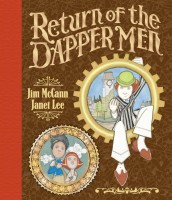
Jim McCann and Janet Lee’s Return of the Dapper Men

Jim McCann and Janet Lee, Return of the Dapper Men (Archaia Entertainment 2010)

This is a kind of steampunk fairy tale graphic novel, self-consciously beautiful to the extent that it includes an appendix explaining its decoupage technique. I found it visually boring if not outright repulsive, and was left cold by the story, which involves a city, or perhaps a whole world, where time has stopped but starts again when hundreds of identical ‘dapper men’ float down from the sky, a mute mechanical angel that somehow brings harmony, an elliptical message about destiny, and strangely empty allusions (the city is Anorev, Verona in reverse, but why?).

It was a generous and thoughtful Christmas present, but I guess I’m just not part of the target audience.

Brendan Burford’s Syncopated Picto-essays

Brendan Burford, Syncopated: An Anthology of Nonfiction Picto-Essays (Villard 2009)

I doubt if I would have picked this up in a bookshop or a library. First there was the suggestion of possible illiteracy in the subtitle: it’s surely redundant to say an essay is not fictional, and what is this word ‘picto’? But moving on past that bit of pedantic persnickertiness on my part, the idea of a comic book essay didn’t look all that attractive. But I was given it a Christmas present, along with Ramona Koval’s Best Australian Essays 2011, and behold, the collection of non-picto essays is still in my teetering to-be-read pile, while I’ve read the comic and enjoyed it hugely. It does all the things that one could expect of a collection of essays.

One thing essays classically do is to interest  readers in things they never expected to be interested in. Here Nick Bertozzi’s ‘How and Why to Bale Hay’ and Rina Piccolo’s ‘Penny Sentiments’ (on the history of postcards) are prime examples of the type.

Other essays open up whole new areas of knowledge: Brendan Burford and Jim Campbell’s ‘Boris Rose: Prisoner of Jazz’ tells the story of a man who started creating and selling bootleg jazz records around 1940 and progressed to obsessively cutting records of obscure jazz radio broadcasts, so that when he died in 2000 he left a vast collection of one-of a kind recordings; Alex Holden’s ‘West Side Improvements’ tells of Chris Pape, who painted striking murals in a disused New York subway station; Nate Powell’s ‘Like Hell I Will’ brings to shocking life the 1905 Tulsa race riots, though massacre is probably a better word for what happened.

Then there are essays that cover familiar ground, but do so in a way that makes the subject fresh. So in ‘What We So Quietly Saw’ text from FBI reports on Guantanamo prisoner interrogations is rendered poignant by Greg Cook’s stark silhouettes, Paul Karasik manages in eight pages to provide a critical biography of psychologist Erik Erikson, and Alex Longstreth tells the story of August Dvorak’s all but completely fruitless struggles to have his typewriter keyboard layout supersede the eminently stupid qwerty (I had a nerdy joy when I read that all computers now can be switched to use the Dvorak layout, but I can’t see how to do it on mine, so maybe that’s another feature of essays – they don’t always give the full story).

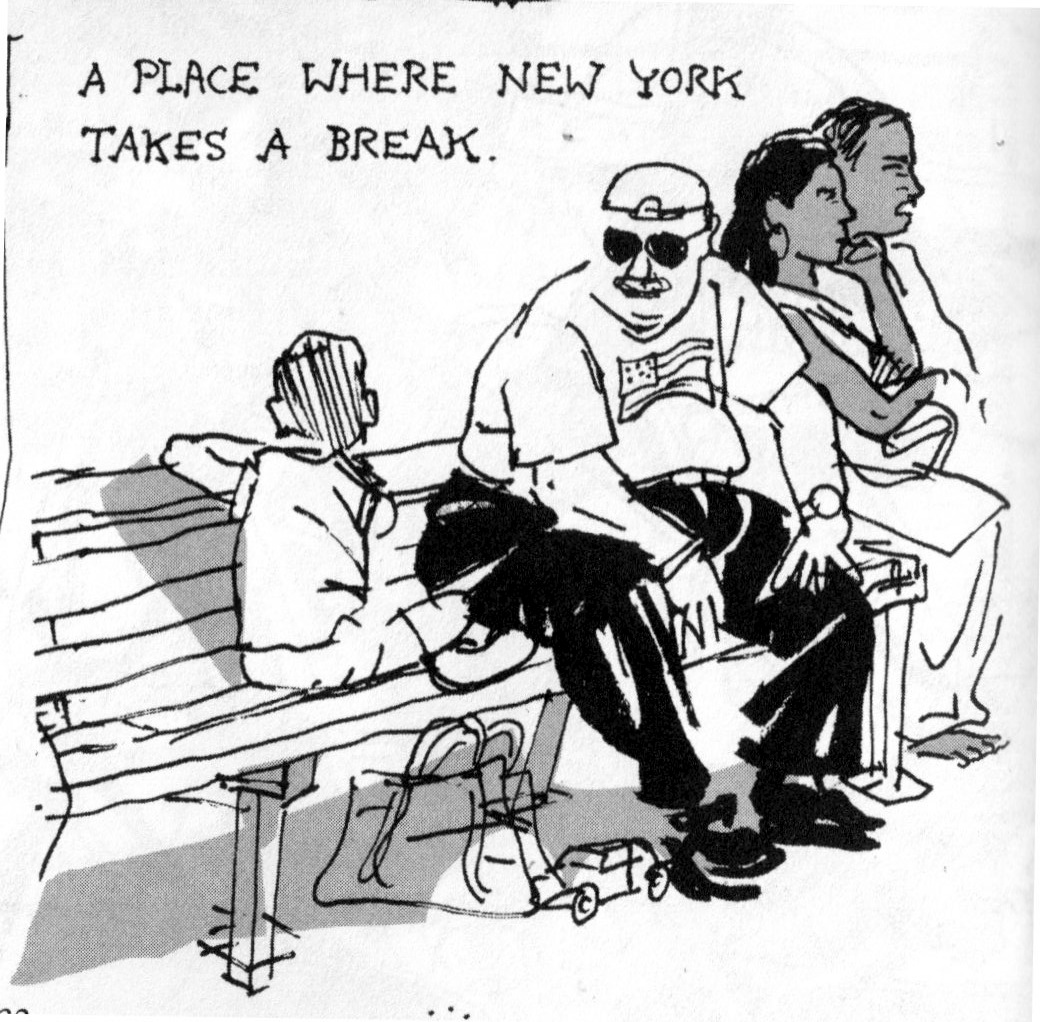
Some degree of individuality, even quirkiness, is essential to the essay form, and the comic book as essay, with its strikingly personal interplay of word and image, inevitably has this element in spades. As a tiny example, take this frame from Paul Hoppe’s ‘Coney Island Ruminations’:

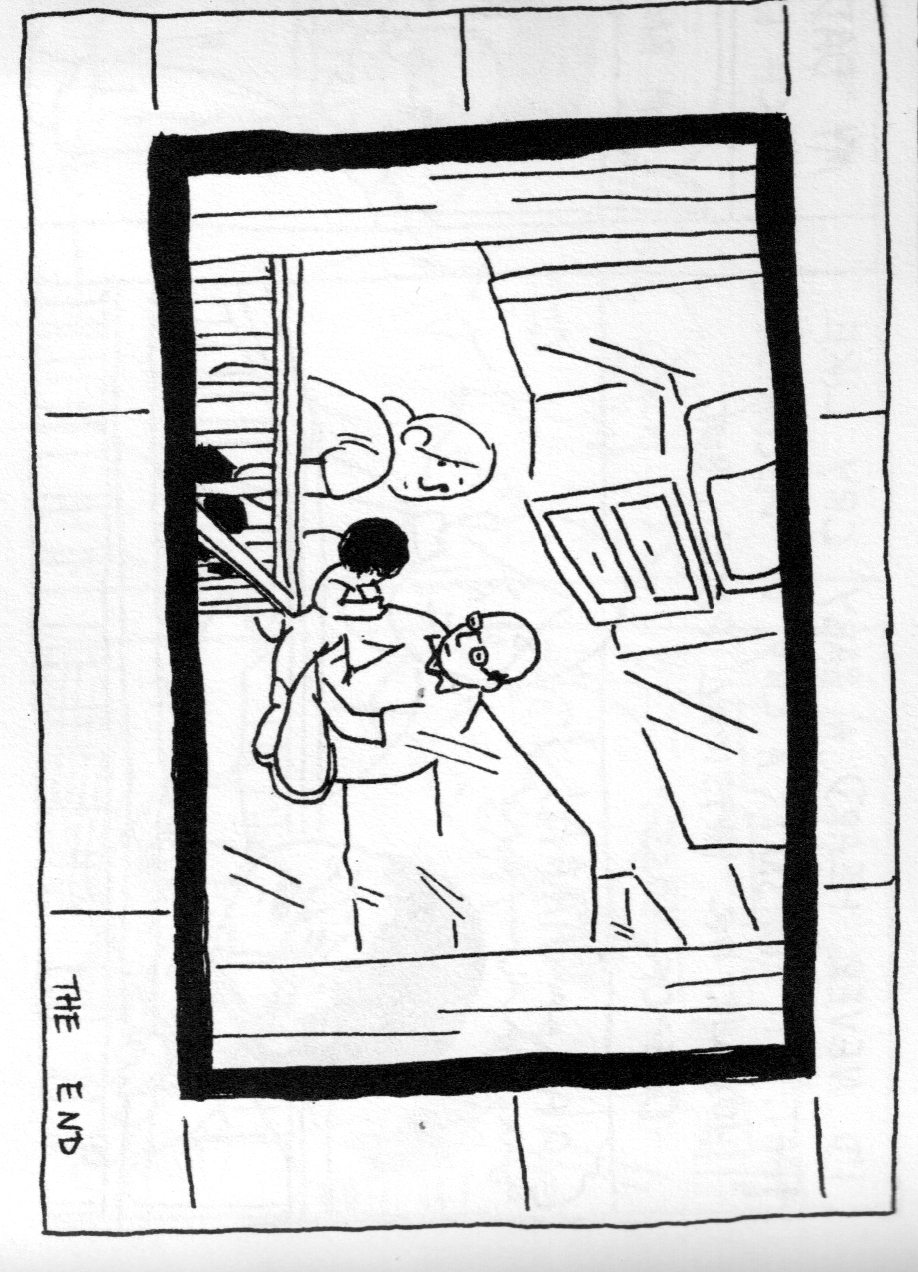
These four people are clearly not ‘New York’. It’s not so much that the abstraction of the text is tied down to a particularity, as that the particularity of the image suggests the vast range of individual experience covered by the text’s eight words. The book offers example after example of this kind of thing. A different kind of interplay comes at the very end of ‘The Sound of Jade’, Sarah Glidden’s piece about accompanying her father to China to adopt a baby. After walking us through the process, including observations of the other adopting USers, statistics of such adoptions, regulations governing them, moments of intercultural awkwardness and emotional rawness, Gliddens ends with a peaceful scene of the new family, then in a final frame we are looking into the room through a window from a slightly elevated angle, and ‘Sarah’ is looking out at us uneasily:

In a way that would be hard to achieve in any other medium, we’re left to do our own thinking about what might lie beneath her unease.

In short, this was an excellent Christmas present.

Wilson

Daniel Clowes, Wilson (2009, Drawn and Quarterly 2010)

20111226-124107.jpgOne of my joys at Christmas these days is that my family give me comics. This year I received a grand total of six hefty hardbacks, all by people I haven’t read anything by. Wilson is the least daunting, appearing at first glance to be made up of 80 or so single-page strips about the unkempt, misanthropic Wilson. In one strip he asks a woman to help him out by estimating the weight of a small parcel he plans to post, and then tells her it’s full of fresh dog poop. In another he tries to start up a conversation in a cafe with a man who politely indicates that he’s working on a laptop, and eventually delivers the punchline, ‘Hey asshole, I’m talking to you!’

That sort of thing is amusing in its own depressive way, and then the apparently unrelated strips come together into a coherent story arc. There’s a satisfying payoff to both the dog poop and the laptop man, and in the end it’s a kind of love story.