Daniel Clowes, Wilson (2009, Drawn and Quarterly 2010)
One of my joys at Christmas these days is that my family give me comics. This year I received a grand total of six hefty hardbacks, all by people I haven’t read anything by. Wilson is the least daunting, appearing at first glance to be made up of 80 or so single-page strips about the unkempt, misanthropic Wilson. In one strip he asks a woman to help him out by estimating the weight of a small parcel he plans to post, and then tells her it’s full of fresh dog poop. In another he tries to start up a conversation in a cafe with a man who politely indicates that he’s working on a laptop, and eventually delivers the punchline, ‘Hey asshole, I’m talking to you!’
That sort of thing is amusing in its own depressive way, and then the apparently unrelated strips come together into a coherent story arc. There’s a satisfying payoff to both the dog poop and the laptop man, and in the end it’s a kind of love story.
It’s tempting to say that Audrey Niffenegger creates comics for people who don’t like comics. It’s probably more accurate to say that she creates the kind of comics that appeal to people who like, say, Emma Magenta’s work, or Kate Williamson’s, which are, after all, comics as much as Watchmen or Sin City. (I’ve read both Emma Magenta and Kate Williamson thanks to the Book Club, which is also where I got The Night Bookmobile.)
The Night Bookmobile is more like other comics than The Three Incestuous Sisters, the only other of Niffenegger’s books I’ve read, in which the text played very poor second fiddle to the images. This is much more integrated. A young woman called Alexandra (get it?) discovers a fantastical night bookmobile that contains every book she has ever read. Over the years she encounters the bookmobile and its kindly, melancholy driver a few more times, and each time its collection has grown to incorporate what she has read in the meantime. It’s like a dream incarnation of a LibraryThing account. Alexandra becomes a librarian and longs to work in the bookmobile. Two pages of skippable text at the end explain how to interpret the story, and tell us that its the first instalment of a much larger work, The Library.
I was charmed, and not just charmed, but unsettled by the book’s dark and mercifully unexplained elements. There’s something half in love with death about Niffenegger.
As it happens, Perry Middlemiss’s site, Rhymes Rudely Strung, which publishes an Australian poem a day, turned up today with this, first published in The Bulletin in 1917, but taking Niffenegger’s sex-death-books connection and running with it:
Books
by Zora Cross
Oh bury me in books when I am dead,
Fair quarto leaves of ivory and gold,
And silk octavos bound in brown and red,
That tales of love and chivalry unfold.
Heap me in volumes of fine vellum wrought,
Creamed with the close content of silent speech.
Wrap me in sapphire tapestries of thought
From some old epic out of common reach.
I would my shroud were verse-embroidered too –
Your verse for preference, in starry stitch,
And powdered o’er with rhymes that poets woo,
Breathing dream-lyrics in moon-measures rich.
Night holds me with a horror of the grave
That knows not poetry, nor song, nor you;
Nor leaves of love that down the ages wave
Romance and fire in burnished cloths of blue.
Oh bury me in books, and I’ll not mind
The cold, slow worms that coil around my head;
Since my lone soul may turn the page and find
The lines you wrote to me, when I am dead.
I generally avoid the term ‘graphic novel’, because I don’t kowtow to the view that comics need to be called something else if they’re to be taken seriously. But this hefty tome (1.248 kilos by my kitchen scales) is definitely a graphic novel, not a comic. It’s not a book you can read with half your attention somewhere else. The dominant visual style is brooding halftone; the lettering is mainly tiny; the story emerges from fragments told from many points of view, and some of the fragments are at best tangential to the overarching narrative. You can see the first 28 pages, pretty well all of them in the tangential category, here.
In the world of the book, animals are fully sentient and communicate fluently in human languages, though they do retain their otherness in relationship to humans. When a pet puppy is taken out for a walk, for example, he rushes towards the nearest tree, calling, ‘There’s the tree!’ The higher mammals – particularly the apes – chafe at human arrogance and there’s a general sociopolitical movement towards full equality, involving some human allies. Naturally, this movement has its violent elements, and a terrorist bombing of a human college provides the central story line.
There’s a lot here that’s brilliant, and I gather that it’s intended as the first of nine equally hefty and demanding volumes. I’m not hooked. In fact, I took some dialogue between a man and a starling on page 287 (‘[This book] has been a ball and chain around my neck and I’ll be happy to be done with it’] as a sly but gracious acknowledgement from the author of readers like me.
Partly my lack of enthusiasm has physical causes. The diminutive type and the ink wash that predominates in the images make the book hard to read in poor light or with less than optimal eyesight: even in the middle of the day I had to choose in which chair or at which bench to read, and even in full sunlight, many of the full page images were murky to the point of illegibility. This may be deliberate (given that parts of some images and some text are deliberately obscured by other images or other text, I’m not ruling that out). It may be a result of poor printing, or of Mr Hines poor understanding of what kind of image prints up well. The book’s sheer bulk make it uncomfortable to read in bed or bath (not that I’ve tried that), and impossible to read while walking the dog.
If you have young, sharp eyes and a sensibility attuned to postmodern self-interruptions, if you’re passionate about the pushing the boundaries of what can be done with sequential graphics, if animal liberation issues stir the fire in your soul, then I recommend Duncan the Wonder Dog to you. Please say something in the comments here.
I’m not a horror aficionado, but my younger son knew I enjoyed and admired other Alan Moore comics. He gave me From Hell for my birthday, and this for Father’s Day.
Having read it, I’m still not a horror fan. Demons and monsters aren’t my bag unless they’re funny like Bartimaeus, theological like Milton’s Satan, or … actually, there are quite a lot of exceptions. Still, I respond too literally to things like children becoming autistic as a result of major trauma and then institutionalised and preyed on by stray demons, and when a plot hinges on some plants speeding up their production of oxygen at night, I want to give a lecture on the difference between plant respiration and photosynthesis. Maybe pedantry protects me from the horrors of the unconscious mind.
Still, Alan Moore is a story-telling genius. In 1982, he – and illustrators Bissette and Totleben – took over the Swamp Thing comic series created ten years earlier by Len Wein and Bernie Wrightson. They collaborated on something like 45 issues – this book collects the first eight of them, of which the very first busies itself tying up loose ends from the previous 19 issues, and the second redefines the nature of the eponymous monster. So we are plunged in medias res, but know we won’t be given the detail of what went before. We can tell something is being rebuilt, not quite from the ground up, and forward impetus is well established.
This book interested me as early work by the creator of Watchmen which, like Neil Gaiman’s Sandman, won my engagement by sheer brilliance. I don’t feel compelled to read on here, though anyone with a love of horror would certainly be hooked.
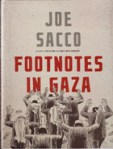
I’ve just heard Chris Flynn’s excellent review of Footnotes in Gaza on the ABC’s Book Show of 21 April. It’s preceded by interesting discussions of European comics (‘graphic novels’) in translation and South Korean comics, in a refreshing antidote to the patronising treatment often handed out to comics in the mainstream media. Chris Flynn says in part:
Sacco tries his level best to build up an accurate picture of what might have happened. he comes at the massacres from all angles, presenting eyewitness accounts that sometimes correspond and sometimes conflict. Footnotes in Gaza is thus a fascinating document of ordinary people, but it is disappointing that it lacks an Israeli perspective on what happened. In his introduction Sacco bemoans that he was stonewalled, and the limited access that he was granted to UN and Israeli Defence Force archives, and he puts out a plea for Israeli soldiers who were present on the days in question to come forward with their versions of events.
As an eye-opening piece of war reportage, Footnotes in Gaza succeeds largely thanks to Sacco’s innovative, fresh approach in presenting a forgotten moment in history in such a modern fashion. As a narrative piece of story-telling, it contains several moments that made me put the book down and hold my head in my hands. As illustrative journalism, it has a huge emotional impact, particularly during the grand vistas of destruction and the final, silent pages that transcend words. There are no answers here, just terribly sad questions.
As serendipity – or fortuity – would have it, this weekend’s Spectrum supplement to the Sydney Morning Herald announces on its cover that ‘The funny pages get serious’. Inside, in an article meant to provide context for Josh Neufeld’s AD: New Orleans After the Deluge, Samantha Selinger-Morris tells us:
Long regarded as a guilty pleasure, or suitable for delivering nothing but caped crusaders and candy-coated fantasy, comic books – or graphic novels, as titles with literary ambitions are known – have lately become the go-to genre for meditative and often harrowing storytelling.
‘Regarded by whom,’ one might ask, not without grumpiness, ‘and how recent is lately?’ All these decades after Art Spiegelman’s Maus, Will Eisner’s Contract with God trilogy, Frank Miller’s dark reinvention of Batman, Neil Gaiman’s vast and complex Sandman, yet another feature writer discovers that comics have ‘lately’ become interesting.
Oh well … in Herodotus’ time writing in prose was considered infra dig, and it took more than just a couple of decades for those attitudes to change.
Footnotes in Gaza is a harrowing read. There are no caped crusaders in sight, nothing is candy coated, and the few jokes function not so much to amuse as to reassure that the characters are capable of humour. Joe Sacco has, I gather, pretty much created the genre of comics journalism (of which Neufeld’s AD looks like a rare specimen created by someone else). He is best known for Palestine (1993/2001), which was published with an introduction by Edward Said and is held in high regard by them that know about these things. For obvious reasons I initially hesitated to read Footnotes in Gaza without having read Palestine, but it turns out the title doesn’t mean to imply that this book is a footnote to his earlier one. The footnotes in question are the deaths that are relegated to footnotes in the historical account, only to fall off the bottom of the page altogether at some stage.
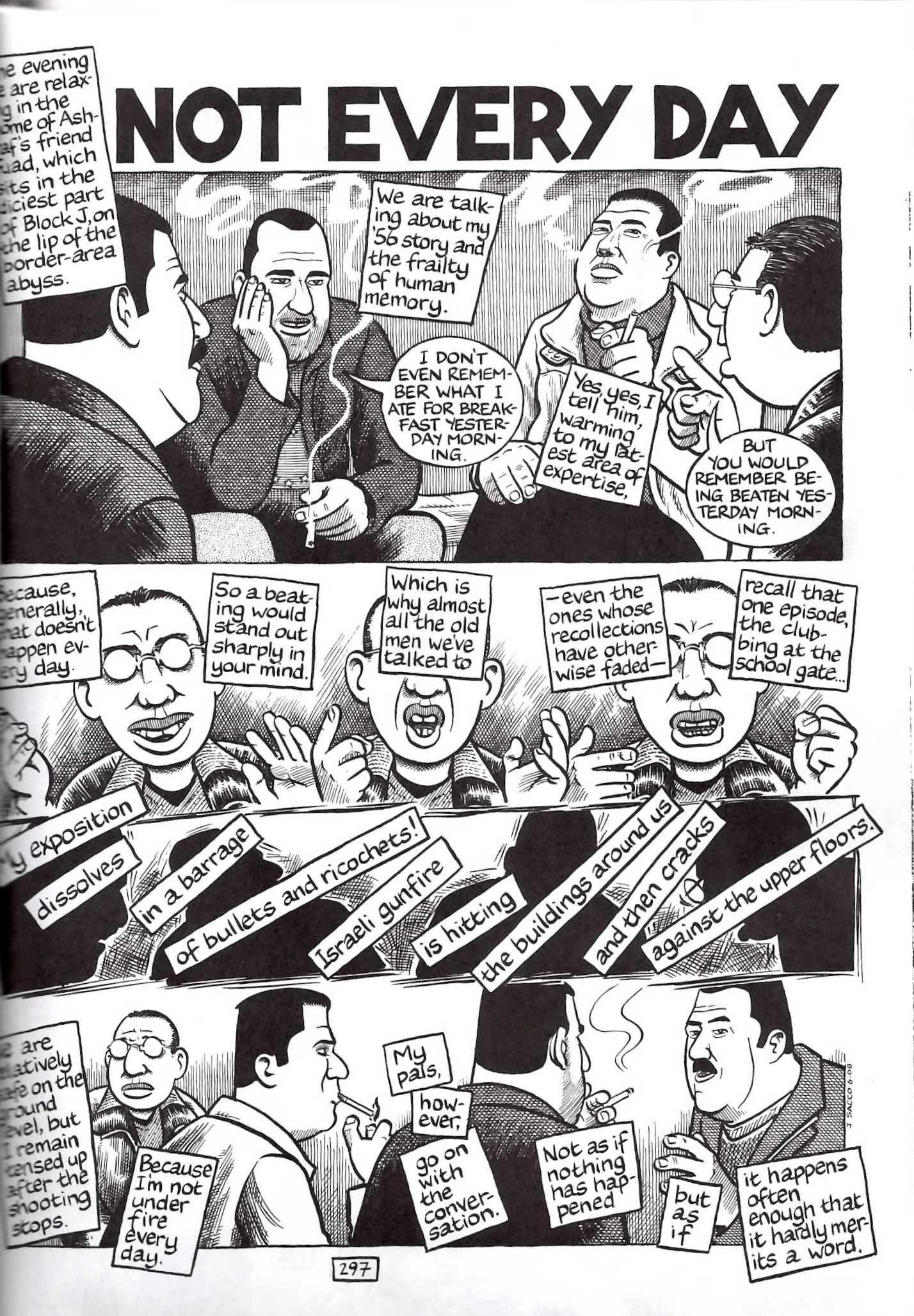
Sacco visited the Gaza Strip from November 2002 to March 2003 to record the stories of eyewitnesses to two massacres that occurred in 1956. The book intertwines the story of his investigations with the story he uncovers. Again and again, he is asked why he is interested in events of 1956, when the trouble is continuous, the present is just as bad: Israeli bulldozers are destroying people’s homes, walking the streets at night invites tracer fire from an Israeli watch tower, there are endless delays at checkpoints … The impact of this continuity on his investigation is put succinctly in this page (I apologise for the chopped off bits – I couldn’t get it all in without doing severe damage to the book):
Transcript in case you can’t read it or deduce the missing bits:
Not every Day
One evening we were relaxing in the home of Asraf’s friend Fuad, which sits in the diciest part of Block J, on the lip of the border-area abyss. We were talking about my ’56 story and the frailty of human memory. [Fuad(?):] I don’t even remember what I ate for breakfast yesterday morning. Yes, yes, I tell him, warming to my latest area of expertise. [Joe: ]But you would remember being beaten yesterday morning.
[Joe:] Because, generally, that doesn’t happen every day. So a beating would stand out sharply in your mind. Which is why almost all the old men we’ve talked to – even the ones whose recollections have otherwise faded – recall that one episode, the clubbing at the school gate.
My exposition dissolves in a barrage of bullets and ricochets! Israeli gunfire is hitting the buildings around us and then cracks against the upper floors.
We are relatively safe on the ground level, but I remain tensed up after the shooting stops. Because I’m not under fire every day. My pals, however, go on with the conversation. Not as if nothing has happened but as if it happens often enough that it hardly merits a word.
Sacco displays journalistic scrupulosity in identifying his sources and scrutinising their reliability. The comic-book presentation allows variants to be acknowledged and presented alongside one another with minimal fuss or distraction. It also allows both stories – of 1956 and 2002–3 – to be told with harrowing immediacy. If anyone is tempted to think of the Israeli–Palestinian conflict as somehow involving roughly equal parties, I strongly recommend this book. The Palestinians aren’t presented as saintly victims: the scenes of quiet celebration after a successful suicide bombing or at US casualties in Iraq are very unsettling. Many if not most of the people Sacco interviews, however, want to distance themselves from Palestinian militants, and the Israeli defence force point of view is given in a note at the back. I noticed that while the authorial captions unfailingly refer to ‘Israelis’, the Palestinian characters refer to their tormentors as ‘Jews’. Sacco distances himself from the antisemitism of his subjects, silently and without moralising. I could only wish that some of the Israeli voices, and voices from the Jewish diaspora, that have spoken out consistently against the Occupation might have found their way into these pages, but perhaps that’s asking for a different book.
Alan Moore & Eddie Campbell, From Hell (Top Shelf Publications 2000)
Each of my sons gave me a big comic for Christmas. I’ve already posted a note about R Crumb’s Genesis. From Hell, in which Alan Moore and Eddie Campbell tackle Jack the Ripper, makes an interesting companion read. Both books have ample sex, violence and uncanniness. Both deal in multiple versions of the same events. Both feature self portraits by the illustrator that are charmingly at odds with the rest of the book (Crumb on the dust jacket flap in his ‘lounge pants’; Campbell in an Appendix as a gangly stay-at-home dad). And both have notes up the back that exert a fascination of their own.
I’m not particularly fascinated by Jack the Ripper. In my teens I read what must be one of the few books on the subject not mentioned in the appendices of this one, The Identity of Jack the Ripper by Donald McCormick (what’s the good of keeping these records if you can’t trot them out occasionally), in which Jack was revealed to be the Prince of Wales, and that was enough for me. Alan Moore, by contrast, has immersed himself in Ripperology and hammered it into a vast, complex web of story, incorporating court records, newspaper accounts, speculation, rumour, architectural history, literary history, Masonic ritual, unexpected historical connections and just plain invention, with appearances by Queen Victoria, William Blake, William Morris, Aleister Crowley, Hitler’s parents – the list goes on. I can’t say it was a pleasant read, but it’s a very impressive one. Likewise Eddie Campbell’s art (in this book) is rarely pleasant, but it’s darkly powerful. There’s a lot of hatching, and it’s often hard to tell exactly what is being shown – which at he more grisly moments is a great blessing!
I started out reading the main narrative in tandem with the notes that constitute the first appendix, but gave up about a third of the way in, because the plethora of information about sources was slowing the story down terribly. However, it’s good to know how little of the narrative is pure invention on Moore and Campbell’s part, and I’m reasonably sure that without the notes some bits of the story would have remained completely mysterious to me. And there’s one fabulous twist in the tail that would certainly have bypassed me if the last couple of notes (I skipped to the end) hadn’t first told me that the ‘scene on page 23’ was cryptic, second told me to work it out for myself, and third given me a big hint that transformed the meaning of one of the many subplots into something almost redemptive.
In the first few pages, a convenient warning to parents to put the book on a high shelf, there’s a sex scene that exemplifies Eddie Campbell’s genius by managing to be very explicit (by which I mean anatomically specific), not at all soft-focus prurient, and also joyful. This scene is what sets the whole ghastly plot into action, which according to one school of Biblical interpretation brings me back to the similarities to Genesis.
In short, I don’t know who I’d recommend this book to, but it’s very good.
On the dust-jacket flap (yes, I read it in hardback, it was a Christmas present) we’re told that Crumb originally intended to do a ‘take-off of Adam and Eve’, but found himself so fascinated by the thing itself that the project transformed into this – a comic version of the whole book of Genesis, ‘NOTHING LEFT OUT!’ Being a bit slow on the uptake, I was still expecting that somehow this would be a crude and raunchy telling, a version for the irreligious.
Nup! It’s a straight graphic-novelisation. Admittedly, Crumb doesn’t shy away from the text’s abundant sex, violence and general skullduggery, but he doesn’t linger on it or portray it in lascivious detail. In fact, he has a couple of pages of lucid notes up the back proposing explanations for some of the more puzzlingly lurid behaviour of Abraham and Isaac, some of them drawing on feminist biblical scholarship (yes, that’s right, the creator of Fritz the Cat reads and refers his readers to feminist biblical scholarship).
My elder son, who is shamefully ill-informed about the foundational Judaeo-Christian texts, read the first few pages, and for the first time was full of questions about matters Biblical. I imagine some religious people might find the book a bit confronting, but if they were honest they would probably admit to finding it confronting even without Crumb’s contribution.
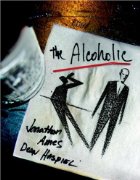
Jonathan Ames & Dean Haspiel, The Alcoholic (Vertigo 2008)
Disclaimer: I was not given this book by a publisher, nor is this blog entry a viral effusion in the hope that Vertigo will send me lots of freebies, though I wouldn’t be offended to be told that this review os not a review.*
I don’t imagine that many people would feel compelled to compare this comic with J M Coetzee’s Summertime. But here goes.
J M Coetzee’s hero is called John Coetzee; Jonathan Ames’s is Jonathan A. Both books, then, are presented as some kind of autobiography. In both, wiggle room is created, and the narrative saved from indulgent self-loathing, by the interposition of point(s) of view other than the author’s. In place of Coetzee’s multiple unreliable narrators, interviewees as well as fictional biographer, Ames has the graphic art of Dean Haspiel. It’s possible to imagine Ames’s story of his alcoholism being told for laughs, or with that creepy kind of apologeticness that leaves out the taking of responsibility, or in a way that invites hypocritical prurience, or as a hollow redemptive tale. Jonathan A is a writer, and at one stage he has an audience convulsed with laughter by an essay about his own fecal incontinence. But the pared down narration here, accompanied by Haspiel’s ruthlessly austere black and white art, gives us nothing to laugh at. There are sex scenes, and plenty of naked breasts, but there’s none of the adolescent eroticism of, say, Frank Miller, or for that matter Woody Allen. The hero makes excuses (he’s ‘allergic’ to alcohol, his well-meaning parents were too trusting and then died in a terrible car crash, etc), but on the page they remain just that – excuses. The final moment of decision is as unresolved as that of Summertime. Again and again, the visual severity of the images holds us to a moral (not moralistic) way of seeing. They’re very different books, of course, but they do share this uncompromising self-scrutiny. I don’t think I could have borne the story of The Alcoholic presented as straight autobiography. As an uncomical comic (or graphic novel, if you need your sequential art to sound dignified), it’s a quick but powerful read.
*Given the frequency of my typos, I should note that that ‘os’ comes from the headline of Rosemary Sorenson’s article as it is online just now. By the time you go there it may have been corrected.

 One of my joys at Christmas these days is that my family give me comics. This year I received a grand total of six hefty hardbacks, all by people I haven’t read anything by. Wilson is the least daunting, appearing at first glance to be made up of 80 or so single-page strips about the unkempt, misanthropic Wilson. In one strip he asks a woman to help him out by estimating the weight of a small parcel he plans to post, and then tells her it’s full of fresh dog poop. In another he tries to start up a conversation in a cafe with a man who politely indicates that he’s working on a laptop, and eventually delivers the punchline, ‘Hey asshole, I’m talking to you!’
![Man to starling: [This book] has been a ball and chain around my neck and I'll be happy to be done with it](https://shawjonathan.com/wp-content/uploads/2011/02/1duncan0051.jpg "1duncan005")