Tag Archives: David Brooks

Southerly 75/2

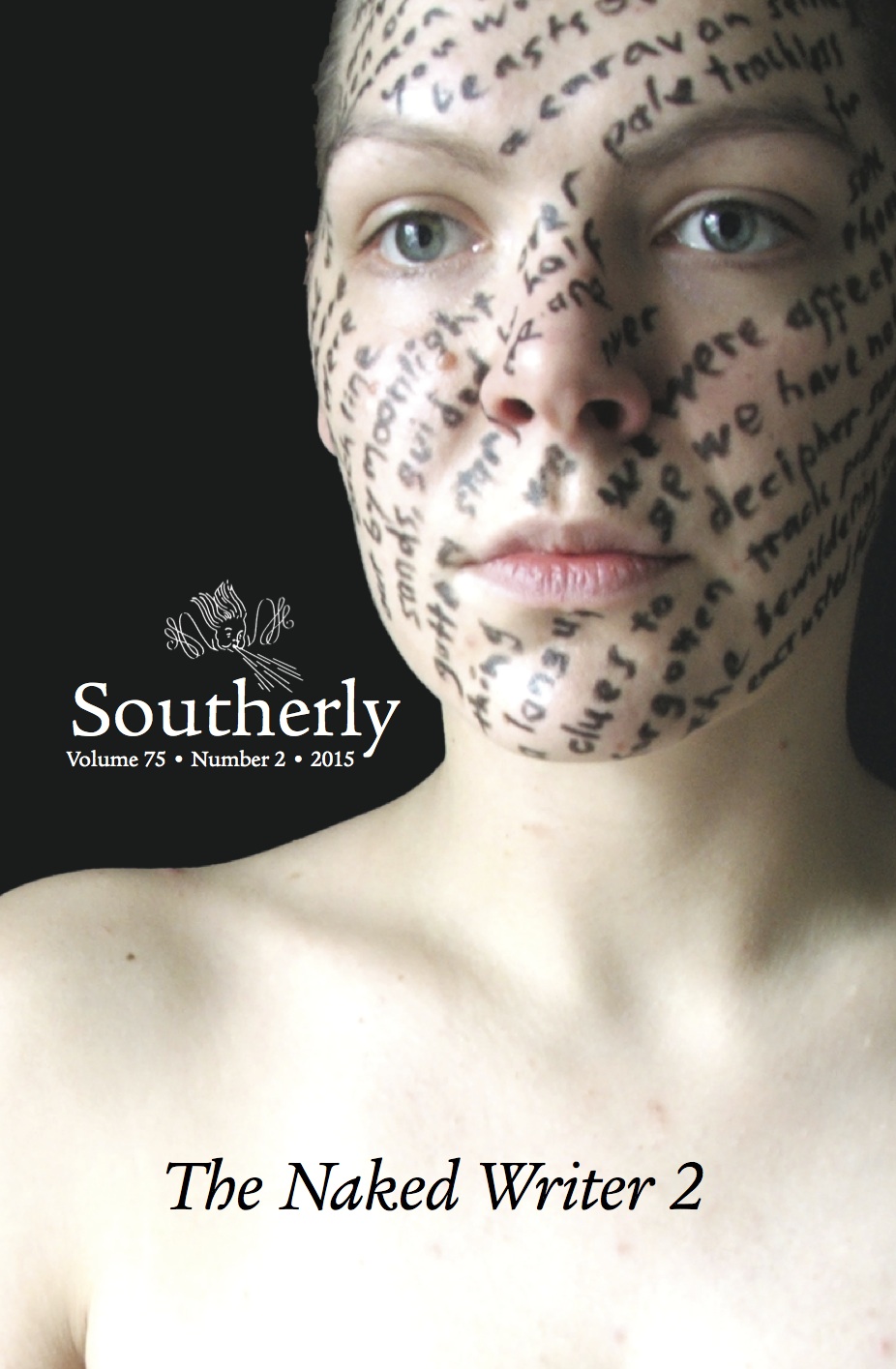
Elizabeth McMahon and David Brooks (editors), Southerly Vol 75 No 2 2015: The Naked Writer 2 (The Journal of the English Association, Sydney, Brandl & Schlesinger)
southerly752.jpg

John Kinsella and Charmaine Papertalk-Green have a collaborative poem in this Southerly. The son of an Anglo-Celtic farmer, Kinsella lived in Geraldton, Western Australia, for the last three years of high school. Papertalk-Green is a Yamaji woman who grew up in nearby Mallewa and now lives just outside Geraldton. The poem – actually a sequence of poems written by the two poets alternately – responds to the works of Western Australian religious architect Monsignor John Hawes as enduring symbols of colonisation.

In what looks like an anxious concern that readers appreciate the significance of the poem, it is embedded in an article by Kinsella, ‘Eclogue Failure or Success: the Collaborative Activism of Poetry’, which among other things spells out the back story, makes learned observations about Virgil’s Eclogues, quotes Wikipedia, throws in a few Greek words, and makes sure we don’t confuse the poem’s first-person elements with the ‘entirely self-interested and subjective’ phenomenon of the selfie. Kinsella is willing to risk being annoyingly self-important if that’s what it takes to ensure that we take him and his collaboration with Papertalk-Green seriously.

Maybe it worked, or maybe the poems would have spoken for themselves, but it’s the kind of project that makes one glad to be alive in the time that it is happening. (Of course, it’s not unique: another stunning example is My Darling Patricia’s 2011 theatrical work, Posts in the Paddock, a collaboration between descendants of Jimmy Governor and descendants of a white family he murdered. That one seems to have sunk without a trace, so maybe all such works do need a John Kinsella to tell us how important they are.)

The challenge of unsparing conversation between Aboriginal peoples and settler Australians is also the subject of Maggie Nolan’s essay ‘Shedding Clothes: Performing cross-cultural exchange through costume and writing in Kim Scott’s That Deadman Dance‘. Apart from calling to mind the pleasure of reading the novel and quoting from it generously, Nolan suggests that, though Bobby/Wabalanginy’s failure to communicate to the colonisers by means of dance may end the book, ‘perhaps his invitation remains open, and Kim Scott, through this novel, is re-extending it to his readers’. I think she’s hit the nail on the head.

There is plenty else here to exercise and delight the mind. In no particular order:

  • David Brooks bids an idiosyncratic and clearly deeply felt farewell to his friend the literary critic Veronica Brady, who died last year.
  • Fiona McFarlane’s ‘On Reading The Aunt’s Story by Patrick White’, originally a Sydney Ideas lecture, is a warmly intelligent revisiting of that novel.
  • Hayley Katzen’s personal essay ‘On Privacy’ rings the changes on the perennial theme of its title, interestingly resonating with John Kinsella’s distinction between the writerly ‘I’ and the facebook or selfie ‘I’, and also with Kim Scott’s meditations on what happens when you write things down.
  • Jill Dimond and Helen O’Reilly delve into their respective family histories, the former with an engrossing tale of failed literary aspirations, the latter with the story of the connection between her second cousin Eleanor Dark and poet Christopher Brennan.
  • Joe Dolce, whom I should be able to mention without referring to ‘Shuddupaya Face’, interviews the late Dorothy Porter about C P Cavafy and they discuss his poetry’s importance to both of them.
  • Of the wide-ranging selection of poems, I particularly enjoyed Alan Gould’s ‘The Epochs Must Go Chatterbox’ and ‘The Insistent Face to Face’, Geoff Page’s genial ‘A Drinking Song for A D Hope’, and Mark Mordue’s Sydney train journey, ‘A Letter for The Emperor’.
  • Craig Billingham’s ‘The Final Cast’ reads like a slice of wryly observed Glebe literary life, though its ‘Fiction’ label should spare embarrassment all round.
  • Nasrin Mahoutchi’s story of widowerhood, ‘Standing in the Cold’, evokes a bitter Iranian winter with just the right amount of twist at the end.
  • In the review section, A J Carruthers discusses Michael Farrell’s Cocky’s Joy and Les Murray’s Waiting for the Past, justifying this unlikely pairing by claiming both poets as ‘experimental’, and arguing that experimental poetry is mainstream in Australia now (and as I write that I realise that the four poems I have singled out above are probably the least ‘experimental’ in this Southerly – ah well, I’m now in my 70th year, so I hope I may be forgiven).
  • In The Long Paddock, the journal’s online extension, Jonathan Dunk gives what he describes as a ‘gloves off’ review of Jennifer Maiden’s Drone and Phantoms, and elicits a bare-knuckled response from Maiden. Good on you, Southerly, for putting the conversation out in the open.

I tend to skip the densely scholarly articles (the ones that use words like chronotopic), or at best dip into them. Dipping can come up with some pleasant oddities. In this issue I stumbled on a quote from one Eric Berlatsky to the effect that in some ways ‘the institution of heterosexual marriage is “always already queer”‘. How far we’ve come since William Buckley Junior caused an uproar by calling openly gay Gore Vidal a ‘queer’ on US television in 1968. Now, it seems, in academic parlance, even those ensconced in heterosexual marriages are queer.
Rhyme #4 and Southerly 75/1

Elizabeth McMahon and David Brooks (editors), Southerly Vol 75 No 1 2015: Elemental (The Journal of the English Association, Sydney, Brandl & Schlesinger)

Rhyme #4: What's in a title (with anagrams)?
Blow the wind southerly, Southerly, southerly,
rattle our windows and slam dunny doors,
blow off the same old stuff, bring on the Otherly,
bust up the torpor that stifles these shores.
The name holds promise that the journal
challenges what seems eternal –
our bow to all that's from the North,
our faith in all it issues forth.
The title tells us what's been hidden:
a home-made tool that truly hoes
this soil, as surely hot it grows.
Shout, lyre! Play something that's forbidden.
The RSL you knew is now
A rusty hole, a sacred cow.
s152

I have a love-hate, or at least an affection-irritation relationship with Southerly.

As one who was educated before what someone in this issue calls ‘the cultural turn’, which I guess refers to the rise of Theory and cultural studies in the academy, I am often left whimpering uncomprehendingly in the dust of the more scholarly work – of which there’s a fair bit in this issue, including at least five examples of reviewers indulging in clever exegesis of a book or other work’s title (hence my rhyme above). On the other hand, there is always something that more than justifies the price of admission.

In this issue, two essays – ‘Oi Kaymeni (“The Burnt Ones”)’ by George Kouvaros and ‘Angry Waves’ by Dael Allison – are wonderful.

Kouvaros’ essay begins with his mother’s reluctance to watch the 1950s movie A Place in the Sun on TV, and fans out to tell the story of her emigration from Cyprus, then to reflect on the role played by Hollywood movies in the lives of people in peasant cultures facing rapid modernisation and sometimes massive dislocation. An excerpt:

Recounting this history helps me to understand the events that shaped my mother’s personality. It also provides an opportunity to clarify two interrelated propositions. The first is that migration is not just about a dispersal of individuals  across continents; it is also about a dispersal of the narrative details that we use to understand the people close to us.

His second proposition, which has to do with a movie’s unchangingness as opposed to that of living people, leads to the realisation that for his mother ’embedded in the film’s story was her own history as  a sixteen or seventeen year old cinemagoer’.

What he writes is specific to his mother’s life, and to the history of Cyprus, but it will resonate richly for anyone of a certain age who loves the movies.

Dael Allison writes about the impact of climate change on Kiribati (pronounced Kiribass – Kiritimati is the Kiribati spelling of Christmas) from the point of view of a westerner who has lived, worked and had friendships there for some years. As you’d expect, the picture is alarming – the brunt of climate change is and will be felt by those who have done least to cause it. Allison’s wealth of detail and observation and quotation brings the situation home sharply. For instance, the recent damage done on Kiribati, unlike that on, say, Vanuatu, is not the result of cyclones, but of tidal events which bring the angry waves of the essay’s title; unlike the damage on Vanuatu it cannot be quickly healed because coral reefs do not regenerate as forests do. There’s no cause for total panic:

Unless there is a massive global catastrophe like a melting Antarctic ice shelf sliding into the sea, Kiribati will not all become unliveable at once. But the process of relocating villages because of inundation, coastal erosion or salt contamination due to wave over-topping of the fragile freshwater lens, has already begun. Projections suggest entire atolls may become uninhabitable in the next generation. Some islanders say they will stay on their land despite that outcome.

There are other treasures: ‘Wyenondable Ashes’, Alice Bishop’s memoir of losing  her family home on Black Saturday 2009; ‘St Thomas’ Churchyard’, in which Roslyn Jolly takes a closer look at the gravestones that dot her local park, formerly a colonial cemetery; ‘A Richer Dust’, where John Stephenson finds resonance between a passage from the Aeneid he happens to be reading and a ‘sentimental conversation’ from a week earlier, and arrives at a sweet elegiac moment.

The poems that stand out for me are Dugald Williamson, ‘Caprice’; Pam Brown, ‘Twelve noon’; Stuart Cooke, ‘Old World’; Laurie Duggan, ‘After a storm, Brisbane’; David Brooks, ‘Choosing to Stay’ and ‘Silver’ (which only a vegan could have written); and Brett Dionysius, ‘American Love Poem’ (not a sonnet, not set in Queensland, but terrific).

Of the short fictions, Moreno Giovannoni’s ‘The Bones of Genesius’ make one look forward to Tales from San Ginese, the book he is writing about his birthplace; and Claire Corbett’s ‘The Trillion Pearl Choker’ is a weird tale of the forces of nature fighting back on the climate change front.

As a rule, I don’t read Southerly‘s reviews of books I haven’t read, of which there are many here. But I did dip this time. Felicity Plunkett introduces her review of a book of criticism with a selection of trenchant quotes from writers ‘writing back’ to the critics; Nicolette Stasko makes me want to read Peter Boyle’s Towns in the Great Desert; Vivian Smith and Chris Wallace-Crabbe’s grey hairs lend distinction to the review pages; Kate Livett draws attention to a timely new edition of Judith Wright’s 1971 account of a battle to save the Barrier reef, The Coral Battleground:

Weirdly, although this battle for the Reef took place from 1969 to 1975, Wright’s text initially reads as if it could be taking place today, with the ridiculous ‘postmodern’ political moves made by Bjelke-Petersen’s government, such as employing an American geologist with no knowledge of biology, let alone marine biology, to do a three-week survey on the Reef.

And now for a little grumpiness. Some of the writers here would do well to read Joseph M Williams’ Style: Lessons in Clarity and Grace. One essay in particular  veered from banal to incoherent to impenetrably technical. I persevered for a while, but threw in the towel when principle appeared as an adjective – just a typo perhaps, but in that context very dispiriting. And what’s with the US spellings throughout – harbor, jewelrymeter (as a measure of distance)? In the absence of a statement that this is policy, it creates the impression that the English Association, Sydney is made up of people who don’t care much about the language.

Southerly 74/2

David Brooks and Elizabeth McMahon (editors), Southerly Vol 74 No 2 2014: Australian Dreams 1

southerly-74-2

When Dorothea Mackellar was living in England a little over a century ago, she dreamed – and versified – about a sunburnt country, rugged mountain ranges and sweeping plains. Times have changed. When David Brooks sent out an invitation for an issue of Southerly on Australian dreams, he wrote of ‘a mounting dismay and shame at seeing the cruel place we’ve become’, and though in his editorial he protests that he doesn’t want to deliver a jeremiad, that editorial will do the job quite effectively until an actual jeremiad comes along.

So there’s not a lot of singing about the wide brown land here.

Rowena Lennox’s ‘Timor Dreaming’, about a friend who was killed in the East Timor massacre of 1976, pokes at the open wound of the Australian government’s silence then and its bullying more recently. JH Crone’s three-part ‘Elegy to Giants’ mourns Australians killed in the Bali bombing while ambivalently celebrating their ‘binge Bintang, root, vomit’ lifestyle (and in the third part, a jarringly unrhymed parody of CJ Dennis identifies them as descendants of Dennis’s Ginger Mick).

Jim Everett, a plangermairreener man of the First Nations of north-east Tasmania, refuses to identify as an Australian citizen in a fiercely polemical article, ‘Savage Nation: First Nations’ Philosophy and Sovereignty’. Mudrooroo Nyoongah, citizen of the world, faces old age, illness and the prospect of death in two powerful lyrics, ‘Wisps of Delightful Desire’ and ‘Old Fella Poem’.

Joshua Mostafa’s ‘Against Progress: Dreams, Nightmares, and the Meaning of Abbott’ probes the state of the Australian political culture (don’t be put off by its citing of a contemporary French philosopher, which often foreshadows pages of heavily academic prose, but not here): crudely summarised, he argues that public debate is too often limited to a contest between those who play on people’s fears and those who play on the fear of having one’s fears played on.

A number of the poems could have been written in direct response to David Brooks’ Claytons-jeremiad, touching on asylum seekers’ deaths at sea, environmental degradation and the parlous state of currently existing democracy. The poems that resonated with me most strongly, though, didn’t have an obvious connection to the theme: travellers’ tales from Laurie Duggan – ‘A short history of France’ and ‘New York Notes’ (not the only travellers’ tales by any means); a snowy expatriate winter from Kevin Hart – ‘February’; and a long piece by Sian Ellett, ‘Chopin & Friedric’, in which the top part of each page has a slam poem by a teenager with multiple sclerosis while at the bottom his mother gives her point of view.

The closest thing to a good old-fashioned bush yarn is Frank Moorhouse’s ‘I, initiation’, which starts out, ‘At the age of eight as a cub scout, with a never before experienced delight, I cooked and ate my first lamb chop barbecued on a green forked stick at my first camp fire in the bush,’ and goes on to talk about his regular eight-day solitary sojourns in the bush. But we are taken way out of our – and his – comfort zone with the story of an accident involving his scrotum and the years of psychoanalysis that followed.

The closest thing to a good old Aussie family story, and the piece if fiction that most wrung my withers, is Cecelia Harris’s ‘All That is Left Behind’, a father–daughter story that is full of snow rather than sunburn.

Michelle Borzi’s ‘David Malouf, Earth Hour‘ provides what I’m always hoping for when I read literary criticism. She quotes generously, and helps us see the poetry with fresh eyes.

There are signs that some items were written – and edited – in haste. It’s hard to take seriously an article about Gough Whitlam that misspells Malcolm Fraser’s surname and the name of the Labor Party (especially given that Southerly follows US spelling conventions elsewhere). A reference in one article led to a critical response to the piece it was supposed to refer me to. One story ends so abruptly that one wonders if a couple of pages have dropped off or, more likely, it’s an undeclared excerpt from a longer work. And, fascinating though it is, I do wonder if Frank Moorhouse mightn’t have put his memoir through another draft to take some of the awkwardness out of his discussion of Aboriginal initiation ceremonies and the TMI discussion of his therapy.

Evidently a further Australian Dreams issue is in the pipeline. Good!

Southerly 74/1

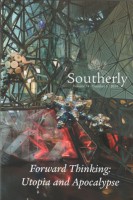
Elizabeth McMahon and David Brooks (editors), Southerly Vol 74 No 1 2014: Forward Thinking: Utopia and Apocalypse

southerly741If I read  the editorials in journals at all, I generally leave them until last, so I read without regard for any theme. I did read enough of this Southerly‘s editorial to gather that it was anticipating the 500th anniversary of Thomas More’s Utopia, but in the rest of the journal I mostly registered mentions of Utopia or utopianism as peripheral to what I found interesting. Some of my highlights:

  • Rozanna Lilley’s memoir, ‘The Little Prince, and other vehicles’, would be wonderful reading whatever her parentage: it’s very funny on the subject of inter-generational bad driving and builds to bitter-sweet reflections on her relationship with her father. But as Lilley’s parents were Dorothy Hewett and Merv Lilley (a fact coyly avoided in the Editorial and Notes on Contributors, but explicit in the memoir itself), it makes a substantial addition to the lore about that magnificent couple. For example, the passing mention that Rozanna had hidden her father’s rifle away from him in his erratic old age is particularly chilling in the light of Merv’s book, Gatton Man, which argues plausibly that Merv’s father was a serial killer, and convincingly that he was capable of murder.
  •  ‘Exile on Uranium Street: The Australian Nuclear Blues’, by Robin Gerster, author of the brilliant Travels in Atomic Sunshine about the Australian occupying force in Hiroshima after the bomb, is a sprinting survey of Australian responses to the nuclear age. Wilfred Burchett’s famous report from Hiroshima, Neville Shute’s novel On the Beach and Stanley Kramer’s film of it have overshadowed other responses, from Helen Caldicott’s activism to protests about Maralinga’s murderous tests. This essay fills out the picture in a way that makes one hope there’s a book on the way. It has a disconcertingly jaunty self-deprecating tone, but occasionally moves in for the kill, as when it challenges our current complacency about nuclear weapons: ‘There is no cause for panic, then – unless one ponders the possibilities.’
  • ‘And in our room too’ by Liesl Nunns starts from the experience of being woken by an earthquake in the middle of a storm in Wellington, New Zealand, and ruminates interestingly about the unexpected, weaving together stories of Maori gods and taniwha, personal experience, and scientific data in true essayist style. I am uneasy about her telling Maori stories in a way that makes them sound like Greek myths, but they powerfully evoke the instability of that part of the world, as does her recurring phrase, It never occurred to me that this could happen.
  • A number of pieces deal with individual mortality. Nicolette Stasko’s poem ‘Circus Act’ deals with the stark unreality of death in a hospice. Susan Midalia’s short story ‘The hook’, in which a woman goes travelling alone two years after her partner’s death, captures the way grief persists but life eventually begins to reassert itself.
  • As always, there’s a satisfying range of poetry. Apart from ‘Circus Act’, I most enjoyed Andy Jackson’s pantoum ‘Double-helix’, Margaret Bradstock’s ‘The Marriage (1823–1850)’ (another of her fragments of colonial history) and Ben Walter’s ‘Joseph Hooker’s Hands’. Geoff Page’s review of books by Tim Thorne and Chris Wallace-Crabbe made me want to read them both.
  • I skipped much of the scholarly content (Southerly is, after all, a scholarly journal), but Jessica White’s ‘Fluid Worlds: Reflecting Climate Change in The Swan Book and The Sunlit Zone‘ was worth persevering with for its interesting insights about Alexis Wright’s work. Danny Anwar’s ‘The Island called Utopia in Patrick White’s The Tree of Man‘ may do the same for Patrick White, but the near-impenetrable technical language proved too daunting for me. My prize for impenetrability goes, though, to A J Carruthers’ review of Melinda Bufton’s Girlery, which isn’t so much densely technical as splendidly uncommunicative, not to mention disdainful of the need for consistent punctuation or the workings of the French language, as in this snippet (because I can’t make WordPress show non-itals in quotes, words that should be in italics appear here as red):

Think of Girlery as a sociostylistic and amorous liaison with girlish grammar. Around each coquine clause the female reader eyes the book, “Hitherto unwritten”, knowingly participating in a kind of ‘quixotica,’ an erotics of reading where “a little grin does that thing only read in books / Plays on our lips / Tout les deux” (27).

Someone in these pages talks about the role of the creative writer in helping us to bring our minds to bear on frightening or otherwise potentially numbing realities. It’s important work, and this Southerly is part of it.

David Malouf’s Remembering Babylon and the Book Group

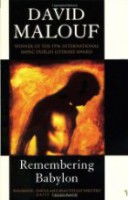
David Malouf, Remembering Babylon (©1993, Vintage 1994)

009930242X Remembering Babylon is an A-Stranger-Comes-to-Town story. The Stranger is Gemmy, who was thrown overboard as a boy from a ship somewhere off the Queensland coast in the first half of the 19th century. Already not quite the full quid after an impoverished early childhood in London, and traumatised further by his near death by drowning, he was taken in by a group of Aboriginal people. The Town is a tiny community of white settlers who arrive in the area some years later. As Gemmy observes them, his half-remembered previous life stirs in memory, and on encountering a group of children he stammers words David Malouf has appropriated from the historical Gemmy Morrell (or Morril), ‘Do not shoot. I am a B-b-british object!’

Although we have some access to Gemmy’s inner life, the book is mainly about the small settler community, about their range of responses to this part white, part Aboriginal man, and more broadly about the process of British settlers accommodating to the new Australian reality. Malouf would never put it this crudely, but it’s as if Gemmy, for all his addledness, has adapted to the new world more fully than any of them, so his presence becomes a catalyst for their differences and tensions to be exposed.

In Gemmy’s early days in the settlement, for example, a number of the men try to extract information from him about ‘the blacks’, but he resists:

And in fact a good deal of what they were after he could not have told, even if he had wanted to, for the simple reason that there were no words for it in their tongue; yet when, as sometimes happened, he fell back on the native word, the only one that could express it, their eyes went hard, as if the mere existence of a language they did not know was a provocation, a way of making them helpless. He did not intend it that way, but he too saw that it might be true. There was no way of existing in this land, or of making your way through it, unless you took into yourself, discovered on your breath, the sounds that linked up all the various parts of it and made it one.

Yet while this theme is being explored, the narrative adopts one character’s point of view after another – two of the three children who first meet Gemmy, their parents, the young school teacher, the minister – and each time on feels one is meeting a real person, someone Malouf knows well, perhaps even someone he in some way is or has been.

I read Remembering Babylon as part of a body of work by non-Indigenous writers, including Inga Clendinnen’s Dancing with Strangers (2005), Ross Gibson’s 26 Views of the Starburst World (2012) and David Brooks’ essay ‘Origins of Modernism in the Great Western Desert‘ (2008), which explore ways the encounter between these vastly different cultures plays out in non-Indigenous minds. It’s not really a historical novel: I doubt if any part of the Queensland coast was settled as peacefully as this fictional one apparently was, or if there would have been so little contact (ie, none apart from Gemmy) with the local Aboriginal people if it had. It’s surely symbolic rather than historical that an aristocratic woman lives in a beautiful Queenslander just a little way off in the bush from the rudimentary dwellings of the other settlers.

I’m sorry it’s taken me so long to read this book, but it’s interesting to see that some of the themes of Malouf’s recent poetry – particularly the idea of humans as creating a planet-wide garden – were being developed 20 years ago.

The group is meeting tonight. I can’t go because there are things happening in my family that have priority. It’s a pity, because there’s a lot to discuss.

Southerly 73/3

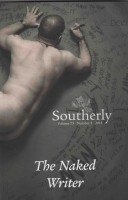
David Brooks and Elizabeth McMahon (editors), Southerly Vol 73 No 3 2013: The Naked Writer

1nw

Alain de Botton was on the ABC recently arguing that we need to reclaim art (and by extension literature) from the academies and museums, to recognise its role in our ordinary lives. He was annoyingly persuasive, and had me wondering whether I really needed to read Southerly, which is after all solidly grounded in the English Department of the University of Sydney, largely written and edited by academics for academics. It seems to have stopped publishing poems by Jennifer Maiden, the regular appearance of which led me to re-subscribe a couple of years ago. So despite the fabulously daring cover, I approached this issue warily. What was in it for me?

It seems I enjoy reading about friendship. Alex Miller’s ‘A Circle of Kindred Spirits’ is a moving account of biographer Hazel Rowley’s career, seen through the prism of Miller’s long friendship with her, which they conducted almost entirely by email. Ann-Marie Priest’s ‘“Colour and Crazy Love”: Gwen Harwood and Vera Cottew’ explores a deep friendship between two women that has been sidelined in most discussions of Gwen Harwood’s poetry. It’s a beautiful essay, explicating some of the poetry and exploring the complex possibilities of friendship between women.

Scott Esposito’s ‘The Gate Deferred: J.M. Coetzee and the Battle against Doubt’ is interesting for similar reasons: at heart it’s about the relationship between readers and writers. The essay explores Coetzee’s engagement with Kafka. Far from writing dry academic analysis, Esposito begins by telling us how as a child of non-religious parents he (Esposito) experienced his own version of Pascal’s ‘le silence eternel des espaces infinis m’effraie’ (the Pascal reference is mine), then gives us a beautiful account of how in Coetzee he found someone with a similar sense of things, expressed in part by Coetzee’s engagement with Kafka. Coetzee, Esposito writes,

gives us not an answer to Kafka, nor an interpretation of him, but rather his experience of dwelling within Kafka’s mysteries.

Esposito comes close to dwelling within Coetzee’s mysteries. (I haven’t read enough of J M Coetzee – just Disgrace and the three volumes of quasi-memoir – to have an opinion on the validity or otherwise of Esposito’s reading, but that seems beside the point.)

Rowena Lennox’s ‘Head of a Dog’ is about another kind of relationship – that between dogs and humans. Her account of walking her dog made me wonder if she lives near me: could my collie be the one she describes as driving her kelpie-cattle dog cross to such paroxysms of exhilarated rage simply by existing behind a fence? Dogs ‘are the closest we have come to living with and knowing another species’, she writes, and whatever the cat brigade may say I think she’s right. The essay ranges widely, drawing on, among others, Frank Dalby Davison (Dusty), Jack London (The Call of the Wild), and Aboriginal elders Tim Yilngayari and Daly Pulkaa (as quoted by Deborah Bird Rose in Dingo Makes Us Human).

There are fine poems: Tracy Ryan has four on a hoard hidden and centuries later found;  Judith Beveridge (‘Peterhead’), Geoff Page (‘Angus’) and Stephen Edgar (‘The Sense of an Ending’) lend lustre (and just watch that Stephen Edgar use rhyme!); Ali Jane Smith (‘The Galapagos’), Simeon Kronenberg(‘Death of a Bull’) and Ross Donlon (‘Storm Water’) each do narratives it will be good to spend more time with.

There are fine reviews. I was especially glad of Anne Brewster on Melissa Lucashenko’s novel Mullumbimby, which I plan to read, and John Tranter being generous, illuminating and a little gossipy on Pam Brown’s Home by Dark.

That’s just some of the highlights for me. Other people may fall with cries of joy on the 42 page offcut from a forthcoming experimental novel by John A. Scott, Michael Buhagiar’s elegant discussion of Christopher Brennan’s debt to A. C. Swinburne, Robet Darby’s explication of the homoerotic content of a Martin Boyd novel, or … well, there’s quite a lot that I haven’t mentioned.

I’m going to finish with some whingeing, so feel free to stop reading now.

• First, does Southerly deliberately follow US spelling conventions for things like centre/center or the verb practice/practise?

• Second, is it just a little disrespectful to display a poet’s naked body on the cover and make no reference to him or his work except in the photo credit? If you’re interested, here’s a video of spoken word poet Randall Stephens full frontal, clothed and performing:

• Third, was it inattention or editorial illiteracy that allowed Ann-Marie Priest to go into print saying that

there is no mainstream literary tradition of female friendship, as there is with male friendship (think of Tennyson’s In Memoriam A.H.H., Achilles and Patroclus in The Illiad, and Jonathon and David in the Bible).

Maybe Ruth and Naomi just a few pages over from David and Jonathan ‘in the Bible’ don’t constitute a tradition, but surely they deserve a mention; even spellcheck knows how to spell The Iliad; and however many people name their children Jonathon, it’s Jonathan in the Bible. Even if you don’t count the ‘with’ that really ought to be an ‘of’, that’s an impressive error count in so few words.

Southerly 73/2

David Brooks and Elizabeth McMahon (editors), Teja B. Pribac (Guest Co-editor),  Southerly Vol 73 No 2 2013: Lyre/Liar

73-2-sI didn’t read enough of this Southerly to write a review. It says more about me than about the journal that I just couldn’t make myself read a collection that focuses on exploration of ’emerging ethical implications of writing, with a particular emphasis on representations of nonhuman animals’. A quick skim seemed to show writer after writer identifying as vegan or animal liberationist in a way that felt just a little too correct-line for my taste. I may be wrong, and if I come back and find that I am, I’ll write a retraction, but I wasn’t deterred from my rash judgement by an extraordinary disclaimer from the Southerly editorial team, saying their views are not necessarily reflected by the ‘views expressed in this issue’.

I did read, though, an excellent review of Jordie Albiston’s The Book of Ethel by Mark O’Flynn (which articulates nicely some of what Albiston does with internal rhyme), some memorable poetry including ‘Mouse Plague’ by John Kinsella and ‘A Second Ago’ by Pam Brown, and an illuminating essay on lyric poetry in ‘post-theory’ times by Claire Nashar.

Southerly 73/1

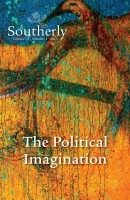
David Brooks and Elizabeth McMahon (editors), Southerly Vol 73 No 1 2013: The Political Imagination

1spiRoughly two thirds of this Southerly is devoted to essays that started life as papers for ‘The Political Imagination: Contemporary Diasporic and Postcolonial Poetries’, a conference held in Melbourne in April 2012. So the political imagination under discussion is much more specific than the issue’s title suggests. It’s as if the god of the mailbox saw me tossing terms like ‘immigrant poetry’ around in my last blog post, and decided to send me some heavy-duty reading matter as a reproach for my lack of theoretical rigour (or theoretical anything, if the truth must be known). Ali Alizadeh, one of the subjects of that last post, was responsible along with Ann Vickery for editing the essays from the conference, and co-wrote one of them with Penelope Pitt-Alizadeh: and he more than adequately fits my description of him as way out of my intellectual league.

Of the theme essays, the clear stand-out is Danijela Kambaskovic’s superbly readable ‘Breaching the social contract: the migrant poet and the politics of being apolitical’. When Kambaskovic left Belgrade in the 1990s she had already published poems, translations and criticism in Serbian and was fluent and well read in English. She came to Australia, gained a PhD and eventually began to write poetry again, now in English. The essay addresses the question of her deep reluctance to write about migration, to write poetry from the migration experience. In vivid prose, she lays out her own story and that of others with similar experiences: it’s the story of someone fighting for her own mind, resisting pressure to further her career by commodifying her painful history and at the same time searching for an ethical practice:

Traumatised writers spend their lives searching for precise verbal equivalents for the dread, the horror, the identity shifts, the hatred of one’s environment, the inability to identify with the structures and institutions of society, the fear of reality, the mental dysmorphia – all non-verbal and confronting emotions made even more complex by the awareness that one has moved into a much ‘better’ society and ought to be ‘grateful’. How is it possible to write about these for an audience who may be baffled, even confronted, by the uneasy conjunction of praise and criticism of their own society, which may make the migrant writer seem negative and ungrateful, or at the very least, unnecessarily conflicted? I salute those migrant writers who can find enough clarity in their minds to write about any of those, and avoid the pitfalls. Any of my attempts that have been in any way successful have skirted on the surface of the experience.

This essay is worth the price of admission, for itself, and for the way its flesh and heart helps with the preponderantly academic tenor of the other essays.

Those essays explore similar issues. Alizadeh and Pitt-Alizadeh carefully and meticulously discuss the dangers of categorising people and/or poetry according to a single ethnic or racial identity, and give a model of how to read a poem that avoids those dangers without imposing mainstream assumptions on it. A full understanding of their model depends on the reader being familiar with Alain Badiou’s readings of Mallarmé, which sadly I am not. Adam Aitken’s demanding discussion of hybridity casts interesting light on his own poetry:

Rather than a poet who writes about travel I would like to be read as a poet who charts the changing nature of the ongoing historical meaning of the Asian-in-Australia.

Peter Minter floats an idea of imagining ‘a decolonised twenty-first century Australian poetics’ by thinking in terms of archipelagos – I think he’s saying something that’s not just interesting but exciting, but I’d have to make headway with 15 or so heavy-duty theorists he cites to understand him properly. Had I but world enough and time! There is a lovely moment where he quotes in quick succession and mutual support Les Murray, Karl Marx and the Whole Earth Catalogue.

I also enjoyed Timothy Yu’s discussion of Asian Australian poetry. As a US scholar, he was struck by the different way migrant communities talk about themselves here. Sydney comedian Michael Hing, who can trace his family’s history in Australia back some five generations, refers to himself, not as an Asian Australian (the equivalent of Asian American, the most likely term if he had been in the US) or even as a Chinese Australian, but as ‘a Chinese guy’. Yu ruminates interestingly on this difference, and gets down to specifics in considering aspects of the poetry of Ouyang Yu.

The rest of the journal is taken up with poetry, short stories and reviews, all interesting, some wonderful.

Danijela Kambaskovic stars again in the poetry section with ‘Belgrade Sunday Lunch’, a translation from her own poem in Serbian (incidentally, her article has a nice riff on what it means to translate one’s own poem as opposed to someone else’s). She has two more poems in Southerly‘s online component, The Long Paddock, just a click away.

Of the stories, I liked best Jeremy Fisher’s modest domestic scene, ‘Ready to Dance’, which has a predictable but satisfying twist, and Rachel Leary’s ‘God’s Lost Sheep’, which plays like a short grunge movie of a bus hijack.

There’s an interesting combined review by Jal Nicholl of Michael Farrell’s open sesame and Jennifer Maiden’s Liquid Nitrogen. He sees these vastly different poets as inhabiting ‘different wings of the same belated [ie, post-modernity/post-modernism] dream-house.’ And one of life’s little mysteries is solved on page 256 where Sam Franzway review’s Vikki Wakefield’s young-adult novel Friday Brown: Sam is known in these quarters as franzy, creator of the blog Writing. So now we know why he’s been neglecting his blog – he’s doing a PhD and writing scholarly reviews, thankfully without a single mention of Deleuze, Kristeva, Baudrillard or even Foucault.

Curmudgeonly footnote: I would pass in silence over the ‘back-peddling’ character in one of the stories, because there is pleasure in such misspellings. But I have to complain about a moment in Danijela Kambaskovic’s brilliant essay where she was left hanging out to dry by the editorial team. Observing that some people question whether a woman of non-English speaking background can adequately teach Shakespeare to Anglo-Saxon students, she comments in parentheses: ‘This reminds me of famous quip by George Bernard Shaw that women writers are like dogs dancing on their hind legs: the wonder is not that it is done well, but that it is done at all.’ It’s a slip that anyone could make, but surely one of the many pairs of eyes that read that paragraph on its way to press should have picked up that the famous quip was made by Samuel Johnson, and it was about a woman preaching.

Southerly 72/3: Islands and Archipelagos

David Brooks and Elizabeth McMahon (editors), Southerly Vol 72 No 3 2012: Islands and Archipelagos

1southerly723

The title of this issue of Southerly, ‘Islands and Archipelagos’, refers to its subject matter, but it could just as easily refer to its form: a literary magazine, archipelago-like, is a gathering of diverse entities, each with its own integrity but all having something in common, whether a theme as in this case or something less tangible, like a tone, or an ethos, or a presiding personality.

I enjoyed my island hopping. My favourite moment is the bravura opening sentence of ‘Outcast of the Islands: Malinowski Amongst the Modernists’ by David Brooks :

If there could ever be such a thing as a True History of Modern Thought, at least one chapter would have to trace that set of strange, 
neglected, yet teasingly-almost-direct lines between a heterogeneous
 crew of squatters, graziers, country postmasters, district magistrates, missionaries, and employees of the Overland Telegraph recording details of Indigenous Australian life and culture in the mid- and late- nineteenth century and the desks of Edward Tyler at Oxford, James George Frazer at Cambridge and Emile Durkheim in Paris, and, through them, and a number of other significant late-nineteenth-century anthropologists, to the likes of T. S. Eliot, Ezra Pound, Sigmund Freud (see, for example, the first half of Totem and Taboo), Marcel Mauss (Essay on the Gift) and so many other key figures in early twentieth-century thought and aesthetics that one wonders whether the Simpson Desert or the Trobriand Islands should be given a place – a quite significant place – amongst the generating landscapes of Modernism.

Yes, that is just one sentence. The article not only delivers on the sentence’s promise but ends with a link to a provocatively titled companion piece, ‘Origins of Modernism in the Great Western Desert: An Introduction’.

Tying for second favourite moment are:

  • Michael Sharkey’s poem ‘First Eleven’, eleven stanzas consisting of phrases that evoke an Australian baby-boomer childhood, presumably to the age of 11. Much of it might be inscrutable to people of other generations and other places, but I was born in 1947, a year after Sharkey, and his deft hand worked nostalgic wonders in me, even in the minority of phrases that didn’t touch directly on my own experience:

    The Royal Visit. Easter Show.
    My sherbet packet. Liquorice stick.
    My shop-bought pie. My Iced Vo-Vo.
    My Cracker Night. My Jumping Jack.
    My father’s gas mask. Old blue tunic.
    My small sister in the clinic.
    My six-stitcher. My first duck.
    The choko vine. The dunny truck.


  • Michael Jacklin’s ‘Islands of Multilingual Literature: Community Magazines and Australia’s Many Languages’, which prises open the subject of Australian literature in languages other than English. I’ve always felt odd about the portrayal of 1950s Australia as monocultural and monolingual: Italian and other southern European languages were part of the soundscape of my 1950s north Queensland childhood; one of my best friends in primary school was Chinese; my farmer father played poker with a Greek, a Korean and a Yugoslav; in the 30s and 40s my magistrate grandfather spoke to Italians who appeared before him in their own language. This essay discusses evidence, including a journal from Brisbane in the 1930s, that there has long been lively, linguistically diverse literature in the Australian context, much of it invisible to the mainstream literary establishment.
  • a new poem by Jennifer Maiden, always a thrill. ‘Diary Poem: Uses of Ethiopia’ is in part a polemical essay, taking issue with some feminists who are ‘well in favour / of ethical security’. I’m not sure what ethical security is (Google is no help): it’s related to rigid ideological narrowness, I think, and may have elements of self-serving moralism. Feminist ‘fandom for Gillard’ is a symptom. My regular readers know that I often feel like an outsider with contemporary poetry (and by the way I think that’s more about me as a north Queensland boy than about the poetry). With this poem, I probably get the references more than most readers: not the Ethiopian art or the story of Sylvia Pankhurst, which are central to the poem and beautifully fleshed out, but the passing allusions – to Julia Gillard’s misogyny speech, and her cutting of the supporting parents’ benefit on the same day; to the earlier poem ‘A Useful Fan’, neatly encapsulated here as ‘trying to inhabit Abbott interestedly’; to a set-to on the Overland web site described as her ‘daughter the fire tiger’ (itself a reference to an earlier poem, ‘The Year of the Ox’) defending her ‘on a hostile magazine site now given / to ethical self-security’. Paradoxically, familiarity with the references predisposes me to foreground the detail of poem’s polemics (I want to argue about her view of Overland, for example, and I’m not sure about the connection she seems to be making between some feminists and abortion), rather than the poem’s central thrust, which I read as captured in the description of doves in Ethiopian art as

    aware of complex peripheries,
    well-mannered with watchfulness,
    —————————————-still.


As well as these pieces that topped my pops, there are learned essays on issues facing real islands and islanders, on Andrew McGahan, Randolph Stow, Drusilla Modjeska, and the rock band the Drones. There are short stories (especially Sandra Potter’s ‘“an empty ship in these latitudes is no joke”’, a lightly annotated list of things taken to and from Antarctica, and Terri Janke’s ‘Turtle Island’, a not-quite-ghost-story, not-quite-love-story, not-quite-war-story set in the Torres Strait in World War Two). There are other excellent poems and nearly 70 pages of reviews, plus the overflow in The Long Paddock, which includes a fine review by Sarah Holland-Batt of Ali Cobby Eckermann’s Ruby Moonlight.

A final note: the spectacularly beautiful cover, reproduced above, is described on the contents page as Sue Kneebone’s Continental Drift, but it’s actually a detail from that work, which I recommend you have a look at on Sue Kneebone’s web site.

Southerly 72/2: True Crime

Melissa Jane Hardie (guest editor), David Brooks and Elizabeth McMahon (editors), Southerly Vol 72 No 2 2012: True Crime – Every Contact Leaves a Trace

Southerly 72-2 cover_Layout 1

The Southerly of my youth, whatever its contents, always had the same staid, non-committal design: a single colour cover with a small blowing-wind logo the only decoration. (For non-NSW readers, the southerly is a cool and often rain-bearing wind from the south-east, famously welcome for its sudden arrival on stinking hot summer days.) Those days are long past, though the little wind is still there above the title. This issue’s cover, featuring an enigmatic photo from the NSW Police Forensic Photography Archive, is a perfect teaser for an issue built around true crime stories, more than one of them drawing on that same archive.

The archive, consisting of 130 000 photographs taken in the first half of last century, found without any accompanying documentation and now held at the Justice and Police Museum in Sydney,  is an Aladdin’s cave for researchers into Sydney’s criminal history. Peter Doyle’s ‘Detective writing: mapping the Sydney pre-War underworld’ is a fascinating dip into it, complemented with an account of a couple of relatively long-lived publications, which he describes as ‘kind of ‘ trade papers for cops, full of vivid and sometimes lurid portraits and narratives from the criminal scene. In Southerly‘s online section, The Long Paddock, Ross Gibson’s ‘Collision Course‘ plays with the narrative possibilities of a selection of images – though none of them are as queerly suggestive as the one on the cover – and refers the reader to his ongoing project with Kate Richards, Life After Wartime. Marise Williams, in ‘Women’s Work’, explores the same milieu, though without drawing on that archive: the women of her title are Kate Leigh and Tilley Devine,who ran organised crime networks in Darlinghurst in the 1920s and 1930s. It’s not just the covers that have come a long way since the staid 1960s.

My favourite single prose piece in this issue is Cassandra Atherton’s ‘Raining Blood and Money’. Classified as fiction, it’s a graphic imagining of New York’s terrible 1911 Triangle Shirtwaist fire, in which 146 people, most of them women workers, died in 18 minutes. The fire was hugely significant in the history of women and labour in the USA, and in the century since it happened it has given rise to innumerable songs, stories, monographs, rallies, and organising activities, as the links on its Wikipedia page demonstrate. Some stories need to be told and retold, and Atherton’s telling feels as fresh and visceral as if it happened yesterday.

Of course, Southerly is still a scholarly journal, so: there’s a theoretical consideration of sensationalist 19th century crime writing; the formidable thinking of Deleuze and Guattari is brought to bear on Ned Kelly’s Jerilderie letter; a Black Saturday arsonist is considered in the light of the different understandings of the notion of  ‘abjection’ in the writings of Julia Kristeva and Judith Butler; Schapelle Corby is the subject of abstruse reflections that include such highly technical language as: ‘To be where you are … requires a sense of affective difference, understood as either the Spinozan–Deleuzian mapping of co-ordinates of intensities or as the forms of projective identification required in nominating and refining the arbitrary and violent constitution of the nation-state.’ Lit crit has moved on since my day.

There’s forty pages of reviews, including Kate Middleton in elegiac mode about the late Peter Steele’s Braiding the Voices, and a swag of poetry, of which Adam Aitken’s ‘The plein-air effect (after John Clare)’, Michael Farrell’s ‘Disapproval’ and Hazel Smith’s ‘Experimentalism’ stand out for me.

A dip into the Long Paddock  came up with not only Ross Gibson’s piece, but also Melissa Jane Hardie’s review of A Tragedy in Two Acts: Marcus Einfeld & Teresa Brennan by Fiona Harari. I met Teresa Brennan once, and am glad to see that this book makes more of her than a name in a false alibi: it doesn’t mention that she was at one time a writer for Barry Humphries/Edna Everage.