Tag Archives: essays

George Megalogenis’ Minority Report

George Megalogenis, Minority Report: The new shape of Australian politics (Quarterly Essay 96, December 2024)

George Megalogenis takes Australia’s federal polling statistics and renders them into readable, even enjoyable prose. In this Quarterly Essay, he reads the data from elections since John Howard’s time up to the present moment, and attempts to make sense of the current political landscape.

The global financial crisis, the coming of the teals, Covid, the defeat of the Voice referendum, the genocide in Gaza, housing, the climate emergency, the hollowing out of the ABC: all are grist to the mill of this nuanced inside-baseball analysis.

The essay and the correspondence in Quarterly Essay 97 probably make a significant contribution to our general understanding of Australian electoral politics. But as I was reading it, I couldn’t help but be aware that it was written at the end of 2024, and if a week is a long time in politics, then the four months that have passed between then and now amount to an epoch. Even the correspondence was written before Donald J. Trump’s ‘Independence Day’. Who knows if, as Megalogenis projects, there will be a hung parliament in May? And if there is, who knows if he is right that it ‘offers perhaps our last best chance to restore purpose to our politics – and policymaking’?

Still, I admire and enjoy Magalogenis’ ability to communicate complex matter in a readable way. Page 47, which begins a section on the level of trust in government, includes an example:

In the wake of the 2010 federal election, I pinpointed the 2001 campaign as the turning point to a more trivial politics.
John Howard responded to warnings of electoral doom with a panic of handouts in the first half of that year. …
None of the bribes offered to voters in this period came with offsetting savings for the budget. They left a maze of entitlements and distorted market signals which stored up problems for the future, most notably in the housing sector, where prices boomed beyond the reach of the middle class, and in public infrastructure, which could not keep up with population growth.
Labor’s unforced policy errors on climate change and the mining tax in 2010 felt like the culmination of a decade-long trend which reduced the relationship between government and citizen to the question: how can I buy your support?

That general trend to trivialisation was interrupted first by the global financial crisis which, Megalogenis argues, created ‘a bubble of trust in our leaders and institutions, which burst once the existential threat passed’, triggering what he calls a ‘new super-cycle in our politics – pro-incumbent in the crisis and anti-incumbent in the recovery’.

There’s pleasure in discerning patterns of this sort. There may also be some usefulness.


In the correspondence, the stand-out for me is Judith Brett. She observes that the major political parties have been hollowed out, as their membership has declined and they have become ‘professional electoral machines’. When memberships were much larger, debate, negotiation and compromise took place within the parties. These debates connected with the lived experience, interests and prejudice of a range of electors. And when the legislation reached the parliament it was assured safe passage by the government’s majority:

What is happening, I think, is that the debate, negotiation and consensus-building is shifting from inside the parties back to the parliament, where they were for most of the nineteenth and early twentieth centuries … The conflicts of interest will be more publicly visible than they are when the resolution takes place inside the parties. This will be a magnet for media speculation and give the impression of dysfunction, but in my opinion it is no cause for alarm. The public will have a clearer view of the interests and arguments at play, and the government will have to negotiate. But it does not mean the end of effective legislation.

We’ll see.


I wrote this blog post on land of Gadigal and Wangal of the Eora Nation, where the day started out with rich blue sky, turned to heavy rain, fined up, and as I press ‘Publish’ is beginning to rain once more.. I acknowledge the Elders past and present who have cared for this land for millennia.

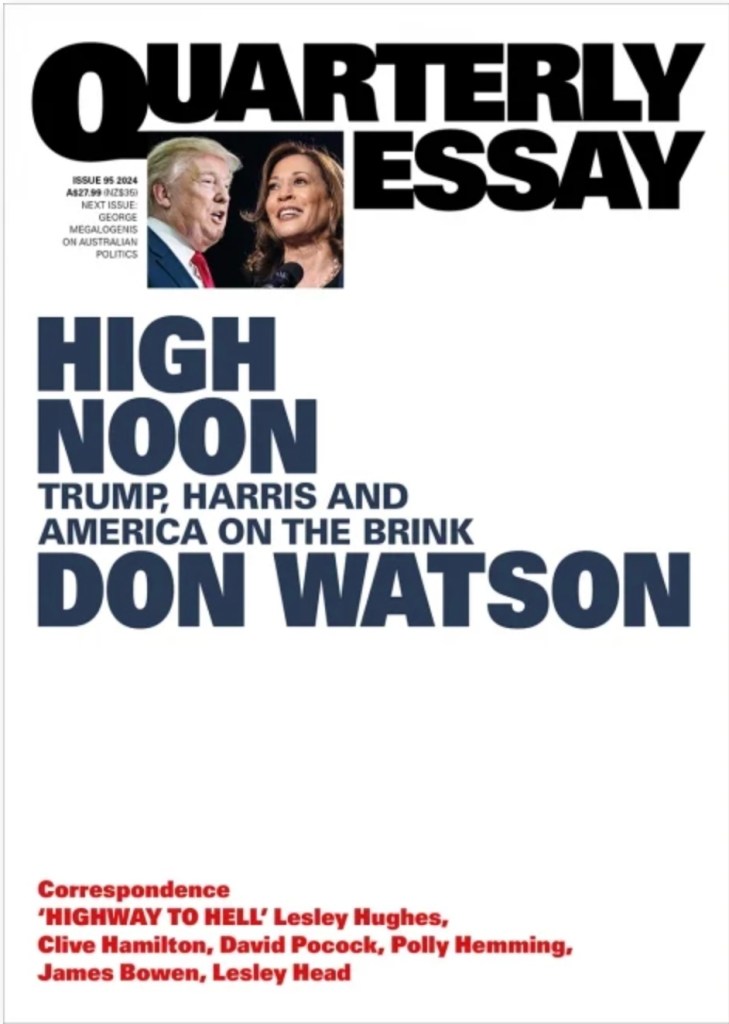
Don Watson’s High Noon

Don Watson,  High Noon: Trump, Harris and America on the brink (Quarterly Essay 95, September 2024)

Eight years ago Don Watson reported on the presidential election face-off between Donald Trump and Hilary Clinton. According to my blog post, his Quarterly Essay 63, The Enemy Within: American politics in the time of Trump dwelled on Bernie Sanders as belonging to ‘a much assailed and greatly debilitated, but unbroken American tradition of democratic socialism’, and expanded his point by focusing on the history of the state of Wisconsin.

In this Quarterly Essay, as Trump is once again up against a female opponent, Watson doesn’t have a third option to discuss but he again goes local, and gives fascinating brief histories of two US cities, Detroit and Kalamazoo. These snapshots, plus his reports on conversations with Trump supporters, make the essay worth reading even though its journalistic moment is past. Maybe it’s even more readable now, because its resistance to the temptation to predict outcomes might have frustrated his readers three months ago.

The fifteen pages on Detroit are excellent: Watson traces the city’s history from the first half of the twentieth century when:

White folk from the economically depressed regions of the United States, especially Appalachia and the South; Black folk from the South and east-coast cities where wages were low and jobs hard for Blacks to get; Poles, Greeks, Irish, Italians, Germans, and people from the Middle East and the countries of Central America were all drawn to Detroit by the unstoppable car industry and the promise of five dollars a day.

In 1960 it had a population of 1.8 million. Since then ‘the city that gave the world the Ford Mustang and Stevie Wonder’ has fallen on hard times as the motor industry collapsed. Corruption, racism, predatory lending, the destruction of unions had their effects:

Detroit became a shrinking city of the poor, the poorly educated, the unemployed and the unskilled. A city of crime: corrupt in its high places, its streets plagued with violence, theft, arson, prostitution, drug dealing and addiction.

Detroit, Watson writes, ‘was the definitive American city … For a city like Detroit to fail was more than a disaster, it was a humiliation.’ Yet, his strategy of focusing on this one city, and then the contrasting city of Kalamazoo, brings home the immense diversity of the United States. It’s not a country where one story covers all.

There are insightful discussions of Trump and Harris, but you know, though I’m as mesmerised by the Trump phenomenon as anyone could be, I can’t bear to say much about that here.

The essay ends with the date: 23 August 2024. It was written after Joe Biden withdrew from the presidential race, after the Democratic Convention, but before the ‘They’re eating the dawgs’ debate.

Even the Correspondence in the following Quarterly Essay was written before the election results were known.


In the correspondence, Tom Keneally, lively as ever, contrasts Australian and US politics but doesn’t engage with Watson’s essay in any detail. David Smith, who did his PhD in Detroit, makes fascinating additions to Watson’s account of that city, including more examples of how unhinged US public life can be. Bruce Wolpe, senior fellow at the US Studies Centre, does a nice job of validating and amplifying Watson’s points. And Paul Kane, among other things former director of the Mildura Literary Festival, praises Watson for his ‘adroit outsider’s perspective’, and, in a lovely three and a half pages, manages to include references to or quotes from Raph Waldo Emerson, Alexis de Tocqueville, Robert Penn Warren (All the King;’s Men, 1946), Father Charles Coughlin (a whiff from my Catholic childhood), Woody Guthrie, Plato, John Stuart Mill, Wordsworth, and Barry Hill. He concludes with Benjamin Franklin’s reply when asked if the Constitution had established a monarchy or a republic: ‘A republic, if you can keep it.’

Both Don Watson’s essay and the responses to it are full of the pleasures of language. The subject is grim, and even grimmer when read after the event, but the telling of it is a joy to behold


I wrote this blog post on land of Gadigal and Wangal of the Eora Nation, where we have had very heavy rain and are now sweltering in great humidity and heat. Cicadas are deafening. I acknowledge the Elders past and present who have cared for this land for millennia.

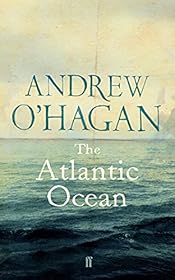
Andrew O’Hagan’s Atlantic Ocean

Andrew O’Hagan, The Atlantic Ocean: Essays on Britain and America (Faber 2008)

This book was my gift in a Book Group Kris Kringle years ago, and has been languishing on my top shelf ever since. I was prompted to read it by Caledonian Road, Andrew O’Hagan’s most recent novel – which I’ve just read for my other Book Club (blog post to come after the next meeting).

These 23 essays were first published between March 1993 (‘The Killing of James Bulger’) and February 2008 (‘Brothers’). That’s not so long ago, but the book feels as if it comes from another, ancient era. Michael Jackson was alive. 9/11 (and England’s 7/7), the Iraq War, Hurricane Katrina and George W. Bush were in the headlines. Donald J Trump was barely a reality TV star; Brexit wasn’t a cloud on the horizon; a global pandemic was predicted, but with no sense of urgency.

Most of the essays were first published in the London Review of Books, many of them as book reviews. We are told the month and year of first publication, but not the details, or sometimes even the name, of the books being reviewed. We’re invited to read them as stand-alone essays, and for the most part they succeed – as memoir, literary journalism, social commentary, a general reflections on literature. There are pieces of serious long-form journalism, like ‘On Begging’ (November 1993), in which 25-year-old O’Hagan joins the beggars of London with a tape recorder in his pocket, or ‘Brothers’, the book’s final essay, in which he visits the people left behind by the deaths of two servicemen in the Iraq War, one from each of England and the USA.

Three essays illustrate the range of O’Hagan’s subject matter and the variety of his approaches:

‘The Killing of James Bulger’. In the north of England in 1993, two 10-year-old boys abducted, tortured and killed two-year-old James Bulger. The great Gitta Sereny wrote about the murder, probing the boys’ motives and challenging the vengefulness of the press, the courts, and the crowds that gathered to demand the death sentence. O’Hagan’s essay has a similar impetus but, strikingly, his starting point is to identify with the killers. He describes in unsettling detail the way, as a child in Glasgow, he and a girl friend mistreated a much younger child, and expands from there to the general normalisation of cruelty in his part of Scotland. (Shades of Douglas Sewart’s Shuggie Bain or Jimmy Barnes’s memoir Working CLass Boy. It’s a challengingly personal essay that is shamefully relevant to the place I’m in just now, as Queensland’s Liberal National Party is pushing an ‘Adult crime, adult time’ policy.

‘On the End of British Farming’ (March 2001), one of the longest essays, is a brilliant piece of investigative journalism. O’Hagan visits a number of small farmers, and gives shocking statistics on the economic pressures they are up against. Most shockingly, perhaps, is what happens when he follows up a claim by a Sainsbury representative that the retail chain has an excellent relationship with a dairy farm in Devon. On visiting the ‘farm’, he finds that in order to survive (and then thrive), the couple who run it have got rid of all their cows. Their enterprise is now is in effect a yoghurt and ice cream factory, buying milk at just above the unsustainable going rate from neighbouring farms. The essay sees the source of the problem in the subsidy policies after the Second World War. There is some discussion of the role of the EU (real, but not major, he argues). It’s one of the many moments when I would love to see an update: did Brexit improve things?

‘After Hurricane Katrina’ (October 2005). O’Hagan saw online that two men from another state were driving to New Orleans to help in the aftermath of Hurricane Katrina. He contacted them and asked to travel with them. The essay is a literary equivalent of a fly on the wall documentary: the writer is all but invisible, making no overt judgement, authorial comment or explanation, but allowing the story to unfold mainly through the dialogue of the two men. They are rowdy, spectacularly sexist, uncareful about racism (one of them is African-American), and a weird combination of generosity and self-absorption. It reads a bit like a Carl Hiaasen novel. I could only wish that Caledonian Road had as much exuberant life.

Page 77 occurs in ‘Tony and the Queen’ (November 2006), which is part a reflection on the Stephen Frears/Peter Morgan Movie, The Queen – long since superseded in our minds by the TV series The Crown (also largely written by Peter Morgan). The page happens to include one of the passages where O’Hagan notes the influence of US culture on Britain’s. He is discussing the moment in the film and in real life when the Queen was slow to grieve publically after the death of Lady Diana:

Obviously, the elder royals and their familiars had completely missed out on the Oprah-isation of the universe. If they hadn’t, they might have learned the new first rule of successful leadership: enjoy your inscrutability if you must, but don’t ever stand in the way of a confessional heroine. If stopping Diana was something of a thankless task while she was alive, the effort would come to seem suicidal for the British monarchy in the summer of 1997, after Diana died in that Paris tunnel. William Shakespeare himself could scarcely have imagined, in the days after the crash, a royal household with more out-of-touch advisers than the Windsors had on twenty-four-hour call, each of them sharing a gigantic unawareness of the difference between a pest and a mass phenomenon. But it is said that much of the intransigence was coming from the Queen herself, who, despite all her experience, disported herself that summer like a person lumbering in a dark cave. She was somehow unable to see what the infants and the dogs in the street could see, that the old style was unsuited to the virulent new mood – and that if something had to give, or someone, it was most likely going to be the woman whose head appears ready-severed on Britain’s postage stamps.

An astute observation at the time, and probably accurate about the changing times, but it fails to imagine – and how could it – the powerful impact of the image of that same inscrutable queen sitting alone at the funeral of her husband. Inscrutability itself, evidently, can find favour in the ‘virulent new mood’, and O’Hagan’s ominous hints of decapitation to come (inspired no doubt by Scottish wishful thinking) fell very wide of the mark.


I finished writing this blog post in Ma:Mu country. My father, my siblings and I were born on this country, and I’m very happy to belatedly acknowledge the Ma:Mu Elders past and present who have cared for this prodigally beautiful land for millennia, and continue to do so..


* My blogging practice for some time has been to focus arbitrarily on the page of a book or journal that coincides with my age, which currently is 77.

Julius Lester’s Falling Pieces

[This is a post from 22 July 2008, which I’ve retrieved from the ‘Private’ category because Julius Lester’s name has cropped up in relation to my current reading. I’ve just learned on Wikipedia that he died in 2018, and discovered a lot more about his life. He was committed to telling the truth as he saw it, whatever the personal cost. Judging from my brief contacts with him, he was also a really nice guy.]

Julius Lester, Falling Pieces of the Broken Sky (Arcade Publishing 1990)

falling.jpg

Since I’ve started making  notes here about every book I read, I’ve been tempted to feel ashamed of the chaotic omnivorousness of my reading habits. I read books because they are on offer at the Book Club, because they happen to catch my eye at an airport, because I’ve received them as gifts, because they’re part of the canon and I should read them, because I need to get an insistent friend off my back, because I’ve run out of cereal packets to read at breakfast …

At first blush, it would seem that I’ve read Julius Lester’s collection of essays for a purely random reason – because I won it in a little competition he ran. But I wouldn’t have won it if I wasn’t a regular reader of Julius’s blog, and I wouldn’t read his blog regularly if— And it struck me, perhaps because I started reading this book just after spending two days reading a friend’s novel-in-typsecript, that one whole category of my reading is Books Written By Friends. I’m probably using ‘friend’ in a slightly idiosyncratic way here since I know Julius only through his writing – a handful of his books (Sam and the Tigers: A new telling of Little Black SamboJohn HenryWhen Dad Killed Mom), his contributions to an E-List I once belonged to, his blog and a very few emails.

I’m expect that very few people in Australia have read this book of essays, published in 1990 and now out of print. And that’s a shame because each of its three sections is full of good stuff. The first, ‘Writers and Writing’, makes unlikely bedfellows of Henry Miller, Thomas Merton, Aldous Huxley and James Baldwin, and among other bracing delights includes an essay that begins, ‘I am grateful that among the indignities inflicted on me in childhood I escaped The Adventures of Huckleberry Finn.’ There are also a couple of pieces about his own writing, one of which begins:

I have always loved books. Medical science has learned that infants suck their thumbs in the womb. I read. I love books as much for their sheer physicality as for what I may learn and experience through the words on their pages. I love to touch books, to hold them. They are my security blanket, and whether I am happy or depressed, I go to bookstores to orient myself to the world, to feel myself enclosed, almost womblike, by books on all sides. I need books, almost as an alcoholic needs liquor. When I was in college, I always carried a book with me on dates, not sure that any girl could be as interesting or involving as a book. My wife wonders if I’ve changed.

The second section is titled ‘Race’. If there’s a binding thread to the book, it’s the responsibility of the writer to be truthful – to write the truth as he or she sees it, regardless of the demands of collectives of whatever kind. In this section Julius argues again and again for a deeply human perspective, rather than one determined by identity politics. He was part of the Civil Rights Movement, and laments the separatism and advocacy of violence that followed the assassination of Martin Luther King Jr, as well as the coming to dominance of victimhood and the shucking of responsibility. As a convert to Judaism, he has pungent things to say about anti-semitism among US Black leaders, and the tolerance of it among Black and other intellectuals.

The third section, ‘Falling Pieces of the Broken Sky’, draws its title from Seneca, ‘Of all the generations, it is we who have been designated to merit this fate, to be crushed by the falling pieces of the broken sky.’ The section consists mostly of short pieces that read as blog-entries before the existence of blogs – they were written to be read on the radio. I don’t think the title means to suggest that the reader will be crushed by them. On the contrary, I found myself thinking of the Judaic concept of Tikkun Olam, repair of the world, as if these small pieces are helping to piece the sky back together. Many of them are serio-whimsical – objecting to the term ‘Safe Sex’, for instance, because sex always has an edge of emotional or spiritual risk, so to ‘lead the young to believe that sex is safe may one day deprive them of love itself’. There’s a brilliant essay in defence of ‘the canon’ against those who urge educational institutions to introduce students primarily to writing that reflects their own experience, including this:

It is reprehensible that those who have suffered because they are different should now be the ones using difference as a weapon against others. Doing so denies that we are bound to each other by the simple fact that we all laugh and cry and suffer and rejoice about the same experiences or in the same ways. What matters is that we find the humanity within ourselves to delight in the laughter of others, even if we are not amused; that we feel a twinge of pain upon noticing someone weeping, though our own eyes remain dry; that our hearts pause in the presence of another person’s suffering; and that we exult when someone else rejoices, even when we do not understand the occasion for the joy.

The final essay is a mediation on the Holocaust and a brief account of his conversion to Judaism, which makes me want to read his memoir on the subject, Lovesong.

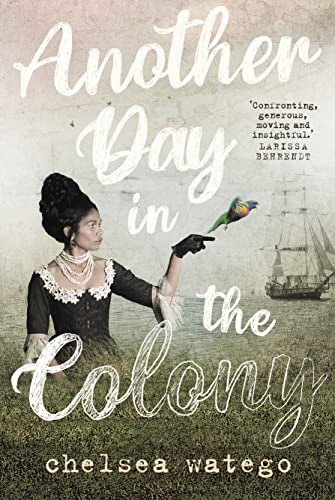
Another Day in the Colony with Chelsea Watego

Chelsea Watego, Another Day in the Colony (University of Queensland Press 2021)

Not every book is as explicit as this one about its intended readership. The Introduction gives fair notice:

This is not a book for colonisers, or those aspiring to share the same status as them. This is a book that is written specifically for Blackfullas, and when I say Blackfullas I mean of the capital B kind.
When I speak of the uppercase Blacks, I speak of those who simultaneously recognise and refuse the racialised location we’ve been prescribed, as well as those who have been haunted by it.

(Page 9)

‘Colonisers’ is the term Chelsea Watego prefers over, say, ‘non-Indigenous people’ or ‘settlers’ because, she argues, those terms gloss over the continuing violence of colonisation. As a reader of Anglo-Celtic heritage, I’m glad to report that the Introduction continues:

Of course, the colonisers may find something of use here.

In 2020, the first year of Covid-19 and the year of a re-energised global Black Lives Matter movement, as well as the 250th anniversary of Cook’s arrival in Australia, Chelsea Watego took leave from work, including her Twitter account and the Wild Black Women radio show. In the Introduction, she tells us that her ‘body was tired and, in this moment, appeared to insist that [she] tell a story’. The stories that she told make up this book:

  1. ‘don’t feed the natives’ – among other things, a personal account of growing up and taking on a career in Indigenous health, which Watego has come to understands as aiming ‘to strategise a Black living which presumes a Black future, of a forevermore kind … that is set on our terms, on our land’
  2. ‘animals, cannibals and criminals’ – about which more later
  3. ‘the unpublishable story’ – an article, discussed in the previous essay, that was rejected by the journal that had commissioned it
  4. ‘on racial violence, victims and victors’ – an argument for the importance of naming racism, accepting that it is embedded in the institutions of the colony, rather than talking of culture and diversity, and relying on the courts to put things right
  5. ‘ambiguously Indigenous’ – a critique of the ’emerging tribe’ of people who discover Aboriginal heritage and identity after growing up white, and assume positions of authority in Indigenous affairs. She describes this grouping as a modern equivalent of the nineteenth century Native Police
  6. ‘fuck hope’ – an argument against a version of hope that minimises current mistreatment and suffering by focusing on an imagined time when things will be better
  7. ‘a final word … on joy’ – which could be an extended paraphrase of Alice Walker’s revelation at the end of Possessing the Secret of Joy, ‘The secret of joy is resistance.’

That list can only give a faint idea of the confronting riches of the book. I’d be lying if I said I didn’t get defensive at times, identifying with the writers, editors and reviewers Watego finds wanting, or that as a man I didn’t feel a guilty relief when she focused on white women as key culprits, or that at times I didn’t respond with something like, ‘Steady on now, that’s a bit intemperate.’ Et cetera. I’m pretty sure any non-Indigenous/coloniser reader will have similar responses, which might be some consolation to the people whose names are named. We’re in this together.

The second essay, ”animals, cannibals and criminals’, lays out the way Australian fictional and non-fictional (‘faction’) writing has depicted Aboriginal people as either belonging in the past with quaint customs and stories, or as problems to be solved by white managerialism. These representations aren’t safely in the past.

The essay discusses Sarah Maddison’s book The Colonial Fantasy (‘which it could be argued is one of the more sympathetic works to the plight of Indigenous people in our time’), and Randolph Stow’s To the Islands (or at least Stow’s preface to the 2002 revised edition, which deterred her from reading much further).

The Black story must be a site for which the coloniser can express sympathy, and not in a solidarity kind of way, but a condescending sorrow for our supposed plight. Our stories should not be repositories for which faux coloniser sympathy may find a home, yet too often they are.

(Page 67)

The essay moves on to stories of how Watego’s own writing has run foul of gatekeepers. She entered academia with the aim of correcting the prevailing account of First Nations people by presenting a solid evidence base. She found it wasn’t a matter of evidence, but of a deeply embedded attitude in the minds of the colonisers.

Editors have asked her to include on-the-other-hand paragraphs that undercut the thrust of her writing; have quibbled with her use of language like ‘white’ to describe a racial category; articles have either gone unpublished or are still awaiting publication years after being accepted.

The chapter ends with the story of an article she wrote for a special edition of the Australian Feminist Law Journal, but which didn’t make it into the journal. As with all such stories, the reader is left wondering what version of events the unnamed meddlers and censors would tell. We don’t get that, but we get something even better: the following chapter, ‘the unpublishable story’, gives us the article to read and judge for ourselves.

There can be little doubt that the article would make painful reading for Cathy McLennan, whose memoir Saltwater (link is to my blogpost) is unsparingly criticised, but it’s not the first time the book has been given the treatment (see ‘Crocodile Tears‘ by Russell Marks in Overland Summer 2019), and it’s hard not to see the force of Watego’s argument that the editors who spiked the story were mistaken to override the judgment of the two First Nations editors of the special issue as well as two anonymous peer-reviewers.

Back to the story of the article being spiked:

After much back and forth, the managing editor and editor-in-chief advised that this work was not publishable in any form because it apparently posed a threat of defamation because the white woman author of the book I was critiquing wouldn’t like my review … Her real concern was that there was an imputation that the author of the book was racist.

(Page 76)

This sounds like arse-covering to me, and I expect academics of all kinds run into it all the time. The book being criticised was, after all, written by a lawyer.

Watego’s next sentence is the killer:

Now I didn’t say the author was racist, but I did have about 180 footnotes, three-quarters of which were direct quotes from the text that cited animalistic references to the Aboriginal characters.

On first reading, I took this to be a bit of smart-aleckery: ‘I didn’t say she was a racist, I just gave 180 examples of her racism.’ But it’s more interesting than that. However emphatic she is about the harmful nature the book, she really isn’t imputing malice to the writer. Her argument is that we colonisers are so imbued with the notion of our own superiority – so enmeshed in a racist and colonising system of thought and practice – that no matter how good our intentions or sincere our anti-racist attitudes, we fuck up.

And this is at the heart of the storytelling war, and the dangers confronting the sovereign storyteller in the colony. We simply are not permitted to speak freely and truthfully about the violence we are subject to.

The book as a whole is a living contradiction of that last sentence. Thank you Chelsea Watego and University of Queensland Press for this abrasive, uncompromising, sometimes hilarious piece of free and truthful telling.

Gregory Day’s Words Are Eagles

Gregory Day, Words Are Eagles (Upswell 2022)

Decolonising is a very personal business. It cuts in close to our sense of self. … It will take new emotional skills our parents, and their parents, were unable to teach us.

(‘Serving up colonisation instead of care‘, Overland 247, page 24)

That’s Caitlin Prince, an occupational therapist who has spent most of her adult life living and working in remote Aboriginal communities. She argues that non-Indigenous individuals have intimately personal work to do; we must face and acknowledge intense emotional discomfort, and create safety for each other to do that, so as to make headway against our received and ingrained racism and colonialism.

The processes of personal decolonisation her article describes may seem worlds apart from anything in this collection of highly literary essays, but Gregory Day is engaged in a similar project.

In a brief foreword, ‘Where the Songs Are Made’, Day explains the collection’s title. In British writer Alan Garner’s novel Strandloper, an 18th century English castaway demonstrates writing to an Aboriginal elder, Nullamboin. The fictional Nullamboin recoils in horror: ‘”Then all will see without knowledge,” he cries, “without teaching, without dying into life! Weak men will sing! Boys will have eagles! All shall be mad!”‘ Day glosses this as referring to ‘the violent chaos that ensues from a carelessness caused by the lack of connection to the memorial contours and emotional topographies of place’. Written words ripped from their rightful places are eagles and must be treated warily.

So as the book opens it comes close to questioning whether it ought even to exist. (It comes even closer if you understand Garner/ Nullamboin to mean that the ‘violent chaos’ has a more radical cause: it comes from language being divorced from direct, embodied human contact: the written word is in itself dangerous.)

Approaching this dilemma from a number of angles in these essays is Day’s version of Prince’s personal decolonising.

Day has a deep, insistent commitment to place, specifically the part of south-west Victoria where he has lived all his life. He is best known for his Mangowak trilogy; ‘Mangowak’ is the Wadawurrung name for Airey’s Inlet on the Great Ocean Road, into which the Painkalac Creek flows. Two thirds of this collection of essays relate to that place in some way, many of them to its Wadawurrung heritage. In extremely productive tension with that commitment, the essays also evince a profound commitment to the English language, the written word, the literary traditions of his ancestral countries – England, Sicily and Ireland. (‘Evince’, incidentally, is a word he spends some time pondering. He uses it differently from me.) In what follows, I’ve included links to articles where I can find them online, sometimes as PDFs – sorry!

The collection proper kicks off with ‘The Watergaw‘. Winner of the 2021 Nature Conservancy Australia Nature Writing Prize, it’s a virtuoso piece. Starting from the sighting of a broken rainbow in rural Victoria, it goes to Scottish poet’s Hugh Macdiarmid’s ‘The watergaw‘ which relates to the same phenomenon. The broken rainbow takes on complex metaphorical meanings, and there follows meditation on place, colonisation, Celtic and Sicilian ancestry, the deaths of fathers, Day’s study of Wadawurrung language parallelling Macdiarmid’s writing in a version of Scots. Starting the collection with this essay throws the reader in at the deep end – it may strike you (as it did me on first reading) as convoluted and self-consciously, even self-indulgently, ‘literary’, but it’s a beautifully compressed weave of the themes that are developed more expansively in the essays that follow.

There’s a leisurely swim with a friend around the river bends at Airey’s Inlet / Mangowak, an exultant respite from the world dominated by smart phones (‘Summer on the Painkalac‘); a piece on the difficulty of naming the colour of soil turned up by roadworks near Anglesea (‘The Colours of the Ground’); a lyrical account of how Day’s ancestors came to the area (‘The Ocean Last Night‘); a reflection on what it means that colonial and more recent writings record 133 different spellings of ‘Wadawurrung’ (‘One True Note?‘); an engrossing account of the elements that went into the making of his novels (‘Otway Taenarum‘); reflections prompted by his experience teaching Wadawurrung language to schoolchildren, with the approval of local Elders (‘Being Here‘).

Though there are occasional mentions of a named Elder who has been Day’s mentor, the only First Nations person to be quoted directly in these essays is the fictional Nullamboin, the invention of a British writer. Even in the reprinted review articles that make up the final third of the book, no First Nations poets or novelists are addressed. This might seem to undermine, or at least make paradoxical, my reading of the essays as embodying a personal decolonising project. Maybe. But I’m sticking to my guns. As I read them, they take on the challenge without appropriating First Nations voices or forms, and without leaning on the writer’s relationships with First Nations people, but find their own way forward as part of what’s sometimes called place writing within the western tradition. As they used to say on Twitter, he’s doing his own research, not expecting First Nations people to do his emotional and intellectual labour for him.

For instance, the essay ‘Mere Scenery and Poles of Light’ (pp 69–94) enters imaginatively into the minds of four people who walked a lot: Paul Cézanne, J S Bach, William Buckley and David Unaipon. Of Cézanne:

The painter’s walks were not artist’s escapes or spiritual retreats but confrontations … It was while walking, while looking at giant cubes of stone spilt on cypressed ledges and the green moisture of gullies in the sea’s brisk shadow, that he best understood how to overcome our now dangerously attenuated sense of time and sylvan space.

Of Bach, who as a young man walked 250 mile to hear his hero Buxtehude play the organ:

With only the orchestra of bird, rain and tree in his ear, surely those walks, conducted for the twin catharses of music and freedom, were intrinsic to the sound that was slowly building within him, even at such a young and truant age.

Of Buckley, the Englishman who lived for decades with the Wadawurrung people:

Here was a European man honoured as a native, a man of fact not fiction, but fated through an almost sci-fi style misunderstanding to survive in sympathy with nature; a man who’d been taught, as we say now, to walk in both action and reflection, to both hunt and to sacralise the hunt, to live sustainably within the behests and laws of his adopted habitat. And how did it end for him? Where did walking take him to? Just to despair? Or also to that secret place where the author of all the songs resides?

Of David Unaipon:

Unaipon moved through the land as a divining rod, and he came with a forked message, one contained within the yarns of the bound and official Bible he held in his hand and the other a message in danger of being cauterised to silence by the white invasion: the knowledge of the spirit realm, where the song still dwelt, the pity and sympathy, the knowledge and laughter still flowing through the land.

And of himself:

I can see myself, the walker, as assemblage, with Buckley’s tattoo on my tongue, with the score of Bach’s English Suites written onto my skin, with a vision of the sea at Cézanne’s l’Estaque lifting me to the top of the climb. My whole body is transformed by the journey into a condition resembling the circular breathing of the didgeridoo player, or David Unaipon’s perpetual motion machine.

It’s a world away from the kind of cultural confrontations that meet a whitefella occupational therapist working in a remote Yolngu community. Maybe it’s more fanciful, more vulnerable to self-deception but maybe, also, it’s important work that makes a valuable contribution to our moment in history.


A note on Upswell, publisher of Words Are Eagles. It’s a not-for-profit publishing house established in 2021 by Terri-Ann White who previously was responsible for a brilliant line-up of books at UWA Publishing. As she says on the Upswell website:

I’ll publish a small number of distinctive books each year in, broadly, the areas of narrative nonfiction, fiction and poetry. I am interested in books that elude easy categorising and work somewhat against the grain of current trends. They are books that may have trouble finding a home in the contemporary Australian publishing sector.

This is the first Upswell title I’ve read, a gift from a friend who lives on the edge of Painkalac Creek. Long may Terri-Ann White prosper, and the Painkalac flow.

Summer reads 7: Gabriel Zaid’s So Many Books

Gabriel Zaid, So Many Books, translated by Natasha Wimmer (Sort Of Books, 2004)

I took a number of physically small books away on our summer break, and have blogged about them as ‘Summer reads’. I was only dimly aware that they were all gifts – either from friends who thought I’d enjoy them or from publishers who hoped I’d blog about enjoying them.

So Many Books was the former kind of gift, and has its own opinion on books as gifts. An early chapter says that they ‘threaten the recipient with the task of responding to the questions “Have you read it yet? What did you think of it?”‘ and goes on:

In fact, the most uncommercial slogan in the world might be: ‘Give a book! It’s like giving an obligation.’

(‘An Embarrassment of Books’, page 13)

The obligation in this case was entirely enjoyable.

Gabriel Zaid is a Mexican poet and essayist. His Wikipedia entry lists a formidable number of essays on a broad range of topics. This little hardback, of the kind that sits on the front counter of a bookshop, is a series of short essays that revolve around the vast number of books published each year: the impossibility of any one person reading more than a tiny fraction of them; the way books, compared to movies or TV shows, are inexpensive to produce in small numbers so don’t have to be best-sellers to be viable; the relationship between ‘culture’ and ‘commerce’; the nature of reading; the way many people, especially academics and aspiring poets, want their writing to be published but tend not to read other people’s; why economies of scale apply to motor vehicles but not to books; and more.

So Many Books (which my fingers keep wanting to call Too Many Books, not necessarily what Zaid means) was published in Spanish as Los demasiados libros in 1996, and in Natasha Wimmer’s gorgeously smooth translation in 2003, before Amazon had completely dominated the book market, and before e-books and self-publishing really took off, so some of it is well out of date. But an update would require some tinkering at the edges of Zaid’s arguments rather than wholesale rethinking.

Regular readers of this blog will be able to tell that the book touches subjects close to my heart. Here’s Zaid on careful rewriting and copy-editing:

[A writer who] is a doctor, a lawyer, or an executive … can’t devote himself to rewriting a paragraph over and over, although the additional work might save his readers time. It is absurd for the writer to devote two hours to saving his reader a minute if the text is a note to his secretary. But if it is a book with twelve thousand readers, each minute represents a social benefit of two hundred hours in exchange for two, and the reward is one hundred times the cost. …

Of course, the cost of reading would be much reduced if authors and publishers respected readers’ time more, and if texts that had little to say, or were badly written or poorly edited, were never published.

(‘The Cost of Reading’, p 88–89)

Here he is being completely wrong about reading very slowly (see my series of blog posts on A la recherche du temps perdu, The Prelude, the Iliad, and now Middlemarch):

Is anything more certain to make a book completely unintelligible than reading it slowly enough? It’s like examining a mural from two centimetres away and scanning it at a rate of ten square centimetres every third day for a year, like a short-sighted slug. This doesn’t allow for the integration of the whole, for taking in the mural at a glance.

(‘Some Questions About the Circulation of Books’, p 72)

On bookshops:

To be angry because a book isn’t where you want it to be is to be angry at the randomness of fate.

(‘Constellations of Books’, p 110)

Early in my blogging life I wrestled with the word fortuitous in a number of posts. I’m pleased to report that Gabriel Zaid uses it in a way I find completely unproblematic:

In a good bookshop, supply and demand are fortuitous, but not chaotic: they have a physiognomy, a recognisable identity, like constellations. The probability of finding a particular book increases in relation to the clarity of the shop’s focus, the diligence and shrewdness of the bookseller, and the size of the business.

And from page 75, the opening of ‘The End of the Book’:

No experts in technological forecasting are predicting the end of fire or the wheel or the alphabet, inventions that are thousands of years old but have never been surpassed, despite being the products of underdeveloped peoples. And yet there are prophets who proclaim the death of the book. This prophecy is understood as an apocalyptic judgment: the overabundance of books oppresses humanity and in the end will provoke divine wrath. But as a technological judgment, it doesn’t withstand the slightest scrutiny.

The essays are witty, instructive, thought-provoking, satirical and totally readable. If you stumble on them, possibly in someone else’s to-be-read pile or a street library, I encourage you to dip in.

And that’s a wrap for my Summer Reads.

Claudia Rankine’s Just Us

Claudia Rankine, Just Us: An American Conversation (Penguin 2021)

This is a wonderful book.

Note to Australian (and possibly other non-US) readers: Don’t be put off by the book’s self-description as ‘an American conversation’. It is deeply, intimately USian, but Claudia Rankine’s mind is to be learned from and loved by anyone with a heartbeat. The book’s central question is how people can reach for each other in human ways given the horrors of racism that divide us – and racism isn’t a uniquely US phenomenon.

Note to white readers, especially white male readers: Though these essays are mostly about racism as enacted and mistaken for reality, don’t read them in the spirit of self-lacerating virtue or grudging worthiness. They are exhilarating, challenging, inviting, occasionally funny. Almost every essay is written as part of a conversation. People quoted in the essays (including white men and white women) are given right of reply, adding unexpected perspectives and enriching the conversation wonderfully.

The title is a pun. The first of the book’s two epigraphs is a line from Richard Prior’s stand-up comedy:

You go down there looking for justice, that’s what you find, just us.

In its original context, which you can see on YouTube, the line could be paraphrased: you look for justice in the criminal justice system but all you find is the targeting of Black people. Rankine’s use implies an additional possible reading: If you want justice, you have to find a way to make us all part of one ‘us’.

The book’s 19 essays and two poems are mostly printed only on the right-hand page of each spread. The left-hand page is sometimes blank, but mostly carries ‘notes and sources’, or images, or fact-checks. When a piece of police brutality is discussed on the recto, the verso might show how it was captured on camera. A general assertion on the right is backed up by statistics on the left. And so on. It’s an inspired design concept.

The opening essay starts with the author preparing to teach a class on whiteness at Yale University. After discussing some of what she asks of her students, the essay takes an interesting turn:

I wondered what it would mean to ask random white men how they understood their privilege. I imagined myself – a middle-aged black woman – walking up to strangers to do so. Would they react as the police captain in Plainfield, Indiana, did when his female colleague told him during a diversity training session that he benefited from ‘white male privilege’? He became angry and accused her of using a racialised slur against him. (She was placed on paid administrative leave and a reprimand was placed in her file.) Would I, too, be accused? Would I hear myself asking about white male privilege and then watch white man after white man walk away as if I were mute? Would they think I worked for Trevor Noah, Stephen Colbert, or Chelsea Handler and just forgot my camera crew? The running comment in our current political climate is that we all need to converse with people we don’t normally speak to, and though my husband is white, I found myself falling into easy banter with all kinds of strangers except white men. They rarely sought me out to shoot the breeze, and I did not seek them out. Maybe it was time to engage.

(‘liminal spaces 1’, page 19)

So we follow her as she shies away from the challenge a number of times, before finally hitting paydirt. On the way, she slips in a quick introduction to Peggy McIntosh’s popularising of the term ‘white privilege’, noting in passing that she would have preferred ‘white living’ because ‘”privilege” suggested white dominance was tied to economics’. She seamlessly invokes other scholarly and non-scholarly writing (including some excruciating Twitter threads). We hardly notice that we’re being educated as the suspense builds, and as a white male reader I found I had a lot invested in the project as well.

That essay sets the tone. Rankine is after conversation, not confrontation. She aims not to provoke defensiveness or denial but to learn something.

The subject matter of the following essays include revelatory moments in ‘diversity training’ workshops, including the one referred to in the quote above; her marriage; a meditation on Woman with Arm Outstretched, an art photograph by Paul Graham; white supremacist assumptions in the education system, specifically at her daughter’s school; the way different white and black people remember a cross-burning incident in her college days; a dinner party where she gets to be the ‘angry Black woman’ for insisting on the primacy of racism as a factor in Trump’s election; how racism plays out against Latinx and Asian people; and a brilliant discussion prompted by the moment at an all-Black dinner party when a professor asks her what to tell her black female students who bleach their hair blond. The essay on hair has the distinction of being the only essay/conversation where the right-of-reply takes the wind out of Rankine’s sails, when one of the young women under discussion gets to speak.

This book is evidently the third in a trilogy of sorts. Where this book is mainly essays, the earlier two are a mix of poetry and videos, sharing the subtitle An American Lyric. I haven’t seen Don’t Let Me Be Lonely (2004), but I was completely enthralled by Citizen (2014, my blog post here), so I came to Just Us with high expectations. I was not disappointed. The book opens the world up to great possibilities.

To give Rankine the last word, here’s part of the left-hand-page commentary on the final spread:

A friend finished reading the final pages of Just Us and said flatly, there’s no strategy here. No? I asked. Her impatience had to do with a desire for a certain type of action. How to tell her, response is my strategy. …
For some of us, and I include myself here, remaining in the quotidian of disturbance is our way of staying honest until another strategy offers a new pathway, an as-yet-unimagined pathway that allows existing structures to stop replicating. Until then, to forfeit the ability to attempt again, to converse again, to speak with, to question, and to listen to, is to be complicit with the violence of an unchanging structure contending with the aliveness and constant movement of all of us.

And here are the final lines on the right-hand page:

What I know is that an inchoate desire for a future other than the one that seems to be forming our days brings me to a seat around any table to lean forward, to hear, to respond, to await response from any other.

Tell me something, one thing, the thing, tell me that thing.

Sarah Holland-Batt’s Fishing for Lightning

Sarah Holland-Batt, Fishing for Lightning: The spark of poetry (UQP 2021)

Between March 2020 and March 2021 Sarah Holland-Batt had a weekly column about poetry in the Weekend Australian. Each column focused on a recent book of poetry, all but two of them Australian, and was accompanied by a poem from that book. University of Queensland Press has done a great favour to those of us who don’t read The Australian by collecting those columns into this richly engaging book. Here’s how Holland-Batt describes the book:

I offer some suggestions about how to learn to pay attention to poetry and what poets do. In these essays, I am writing for readers who are out of touch with poetry, or who want to learn more about it, and even those who think they hate it, as well as for those who have already found a place for poetry in their lives. Some of these essays focus on opening up and demystifying poetic forms – the elegy, the ode, the sonnet, the villanelle – while others focus on poetic style and techniques. Many also offer some historical context. Poetry is, after all, an ancient art so durable and powerful that it has lasted millennia. Much of what poets do today still connects to prehistoric poetry that was sung and spoken prior to the invention of the written word; where I can, I illuminate those historical links.

That’s pretty much a perfect description. Sarah Holland-Batt has racked up an impressive list of awards and honours as a poet herself and she’s an Associate Professor of Creative Writing at QUT. While these essays benefit from her broad knowledge of poetry and her love for it, they don’t patronise their readers or leave them eavesdropping at the door of a closed shop conversation – both things that tend to happen in critical writing about contemporary poetry.

Take, for example, the essay first published on 11 July 2020, ‘The Sonnet Sequence: On Keri Glastonbury’, which begins:

In the winter of 1962, stoked by amphetamines, the American poet Ted Berrigan compulsively wandered the streets of Manhattan at all hours, and began writing his first book, The Sonnets: a book length sequence that sings up New York’s Lower East Side in all its grimy, fast-and-loose glory.

The essay spends a lively page on The Sonnets, its role in Berrigan’s subsequent career as a poet, and its status as ‘a touchstone of a poetic generation’. Having deftly evoked this precedent (no need to belabour us with the history of sonnet sequences from Petrarch to Christina Rossetti), it spends roughly two pages on general description of Keri Glastonbury’s Newcastle Sonnets, and rounds off with a page-long reading of one poem, ‘The Pink Flamingo (of Trespass)’: how it exemplifies the preceding generalities, how it is an exception, and how the poem itself works. It ends with an observation that arises from this close (but not too close?) reading:

Like many of the poems in Newcastle Sonnets it leaves you both with the feeling of having been let in on a joke by an insider, but also left slightly on the outer too: like Newcastle itself, as Glastonbury suggests, this is both a comfortable and disorienting place to be.

By the time we reach the poem itself, we are well equipped to read – and enjoy – it.

I picked this essay because I blogged about Newcastle Sonnets (here), and the comparison is instructive. While I hope I communicated my enjoyment of the book, most of my blog post was taken up with its difficulty, with my own sense of being an outsider. Reading Sarah Holland-Batt – on this poem and on any number of others – I realise (again, at last) that reading poetry isn’t about nailing down a clear meaning: not quite understanding, or even being mystified, can be part of the enjoyment.

Anyhow, I can endorse Holland-Batt’s own sentiments: whether you are out of touch with poetry, or want to learn more about it, or think you hate it, or have already found a place for it in your life, I’m pretty sure you could find some joy and light in this book.

Added later: I have one major discontent with the book, namely that there doesn’t appear to be a sequel in the works. I’m pretty sure another 50 new poetry books would be there for the SHB treatment if she were up to it. She could ‘do’ Jennifer Maiden, Adam Aitken, Kit Kelen, Pam Brown, Ouyang Yu … to name just the poets near the top of my To Be Read/To Be Blogged pile.

Zadie Smith’s Intimations

Zadie Smith, Intimations: Six Essays (Penguin 2020)

This tiny book was written in the first half of 2020, when Covid-19 was running wild in New York City, where Zadie Smith teaches creative writing. It comprises six personal essays, which their author describes in her foreword as ‘small by definition, short by necessity’. They are written in the spirit of what she learned from the stoic philosopher Marcus Aurelius: ‘Talking to yourself can be useful. And writing means being overheard.’

It’s a tiny book, but it’s not slight. As I read it, I could feel my personal understanding of the word ‘intimations’ changing to include an element of intimacy. These essays ruminate intimately on life, art and relationships in the middle of a pandemic. The first essay, ‘Peonies’, sets the tone:

Just before I left New York, I found myself in an unexpected position: clinging to the bars of the Jefferson Market Garden looking in. A moment before I’d been on the run as usual, intending to exploit two minutes of time I’d carved out of the forty-five-minute increments into which, back then, I divided my days.

She was transfixed by the sight of a bed of garish tulips, wishing they were peonies. That moment leads into reflections on the concept of a ‘natural woman’, the nature of creativity (‘Planting tulips is creative. … Writing is control’), the ‘global humbling’ that was to happen a few days later, on creativity and submission. She quotes a parable from Kierkegaard about the difference between how we actually are in the world and the stories we tell about ourselves in the world. You can make them peonies in a story, but they are still tulips in the real world. With the lightest of touches, the essay takes us into the deep challenge that April 2020 – ‘an unprecedented April’ – presents to our sense of ourselves.

The second essay ‘The American Exception’, also has a brilliantly enticing first line: ‘He speaks truth so rarely that when you hear it from his own mouth – 29 March 2020 – it has the force of revelation.’ We know exactly who she means. Paradoxically, the truth he spoke is that before that date ‘we didn’t have death’. The essay goes on to justify the paradox beautifully.

All the essays tackle big themes, and do it lightly. The longest, ‘Screengrabs (After Berger, before the virus)’ is the one where the author brings her gifts as a novelist most strongly to bear. I think the Berger in brackets is John Berger, and there may be a reference to his famous quote, in Understanding a Photograph: ‘I have decided that seeing this is worth recording.” The essay offers six portraits, mostly of people peripheral to Smith’s New York life, though one, subtitled ‘An Elder at the 98 Bus Stop’, is someone who has known her since childhood back in London. Each of the portraits has a twist at the end, as the pandemic leads the person to reveal something unexpected about themselves. After the portraits, there’s ‘Postscript: Contempt as a Virus’:

‘The virus doesn’t care about you.’ And likewise with contempt: in the eyes of contempt you don’t even truly rise to the level of the hated object – that would involve a full recognition for your existence.

The brief essay-within-an-essay ranges over racist micro-aggressions, Dominic Cummings’s cavalier violations of Covid restrictions, and, most compellingly, the look on Derek Chauvin’s face as he murdered George Floyd.

I haven’t read anything by Zadie Smith before this. I haven’t even seen White Teeth on TV. I’ve enjoyed her brother Ben Bailey Smith’s occasional stints on the Kermode and Mayo’s Film Review, but that’s as close as I’ve got. I brought this book home from the Book(-swapping) Club, and Im very glad to be introduced to this fine writer.