Having read Thea Astley’s A Kindness Cup because it was on Kerryn Goldsworthy’s What’s What List and been sharply impressed, I decided to follow it up with this, which is also on that list. I am in awe of Helen Garner’s non-fiction, a category which for my present purposes includes the novel The Spare Room, but I’ve read very little of her fiction. Monkey Grip, her first novel, read to me like an elegantly processed diary: it was interesting and impressive, but didn’t entice me to read more. So reading The Children’s Bach involved reversing an earlier virtual decision.
I’m not sure my life is much richer for the reversal. Admittedly life was offering some stiff competition for my attention as I read it, what with the wedding, settlement day on our new house and the imminence of Christmas, but the book failed to enthrall me. About two fifths of the way through I was having trouble keeping track of who was related to whom, so I drew a diagram and was astonished to realise there are only ten characters, of whom three are children, yet I had trouble telling them apart. Dexter is the man who shouts a lot, cheerfully. Vicki is the young woman who has come over from Perth to live with her sister and then moved in with Dexter and his family. Which of the more or less indistinguishable women is Dexter’s partner? Who is Poppy again? When they talk about the little guy with the tatts are they referring to the same man who tells his daughter a bedtime story about the Paradise Cafe? Surely the man who is taking Athena out walking isn’t the same man who came into her house the other night and had sex up against the fridge with young Vicki, with whom she is kind of in loco parentis? Luckily, I drew my little chart of relationships and got it all clear before the main events of the book, which involve extra-marital sex (though I’m not sure any of the characters is married, strictly speaking).
I probably missed a lot. For example, I wasn’t sure if the first of two main sex scenes was actually a sex scene until the dying fall of the last sentence, just before one of the characters said something about having to make some phone calls. But even for as undiscerning a reader as I was, the book delivers a moral jolt. Each of the four characters involved in the sex scenes has a completely different take on what the action means: assumptions are challenged, values questioned, tensions left unresolved. There’s no tragedy, no high romantic drama, no ultimate judgement – just people making their way with each other. And beyond that, I think, a documentary impulse in the writing: it aims to tell us about the lives of a certain group of people – perhaps the ‘friends’ the book is dedicated to –
I was looking forward to this book. Kate Jennings and I have a lot in common. We both hail from rural Australia, had diffident but dependable fathers, were skinny when young (she still is), did Arts at Sydney University in the 1960s. We both hate alcohol culture. We’ve both had people with Alzheimer’s in our lives. We were never part of the same set, but had friends in common. We met at least once, when one of those friends had us both to dinner, possibly with ill-conceived match-making intent. (I have only the vaguest memories of that meal, not much more than being pleasantly surprised to find that the formidable Kate was a country girl.) As I’ve mentioned before, I was there for her famous speech to a Vietnam Moratorium crowd on Sydney Uni’s front lawn in 1970, I also vividly recall her tremulous presence at Balmain Poetry Readings in the 70s. Both the front lawn speech and the poem I remember most clearly, ‘Couples‘ (‘couples make me guilty of loneliness, insecurity, or worse still, lack of ambition’), are included in this volume.
Apart from one essay, perhaps in The New Yorker, I didn’t read anything more of Kate’s writing until her 2002 novel about Alzheimer’s and Wall Street, Moral Hazard, her 2008 book about her dogs, Stanley and Sophie, and her recent essays in The Monthly, all of which I enjoyed. Trouble, a selection in lieu of memoir, looked like an opportunity to fill the gaps: how did the rage-filled, nervy radical feminist of the 70s become the consummately urbane, confident New Yorker?
If you’re looking for a review, stop reading now, because I gave up just after the halfway point. Jennings describes herself as prickly and graciously acknowledges that Chris Feik of The Monthly and Quarterly Essay ‘gently moderates [her] frequent immoderation’. But it wasn’t lack of moderation or prickliness that got me down. I diagnose at least a mild case of expat syndrome: I’ve grown older and regret my youthful foolishness, you’ve grown older and have mended your immoral ways, expats have grown older and think they were once foolish and immoral because of the immutable culture of their native land. The essays and interstitial pieces pour scorn on Australian feminists (so trapped in ‘theory’ and waffle), on Australian drunks (so representative of all Australians and so unregenerate), on Australian poets (so caught up in ‘infinitely ridiculous poetry wars’, and while she’s on the subject, one side of those wars is historically ignorant and engages in ‘appallingly damaging’ games of Chinese whispers) and, with no obvious sense of the irony, on the Australian proclivity to pour scorn (her word is derision).
She complains that an essay making sweeping statements about what’s wrong with Australian feminism was ignored (‘Clever tactic to silence criticism’), but since the essay names no names, quotes no quotes, and seems to be broadly ignorant of Australian socialist feminism, the Women’s Electoral Lobby, Women Behind Bars and lord knows how much else, I suspect the silence was embarrassed rather than clever. She complains that her poem about Martin Johnston led to disapprobation being heaped on her, and that unnamed persons (a weaselly passive voice implies that it was the entire corpus of Australian poets) referred to her as the ‘execrable Jennings’, but an angry response shouldn’t have surprised her given that the poem virtually accuses unnamed people of taking ghoulish delight in Martin’s slow suicide by alcohol, and if anyone used the phrase ‘execrable Jennings’ in public they managed to keep it hidden from Google. A former lover once threatened to sue her for a portrayal of him which she claims was a caricature that no ordinary readers would give a fig about identifying with any actual person. The story in question, included in this book, seemed to me a nasty piece of work that might as well have conte à clef as a subtitle: you don’t have to be a member of any in crowd to recognise Helen Garner (incidentally one of the people who don’t exist in Jennings’s version of Australian feminism). Poor Kate, always being misunderstood.
I could multiply examples of annoying moments:
The chief characteristic of Australian feminism is a proud combativeness, best illustrated by the refrain of a song popular in the first days of the movement: ‘I’m a shameless hussy and I don’t give a damn.’
It may be nitpicking, but the song, as I remember it and confirmed by 30 seconds of research, goes like this:
We're shameless hussies and we don't give a damn
We're loud, we're raucous and we're fighting for our rights
for our sex
and for fun
and we'll win.
Proud combativeness? I would have thought the tone was more like rowdy optimism. And KJ’s slip from plural to singular is surely indicative of something.
By the time I reached page 174 I realised the book wasn’t fun any more. On that page Jennings says a friend ‘complained that he had to keep backtracking to figure out what was going on’ in a detective novel she is enthusiastic about, and I caught myself reading that as a sneer at her friend’s philistinism. Almost certainly it was nothing of the sort, but my cumulative annoyance had reached a level where I was reading with half my mind on the lookout for the next annoying thing. I even started cavilling at an occasional turn of phrase, and that had to be me not Kate, because she writes beautiful, concise prose. This book and I needed some space from each other. I may go back to it, but for now I’m going to read Alan Moore’s Saga of the Swamp Thing. Sorry.
[I posted about this in my old blog in 2008, and am retrieving it to this one because it mentions Somewhere Towards the End by Diana Athill, who died in January, and whose more recent book of essays, Alive, Alive Oh! I plan to blog about soon – JS, 31 March 2019]
As I mentioned last month, I started reading Schulz and Peanuts to check its suitability for a young fan. I’m happy to report that in general it passes with flying colours. A young woman has a termination, and the break-up of ‘Sparky’s’ first marriage is gruelling, but these are both handled with a good bit more tact than you’d find in many YA novels.
Every week, for just months short of 50 years, Charles M Schulz sat at his drawing board to produce six daily strips and a longer Sunday piece. He inked every line himself, and penned in every letter until his final stroke meant that the speech balloons in the very last frames were filled by computer-generated lettering. Peanuts was the most important thing in his life; he hated being away from home, and died the day his last cartoon was published.
This isn’t a tale of heroic physical exploits or grand public gestures, but David Michaelis seems to have interviewed every living soul who had a meaningful connection with his subject, from the psychology student who gave him an impromptu – and effective – counselling session on his agoraphobia at a tennis tournament and never had another conversation with him, to Joyce nee Halvorsen, the main model for Lucy, his first wife and the mother of his many children (one of the best bits of the book could have been titled The First Wife’s Story).
The result is a fascinating, many-faceted portrait of an artist and of a man. Peanuts strips are scattered through the pages, not as decoration but as integral elements of the narrative. Cartooning was not only Schulz’s life work, the fulfilment of a central ambition; it was also, dare I say, a spiritual discipline by which he found perspectives on the difficulties and dilemmas of his life (and the lives around him) that allowed the release of laughter. While Michaelis is very bold (and repetitive) in some of his psychologising, I found his thesis persuasive: that what we common or garden readers received as Schulz’s comic reflections on life in the abstract were often if not always born out of particular moments of pain or joy. Schulz seems to have been an excellent exemplar for Neil Gaiman’s advice on how to deal with trouble: Make good art.
Michaelis places Schulz interestingly in the history of comics – though he barely mentions comic books as opposed to strips, and surely the moral panic in the 1950s epitomised by Fredric Wertham’s Seduction of the Innocent (which led to a nun confiscating a Phantom comic from me in Grade Three, and to our teachers’ recommending that we read the boring Catholic comic Topix) had something to do with the runaway success of Schulz’s wholesome creation. It’s surely not entirely coincidence that for a time in the 1940s, before he got his big break, Schulz did lettering for Topix.
[I passed the book on to my young friend, whose mother reports that after dipping into it he said, ‘It’s not all that interesting to me, even if it is to Jonathan. But he reads everything.’ Then, softening the blow, ‘Some of it is pretty good.’]
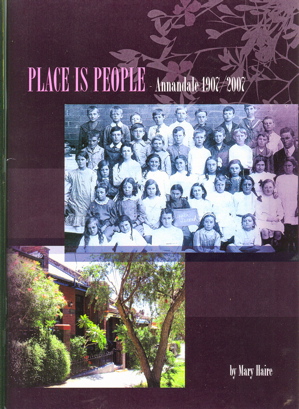
Place is People is a strange little book, neither an attractive collection of photographs to introduce the suburb to visitors nor a quick historical overview. It’s got elements of both those, but is something more personal and less orderly than either; if it was even more personal, it might have been an extended prose poem, but it isn’t quite that either.
Mary Haire leads walking tours, and the book has something of the serendipitous feel of such tours: here’s a little girl walking to school; let me tell you about a boy that age who went to the same school a hundred years ago. I know more about my suburb’s history having read it; some errors have been corrected, and some tantalising trails laid in my mind: Cardinal Freeman was born here, for instance, and the young woman at the florist’s is a single mother. How can I put those two snippets in the same sentence, you ask? I plead that the book sets a precedent with its gloriously unconcerned potpourri approach to its subject.
Talking at Gleebooks recently, Helen Garner paid tribute to Elmore Leonard’s essay, ‘Ten Rules of Writing‘: she has his sentence, ‘If it sounds like writing, I rewrite it,’ on the wall above her desk. In The Spare Room, she has given us a feminine Elmore Leonard story: it’s about the emotional tangles between two women, or at least those tangles provide the language for its telling, but it has the clean lines, the sure forward movement, the lack of hooptedoodle, that give such pleasure in Leonard’s tough-guy narratives from The Tall T to, say, Pagan Babies.
It’s a very quick read, and an intense one. There’s plenty of complexity, some of which I’ve found making itself known to me weeks after finishing the book. For instance, ‘Helen’ the character, who is manifestly a version of Helen the writer, claimed my allegiance and assent to her judgements while I was reading, but has since come to seem much less reliable, much too caught up in her own emotional reactions to be able to give us the full picture (some of which the book gives us in spite of her). It’s a magnificent achievement.
I doubt if David Campbell (1915–1979) is still studied in Eng Lit courses at many Australian unis, but I hope he is fondly remembered and occasionally reread by more than just me. He and Martin Johnston share a posthumous moment in John Forbes’s elegiac ‘Lassù in Cielo’; he cropped up in a footnote in the John Manifold collection I read last month; a recent Poetica featured his correspondence with Douglas Stewart; lines and images from his poems arrive in my mind unbidden from time to time.
Most of the poems in this selection are a strange mixture of the bucolic and the erudite (and just in case I’ve misused those words, I mean rustic and scholarly), and there’s a pleasant music to them. When I read the sequence of twelve twelve-line rhyming poems of ‘Cocky’s Calendar’, I found myself wondering how he managed to pick up his pen again after writing something so wonderful. Back in the early 1970s, in an Aust Lit seminar on this sequence, a student from North America totally didn’t get them: while the rest of us were being drawn into the poetry’s intensely personal relationship with the landscape, he lost patience altogether and said the whole thing read like verse you’d find on a Norman Rockwell calendar. I thought then that he was missing something, and I find I still do. This is the ninth poem, for September:
Under Wattles
Now, here and there, against the cold,
The hillsides smoulder into gold
And the stockman riding by
Lifts to the trees a yellow eye.

It's here the couples from the farms
Play in one another's arms
At yes and no – you'd think the trees
Sprang from their felicities.

So may our children grow up strong,
Got while the thrush drew out his song,
And love like you and I when we
Lie beneath the wattle tree.
How about that present tense ‘lie’, eh?
I think the sequence as a whole speaks to me so strongly because of my father. At a family gathering once, another farmer, of a younger generation, said something about the boredom of spending a whole day driving around a paddock in a tractor (this was before the days of air-conditioned tractor cabins and iPods). When my father said mildly that he didn’t get bored, one of my female cousins asked him what he did with his mind when he was out there all day. As he drew breath to answer, my mother came to the rescue by changing the subject (‘Oh Jenny, you know you’ve been asking me about tatting, I have a pattern here I can show you’). Probably to his relief, my father didn’t get to answer the question. I like to think that David Campbell’s contemplative poems, even though his is a sheep property while my father grew sugar cane, provide some version of what my father might have wanted to say back then over tea and scones.
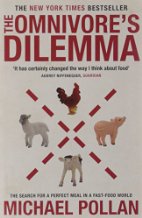
With The Omnivore’s Dilemma I was back to farming, in three categories: industrial, of which I read with a mixture of horror and curiosity; pastoral, which is not synonymous with ‘organic’, but tends to have the virtues claimed for it; and personal, in which the author creates a meal from things he has personally grown, hunted and killed, or foraged. I don’t know that anyone could read this tremendously engaging book without changing the way they think about food. It’s very heartening that it was a New York Times best seller. If you want a quick look at the central part of the book, which deals with ‘intensively managed grazing’ or clever grass farming, here’s a video from Michael Pollan’s recent TED talk:
The book integrates into its narrative any number of lively essays: on the ethics of meat-eating (in which Pollan engages with Peter Singer), the joys of hunting (ditto Ortega y Gasset), attempts at humane design in modern abattoirs (Temple Grandin), the US domestic and international politics of corn (in which he doesn’t discuss the so-called Free Trade Agreements that leave the US free to subsidise its grossly inefficient corn agribusinesses while preventing other nations from continuing with similar protections, but he makes their absurd brutality abundantly clear), on just about anything you can think of that’s related to his central question, ‘What should we have for dinner?’ Some of it is very funny. Some is inspiring. Some horrendous. All of it is engrossing.
I hadn’t read David Campbell’s The Man in the Honeysuckle before. As with Selected Poems, I’m fairly indifferent to the learned bits, mainly translations and imitations from the Russian, but some of the lyrics, especially the Aust Pastoral pieces, are extraordinary. The book was published posthumously, and it’s hard not to read a number of the poems as being poignantly suffused with a sense of death as imminent. ‘Crab’, ‘The Broken Mask’ and the whole ‘With a Blue Dog’ section stand out for me in this first encounter. How’s this:
Wind in Casuarinas

Camped under the she-oaks
With a dog and swag

The woman a white sapling
A straight flame
Blown all ways
And the children off
On their several roads

Lives rounding like river stones
Or washing out in wheel ruts

A high sky over tree and hill
And the clouds taking fire
I am spread out I burn
Yellow and rose – blessing and blest
A still flame in the arms of the she-oaks

Life butting into the world
With five wants and a howl
And shambles out with a blue dog.
I want to put ‘five wants and a howl’ right up there with ‘helpless, naked, piping loud’.
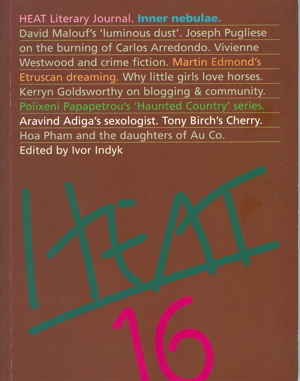
I don’t imagine Elmore Leonard would care much for this Heat. There’s hoptedoodle galore … though generally very high quality hoptedoodle. Ironically, the one article that seem to me to be 90 percent hoptedoodle is by a crime writer whose point seems to be that crime fiction has advantages from being bound to an absence of hoptedoodle (but maybe I was just irritated because her essay on the relationship between genre fiction and literary fiction totally ignores the existence of children’s literature and science fiction).
There’s a terrific piece on blogging by Kerryn Goldsworthy, not a hopt or a doodle in sight; a lovely pairing of a story by Eva Sallis (‘Abattoir’) and an essay by Elizabeth Campbell (called ‘Why Little Girls Love Horses’ on the contents page but ‘Envy Worship and Passion’ on its own title page); chiming mentions of the catacombs of Paris, of which I’d never heard, first in one of Jennifer Maiden’s still-intriguing George Jeffreys–Clare Collins poems and then in an engrossing essay by Sarah Knox about researching historical novels, her own and Hilary Mantel’s; and a number of memorable pieces on aspects of migration: Elisabeth Holdsworth’s memoir ‘New Holland’, a short story by Hoa Pham, poems by Ali Alizadeh (on his unborn baby) and Peter Skrzynecki (on his late father). There’s lots more. I’m a happy subscriber.
I understand that it must be a nightmare to copy edit a magazine like this: so many words, so many different voices, so little time. But there are enough lapses to present a significant obstacle to the reader, at least to this one. At one point, havoc is ‘wrecked’; as something wreaks havoc just a few pages later in the same article, it seems likely that the error resulted from an editor’s dependence on a spellchecker rather than ignorance. In the sentence, “The memoir becomes a book about illness to many reviewers; a ‘survivors’ tale; a plumbing of the issue of women’s health, and the continuing masculinist paternalism of the public health system” it looks very much as if the apostrophe after survivors was misunderstood by someone who inserted another before it to make it function as a quote mark; and the comma after health almost derails the sense. I don’t want to go hunting for similar moments, but the erratic comma and absent apostrophe in ‘reconstruction, so redolent of the historian’s duty, and the re-enactors fancy’ just leapt up at me from further down the same page (p 172). This might be just the irritated snitchiness of an underemployed pedant, but in this context it becomes hard to tell if the truly eccentric punctuation in a number of the poems is what the poet intended or the product of editorial inattention.</curmudgeonly grumble>
How could I resist reopening The Branch of Dodona, my only other David Campbell book? This one had pride of place in the bathroom for a week, to allow for contemplative reading in short bursts. Again, it’s his farming poems – in this volume, the ‘Works and Days’ sequence, with its love–hate relationship to sheep – that speak most strongly to me. Even his ‘My Lai’, which I remember him reading at Vietnam Moratorium Readings in another age, works so powerfully because of the farmer-to-peasant solidarity it embodies:
I was milking the cow when a row of tall bamboo
 Was mowed by rifle fire
 With my wife and child in the one harvest,
 And the blue milk spilt and ruined
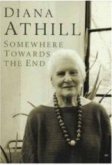
I’m not sure what the friend had in mind who gave me Diane Athill’s reflections on old age, Somewhere Towards the End, as a present for my 61st birthday. As Ms Athill is almost exactly 30 years older than me and still going strong, I’ll assume she wasn’t hinting it’s time I hang up my spurs.
In terms of my current reading, the book’s matter-of-factness, its almost belligerent steadiness of gaze play as a sober counterpoint to the rage and evasion of The Spare Room: both books generate what Athill calls an ‘addictive excitement of the mind’, and they speak to each other. Ms Athill’s brief reference to Hilary Mantel’s A Place of Greater Safety endorses Sarah Knox’s praise of it in her essay in Heat. The book has in spades a (to me) miraculous quality that I think of as Protestant integrity, a quality also displayed, ineffably, in the manner of my friend J’s leavetaking. I wouldn’t mind having a mind like Diana Athill’s when I’m 90. She manages to be remarkably cheerful about things usually discussed, if at all, in gloomy mode. One chapter begins, for example (the emphasis is mine):
When you begin discussing old age you come up against reluctance to depress either others or yourself, so you tend to focus on the more agreeable aspects of it: coming to terms with death, the continuing presence of young people, the discovery of new pursuits and so on. But I have to say that a considerable part of my own old time is taken up by doing things or (worse) failing to do things for people older, or if not older, less resistant to age, than myself.
Can’t you just see that paragraph, followed by the word ‘Discuss’, as an exam question on The Spare Room?

 Having read Thea Astley’s A Kindness Cup because it was on Kerryn Goldsworthy’s What’s What List and been sharply impressed, I decided to follow it up with this, which is also on that list. I am in awe of Helen Garner’s non-fiction, a category which for my present purposes includes the novel The Spare Room, but I’ve read very little of her fiction. Monkey Grip, her first novel, read to me like an elegantly processed diary: it was interesting and impressive, but didn’t entice me to read more. So reading The Children’s Bach involved reversing an earlier virtual decision.



 Me fail? I fly!