Tag Archives: Judith Beveridge

NSW Premier’s Literary Awards Shortlist announced

A bit late for anyone who wants to read the whole short list before the winners are announced next month, but the (very long) short list for the NSW Premier’s Literary Awards has been announced. You can see the full list with judges’ comments on a pdf press release from the State Library.

Here’s most of it – all except the translator – with links to my blog posts on the few I’ve read, all of which have me nodding my head in agreement with the judges. (Maybe it will take grandchildren to bring me back up to date on children’s lit.)

Christina Stead Prize for Fiction
Only the Animals, Ceridwen Dovey (Penguin Australia)
In Certain Circles, Elizabeth Harrower (Text Publishing)
Golden Boys, Sonya Hartnett (Penguin Australia)
The Snow Kimono, Mark Henshaw (Text Publishing)
The Golden Age, Joan London (Random House Australia)
A Million Windows, Gerald Murnane (Giramondo Publishing)

UTS Glenda Adams Award for New Writing
The Tribe, Michael Mohammed Ahmad (Giramondo Publishing)
Foreign Soil, Maxine Beneba Clarke (Hachette Australia)
The Strays, Emily Bitto (Affirm Press)
An Elegant Young Man, Luke Carman (Giramondo Publishing)
Here Come the Dogs, Omar Musa (Penguin Australia)
Heat and Light, Ellen van Neerven (University of Queensland Press)

Douglas Stewart Prize for Non‐fiction
The Europeans in Australia, Alan Atkinson (NewSouth)
Citizen Emperor: Napoleon in Power 1799‐1815, Philip Dwyer (Bloomsbury)
This House of Grief, Helen Garner (Text Publishing)
The Reef: A Passionate History, Iain McCalman (Penguin Books Australia)
In My Mother’s Hands, Biff Ward (Allen & Unwin)
The Bush, Don Watson (Penguin Books Australia)

Kenneth Slessor Prize for Poetry
A Vicious Example, Michael Aiken (Grand Parade)
Devadetta’s Poems, Judith Beveridge (Giramondo)
Kin, Anne Elvey (Five Islands Press)
Wild, Libby Hart (Pitt Street Poetry)
Unbelievers, or The Moor, John Mateer (Giramondo)
Earth Hour, David Malouf (University of Queensland Press)

Patricia Wrightson Prize for Children’s Literature
The First Voyage, Allan Baillie (Puffin Books)
Rivertime, Trace Balla (Allen & Unwin)
Figgy in the World, Tamsin Janu (Omnibus/Scholastic Australia)
The Duck and the Darklings, Glenda Millard & Stephen Michael King (Allen & Unwin)
Crossing, Catherine Norton (Omnibus/Scholastic Australia)
The Adventures of Sir Roderick the Not‐Very Brave, James O’Loghlin (Pan Macmillan Australia)

Ethel Turner Prize for Young Adult’s Literature
Book of Days, K.A. Barker (Pan Macmillan Australian)
The Road to Gundagai, Jackie French (HarperCollins Publishers)
Are You Seeing Me? Darren Groth (Random House Australia)
Razorhurst, Justine Larbalestier (Allen & Unwin)
The Cracks in the Kingdom, Jaclyn Moriarty (Pan Macmillan Australia)
Cracked, Clare Strahan (Allen & Unwin)

Betty Roland Prize for Scriptwriting
The Code Episode 1, Shelley Birse (Playmaker Media)
Upper Middle Bogan Season 1, Episode 8: The Nationals, Robyn Butler and Wayne Hope (Gristmill)
The Babadook, Jennifer Kent (Causeway)
Fell, Natasha Pincus Story by Kasimir Burgess and Natasha Pincus. (Felix Media)
Please Like Me Season 2, Episode 7: Scroggin, Josh Thomas
Once My Mother, Sophia Turkiewicz (Change Focus Media)

Nick Enright Prize for Playwriting
Brothers Wreck, Jada Alberts (Currency Press)
The Sublime, Brendan Cowell (Melbourne Theatre Company)
Jasper Jones, Kate Mulvany (adapted from a novel by Craig Silvey) (Barking Gecko Theatre Company)
The Trouble with Harry, Lachlan Philpott (TheatreofplucK Belfast/MKA New Writing Theatre)
Kryptonite, Sue Smith (The Sydney Theatre Company)
Black Diggers, Tom Wright (Queensland Theatre Company)

Community Relations Commission for Multicultural NSW
Jump for Jordan, Donna Abela (Griffin Theatre Company)
Black and Proud: The story of an AFL photo, Matthew Klugman and Gary Osmond (NewSouth Publishing)
Refugees, Jane McAdam and Fiona Chong (UNSW Press)
I, Migrant: A Comedian’s Journey from Karachi to the Outback, Sami Shah (Allen & Unwin)
The Tainted Trial of Farah Jama, Julie Szego (Wild Dingo Press)
Once My Mother, Sophia Turkiewicz (Change Focus Media)

Congratulations and good luck to all of them, and may the judges’ eyes and brains enjoy a rest.

Sydney Writers’ Festival: My Day 5

Sunday morning gestured vaguely in the direction of imminent winter. The sky was overcast and the breeze was making a stab at being chill. By the middle of the day, we were back in balm once more, but don’t anyone mention climate change. If I was  a truly conscientious blogger I would have managed at least three events, but non-SWF life called, so I’m reporting on only one:

10 am: Real Worlds / Imagined Worlds
This poetry session was chaired by Ivor Indyk, whose Giramondo Press publishes all four poets on the panel. (It also publishes at least two of the #threejerks from yesterday, which says a lot about the diversity of its list.)

Having acknowledged the traditional custodians, Ivor also acknowledged the slipperiness of themes at the SWF. The title and description of the session were what he had come up with for the program, he said, but the poets might well decide  to read something else altogether. The theme, which might or might not hold, was to be travel – either to other places or to other realities. Actually, it’s hard to imagine a poem that can’t be tied to that theme somehow so it was fairly safe.

Judith Beveridge took us to ancient India in readings from her new book, Devadatta’s Poems, written from the point of view of the Buddha’s cousin who tried to kill him three times, and in his voice: many intensely physical images of unpleasant things, delivered in Judith’s cool, self-effacing manner.

Ali Alizadeh ruminated a little about whether the whole idea of travel poem amounted to some kind of commodification, then read a number of what I think were unpublished works, plus ‘Robespierre’ from Ashes in the Air (my blog on which is here).

Kate Middleton’s most recent book, Ephemeral Waters, is a trip down the Colorado River, so she fitted the theme exactly. I especially liked a poem about Monument Valley, bristling with movie references (the Valley and the poem both). My sense is that we got the barest hint of the richness of this book.

Ivor Indyk introduced John Mateer as Australia’s main traveller poet. He read from his most recent book, Unbelievers, or ‘The Moor’ and other places, taking us to mediaeval Spain and Portugal, and then to those modern places.

There was time for questions. Poetry readings always seem to provoke questions that are either profound or silly, or both. Here the first question, something like, ‘What use does poetry have in the West, for us … for me?’ provoked interesting responses. Ali Alizadeh took it as a challenge – ‘You obviously think it doesn’t have any use, from the way you asked the question’ – and went on to argue that poetry is useless: it doesn’t make any money in the novels do, and it doesn’t give information like non-fiction. He then ruined his own argument by telling us he was working on a poem called ‘The Wink’, so that people would never forget what kind of man we have as Prime Minister right now.

The other question was even more profound/silly. ‘How do you work out what words to use when you write poetry?’ As the questioner explained what she meant, it emerged that as someone from a complex cultural background, she was wrestling with how to write when it felt as if she had to choose between languages and cultures. Again, Ali Alizadeh played the enfant terrible: ‘I disagree with you about cultural difference. If someone came here from Mars and looked at us, they’d say, “You all look the same to me. Get over it.”‘

And my Festival was over: three poetry sessions, two movies, one evening of stand-up, no rain; the world as a battlefield, the heart and mind as tools for liberation; a lot of laughter, a quantity of rage, some tears, and one or two gasps of delight. I got to see a fraction of it, but I intend to see more by way of the blogosphere and podcasts as I seek them out or stumble across them. Plus, I’ve got a swag of books either already bought or on my list to buy.

I love this Festival.


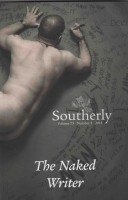
Southerly 73/3

David Brooks and Elizabeth McMahon (editors), Southerly Vol 73 No 3 2013: The Naked Writer

1nw

Alain de Botton was on the ABC recently arguing that we need to reclaim art (and by extension literature) from the academies and museums, to recognise its role in our ordinary lives. He was annoyingly persuasive, and had me wondering whether I really needed to read Southerly, which is after all solidly grounded in the English Department of the University of Sydney, largely written and edited by academics for academics. It seems to have stopped publishing poems by Jennifer Maiden, the regular appearance of which led me to re-subscribe a couple of years ago. So despite the fabulously daring cover, I approached this issue warily. What was in it for me?

It seems I enjoy reading about friendship. Alex Miller’s ‘A Circle of Kindred Spirits’ is a moving account of biographer Hazel Rowley’s career, seen through the prism of Miller’s long friendship with her, which they conducted almost entirely by email. Ann-Marie Priest’s ‘“Colour and Crazy Love”: Gwen Harwood and Vera Cottew’ explores a deep friendship between two women that has been sidelined in most discussions of Gwen Harwood’s poetry. It’s a beautiful essay, explicating some of the poetry and exploring the complex possibilities of friendship between women.

Scott Esposito’s ‘The Gate Deferred: J.M. Coetzee and the Battle against Doubt’ is interesting for similar reasons: at heart it’s about the relationship between readers and writers. The essay explores Coetzee’s engagement with Kafka. Far from writing dry academic analysis, Esposito begins by telling us how as a child of non-religious parents he (Esposito) experienced his own version of Pascal’s ‘le silence eternel des espaces infinis m’effraie’ (the Pascal reference is mine), then gives us a beautiful account of how in Coetzee he found someone with a similar sense of things, expressed in part by Coetzee’s engagement with Kafka. Coetzee, Esposito writes,

gives us not an answer to Kafka, nor an interpretation of him, but rather his experience of dwelling within Kafka’s mysteries.

Esposito comes close to dwelling within Coetzee’s mysteries. (I haven’t read enough of J M Coetzee – just Disgrace and the three volumes of quasi-memoir – to have an opinion on the validity or otherwise of Esposito’s reading, but that seems beside the point.)

Rowena Lennox’s ‘Head of a Dog’ is about another kind of relationship – that between dogs and humans. Her account of walking her dog made me wonder if she lives near me: could my collie be the one she describes as driving her kelpie-cattle dog cross to such paroxysms of exhilarated rage simply by existing behind a fence? Dogs ‘are the closest we have come to living with and knowing another species’, she writes, and whatever the cat brigade may say I think she’s right. The essay ranges widely, drawing on, among others, Frank Dalby Davison (Dusty), Jack London (The Call of the Wild), and Aboriginal elders Tim Yilngayari and Daly Pulkaa (as quoted by Deborah Bird Rose in Dingo Makes Us Human).

There are fine poems: Tracy Ryan has four on a hoard hidden and centuries later found;  Judith Beveridge (‘Peterhead’), Geoff Page (‘Angus’) and Stephen Edgar (‘The Sense of an Ending’) lend lustre (and just watch that Stephen Edgar use rhyme!); Ali Jane Smith (‘The Galapagos’), Simeon Kronenberg(‘Death of a Bull’) and Ross Donlon (‘Storm Water’) each do narratives it will be good to spend more time with.

There are fine reviews. I was especially glad of Anne Brewster on Melissa Lucashenko’s novel Mullumbimby, which I plan to read, and John Tranter being generous, illuminating and a little gossipy on Pam Brown’s Home by Dark.

That’s just some of the highlights for me. Other people may fall with cries of joy on the 42 page offcut from a forthcoming experimental novel by John A. Scott, Michael Buhagiar’s elegant discussion of Christopher Brennan’s debt to A. C. Swinburne, Robet Darby’s explication of the homoerotic content of a Martin Boyd novel, or … well, there’s quite a lot that I haven’t mentioned.

I’m going to finish with some whingeing, so feel free to stop reading now.

• First, does Southerly deliberately follow US spelling conventions for things like centre/center or the verb practice/practise?

• Second, is it just a little disrespectful to display a poet’s naked body on the cover and make no reference to him or his work except in the photo credit? If you’re interested, here’s a video of spoken word poet Randall Stephens full frontal, clothed and performing:

• Third, was it inattention or editorial illiteracy that allowed Ann-Marie Priest to go into print saying that

there is no mainstream literary tradition of female friendship, as there is with male friendship (think of Tennyson’s In Memoriam A.H.H., Achilles and Patroclus in The Illiad, and Jonathon and David in the Bible).

Maybe Ruth and Naomi just a few pages over from David and Jonathan ‘in the Bible’ don’t constitute a tradition, but surely they deserve a mention; even spellcheck knows how to spell The Iliad; and however many people name their children Jonathon, it’s Jonathan in the Bible. Even if you don’t count the ‘with’ that really ought to be an ‘of’, that’s an impressive error count in so few words.

Toby Davidson’s Beast Language

Toby Davidson, Beast Language (Five Islands Press 2012)
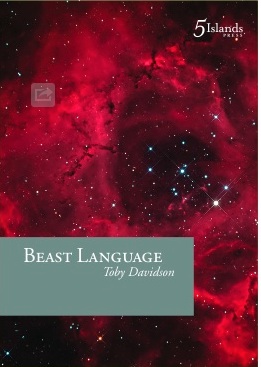
Beast LanguageIn a recent post on the Southerly blog, Judith Beveridge quotes the Irish poet Michael Longley: ‘The poet makes the most complex and concentrated response that can be made with words to the total experience of living.’ That struck me as a reasonable description of what the poems in this book aspire to. She also writes, turning the spotlight away from the book and onto the reader:

What every poet wants I suppose are readers who are not necessarily other poets, who are not critics, who are not scholars, who are not dabblers, but people who are able to immerse themselves in reading so earnestly, so longingly that their experience of books is one of the best parts of their experience of life.

Well, I’m not necessarily another poet, a critic or a scholar, but as my regular readers would agree I’m prone to dabbling. I do know about earnest, longing immersion in the experience of reading: that’s how I used to read everything – Enid Blyton’s Finder-Outers in bed by light from the next room at 10, Agatha Christie when I was supposed to be studying for the Queensland Scholarship exam at 13, The Brothers Karamazov to challenge my faith as a pious Catholic 17 year old, Francis Webb as I was losing religion in my mid 20s. I could go on.

I still read a lot, but for whatever reason I’m less willing to commit myself these days. A writer – poet or otherwise – has to earn my earnest attention, and I’m more likely to approach a new writer with wariness than with longing. Something has to snag me before I can become, fitfully and imperfectly, that ideal reader.

As a dabbler, I enjoyed Beast Language. The language is alive and challengingly sharp, there’s plenty of wit and complex wordplay, and some brilliant images. Some elements, though, threatened to keep me at dabbler level: a lot of allusions (inevitably) left me mystified; some poems are compressed to the point of compaction; and I often found myself skimming without understanding (though not without enjoyment), starting with the very first poem, ‘Indian Ocean Dedication’, which begins ‘She has the genius of an ear / splitting hairs with either mind’ (I’m a lazy reader, but my couple of attempts at unpacking that have come up with nothing).

On the other hand, there’s a lot that makes me want to spend time with these poems. 1: I was predisposed to like them because Toby Davidson has done such a lovely job of editing Francis Webb’s Collected Poems and putting a spotlight on Webb more generally. 2: There’s a pervasive, attractive sense of seriousness, and of playfulness. 3. Where the poetry does communicate to me, I’m engaged. The second poem, ‘Genesis 1.2’, undoes the negative influence of the first with a sweet evocation of the effect of a cool breeze in a beach suburb. ‘Three Months Old’ inevitably invites comparison with Francis Webb’s ‘Five Days Old’, but shrugs it off: this is its own poem, a different person facing in his own way the experience of looking into a baby’s face: ‘Your eyes open mine like a sun strikes a planet / as planet eyes sun, our replete double-bond.’ And there’s much more.

So, the book is divided into three sections, ‘Juvenescence’, ‘Reproduction’ and ‘Hibernation’ – dealing roughly with childhood and youth, sex and art, and illness and death respectively. Starting with a child’s birthday party, an Australia Day punch-up, a zucchini, computer games, and especially, fabulously, car trips, the poems take us to unexpected, horizon-expanding places.

‘On Being a Toby’ is a poem I like a lot. Though it’s not particularly difficult, it’s a good example of the kinds of difficulty and pleasures I have found in this poetry. Here’s the whole poem, which I’ll assume is OK with Five Islands Press. Some bits are in bold because I can’t get WordPress to unitalicise words in quotes.

On Being a Toby

Triangular hat, jug of ale and a dog,
little brown mouse of children’s tv,
Hamlet’s cri de coeur incarnate;
all of my life it will be
———————me or not me.

What’s in a name? Put that to a stem cell
conjugating the infinitive root;
not yet splitting, earthing, bonding
micro-pilgrims to our next
———————gnarled suit.

Cut to lump we live with what we have,
no one asks any more. Bearers of the question
of my name have twisted from the rack
and melted through the chimes of passing
———————to a lower floor.

In what’s name? Ask hats, jugs, dogs,
mice, princes, star-crossed lovers and stem cells.
Ask them what it is to be
and they will say don’t play the Dane
———————but understudy artfully:

for just as poems are understudies to Poems
your name is the understudy to a Name.

The first stanza starts out playing with associations on the poet’s name and progresses to wordplay referring to Hamlet that I’m embarrassed to say I initially found inscrutable, but I won’t insult you by spelling it out.

In the second stanza the plot thickens. It’s the kind of thing it’s easy to glide over when in dabbling mode. But when I reach it I’m feeling pleased with myself for having got the ‘to be or not to be’ reference, so I’m willing to do a bit of wrestling. Having invoked Hamlet‘s most famous line the poem now quotes the most famous line from Romeo and Juliet. (If you didn’t know anything about Shakespeare, this transition would still work, of course, but would give less pleasure.) Toby’s answer to the question couldn’t be further from Romeo’s. A name, he suggests, has something in common with a stem cell, whose development is described in a kind of metaphor mash-up of linguistics and embryology: stem cells act like etymological roots, and they develop as verbs are conjugated; cells and infinitives split, and the infinitive, now that it’s been mentioned, suggests something of the mystery of coming into being, from the infinite to the particular. A name is an abstract thing, all potential, as a stem cell is unspecialised, until complexity and experience give some shape, a gnarledness. (Skip that ‘suit’ for now. It stands out oddly, but sometimes skipping isn’t laziness, but negative capability.)

The next stanza isn’t easy either. Cut to lump? At first, looking for complication, I thought this might allude to the oafish character in She Stoops to Conquer. But no, Google tells me his name is Tony, not Toby, Lumpkin. I decided to read the phrase as a direction to the reader: cut from the image of delicate micro-pilgrims to the lumpish complete human. And of course there’s a hint of ‘Like it or lump it’. With ‘Bearers of the question / of my name’ we realise that the whole poem depends on getting the Hamlet reference. If you missed it back there, this phrase is pretty much a handful of nonsense. But what is this rack of which it speaks? The torture of indecision? And if so, what are the chimes? (Dylan’s ‘Chimes of Freedom’? Nah.) I take ‘a lower floor’ as my key: the poem has leapt to a department store (a leap, I now realise, that was foreshadowed by that ‘suit’ earlier), where some suits have twisted from their clothing rack and taken the lift (which chimes on arrival) downwards. I first read this as suggesting a descent into hell – suicide or failure to function, perhaps – but I think that’s a dead end: the lower floor is closer to the ground, so their movement is a continuation of the ‘earthing’ movement of the ‘micro-pilgrims’, from abstraction to the particular. (I wonder momentarily if ‘Cut to lump’ is a tailoring term, which would make the transition from microbiology to department store less abrupt, but as far as I know it’s not.)

‘In what’s name?’ At this point, extraneous information comes into play in my reading. I know that Toby Davidson has a book coming out this year entitled Born of Fire, Possessed by Darkness: Mysticism and Australian Poetry. So maybe we’re moving into mystical territory. The question seems to assume some deeper reality, perhaps a Platonic realm. But whereas the earlier question was to be asked of a stem cell, this one is to be put to the whole array of things, people and imagined entities evoked in the poem so far (including Romeo and Juliet but not off-the-rack suits). And they all line up behind Uncle Monty in Withnail and I (no I didn’t have the reference in my head, but the phrase ‘play the Dane’ rang a bell, and I found this online):

It is the most shattering experience of a young man’s life, when one morning he awakes and quite reasonably says to himself, ‘I will never play the Dane.’ When that moment comes, one’s ambition ceases.

Just as the poem gives a different answer to Romeo’s question, this means something different from Uncle Monty: as I read it, the ‘hats, dogs, jugs’, fictional creations and scientific knowledge, all are invitations to engage with the world – ‘don’t play the Dane’ means something like ‘don’t get lost in metaphysical introspection’.

And then the last two lines reassert the metaphysical world view that the chorus of hats etc has just rejected. I don’t actually know what’s being said here beyond a general sense that the lines are urging an attractive modesty, and I realise that that’s quite enough for me. When I was studying George Herbert in an earlier life, I was shocked by a distinguished scholar’s reading of ‘The Flower‘ that silently ignored that wonderful poem’s last stanza, in which the poet addresses God – clearly unnecessary to the scholar’s humanist sensibility. Maybe I’m doing that to this poem, but, well, at least I’m not being silent about it. I ought to point out, as an afterthought, that one of my favourite lines in the whole book could be read as expressing a spiritual / mystical / transcendental yearning, but whether it does or not it embodies a similar, though definitely less cheerful reconciliation to the actual world as ‘On Being a Toby’. After describing a drunken punch-up on Australia Day, the poem ‘Skyshow’ ends:

__________To summarise: we are a noble people, unable to bear
ourselves without booze, if we can’t blow things up we just fight
for the hell of it, our national day is a crucible of destruction,
and I want to go home, I just want to go home, but this is where I live.

So there you are. I’ve barely given any kind of sense of the book as a whole, but that’s all my blogging time used up.

(I ought to mention that Five Islands Press gave me a free copy of this book. I would have bought one anyhow.)

SWF 2012: The Weekend

First, a photo from Friday night. This is Tamar Chnorhokian, who read first in Moving People. That’s not a sponsor’s logo in the background, the story was set in a supermarket. You can see what I mean about the performers having nowhere to hide.

And now a sprint through my crowded weekend. My only serious queuing experience of the Festival was for the 11.30 session of What Would Edith Do? on Saturday – I got there before the previous session finished and so was comfortably towards the front of the queue. Edith Campbell Berry, the main character in Frank Moorhouse’s Dark PalaceGrand Days and Cold Light, may not have seized my imagination, perhaps because I haven’t read the first two books, but she has clearly been important to many people. I went to this hoping to find out what I’ve been missing and I got what I was after. Emily Maguire, novelist, discovered Edith in her late teenage years as a model of how it might be possible to live – rising to challenges and living nervously out of one’s depth rather than settling for the life mapped out by social expectations. She said there had been a number of times when she had actually asked herself the WWED question. Sadly, she deemed only one of them suitable for public exposure, but as it involved being invited to speak at a function in North Vietnam when she actually had no idea of the purpose of the function or who the Party functionaries thought she was, it was a perfectly satisfactory anecdote. The other panellists, journalists Annabel Crabb and Cynthia Banham, had come to the character later in life, but managed to convey the appeal. I realised that Cold Light is all aftermath: a woman who has lived daringly and intelligently, challenged convention in her private life and made a contribution on the world stage, returns to Australia in the 1950s where there is no place for such a woman and lives on scraps for the rest of her life. For those who have seen Edith riding around Geneva in a cowgirl suit or (is this really what they said?) stroking Anthony Eden’s head in her lap, the third trilogy is heartbreaking. Frank Moorhouse wasn’t there, but the best line of the session was his. He had told Annabel Crabb that one of the advantages of having spent 20 years with a single character was that she can now do her own PR and he doesn’t even have to turn up.

National Treasures was another poetry session that wasn’t quite what I had read the advertising to mean. I thought the participants – Mark Tredinnick, Vivian Smith and Judith Beveridge – were going to talk about Australian poetry they treasured, and read some to us, plus some of their own. What we got was excellent, but it wasn’t that: Judith Beveridge stayed firmly in the chair role, and the others talked of their own writing careers, and read from their work. When he was 15,  in the 1940s, Vivian S had sent off poems to The Bulletin, then pretty much the only place that published poetry in Australia. He received encouraging responses from the literary editor, Douglas Stewart, advising him to ditch the archaic poeticisms and recommending that he read contemporary poets such as T S Eliot. Decades later, Mark T was similarly advised by critic Jim Tulip, but the poets he recommended were William Carlos Williams, Robert Gray and Vivian Smith.

Tasmanian Aborigines was next, in which Lyndall Ryan talked to Ann Curthoys about her new book, a rewrite of her 1981 book on the same subject. Inevitably, the session involved a revisiting of the so-called History Wars: Keith Windschuttle had singled Professor Ryan’s 1981 book out for his accusation that lefty historians had fabricated evidence of massacre and his claim that in fact the original inhabitants of this country had just faded away when the Europeans arrived, possibly because of their inherent weaknesses. Windschuttle has been thoroughly discredited as a historian, of course, but it was interesting to hear Ryan’s take on the episode now. Asked what difference his intervention had made to our general understanding of Australian history, she said that paradoxically he had driven her and other back to interrogate their sources more thoroughly, and where in her first book she had focused on Aboriginal resistance, she had now looked at ‘settler activism’ and found that the evidence indicates that the violence of the frontier was much worse than historians had previously understood. Massacre, for instance, looms much larger in the new book than it did in the original.

Anne Curthoys was warm and personal as her interlocutor. She opened with a wonderful quote to the effect that in order to write history, one needs to have a deep commitment to the subject that relates to some great love or business in the present, and asked Lyndall Ryan what this love or business was in her case. But Professor Ryan was not to be seduced away from her calm, scholarly demeanour, and answered in terms of the breakthroughs in research since 1981. The question in my mind, which I didn’t get to ask, was along the same lines: as a white Australian, uncovering the evidence of terrible things done by your own forebears, how do you keep your composure, or if (as I think would be desirable) you lose your composure how do you keep your scholarly integrity? I guess I’ll just leave that one hanging.

Then I was back to the sun-filled Bangarra Mezzanine for Poetry Australia with Robert Gray, Rhyll McMaster, Tricia Dearborn, Geoffrey Lehmann – and the unfulfilled promise of Robert Adamson. It was a dazzling session – the sun was low over the Harbour and from where I was sitting it was impossible to look directly at whoever was at the lectern. Speaking less literally, it was okay. Each of the four poets read from their own work – some startling eroticism from Tricia Dearborn (I mean that in a good way), two poems from Rhyll McMaster that had me reaching for my pen to write down brilliant lines I knew I’d forget, in a scribble I now can’t read – her new book, Late Night Shopping, is now on my To Buy list. Geoffrey Lehmann read ‘Parenthood’, which begins ‘I have held what I hoped would become the best minds of a generation /  Over the gutter outside an Italian coffee shop watching the small / Warm urine splatter on the asphalt’, and lives up to the promise of it opening. Almost as if in direct reference to Ali Alizadeh’s scathing Overland review of the Lehmann–Gray anthology, Robert Gray read a number of John Shaw Neilson’s limericks.
In the short Q&A, someone did tactfully name the elephant in the room. A bookseller from Perth, she said that the anthology Australian Poetry Since 1788 was selling brilliantly. But, she said, she didn’t understand how a fine poet such as Fay Zwicky hadn’t made the cut. Ali Alizadeh, John Tranter, Peter Minter and other fierce critics of the anthology might have asked the same question but added a hundred names and whole classes of poetry, and gone on to challenge the inclusion of limericks. Here it was a genuine question rather than an attack. It seems to me that what was missing in the selection process was the intervention of someone who knew the field  and could veto the editors’ eccentricities. I can see why it would be hard to resist modifying the general perception of John Shaw Neilson by including a swag of limericks, or to include 14 poems by ‘Bellerive’, whose poems never even made it to the literary pages of the Bulletin of his time. But that’s when an authority figure needs to step in and rap someone over the knuckles.

Oh my paws and whiskers, across the road again to see Hilary Mantel on a huge screen in the Sydney Theatre talking about Bring Up the Bodies. What can I say? She was magnificent, and I’ve now got the book on my iPad. A friend of mine couldn’t read Wolf Hall, because he couldn’t tell who was being talked about a lot of the time – the book would say ‘he’ and expect you to know it was Thomas Cromwell. Evidently a lot of people had the same difficulty, because this new book says ‘he (Cromwell)’. As Michael Cathcart, interviewing Ms Mantell from our stage, said, you can almost hear the author saying, ‘Is that clear enough for you?’

[Added on Wednesday: The Literary Dilettante has an excellent account of this conversation here.]

Gluttons for punishment, we rushed from the theatre and drove to Marrickville for an evening of youthful cabaret/burlesque, which might have been on a different planet, but that’s another story altogether.

On Sunday, I only managed one event, The Oskar Schindler of Asia? in which Robin de Crespigny (pronounced Crepny) and former people-smuggler Ali al Jenabi conversed with ABC’s Heather Ewart (who is much smaller in person than she seems on the TV screen). This was 2012’s equivalent of last year’s conversation with David Hicks. Like Hicks, Ali al Jenabi is being treated unjustly by the Australian government. Although the title of the session is a quote from the judge who tried him for the crime of people smuggling, the government is so committed to the demonising term ‘people smuggler’ or at least so terrified of being attacked by the snarling Tony Abbott  if they are seen to be soft on such people, that al Jenabi, who seems to be a perfectly decent man who has endured terrible things, remains on a bridging visa pending deportation, even while all his family are now Australian residents.

It was a great Festival. Now I have to get back to work.

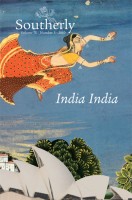
Southerly 70/3

David Brooks & Elizabeth McMahon (editors), Santosh K. Sareen & G. J. V. Prasad (guest editors), India India: Southerly 70/3

Southerly is a venerable institution – the Journal of the English Association, Sydney, it has been going for 70 years (which isn’t long compared to children’s literary journals such the School Magazine or its New Zealand equivalent, but impressive among little magazines for grownups). This issue has a central focus on Indian–Australian literary relations, but I bought it for Jennifer Maiden’s poem, ‘The Year of the Ox’, which doesn’t relate to that focus.

‘The Year of the Ox’ is to an end-of-year family letter what many of Jennifer Maiden’s poems are to diary entries, that is to say, same same but different. It brings us up to date on characters who have been inhabiting her poetry for some time: herself and her daughter, current political leaders (Obama, Clinton, Gillard), iconic figures of the recent and not so recent past (Diana Spencer, Mother Teresa, Florence Nightingale, Queen Victoria, Eleanor Roosevelt) and her fictions George Jeffreys and Clare Collins. It’s a long and complex poem, but from one point of view, it brings us up to date on the doings of this mental family during 2009, the Chinese Year of the Ox, and into 2010, Year of the Tiger, all the while ringing the changes on the images and connotations of ox and tiger. I love the way the poem swings with apparent nonchalance from observations on her own close relationship, the political scene and the nature of poetry, to – what to call them? – Platonic dialogues between icons, to vividly realised domestic scenes from a virtual novel, and all the while there’s a sense of poet-as-ox pulling a plough through the furrows of a mind alert to the world.

There are other excellent poems: by Ali Alizadeh (whose ‘Election Announced’ chillingly mentions someone as ‘the theocrat / a retributivist in speedos’), Judith Beveridge (whose two poems are actually India-related, thanks to her interest in Buddhist lore), Richard Deutsch, Craig Powell and a list of other Australians, and by a handful of Indian poets. I couldn’t get into any of the short stories, with the exception of Sarah Klenbort’s ‘The Chinese Circus Comes to Cessnock’, in which three fruit-picking backpackers encounter the complexities of Australia’s policies about Asian immigration.

Southerly comes from academe, and there a number of academic pieces, in particular surveys of the India-Australia literary connection and studies of particular texts. I intended to read the journal from start to finish, but decided to skip the scholarly bits when I read on page 20 that one novelist’s work ‘might be taken as a case study of Deleuzean deterritorialised nomadology […] Derridean self-critique in which text and meta-text mutually […]’. Too much like hard work! I skipped pieces by Indian critics on Mollie Skinner, Hazel Edwards, and a number of Aboriginal subjects with words like subjectivity, constructing and historiography in their titles. But I was wooed back by Mark Macleod’s ‘Reading my first time in India: the ACLALS Conference 1977’. Once you get past the daunting title, this is a fabulous piece of travel writing structured around two literary conferences. It sheds light all over the place, and abounds with striking images and telling anecdotes.

The other stand-out piece was by Patrick Bryson, a white Australian married to an Indian woman and living in rural India. His ‘The Men Who Stare at Bogans’ explores the Indian press’s coverage of the anti-Indian racism in Australia, and moves on to a brilliant essay on the treatment of ‘tribals’ in India.

As I was writing this, the next issue of the Asia Literary Review arrived in the mail. It’s an English language journal reflecting writing in and about Asia. This Southerly does a nice job of reminding us of one of our strong Asian relationships.

SWF: Busy Friday

I had tickets for a 10 o’clock session yesterday morning. One of the participants was prevented from being there by the Chinese government, and I was kept away by an act of vandalism (see previous post). There’s a photo of Liao Yiwu on a chair in the Gleebooks shop, but I got my whole body to Walsh Bay in time to spend a little money and queue successfully for

11.30 am: The Fascinator
Delia Falconer, Ashley Hay and Gail Jones have all recently written books set in Sydney. With Jill Eddington in the chair, the three of them – one a lifelong Sydneysider, one here since she was about 20, one a very recent arrival – chatted interestingly. Jill Eddington recommended reading all three in succession because the effect was like three movements in a piece of music. She imagined a movie that might be made of the three of them wandering the Harbour foreshores, going in and out of the Mitchell Library, walking in each other’s footsteps, almost meeting. The conversation that followed was a nice contradiction to the myth that writers are essentially in vicious competition with each other: Ashley Hay, for example, said that when her book was finally with the printer, reading Delia’s, which covered so much of the same territory but from a very different perspective, was like a special reward.

I tore myself away early, just as they were playing with possible readings if the session’s title: were we meant to think of the Harbour as a hat or an evil enchanter from a Margo Lanagan short story, or – the preferred option – both? I left reluctantly so as not to risk missing out on the Francis Webb session at 1 pm. This turned out to be a wise move, and brought a sweet bonus: I was hailed by a friend I hadn’t seen for 40 years, and while I kept one eye on the Webb queue we snatched a quarter of an hour to get reacquainted. When the growing queue vanished into the dark, we promised to follow up on Facebook, and I skedaddled to:

1 pm: The Lost Poetry of Francis Webb
This was in a much bigger venue than other poetry events, and we were told that it could have filled a space twice the size. It was one of a series of events around Australia to celebrate the recent publication of the UWA Collected Poems. The book’s editor, Toby Davidson, has organised and chaired the events, in which local poets read poems by Webb and speak briefly of their connections to him.

Toby D is a young man whose enthusiasm for his subject wouldn’t have shamed a revivalist preacher. He wants us all to read Webb, in solitude and aloud to our friends. He recommends the practice of carrying a book of his poems everywhere with us (which Bob Adamson told us later he actually does). He kicked things off by reading ‘Ball’s Head Again’. He didn’t read badly by any means, but he did demonstrate the difficulty of Webb’s verse and gave us a yardstick by which to judge the other readers.

By any measure they were all brilliant.

Judith Beveridge spoke of the texture of Webb’s language, its compression and richness, and read ‘Images in Winter’ and ‘For My Grandfather’.

Brook Emery quoted a speaker from an earlier session who referred to ‘songs that please the ear and songs that please the heart’ and said he would add ‘songs that please the mind’ – Webb’s poems, he said, are always reaching for meaning. He read ‘Night Swimming’, the first poem by Webb I ever read, when I was 24 or so, and ‘Nessun Dorma’.

Johanna Featherstone, easily the youngest of the poets, struck a blow against the view that Webb is a poet’s poet, read only by scholars and fellow poets. She takes poetry into correctional centres, where prisoners, possibly influenced by knowledge of his time in institutions, believe him. She read ‘The Runner’ and ‘Harry’.

Craig Powell, a psychiatrist in his day job, told a little story of his acquaintance with Webb when in a psych hospital in Melbourne. He read ‘Five Days Old’, prefacing it with the story of its creation: a psychiatrist in England took Webb on an outing, and asked him to hold his little baby for a moment. Powell almost spoiled the moment by asking with a snigger, ‘Who would hand their baby over to a certified chronic schizophrenic?’ But he gave us the poem with sound and heart and head. He also read ‘Hospital Night’.

Robert Adamson talked about the stigma of ‘mental illness’, quoting an eminent poet-critic-media-personality’s description of Webb as ‘the maddy’. When they met, Webb asked Adamson, ‘Are you a Communist?’ ‘Why?’ ‘The long hair.’ He read ‘Bushfire’, ‘Black Cockatoos’ and ‘End of the Picnic’. As a final comment he said that whereas a lot of discussion of Webb’s poetry focuses on his ‘mental illness’, the poetry itself is full of hope and lucidity.

The young Bulgarian woman sitting next to me said she’d loved the poetry, though there were many words she didn’t understand. Me too.

As I was on my way to the next session, I accosted Bob Adamson and said how much I’d loved his reading. He reached into his briefcase and gave me a book! So, dear reader, when someone does something that delights you, make a point of thanking them.

2.30 pm: The Merchants of Doubt
Naomi Oreskes’s eponymous book (can you say that?) is an exploration of the doubt-mongering techniques developed by the Marshall Institute in the US to defend vested interests against the implications of scientific research. They began with the connection between tobacco smoking and cancer, and progressed to a range of environmental issues, reaching some kind of peak with climate change They don’t have to lie (though they do anyway), but they do systematically create disinformation. She was in conversation with Robyn Williams, and they are clearly kindred spirits, science journalists passionately concerned about the current attacks on science.

I won’t try to summarise. Robyn recommended a BBC doco, Science Under Attack. In a neat echo of Adamson’s anecdote, he told of meeting one of the doubt-mongerers at a conference, and being asked of his journalist colleagues, ‘Are they all Communists?’

My main take-home point was that scientists (and, I would add, others) have a deeply held belief that the facts will speak for themselves. But this is manifestly not so on matters with big emotional charges on them.

Judith Beveridge’s Wolf Notes

Judith Beveridge, Wolf Notes (Giramondo 2007, 2010)

On a Sydney Writers’ Festival panel some years ago Inga Clendinnen indulged in a flight of metaphor, saying that the writer of a personal essay takes the reader by the hand and says, ‘Come walk with me,’ while a novelist invites a reader to play Catch-me-if-you-can. The novelist who chaired the panel commented afterwards that though he adores Inga (as who doesn’t?), he was a little offended. At the risk of offending poets everywhere then, I’d like to suggest that the author of a book of poems is saying, ‘Come in, make yourself at home, stay a while.’

That is to say, I have to live with a book of poetry for a while before I feel that I’ve actually read it. At this stage of my relationship with Wolf Notes, I can say confidently that there’s lots of good stuff in it, but I’d have read it again, dip into it, and do some digging before I could say anything useful about it. (I’ve just read Martin Duwell’s latest entry on his Australian Poetry Review site, and I tell you I’m in awe.)

For an example of why I’m not competent to say much about this book, I have no idea why the first of its three parts is called ‘Peregrine’: it begins with character sketches of people you might see in an Asian city or countryside – a saffron picker, a pedlar, a bone artisan –, and goes on to a miscellany of other subjects – a contemplative walk beside a lake, a suicide, a boy killed by leeches, a mother wrestling with inexplicable sadness, a crew of three on a fishing boat, and so on. Does the title suggest that the poet is a pilgrim? A falcon? I draw a blank.

In a different way, it seems that to appreciate the middle section, ‘Between the Palace and the Bodhi Tree’, described in an introductory note as ‘an imaginative depiction of the time Siddhattha spent wandering in the forests and towns before achieving enlightenment’, I would have to learn something about Buddhism and the story of the Buddha. I found many of these poems beautiful, especially the ones filled with observations of the natural world, but I have very little clue where they stand in relation to Buddhism: are they devout meditations or relatively unengaged textual games? I think the former, but don’t know enough to be sure. (The third section, ‘Signatures’, presents no general problem – it’s a number of monologues, easily understood to be their speakers’ signatures.)

So far I’m just a visitor to this book, then, but it offers enough observation, drama, wit and seriousness to make me want to spend more time here. One pleasurable thing is the way the moon appears again and again, especially in the middle section. If I quote a number of its appearances, you’ll get some idea of Judith Beveridge’s voice, at least when she’s channelling Siddhattha:

From ‘The Rains’:

————— I look at the moon
primed and narrow as the sting
of a scorpion’s tail.

From ‘Quarry’:

I watched the moon gather shine
like limestone in a mason’s hands.

From ‘Circles’, after describing vultures in picking at a dead ox:

I saw the moon, a desecrated bone
upon which those birds
might drip some blood.

From ‘New Season’:

——————————— the sky’s
depth, where the moon pares itself down
into the smile of an obedient wife

From ‘The Krait’:

I was scared. I didn’t notice the moon,
a fang poised above my slightest act.

From ‘Doubt’:

Today I hear only wind smuggled in.
The moon bears down with its gift-less smile.

From ‘Death‘ (possibly the most immediately accessible poem in the book, it’s the fourth or fifth one down at that link):

Even the moon can’t keep itself clean:
soap soiled by a dung-collector’s hands.

From ‘Ficus Religiosa’:

I vow with all beings
to sit until the moon, a bowl,
is almed only by the Good.

Same moon, same poet, different poems, different feel. I won’t be shaking this book’s dust from the soles of my sandals for a while yet.

Heat 23, Overland 200 and Asia LR 17

The ‘dead white male’ critique of Western Civ […] did not lead, as many of us had hoped, to a new internationalism, but rather to a new form of nationalism that emphasised hyphenated Americans. Chinese-Americans and Chicanos were now part of  the intellectual universe, which was fine as far as it went, but Chinese and Mexicans were still excluded. Multiculturalism was, and is, not very multicultural at all.
(Eliot Weinberger, ‘The Post-National Writer’ in Oranges and Peanuts for Sale)

I’ve just read three literary journals whose roots lie respectively in a rejection of Australian xenophobia, in Communism with its commitment to internationalism and in a mission to publish Asian writing in English. Although we don’t do hyphens in quite the same way as the US, it seems reasonable to see how these journals stack up against Weinberger’s complaint.
***

Ivor Indyk (editor), Heat 23: Two to Go (September 2010)

This issue of Heat is atypical in not including any work in translation. Multicultural themes are addressed, but very little attention is paid to the world beyond our shores. There’s not even any travel writing, unless you count Vanessa Berry’s ‘Dark Tourism: Three Graveyard Tales’, in which the author visits two graves and strolls in a London cemetery (in a piece that might have been more accurately titled ‘Mildly Crepuscular Travels with my Mum’).

Turkish born, ethnically Greek Melburnian Dmetri Kakmi’s ‘Salam Cafe and the Great Burqa Debate’ might seem to fit Weinberger’s description of Clayton’s multiculturalism pretty well – a non-Muslim man joins the argument about what Muslim women should or shouldn’t be allowed or made to wear. But he puts the lie to that pigeonholing by acting as a conduit for Muslim points of view, drawing on his childhood memories of Turkey and his time as a student in Istanbul, and discussing burqa-related artworks by Muslims Shadi Ghadirian (a woman) and Kader Attia (a man, whose ‘Kasbah’ was shown in this year’s Sydney Biennale).

Weinberger’s aspersions might also seem to apply to Michael Mohammed Ahmad’s story, ‘The Hat Dance’, the piece that comes closest to the kind of hyphenation he dislikes. But this account of a dust-up in an extended family living in Western Sydney is so gloriously exuberant only some kind of Diversity Bean-counter could fail to relish it.

Of course, Heat doesn’t claim to fill a hypothetical Diversity Quota in every issue, and there’s no reason it should. Its characteristic approach to fostering diversity is by presenting crosscultural encounters, an approach I’m fairly sure Weinberger would approve of. Kakmi’s piece is an example of that approach. So is Michael Atherton’s portrait of Harry (christened Charalambos) Vatiliotis, who lives in the Sydney suburb of Croydon and makes classical violins in the manner of Stradivere, each one a unique work of art. Cassi Plate quotes from letters of Costas Tachtis, Greek novelist who lived for some years in Australia, and his friend Carl Plate, an Australian artist: ‘The letters,’ she writes, ‘take us into a cosmopolitan world within the heart of what is often assumed to be parochial 1950s Sydney.’ Maybe cosmopolitanism is a better word than diversity for the thing that Heat does so well.

Cosmopolitanism can incorporate voices from elsewhere, and also bring a sharp eye to bear on the local, as Peter Doyle’s fascinating ‘Bashful City: Sydney’s Covert Criminality‘ does to photographs from the archives of Sydney’s Justice and Police Museum.  It can also include intensely place-specific writing like  Mark Tredinnick’s review of  Judith Beveridge’s most recent book of poetry, in which, incidentally, he compares her to a shark and a Philip Marlowe thug, and convincingly means both as compliments.

I do worry about Heat‘s copy editing and proof reading. There’s curiousity, practicing (though correct Australian usage practises elsewhere), an umbilical chord. Someone is heard cluttering in his garage. In Robert Adamson’s delicately poised ‘The Coriander Fields of Long Bay Penitentiary’, a with is repeated over a line break – I know it’s poetry, but that’s just a mistake. One article has this near the beginning: ‘It is one of the great dividers between the civilised among us: those of impeccable taste.’ I wasn’t interested enough in the article’s subject – taxidermy – to endure whatever came after that.
****

Jeff* Sparrow (editor), Overland 200 (Spring 2010)

The first issues of Overland, published in 1954,carried the slogan ‘Temper democratic; Bias, Australian’, hardly a promise of cultural diversity or cosmopolitanism. But as a project of the mainly Communist Realist Writers’ Group, the journal had a commitment to internationalism. Surprisingly, there’s not a lot of that in this anniversary issue, unless you count a deference to Europe and the US. Not that there’s necessarily anything wrong with that: for instance, Alison Croggon’s ‘How Australian Is It?‘ talks with her characteristic clarity and generosity about the way much of our theatre has opened out to the world, freed from constricting preoccupations with national identity but distinctively Australian all the same. On the other hand, when Clive Hamilton characterises the Australian as an agent of ‘the Republicans’ war on climate science’, he implies – perhaps intentionally – that in this matter Australia is humiliatingly no more than an arena in which US battles are being fought. There’s a fair whack of ‘theory’**, enough to create a gnawing sense of Australia as a site for the application of theory developed elsewhere – no sign of Raewyn Connell’s Southern Theory here. (The most theory-rich piece, Alwyn Crawford’s ‘Permanent Daylight‘, which deals with the intimate connection between capitalism and anorexia, is nevertheless compelling reading because of a ballast of passionate personal testimony.) Christos Tsiolkas is the Literary Big Gun of this issue, with a short story about the market in European art, but I found it unreadable (that is to say, I couldn’t tell what the story was trying to do, whether it was a spoof or something else very dull). There’s no non-European voice, and little interest in non-European culture: one piece, by a non-Muslim, quoting no Muslim voices, uses the Western burqa debate as a springboard for theoretical reflections on the visibility or otherwise of women in the West; Jacinda Woodhead gives us an attractive profile of Melbourne rapper-comedians Fear of a Brown Planet (there’s a wonderful YouTube clip of one of them here); Kabul is mentioned in one article, but it’s in a quote from an organisation aimed at creating a market for US cosmetics there.

So Weinberger’s kind of internationalism isn’t overwhelmingly evident in Overland. The three outstanding pieces, in fact, aren’t even particularly multicultural. Chris Graham does a demolition job on Noel Pearson in ‘Telling whites what they want to hear‘. Graphic novelist Bruce Mutard re-tells a story from Overland 1: the story is ‘Nine O’clock Finish’ by John Morrison, a marvellous socialist realist writer, and the resulting 8-page comic is to weep. Janette Turner Hospital’s short story ‘Weird People’ is a tour de force centred on the captain of a tourist boat that takes mainly US tourists out to look at humpback whales off the coast of New South Wales – I suppose it could be read as a protest against our cultural client-state identity.

In Overland, though less so than in Heat, proofreading is a worry: ‘haute bourgeois’, the Communications Minster, and at least one article written in an academic style that apparently defeated all attempts to wrangle it into English.

* In a classic example of Mruphy’s law, when I first put this up, I misspelled Mr Sparrow’s first name – immediately after whingeing about someone else’s poor copy editing. I’ve fixed it now
**  Writers referred to include Ariel Levy (North American liberal feminist), Nina Power (British philosopher and feminist), Mark Fisher (British cultural theorist), Guy Debord (French theorist), Sheila Rowbotham (British feminist historian), Edward Said (the exception that tests the rule and finds that it holds up), Naomi Baron (US linguistics professor).

****

Stephen McCarty(editor), Asia Literary Review 17 ([Northern] Autumn 2010)

It’s a telling confirmation of Weinberger’s generalisation that the ALR’s web page header reads ‘Asia Literary Review – Asian American writing’, apparently promising US-ers that they can read it without danger of encountering anything genuinely foreign. Happily, it’s a false promise.

From the beginning, there’s no doubt that we’ve left the leisurely contemplation of anti-grand abstractions far behind. US-expat journalist Robbie Corey Boulet kicks off with a report on the first case tried – in 2009! –  by the tribunal set up to deal with ‘those most responsible’ for the crimes of the Pol Pot regime. Itself a fine combination of court-reporting, historical background and interviews with people still looking for answers about their murdered relatives, it is followed a few items later by a suite of poems by Peauladd Huy whose parents were murdered by that regime and who now lives in the USA. And it finds a grim echo at the end of the journal, in an excerpt from Frank Dikötter’s Mao’s Great Famine, which draws on archival sources to explore the terror and violence of the Great Leap Forward (‘at least 45 million people worked, starved or beaten to death’). There are other pairings, including a story and a photo essay about floods in the Philippines. A good bit of the ALR probably amounts to armchair dark tourism – much stronger medicine than the piece wearing that label in Heat.  The one actual piece of travel writing – about Mount Merapi, a Javan volcano –  has enough disastrous loss of life for the darkest tourist sensibilities.

There aren’t many laughs, but there’s plenty of wit and imagination: ‘Youth-in-Asia‘,  a story set in Korea by Canadian Ron Schafrick, delivers on its punning title; Priya Basil’s ‘Losing Their Religion‘ is a quietly entertaining memoir of religious conversion and un-conversion that spans three continents; GB Prabhat’s ‘The Silencer‘ gives us a clever inversion of  celebrity stalking.

There is no Australian presence, apart from two full-page ads, for the Melbourne Writers Festival (featuring a Hokusai wave) and Heat (‘Australia’s only international literary journal’) respectively.  Insert your own ironic comment.

One sentence leaps out to meet my eye.  Jonathan Watts, an English journalist, moved from Korea to Beijing in 2003. His interviewer James Kidd tells us:

The signs of conspicuous pollution made an immediate impression: a keen runner, Watts found himself wheezing after a short jog; a father, he was alarmed when his two daughters were not allowed outside during breaks at their Beijing school. It was China that taught him to fear for the future of the planet.

I’m not sure I can afford to keep up my subscriptions to all three of these journals. I was thinking of letting my subscription to Asia Literary Review lapse – but it’s teaching me to think in terms of the whole planet

A full day at the SWF

My yesterday was entirely devoted to the Sydney Writers Festival, and I had a great time, starting out at Walsh Bay, where my choices seemed to keep me away from the monster queues.


10 : 00 Poetry on the Harbour: Adam Aitken, Judith Beveridge and Kim Cheng Boey, with Ivor (‘I know they’re good poets because I published them’) Indyk in the chair.

In general I prefer to hear poets read their own work over having actors deliver sonorous, deeply felt renditions, because actors’ performances tend to narrow the range of possible readings. I also prefer poets’ readings that avoid the incantatory (though I’m delighted by the over the top bits of Yeats and Tennyson I’ve heard). All the same, all three of these poets read their work with such modesty and introspection that I longed for just a touch of the rock star, just a hint that they might be able to hold us in the palm of their hands and wring our withers.

It was an excellent reading nonetheless. Adam Aitken read his ‘Pol Pot in Paris’, and a poem taken from his father’s letters (introduced with, ‘I love my father, but he had colonial attitudes’) got actual laughs. Judith Beveridge began with an anecdote from Robert Creeley: at a school reading a child asked him, ‘Mr Creeley, was that a real poem or did you just make it up yourself?’ Among the poems that JB had made up herself was a lovely piece about a man washing himself at the railway station tap just outside Delhi. Of the extraordinarily cosmopolitan Kim Cheng Boey’s poems, I particularly liked ‘Stamps’, in which the poet converses with his little daughter.


11 : 30 First Nation Stories: Richard Van Camp and Boori Monty Pryor herded ‘like cats’ by Anita Heiss.

In introducing his poets, Ivor Indyk mentioned university positions and awards. In this session, Anita Heiss talked about which Indigenous Nations/mobs people came from, including herself. Both Richard and Boori perform and tell stories in schools. Richard gave us what I took to be one of his school performances; Boori talked about his. Both men were very funny, and Boori gets the Me Fail I Fly nomination for the most charming man on the planet. Yet with all the humour and charm he managed to put some hard truths. ‘This is the only country in the world,’ he said, ‘that mines a culture and sells it off to the world but doesn’t want to know about the people who produce it.’ He told of a group of preschool teachers who asked him for advice on how to tell Aboriginal stories to their charges. ‘Do you know about the 1967 Referendum? The Gurindji campaign? The reserves?’ he asked (though he probably named different specifics). ‘You won’t be able to tell the stories until you know about the fight to keep them alive.’


13 : 00 The Politics of Storytelling: Mike Daisey and William Yang, chaired by Annette Shum Wah.

I’m told Mike Daisy’s story was shattering, but I went to sleep during the loud, bombastic opening section of his monologue, which I guess was meant to be the warm-up (a baby cried, presumably at the sheer loudness, and was incorporated into the rant, to the delight of the fans in front of me but adding to my need to absent myself). William Yang showed a number of slides, and it was reassuring to see that his style worked just as well when taken out of the tightly controlled environment of his shows. The discussion was interesting – Annette asked about their provocativeness (William’s photos can be a bit rude, and Mike uses four-letter words, hardly confronting in Sydney I would have thought, but he did mention a show where a big bloc of the audience stood up and walked out – it’s on YouTube and his response is wonderful). William said that when he first did his shows he was part of an angry community. Now he might put in an occasional naughty photo out of impishness. These were such different men, yet their mutual appreciation was lovely to behold.


16 : 00 David Wessel, Meet Paul Keating with George Megalogenis

Note to anyone doing this kind of gig: it really really helps if you read up on the person you’re appearing with and can refer approvingly to his work. Both these men did that and it was a great leavening to what could have been a dry conversation about economics. David Wessell (economic editor of the Wall Street Journal, was able to drop a number of Keating’s famous phrases into his presentation (‘The recession we had to have’, ‘A shiver looking for a spine to run up’, etc). Wessell explained the causes of the GFC memorably as resulting from two false assumptions in the US: that house prices would never fall, and that extraordinary financial innovations spread risk in such a way as to diminish it to the point of negligibility. Keating, equally memorably described Chinese reserves as a great cloud full of water and electricity floating over the world, and Alan Greenspan building a copper pipe up into the sky to draw down the water. He also talked about Spain, Portugal, Ireland and Greece as having a big one-off party made possible by converting to the Euro and suddenly enjoying German interest rates. Right now we’re seeing the morning-after crash. Questions were probably intelligent, but were well above my head.


18 : 00 Have We All Been Conned?: An Emergency Town Meeting: Bill McKibben, Ross Garnaut and Clive Hamilton, with Tim Flannery as participating Chair, discussing the politics and science of climate change.

A case of false labelling. Of course, we all knew it was a Writers’ Festival event and not a political rally, so it was no surprise that it was, as my son described them, four bald men in glasses talking to an appreciative audience about the current state of affairs. No one was really concerned to plug his own book – it was, as Tim Flannery, said, a bit of a dream team.

Was Copenhagen a success or failure? Too soon to tell, but it has meant that developing countries are now taking on climate change rather than waiting for the developing countries to do their bit first.

How come Australia is the biggest laggard in climate change action, yet it has the most to lose? Ross Garnaut spoke with transparent obliqueness of lack of political leadership. Bill McKibben, I think it was, first mentioned Kevin Rudd by name. Clive Hamilton sunk the boot: Kevin Rudd thinks science is a lobby group, and he’s a manager not a leader.

What about the Greens’ rejection of the CPRS? A lamentable strategic error, seemed to be the consensus, rather than a grievous failure of principle as we have seen from federal Labor. Bill McKibben said wise words here. Coming from afar, he said, he had the luxury of responding without knowing or needing to know the details, but what we have to remember is that any victory, however small, is to be celebrated, and any victory, however large, is only a step forward. This is a struggle that will continue for our lifetimes and beyond.

Perhaps the grimmest note of the evening was the statement from, I think, Bill McKibben, that our challenge now is no longer to prevent climate change but to take action to deal with the new world we now live in.

In question time we reaped the consequences of the false advertising. Person after person took the microphone to tell us what they thought about the subject. One woman, from an outfit called A Hundred Percent Renewable, had even brought a banner, which she trailed after her disconsolately as she left the microphone, having failed to get a taker to hold up its other end.

And I’m off to another full day today.