Tag Archives: Kit Kelen

2025 End of Year List 4: Books

The Emerging Artist now keeps a record of the books she reads so she can easily whip up a list for the blog at this time of year. First her data:

  • 62 novels,  9 non fiction, 3 art books 
  • 29 novels by women
  • 20 novels by non English speakers
  • 2 First Nations authors

Best novels
I’ve tried not just to mention books reviewed by Jonathan. That meant excluding two favourites: Time of the Child by Niall Williams and The Granddaughter by Bernhard Schlink. My best five are:

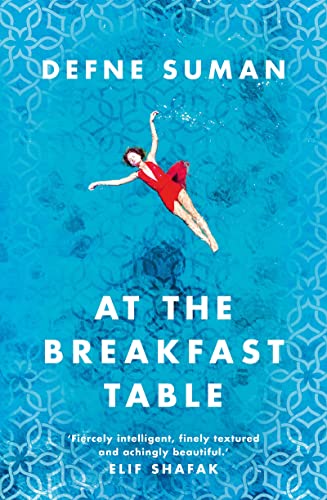
At the Breakfast Table by Defne Suman. Set in Istanbul, it weaves the story of four generations of a family, focused around one weekend, but giving glimpses into the recent history and politics of Turkiye through the lives of each character. The role of women, class and art are in the process. It was one of my random picks from the library, and I now have another of hers on order. 

Glorious Exploits by Ferdia Lennon. What a terrific read, full of humour, violence, Irish sensibilities set in ancient Syracuse. The love of Euripides’ plays drives our two main characters to stage a production performed by prisoners. We saw Ferdia at the Sydney Writers’ Festival where he was equally entertaining. 

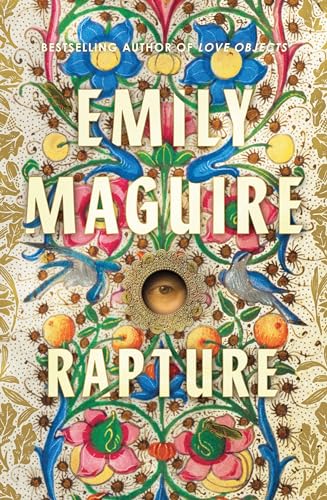
Rapture by Emily Maguire. I had put off reading this but eventually, somewhat reluctantly, picked it up. It was gripping, conjuring up mediaeval Europe and a woman struggling to have independence from the constraints imposed at the time.

Brotherless Night by V. V. Ganeshanathan. Another random pick from the library, this is set in Sri Lanka as the civil war builds over a few decades. Its main character, a young female medical student, tries to sidestep the conflict as her brothers are increasingly caught up in it. A powerful read.

33 Place Brugmann by Alice Austen. During the Second World War, an apartment block in Belgium holds the range of residents that reflect the broader society – those enthusiastic about Nazism and willing to inform, those willing to put their lives in danger to hide Jews and those who become the target of hatred. 

Best non fiction
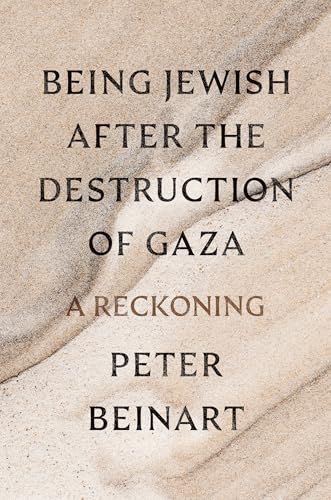
What does Israel Fear from Palestine by Raja Shehadeh and Being Jewish after the Destruction of Gaza: A Reckoning by Peter Beinart are two excellent books about the current genocide.

From me

I can never pick a favourite or best book. Some highlights of 2024 were:

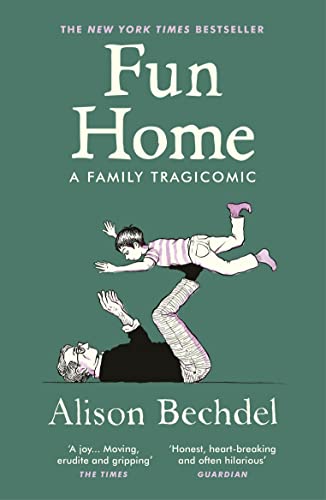
A comic: Fun Home by Alison Bechdel, an LGBTQI autobiographical work that has become a classic. A friend was shocked that I hadn’t read it already (she didn’t care that I haven’t read Pride and Prejudice).

A novel: Time of the Child by Niall Williams, one of three novels so far set in the small fictional Irish town of Faha. Its picture of the role of Catholicism in the life of the village struck a deep chord for me as a child of a Catholic family in North Queensland.

Another novel: First Name, Second Name by Steve MinOn features a Jiāngshī (a kind of Chinese vampire). This struck a personal note for me as the Jiāngshī’s journey ends at the Taoist Temple in Innisfail – and a childhood friend of mine told me that the MinOns lived down the street from him when he was a child.

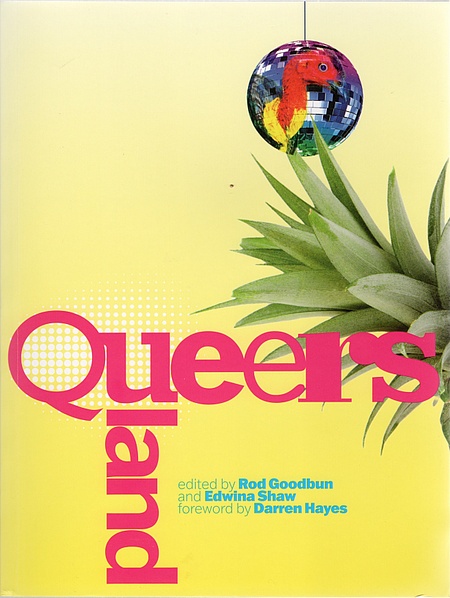
A collection of essays: Queersland is full of stories about being LGBTQI+ in the state of Queensland, especially in the Jo Bjelke-Petersen era, co-edited by Rod Goodbun and my niece Edwina Shaw. I love it because it is so necessary and for obvious nepotistic reasons.

Poetry: Rather than sngle out an individual book I’ll mention the Flying Islands Poets series edited by Kit Kelen. I read 12 books in the series this year, and my life is much richer for it.

I should mention Virginia Woolf. I was inspired by a podcast about the centenary of the publication of Mrs Dalloway to plunge into that book. I’m very glad I did, though plunge is probably exactly the wrong word for my three-pages-a-day approach.
To get all nerdy, I read:

  • 77 books altogether (counting journals and a couple of books in manuscript, but only some children’s books)
  • 32 works of fiction
  • 19 books of poetry
  • 5 comics
  • 11 books in translation – 4 from French (including Camus’ L’étranger, which I read in French), 2 from German, and 1 each from Chinese, Icelandic, Korean and Hungarian
  • 9 books for the Book Group, whose members are all men
  • 11 books for the Book Club, where I’m the only man
  • counting editors and comics artists, 39 books by women and 41 by men
  • 3 books by First Nations writers, and
  • 14 books by other writers who don’t belong to the White global minority.

And the TBR shelf is just as crowded as it was 12 months ago.

Happy New Year to all. May 2026 turn out to be unexpectedly joyful. May we all keep our hearts open and our minds engaged, and may we all talk to peope we disagree with.


I wrote this blog post on Wadawurrung land, overlooking the Painkalac River. I acknowledge their Elders past and present and welcome any First Nations readers of the blog.
Flying Island’s 100 Poets

Brian Purcell & Kit Kelen (editors), 100 Poets (Flying Islands 2025)

Most poetry anthologies are implicitly made up of poems that are ‘the best’ in some way or at least the editors’ favourites chosen from a much bigger field of lesser or less loved work. Though the editors of 100 Poets have necessarily been selective, the point here is not that these hundred poems are Winners. Instead, the book is offered as an introduction to a poetic community.

Flying Islands, the brainchild of Kit Kelen, is a non-profit publisher, and a community of poets and readers of poetry. Over the last decade and a half, they have published 100 pocket-sized books of poetry (I’ve read an enjouyed about 20). They have features award-winning poets, grumpy old poets who complain about the lack of recognition elsewhere, and brand new poets flexing their wings. They have included translation, mostly from Chinese to English or vice versa – Kit Kelen is an emeritus professor at Macao University, and Flying Islands has partnered with Macao-based community publisher ASM (the Association of Stories in Macao). They have had a wonderful variety of style, form, tone and subject matter. All of that is represented in 100 Poets.

This book, pocket-sized like the rest, is the hundredth in the series. Each of 100 poets previously published in the series has a single page – a couple of them fit two short poems onto their page, but none take more than a page. Not every notable Australian poet is represented here – there’s no David Malouf, Eileen Chong or John Kinsella, for instance, and not very much from the world of Spoken Word – but it’s hard to imagine a better introduction to the basic ecology of contemporary Australian poetry.

I was going to list the poets from the book who have appeared in this blog. It’s a long list, and not all of them are there because I read their Flying Islands publications. But it would just be a list of names with links. Instead, here is my favourite title, from Tricia Dearborn:

Perimenopause as a pitched battle between the iron supplements and the flooding

And, in keeping with the blog’s tradition, here’s the poem that appears on page 78, ‘The Sleepover’ by Gillian Swain, whose Flying Islands book is My Skin Its Own Sky (2019):

The first nine lines evoke a pleasant childhood memory. Even if, like me, you never slept over at a friend’s place when you were young, the details – the barbies, the giggling friends brushing their teeth together, the child bodies in adult-sized sleeping bags, the model aeroplanes on the friend’s ceiling – capture brilliantly thrilling combination of intimacy and strangeness that is a sleepover.

Lines 10 and 11 form a finely judged transition from that memory to the very different current situation. They move from the past to the present tense, and the child’s perspective carries over to the different reality – the bed that moves up and down already suggests a hospital, but is presented as a novelty:

like the way your bed moves up and down like 
all the colours the flowers bring

And line 12 lands us firmly in the grim present.

to this grey room.

The person addressed in the first lines is now in a hospital bed.

The interplay of benign memory and grim present continues in the rest of the poem: the three friends once again enjoying each other’s presence long into the night. There is giggling again, and stories. The friendship is as alive as ever, but one of the three friends is dying.

The final lines hold this complex emotional reality in a neat paradox. The imminent death of a friend is not trivialised – but nor is the joy of friendship.

the wrong reasons and  tonight 
your deathbed
is joyous.

The person I have known longest apart from my two sisters died early this year. Our childhood friendhsip wasn’t of the giggling, sleepover variety, but the last time I saw him we did pay more attention to what we enjoyed with and about each other than to what we all knew was coming. The poem resonates strongly for me.

Multiply that by 100 – or to be honest by maybe 75, because not every poem in the book sings to me – and you have quite an experience. I look forward to Flying Islands’ Second 100.


I finished this blog post on the land of Wandandian of the Yuin Nation, whose beaches are said to have the whitest sand on the planet. I acknowledge their Elders past and present, and welcome any First Nations readers.

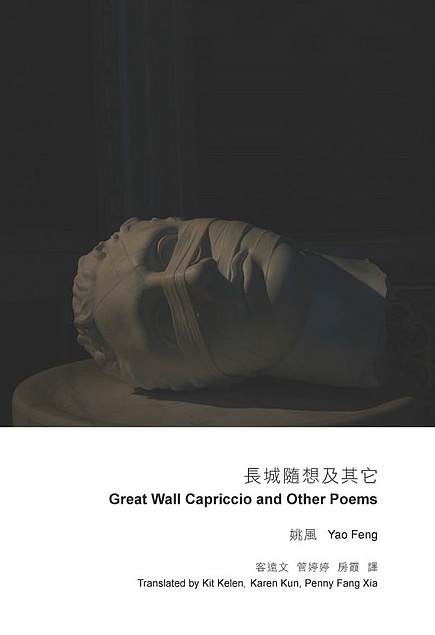
Yao Feng’s Great Wall Capriccio

Yao Feng, Great Wall Capriccio and Other Poems, translated by Kit Kelen, Karen Kun and Penny Fang Xia (Flying Island Books 2014)

Beijing born Yao Feng is a much awarded poet, translator, artist and prose writer. In 2014 when this small book was published he was Associate Professor in the Portuguese Department at the University of Macau, where Kit Kelen, one of the translators of this book and series editor of Flying Island Books, was also a professor.

One of the lovely things about Flying Island Books is that they have two publishers, one in the cosmopolitan city of Macao (which seems to be the accepted spelling in English) and the other in Markwell, a tiny village 16 kilometres from Bulahdelah in New South Wales. The Macao partner is ASM (the Association of Stories in Macao), which has been described as ‘the most devoted publisher of translated literature in Macao’. As far as I can tell ASM was originally Kit Kelen’s baby, and is now under the directorship of Karen Kun, another of this book’s translators.

The book’s title poem is a series of eight dramatic monologues by characters who have stood on the Great Wall over centuries, from lonely soldiers to graffiiti-ing tourists. There are other poems that deal with Chinese history, including ‘memories yet to be disarmed’, a reflection on a painting in memory of the Cultural Revolution. But not all the poems are about China – and not all of them are on serious subjects. The poet sits in the sun and watches jacaranda blooms at the summer solstice, he looks in the mirror and sees that his ears have mysteriously disappeared, he imagines in what circumstances he might renounce his atheism and ‘approach God on all fours’. Poems are set in various parts of China, but also in Portugal, the Netherlands, the USA, Japan … the list goes on. There are poems about Pushkin, Ceaușescu, Aung San Suu Kyi and Marilyn Monroe. In other words, these 130 pages contain multitudes, and are a terrific introduction to this poet.

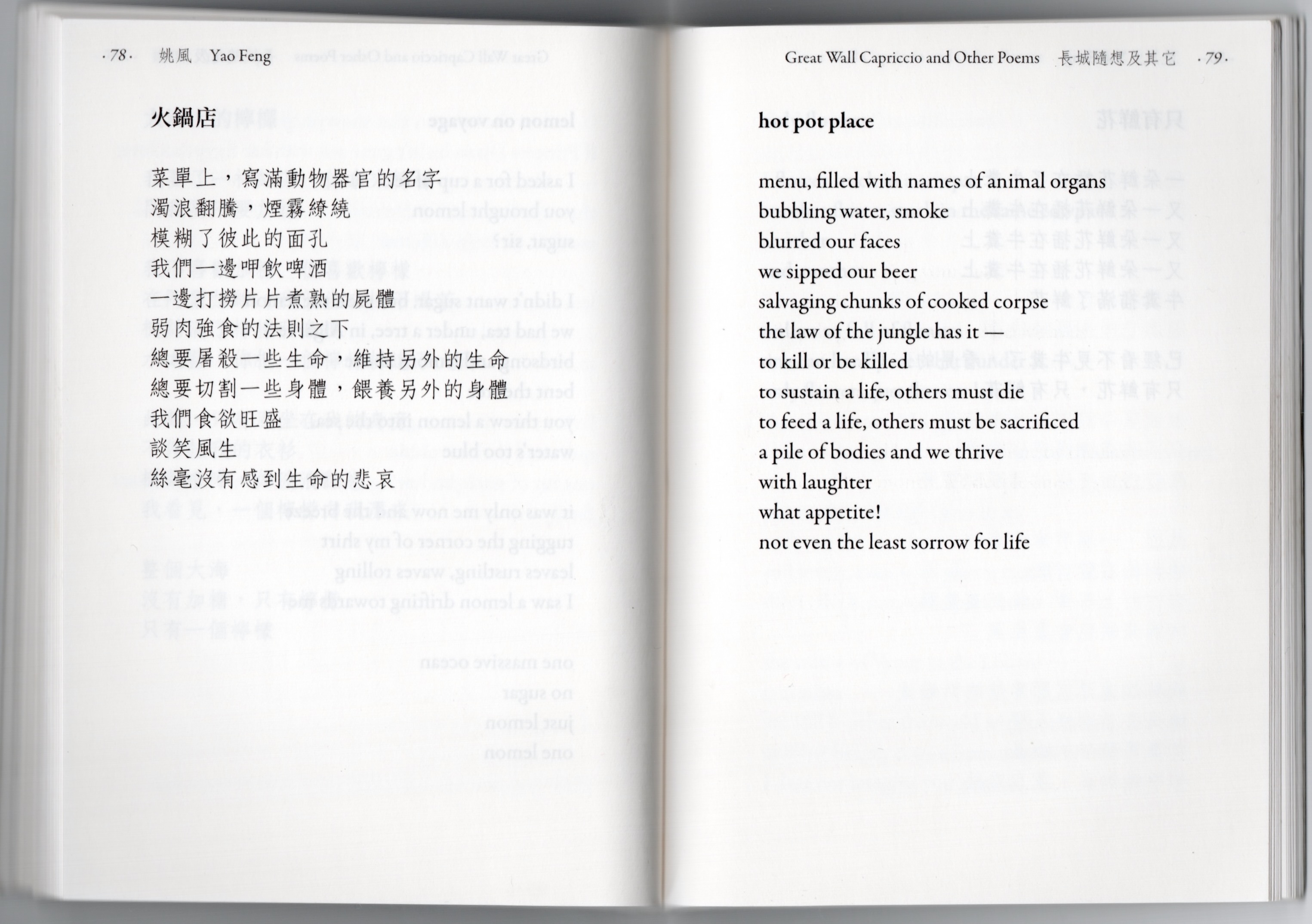
The poem on page 78, which I’m focusing on because of my arbitrary blogging rule*, has personal resonance for me.

hot pot place

menu, filled with names of animal organs
bubbling water, smoke
blurred our faces
we sipped our beer
salvaging chunks of cooked corpse
the law of the jungle has it —
to kill or be killed
to sustain a life, others must die
to feed a life, others must be sacrificed
a pile of bodies and we thrive
with laughter
what appetite!
not even the least sorrow for life

Let me start with my grandson.

My four-year-old grandson is uncompromisingly vegetarian. He likes lambs or pigs to pat in a petting zoo, not to eat. When he overheard a WhatsApp message from someone saying they’d bring a chook to the Book Group, he asked if the chook would be alive, and I felt like a criminal when I told him it would be cooked and ready to eat. There was horror in his voice when he told me one afternoon that the lunch at daycare had been spaghetti bolognese.(He went hungry that day.)

‘Hot Pot Place’ lobs neatly right there. In case you need reminding, in such restaurants a variety of uncooked food is placed on the table, and the diners drop their chosen morsels into a communal pot of boiling stock. The first four lines conjure a cheerfully exuberant social occasion in one: the smells, the sounds the tastes are effectively implied.

The tone changes in the fifth line. The diners aren’t just fishing pieces of meat from the pot, but ‘salvaging chunks of cooked corpse’. The harshness of the language is completely in tune with my grandson’s horror at bolognese sauce, and the next four lines, with their change from past to present tense, can be read as a defensive response from a meat-eater. Everywhere in nature animals eat the corpses of other animals. So it makes sense to enjoy this meal.

But this is a poem, not an argument. The lines about the law of the jungle can also be read as affirming: in eating meat we are playing our part in the natural order of things.

I remember the particular joy I had as a child – quite a bit older than four, I think – when a bullock I’d known from when he was a calf was cooked on a spit at a party to celebrate a family member’s major birthday. Terry, the bullock, even had a nickname. We children called him Pookie because his head was often adorned by a little cap of cow poo from approaching his adopted mother’s udder from behind. I don’t remember feeling any horror, more a kind of comfort that I was eating an animal I knew, not one that had been turned into a commodity.

Then the last four lines. Are they the words of someone recoiling from the carnivorous spectacle? Or are they celebrating the event? Or even somehow both?

It’s not possible to read the phrase ‘a pile of bodies’ without thinking of horrendous events of the last hundred years, including some events where the bodies have been those of animals – I’m thinking of beached whales and recent massive fish kills in New South Wales. So the line ‘a pile of bodies and we thrive’ holds an almost impossible tension. It doesn’t condemn, but it won’t look away.

The last line, I think, does make a judgement. The poem’s speaker isn’t arguing for vegetarianism. It’s ‘sorrow for life’ that is absent, not guilt. He is noticing a callousness in himself and his companions. My mind goes back to Terry/Pookie: along with the joy of eating him, there was something that you might call reverence. The poem doesn’t ask, but it opens out towards asking: is it possible to thrive with laughter and appetite and at the same time honour the lives of the beings we eat, to feel the sadness of the dispensation in which ‘to feed a life, others must be sacrificed’?

My grandson would probably read the poem differently from me. It’s a bit beyond his capacity right now, but if he ever does get to read it, I hope he finds as much joy in it as I have.

This is my sixth post for National Poetry Month, and the fourth bilingual book from the Flying Island Books.


I first read Great Wall Capriccio while flying between Djaubay land and Gadigal Wangal land. I wrote the blog post on the land of Gadigal and Wangal of the Eora Nation. I acknowledge Elders past and present of all those Nations, and welcome any First Nations readers.


My blogging practice is to focus on the page that coincides with my age, currently 78.

Dombóvár, the anthology

Hunter Writers’Centre, Dombóvár: Newcastle Poetry Prize Anthology 2024 (Hunter Writers’ Centre 2024)

On its web page, the Newcastle Poetry Prize describes itself as the most prestigious poetry competition in Australia. Few people would disagree.

The Hunter Writers’ Centre has coordinated the prize since 2002, and it publishes an anthology every year that includes the prize winning poem, the runners up, a number of subsidiary prize winners and a selection of other submissions.

As the 2024 judges Caitlin Maling and Peter Boyle, each with their own impressive list of prizes, point out, a distinctive feature of the prize is that poems up to 200 lines are accepted. And most of the poems in this anthology are of substantial length – the shortest is 27 lines. The anthology is a rare opportunity to read a selection of longer poems from a wide range of Australian poets.

As my regular readers know, I read quite a lot of poetry, if not enough to call myself a critic. I was happy to read poems here by people whose work I respond to:

  • Mark Tredinnick, whose ‘A Godwit Sonnet Cycle’ won the Hunter Writers’ Centre Member Award
  • B. R. Dionysius, whose three-line stanzas in ‘Fishbone Ferns’ give us scenes from life on the Darling Downs – ‘it can be quite WW1 out on the downs, bodies / hung up on barbed wire, left to rot as a sign to / others – don’t try it, don’t cross into no man’s.’
  • Brendan Ryan, with another of his wonderful cow poems, ‘The snaking accuracy of cow trails’
  • Kathryn Lomer, with ‘Hyaenia song’, a narrative poem set in Ethiopia.

And there’s the immediate reason that I bought a copy, Christopher (Kit) Kelen’s ‘Dombóvár’, which won the prize and gave its name to the anthology. I don’t envy the judges their task, but they’ve chosen well with ‘Dombóvár’, which evokes the small Hungarian town that Kit Kelen’s family come from (at least that’s how I read the poem).

I can’t do better than quote the judges (a PDF of their report is available at this link, and is worth reading in full):

‘Dombóvár’ skilfully integrates thoughtful reflection on important issues, humour, inventiveness and an engaging partly colloquial tone. This evocation of small town rural Hungary carries echoes of the moral ambiguities and violence of settler societies like Australia. Throughout the poem there is the suggestion of a larger, potentially national, narrative, but the reader is left to work through the weave themselves … With great skill the poem breaks standard idioms and expected word choices to produce a clipped, very tight effect that intensifies the reader’s experience. ‘Dombóvár’ uses the form of a poem sequence to powerful effect, shaping a masterful poem that can be read on multiple levels.

this is the land of forgive ourselves
for all we've done, will do

There’s lots more in the anthology. To be true to my page 78* practice, I’ll mention ‘The Keeper of the Field’ by Mal McKimmie (pages 74–80). It’s one of several sonnet sequences in the anthology, and a quick web search informs me that it’s far from being the only one written by Mal McKimmie.

The sequence is prefaced by a quote from the Bhagavad Gita, and I’m guessing that the ideas it explores are related to Hinduism: the field is (crudely speaking) the mind, and it is populated by sheep (ideas? poems?). The sonnets circle around the notion of an empty field – mind empty of thought, perhaps. In the two sonnets on page 78, the sequence moves forward to the notion that all fields (all minds?) are connected – we are not the isolated individuals that we think we are in the West. That might sound abstract and difficult, but the poems are remarkably lucid. Here, ripped from its context, is one of the two on page 78 to give you a taste:

Did I say this field has a fence? Well, it 
doesn't anymore. It seems the fence came
down, was taken down, or disappeared
with the sheep, as if they were interdependent
(I faintly recall a lyric passing
through here, singing something along these lines).
Given the absence of a fence, where is
the distinction between this field and another?
Do I tend a disappearing border?

Leaves of grass, field to field, lean in sympathy,
mirror each other; flowers too; even
weeds copy their kin; creepers creep towards
each other; and roots, well, roots have always known:
nothing is alone, nothing under the sun.

if the poem is exploring ideas from Hinduism, it manages to remind us that the quintessential North American poet Walt Whitman was in similar territory – his poem ‘Song of Myself’ includes lines like ‘For every atom belonging to me as good belongs to you.’ And recent science about tree roots supplies the poem with a beautiful metaphor for interconnectedness.

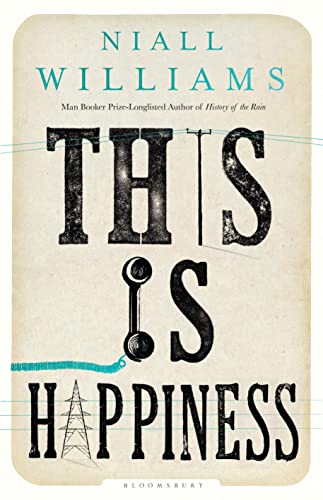
This is Happiness, Niall Williams and the Book Group

Niall Williams, This Is Happiness (Bloomsbury 2019)

Before the meeting: When we discussed Niall Williams’s History of the Rain in October, a number of people had also read his next book, This Is Happiness. December’s chooser, impressed by their enthusiasm, decided we should all read it.

The book’s first sentence, ‘It had stopped raining’, which sits on a page by itself, is pretty much identical with the final sentence of the earlier book, and the tiny, backward village of Faha in West Ireland is again the setting, but the bulk of the narrative takes place in an earlier period, and there is no obvious reference to the characters or events of History of the Rain. It’s the story of the coming of electricity to the village; a coming of age story of young Noe, who has taken leave of the seminary and is telling the story as an old man in the USA; and a big romantic story of love lost and found by Christy, an older man who befriend Noe.

Page 75* must be one of the book’s few pages that doesn’t mention the absence of rain. It happens in the thick of one of the book’s comic set pieces. It’s not the set piece when the lights go down and the cinema comes alive with amorous grapplings, or the one where Noe goes to the communion rail at Sunday Mass in order to get a good look at the woman Christy left at the altar, or the spectacular one where he is knocked unconscious by a falling electricity pole. On page 75 Noe and Christy are on the first of a number of epic pub crawls.

These pub crawls are as much about music as about alcohol, music performed by men who are shy and nondescript until they start playing, and then are brilliant conduits of a great folk tradition. On this first adventure, when the evening is well under way, Christy startles Noe and everyone else in Craven’s pub by starting to sing:

Not only was Christy singing, he was singing with screwed-up eyes and fists by his side a ballad about love. He was singing it full-throated and full-hearted and before he had reached the second verse it was clear even to Roo the dog that a passionate truth was present in that place. It wasn’t only that this didn’t happen in Craven’s, it was that there was something raw in it, something deeply felt, that was, even to those who had descended blinking into the umbrae and penumbrae of numberless bottles of stout, immediately apparent and made those who first looked now look away.

(page 73)

Christy has come to Faha as a worker in the great electricity project. This episode is our first inkling of his profoundly romantic reason for signing up for the work. Not so obviously, it prepares us for the major role music is to play in Noe’s story. Page 75 itself is a beautiful piece of misdirection. After Christy has sung, Noe writes:

I did the only thing I could do. I went to the counter and got two bottles of stout.

Those bottles are followed by another two, and then another. Greavy the guard arrives and declares that it’s Closing Time (as Noe says, this is one more way in which Faha lags behind the times), but the two of them are incapable of moving. Alcohol-based humour usually leaves me cold, but Niall Williams’s version made me laugh out loud. I suppose the whole book could be read as an extended Irish joke: the villagers have an almost superstitious awe of the one telephone in town, and the coming of electricity has almost cosmic significance for them. If you read the whole book like that, the stereotypical Irish drunkenness in this passage is representative (including the sly invocation of Waiting for Godot):

Getting up proved aspirational. There was the idea of it, quite clear. Unmistakably clear now. There were hands placed on knees for push-off. There was a Right now. There was another when that failed to produce action. A Right so following. And still nothing. Between thought and verb a vacancy, not intended, but not grievous, just gently perplexed, and in that perplex the realisation that Craven’s was not in fact such a bad place at all, was downright comfortable in fact, in fact there were few places on this earth as agreeable. True? Too true. A person could stay here, could stay right here and be quite happy now, quite, for a very long time. What’s your rush? There’s no rush. All the problems of the world could be settled right here.
Right.
Will we go so?

I don’t want to minimise the book’s humour. Far from it. But there’s a seriousness to it that page 75 gives no clue of. Christy’s romance is genuinely touching. The villagers’ resistance to the coming of electricity is more than comic: and these villagers are described as custodians of their land, defending an ancient culture under siege by capitalism – without being at all heavy handed, the narrative reminds us that the Irish were the first people to be colonised by the English. The dramatic decline in the Catholic Church’s power since the 1950s is deftly evoked both in Noe’s commentary and in his own story: his turning away from his priestly vocation is a tiny reflection of the ending of Church-domination in Ireland at large.

After the meeting: There were seven of us. Covid–19 and other coronaviruses kept some away, while one or two had better things to do – and one sent video of spectacular drone art over Sydney Harbour.

This was our end-of-year meeting so we had other business besides the book, but it generated quite a bit of discussion. The discussion was unusual in that quite a few of us read out favourite passages. Indeed, two of the absentees sent lists of quotes – it’s that kind of book. One interesting insight was that the narrative as we receive it is created by an old man looking back on a key moment in his youth, making a story out of it, and casting a benevolent glow over the community in which that moment happened.

Other business, besides of course the plentiful food including a splendid pavlova, included a Kris–Kringle book exchange with the usual mixture of cautious delight and polite almost-hidden dismay, and a poetry reading. We were each supposed to bring a poem, and most did, even one of the absentees.

Poems were a nonsense poem by CJ Dennis (‘Triantiwontigongolope’), a poem about climate change (that was me – Kit Kelen’s ‘Parable’), a Thomas Hardy (‘Heredity’), a Robert Frost (‘A Time to Talk’), a poem from Claudia Rankine’s Just Us (‘sound and fury’), and two poems of Australian patriotism that couldn’t have been more different (Sara Mansour’s ‘My Australia‘ – link to her performing it on YouTube – and a poem whose name and creator I don’t remember celebrating the lump in the throat brought on by, for example, Anzac Day). This little reading, including by two people who said they felt awkward reading poetry aloud, left us reeling.

And that was a wrap for the Book Group for 2022.

* Currently when blogging about books I take a closer look, arbitrarily, at page 75 – moving on to page 76 at my next birthday if the idea works well enough.

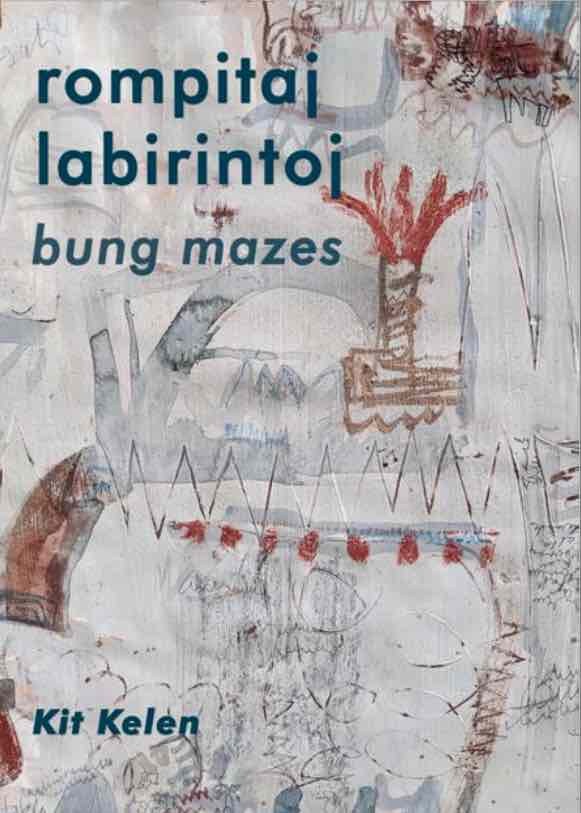
Kit Kelen’s Bung Mazes

Kit Kelen, Rompitaj Labirintoj / Bung Mazes (Australian Esperanto Association 2022)

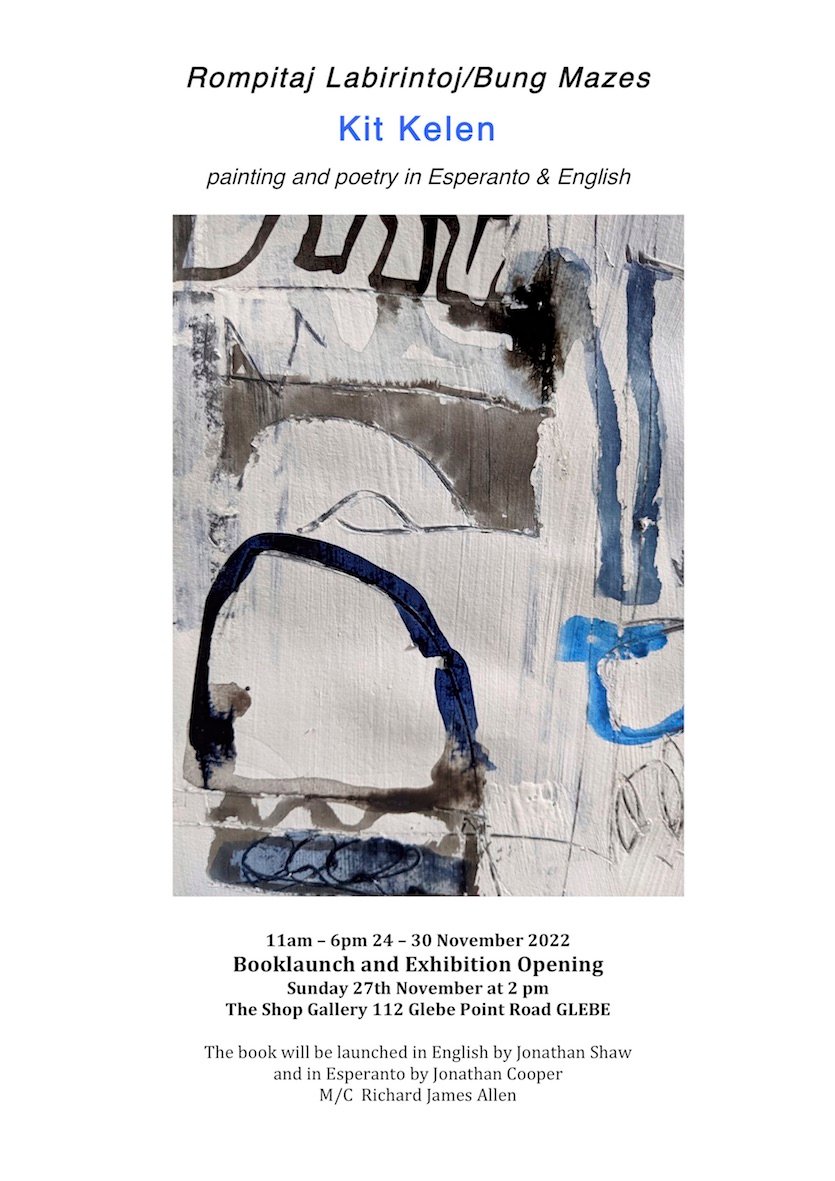
It was my great pleasure to launch the English part of this bilingual book today. The Esperanto part was launched by Jonathan Cooper from the Australian Esperanto Associaton, in an afternoon that also featured Kit Kelen’s’s exhibition of palimpsest works on paper with the same title, plus music, at the Shop gallery in Glebe, all MCd by Richard James Allen. There was music, and a conversation between Kit and Magdalena Ball. Here’s a version of my launch speech.

Rompitaj Labirintoj / Bung Mazes is not the first bilingual poetry book Kit Kelen has been involved in, not even the first bilingual book of his own poetry. But it marks his debut as translator of his own work, both from English into Esperanto and in the other direction as well.

Mostly, unless you’re appropriately bilingual, you can ignore the language that’s not your own when you read a bilingual book. This one isn’t like that. The Esperanto isn’t an added extra. To read the book thoughtfully is to engage with Esperanto, maybe learn a word or two, discover some of its history, and glean some understanding of its underlying philosophy.

It’s easy to see why Esperanto is a good fit for Kit’s poetry. Esperanto, as I understand it, is all about opening channels of communication where none might otherwise have existed. Kit’s work shows a deep commitment to being open to other cultures, other languages, and to other minds. for example, when he asked me to give this talk, he didn’t say, ‘I hope you like the book,’ but ‘I’m interested to hear what you think of it.’

The English versions of many of poems in this book predate Kit’s interest in Esperanto. They cover a wide range of subjects, from the plight of refugees and the climate emergency, to simple celebrations of the natural world and poems about poetry itself. But there’s no great discontinuity between them and the poems dealing explicitly with Esperanto.

One example of these older poems is ‘here’s the story to save the world’, which includes these lines:

what is it keeps us alive?
keep talking
I want to know how the story ends
keep talking
I’ll listen

You can draw a straight line from that to ‘Hitching my wagon to a green star’, a statement of allegiance to Esperanto, which has the lines, ‘we come here for a conversation / while we wait for states to wither away’.

There are poems about learning the language. ‘thank you poem for Trevor Steele’ is explicit:

these lines here are just to say –

thanks for the grammar
I know it must be very annoying –

all the stupid mistakes I make

but how can there be so many accusatives?

Or there’s this from ‘being a humble beginner’:

often I slip
sometimes I slip off the tongue together

This is the poem that most makes me wish I could read Esperanto. What’s the Esperanto equivalent of the mistake ‘slip off the tongue together’? ‘tute glitas de mia lango’ doesn’t tell me anything. It makes me wonder how many references there are that Esperantists get but just sail past me.

Beyond this interest in learning the language, the book engages with its underlying philosophy.  ‘being a humble beginner’ again:

but I’m here for the conversation
I believe that is an art
like leaving the world better than found –
another impossible thing

L L Zamenhof, the language’s creator, is quoted in one of the book’s two epigraphs:

Rompu, rompu la murojn inter la popoloj!

Translation hardly seems necessary, but Google translates it as:

Break, break the walls between the peoples!

‘Bialystok dreaming’ tells how Zamenhof first thought of inventing a neutral second language in Russia in the late 19th century. ‘Suprasegmentals’ makes fun of Chomsky’s declaration that Esperanto is not a language. ‘samideanoj!’ spells out the vision with characteristic Kelenian paradox. It begins:

today we are building a dead language
syllable by syllable, from scratch

it is a tiny country
all between
and never was at all

Esperanto, to paraphrase, has no currency except the people who speak it. Incidentally, this poem stands out for two reasons: the title, meaning ‘like-minded people’ isn’t translated, and the first one-word line  – ‘kamaradoj’ – doesn’t appear in the English. The book is aware of its dual readership.

The poems about Esperanto don’t pull back from its utopian aspirations. In fact they endorse them, but there’s a feeling of astonishment, perhaps even with an edge of amusement, at the vastness of those aspirations. The poems are completely serious, but not self-important.

The two poems that for me are the guts of the book, are ‘shelter’ and ‘bung mazes’. The book has been described as ‘an abstract treatment of the situation of asylum seekers’. The poems celebrating our common humanity, and Esperanto as a way to sharing it, the poems about openness to the natural world and the value of conversation, create a version of the world in which the current treatment of asylum seekers is a cruel absurdity. In ‘shelter’ and ‘bung mazes’, the point is made explicitly.

The title poem ‘Bung Mazes’, begins with a line from the public debate about asylum seekers, ‘everyone knows there is no queue’, and goes on in fifteen short poems to create a kind of maze of its own. I found it the most difficult poem in the book. Sentences don’t finish, images rub up against each other, it’s hard – even maybe impossible – to grasp how some lines hang together. For example:

where you see desert’s edge
a labyrinth in canvas shook

lent to, how it blows off
who’s after you? can it be imagined?

their weapons and the names they call
crime of a clock, dreamt that too

There’s the image of a refugee camp, and a general anxiety is evoked, but it’s hard to pin down a clear meaning. If there is a meaning there, it’s just beyond my grasp (whose weapons? what clock committed what crime? who dreamt what?)

Generally if a poem grabs me, but I don’t understand why, I’ll sit with it, and let it brew in my mind. Sometimes a meaning becomes apparent in the brewing process. In this case, it’s not a meaning, but the effect created by the poem’s elusiveness. In effect the poem, made up largely of unparsable moments like this, gives me a faint inkling of the emotional impact of being lost in the dangerous maze of asylum seeking.

 ‘Shelter’ includes lines that cry out to be quoted:

now they are changing all the world’s weather
island here, river there, tents blow away
tanks shift borders out of the way

big bird flies where it will, drops its droppings

fire now flood now famine war
we were forced to flee

then where to shelter?
in the cave in my head?
but you’ll never get in
there’s never been a queue

there’s a maze
of rules and rights
of yours, not mine
and my turn
never comes

and later:

for the sixty million wandering
this world is a maze gone bung

Sixty million is the UNHCR’s 2015 estimate of the number of people displaced worldwide by wars, conflict, and persecution.

So this is a book about intensely serious subjects.

My mind goes to something Kit wrote almost 10 years ago. Speaking of the problematic nature of writing in the pastoral mode as a settler Australian, he said: ‘The challenge is to have fun while you problematise (otherwise please don’t write a poem).’

This book is fun. Even at its most serious, it avoids ponderousness. It delights in paradox, puns and syntactical playfulness. It always treats the English language – I can’t speak of the Esperanto – as an endlessly enjoyable and challenging playground (‘bung mazes’ is an example; it rejects the obvious English for Rompitaj Labirintoj, that is to say, Broken Labyrinths, in favour of something much less respectful). The poems are full of music, as I hope the bits I’ve read demonstrate.

In this context, fun can be many things. Take the short poem ‘parable’ for example. I loved it at first reading because I felt it brought a much needed lightness of touch to the climate emergency, a step back from the details of rising temperatures, collapsing ice sheets, greenwashing by corporations and governments, and so on. I read it as a kind of wistful fantasy. Then, while I was preparing for this talk, I read it to a friend who’s a climate activist, and it made us both cry – I think because it manages to strike a note of forgiveness along with terrible grief. Here it is. I don’t expect it to make you or me cry today, but just listen to it:

parable

we came from the ice
and out of the trees
and wanted the whole world warmer

we lit fires
and at timber
we were the axe
we were the flame

as if winter were our own forever

we only wanted the whole world warmer

o fearful the dark
but we brought the firelight

the others we’ve eaten by now

we burnt till all of the forest was gone

we came to the clock
that’s where we are now

hard to hear anything
everyone’s in charge
we all follow orders

it’s hard to see how this will pan out
but I predict, in time to come
at the Court of All Spirits
our defence will simply be

we came from the dark
we came from the ice
we wanted the whole world warmer

[It didn’t make me cry when I read it out, and I don’t think anyone else shed a tear either.]

Anyhow:

It’s my honour and privilege to commend this book to you. Buy a copy, and, as the poem ‘keep this book’ says with only a hint of over-selling:

walk with it
sleep with it
read it out loud
quote it at will

I declare Rompitaj Labirintoj / Bung Mazes, the English half, launched.

And here’s a pic of me talking, with Kit’s art in the background and Kit wearing a hat in the corner

Photo by Penny Ryan

A Launch

If you’re in Sydney this coming Sunday – 27 November – you might like to drop in on this exhibition opening and book launch at the Shop Gallery in Glebe at 2 pm. The book is Rompitaj Labirintoj / Bung Mazes, poems in English and Esperanto by Kit Kelen (about whom I have blogged a couple of times).

I have the honour of being the English-language launcher, and will do my best to say something coherent. A different Jonathan wll do the honours in Esperanto. I’m pretty sure there will be music and nibbles.

The book, which I’m loving, is available for purchase at Booktopia.

Two Flying Island pocket poets

The Flying Islands Poetry Community has been publishing pocket-sized poetry books (14 x 11 cm) for more than 10 years. According to its website:

The Flying Island Pocket Poets series originated as a simultaneous entity in Markwell, NSW and Macao, China, through the work of Professor Christopher (Kit) Kelen. Running since 2010 (in association with the Macao-based community publisher, ASM), Flying Islands has published more than eighty volumes, with authors from all over the world, but more from Australia and China than from anywhere else.

We can subscribe from within Australia for $120 to receive a year’s publications (details here). From the beginning of the series, the RRP for individual copies has been kept to A$10. But that’s not all. To quote the website again:

These books that magically appear out of pockets are part of a gift and exchange art-economy. They are our currency! 

Those aren’t just empty words. It was through versions of the gift and exchange art-economy that I found out about the Pocket Poets series, and came to possess, and read, two of these niftily designed books.


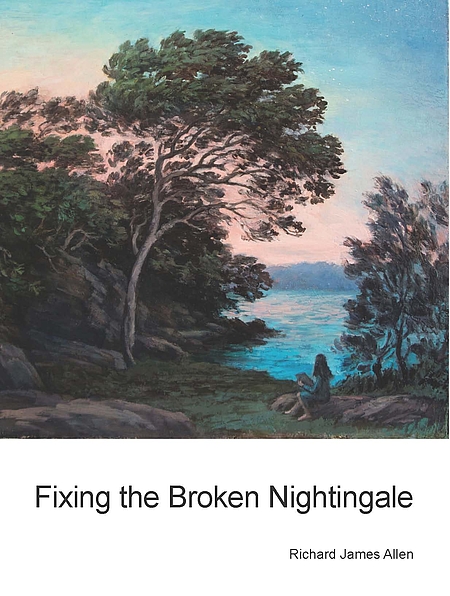
Richard James Allen, Fixing the Broken Nightingale (Flying Island Books 2013)

At a poetry reading in Sydney a couple of years ago, Richard James Allen read his poem ‘It’s Saturday night in almost any city in the world and’, and offered a prize for whoever could guess the city in which he wrote it. The audience called out the names of almost every city in the world, but I was the one who finally shouted, ‘Florence!’ and won the prize, Fixing the Broken Nightingale, which did seem to magically appear out of a pocket.

There’s a rich variety of poems in the book, ranging from straightforward love poems to poems that turn back on themselves like Escher drawings. There’s whimsy and melancholy, moments of ontological despair and intimations of mortality. The most striking poem is ’13 Acts of Unfulfilled Love’, which has some extraordinarily explicit sexual images, to arrive at this, in ‘ACT TWELVE‘:

These are my real thoughts,
not my dirty thoughts.
______________________ ____________This is my real love,
_________________________ ____________not my dirty love.
I am trying to live a real life,
not a dirty life.
_________________________And I'd like you there with me,
_____________________________in this soiled, holy world.

Kit Kelen, A Pocket Kit 2 (Flying Island Books 2015)

When I bought a copy of Kit Kelen’s Book of Mother at its launch in Sydney, neither of us had correct money. This little book materialised as if by magic to be my change.

It’s very different from Book of Mother and from other books of Kelen’s that I’ve read (blog posts here, here, here and here). As the title suggests, it’s a kind of sampling of his work, rather than a collection organised around a central subject or theme. A first Pocket Kit was published in 2011.

This is mostly a cheerful book. There are poems celebrating elements of Australian culture, like ‘Blokes’ (‘They know it’s bad luck to speak / when gesturing would do the trick’) and ‘shed’ (‘the peasant is the king here / where monarchs tinker with old crowns / no need for revolution’). The same ironic celebratory tone comes to bear on Macau where Kelen was a professor when this book was published, on his Hungarian heritage, on the prospect of having children, on the yellow umbrellas of Hong Kong in 2014.

My favourite in the book is ‘to tend’. If I remember correctly, Kelen like me had a Catholic childhood. This poem delicately addresses the question of what to do about the gap created when you stop believing. It starts:

to tend the gods as given, as found
new habits of homage are required

in word untamed, in sight unframed
paths to follow are so chosen,
by you, for you, willing, blind

go to the makers
not to the mockers
take the trouble to tell them apart

And ends:

go to the makers
never the mockers

tend to the habits of homage
you've found

Even though Kelen can begin a poem called ‘ancestor worship’ with ‘people smelt bad in the old times / they had bad teeth, they were stupid’ and can continue in that vein for 20 lines, he is certainly one of the makers, not one of the mockers.

Kit Kelen’s Poor Man’s Coat

Kit Kelen, Poor Man’s Coat: Hardanger Poems (UWAP 2018)

As I think about this book of poetry, the word ‘immersive’ comes to mind.

‘Hardanger’ in the subtitle is not an uncompromisingly hostile state of mind but a place, the Hardanger Fjord in Norway, where Kit Kelen evidently spent some time and, it seems, let the place generate poems in him.

These lines appear on the book’s title page:

the forest is the poor man's coat
keeps off the worst wind's bite

step in – let other worlds elapse
follow the trail of light

They offer an explanation and an invitation. The first line explains the title in what sounds like a folk saying, which in another context could be a lament for the poor man’s exposure to the elements, but here asserts that forest provides protection. We are invited to step into the book, as into a forest, for an alternative to whatever other worlds we inhabit. The book is offered to us as respite. That’s where my sense of immersion comes in: poem after poem offer glimpses of restorative calm, mostly in the Norwegian landscape. It’s the closest thing I’ve found in a book to walking in the bush.

Not that it’s all cosy, and far from humourless. As in ‘sweet’ (page 100):

sit zazen
and you'll draw mosquitoes
from the thinnest air

There are poems about death as well as poems describing the view of the fjord from a mountain top; poems of autumn and winter as well as summer; a lot of rain. The poet spends time in the small town of Ålvik, visits museums in larger centres, and riffs on the gravestones in a local cemetery. There’s often a sense of language not being quite up to capturing the experience of being in nature: sentences trail off, though we usually more or less know how they would have ended; or they miss their opening words. It often feels easy, throwaway, as if the poem just happened, the thought or feeling or spectacle effortlessly caught on the wing. But, of course, that’s the apparent ease of a virtuoso.

Though these are overwhelmingly poems that respond to a place, I found myself brooding on the small section of ekphrastic poems – that is, poems responding to paintings. They raise the interesting question: can you really appreciate such a poem if you haven’t seen the painting it refers to? Like the poems of place, there are three elements present when you read the poem: the words on the page, you the reader, the place or work or even referred to – and the ghost of the poet who put the words together. With poems of place, at least the ones in this book, you don’t need to have been there to appreciate the poem. (Just like you don’t need to have been in love to enjoy Robert Burns’s ‘A Red, Red Rose’.). Take the poem ‘the fjord like laid paper’, whose title doubles as its first line, which begins:

the fjord like laid paper

a ship rules a line
the only thing straight
in all the world turning

If you’ve stood and looked out at the fjord on such a calm day, you will read that differently from someone – like me – who has never been to Norway. For me, it primarily conjures up an image; for you, perhaps, the main thing is the simile/metaphor. Either way, the effect of the poem is to bring a vivid image of the fjord to mind, and I don’t feel any need to fly to Norway in order to understand the poem. (I do feel an impulse to go and see the places for myself, but that’s a different matter.)

When the subject s a painting, though, it’s a bit different. Take ‘Cowshed Courting’ (page 148), which refers to a 1904 painting by Nikolai Astrup that hangs in the Bergen Museum:

If you read this without seeing the painting, you’re left pretty much groping in the dark. I’m grateful that Kelen has named the painting in his title rather than calling the poem something like ‘After Astrup’, and I’m grateful for the internet, because it was no trouble at all to find an image of the painting online.

The opening lines have typical Kit-Kelen syntax:

fin de siècle light they caught then
we still breathe – it's unnatural

A conventional phrasing might be, ‘They caught a fin de siècle light then, which we still breathe, even though it’s unnatural.’ But the syntax serves a purpose: it reflects the process of seeing the painting. You begin with a general impression to do with the quality of the light, which makes you realise that this painting belongs to a particular era (fin de siècle, the end of the 19th century); next you have a sense of the painters of that time – no more specific than ‘they’, because after all this isn’t an art history essay; but having seen it as belonging to its own time, you realise that this painterly light still feels to us as familiar as the air we breathe – familiar but all the same artificial / ‘unnatural’.

The artifice has a purpose, as the viewer’s eye finds the figures on the left, and the brightest spot of colour in the image:

the colour's captured
a passion in the cowshed
rose cheeks and have you in my arms
deep pockets of brandy for inspiration

From the woman’s cheeks, the eyes travel over the figures. The poet projects himself into the image, identifying with the male figure and reading the bottles in his pocket as ‘inspiration’. (A different viewer might see those bottles in a less benign light, but that’s not this poem, or at least not foregrounded here.)

Then we’re taken on a tour:

never mind the pong
someone's peeping from the loft

A vague look to the right of the courting couple – yes, we notice that there are steaming heaps of cow poo all over the floor of the shed. Then we travel clockwise up to the top of the frame, and oh, there’s a creepy voyeur – a peeping tom – unnoticed until now. If the poem was a sonnet, this would be the volta, the turn. A poet less sure of his effects might have inserted a line space here, to mark the discord. But we move on without comment:

no glass but spring shines through the window
past which dung's piled – verdure and ordure

Only now do we come to the geometric focus of the painting, the window through which we can see a dung heap and beyond it some vague greenery. This is the source of that light we first noticed, and there’s an ambivalence to it: dung and greenery, ponginess and light. The assonance (if that’s the word) of ‘verdure and ordure’ reminds us that these things are intimately connected.

Our eyes travel down to rest on the middle of the image – the row of cows’ rear ends, and the unswept floor.

hear it ringing from the rear of each
and the floor steams unswept

Astrup doesn’t show the cows decorating the floor (surely ‘ringing’ is the politest term ever used for the sound of cows shitting), but Kelen gives us an aural equivalent what he shows, just as the earlier ‘pong’ has given us an olfactory one.

In the last line, our eyes travel back to the figures:

days are barefoot now

There’s a sense of completion as the poem finishes its circuit of the painting, from the woman’s cheek to her feet. With characteristic apparent ease, it has introduced a number of pairings: the pong and the ringing; the passion and the peeping; the verdure and ordure; the man fortified with brandy and the woman barefoot and vulnerable; then and now. That last pairing has a lovely complexity to it: in the opening lines, ‘then’ is the time of Astrup and ‘still’ is our time; ‘now’ in the emphatic position as the poem’s last word may refer to the changing seasons implied by the mention of spring in line 9, or it may again be contrasting the time of the painting with modern times when courting doesn’t have to happen in secret in cowsheds, but the whole day – the world outside the window – can be barefoot, open to intimacy.

The poem has made me look closely at the painting, and I may well read it differently from Kelen. In fact, by naming the peeper and then moving on quickly, the poem almost invites an argument. But in Kelen’s reading, or at least in my reading of Kelen’s reading, the painting, and so the poem, celebrate the way love can thrive in unlikely circumstances, and not be tarnished by prurient attention to it. The peeping tom is noticed and then ignored. The dung helps the greenery to grow. The poem gives shelter from ‘winter’s worst bite’. I don’t know that I could have understood any of that from the poem without reading it with the image open beside it.

Having written all that, I really should show you the image as well:

Kit Kelen’s Book of Mother

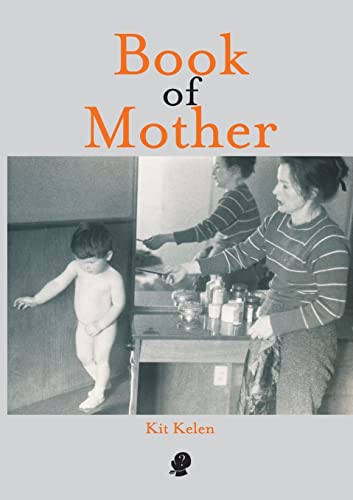
Kit Kelen, Book of Mother (Puncher and Wattmann 2022)

Dementia is becoming a major theme of story-telling in the 21st century. I can think of four excellent movies without even trying, the most recent being Everybody’s Oma, which I’ve seen at the Sydney Film Festival since reading Book of Mother. In poetry, Hawaiian poet Susan M Schultz’s Dementia Blog (2008), among other things, vividly evokes the social life of a dementia ward.

The Book of Mother is a substantial addition to this writing. The back cover blurb describes it well – it reads, in part:

This book is an intimate encounter with dementia as lived experience. Words are an important way into the world and when we begin to lose them we find ourselves with fewer tools and fewer familiar signs to go by. Phrases lost and tip-of-the-tongue half-forgettings – loose threads like these belong to the everyday business of knowing who we are. They are also the nuts and bolts of Kit Kelen’s poetry. A long play record of memory and its tricks, one comes to and from Book of Mother with always some questions about who is talking to whom, about when we are where, about whether we wake or dream.

There are a number of poems about lost keys – emblematic of dementia’s multitude of minor frustrations, for both sufferer and carers/relatives – whose titles are almost enough: ‘the keys are gone again’, ‘no one else has put them anywhere mum’, ‘you have hidden them’.

At least three poems had me in tears. ‘everything will be taken from us’ is a lament that speaks to the grief that accompanies the gradual loss of a loved one to dementia. ‘she’, the longest poem in the book, celebrates the poet’s mother as an individual and as an archetype of all mothers. It begins:

she

who had supernatural powers
who knew what Christmas wanted
what naughtiness was and was not

she who said wait till your father gets home
she who was a step before
could spell every word there was
and we could add things up together

vale mum’, the final poem, is an elegy that includes this wonderful image:

like lost at the Easter show
and a voice comes over the air
says this is how it is from now
your mother – all mother – is gone

For me, the power of the book comes from the cumulative effect of poems where the language feels as if it’s falling apart, in counterpoint to a number of poems in which a very young person’s language is coming together. That is, along with poems that document his mother’s decline, Kelen gives us poems about his own dawning grasp of the world through language as a small child closely connected to his mother. That may sound like an imposed schematic, but it reads as organic: being confronted with the present situation, the mind naturally goes to the past. As a reader, I found the transition between the two kinds of poem disorientating in a way that adds charge to both.

I love this book. If I was to recommend a single poem, it would be ‘everything will be taken from us’. Sadly, it’s too long for me to quote here with a good conscience, and I can’t find it online, but if you happen on the book in a bricks-and-mortar bookshop, turn to page 75, and read this one, aloud if possible. It won’t take long, and it may inspire you to buy the whole book.

Meanwhile, here’s ‘in a waiting room’, a short poem that may give you a sense of the book’s shape-shiftiness:

This poem may take a little puzzling before it yields itself to the reader, but it’s not at heart a puzzle to be solved.

The title and first four lines are clear enough.

to make you happy
for your own good
because we love you
because I can't explain

We are in a waiting room, where someone is responding to a question, something like, ‘Why have you brought me here?’ Read in the context of this book, the lines could be spoken by the carer for a person with dementia or to a child. That is, it could be a poem about the poet’s mother, or one about a childhood memory. Or, perhaps more interestingly, it could be both. Either way, the lines give four different answers to the same question – the questioner, whether it’s a child who is unsatisfied with each successive answer, or the adult with dementia who doesn’t remember the previous answer, keeps on asking.

The next line maintains the ambiguity:

won't remember your hand was held

Anyone who has lived with or cared for someone with dementia will recognise the experience this neatly evokes. No matter how many visitors they’ve had, no matter how much hand-holding, they will still say none ever comes to see them, no one ever holds their hand. But equally the owner of the hand could be a child – in this book, the poet himself in memory – whose adult memory doesn’t include a hand being held. The omission of a pronoun at the start of the line is worth noting. Even though syntactically the line can’t be read other than, ‘[You] won’t remember’, by not giving us the ‘You’, the poem increases the shifting-sands feel.

Though I generally treasure clarity in writing, and see ambiguity as something to be avoided, it’s the double possibilities in these lines that I love. It could be either thing, which means that the two things are similar, which – in this context – suggests that when you relate to a person with dementia, your own hold on reality can begin to shift, or memories may surface of times when you were similarly dependent, confused or failing to understand. The poem takes the reader gently into that border state.

Then, there’s this:

in yellow light
dinosaurs confer
smoke clouds them
or at cards

After a moment’s pause (or, to be truthful, a couple of days), I read this as a description of the waiting room. Perhaps it’s wallpaper, or a painting – of dinosaurs in a cloud of cigarette smoke, playing cards? A google of “dinosaurs playing poker” comes up with plenty of images. It’s not hard to imagine one in a doctor’s waiting room. To repeat myself, though, the pleasure here isn’t in having solved a puzzle or deciphered a cryptic set of words to settle on a clear meaning. It’s in the state of mind before the image is understood. I suppose it’s analogous to the couple of minutes when you savour a weird dream before understanding that it’s just a rehash of something banal that happened the day before. More to the point, it’s like when you have a memory in the form of a striking image, and it takes a while to make sense of it by remembering its context.

here elephants trumpet about
giraffe pokes in a head

The weirdness continues. Perhaps it’s another painting on the wall. This could be a waiting room for either a child or a person with dementia. If a child, these are the details of the waiting room that stand out as interesting, and return as memories when you’re an adult poet. If a person with dementia, they are the disturbing and disorientating features of the environment.

stood by the fire
too close
to beginning

The first two lines here give the reason the person (whose hand may or not have been held) is in the waiting room. They have stood too close to a fire. Then the phrase ‘too close’ does double work, introducing the third line: he stood too close to the fire, and he was also too close to his own beginning, that is to say, too young. And with that line, the poem’s main ambiguity is resolved. This is a childhood memory.

peg in the board where everyone fits
that was my Day at the Zoo

Oh, the elephants and giraffe weren’t in a painting after all. They were part of a board game, Day at the Zoo. This last couplet has an air of finality, like the ending of a child’s composition. Almost smugly, the mystery of the images is cleared up. The memory is reclaimed in full. The ‘your’ becomes ‘my’. Read in the context of the whole book, there’s also a sense of relief: in this case, the weirdness, the things that aren’t understood, have been resolved.

Then you turn to the next poem, ‘forget a thing and it’s gone’, and we’re back to dealing with dementia.

In an earlier version of this blog, I tried to capture things that happened with language with Mollie, who was living with us and with dementia. This extraordinary book does that with wonderful compassion and love, as well as wit, precision and, I guess the word is delight.