Before the meeting: As my regular readers probably know, I belong to two book groups – the Book Group and the Book Club. The Book Club read this book in November, and I blogged about it, here. For this Book Group meeting, I reread as much as I had time for, which wasn’t much. I enjoyed the writing even more this time, but will let that earlier blog post stand as my ‘before the meeting’ notes.
After the meeting: It was a long time since we’d met. One man had had major heart surgery; another had spent months in India; there were stories of surgery on larynx and eyes; terrible things had happened in Sydney and around the world; Christmas had been and gone … Our host had prepared a delicious meal from recipes in the Kerala section of Madhur Jaffrey’s Indian Cookery, supplemented by riata, palak paneer, naan and choctop icecreams brought by others.
We had all enjoyed the book. One man said it was pretty much the best book he’s every read. Another (or perhaps the same one?) read it in a single sitting on a Sydney to Melbourne train trip. Our host said that he usually loves books that create a strong sense of place but loved this one in spite of its not doing that, and referred us by way of contrast to Madhur Jaffrey’s description of Kerala in her cookbook.
We tended to focus on the political dimensions of the book. Someone said that he had found first third of the book self-indulgent (not a view widely shared), but then it got interesting as Arundhati became more politically engaged. The picture that emerges of Narendra Modi was particularly striking – the man who had spent time in India said that his negative sense of Modi had been modified by conversations with educated, affluent Indians who saw his impact as largely benign; this book left him bemused. He was also able to tell us interesting bits about the antiquity Syrian Christians. (Founded by St Thomas in the first century CE. ‘I doubt that,’ said someone, then realised he’d made a Biblical joke.)
And inevitably we got to the paradox that a mother could be so horrible to her children, so beloved of people just outside her immediate family, and also a foundation for her daughter’s enormous success.
It looks as if our next book will be Arundhati Roy’s The God of Small Things.
We met on the land of Gadigal of the Eora Nation, and I have written this blog post closer to the river, on the land of Gadigal and Wangal. I acknowledge Elders past and present of those clans, and welcome any First Nations readers.
Before the meeting: Mary Roy (1933–2022) was an extraordinary woman. She successfully challenged an inheritance law in the Indian state of Kerala so that women were able to inherit property, and she founded a ground-breaking school. That school, Pallikoodam, has a photo of her on its home page, accompanied by a vision statement:
Pallikoodam is born of the vision of Mrs Mary Roy. For fifty plus years she worked on moulding an extraordinary school that imparts a creative and all-round education that produces happy, confident children, aware of their talents as well as their limitations, unafraid of pursuing their dreams and living life to its fullest. Today, every one of us in Pallikoodam works to realise and forge ahead with her dream.
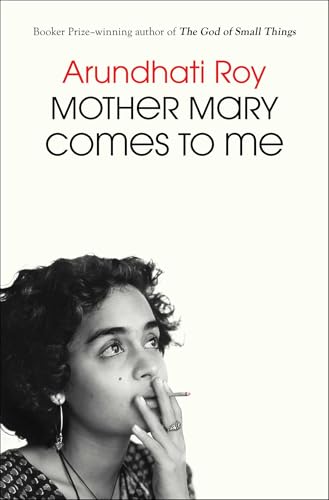
Mary Roy was also the mother of writer Arundhati Roy. In this memoir, she emerges as a formidable woman who did brilliant things, earning the admiration and cult-like devotion of many while challenging patriarchal institutions, and was at the same time a tyrannical, unpredictable, terrifyingly self-centred mother. Near the end of the book, Arundhati Roy describes a moment in 2022 when she was having dinner with three male friends, including her close friend Sanjay. She received a message on her phone:
It was from my mother. They, all men, each of them, including Sanjay, beloved by their besotted mothers, must have noticed the blood drain from my face and wondered what had happened. How could I explain to them that what had scared me was that I had got a message from my mother saying that she loved me.
It says a lot that readers understand perfectly why the message is terrifying, and that we also understand the intense moral, emotional and intellectual complexities involved in Roy sending a positive reply.
I love this book. It’s the story of the intertwined lives of two brilliant women, with the last half century of Indian history as an often intrusive backdrop. The genesis of Arundhati Roy’s writing is vividly told: her two novels The God of Small Things and The Ministry of Utmost Happiness, as well as her non-fiction, ‘activist’ writing, opposing the construction of a big dam that would displace millions of people, exposing the suffering of the people of Kashmir, reporting on time spent in a jungle with communist (‘Naxalite’) guerrillas, opposing Narendra Modi’s regime, and more.
I can imagine the book being portrayed as a misery memoir in which a famous writer complains about her wretched childhood, or as an exposé of a monster generally regarded as a saint. But that would be to misrepresent it. Mrs Roy’s personality was no secret. Her most loyal adherents were aware of her rages, her indulgences (she was always accompanied by an attendant bearing her asthma medication and, later in life, a supply of jujubes). And though Arundhati and her brother suffered terribly at their mother’s hands, she was a powerful force for good in their lives. There are any number of quotable lines to illustrate this complexity. Here’s just one from page 61, when the daughter was fifteen years old:
Between her bouts of rage and increasing physical violence, Mrs Roy told her daughter that if she put her mind to it, she could be anything she wanted to be. To her daughter those words were a life raft that tided her over pitch-darkness, wild currents and a deadly undertow.
There’s so much to enjoy. Arundhati has a friendship with the legendary John Berger, which gives us the unforgettable image of him as an elephant fanning her with his flapping ears. Hollywood actor John Cusack makes a cameo appearance as a witness of the mother–daughter relationship.
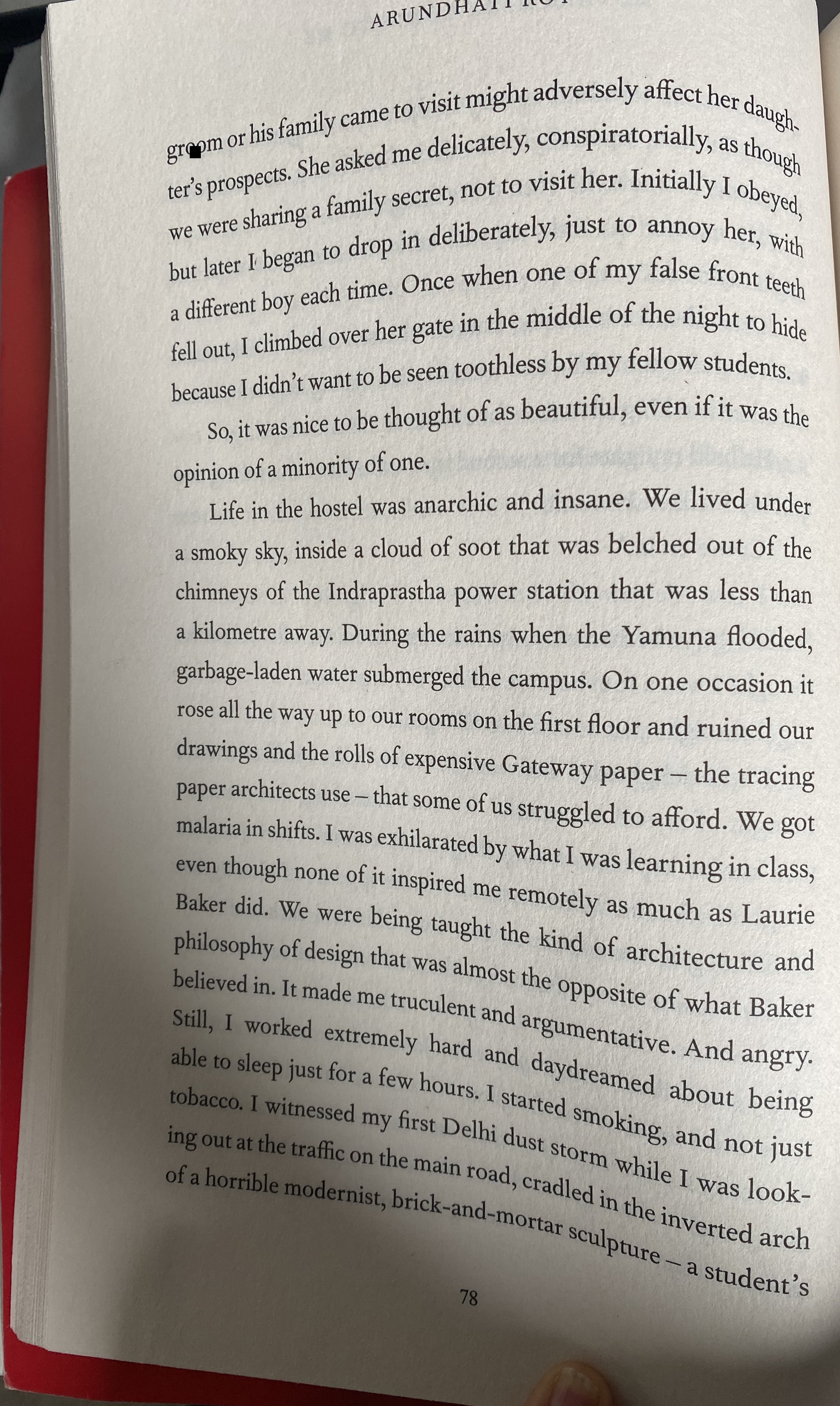
A look at page 78* makes it clear that the book is at least as much about the ‘me’ of the song as it is about ‘Mother Mary’. Young Arundhati is at the Delhi School of Planning and Architecture, free for the first time of Mrs Roy’s overwhelming presence. She has re-encountered the young man she calls JC – her first meeting with him when she was nearly fifteen and he was nineteen had been the first time she understood what sexual desire was: ‘My brain, my heart, my soul – all parked themselves in my groin.’ Back then, she had tried to be invisible. But on page 77, he tells her that he had thought she was a beautiful girl:
I was delighted. I had never, not for half of half a second, thought of myself as beautiful. <snip> I was the opposite of what Syrian Christian girls were meant to be. I was thin and dark and risky.
Such is the power of the writing that one hardly stops to question how the stunningly beauty the young Arundhati Roy that we see in photos could ever have felt that way.
On page 78 – after a paragraph about the Delhi family connection, Mrs Joseph, who disapproves of her – Arundhati is still absorbing that first delight:
So, it was nice to be thought of as beautiful, even if it was the opinion of a minority of one.
The rest of the page evokes grungy student life at the School of Planning and Architecture in new Delhi.
Laurie Baker (Wikipedia page here) is named as standing for the opposite of what was taught at the school. He was a pioneer of sustainable, organic architecture who designed Mrs Roy’s Pallikoodam school. He had inspired Arundhati to veer away from her earliest ambition, to be a writer, and leave home to study architecture. Though Arundhati did go on to be a writer, it was at the School of Planning and Architecture that some of her most important, enduring relationships were formed. As much as anything else the book celebrates these friendships.
After the meeting: Everyone loved this book and we loved discussing it. Someone threw a small grenade, saying that she didn’t see that Mrs Roy was such a terrible parent, that really Arundhati Roy had unfairly demonised her. The catalogue of physical and emotional violence, the fact that Arundhati’s brother shared her view, the way independent witnesses described Mrs Roy as ‘your mad mother’ and laughed at the terror on Arundhati’s face when she had to deal with her: none of this made a dent in her view. We could agree that Arundhati didn’t stay victim – she saw her mother as a model of being powerful in the world, and eventually came to recognise that in her way she loved her, and had given her the wherewithal to build a big life for herself, even if that meant rebelling against her.
We all learned things. For some it was about Indian politics, in particular about Karachi. For all of us, the impact of winning the Booker Prize was a revelation. We all had our ignorance about the Syrian Christians of India slightly decreased (the Roys are Syrian Christians – in Modi’s India, not Indian enough).
We read and discussed the book along with Kiran Desai’s The Loneleiness of Sonia and Sunny. Both books feature complex mother-daughter relationships, both have rich insights into the cultural and political relationships between India and the West, a number of historical events feature in both. But no one was much interested in a compare-and-contrast discussions.
Because it’s November*, I will now burst into rhyme:
November verse 4: Student days
Are student days always anarchic,
smoke-filled, garbage-racked, insane,
angry at the hierarchic
lectures that would tame the brain
with wisdom that's received as certain?
Always the time that lifts the burden
from the backs of those who bear
the yoke of old beliefs? Time where
new songs are sung and new words spoken,
daughters, sons beyond command
(don’t even try to understand),
first loves formed and hearts first broken,
new ways found with fork and knife,
friendships made that last for life?
The group met on the land of Gadigal of the Eora Nation, and I have written this blog post on the land of Gadigal and Wangal. I acknowledge Elders past and present of all those clans, and welcome any First Nations readers.
* My blogging practice is to focus on the page that coincides with my age, currently 78, and in November I write fourteen 14-line stanzas in the month. which means incorporating one into most blog posts.
We decided on this book before checking on availability. All was good for the Kindle readers, but there was a long queue at the library and it was out of stock in Sydney bookshops, pending reprint. Nor did we have any luck at Avid Reader in Brisbane on our travels. In the end, the Emerging Artist bought it for the Kindle app and we read the book to each other.
So that is how I experienced Anything Can Happen: being read to or reading it aloud on beaches, in cafes, under the benign tropical winter sun. I recommend it.
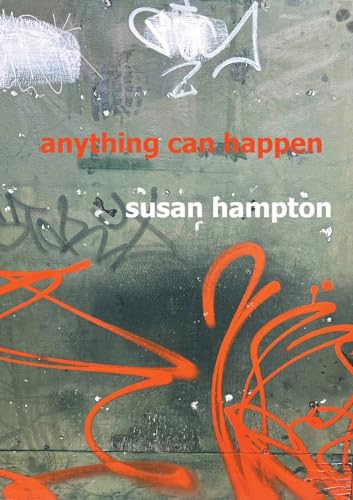
Before the meeting: Susan Hampton is a poet. She has ghost written a celebrated memoir with a First Nations person, and The Kindly Ones, a novel in verse, but this book is the first long prose work of her own making. It’s not an autobiography, but memoir. She makes that distinction in the first pages:
Whereas in autobiography ‘everything’ is told, often in chronological order, the memoir is partial, with the capacity for time loops … The scenes of your childhood, the river, the back lane, the silo, rise up to replace your mother’s arm. That dissolves and you find you’re hearing or in fact making up a conversation.
Anything Can Happen isn’t in chronological order, and it doesn’t attempt to tell everything. It gives us accounts of key relationships: Hampton’s Slovenian husband, Joe, whom she left after a very few years but who was an important part of her life until his death in Slovenia decades later; her mother and grandmother; her son Ben; Tommy, a woman in her thirties on whom she had a crush when she was a teenager and who stayed in her life until Tommy died in her 80s, by then a close friend of the Susan’s mother; a number of romantic and/or toxic entanglements and other friendships with women.
There are glimpses of a working-class childhood in the Hunter region; of life as an academic single mother in the Inner West of Sydney (she and I had children at different schools in the same suburb in the 1980s); of a number of years living in a rural area and becoming a kind of hub for a Lesbian community; of later married life in the beautiful mid-north coast of New South Wales (she married her partner Charlotte in the British embassy in Canberra before same-sex marriage became legal in Australia).
And there’s an impressionistic account of her development as a writer. A main thread of this account is a novel project, which remains on the go for decades and still exists only as a series of unsatisfactory drafts and many books full of notes. One of the many pleasures of this book is the dawning realisation that it is an extended piece of prose from a writer who says she is incapable of writing such a thing.
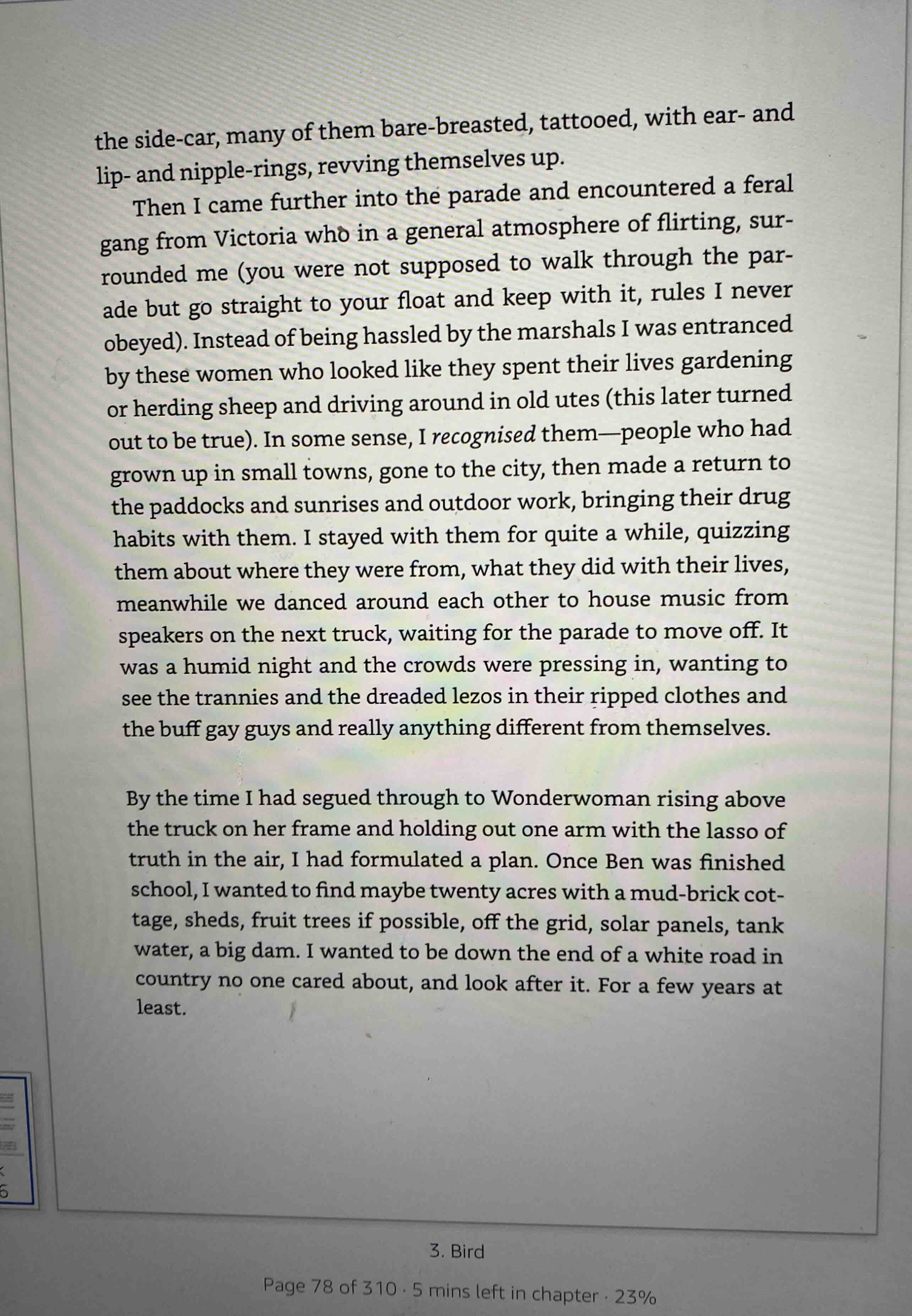
In a memoir of a life that has seen so many wildly different phases, you could open up any page and get a different sense of what kind of book it is. At page 78, Susan joins the Gay and Lesbian Mardi Gras. She walks alone among the Dykes on Bikes. One or two women sat on each bike, and often one of the side-car:
Then I came further into the parade and encountered a feral gang from Victoria who in a general atmosphere of flirting, surrounded me (you were not supposed to walk through the parade but go straight to your float and keep with it, rules I never obeyed). Instead of being hassled by the marshals I was entranced by these women who looked like they spent their lives gardening or herding sheep and driving around in old utes (this later turned out to be true). In some sense, I recognised them – people who had grown up in small towns, gone to the city, then made a return to the paddocks and sunrises and outdoor work, bringing their drug habits with them. I stayed with them for quite a while, quizzing them about where they were from, what they did with their lives, meanwhile we danced around each other to house music from speakers on the next truck, waiting for the parade to move off.
Just a few pages earlier, Hampton has reflected that her autobiographical writing is ‘partially confected, altered, made more symbolic, exaggerated, even invented’ because after all, ‘you wanted the reader to be swept along in the story, to turn the page’. I don’t at all doubt the truthfulness of this paragraph, but it’s also a nice example of detail being selected in order to serve the longer story. The Dykes on Bikes are colourful context, but the ‘feral gang from Victoria’ are there to foreshadow the years in which Hampton was to own a small property in rural Victoria and, even while she did scholarly and poetic work indoors, became one of just such a feral gang. And there’s recurring motif of Hampton ignoring rules – here she disobeys the Mardi Gras rule; elsewhere she climbs fences into private property, snoops in people’s bedrooms, even pilfers personal items. These details may be ‘partially confected’, or they may be part of a ruthless honesty about her own failings – either way they do keep us turning the pages (or swiping the screen).
Then there’s this sentence, easy to miss among all the colour and movement:
It was a humid night and the crowds were pressing in, wanting to see the trannies and the dreaded lezos in their ripped clothes and the buff gay guys and really anything different from themselves.
There’s a gentle challenge to the reader here. The Gay and Lesbian Mardi Gras parade is an event primarily for the LGBTQI+ community (a term Hampton doesn’t use) but it’s also a spectacle enjoyed by the mainstream, possibly voyeuristically she suggests. Could something similar happen with this book? Unlike, say, Kerryn Higgs’s excellent novel All That False Instruction, this book doesn’t set out to ‘explain’ Lesbian experience to mainstream readers. If anything, the author is seeking to understand her own story, of which Lesnianism is a major part but not the whole. But, she suggests indirectly here, some readers may be here for the inside story on ‘the dreaded lezos’ – as at the Mardi Gras, they may not be unwelcome, but they are on the outside pressing in.
By the time I had segued through to Wonderwoman rising above the truck on her frame and holding out one arm with the lasso of truth in the air, I had formulated a plan. Once Ben was finished school, I wanted to find maybe twenty acres with a mud-brick cottage, sheds, fruit trees if possible, off the grid, solar panels, tank water, a big dam. I wanted to be down the end of a white road in country no one cared about, and look after it. For a few years at least.
And that is more or less where the story soon goes.
We read this book along with Debra Oswald’s 100 Years of Betty. Where that book feels as if it grew from a treatment for a TV series, and never quite shook off its origins, this one may well have started out as a collection of prose poems, and has kept some of the compressed, elliptical, elements of that beginning.
After the meeting: We met in a pub, and had a lot of catching up to do. Two of the five of us had met Susan Hampton, one just briefly, and one for some time when they both lived in Canberra (where in the book she says she made a number of good friends). So our book conversation was a little more gossipy than usual – though not at all nasty or juicy. I had hoped someone would know the identities of the women known as the Gardener and the Radiographer with whom Hampton had an unsettling relationship, but that wasn’t to be.
We all enjoyed the book, partly because so many of its places were familiar to at least some of us, and it was pleasurable to have them described from a different point of view. One person felt that there was an almost sociological tone to the chapters about Hampton’s family background, and that seemed to spread in some way to a kind of distance or detachment in the telling as a whole. (I don’t know what I think about that.It didn’t strike me that way, but I don’t think it’s wrong.) We noted that there are gaps in the story, but realise they may have been necessary to protect other people’s privacy.
One of the many rules of the Book Club has been ‘No Lesbian novels unless the Lesbianism is incidental to the plot.’ The club’s membership is majority Lesbian, and the rule was there because (I’m told) novels about Lesbianism tend to be badly written. With The Safekeep and Anything Can Happen, the prohibition has gone the way of Mardi Gras rules on page 78.
We read Anything Can Happen to each other on Wulgurukaba land, beneath an intense blue sky on the island of Yunbenun. The Book Club met on Gadigal Wangal country, which is where I have written the blog post. I acknowledge the Elders past and present of those Nations, and welcome any First Nations readers of this blog.
* My blogging practice is to focus on the page that coincides with my age, currently 78.
Alphonse Duchesne, who ran a small cafe/grocery in Normandy with his wife, died in 1967, two months after his daughter Annie Ernaux qualified as a school teacher, marking a transition in the family’s class status. On the train journey home from the funeral, Ernaux writes:
I tried to keep my son entertained so that he would behave himself. People travelling first-class have no time for noise and restless children. I suddenly realised with astonishment, ‘Now I really am bourgeois,’ and ‘It’s too late.’ (Page 18)
Later that summer, she thought to herself, ‘One day I shall have to explain all this,’ meaning she needed to write about her father and the distance that had come between them during her adolescence: ‘Although it had something to do with class, it was different, indefinable. Like fractured love.’
This short book – just 64 pages – is a rigorous, spare and unsparing, attempt to rise to that need. In 1982, having already written three novels, Ernaux set out to write a fourth one, about her father. But, she writes:
I realise now that a novel is out of the question. In order to tell the story of a life governed by necessity, I have no right to adopt an artistic approach, or attempt to produce something ‘moving’ or ‘gripping’. I shall collate my father’s words, tastes and mannerisms, the main events of his life, all the external evidence of his existence, an existence which I too shared.
The book tells two stories: the life story of Ernaux’s father and – always in the present tense as if allowing us to look over her shoulder as she types – the self-reflexive story of the writing of the book.
The father was from a peasant background. His own father was illiterate, and he worked first as a farm hand, then as a factory worker and finally, along with his wife, ran the small grocery shop and café. He bickered with his wife, spoke a rustic version of French, never set foot in a museum, voted for reactionary politicians ‘for a lark, but without conviction’, was intensely proud of his daughter’s success in moving into the middle class but didn’t make any part of the transition with her.
Every now and then, Ernaux steps directly into the frame to say how long she has now been writing, explain that it is a slow process because she is avoiding her own emotional memories in order to focus on her father’s story. It’s not that she doesn’t draw on memory – as for example when she describes a photo of her father taken at her wedding reception, and recalls her sense of him at the moment it was taken, ‘certain that he wasn’t enjoying himself’. And through it all, told in flat unemotive language, the terrible undertow of the daughter moving away into a different world:
One day he said, ‘Books and music are all right for you. I don’t need them to live.’
This was the first of Annie Ernaux’s ‘autobiosociological’ books. It’s the fourth I’ve read, and with each one I become more grateful to the Nobel committee for drawing her to my attention. The others (with links to my blog posts) are:
After the meeting: I was a little apprehensive about this meeting, as I had picked the book. The job was sprung on me at the last meeting, it had to be a short book, and this was on my TBR list, so I named it on the spot without due consideration.
It turned out that, quite apart from the big plus of brevity, the book was generally much liked, and we had a discussion that made me glad all over again to be in the book group. At times the discussion was personal: one man honed in on the early part of the narrative when the family’s life was disrupted terribly by the bombing of Normandy in World War Two (a part of the narrative that had passed me by); a number of us drew parallels with the trajectories of our own lives – as the first generation in our families to go to university; and the conversation wandered, seemingly off-topic, to our relationships to our parents, and various ways in which the stories of different parents had been discovered and even published.
We had a wonderful difference of opinion. One man, call him K–, himself a recently retired small businessman, said that Annie Ernaux had completely failed to get that her father, as a small businessman, had made a life for himself that he was completely happy with: when Ernaux portrays him as ashamed of his lack of ‘culture’, that is complete projection. I must be just a little bit in love with Annie Ernaux because my defensive hackles went up, and I disagreed that the father was portrayed as anything other than happy with his life!
The back cover blurb of the Ftzcarraldo edition says that ‘Ernaux reveals the shame that haunted him throughout his life’. So K– isn’t alone in reading the book that way. I still disagree. But I’ve been reflecting for days, and while I still think K– was wrong, I believe he put his finger on something at the heart of the book.
There’s no doubt that Annie the character believed that she had a better life than her parents, that they were proud she had made the transition, that a gulf of mutual incomprehension developed between the generations. The father certainly feels shame in some social situations – not understanding what a school teacher means by ‘town clothes’, not being able to spell when filling out a form. It’s explicit that the people of the daughter’s world look on people like her father with scorn. But I don’t read Ernaux or her father as sharing their judgement. She lays out the detail of his world, and is pretty clear about her own ‘bourgeois’ perspective. When she mentions in passing that he votes for a reactionary politician ‘for a lark’, it’s clear that she disapproves, but her disapproval isn’t the point.
K– went hunting for passages to support his reading. His case doesn’t stand or fall by one tiny sample, but what he came up with was this, from when the 20-something Annie is visiting her parents:
As soon as I plugged in the bedside lamp, the wire blackened, sparks flew and the bulb went out. The lamp was in the shape of a ball resting on a marble base, with a brass rabbit standing upright, its front paws sicking out at its sides. I had once thought it very beautiful. It must have been broken for ages. Indifferent to things, they never got anything mended at home.
K– read the tone of that last sentence as something close to contempt: ‘These people are barely human, they care so little for their environment.’ I read it as more two-edged: ‘As the kind of person who travels first-class, I expect my things to function well and to meet certain aesthetic standards. My parents have different priorities, a much greater tolerance for imperfection.’
I’m going to reread the book.
The Book Group met on the land of Gadigal of the Eora nation. I wrote this blog post on Wangal and Gadigal land. I gratefully acknowledge the many generations of Elders past and present who have cared for this beautiful country.
Annie Ernaux, Une femme (Editions Gallimard 1987) —–, A Woman’s Story (translated by Tanya Leslie 1991, Fitzcarraldo Editions 2024)
Before the meeting: The press release announcing that Annie Ernaux had won the Nobel Prize in Literature spoke of:
the courage and clinical acuity with which she uncovers the roots, estrangements and collective restraints of personal memory.
Every word of that is well chosen. Ernaux revisits her own life story in every book, pitting her ‘personal memory’ against what she finds in old photographs and diary entries, constantly questioning and challenging herself. She makes most other autobiographies / memoirs seem at least a little glib and self-serving.
I read Une femme / A Woman’s Story in both French and English. I could do this because it’s a short book – 60 pages in English, 95 in French. Apart from an opportunity to flex my rusty French, I was motivated by the way the English title departs from the original. Une femme is literally ‘A woman’. Calling it A Woman’s Story is a tiny change, but it significantly shifts the meaning. I wondered if similar shifts happened in the body of the book. (I think they do, and I apologise in advance for the way this blog post gets bogged down in the details of translation – fascinating to me, but maybe not to you!)
A Woman’s Story / Une femme does tell the story of a woman: Ernaux’s mother. But actually there are three stories. There’s Ernaux’s reconstruction of her mother’s life: her youth, her time as a shopkeeper in an impoverished part of France, her marriage, her ageing, and at last her dementia and death. There’s the story of Ernaux’s relationship with her, including the times that she lived with her and her family, and at the very end a brilliantly concise statement of what, after the initial intense grief, her mother’s death meant for her. And there’s the story of writing the book, begun in April 1986, very soon after her mother’s death, and finished in February the following year. This is a book in which une femme writes about une femme, and either could lay claim to the book’s French title.
I love this book. It reaches tendrils into parts of my own life that could do with a bit of ‘courage and clinical acuity’. I find Ernaux’s sheer dogged determination to find truthful words completely engrossing. In one of several moments when she steps in to tell us about the process of writing, she says:
When I speak of her, my first impulse is to ‘freeze’ her in a series of images unrelated to time – ‘she had a violent temper’, ‘she was intense in everything she did’ – and to recall random scenes in which she was present. This brings back only the fantasy woman, the one who has recently appeared in my dreams, alive once more, drifting ageless through a tense world reminiscent of psychological thrillers. I would also like to capture the real woman, the one who existed independently from me, born on the outskirts of a small Normandy town, and who died in the geriatric ward of a hospital in the suburbs of Paris. The more objective aspect of my writing will probably involve a cross between family history and sociology, reality and fiction [la jointure du familial et du social, du mythe et de l’histoire] … I would like to remain a cut below literature.
(Page 17)
That is to say, don’t look for fine writing here. Look for a serious attempt to see the reality of this woman’s life and how it was interwoven with Ernaux’s own.
My practice of looking at page 77 is a good way of giving you a flavour of the book, and of some of the issues that must have faced Tanya Leslie, the translator.
On page 77 of the French edition, page 51 of the English, it’s the early 1970s. Ernaux’s mother, now a widow, has sold her business and abandoned her life as a shopkeeper. She has moved to Annecy at the other end of France to live with Ernaux and her young family. She isn’t thrilled with her new life: she is no longer a significant part of a community. Her life has shrunk. ‘Now she felt she was a nobody’ / ‘Elle ne se sentait plus rien.’ She was proud of the life Annie had made for herself, but felt uneasy with the middle-class life that now surrounded her.
I ought to say that after my partner’s father died, her widowed mother became a much bigger presence in our lives, after a time spending a couple of nights a week living with us and then moving in full time. We didn’t have the class difference that Ernaux describes, but this page resonates powerfully, and I am in awe of the way the writing reaches for a deeply respectful understanding of the mother’s point of view:
Living with us was like living in a world that welcomed her and rejected her at the same time. One day she said angrily, ‘I don’t think I belong here.’
The transition from the generalised to the particular in those two sentences is typical Ernaux. In the French, it’s slightly different:
C’était vivre à l’intérieur d’un monde qui l’accueillait d’un côté et l’excluait d’un autre. Un jour, avec colère: « Je ne fais pas bien dans le tableau. »
There are three departures from a literal, word for word translation. First, there is no ‘us’: it’s all about the mother. Second, the English has tidied up the second sentence and given it a verb – ‘she said’ – which is not there in the French. There’s a lot of that in the book. The French text sometimes reads like quick notes: no need to spell out who was speaking etc. The English tidies it up, with the effect that what in French feels rough and raw becomes in English a more polished, considered text. And third, what the mother says has been softened: the tentativeness of ‘I don’t think’ is an insertion, where the French just has an angry statement of fact: ‘I don’t belong here.’
The rest of the page, in English:
And so she wouldn’t answer the phone when it rang next to her. If her son-in-law was watching football on television, she would make a point of knocking on the door before entering the living room. She was always asking for work – ‘Well, if there’s nothing to do, I might as well leave then’ – adding with a touch of irony, ‘After all, I’ve got to earn my keep!’ The two of us would argue about her attitude and I blamed her for deliberately humiliating herself. It took me a long time to realise that the feeling of unease my mother experienced in my own house was no different from what I had felt as a teenager when I was introduced to people ‘a cut above us’. (As if only the ‘lower classes’ suffered from inequalities which others choose to ignore.) I also realised that the cultural supremacy my husband and I enjoyed – reading Le Monde, listening to Bach – was distorted by my mother into a form of economic supremacy, based on the exploitation of labour: putting herself in the position of an employee was her way of rebelling.
And in French:
Donc elle ne répondait pas au téléphone quand il sonnait près d’elle, frappait d’une manière ostensible avant de pénétrer dans le salon où son gendre regardait un match à la télé, réclamait sans cesse du travail, « si on ne me donne rien à faire, je n’ai plus qu’a m’en aller» et, en riant à moitié, « il faut bien que je paye ma place!». Nous avions des scènes toutes les deux à propos de cette attitude, je lui reprochais de s’humilier exprès. J’ai mis longtemps à comprendre que ma mère ressentait dans ma propre maison le malaise qui avait été le mien, adolescente, dans les « milieux mieux que nous » (comme s’il n’était donné qu’aux « inférieurs » de souffrir de différences que les autres estiment sans importance). Et qu’en feignant de se considérer comme une employée, elle transformait instinctivement la domination cultureIle, réelle, de ses enfants lisant Le Monde ou écoutant Bach, en une domination économique, imaginaire, de patron à ouvrier: une façon de révolter.
You can see what the translator had to wrestle with. She breaks two long sentences into shorter ones. I can’t tell if this is her way of making the text more elegant, or if it’s a difference in the way the languages work. And domination must have given her nightmares: ‘supremacy’ isn’t a dictionary equivalent, but it’s surely eccentric to describe reading Le Monde as an act of domination. Yet maybe that eccentricity is exactly what Ernaux intended – certainly ‘economic supremacy’ makes less sense than ‘economic domination’.
This is one place where I was happy I had read the French as well as the English. I didn’t understand the bit in brackets about the ‘lower classes’ until I read the French, where, rather than the ‘others’ choosing to ignore inequalities, they consider some différences to be unimportant (and yes, différences translates as ‘differences’, no inequality necessarily implied). Le Monde is just a newspaper to Ernaux and her husband, and Bach is pleasant to listen to. For the mother, they are markers of cultural superiority. A smaller oddity of the translation is that whereas the French insists that the ‘cultural supremacy’ / domination culturelle is real (réelle) and that the ‘economic supremacy’ / domination économique is imaginary (imaginaire), the English lets the word ‘distorted’ carry that distinction. On top of that, leaving out the word instinctivement, it seems to me, makes the mother seem much more calculating, and perhaps makes Ernaux less patronising. I don’t think Ernaux wants to blame her mother, or spare herself, in this way.
After I’d written that last sentence I noticed a moment in the previous paragraph that struck a chord with me. One of the things Ernaux’s mother has to do to conform to the household’s lifestyle is, in English:
‘observing personal hygiene’ (blowing the boys’ noses on a clean handkerchief).
That’s unremarkable, just one more detail in the list of things she has to adapt to. The original French is:
avoir de l’« hygiène » (ne pas moucher les enfants avec son propre mouchoir).
A literal translation of the phrase in brackets is, ‘not to blow the children’s noses with her own handkerchief’. They say a translation can never be complete, but still I allow myself to mourn the loss of this tiny, graphic image of grandparent–grandchild intimacy forgone in the name of upward mobility, and lost to the English text for who knows what reason: perhaps handkerchiefs themselves are so repugnant to modern Anglo sensibilities that sharing them is unspeakable.
After the meeting: In the Book Club, we traditionally discuss two books. This book was paired with Abdulrazak Gurnah’s Paradise (linkto come added later). I think the reason for the pairing was that they’re both by Nobel laureates. At the start of our discussion, an astute person pointed out that they both feature shops (the mother’s shop in Ernaux’s book, and two different shops where Gurnah’s protagonist worked). That’s about where the similarities began and ended. Our evening – or at least that part of it not taken up with excellent food and even more excellent conversation about life, physical afflictions, travel plans and so on – was split neatly into two parts.
As you’d expect, my having read the book in both languages was met with eye rolls, but there was general recognition that the difference was substantial between blowing a child’s nose on a clean handkerchief and not blowing it on one’s own handkerchief.
We had a very interesting discussion of a passage where Ernaux describes her aim as to set aside her own emotional memories about her mother (how she felt when she was angry etc) and tell the story from her mother’s point of view, but says that she finds those emotions breaking through anyway. I think we agreed that this, far from being a failure, is one of the things that makes the book so rich.
One person out of the five of us didn’t care for the book. Reading it, she couldn’t see any reason why Annie Ernaux would have been given the Nobel. Those of us who had read a number of her books tried to articulate our reasons for holding her in high esteem, but maybe it’s a matter of taste. What I/we saw as minimalism, for example, she saw as sketchiness.
One person spoke of the way the book had inspired her to try to write about her own childhood, focusing on specifics rather than a broad narrative. The exercise had led to interesting insights into her early life. We had a brief but interesting conversation about how for ‘our generation’ in Australia (we range from a couple of weeks short of 70 to a couple of years beyond 80), as for Annie Ernaux, there was a shift in class – ‘upward mobility’ – that hadn’t been so widespread in previous generations. This shift was due in part to increased access to education – so we did the Australian equivalent of listening to Bach and reading Le Monde.
It might seem that that conversation was of the same order as travel plans and medical reports, but I think it’s a quality of Ernaux’s books – not just this one – that they prompt readers to reflect on their own lives.
Before the meeting: Richard Flanagan is a giant of Australian literature. His non-fiction work has been transformative. He has won the Booker Prize and many other awards.
Before this year, I had read one and a half of his novels and had no desire to read any more. My blog posts on The Unknown Terrorist and Wanting speak for themselves.
So, bidden by the Book Group, I came to Question 7 bristling with prejudice.
I was not encouraged by this passage on the second page:
Sometimes I wonder why we keep returning to beginnings – why we seek the single thread we might pull to unravel the tapestry we call our life in the hope that behind it we will find the truth of why. But there is no truth. There is only why. And when we look closer we see that behind that why is just another tapestry. And behind it another, and another, until we arrive at oblivion.
Oh really? Other opinions are available, but this struck me as the kind of thing Les Murray meant when he described another of Richard Flanagan’s books as ‘superficial, showy and pretentious’ (link here)?
But what the Book Group wants, the Book Group gets … I read on.
I found a lot to dislike. The whole Question 7 schtick struck me as ‘superficial, showy and pretentious’ (more about that later). There are a couple of pages that could have been written by a self-righteous teenager, denouncing Oxford holus bolus as misogynist, racist and imperialist; a sneer often hovers at the edge of Flanagan’s descriptions of other writers; there’s a muddled insistence that all time is now – a kind of mix-up of Kurt Vonnegut in The Sirens of Titan and co-opted Indigenous notions. Regularly, out of the blue, there will be a bit of ‘philosophising’ about the uselessness of words, or a portentous one-line paragraph: Chekhov’s non-sequitur, ‘Who loves longest?’ or the sub-Vonnegut refrain, ‘That’s life.’
It could have been an engrossing book. There are powerful portraits of his grandmother, his mother and his father, and a gruelling, operatic account of near-death as a young adult. Above all, there’s the way Flanagan sets out to explore his own origins in the context of world history.
His father was a prisoner of the Japanese in 1945 and would have died in the camp if not for the nuclear bombs dropped on Hiroshima and Nagasaki – Flanagan owes his existence to that massively destructive act.
The book comes at that painful paradox from a number of angles: his father’s reminiscences of the camp; his own visit to its site, including an encounter with a former guard; stories about H. G. Wells, who coined the phrase ‘atom bomb’; the life of Leo Szilard, the scientist who first conceived of a chain reaction and after 1945 became a tireless campaigner for nuclear disarmament. It’s a fascinating tapestry of interlacing lives, thoughts and actions.
Flanagan is a Tasmanian, so he also owes his existence to the genocidal dispossession of the First Nations of luwitja. (In one of the recurrences that the book delights in, H. G. Wells’s novel The War of the Worlds was inspired that history.) There are powerful passages about colonisation, which (to my mind) he undermines by describing the term settler colonial society as lazy thinking because it hides the inequalities on which what he calls ‘the new Martian world’ was built. His point is that many of the first non-Indigenous arrivals were convicts, suffering terribly under the British system – and among them he counts his forebears. IMHO, settler colonial society is a fine term: patriarchy doesn’t hide inequalities among men; capitalist society doesn’t hide inequalities in our current world. The fact that you suffer doesn’t change the fact that you play an oppressive role. Not that Flanagan denies that, but he want to make it clear that his people were primarily victims rather than perpetrators.
But I’m getting irritated again.
Page 77* does not show the book in its best light. It falls in the midst of an excursion into historical fiction involving H. G. Wells.
The much younger Rebecca West has come into Wells’s life, and they are mutually entranced. After a first passionate kiss, he withdraws – not so much because he already has a wife and a mistress as because, according to Flanagan, she is too much his equal.
All that is evidently true to the known facts. West and Wells’s relationship was to endure. She had a son with him and they remained friends until his death. But at page 77 that’s all in the future, and she is struggling with his rejection of her:
Rebecca West, though, was not for defeat. For her, love and victory were synonyms. And she was not one for losing. She coupled audacity and ambition with an idea of stability she would forever after mistake older men as offering. She held herself to a high standard. She had written only a few months earlier how unrequited love was pathetic and undignified, adding as proof her contention that Christianity lacked dignity – and by implication was pathetic – not because Christ was crucified, but because his love for the world was unrequited. ‘A passion that fails to inspire passion,’ she wrote, ‘is defeated in the main object of its being.’
Having dispensed with God, she wrote to Wells that she was going to kill herself after being rejected by him, that all she could do was love. She had tried to hack the overwhelming love she felt for him back to the little thing he seemed to want. But even that, she realised, was too much for him.
Does that feel to you like a real person? Is it respectful of the historical Rebecca West? Does it use its sources fairly or even accurately? On the latter point, I looked up the essay it quotes (in The Freewoman, July 2012). It’s a brilliantly witty takedown of a book of literary history, in which the reference to Christ is cheeky, but not dismissive and not meant to prove anything. Flanagan is being snide, and not pretending otherwise. His Rebecca West is basically a comic character.
But what is she doing in this book at all? Maybe she’s there to establish that Wells was a truly complex, flawed human being (‘flawed’, to be specific, means physically ugly and using high-sounding ideals of free love to justify his promiscuity). It also serves the purpose of having a strong female presence in the historical part of the novel, which is otherwise full of men. This particular passage may owe something to her reference to Jesus echoing a repeated line in Flanagan’s The Unknown Terrorist: ‘the innocent heart of Jesus could never have enough of human love.’
The West–Wells story also, confusingly I think, seems to relate to the book’s title. That title is a riff on an early Chekhov short story, ‘Questions Posed by a Mad Mathematician’, an absurd parody of a mathematics quiz. The seventh quiz item starts with trains leaving stations at various times and ends with the non-sequitur question, ‘Who loves longer, a man or a woman?’ Because it’s posed as a question about gender, the Wells–West story (the only romance in the book) seems to hark back to it, but I think now probably not, as the version of the question that pops like a refrain, is simply, ‘Who loves longer?’ (Incidentally, the only version of Chekhov’s story I could find online, at this link, translates the question as, ‘Who is capable of loving?’ I’d be interested to know if the gendered version of the question is more a product of the gendered nature of the Russian language than of Chekhov’s intention.)
In the rest of the page, we follow the West-resistant Wells to Switzerland:
Wells arrived at his mistress’s magnificent Swiss retreat with his two sons and half a suitcase of scientific reprints concerning the recent discoveries about radium – discoveries that, he told Little e, as he called the diminutive Elizabeth, pleasantly took his mind as far away as laudanum once had Samuel Taylor Coleridge’s and which would form the basis of the novel he would write – the story of man summoning a power equivalent to the sun.
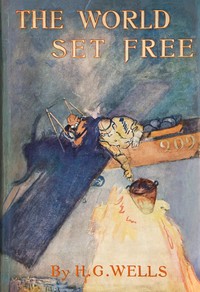
Wells runs from West to write the novel that is his reason for being in this book. It’s The World Set Free, in which he will coin the term ‘atom bomb’ and imagine with amazing accuracy the devastation such a bomb was to create. (I’m depending on Flanagan’s description. The novel is available at Project Gutenberg for the truly dedicated.)
Presumably the real-life Wells is being cited here, but what sense does it make to say that his lifelong interest in science was like a drug? In the immediate context, the implication seems to be that his interest in radioactivity is a distraction from the emotional turmoil associated with with Rebecca West. Am I wrong to read this as a sneer?
So, I look forward to having the virtues of the book made clear to me by people who have not been blinded by their own grumpiness.
After the meeting: After a wonderfully eclectic dinner over which we had exchanged important information about dumplings and life in general, we had one of the most interesting and spirited Book Group discussions ever.
Evidently it’s a love-it-or-hate-it book, and we were fairly evenly divided.
One man had hated the Wells-West thread so much that he re-read the book leaving it out, only to discover that he still hated the book, and spent days trying to figure out why. As I understand it, he realised that he regularly came up against a closing off of possibilities – just as Flanagan proclaimed he was opening up to complexity he would shut things down with a piece of certainty.
Another, on the contrary, read the book as an anti-narrative. Those shutting-down moments were a way of frustrating our quest for simple answers in an impossibly complex world. It’s important that Question 7 is about love, because all through the book there’s a dreadful intertwining of love and brutality.
Where some felt Flanagan was arrogant and withheld, others read him as exposing his own vulnerability. One loved the Rebecca West story; another loathed it. One read out a passage he particularly loved eliciting sympathetic nods from some and groans from others. Some felt that the book spoke directly to their own experience as colonial settlers, others not so much. I had to admit that I had got fixated on the things that annoyed me, and disregarded things that otherwise would have fed my soul.
None of us had previously heard of Leo Szilard. One of us said he now has Family Matters, by Flanagan’s brother Martin, on his to-be-read list, as a supplement to Richard’s account of his parents.
It was amazing! I don’t think anyone left feeling bruised. For myself, I intend to reread the book. But not for a while.
* My blogging practice for some time has been to focus arbitrarily on the page of a book that coincides with my age. Surprisingly, this page often reveals interesting things about the book as a whole.
My family still give each other far too many presents at Christmas, but I’m not complaining. Among the many thoughtful gifts I received recently were these two tiny books by Annie Ernaux. The first is the story of a sexual relationship the writer had with a much younger man when she was in her mid 50s; the second is the text of her Nobel Lecture, delivered in Stockholm in December 2022. Each of them includes about 20 pages of supplementary material, with a lot of overlap between the books: photographs, a ten-page self-written biography, praise for Ernaux’s other books. They’re clearly designed to catch impulse buyers at the till, but they are written by the incomparable Annie Ernaux and I love them.
Neither book has a page 76, or even a page 47, so my usual arbitrary blogging practice is stymied.
If I don’t write things down, they haven’t been carried through to completion, they have only been lived.
Which captures perfectly the nature of this book. It serves to complete a strangely inconclusive episode in the writer’s life.
Dates at the end of the text indicate that it was written over a span of time, from 1998 to 2000, perhaps immediately after the relationship ended, and then prepared for publication – rewritten? – in 2022. It shows the signs of both dates. There’s the freshness of description of, say, sleeping together in his cold student flat, or of feeling the gaze of other people when they lie on the beach together, a gaze that neither of them would have attracted solo. And then there are reflections that have had time to mature:
In more than one domain – literature, theatre, bourgeois customs – I was his initiator, but the things I experienced because of him were also initiatory. My main reason for wanting our story to continue was that, in a sense, it was already over and I was a fictional character within it.
(page 28)
After that last comment, she continues: ‘I was aware that this entailed a kind of cruelty towards this younger man who was doing things for the first time.’
There are at least two high-profile fictional works around at the moment in which an older woman has a sexual ‘affair’ with a boy, Ian McEwan’s novel The Lessons and Todd Haynes’s movie May December. This is not that. This unnamed young man was in his twenties, and Annie Ernaux was not his teacher. There is no question of criminality, but some of the same ethical issues arise. She was an admired cultural figure to whom he could barely speak when they first met in person. She does not spare herself in the writing, but nor does she rush to judgement. As that tiny excerpt illustrates, class is always an issue, and there is a constant sense of the feedback loop between her life and her art.
The copious photos that the publishers have included to make up a decent number of pages attest to the fact that she was, and is, gorgeous. The young man didn’t love her just to learn bourgeois customs.
The title of Ernaux’s Nobel lecture comes from something she wrote in her diary in her early 20s: ‘J’écrirai pour venger ma race.‘ She expands on this sentence in the lecture:
I proudly and naively believed that writing books, becoming a writer, as the last in a line of landless labourers, factory workers and shopkeepers, people despised for their manners, their accent, their lack of education, would be enough to redress the social injustice linked to social class at birth.
(page 12)
The lecture traces the way she moved away from this goal, until she was brought back to it ‘through byroads that were unseen and proximate’. And it explains beautifully her central preoccupation with telling intimate stories from her own life (The Young Man among them):
This is how I conceived my commitment to writing, which does not consist of writing ‘for’ a category of readers, but in writing ‘from’ my experience as a woman and an immigrant of the interior; and from my longer and longer memory of the years I have lived, and from the present, an endless provider of the images and words of others. This commitment through which I pledge myself in writing is supported by the belief, which has become a certainty, that a book can contribute to change in private life, help to shatter the loneliness of experiences endured and repressed, and enable beings to reimagine themselves. When the unspeakable is brought to light, it is political.
(pages 19-20)
(Alison L Strayer has rendered both this lecture and The Young Man into impeccable English. I do wonder, though, whether ‘internal migrant’ might have been better than ‘immigrant of the interior’. I haven’t read the original, but I believe Ernaux is referring to her ‘migration’ from rural working class to the lettered bourgeoisie as opposed to migration between countries.)
There’s a lot more. If you see this little book on the front counter as you’re leaving a bookshop, let yourself be tempted.
Before the meeting:We Come With This Place won an amazing four prizes at the NSW Premier’s Literary Awards this year, including Book of the Year: you can read the judges’ comments here and here. They include this:
This sensational memoir is an unheralded reflection on what it is to be First Nations in Australia, and on the very deepest meanings of family and belonging.
In one of her modest acceptance speeches at the awards ceremony, Debra Dank mentioned that the book started out as part of her PhD study. In the Preface, she elaborates:
I wanted to show how story works in my community and how it has contributed to our living with country for so long. It seemed to me imperative to talk about those voices, both human and non-human, who guided Gudanji for centuries before anyone else stepped onto this land.
(page viii)
The weeks after the referendum on the Voice failed seemed a perfect time to read this book. The Uluṟu Statement from the Heart’s call for Voice, Truth, Treaty has been rejected at the political level: it’s a relief to listen to the voices of First Nations writers like Debra Dank, and participate in this form of truth-telling.
It’s a terrific book: an intimate portrait of family life, placed in the context of ancestral stories, a deep sense of connection to Country, and resilience in the face of the horrors of colonialism. The family lived ‘under the Act’ in Queensland, and managed ingeniously to hide little Debra when the Welfare came looking for light-skinned children; her father worked on a number of rural properties, where sometimes he was treated with great respect, other times not so much. She helps her father work on a windmill. There is a tactfully written scene where she stands up against family violence, and magical moments with her grandfather, and with her children and grandchildren. I love the pages where Dank’s white surfie husband (he’s saltwater, she’s dust) struggles to learn how to read the bush, to see the things that are glaringly obvious to his Aboriginal children.
Dank identifies as belonging to dry country, and she makes brilliant use of images of dust. On the very first page, ‘vague images try to speak to [her] through dust motes rising from the thick pale pages’ of a 400-year-old edition of a book by Aristotle, and a few pages later, she tells us that the stories of her people – the Gudanji kujiga – ‘grow from the fine dirt that plays around your feet and makes the dust that rolls over the the vast Gudanji and Wakaja country’. As a child she is fascinated by the way a drop of blood from a foot caught on barbed wire blends into the soil. Dust rises from the heels of a family group in the not so distant past running in terror from armed men on horseback. It memorably obliterates the Country-scarring road in the passage I versified the other day (here).
I don’t want to give the impression that the book is written in high metaphorical mode. Here’s a little passage from page 76 (for those who came in late, I like to have a closer look at that page because it’s my age). The family are driving from one place of employment to another, and appropriately enough the page starts with dust:
The wind brought dust in with it, but it was the Dry and the road wasn’t too bad. The caravan happily kicked up dust into frothing red feathers that followed us for a bit, then settled back onto the road. Long stalks of tall yellow grass formed a guard of honour as we traveled across the plains. We played games of spot the turkey and several times tried desperately to convince Dad to stop for the goannas that would run across the road and then lie still and flat in the shelter of the yellow grass and amber shadows, but we needed to get there so he didn’t stop. Besides, Mum said she refused to turn up at the new station with a dead gonna in the car.
You see what I mean: if you’re not alert to the dust motif, those frothing red feathers that follow and settle are a nice piece of decoration; if you’ve picked up on it, they’re a reassuring presence of Country. And this tiny moment embodies the way the family manages to live successfully in two worlds: goannas would be great, but not when you’re about to meet a new white boss.
After the meeting: It was our end-of-year meeting, so as well as discussing the book, we exchanged gifts – of books chosen from our bookshelves. I gave Diana Athill’s wonderful memoir, Somewhere Towards the End, and scored J M Coetzee’s 1986 novel, Foe. We also, in a three-year tradition, each brought a poem to read to the group: poems represented included Seamus Heaney, Oodgeroo Noonuccal writing as Kath Walker, Adrian Wiggins, J Drew Lanham, Rosda Hayes, and Sean Hughes.
There were seven of us. Two hadn’t read the book – it’s a busy time of year. One was ‘at about 55 percent’ on his device. One said he had read seven other books since so had difficulty recalling it with any clarity. We were in a pub rather than our usual domestic setting. None of that stopped the conversation from delving into the book, ranging widely and then finding its way back to the page. Those of us who had read it celebrated the way it presented the history from inside an First Nations point of view: even Kim Scott’s brilliant novel That Deadman Dance didn’t get to the inside story as completely as this; and it has a calm assurance that, say, Julie Janson’s Benevolence lacks, for all its other strengths (the second of these comparison came up in conversation in the car ride home).
One Covid-ed absentee emailed in some cogent comments – noting that there seemed to be a number of voices, and that the passages dealing with the author’s personal experience worked better than the narration of ancient stories. He loved, and others agreed, the bits of bushcraft such as reading shadows and catching fish with your hands in the desert, the cultural landscape connections.
I went on a bit about dust.
There was a lot of reflection on personal experiences the book reminded people of. There was also, as usual, much excellent conversation about unrelated matters, including Anna Funder’s Wifedom; the recent blockade in Newcastle and a similar one nearly 20 years ago which provoked a very different response from the police and the press; philosophy and poetry groups in a small town; behind the scenes stories from a fascinating film project; travellers’ tales.
Before the meeting: In January this year as part of a series of belated obituaries, The New York Times published an article on Tove Ditlevsen, 47 years after her death. You can read the whole thing at this link (you might have to sign up for a free account to get access).
The short version: Tove Ditlevsen (1917–1976) was one of Denmark’s most popular authors. Her published works included 11 books of poetry, seven novels and four story collections, as well as the three short memoirs, Childhood (Barndom in Danish), Youth (Ungdom) and Dependency (Gift) that have been collected here as The Copenhagen Trilogy. She didn’t enjoy critical success during her lifetime and was virtually unknown outside Denmark. None of her books of poetry were translated into English. Then in 2016 translator Michael Favala Goldman picked up a copy of Gift in an airport, considered it to be a masterpiece, and set the snowball in motion for a critical discovery in the English-speaking world and elsewhere.
I was prompted to go looking for that background by something about the book itself. Perhaps because I’ve recently read two brilliant memoirs by Annie Ernaux (blog posts here and here), not to mention Proust’s vast À la recherche du temps perdu, I felt that the first book (Barndom/Childhood) and much of the second (Ungdom/Youth) were too neat, too confident in their detail to be trusted as memoir.
The first book begins with Ditlevsen as a small child trying unsuccessfully to avoid triggering her mother’s anger, and observing the life of their apartment block. ‘Childhood is long and narrow like a coffin, and you can’t get out of it on your own.’ She goes to school, and has an ambivalent relationship with the cool girls who gather at ‘the trash-can corner’. She thinks of herself as unattractive and no one contradicts her. She is hospitalised with diphtheria. She reads a lot and writes poetry that she keeps in a secret album.
In Youth, still living at home, she has a series of terrible jobs, is befriended by the worldly Nina, and enters the world of boys and kissing goodnight at the door. She continues to write and, encouraged by her older brother and Nina, dares to show her poems to a literary gent who offers qualified encouragement of her writing and allows her to borrow from his well stocked bookshelves, then disappears without explanation. Another older man becomes a mentor and publishes one of her poems in his literary journal. She fantasises becoming his wife. At the end of this volume, she has had a book of poems published.
Rather than memoirs, these books read as novelisations of the writer’s early life, and as novels they have an almost generic quality. I was so lulled into thinking of them as fiction that I was taken aback when, in Dependency, Piet Hein turns up as a character. Piet Hein, as you probably know, was a Danish polymath (1905–1996) who wrote little poems he called grooks, of which probably the most famous is
The road to wisdom? Well, it's plain
And simple to express:
Err
and err
and err again,
but less
and less
and less.
He was a real person, who would have been known to the book’s first readers at least as well as Ditlevsen herself, and he was very much alive when the book was published. He is portrayed mockingly as a charming but callous serial monogamist. Maybe, I thought, all the other people named – and to varying degrees shamed – were real as well. I did a little duck-duck-going, and sure enough the people given full names mostly did exist. So I’m guessing that part of the books’ original appeal may have been their gossip value – a popular writer was spilling the beans.
In the third book, things get much worse for Tove, and as a result (I’m sorry to confess this of myself as a reader) the book is much more interesting. Its Danish title, Gift, means ‘poison’ but it’s also some form of the word for ‘marriage’. Michael Favala Goldman’s title, Dependency, suggests both Ditlevsen’s approach to marriage and relationships, and her harrowing experience of drug addiction. In this book, Ditlevsen marries, divorces, and has a child with a new lover (not Piet Hein). When she falls pregnant a second time she has an illegal and traumatic abortion, which leads to her first experience of the opioid painkiller Demerol. The book comes fully alive and gripping in the detailed account of the abortion and her subsequent addiction to Demerol. The harrowing process of drying out, relapsing, drying out again, is described with tremendous force.
I’m not sure I needed the first two books, but I was shaken and stirred by the third.
There’s not a lot of lightness – her relationships with men are terrible and mainly explicitly transactional, though (spoiler alert) that changes at the very end. One snippet of literary gossip is an exception that’s worth mentioning as a moment that makes her (and us) realise how grim her life has become in the grip of addiction and of the controlling lover who administers her ‘shots’. It also casts a somewhat benign light on her ambivalence about her children. She accepts a rare invitation to dinner:
During the dinner I sat next to Evelyn Waugh, a small, vibrant, youthful man with a pale face and curious eyes. … Kjeld Abell asked Evelyn Waugh if they had such young and beautiful female authors in England. He said no, and when I asked what brought him to Denmark, he answered that he always took trips around the world when his children were home on vacation from boarding school, because he couldn’t stand them.
(Page 334)
After the meeting: It was a long time between meetings – I wrote the previous paragraphs a couple of months ago – and my memories of the book had faded when at last we met. In the days leading up to the meeting there were ominous rumblings on our WhatsApp group giving advance notice that many group members either disliked the book intensely or couldn’t finish it for reasons other than lack of time. A lone voice said it was brilliant. It was promising to be an interesting evening.
But then, one chap was attacked by an unruly plate-glass door on his way here and had to be taken to a hospital emergency, which would have been bad enough, but the man who drove him to hospital was the book’s main advocate and – I learned later – he himself had just finished the book and thought it was a masterpiece.
Because of the accident itself and the absence of advocacy, discussion was fairly muted. One chap who had also just finished reading the book gave a spirited account of why he loved it (making it three out of 11 definite thumbs up; maybe three definite thumbs-down). He read it quickly. He couldn’t put it down, he said, and then at time he had to put it down. My sense was that a number of people got to the moments when you have to put the book down and just didn’t want to pick it up again – some would say they were lily-livered.
Someone pointed out that a good deal of the action takes place in Denmark occupied by the Germans, and it’s a revelation that for Ditlevsen and her literary pals the occupation was little more than a dark shadow on the edges of their lives.
But it wasn’t long before conversation moved to other pressing matters: the Women’s Football World Cup – the Matilda’s had beaten France, but not yet been defeated by England, and many of us were in love; the Voice referendum, Peter Dutton’s dastardliness and Anthony Albanese’s alleged lack of statesmanship; the mushroom dinner; parental dementia; and far too much food.
No one was interested in my recitation of the above grook.
Annie Ernaux, The Years (Fitzcarraldo Editions 2022, from Les Années 2008, translated by Alison L Straya 2017)
Annie Ernaux won the Nobel Prize in Literature last year, which probably accounts for my long wait for this book at the library. It was worth the wait.
It’s a memoir, covering roughly the first 60 years of the author’s life, from listening to adults telling heroic stories of the Resistance in the late 1940s to presiding over family gatherings at the turn of the century full of lively exchanges in which ‘there was no patience for stories’.
It’s not like any other memoir I’ve read. Ernaux describes how she imagined it, referring to her past self as ‘she’:
This will not be a work of remembrance in the usual sense, aimed at putting a life into story, creating an explanation of self. She will go within herself only to retrieve the world, the memory and imagination of its bygone days, grasp the changes in ideas, beliefs and sensibility, the transformation of people and the subject that she has seen … To hunt down sensations that are already there, as yet unnamed, such as the one that is making her write.
(Pages 222–223)
Earlier (on page 162), she says she wants to assemble the multiple images of herself that she holds in memory, and thread them together with the story of her existence – ‘an existence that is singular but also merged with the movements of a generation’.
So it’s the story of the changing attitudes and sensibilities of a generation (the broader ‘they’ and the more specific ‘we’), and of an individual member of that generation (‘she’), embedded in an impressionistic account of France’s political, social and cultural history over half a century.
Algeria gains independence but anti-Algerian racism persists. 1968 happens, and leaves a deep mark on Ernaux’s generation, including those like her who weren’t actually throwing cobblestones. Catholicism vanishes ‘unceremoniously’ and consumer capitalism invades all aspects of life. There’s AIDS, wars and climate change.
The early sexual experiences of Ernaux’s later memoir A Girl’s Story (the link takes you to my blog post) take up a couple of paragraphs. ‘She’ marries, divorces, becomes a grandmother, teaches, retires, ruminates on the approach of death, and writes.
As I read this book, I often just let a series of specifically French references wash over me – resigned to never knowing everything. An Australian The Years might mention Gough Whitlam pouring sand into Vincent Lingiari’s hands, Jack Thompson’s nude centrefold for the first edition of Cleo, or Auntie Jack threatening to rip your bloody arms off: immediately recognisable to some readers, mystifying to others, and opening a whole new vista to the latter if they go exploring.
My practice of looking at a single page is a good fit for this book – the writing is so compressed that practically every page cries out for detailed explication.
Page 76 focuses on the general scene, talking about ‘we’ and ‘they’, as opposed to the passages that begin with a photograph of ‘a woman’ – always Ernaux – and talk about ‘she’. (It’s a book where you watch the pronouns.)
It’s 1962, near the end of the Algerian liberation struggle. Page 75 has described an incident in October 1961, when Algerian demonstrators were attacked by police, and a hundred of them thrown into the Seine, largely ignored by the press. Page 76 begins:
Try as we might, we would see no resemblance between October’s heinous attack on Algerians by Gaullist police and the attack on anti-OAS militants the following February. The nine dead crushed against the railings of the Charonne Métro station bore no comparison with the uncounted dead of the Seine.
As with many passages, I’m happy to guess at the general drift, but since I’m blogging about it, I’ll delve a little.
The OAS (Organisation Armée Secrète / Secret Armed Organisation) was a violent rightwing organisation opposed to Algerian independence. A demonstration against them was organised in February 1962 by leftist groups including the Communist party. The nine victims of police violence at the Charonne Métro station received a lot of publicity and the event came to be seen as a defining moment in the struggle. Ernaux reflects that ‘we’ – her generation, and I would add most people since – give value to the things the press highlights and have trouble giving full value to the sometimes much greater things it ignores. The narrative doesn’t pause to sermonise on the underlying racism.
Nobody asked whether the Évian Accords were a victory or a defeat. They brought relief and the beginning of forgetting. We did not concern ourselves with what would happen next for the Pieds-Noir and the Harkis in Algeria, or the Algerians in France. We hoped to go to Spain the following summer – a real bargain, according to everyone who’d been there.
You probably guess, correctly, that the Évian Accords were the treaties that brought an end to the Algerian war (Wikipedia entry here). The Pieds-Noir were the Algeria-born whites who opposed independence; the Harkis were Algerians who supported French forces (shades of the people abandoned when the USA and Australia quit Afghanistan). ‘We’ don’t include those people, and though our sympathies are with the freedom fighters we’re more interested in our next holiday abroad (again, a familiar syndrome).
The next paragraph shifts smoothly from ‘we’ to ‘people’ and then ‘they’. Though it’s not a hard border, Ernaux is no longer talking specifically about her own cohort, but about French people generally. It’s a characteristically brilliant summary of the mood of a time, beginning:
People were accustomed to violence and separation in the world. East/West. Krushchev the muzhik/ Kennedy the leading man, Peppone/ Don Camillo, JEC/UEC, L’Humanité/L’Aurore, Franco/Tito, Cathos/Commies.
Peppone and Don Camillo are a Communist mayor and a priest who clash in a series of popular books (Wikipedia entry here). JEC is Jeunesse étudiante chrétienne / Christian Student Youth); the UEC is Union des étudiants communistes / Union of Communist Students). L’Humanité was the Communist newspaper; L’Aurore was a centrist mainstream newspaper. All these dualities can be reduced to the almost affectionate diminutives ‘Cathos/Commies’.
The paragraph continues, now definitely in ‘they’ territory, a clear distance between Ernaux’s student grouping and the attitudes described:
Under cover from the Cold War, they felt calm. Outside of union speeches with their codified violence, they did not complain, having made up their minds to be kept by the state, listen to Jean Nochet moralise on the radio each night, and not see the strikes amount to anything. When they voted yes in the October referendum, it was less from a desire to elect the president of the Republic through universal suffrage than from a secret wish to keep de Gaulle president for life, if not until the end of time.
I suppose every French person would know that Jean Nochet was a vehemently anti-Communist broadcaster and that the referendum of 1962 meant that the French presidential election moved from a US style electoral college to direct popular vote. The motive attributed to the electorate reflects De Gaulle’s changing status in Ernaux’s mind over the years.
And then, a characteristic change of focal length, this time from national politics to Ernaux’s own group, with just a whiff of a suggestion that the students at that time didn’t pay much attention to politics (which was to change six years and a few pages later):
Meanwhile, we studied for our BAs while listening to the transistor. We went to see Cleo from 3 to 7, Last Year at Marienbad, Bergman, Buñuel and Italian films.
As I write this blog post, I recognise a way the book touched me personally. My oldest brother was pretty much the same age as Ernaux. Like her he moved from home in a small town to go to university in a large centre. This list of movies reminds me of the enthusiasms he brought home on uni holidays. He certainly talked about Last Year at Marienbad. I don’t remember if Agnès Varda featured. It was probably in 1962 when he took me on an excursion from boarding school to see my first subtitled movie, Bergman’s The Seventh Seal.
Though the book might not be for everyone, it’s a richly instructive evocation of an era, and at the same time I’m pretty sure most readers would find something in it that speaks directly to their own experience.






 Me fail? I fly!