Tag Archives: Arundhati Roy

Arundhati Roy’s God of Small Things and the Book Group

Arundhati Roy, The God of Small Things (Flamingo 1997)
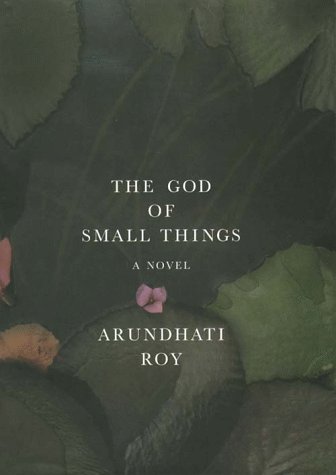
Before the meeting: After Arundhati Roy’s memoir Mother Mary Comes to Me gave us so much pleasure last month, this month’s Chooser met with general approval when he picked the novel that made her famous.

I first read The God of Small Things before I started blogging. Apart from a general sense of having enjoyed it, I retained just one image, of a group of policemen marching in long grass. It turns out that the image comes towards the end of the book, on page 304:

A posse of Touchable Policemen crossed the Meenachal river, sluggish and swollen with recent rain, and picked their way through the wet undergrowth, the clink of handcuffs in someone’s heavy pocket.
Their wide khaki shorts were rigid with starch, and bobbed over the tall grass like a row of stiff skirts, quite independent of the limbs that moved inside them.

There’s so much of the book in those two sentences. The starched shorts, so vividly present and so rich with metaphorical meaning; the initial capitals ‘Touchable Policemen’ marking a childlike personification of key concepts; the river, the undergrowth and the tall grass as part of the physical environment that is such a force in the book. Above all, the complex tone is characteristic: the soldiers are almost comic, puppet-like, yet the reader knows that they are about to do terrible things.

The rest of the book was fresh and new to me. It’s the story of twins Estha and Rahel, their mother Ammu (whose divorced status was scandalous in the mid 1960s, in the Syrian Christian community of their small village in Kerala), and their extended family: Ammu’s brother Chacko, her blind mother Mammachi, and Baby Kochamma. (The text is scattered with Malayalam words, only sometimes translated. I understood ‘Kochamma’ to mean ‘Auntie’, and a quick websearch just now gave ‘a woman who is to be respected like a mother’.) In spite of her cuddly name, Baby Kochamma is a nasty piece of work, disappointed in love by a priest when she was young, and now bitter, moralistic and vindictive. Chacko’s divorced wife, an Englishwoman, comes to visit with her daughter Sophie Mol (‘Mol’ means something like ‘daughter’), who is about the same age as Estha and Rahel.

We know from the beginning that there is to be a disaster. The narrative takes place in at least three time frames: before the disaster, the disaster, and a couple of decades after the disaster. We see Sophie Mol’s funeral before we know who she is, and there are plenty of hints of the other terrible incident – which isn’t revealed until the final pages, just after the scene with the starched shorts.

There’s another moment that has idiosyncratic resonance for me. There are a three or four guava trees on streets near my home. I recently went scrounging and picked from the trees and from the footpaths enough ripe and slightly bruised fruit to make a delicious jar of jam. The unusable fruit on the ground, and there was a lot of it, was a disgusting mess. So it was a personal pleasure when a day or so later, on page 205, Rahel and Estha approach the hut of Velutha, a servant whom they love:

Velutha wasn’t home. <snip> But someone was. A man’s voice floated out from inside and echoed around the clearing, making him sound lonely.
The voice shouted the same thing, over and over again, and each time it climbed into a higher, more hysterical register. lt was an appeal to an over-ripe guava threatening to fall from its tree and make a mess on the ground.

Pa pera-pera-pera-perakka
(Mr gugga-gug-gug-guava),
Ende parambil thooralley
(Don’t shit here in my compound).
Chetende parambil thoorikko
(You can shit next door in my brother’s compound),
Pa pera-pera-pera-perakka
(Mr gugga-gug-gug-guava.)

Exactly what I want to sing to the guavas of Enmore.

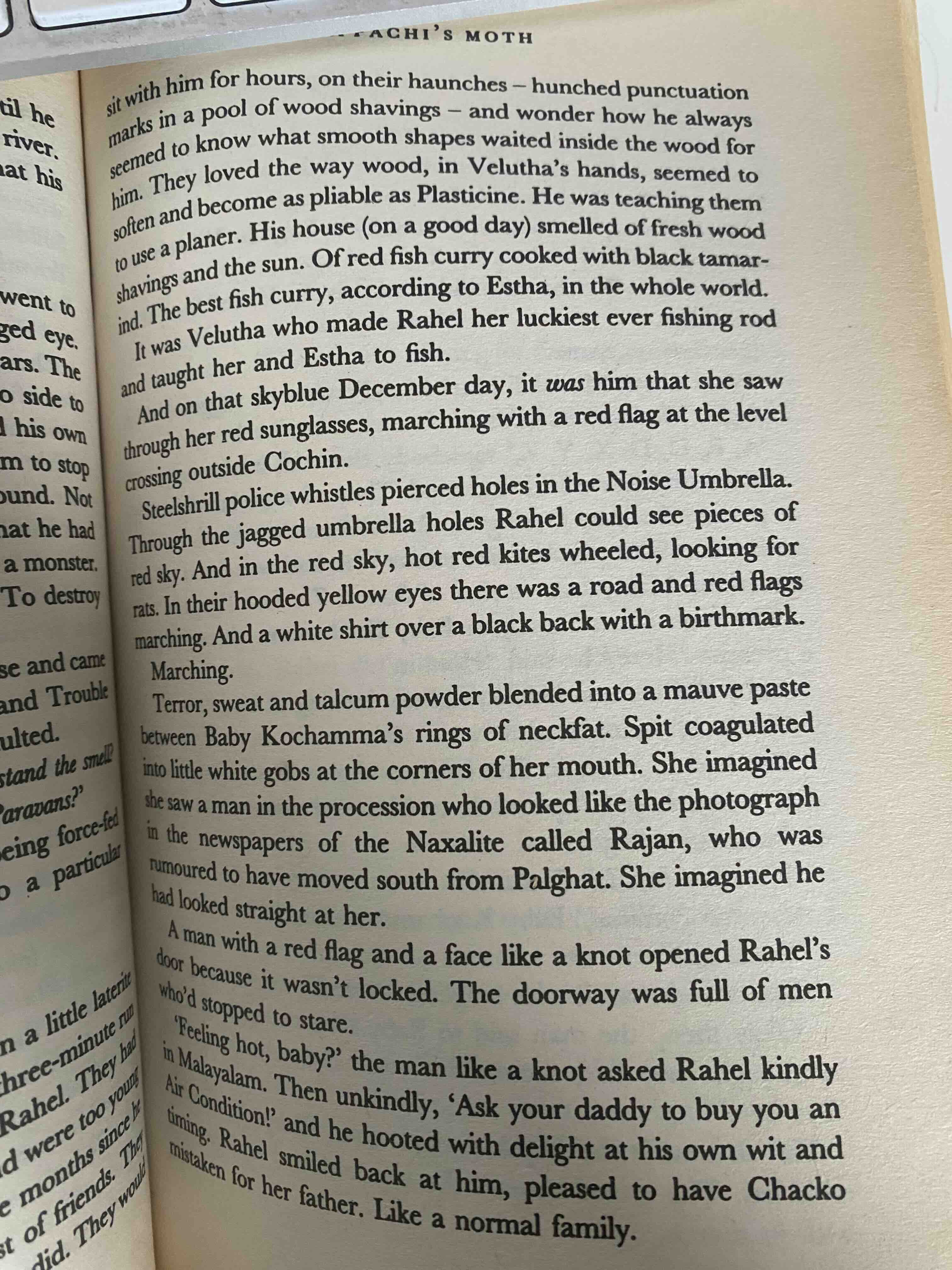
This is a book that cries out for quotation. You can feel Arundhati Roy’s glee as she comes up with similes, malapropisms and mondegreens, little asides, big digressions, wonderful descriptions of people. Page 79* is a good example. As it happens, it starts with Velutha and moves on to Baby Kochamma.

The family are driving to the nearest sizeable town, Cochin, to see The Sound of Music. It’s a long drive, interspersed with flashbacks, flashforwards and songs from the show. At page 78, already running late, they are held up by a demonstration – the street is full of workers, possibly including some Naxalites (the ‘extremists’ who Arundhati Roy was to spend time with in the jungle some decades later), carrying the red flag of Communism. The adults in the car have complex responses. Baby Kochamma is unequivocally on the side of capitalism; Chacko, though he effectively owns a pickle factory, identifies as a Marxist and theoretically is on the side of the workers; the twins’ mother says nothing, but later we realise that she has fellow feeling with the demonstrators. Rahel thinks she sees Velutha – as a former Untouchable, he usually goes shirtless, but the man Rahel sees is wearing a white shirt and waves a red flag.
Though we have met Velutha previously in stories of Ammu’s childhood, it’s here that we learn who he is from the twins’ point of view:

They would sit with him for hours, on their haunches – hunched punctuation marks in a pool of wood shavings – and wonder how he always seemed to know what smooth shapes waited inside the wood for him. They loved the way wood, in Velutha’s hands, seemed to soften and become as pliable as Plasticine. He was teaching them to use a planer. His house (on a good day) smelled of fresh wood shavings and the sun. Of red fish curry cooked with black tamarind. The best fish curry, according to Estha, in the whole world.
It was Velutha who made Rahel her luckiest ever fishing rod and taught her and Estha to fish.
And on that skyblue December day, it was him that she saw through her red sunglasses, marching with a red flag at the level crossing outside Cochin.

Then there’s a characteristic switch in perspective. The omniscient narrator steps in with a premonition. Rahel’s red-tinted glasses fill the world with the colour of danger. Birds of prey wheel above the demonstration, and Velutha’s black back with its distinctive leaf-shaped birthmark becomes a potential target:

Rahel could see pieces of red sky. And in the red sky, hot red kites wheeled, looking for rats. In their hooded yellow eyes there was a road and red flags marching. And a white shirt over a black back with a birthmark.
Marching.

Then the point of view comes right down to a close-up, and some characteristically tactile description. Where Rahel sees a friendly figure in the crows, Baby sees a threat:

Terror, sweat and talcum powder blended into a mauve paste between Baby Kochamma’s rings of neckfat. Spit coagulated into little white gobs at the corners of her mouth. She imagined she saw a man in the procession who looked like the photograph in the newspapers of the Naxalite called Rajan, who was rumoured to have moved south from Palghat. She imagined he had looked straight at her.

I love the final paragraph on the page. Rahel the child is aware that the man with ‘a face like a knot’ means to be unkind, but her preoccupations seize on his unintended normalising of her family.

A man with a red flag and a face like a knot opened Rahel’s door because it wasn’t locked. The doorway was full of men who’d stopped to stare.
‘Feeling hot, baby?’ the man like a knot asked Rahel kindly in Malayalam. Then unkindly, ‘Ask your daddy to buy you an Air Condition!’ and he hooted with delight at his own wit and timing. Rahel smiled back at him, pleased to have Chacko mistaken for her father. Like a normal family

I can’t say I know a lot about India. I’ve never been to Kerala. But at a railway station in Rajasthan, men did stop to stare unblinkingly at the young women in our group. It didn’t feel particularly aggressive or even deliberately impolite. We put it down to cultural difference. That experience helps me to visualise what Arundhati Roy is describing here, and to understand why Rahel isn’t particularly disturbed.

On the next page, the man with the flag turns his attention to Baby Kochamma and speaks to her in English, justifying her terror. But that’s another story, of the many told in this marvellous book.

The meeting: There were seven of us and as always we ate well and enjoyed each other’s company. We spoke as little as possible about Donald Trump, Iran, Israel, fuel and the tendency among younger generations to identify with self-diagnosed mental illness or neurodivergence. We gave passing glances to recent theatre and film pleasures, and to bodily pains, including severe side effects from statins that two of us have experienced, and the satisfaction of a third who convinced his specialist not to prescribe them for him.

One person had said on the WhatsApp group that he’d reach the halfway point of the book and was going to give up. I replied on the group that I loved the book and was looking forward to an interesting conversation – but it turned out that he had read the wrong Arundhati Roy book, The Ministry of Utmost Happiness. He said at the meeting that there are some wonderful passages in it, but he found it very hard going.

Another person had read the right book in the 1990s and hadn’t been inclined to reread it. I don’t think this was from active dislike. As the single parent of a teenager, and the only one at the meeting still in full-time employment, I imagine he doesn’t have a lot of time for reading, let alone rereading.

One person was about halfway through the book, but intending to read the rest and not touchy about spoilers. I’m starting to think it would be good to have a designated non-finisher for every meeting. The non-finisher could then ask questions that lead the rest of the group to think about how things fit together. In this case, there’s a scene where Estha, the boy twin, is sexually molested. Our non-finisher wanted to know if this had a lasting effect on him as it seemed at the time that life just carried on. I replied blithely that it was a bit of a red herring – we were tempted to read this incident as explaining why the Estha we see many years later has become an alienated mute, but the real cause is the much worse incident that happens at the book’s climax. I was gently corrected: Estha’s terror of the incident being repeated set off a chain of events that leads to the climactic incident.

Of the other four, one had read the book reluctantly – feeling that he might have had enough Indian novels for a while (cue a brief digression as we enthused that Amitav Ghosh is scheduled to come to the Sydney Writers’ Festival in May), and it took a while but after the halfway point, once all the characters had been introduced and the plot got moving, the book won him over completely. We generally agreed that it was a bit of a struggle in the first half to keep track of the complex set of relationships. The time shifts, especially in the first half, were often confusing. It’s a book, someone said, that needs to be read in reasonably long sessions – not ten minutes at a time before you go to sleep at night. Nods all round.

Someone else said that when he was struggling with the language he read a passage out to his partner to see if she could make head or tail of it. When he heard the words aloud he realised they were crystal clear. From then on, he slowed down, letting the language play on his inner ear, and enjoyed the experience. (Sadly, he couldn’t find the passage to read it to us.) Conversation hovered around this: not universally seen as a virtue, the book is peppered with writerly quirks, turns of phrase or eccentric punctuation that draw attention to themselves and pull the reader out of the story for a moment. A young writer flexing her muscles, I think someone said. And why not? someone may have said back.

We left our host with the washing up and dispersed into a clear, warm, early Autumn night.


I am a man of settler heritage who has been alive for almost a third of the time that has elapsed since Arthur Phillip claimed this continent for the British crown. The Book Group met on Gadigal land. I wrote this blog post on the land of Gadigal and Wangal, where yesterday’s sudden downpours show no sign of recurring today. I acknowledge Elders past and present and welcome any First Nations readers of the blog.


My blogging practice is to focus on the page that coincides with my age, currently 79.
Mother Mary Comes to me, Arundhati Roy and the Book Group

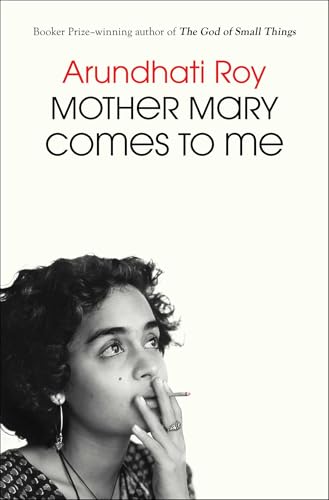
Arundhati Roy, Mother Mary Comes to Me (Scribner 2025)

Before the meeting: As my regular readers probably know, I belong to two book groups – the Book Group and the Book Club. The Book Club read this book in November, and I blogged about it, here. For this Book Group meeting, I reread as much as I had time for, which wasn’t much. I enjoyed the writing even more this time, but will let that earlier blog post stand as my ‘before the meeting’ notes.

After the meeting: It was a long time since we’d met. One man had had major heart surgery; another had spent months in India; there were stories of surgery on larynx and eyes; terrible things had happened in Sydney and around the world; Christmas had been and gone … Our host had prepared a delicious meal from recipes in the Kerala section of Madhur Jaffrey’s Indian Cookery, supplemented by riata, palak paneer, naan and choctop icecreams brought by others.

We had all enjoyed the book. One man said it was pretty much the best book he’s every read. Another (or perhaps the same one?) read it in a single sitting on a Sydney to Melbourne train trip. Our host said that he usually loves books that create a strong sense of place but loved this one in spite of its not doing that, and referred us by way of contrast to Madhur Jaffrey’s description of Kerala in her cookbook.

We tended to focus on the political dimensions of the book. Someone said that he had found first third of the book self-indulgent (not a view widely shared), but then it got interesting as Arundhati became more politically engaged. The picture that emerges of Narendra Modi was particularly striking – the man who had spent time in India said that his negative sense of Modi had been modified by conversations with educated, affluent Indians who saw his impact as largely benign; this book left him bemused. He was also able to tell us interesting bits about the antiquity Syrian Christians. (Founded by St Thomas in the first century CE. ‘I doubt that,’ said someone, then realised he’d made a Biblical joke.)

And inevitably we got to the paradox that a mother could be so horrible to her children, so beloved of people just outside her immediate family, and also a foundation for her daughter’s enormous success.

It looks as if our next book will be Arundhati Roy’s The God of Small Things.


We met on the land of Gadigal of the Eora Nation, and I have written this blog post closer to the river, on the land of Gadigal and Wangal. I acknowledge Elders past and present of those clans, and welcome any First Nations readers.

Mother Mary Comes to me, Arundhati Roy and the Book Club

Arundhati Roy, Mother Mary Comes to Me (Scribner 2025)

Before the meeting: Mary Roy (1933–2022) was an extraordinary woman. She successfully challenged an inheritance law in the Indian state of Kerala so that women were able to inherit property, and she founded a ground-breaking school. That school, Pallikoodam, has a photo of her on its home page, accompanied by a vision statement:

Pallikoodam is born of the vision of Mrs Mary Roy. For fifty plus years she worked on moulding an extraordinary school that imparts a creative and all-round education that produces happy, confident children, aware of their talents as well as their limitations, unafraid of pursuing their dreams and living life to its fullest. Today, every one of us in Pallikoodam works to realise and forge ahead with her dream.

Mary Roy was also the mother of writer Arundhati Roy. In this memoir, she emerges as a formidable woman who did brilliant things, earning the admiration and cult-like devotion of many while challenging patriarchal institutions, and was at the same time a tyrannical, unpredictable, terrifyingly self-centred mother. Near the end of the book, Arundhati Roy describes a moment in 2022 when she was having dinner with three male friends, including her close friend Sanjay. She received a message on her phone:

It was from my mother. They, all men, each of them, including Sanjay, beloved by their besotted mothers, must have noticed the blood drain from my face and wondered what had happened. How could I explain to them that what had scared me was that I had got a message from my mother saying that she loved me.

It says a lot that readers understand perfectly why the message is terrifying, and that we also understand the intense moral, emotional and intellectual complexities involved in Roy sending a positive reply.

I love this book. It’s the story of the intertwined lives of two brilliant women, with the last half century of Indian history as an often intrusive backdrop. The genesis of Arundhati Roy’s writing is vividly told: her two novels The God of Small Things and The Ministry of Utmost Happiness, as well as her non-fiction, ‘activist’ writing, opposing the construction of a big dam that would displace millions of people, exposing the suffering of the people of Kashmir, reporting on time spent in a jungle with communist (‘Naxalite’) guerrillas, opposing Narendra Modi’s regime, and more.

I can imagine the book being portrayed as a misery memoir in which a famous writer complains about her wretched childhood, or as an exposé of a monster generally regarded as a saint. But that would be to misrepresent it. Mrs Roy’s personality was no secret. Her most loyal adherents were aware of her rages, her indulgences (she was always accompanied by an attendant bearing her asthma medication and, later in life, a supply of jujubes). And though Arundhati and her brother suffered terribly at their mother’s hands, she was a powerful force for good in their lives. There are any number of quotable lines to illustrate this complexity. Here’s just one from page 61, when the daughter was fifteen years old:

Between her bouts of rage and increasing physical violence, Mrs Roy told her daughter that if she put her mind to it, she could be anything she wanted to be. To her daughter those words were a life raft that tided her over pitch-darkness, wild currents and a deadly undertow.

There’s so much to enjoy. Arundhati has a friendship with the legendary John Berger, which gives us the unforgettable image of him as an elephant fanning her with his flapping ears. Hollywood actor John Cusack makes a cameo appearance as a witness of the mother–daughter relationship.

A look at page 78* makes it clear that the book is at least as much about the ‘me’ of the song as it is about ‘Mother Mary’. Young Arundhati is at the Delhi School of Planning and Architecture, free for the first time of Mrs Roy’s overwhelming presence. She has re-encountered the young man she calls JC – her first meeting with him when she was nearly fifteen and he was nineteen had been the first time she understood what sexual desire was: ‘My brain, my heart, my soul – all parked themselves in my groin.’ Back then, she had tried to be invisible. But on page 77, he tells her that he had thought she was a beautiful girl:

I was delighted. I had never, not for half of half a second, thought of myself as beautiful. <snip> I was the opposite of what Syrian Christian girls were meant to be. I was thin and dark and risky.

Such is the power of the writing that one hardly stops to question how the stunningly beauty the young Arundhati Roy that we see in photos could ever have felt that way.

On page 78 – after a paragraph about the Delhi family connection, Mrs Joseph, who disapproves of her – Arundhati is still absorbing that first delight:

So, it was nice to be thought of as beautiful, even if it was the opinion of a minority of one.

The rest of the page evokes grungy student life at the School of Planning and Architecture in new Delhi.

Laurie Baker (Wikipedia page here) is named as standing for the opposite of what was taught at the school. He was a pioneer of sustainable, organic architecture who designed Mrs Roy’s Pallikoodam school. He had inspired Arundhati to veer away from her earliest ambition, to be a writer, and leave home to study architecture. Though Arundhati did go on to be a writer, it was at the School of Planning and Architecture that some of her most important, enduring relationships were formed. As much as anything else the book celebrates these friendships.


After the meeting: Everyone loved this book and we loved discussing it. Someone threw a small grenade, saying that she didn’t see that Mrs Roy was such a terrible parent, that really Arundhati Roy had unfairly demonised her. The catalogue of physical and emotional violence, the fact that Arundhati’s brother shared her view, the way independent witnesses described Mrs Roy as ‘your mad mother’ and laughed at the terror on Arundhati’s face when she had to deal with her: none of this made a dent in her view. We could agree that Arundhati didn’t stay victim – she saw her mother as a model of being powerful in the world, and eventually came to recognise that in her way she loved her, and had given her the wherewithal to build a big life for herself, even if that meant rebelling against her.

We all learned things. For some it was about Indian politics, in particular about Karachi. For all of us, the impact of winning the Booker Prize was a revelation. We all had our ignorance about the Syrian Christians of India slightly decreased (the Roys are Syrian Christians – in Modi’s India, not Indian enough).

We read and discussed the book along with Kiran Desai’s The Loneleiness of Sonia and Sunny. Both books feature complex mother-daughter relationships, both have rich insights into the cultural and political relationships between India and the West, a number of historical events feature in both. But no one was much interested in a compare-and-contrast discussions.


Because it’s November*, I will now burst into rhyme:

November verse 4: Student days
Are student days always anarchic,
smoke-filled, garbage-racked, insane,
angry at the hierarchic
lectures that would tame the brain
with wisdom that's received as certain?
Always the time that lifts the burden
from the backs of those who bear
the yoke of old beliefs? Time where
new songs are sung and new words spoken,
daughters, sons beyond command
(don’t even try to understand),
first loves formed and hearts first broken,
new ways found with fork and knife,
friendships made that last for life?

The group met on the land of Gadigal of the Eora Nation, and I have written this blog post on the land of Gadigal and Wangal. I acknowledge Elders past and present of all those clans, and welcome any First Nations readers.


My blogging practice is to focus on the page that coincides with my age, currently 78, and in November I write fourteen 14-line stanzas in the month. which means incorporating one into most blog posts.

Arundhati Roy

[This blog post was originally posted on 6 November 2006 in my now defunct blog Family Life. I’ve retried it here because I’m currently reading and will soon post about Arundhati Roy’s memoir Mother Mary Come to Me.]

Arundhati Roy’s acceptance speech for the Sydney Peace Prize makes interesting reading. The detail she gives on what’s happening in Iraq is heartbreaking. It’s not very long. Here are a couple of bits:

Invaded and occupied Iraq has been made to pay out 200 million dollars in ‘reparations’ for lost profits to corporations like Halliburton, Shell, Mobil, Nestlé, Pepsi, Kentucky Fried Chicken and Toys R Us.

And later:

The real tragedy is that most people in the world are trapped between the horror of a putative peace and the terror of war. Those are the two sheer cliffs we’re hemmed in by. The question is: How do we climb out of this crevasse?

For those who are materially well-off, but morally uncomfortable, the first question you must ask yourself is do you really want to climb out of it? How far are you prepared to go? Has the crevasse become too comfortable?

If you really want to climb out, there’s good news and bad news.

The good news is that the advance party began the climb some time ago. They’re already half way up. Thousands of activists across the world have been hard at work preparing footholds and securing the ropes to make it easier for the rest of us. There isn’t only one path up. There are hundreds of ways of doing it. There are hundreds of battles being fought around the world that need your skills, your minds, your resources. No battle is irrelevant. No victory is too small.

The bad news is that colorful demonstrations, weekend marches and annual trips to the World Social Forum are not enough. There have to be targeted acts of real civil disobedience with real consequences. Maybe we can’t flip a switch and conjure up a revolution. But there are several things we could do. For example, you could make a list of those corporations who have profited from the invasion of Iraq and have offices here in Australia. You could name them, boycott them, occupy their offices and force them out of business.

Those companies again: Shell, Mobil, Nestle, Pepsi, Kentucky Fried Chicken and Toys R Us.