Tag Archives: Michael Griffith

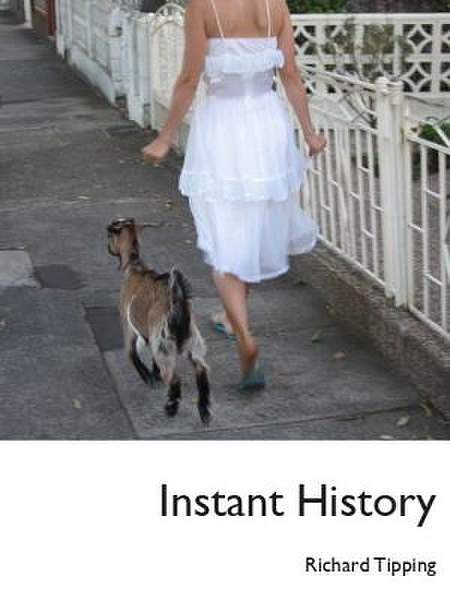
Richard Tipping’s Instant History

Richard Tipping, Instant History (Flying Island Poets, 2017)

As a subscriber to Flying Island Poets, I receive a bundle of ten books at the start of each year. The pocket-sized books belie their miniature appearance by being substantial poetry collections. Taken as a bundle they are wonderfully various – poets being published for the first time and poets with established reputations, embittered old poets and bright-eyed young ones, Chinese poets and poets from rural Australia (Flying Island’s co-publishers are Cerberus Press in Markwell via Bulahdealh and ASM in Macao).

I was delighted to find Instant History in my bundle this year. Richard Tipping is a multi-disciplinary creator whose work I have been encountering and enjoying for more than 50 years.

Probably my first encounter was the poem ‘Mangoes Are Not Cigarettes’ performed as a duet with Vicki Viidikas in the Great Hall at Sydney University in the early 1970s, then reprised immediately as ‘Oysters Are Not Cigarettes’. (That poem lives on – I just found the text, with photos, on Michael Griffith’s blog at this link.)

Tipping’s ‘signed signs’ appear regularly at Sydney’s Sculpture by the Sea. Photos of a couple of them have featured in recent issues of Overland: in issue 255 two chunky rocks near the shoreline bear gold leaf lettering, ‘SEA THREW’; in issue 256 a road sign reads, ‘FORM 1 PLANET‘.

Tipping’s Wikipedia page lists poetry, art, spoken word, documentary films, an art gallery, and more. Yet he doesn’t look at all exhausted in his cover photo.

Instant History bristles with quotable lines. Rather than focusing on just page 78*, here goes with a brief description of each of its four parts and a couple of lines from each.

‘The Postcard Life’ comprises 33 mostly short, impressionistic poems that are like, well, postcards from travel destinations from New York City to the Malacca Strait. My favourite in this section is ‘Snap’, a collection of short poems that are either haiku-like or snapshot-like, depending on your point of view, that capture a visit to Japan, individually and cumulatively wonderful. For example:

Bullet train to Kyoto
speeding by still river, reflecting rain
Chain-smoking chimneys
Greyroofed villages, rice fields, cement

‘Rush Hour in the Poetry Library’, for me the most memorable section, has 28 poems that are mainly about art and works of art. I particularly like ‘On Film (for Steve Collins, editor)’, which reads to me as a poem gleaned from conversations with its dedicatee. It begins with this resonant paradox:

Film is painting in light with time 
for the ears' extra pleasure
even if the pictures are better on radio

‘Earth Heart’ has just nine poems, and includes images of his typographic visual poem ‘Hear the Art (Earth Heart)’ – if you write either of those phrases out a couple of times without word spaces, you have the poem, a wordplay that absolutely sings. Its appearance in this book is one of many manifestations. For a land art version in the grounds of the Lake Macquarie City Art Gallery, you can go to Richard Tipping’s website.

‘Kind of Yeah’, the final section, feels mostly like a bit of fun with the vernacular, nowhere more so than in ‘Word of Mouth’ which includes this:

It was hair-raising, pulling your leg,
turning the other cheek; quick as a wink
you got me by the short and curlies
just as I'd finally got my arse into gear.

That’s just a taste. There’s politics, Buddhism, whimsy, and always a sense of performance, in the best senses of the word.


I wrote this blog post on land of Gadigal and Wangal of the Eora Nation, and finished it in a brief pause from heavy rain. I acknowledge the Elders past and present of this country, never ceded, and welcome any First Nations readers.


My blogging practice, honoured in the breach here, is to focus on the page of a book that coincides with my age, currently 78.

Journal Catch-up 18

I’m not across the detail of the Australian government’s National Cultural Policy – ‘Revive: a place for every story and a story for every place’ (here’s a link) – but I hope it means our literary journals are in a less desperately mendicant state. Certainly, I’m grateful that they continue to exist and even proliferate, even though my reading is limited. Just two on this blog post, both from last year, and both blogged with attention to page 76 as per my arbitrary blog policy.


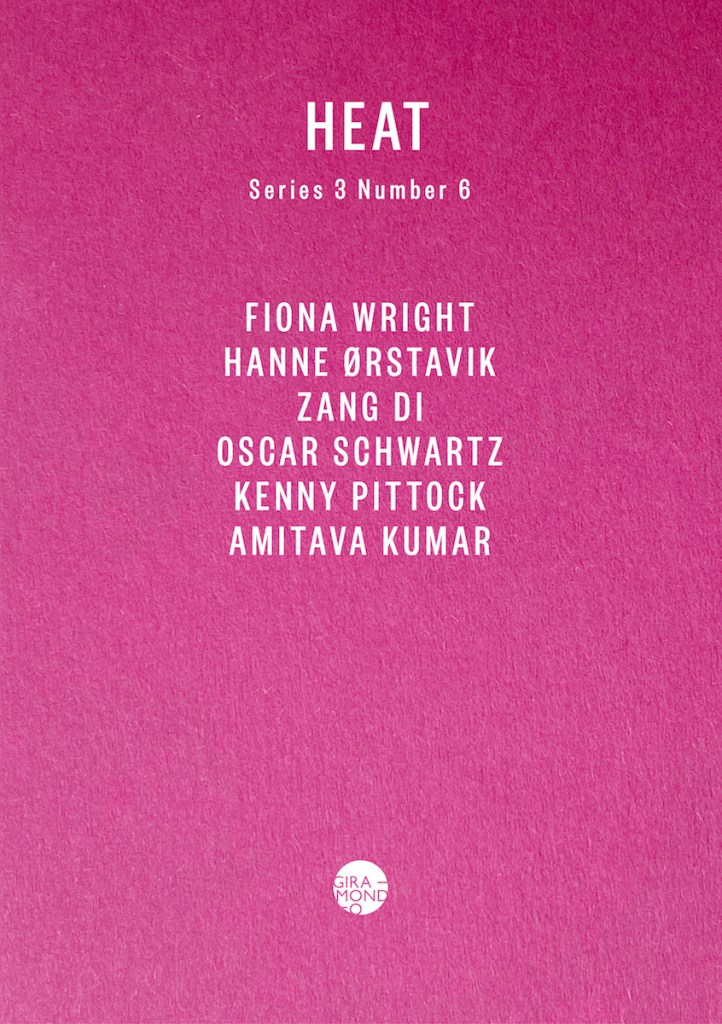
Alexandra Christie (editor), Heat Series 3 Nº 6 (Giramondo 2022)

There are two wonderful homegrown pieces in this Heat: Fiona Wright’s essay about ageing, ‘To Begin / It Broke’; and Oscar Schwartz’s ‘Father Figures’, a collection of ultra-short prose pieces written as the birth of his first child approached. You can read the latter on the Heat website at this link.

There are translations – four poems translated from Chinese and an essay from Norwegian – and six pages devoted to images of witty ceramic pieces by Kenny Pittock with the self-explanatory titlePost-It Notes Found While Working in a Supermarket’.

Page 76 is near the beginning of the longest and most ambitious piece, ‘Dear Editor’ by Amitava Kumar. Kumar was born in India and now lives in Poughkeepsie, New York. The story starts with a writer flying to Mumbai from New York composing an op-ed in his head about the plane’s broken toilets and the smell of shit. He keeps it up:

My ability to exaggerate does on occasion get the better of me but, believe me, I’m not being fanciful when I say that even the blue carpet in the aisles exuded a faecal odour – no, a heavier element, a moist miasma, that entered the nose and seemed to paralyse the senses. This preceding sentence was going into the op-ed.

My resistance was immediate and intense. Why is an Australian literary journal giving over more than a third of its pages to an Indian-born USian complaining about his country of origin? There are quite a few more sentences for the op-ed, but just as I was about to skip to the end of the story, the scene changes to a hotel in Mumbai where the daughter of an old friend is to be married.

It took a few pages, but the narrator has a fleeting sense of himself as an obnoxious expat and starts a conversation wth a fellow guest, an older woman. The imagined op-ed takes on a more serious tenor, and eventually disappears altogether as the narrator is absorbed by the woman’s story. I have no idea how much of this story is fiction, how much journalistic truth, but the ‘mix of arrogance and condescension’, as he later describes it, turns out to have been a slipway into an account of the coming of Hindu-style fascism to a small village. My resistance was completely dissolved, and I’ve added Amitava Kumar to the list of writers I wish had been invited to the Sydney Writers’ Festival in May.


Evelyn Araluen and Jonathan Dunk (editors), Overland 248 (Spring 2022)
(Some of the content – less than in the past – is online at the revamped Overland website, and I’ve included links)

Many of the articles in this Overland have a literary academic feel: Thomas Moran writes about M Barnard Eldershaw’s Tomorrow and Tomorrow and Tomorrow; Michael Griffith compares and contrasts T S Eliot and Catholic German sometime Nazi Party member Carl Schmitt; Abigail Fisher discusses Bella Li’s Theory of Colours. All three are in accessible English, but aim for a readership who is more specialist than usual for Overland articles and, I confess, more specialist than I am.

The poetry, on the other hand, is more accessible than usual. I especially like Isobel Prior’s ‘The Medical Man’, a narrative about a hospital tragedy somewhat in the manner of the late, great Bruce Dawe; and Paul Magee’s ‘Flag mask’, a reminder of what the Australian Parliament was like before May 2022.

Of the five short stories, two play masterfully and unsettlingly with the notion of consent: ‘Espalier‘ by Kerry Greer and ‘What it means to say yes‘ by Megan McGrath.

Page 76 falls in the middle of the other short story that spoke strongly to me, ‘In the garden‘ by Jayda Franks. A character introduced as ‘a young man’ visits another character referred to mainly as ‘the woman’ in an aged care facility. As they chat and play with dirt in the garden, we realise that they have a history but there is a reason beyond her dementia for her not remembering him. It’s a simple, poignant tale whose twist is an emotional twist of the knife rather than a surprise. Here’s a little from the dialogue in the garden to give you a sense of the way the narrative captures the way conversation with someone with demential can go, while suggesting that something else is going on:

‘I don’t remember you,’ she says. She is much more lucid now. Her eyes are sharp and clear and they fix on his own.
‘I know.’
‘I’m sorry.’
‘Please don’t be. I don’t blame you at all.’
She watches him crack his fingers and her brow furrows. ‘The counsellor here says we should ask visitors to tell us about themselves. Even if it doesn’t help us remember. Would you like to do that?’
He smiles sadly. ‘I am afraid I am a very different person to the one you remember.’
She turns to the spider lilies and he watches the conversation leach away from her. She beams at their slender petals and her whole face crinkles up like a young bud in bloom. When she looks back at him, she falters and his heart contracts.
‘Hello.’
‘Hello.’


I subscribe to two other journals, but they seem to be on hiatus. May they be revived by Revive before my next Journal Catch-up blog post.

The 2019 Francis Webb Poetry Reading

For nine years now, Toby Davidson has been organising an annual celebration of Francis Webb’s poetry. Toby edited Webb’s Collected Poems (1911) – my blog post here. Though I’ve been enamoured of Webb’s poetry for 50 years now, this is the first time I’ve managed to attend the event (or the second, if the reading at the 2011 Sydney Writers’ Festival counts – my blog post here).

We met in a large room – the ‘Creator Room’ – at Chatswood Library, in the region where Webb spent his childhood. The library has inherited Webb’s collection of paintings – all or most of them bought with funds Webb received as a government grant, funds spent of art rather than, say, food – and his library of books. The paintings and some of his books were on display, along with other fascinating realia, including a photocopy of the handwritten draft of his final poem.

Toby Davidson was an unabashedly enthusiastic MC for an audience that was an interesting mixture of ancient fans (like me), current students (including some from Davidson’s classes) and satisfyingly motley others. The readers:

  • Robert Adamson, poet (blogged about by me here and here among other places): told us of his awe-struck meeting with Webb in Callan Park Psychiatric Hospital, and read three poems – ‘End of the Picnic’ (an imagining of the arrival of Cook’s ship in 1770 as a spiritual disaster), ‘Morgan’s Country’ and ‘Wild Honey’ (probably my favourite Webb poem, read in a way that had tears on my cheeks). A hard act to follow, but followed it was.
  • Michael Griffith (author of God’s Fool, his 1991 biography of Webb): quoted Shakespeare’s Sonnet 65 ‘How with this rage shall beauty hold a plea / Whose action is no stronger than a flower?’ as emblematic of key themes in Webb (and his own life), and read us two poems with props – the first part of ‘In Memoriam Antony Sandys, 1806–1883’ with the painting that the poem describes on an easel beside him; and ‘On first Hearing a Cuckoo’ preceded by part of Delius’ ‘On Hearing the First Cuckoo in Spring’.
  • Judith Crispin, poet and photographer, whose work, according to her web site, ‘includes themes of displacement and identity loss, a reflection of [her] own lost Aboriginal ancestry’: read the dingo’s second speech from ‘The Ghost of the Cock’, and commentred on the extraordinary way it embodied what webb could not have known, the polarity of moon and dingo in an Arnhem Land foundation story; and two other poems, ‘Episode’ and ‘Toward the Land of the Composer’.
  • Gareth Jenkins, poet, spoke among other things of the sonic, rhythmic quality of Webb’s work, his mastery of long lines, and read, beautifully, ‘The Yellowhammer’.
  • Richard Miller, self-described as a long-time Webb fan and former musician in, I think, the Sydney Symphony Orchestra, in a complete change of mood, delivered a brilliantly theatrical, over the top rendition of ‘Introduction in a Waxworks’ from ‘Leichhardt Pantomime’.
  • Two school students whose names I didn’t catch, one from each of the nearby schools that Webb attended: one read the eminently accessible ‘Australian Night’, which Toby Davidson told us Webb wrote between ages of 7 and 10; the other read ‘Compliments of the Audience’, a sardonic take on a poetry reading, thereby concluding the reading part os the afternoon.

Before we broke for an afternoon snack, we were treated to Oliver Miller’s short film Electric, based on Webb’s radio play of the same name about the first use of ECG on a human subject.

I had a great time. Some of the poems I could just about mouth the words as they were read. Others came from the bits of the work that I have pretty much skimmed. Every reader showed some new aspect of the poetry – and of themselves. Michael Griffiths told us that he had been discouraged from writing his PhD thesis on Webb because, the then Professor of Australian Literature at Sydney University said, ‘He’s mad’. And he’s been dismissed by more than one cultural arbiter. But it was a joy to be in a room full of people who are touched, challenged and invigorated by his poetry.

Robert Adamson on Francis Webb

Someone emailed me a link announcing that Robert Adamson, UTS Chair of Poetry, was giving a public lecture on Francis Webb on Thursday night. How could I not go? As far as I know, UTS – University of Technology Sydney, whose main tower is Sydney’s monument to stark practicality – doesn’t offer any poetry courses, and the prospect of Adamson, anything but stark or practical in his poetry or his person, lecturing on Webb, ditto with bells on, was irresistible.

It turned out to be a fairly intimate affair in a shiny new building across the street from the anti-poetic tower. I recognised a smattering of poets and other writers, scholars, editors and UTS lecturers. I sat at the front, and my neighbours turned out to include Juno Gemes, Adamson’s photographer wife who discreetly plied her trade, Toby Davidson, editor of the new, excellent Francis Webb: Collected Poems, and Michael Griffith, who wrote God’s Fool, the best and only booklength introduction to Webb’s life and work. I’m not suggesting it was a family affair. The room was full, but I don’t think many of us were there without a prior connection to Webb, Adamson or UTS’s Centre for New Writing.

Adamson, whose CAL-sponsored professorship is for three years, began with a disarming list of thankyous – including to poet Martin Harrison for explaining to him what a lecture was. I hope the lecture is somehow made available, as it was a very clear account of Webb’s life and work, informed by a deep engagement with the poetry and a brief but significant personal relationship with the man. He read a number of poems. I’d say he read them brilliantly but that would give the wrong impression: he read them slowly, almost stumblingly, as if he was discovering them as he read them, or even encountering the language itself for the first time, mispronouncing an occasional word (couch in couch grass to rhyme with crouch, impotent with the emphasis on the second syllable), so that the listener was drawn in as a collaborator rather than being cast as a recipient. I find it hard to imagine a better way of reading this poetry.

In the excellent Q&A, freed from his written text, Adamson loosened up and spoke more personally: of how Webb was crucial to his own development as a poet, of how James McCauley looked him in the eye and said, ‘You’re on the right track with Webb – follow him instead of these Americans, of how he and his friends turned up like rockstar fans at Angus & Robertson’s bookshop the day the first Collected Poems was published, only to be told, ‘We publish it, but that doesn’t mean we have to have in here for sale.’ He gave a very funny, and accurate, account of A. D. Hope’s article on Webb: ‘Hope was a vitalist, and suspicious of Webb’s religious dimension, but he discusses the poem Canobolas, saying, “Look, he sees the mountain as a naked woman, so he must be all right, he’s one of us.”‘

Reading about Francis Webb

Bill Ashcroft, The Gimbals of Unease: The poetry of Francis Webb (Centre for Studies in Australian Literature 1996)
Michael Griffith, God’s Fool: The life and poetry of Francis Webb (Angus & Robertson 1991)
Poetry Australia September 1975: Francis Webb (1925–1973) Commemorative Issue
Peter and Leonie Meere, Francis Webb, Poet and Brother: Some of his letters and poetry (Old Sage Press 2001)

Having recently re-read Francis Webb’s collected poems, I didn’t want to just put the book back on the shelf. In order to be as booked-up as possible for the Sydney Writers’ Festival session on Webb next month, I got hold of three books about him, and dusted off my copy of the 1974 Poetry Australia commemorative issue. I can now assert that I have read every book published on the subject of Francis Webb.

Bill Ashcroft was writing an MA thesis on Webb in the Sydney University English Department in the early 1970s when I was a postgraduate student there. Michael Griffith was also in the Department then, and interested in Webb. Both of their books were published in the 1990s. Poetry as dense as Webb’s yields its riches slowly, so I was interested to read the results of such long gestations.
Bill Ashcroft’s emphasis is on explicating the poetry. He talks about Webb’s use of language, and about Webb as Catholic, as schizophrenic and as explorer. I believe Bill approaches Catholicism as an outsider, since he seems to miss references to Catholic liturgy and lore, but his analysis may be all the more useful for that, as he goes instead to major spiritual and intellectual traditions within Catholicism (namely the Thomist–Ignatian and the Augustinian) and locates tensions between them in the poetry.

His discussion of schizophrenia reads as if it was mostly thought through in the 1970s when R D Laing and the anti-psychiatry movement hadn’t lost the battle with Big Pharma for domination. In my opinion it’s all the better for that. He argues that Webb’s extraordinary use of metaphor is intimately connected to the condition for which he was repeatedly hospitalised, drugged and subjected to electroconvulsive therapy; that people diagnosed as schizophrenic often don’t distinguish, as others do, between metaphoric and literal ways of thinking, that this is generally a brilliant way of dealing with impossibly painful situations rather than the symptom of an illness. In the section on Webb as explorer, he argues that Webb’s poetry is groundbreaking post-colonial work, holding ‘a balance between the European spiritual roots and the post-colonial vision’.

According to the book’s back cover, Bill Ashcroft has been a trailblazer in post-colonial studies. As might be expected, then, his prose is heavy with theoretical ballast, and occasionally reaches dizzying heights of abstraction. I expect book would repay close, careful study, but at least for now I’m happy to have read it in a companionable way: I might not understand a lot of what this bloke says, but it’s good to have listened to him talk at length.

Michael Griffith co-edited Cap and Bells, a selection of Webb’s poems that came out the same year as God’s Fool, so he’s probably done as much as anyone to keep the poetry in print for the last 20 years. This book is an offshoot of Griffith’s PhD Thesis. ‘In reducing the work from its longer academic form,’ he writes in his introduction, ‘I have tried also to introduce some aspects of Webb’s humanity which had less place there.’ For this departure from academic rigour, I for one am grateful.

When I studied Eng Lit we did a lot of close reading, and the idea of approaching literary work by way of the author’s biography was sneered at. Bill Ashcroft deals with such potential sneers by talking about the poetry and the poet’s life as two intersecting texts that illuminate each other. Michael Griffith doesn’t see the need for such justification, and just gets on with the illuminating. He does do some explicating of the poetry, but I found much more value in his delving into Webb’s life story than in any tight focus on the text. He draws on Webb’s letters and other documents, including two ‘Hospital Confessions’ written as part of campaigns to have him released from institutions. He quotes correspondence with Norman Lindsay, Douglas Stewart and David Campbell among Webb’s elders, and Rosemary Dobson, Nan Macdonald, Vincent Buckley and others of his contemporaries. One day a collection of Webb’s letters may see the light, but in the meantime this book draws on those that have been preserved by colleagues and family to show us a working poet who, in spite of long periods of incarceration and serious difficulty in coping outside of institutions, was a cherished and active member of a creative community. In particular, it is fascinating to learn details of his early connection to Norman Lindsay, and to consider his poetry of the 1950s in the context of the resurgence of Christian, even Catholic, themes in Australian poetry and art at that time.
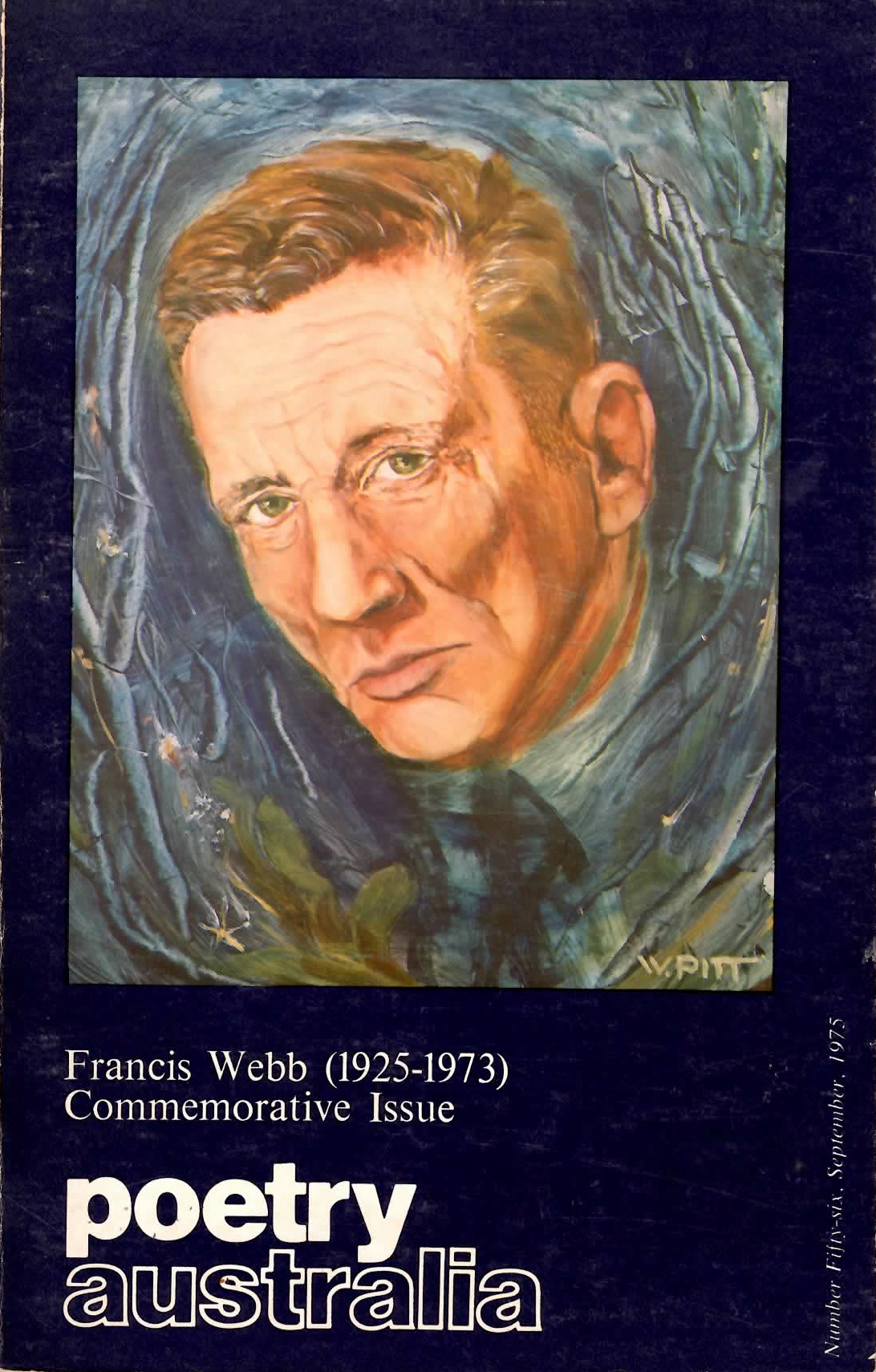
The September 1975 issue of Poetry Australia was devoted to Webb, who had died nearly two years earlier. As well as several previously unpublished poems (all of them now available in Toby Davidson’s 2011 Collected Poems), it includes essays by Griffith, Ashcroft and other scholars, but its enduring interest lies in contributions from Webb’s fellow poets who knew him and appreciated his work – Rosemary Dobson, A D Hope and Vincent Buckley among them. There is also a poignant memoir by Sister M. Francisca Fitz-Walter, a Good Samaritan Sister who befriended Webb.

These essays are a striking reminder of how the language of literary criticism has changed in the last 40 or so years. Compare Vincent Buckley, in his essay ‘A Poet of Harmony’:

He was a great phrase maker and 
there are phrases, sentences, cadences in poem after poem that are quite 
unforgettable. He was a great master, and sometimes a victim, of metaphor, 
the most metaphor addicted poet in this country, I would say, and it is noticeable that time and time again the energy of those very ample driving
 rhythms is also the energy with which metaphors are picked up, created
 and extended through the stanza.

with Bill Ashcroft, 30 years later:

The compatibility of schizophrenia and the post-colonial, or to put it a different way, the schizophrenic discourse of post-colonialism, is seen most markedly in the similarity between the absence of the metacommunicative mode in schizophrenic language and [the] metonymic gap [of post-colonial discourse].

I don’t discount the importance of Bill’s theorising – on the contrary, it opens up great vistas of understanding. But Vin (as Webb called him) says a lot more about the immediate experience of reading the poetry.
Francis Webb, Poet and Brother is a labour of love, compiled and self-published by Webb’s younger sister and her husband in 2001, when they must have been in their 70s. It includes a number of poems that had not been previously published – but which are mostly in Toby Davidson’s collection. Its appendices include an impressive bibliography of critical writings about Webb; nearly 60 pages listing all his poems, the place and date of first publication, the place of composition where that’s known, and all subsequent publications; and 12 pages listing errors in those publications and in writings about Webb. All this will probably be of interest to scholars, but then there are the letters – 56 of them, written to his three sisters and his brothers-in-law from 1943 when he was 18 to a month before his death in 1973, with linking passages by the Meeres, including occasional quotes from other sources, such as for example Vincent Buckley’s memoir Cutting Green Hay – a quotation which, incidentally, tells a story of youthful drunkenness that Buckley hinted at but declined to tell in his Poetry Australia essay. If Webb’s letters to colleagues are as compelling, and poignant, and interesting as these, someone really ought to be getting a collection together.

Four things shine through: Webb’s great affection for his family, especially for Leonie and Peter Meeres; his Catholic piety (almost every letter ends asking to be remembered in the recipient’s prayers, and promising to remember them in his); his single-minded dedication to his calling as poet; and his mental anguish. The reason for his repeated confinement in psychiatric institutions remains (of course) obscure: he repeatedly insists that he is completely non-violent, but the letters are peppered with references to incidents such as ‘a silly brawl’. Whatever the reason, it’s heartbreaking to read his pleas for help, his assurances of his harmlessness, his wretched descriptions of himself as a no-hoper, and towards the end his warnings not to upset and possibly damage children by bringing them to see him in his abject state – and through it all, his piety, his affection and his hunger for solitude and peace enough to write poetry.

The Japanese artist Yayoi Kusama lives in a mental hospital in Tokyo, and is able to go to her studio regularly. It may be that Francis Webb needed to be kept apart from the general community, for his own or other people’s safety, but that he lived a life of such deprivation must surely stand as a reproach to the way people labelled mentally ill have been treated in this country. Yet the miracle of it is that he too created marvellous works:

Are gestures stars in sacred dishevelment,
The tiny, the pitiable, meaningless and rare,
As a girl beleaguered by rain, and her yellow hair?