Tag Archives: Novel

Proust Progress Report 9:

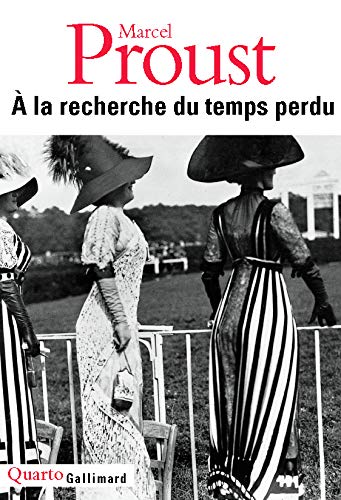
Marcel Proust, À la recherche du temps perdu (text established under the direction of Jean-Yves Tadié ©1987–1992): continuing Book 4, Sodome et Gomorrhe

I’ve been reading À la recherche du temps perdu for nine months now. Part way through this month, I decided to reduce my daily quota of five pages. Three pages were fun, and then the next two were a slog. So I’m now aiming for three pages a day, and expect to be reading Proust – still mostly without a dictionary and still with limited comprehension – well into 2021.

At about page 1320 I nearly threw in the towel – exasperated by the interminable salons and garden parties, the meticulous charting of the rivalries of various duchesses, princesses and other ladies, the intrigues of the idle rich and their shifting allegiances related to the Dreyfus case and antisemitism. If I wanted to read something in French, maybe I should shift to Montaigne … or Jules Verne, where something happens.

Then the narrator goes for a second time to the seaside resort of Balbec, and after an encounter with the manager whose malapropisms amuse him enormously and are carefully explained, he is knocked sideways by memories of his beloved grandmother, who was his companion on his earlier visit. He feels her loss intensely, and is stupefied by grief. Worse, a number of people – workers at the hotel, his mother, his servant Françoise – tell him of sacrifices his grandmother was making for him at a time when he was oblivious to her suffering. This whole section is just brilliant. Though Proust is as much the meticulous analyst of emotional processes as ever, here it feels like vivisection.

And then we’re back with tales of lust and disgust and linguistic oddities. The early parts of this book dealt with the world of Sodom, of male homosexuality. At Balbec, in the part I’m now reading, the narrator becomes obsessed with Gomorrah, the world of Lesbians In particular, he suspects Albertine of Sapphic desires. So far, there’s nothing more graphic than public kissing, tittering and indecent shouts:

elles passèrent enlacées, ne cessant de s’embrasser, et … poussèrent des gloussements, des rires, des cris indécents.

(page 1397)

This must be the kind of thing that gave French literature a reputation for being as good as pornographic in the early 20th century.

I the middle of all this there are a couple of pages where the narrator tells us about a couple of sisters from the country who are employed as messengers by a wealthy woman at the hotel. Having somehow – he doesn’t explain how – struck up a friendship with them, he gives us a blow by blow account of a conversation in his bedroom one morning where they mock him mercilessly. My impression is that a native French speaker would find great joy in their rustic language, but I enjoyed it a lot without that advantage. These two women, Céleste and Marie, are full of vitality and have no respect at all for the narrator’s poor health, social ambitions or writerly distinction. There have been other moments where Proust has taken the mickey, but this one shines.

I’m soldiering on.

The Book Group zooming with Hwang Sok-yong At Dusk

Hwang Sok-yong, At Dusk (translated by Sora Kim-Russell, Scribe 2018)

Before the meeting: One of the many things I love about my Book Group is that a couple of chaps can be counted on, when it’s their turn to choose our book, to send us Somewhere Else. We’ve read challenging books from Indonesia, India, Japan, Poland, Russia .. the list could go on. This month, we’re in South Korea.

Like many novels these days, this one tells two separate stories in alternating chapters, and the links between the stories become apparent only towards the end. The reader is quietly tantalised by hints at the connection, and there are red herrings.

The protagonist of the first narrative strand, Park Minwoo, is a successful male architect nearing retirement age, who has been part of ruthless slum clearance projects and aesthetically hideous urban development. My reading was partly informed and enriched by knowing that I was in the virtual company of architects, a builder and a heritage consultant in the Group, but the ethical issues didn’t need that kind of help. Minwoo has our sympathy: the bulk of his story is taken up with his childhood in the slums, and his escape to a more affluent life through study and patronage; and with the way his childhood friends and, especially, sweetheart remained behind, mostly forgotten by him – until, in the opening paragraph of the book, a young woman hands him a slip of paper with a name and a phone number and the past comes back.

The other story, told in the first person, features Jung Woohee, a young woman who is scraping a living working the graveyard shift in a convenience store in order to pursue her ambition to become a playwright. She is befriended by a man slightly older than her, named Kim Minwoo. I was struggling with the Korean personal names and place names, and at about the time that we learned his name I went back to the start to draw up a list of characters and places: yes, there are two Minwoos, but the mother of Kim Winmoo laughs at the idea of any connection between the son of a poor single mother and a famous architect.

I know next to nothing about South Korean history and culture. Duck Duck Go was my friend, especially in Minwoo’s story, which includes passing references to a coup, martial law and a massacre – all background to his rising fortunes. And I recognised motifs from of Bong Joon-ho’s movie Parasite – I don’t think there’s any influence or borrowing in either direction, just that the movie and the book are about the same world: Woohee lives in a basement apartment like that of the poor family in that film; and like the daughter of the poor family, Minwoo earns some cash by tutoring the initially unresponsive son of a wealthy family.

The thematic relationship between the two narratives is powerful, particularly as embodied in the two Minwoos. One has become successful through projects that have destroyed communities but has been able to turn his back on the human suffering; the other has been led by poverty and need to be part of an eviction squad on just that kind of project. It’s an amazing achievement of the novel that we continue to see these characters as human and deserving our compassion, even while we see the horror of their actions. We take no joy from the fact that things don’t end well for either of them.

I think I’m missing something in the way the two narratives connect at the end. Avoiding spoilers, I’ll just say that it felt like a twist that lacked any pay-off at all. Possibly something is being said about generational cultural shift, or the role of the artist (is Woohee a representative of the novelist?), and maybe there’s something about gender, but it sailed past me. I’m looking forward to talking about it to a lot of little faces on my computer screen.

A word about the translation: Sora Kim-Russell manages to give us a very readable text in natural, flowing English, while at the same time not pretending that this is anything but a Korean story. Take this little passage from Minwoo’s childhood visit to the home of his poorer friend Jaemyung:

Their mother ladled up bowls of sujebi that she’d cooked in a large pot, while Myosoon carried the bowls from the kitchen to the table. Once Myosoon and their mother were seated at the end of the table, dinner began. Instead of the usual firm dough torn by hand, their sujebi was made with a runny dough that was scraped with a pair of chopsticks into a pot of boiling water; as you ate it, the dough flakes turned soggy and loose until you were basically eating flour porridge. The flour must have been of poor quality to begin with, as it was yellowish in colour, and the broth wasn’t made from beef or anchovy stock but was just plain water with a little soy sauce and sliced squash. It barely qualified as sujebi.

(page 56-57)

There’s a lot of explanation embedded in that passage that – I’m guessing – wouldn’t be necessary for a Korean reader, but the ignorant reader (such as me) is neither patronised nor mystified. Sujebi isn’t translated for us, nor is it italicised to mark it as ‘foreign’; but we are told what the yellowish hue of the dough signifies about the flour. I just looked Sora Kim-Russell and see that she’s won awards. I concur with the judges.

After the meeting: I felt our last meeting, our first on zoom, was like an EngLit seminar, by which I think I meant less convivial as well as less chaotic than our Book Group meetings usually are. If Wednesday’s meeting was seminarish, it was only to the good, because we had a wonderfully rich, and enriching, conversation about the book. This may have been helped by the unobtrusive labour of one group member who earns his living largely as a facilitator. In the past he has been mocked for his pleas that we have one conversation at a time. This week, no one mocked, and I think we all silently appreciated the way he made sure everyone had a fair bite of the conversational apple. So, apart from the chap who was called away because his daughter cut her hand badly (she’s OK now), it was a smooth and unchaotic event.

My hope that the architects etc would shed extra light on the book was dashed. Pretty much with one voice they said that the architecture was there as a metaphor (or metonym, maybe: the subject was the modernisation of Korea, and architecture was a way of talking about that.

One chap had read the book twice, and a number of us thought that was a smart move. It’s a short book, but there are many layers: the portrait of Korea, the romance, the interplay of the two narrative strands, and so on. Someone had given the book to a friend to read because he wanted to discuss it before we met. The friend described it as unsentimentally elegiac, a phrase that struck a chord in the group: Author Hwang does tell of a lost past, without romanticising it.

There was an interesting discussion of the ending, which I won’t even attempt to summarise here, partly because that would be spoileristic.

And as well as that, the important business of the evening: hearing about how we are all faring in these Covid–19 times. Some are busier than ever with their jobs, some suddenly out of work, some missing contact with their family, some living in uncustomary closeness with theirs, one man needing advice on a barber for a much-needed haircut, and so on. Have I =said I love my book group? Then I’ll say it again. (Also, someone mentioned my blog, so I have to be nice about them in case they turn up to read it!)

Proust Progress Report 8: The Cities of the Plain

Marcel Proust, À la recherche du temps perdu (text established under the direction of Jean-Yves Tadié ©1987–1992): The last 100 pages of Book 3, Le côté de Guermantes, seconde partie, and the first 80 pages of Book 4, Sodom et Gomorrhe

I’m reading À la recherche du temps perdu five pages a day, mostly without a dictionary and therefore with limited comprehension. Currently, as I’m making my way through seemingly endless accounts of more or less random encounters at a range of social events, I’m quite enjoying it moment by moment, but if there’s a forest I can’t see it for the trees.

The main thing in the pages that I’ve read this month is that M de Charlus has come into the foreground. He’s the close relative of the dazzling Oriane de Guermantes who visited the narrator’s bedroom at Balbec in the second volume, and creepily stroked his chin the next day (as I mentioned in my third progress report, here).

In Le côté de Guermantes, the narrator is invited to M. de Charlus’ home late at night, where he is taken completely by surprise by an angry tirade. Thinking the M. de Charlus is accusing him of slandering him, the narrator swears that he has never said anything that could have offended him. What follows, though deranged, is a fabulous model for how to respond to a faux apology of the ‘I apologise for any offence my remarks may unintentionally have given’ kind:

— Et qui vous dit que j’en suis offensé?» s’écria-t-il avec fureur … «Pensez-vous qu’il soit à votre portée de m’offenser? Vous ne savez donc pas à qui vous parlez? Croyez-vous que la salive envenimée de cinq cents petits bonshommes de vos amis, juchés les uns sur les autres, arriverait à baver seulement jusqu’à mes augustes orteils?»

(Page 1173)

In English (from this link, with one or two changes by me):

‘And who told you I am offended?’ he screamed in fury … ‘Do you suppose that it is within your power to offend me? So you do not know to whom you are speaking? Do you imagine that the envenomed spittle of five hundred little gentlemen like you and your friends heaped one upon another would manage to slobber even as high as my august toes.’

Sodome et Gomorrhe (usually called The Cities of the Plain in English, primly avoiding the suggestion of sodomy, though that suggestion is clearly intended by Proust) gets off to a riveting, though still Proustily longwinded, start with a revelation about M. de Charlus. A 21st century reader will have gathered, or at least suspected, that M. de Charlus is homosexual well before now. But it comes as a revelation to our narrator when he sees him in an erotic encounter – well, he hears the heavy-duty erotic bit through a wall; what he sees is a weird bit of strutting and flouncing that precedes it.

After this revelatory moment, Proust goes off on a mini-essay about homosexuality. Apart from conflating homosexuality and gender fluidity, his reflections about the psychic damage done by the need for secrecy has aged amazingly well. He draws a parallel to Jews and antisemitism: in both cases it’s possible to ‘pass’ and man do. He describes the way internalised oppression can lead men (so far he’s talking almost entirely about men) who are in the closet to penalise and exclude anyone who is openly gay. While it’s not clear whether he thinks Zionism is a good idea, he’s emphatically against the idea of a movement to rebuild Sodom as a homeland for ‘Sodomites’, because:

Or, à peine arrivés, les sodomistes quitteraient la ville pour ne pas avoir l’air d’en être, prendraient femme, entretiendraient des maîtresses dans d’autres cités où ils trouveraient d’ailleurs toutes les distractions convenables. Ils n’iraient à Sodome que les jours de suprême nécessité, quand leur ville serait vide, par ces temps où la faim fait sortir le loup du bois, c’est-à-dire que tout se passerait en somme comme à Londres, à Berlin, à Rome, à Pétrograd ou à Paris.

In English:

For, no sooner had they arrived than the Sodomites would leave the town so as not to have the appearance of belonging to it, would take wives, keep mistresses in other cities where they would find, incidentally, every diversion that appealed to them. They would go to Sodom only on days of supreme necessity, when their own town was empty, in the times when hunger drives the wolf from the woods; in other words, everything would go on very much as it does to-day in London, Berlin, Rome, Petrograd or Paris.

That gives you some idea of the delicate path he treads between serious and interesting analysis and satirical barbs.

But then he goes to another party and we’re back on the subject of the glittering high society that he partly despises and mostly is entranced by. In his newly illuminated state, he notices and remarks wickedly on a number of homoerotic currents. For instance, M. de Charlus makes a big fuss of the woman who is his brother-in-law’s latest mistress, even though everyone would expect him to snub her. The reason for this unexpected behaviour is not, as the narrator’s friend Robert de Saint-Loup, back in town for the evening, is convinced, because his uncle Palamède is a womaniser, but because, as the narrator has told us, the woman in question has two strikingly beautiful sons, whose beauty is reflected in their mother’s.

There’s more. There’s lots more. There are amusingly vicious character sketches, lyrical descriptive passages, surprising asides about the nature of memory, insights into human folly sharp observations about Dreyfusards and antisemitism and, just once so far, a direct address to the reader who the narrator (correctly) assumes wants him to cut to the chase and get on with the story. I’m once again reassured by Clive James’s remark that having read À la recherche in French he then read it in English to find out what he’d read.

The Book Group and Trent Dalton’s Boy Swallows Universe

Trent Dalton, Boy Swallows Universe (Fourth Estate 2018)

Before the meeting: This was an unusual meeting of the Book Group, most obviously because it happened online, with participants spread from Bondi to Balmain, and less obviously because it’s the first time a book has been chosen that I’ve already read.

So for my pre-meeting take on the book, I’ll just point you to this link, and limit myself to saying that I enjoyed the book, and risked a visit to the supermarket to buy a bottle of sarsaparilla to flourish at the zoom screen.

After the meeting: As you would expect, we spent time checking how we were all going in our separate households. One of us reported the death of a friend in England. One made only a brief appearance because he is a health worker and exhausted, as well as putting himself at risk as an essential worker. Another has been working very long hours as his business adjusts to having most people working from home and he spends many hours every day in online meetings, which, he says, may actually be more productive than in-person meetings, but are exhausting. Several of us, me included, reported intergenerational tensions as people variously worried that others weren’t taking enough care or were annoyed by other people’s worry. A number spoke of the odd sense of having a relaxing time to do gardening and sit about and read, while outside – where you’re not allowed to go – terrible things are happening. I got the impression that many of us are addicted to Covid-19 news. There were no jokes.

We did get to the book. Without food to share or the possibility of fragmenting into small incidental conversations the whole thing was a lot less fun than we’re used to. It felt almost like an Eng Lit seminar – not that there’s anything terribly wrong with that. Most of us enjoyed the book. One chap said that generally if a book hasn’t grabbed him by page 72 he gives up on it; this book took until page 272, but then he decided to go with it and really had a good time. Some didn’t care much for the longish expository opening. (I think they were referring to the evocation of Brisbane suburbs, which I loved.) Another felt that the magic realism elements were the least successful, and I think we can look forward to an excellent film.

Philip Pullman's Secret Commonwealth

Philip Pullman, The Book of Dust Volume Two: The Secret Commonwealth (David Fickling Books 2019)

This is the fifth book featuring Philip Pullman’s wonderful Lyra Silvertongue (or Belacqua, take your pick). There was the His Dark Materials trilogy, which I loved to pieces, and which gave rise to a play, a movie and now, I’ve just discovered, a television series (click here for the IMDB entry). Then there was a small book, Lyra’s Oxford, which I missed. And now a second trilogy, The Book of Dust, of which the first book, La Belle Sauvage, was a prequel to the first trilogy and featured Lyla as a baby. The Secret Commonwealth leaps forward a couple of decades, and features events that take place some years after the end of the first trilogy, when Lyra is a twenty-year-old university student.

I wasn’t swept away by La Belle Sauvage (my blog post here). At least in the second part, it felt like a lot of colour and movement and not much interesting by way of plot or character development. The Secret Commonwealth is back on track. At the beginning, Lyla, now a student at Oxford, is at odds with her daemon Pantaleimon. For those who came in late (which I really don’t recommend: start with Northern Lights aka The Golden Compass), in this world a daemon is an animal who is somehow part of a human being. Daemons have names, they change shape frequently when their human is young but settle into a permanent creature around puberty. A daemon generally represents some essential element of its human’s character. To be separated from your daemon is extremely distressing, and most people don’t believe it is possible. To be quarrelling with him or her, as Lyla is when this book begins, is deeply disturbing.

So we’re off to a complex start. Lyla’s difficulty with Panteleimon is central to her personal life, but there are huge issues to deal with in the rest of the world. A version of the Catholic Church wields tremendous power, and though we are more or less in the present day it’s as if the Inquisition is alive and well. Organised religion, militant atheism, postmodern truthysim, religiously inspired terrorism all feature, in a plot of almost Le-Carré-esque complexity as we follow the separate adventures of Lyla, Pantaleimon and Malcolm Polstead, who is in undeclared love with Lyla, all of them being pursued by a fantasy version of the surveillance state.

Where His Dark Materials was intended primarily for a pre-teen or young teenage readership, this is definitely for older readers. I didn’t feel like an intruder as a 73 year old, but that’s not exactly what I mean. There’s some fruity swearing, and there’s one powerful scene of sexually-motivated violence that take it right out of the children’s section into the YA.

I remember how agonising it was to wait for the third book in the His Dark Materials trilogy – would Will really kill the Authority, and since the Authority seemed to be a name for the Judaeo-Christian God, what would that mean? The Secret Commonwealth, like all good second books in trilogies, also ends with a cliffhanger. Will the characters find each other, will they discover the secret behind the Men from the Mountains, fundamentalist terrorists, will Lyra escape the men who have tracked her down to the deserted village in southern Turkey, will the world be saved? But this time, without in any way implying that the book didn’t have me in its thrall the whole time, I can wait.

Proust Progress Report 7: more about the Guermantes

Marcel Proust, À la recherche du temps perdu (text established under the direction of Jean-Yves Tadié ©1987–1992): Le côté de Guermantes, seconde partie (originally published as a separate volume in 1921)

I’ve just realised with a shock that it’s time for my monthly Proust Progress Report.

A month ago I ended my post with the hope that the plot, such as it is, might move along soon. The opening page of the first chapter of Le côté de Guermantes Part Two offers hope, beginning with a plot summary:

Maladie de ma grand-mère. – Maladie de Bergotte.
Le duc et le médecin. – Déclin de ma grand-mère. – Sa mort.

In English:

My grandmother’s illness. – Bergotte’s illness.
The duke and the doctor. – My grandmother’s decline. – Her death.

What follows is a moving account of the final illness and death of the narrator’s beloved grandmother. Proust’s sharp, satirical edge is still there in his accounts of the various doctors and visitors of the sick. In particular, this intensely felt episode doesn’t overshadow completely the main concern of this book (or two books, depending on how you count them), which is the narrator’s relationships with the aristocratic Guermantes family and his acerbic commentary on them.

Albertine, with whom he fell into unrequited love in the second book but who no longer tugs at his heartstrings, turns up when he’s sick with grief and it seems she is now in love with him. I may have misinterpreted Proust’s opaque narrative at this point, but I think they have it off, and remain completely at cross purposes about what it means. The plot is definitely thickening.

But then we move on to the main game, and the forward impetus is lost. The duchess Mme de Guermantes, Oriane, with whom the narrator has also been in unrequited love and who also no longer pulls at his heartstrings – invites him to dinner. The plot of the next 100 pages or so can be summarised as: the narrator goes to dinner with a bunch of aristocrats.

The narrator is pretty much a fly on the wall. Every now and then someone speaks to him and he gets a word in edgewise, but he gives us a meticulous, detailed account of the witty, snarky conversation, so that the various personalities emerge sharply. Embedded in the narrative are essays on aspects of the culture and politics of the salons and of the aristocratic class.

When the narrator arrives at the Guermantes home – which is just across the courtyard from his own, though separated by a great social distance – he is greeted by the duke himself, who happily grants him his wish to be left alone in a room with some paintings by the great Elstir. When he tears himself away from the paintings (having given us a richly evocative analysis of them) he realises an hour has passed. A servant takes him to where the other guests are waiting to start dinner. The duke, aware as are all the guests that the narrator has the lowest status of anyone in the room, is at great pains not to make him feel he has inconvenienced anyone. So even though they have all been waiting to eat for at least forty minutes, he makes a point of introducing him to everyone individually, beginning with the Princess, the noblest person in the room. Only after a decent interval does he signal diffidently to the servants to announce dinner.

That tiny sequence is the occasion for a complex meditation on what you might call noblesse oblige, though that’s not a phrase Proust uses. These people who are in the highest social rank will never make a point of their status. In fact the way they demonstrate their superiority is by treating their inferiors (that is to say, just about everyone) with elaborate deference. It’s hard to explain the pleasure given by this essay – and a number of others, such as one on Oriane’s wit and social eminence. It’s something to do with paradox, and the tension between the infectious enthusiasm that Proust has for these people and his clear-eyed perception that they lead largely idle and trivial lives, and generally have appalling politics. And it’s laid out in sentences that you can get lost in, and then miraculously found again.

I’ve still got about a hundred pages of this book to go. The narrator has an appointment to meet the creepy M Charlus – Oriane’s brother – once he can make his excuses from the dinner, and that appointment hangs over the glittering dinner like a livid storm cloud. The title of next volume is Sodome et Gomorrhe, which raises the possibility that things are going to get a lot spicier.

Vicki Hastrich, Charlotte Wood, Night Fishing on the Weekend with the Book Group

Before the meeting: This month’s designated Book Chooser gave us two books to tide us over the summer break, a collection of memoir essays and a novel. The author of the novel makes a brief appearance in one of the essays, and it’s possible that the novel is set in a version of the locality that is the focus of many of the essays.


Vicki Hastrich, Night Fishing: Stingtrays, Goya and the Singular Life: A Memoir in Essays (Allen & Unwin 2019)

Before the Meeting: I reserved both books at each of the two libraries I belong to. Night Fishing became available within a day, though I was unable to renew my loan because seven people joined the queue while I was reading it. By contrast, there were 50 and 80 people respectively in the queues for The Weekend, but I was saved by the Emerging Artist, who bought it as a Christmas present to herself.

Night Fishing is a collection of thirteen essays that range from 4 to 34 pages in length. They don’t really amount to a memoir, as the title page claims, but they do have memoir elements. They are personal essays, most of which explore aspects of the waters near Woy Woy, where Vicky Hastrich’s family had a holiday house in her childhood and which she now visits often.

The first essay, ‘The Hole’, is filled with rich childhood memories of the place, and the excitement of rediscovering a favourite fishing spot with her brother. They go out in the author’s much-patched fibre-glass dinghy, the Squid, and are just about to pack up for the day, crowded out by half a dozen fancy, gizmo-laden boats, when she gets a bite:

The rod bent. I pulled the big, slow thing up and Rog got the net. It seesawed, it yawed, it took forever, but finally a dark shape materialised. Rog leant out and the shape nosed serenely into the net, though only its head seemed to fit; simultaneously Rog lifted and in a heavy, dripping arc in it came, landing thickly in the bottom of the boat. A huge flathead. Biggest one we’d ever seen – by a mile. Adrenaline pumping, we whooped and screamed.
 Suck eggs, you plastic heaps! Go the mighty Squid,’ I hollered.
We were grown-ups.

There are many moments like this in the essays. Hastrich’s deep love of that place is infectious, and it’s the best thing about the book – in ‘The Hole’ and ‘From the Deep, It Comes’ (in which Western writer and deep-sea fisher Zane Grey makes a guest appearance). She also writes engagingly about her writing life, including an unfinished colonial gothic novel that seems to haunt her, and about the way her past as a television camera operator affects her way of seeing (both in the same brilliant essay, ‘My Life and the Frame’). There’s a wonderful essay, ‘Amateur Hour at the Broken Heart Welding Shop’, about her grandfather, who was a ‘first-class amateur’ engineer – Hastrich describes herself as an amateur writer.

Less successful for me are the essays that are in effect reports on experiments: going fishing at night with only a non-directional lantern on the dinghy (‘Night Fishing’); taking the dinghy out at low tide to The Hole with a bathyscope (‘The Tomb of Human Curiosity’); filming herself as she sleeps two nights in a row and taking 112 selfies on the day in between (‘Self Portraits’). The contrived set-up of these pieces stops them from quite taking off.


Charlotte Wood, The Weekend (Allen & Unwin 2019)

Three women in their seventies meet at a beach house for a weekend over Christmas, but not to celebrate the holiday. Christmas just seems to be a non-event. None of them has family to celebrate with: Wendy is a widow with alienated adult children, Jude is the long-term mistress (old-fashioned term, but accurate) of a wealthy man who spends the holiday with his family, Adele is a once-famous actress who has become increasingly unemployed, alone in the world, and on the brink of homelessness. Nor have they taken refuge with each other as Waifs and Strays. The beach house belonged to Sylvia, the fourth in their little group of friends, who has died recently. They are there to sort out her stuff and prepare the house for selling – for the benefit of Sylvia’s partner, who has left the country,

We are told that these women have been friends for forty years. We are told they are feminists. But as they arrive at the hut, separately, they barely greet each other. Each is allocated a section of the house to clean up, and they proceed to do it in isolation. No calling out from one room to another – ‘Oh my God, look what she kept!’ ‘What should we do with all these gorgeous clothes?’ ‘That’s my saucepan that she borrowed and never gave back!’ – let alone any shared whingeing about the partner who has skedaddled and left them to do what should be her work. They do think such thoughts, but there’s no commonalty in the task. No sense of solidarity in grief either. And only the sketchiest idea of who the recently deceased woman was apart from the her role in keeping the friendship group together. When the three go for a walk on the beach, no one waits for anyone else but each remains wrapped in her own thoughts.

Not a lot happens in the first two thirds of the book apart from reports on the internal monologues of each of the women, and descriptions of the undignified deterioration of Wendy’s deaf, arthritic, incontinent dog. Towards the end, each of the three is delivered a devastating blow, they stumble into a Christmas midnight mass, and they find some solace and forgiveness with each other, but though there’s a terrific evocation of a storm as the blows are delivered, by then I was past caring.

I was so looking forward to this book, because I loved Charlotte Wood’s The Natural Way of Things (my blog post here). It can’t just be the subject matter that led me not to like it – I’ve been known to be very interested in women aged 70 or thereabouts, and I was enthralled by Elizabeth Strout’s Olive, Again (blog post here). I think it’s something to do with the way the narrative generally works. To take a passage pretty much at random, here’s Jude after she’s realised that Adele has claimed the best bedroom without any discussion:

She didn’t care about the bedroom at all – she wasn’t fussed by trivia like that – but still, a fleck of disdain formed itself: how had Adele not, in all these years, developed a shred of restraint, of self-discipline? It was how and why she was an actress, Jude supposed. They were all children, the men too, as far as she could tell. She could see the appeal, when you were young, the liberation of it. But what did it mean when you were old? What were you left with, still a child at seventy-two?

(page 75)

This is the kind of writing I meant by ‘we are told’ in the earlier paragraph. It’s shaped as if it’s giving us Jude’s internal monologue. I don’t think I’m alone in believing that no one thinks like that. Take the generalisation about actors. It’s mean and judgmental, and absurd, but that’s not my problem with it: why shouldn’t Jude be meanly, absurdly judgemental? My problem is that the omniscient narrator is giving us a rundown, an abstract, as if the writer has figured out what Jude’s character is, and is giving us little snippets to illustrate it. We’re not inside Jude’s head, which is where we need to be if we’re to get lost in the story. Sadly, this is pretty much how the narrator’s voice works for most of the book. It feels as if these characters created no surprises for their creator. This reader remained generally disengaged.

Many people have said The Weekend was one of their favourite books of 2019: Sue at Whispering Gums and Lisa at ANZ Lit Lovers, for example, have both written elegant, well-argued, positive reviews of what’s recognisably the same book but seen through very different lenses from mine. I’m glad, because I don’t want any book to be unloved – well, hardly any book. I’m sorry this one isn’t loved by me.


After the meeting: We met in the carport of our host’s newly purchased and not yet completely habitable house in Balmain with a spectacular view of the Sydney skyline, and had pizza. Once we’d got over the splendour of the setting, and tales of cricket from this summer and summers long past, and one or two fabulous tales of adventure in the city involving weddings and mistaken identity (though not in the same tale), we had an animated discussion of the books.

My sense is that no one was as negative about The Weekend as I am. Where I missed the casual back and forth of old friends, the book’s main proponent said he had read that sort of thing as understood but not part of the book’s focus: that the narrative was interested in the characters’ internal lives. another chap said that the main thing the book did for him was to have him reflect on decades-old relationships that are full of obligation but not much else; in particular, there are people who are nominally his friends but are really his wife’s friends, and if she were to disappear he wold gladly never see them again. He wasn’t saying that the three women in this book were like that, but he certainly read their lack of mutual warmth as having a similar source: Sylvia was the glue that held the group together, and no one was sure it could continue to exist without her. Yet another said he wasn’t fazed by the lack of communal grieving: that had already happened, as he read it, and now each character was withdrawn into her own individual grief.

It’s interesting that my main misgivings – which I’m not sure I even articulated – were addressed from so many fronts.

Night Fishing provoked some interesting discussion. Notably, towards the end of the evening, one chap said he was embarrassed to realise that this was the first thing he’s ever read about a woman fishing. His embarrassment was widely shared, and led to some interesting surmise about fishing and gender: men often fish in order to indulge in reverie, that is to say, be alone and do nothing. Is it the same for women? Or does it tend to be a more practical task for women. Today someone sent us a link to Lyla Foggia’s 1997 book Reel Women: the world of women who fish (link here).

On a more general readerly level, while the word ‘patchy’ evoked some head-nodding, we liked the book. A couple of passages were read out to general approval. One of our younger members said the book tapped into a vein of nostalgia. He didn’t get to enlarge on that thought, and I didn’t get to reply, but I think it’s not exactly nostalgia in these essays: the author revisits a place she loved as a child and explores it in a number of ways as an adult, deepening and enriching her understanding of it, and so of herself.

Someone said that they felt that Night Fishing was written by a person, and The Weekend was written by a writer. Obviously Wood and Hastrich are both writers, but there’s something to what he said. Hastrich describes herself as an amateur, which is a different thing from a dabbler or a learner – it points to the elements of vulnerability and lack of subterfuge that make her writing so attractive. The Weekend is Wood’s sixth novel, and even though I was disappointed in it, I didn’t ever want to give up on it.

One last thing: Charlotte Wood has put up on her podcast The Writer’s Room a wonderful interview with Vikki Hastrich that provides fabulous insights into the kind of beast Night Fishing is. Here’s a link.


Night Fishing and The Weekend are the first two books I’ve read for the 2020 Australian Women Writers Challenge.
Proust Progress Report 6: halfway through the third book

Marcel Proust, À la recherche du temps perdu (text established under the direction of Jean-Yves Tadié ©1987–1992): finished Le côté de Guermantes (1020–1921), première partie.

Exactly six months into reading À la recherche du temps perdu, and I’m halfway through the third volume. I have now finished the first part of Le côté de Guermantes, which was originally published separately.

If you’re looking for sizzling action, this book isn’t for you. The narrator has dinner with the military friends of his friend de Saint-Loup and is fascinated by military theory. He meets de Saint-Loup’s mistress, whom everyone except de Saint-Loup knows is a prostitute. He attends a salon where people are variously snobbish, uncouth, bien-pensant, antisemitic, evasively diplomatic and pretentious. He goes for a walk with the extremely creepy and probably predatory M de Charlus. At home, he finds his beloved grandmother is sick. He goes out for a walk with her and she has a heart attack.

Much of it is wryly funny, and there is one belly laugh. At least, I laughed out loud when after about twenty pages in which the narrator is a fly on the wall at the salon, the object of his infatuation who has not deigned to utter a single word to him when introduced, finally – after the narrator’s dear friend Robert de Saint-Loup whispers in her ear – turns to him and says, ‘Comment allez-vous?‘ Your mileage may vary.

I think of Proust as the Anti-Twitter: no proposition goes unquestioned, one’s immediate interpretation of a word or action is more likely than not to turn into its opposite when subjected to sustained, complex explication. No one ever gives a straight answer to a question. We know that Proust and his narrator are dreyfusards*, and the anti-dreyfusard characters are mocked mercilessly, but there’s no sign of Twitter’s door-slamming outrage. And yet Patrick Alexander, author of a guide to Proust, is rewriting In Search of Lost Time (in English) as a series of tweets. Sadly, my computer wouldn’t go far enough back in his Twitter timeline to give me his version of what I’ve just read, so I can’t tell whether he’s making a point of the impossibility of the project.

It turns out, though, that skimming @ProustTweet‘s timeline gave me hope that the endless conversations in this volume are about to give way to something a little more active. The account of grand-mère’s heart attack holds out that promise as well: it happens offstage while the narrator is paying attention to a silly conversation between the ‘marquise’ who attends the public toilets and a caretaker of the gardens they are visiting. The important things, it seems to be suggested, happen when the narrative is engaged elsewhere.


* Proust assumes that his readers are familiar with the Dreyfus Affair, which Wikipedia informs me divided the republic from 1894 to 1906. In essence a Jewish army officer was wrongly convicted and imprisoned for treason, and even when evidence of his innocence came to light the high-ranking office who had actually committed the treason was found not guilty and Dreyfus was again, against the evidence, and went to prison. In Proust, and I assume in the actual world, conservative, Catholic, antisemitic people of the upper classes tended to be antidreyfusards.

Jonas Hassen Khemiri, Everything I Don’t Remember

Jonas Hassen Khemiri, Everything I don’t remember(2015, translated by Rachel Willson-Broyles, audio book read by Jack Hawkins, Bolinda 2016)

I’d pretty much given up on audio books (see here and here), but the Emerging Artist is less prone to burning bridges than I am, and she borrowed two from the library for a longish drive on the weekend. We listened to Everything I Don’t Remember, all seven hours of it, and I’m once again open to the medium.

A young man named Samuel has died in a car crash, probably deliberately, and a writer is interviewing people who were close to him to find out how they make sense of his death. It settles down to three main interviewees: Samuel’s best friend Vandad, a woman not-quite-lover Panther, and Laide, the lover he broke up with a little before his death. Their narratives, sometimes expanded by scenes imagined by the writer, are interwoven, filling one another’s gaps, contradicting one another, commenting – often harshly and unfairly – on the others’ roles in Samuel’s life and death.

Samuel’s impending death provides a central narrative thread, but the book sends out tendrils into very interesting parts of Swedish society. There’s a brilliantly cinematic moment when a recorded tourist commentary on Stockholm plays on while the people hearing it are experiencing a very different version of that city – which is the version where the main action of the novel plays out, populated by artists, low-level public servants and community workers, struggling members of the gig economy, petty criminals, refugees, most of them, like Jonas Hassen Khemiri himself who has a Tunisian father, of African or West Asian heritage.

Some of the time as we listened we were driving through bush that is just beginning to put out new shoots of recovery from bushfire. In spite of the competition from the real world, the world of the novel kept us engaged (though we had to turn it off every so often to let the surrounding devastation sink in).

There are some meta elements. One of the interviewees tells the writer not to attempt to write Samuel in the first person because he can never know what was in Samuel’s mind. The reader (at least this reader) agrees, and the whole weight of the novel seems to lie behind the advice. Then, in the next section, Samuel’s internal monologue appears for the first time. And in the last ten minutes or so the writer explains to us why he undertook the project. These, and similar moments, may be just clever bits of mise-en-abîme (you know: the camera draws back and you realise you’re looking at a picture within a picture within a picture, ad infinitum), but I read them as moving the narrative beyond journalistic enquiry to something more emotionally engaged – and thereFore more emotionally engaging.

The Bolinda packaging doesn’t mention a translator. I found Rachel Willson-Broyles’s name online in connection with the English print edition, and assume that the smooth, elegant English on these discs is hers. And reader Jack Hawkins is a master at speaking to the microphone intimately, so that it almost feels as if the narrative is unfolding inside the listener’s head, while at the same time he manages the extraordinary feat of always, or almost always, being clear which of several voices is speaking at any given time.

Bernhard Schlink’s Weekend

Bernhard Schlink, The Weekend, translated by Shaun Whiteside (2008, Weidenfeld & Nicholson 2010)

A group of friends in their 50s meet for a weekend in a grand, but dilapidated house in the German countryside, the first time they’ve all been together in decades. The occasion for their reunion is Jörg’s release from gaol where he has been serving a sentence for acts of terrorism – including four murders – back in the 1970s. The others had been members or sympathisers of the leftist group he had belonged to, but hadn’t been part of the violence.

As well as Jörg, there are Henner, now a journalist, Ilse, a school teacher, Ulrich who owns a string of dental laboratories, and Karin, a bishop, plus Jörg’s protective older sister, Christiane. Ulrich and Karin’s spouses are also there, as well as Ulrich’s young-adult daughter. Margareta, Christiane’s friend who part-owns and lives in the house where they meet, Andreas, Jörg’s long-time lawyer, and Marko, a younger man Jörg has invited at the last minute complete the cast – until a surprise extra guest turns up on Saturday evening (about whom I won’t say anything).

This is a novel by Bernhard Schlink, who writes fine, complex essays on political-cultural issues (my blog post about his Guilt about the Past here), and as you’d expect these eleven, and then twelve, characters aren’t left to talk about the weather. Christiane has organised the weekend to help Jörg make the transition to civilian life. Marko, to the disapproval of everyone else, especially Andreas the lawyer, urgently wants Jörg to become a leader of the revived leftist group. Others, particularly Ulrich, want him to face the reality of his crimes. The conversation ranges – what happens to the dreams of youth, its ideals, loves and resentments? what has become of the leftist, political terrorism of the 70s, and how is it different from the terrorism of al-Qaeda? if you murdered bystanders ‘for the cause’, how do you see that thirty years later, especially if the cause has failed? (Since finishing the book I met the concept of moral injury, which is what happens when someone, usually a soldier, realises they have done terrible things towards what they thought were good ends, but the ends have been revealed as immoral: that concept looms large here, without the term.)

But the debating is rooted in the context of these real lives. There’s some tears, some sex, some humiliation, some wonderful intergenerational conflict, some sweet tenderness, and two surprises that I should have seen coming but didn’t. Ilse, the quiet one, has started writing a story that plays as a kind of counterpoint to the main narrative. In it, another member of their group, Jan, lives on after faking his own suicide to commit more terrorist acts; she has to imagine how to show the mental life of a man who – like Jörg – lives for decades in prison. In the end she decides to have him die, and does it in a way that I read as symbolising how that brand of leftist terrorism came to an end.

It’s a short book. I enjoyed it. It made me think.