Tag Archives: Novel

Herta Müller’s Passport

Herta Müller, The Passport (1986, translation by Martin Chalmers 1989, Serpent’s Tail 2009)
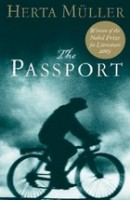
1passport

I got hold of this book via BookMooch soon after Herta Müller was awarded the Nobel Prize for Literature in 2009. Possibly because the press response wasn’t exactly encouraging (which of course it won’t be until a US writer wins), the book sat on my bedroom bookshelf for four years as a shining testament to pious intentions. I finally picked it up now because I’d read two books in translation, and decided to make it three of a kind.

It’s a very short book, just 92 pages, and it’s made up of short sentences. Here’s a random paragraph:

The skinner had given the stuffed animals to the town museum as a gift. He didn’t receive any money for them. Two men came. Their car stood in front of the skinner’s house for a whole day. It was white and closed like a room.

Sentence after sentence. Page after page. It proceeds in that staccato way. It doesn’t quite say what it’s saying. People do things, and say things, and see things. There are snippets of folklore, a bawdy song, symbolic objects, similes and metaphors as odd as the white room in that quote. You have to fill in the gaps, decode the descriptions. Only a handful of characters have names, the rest being known only by their professions or relationships. It took me until page 42 to realise I was in the middle of a narrative that I hadn’t been following. I started over. I’m glad I did.

It’s a terrible tale of the German-speaking minority in a village in Ceauçescu’s Romania. Uneducated, superstitious, despised by the Romanian majority, they live lives of quiet desperation and degradation. The village miller sets out to secure from the corrupt system a passport that will enable him, his wife and daughter to leave for West Germany.

I hated a lot of this as I was reading it: I just wanted to be told the story, to have a spade called a spade, rather than a headache being called a grain of sand moving around behind the forehead (at least, I assume that was a headache). But there is something mesmeric about it. I’m amazed that now I intend to immerse myself in that world again – not immediately, but when enough time has passed that I will be revisiting it rather than extending the current visit.

A couple of scrappy notes about the translation:

  • The English title draws attention to the plot, such as it is. The original German, taken from something the miller says at his lowest point, translates as ‘A man is nothing but a pheasant in the world’, and signals the sometimes enigmatic narrative mode.
  • There is a three-word glossary up the back. I could have done instead with a brief note at the start informing us that the original was written in German, that the action takes place in Romania (something that I’m guessing is obvious in the original but doesn’t become evident in the translation until we’re well under way), that most (all?) of the characters are German-speakers – in other words, filling us in on some things that are almost inevitably lost in translation.
  • There are one or two places where I completely didn’t know what was being described, and would love to know if it was because of the translation or the original. In particular, there’s a scene in which a woman is pleasuring herself or discovering she has some terrible disease – I’ll refrain from going into detail of the description here, but my confusion is genuine, and her husband’s comment, ‘So that’s how it is with your bladder, my lady,’ doesn’t make any sense either way. Perhaps this is the kind of thing that people mean when they say Herta Müller writes surrealism.

I suspect that this book is another that was a nightmare to translate, and it’s wonderful what a distinctive voice comes through in the telling.

PS: When I had uploaded all that I went to LibraryThing to post a version of it as a review there. And behold there was a very interesting post by Meisterpfriem, who had loved the book in German and been surprised at its lukewarm reception in Engish translation. I recommend it.
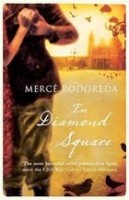
Mercè Rodoreda’s In Diamond Square with the Book Group

Mercè Rodoreda, In Diamond Square (1962, Translation by Peter Bush, Virago 2013)

1ids

Before the meeting: I came to this book with inaccurate expectations. Gabriel Garcia Marquez describes it on the cover as ‘the most beautiful novel published in Spain since the Civil War’, which I misread, lazily, as ‘about the Spanish Civil War’. True, the action of the novel spans the years of the Civil War, which is a major element in the story, but it would be quite a stretch to say the novel is about the war. The novel tells the story of Natalia, a naive, uneducated young woman from Gracia, then a poor area of Barcelona rather than what the internet now calls ‘one of the city’s hippest areas’. She marries a volatile young man whose entrepreneurial ambition fills their apartment, bizarrely and malodorously, with pigeons. The Civil War disrupts their family life when her husband and their male friends joins the militia – we see none of the combat, and none of the reasons for the war are discussed or explained, but we stay within Natalia’s narrow horizons, following her through wretchedness, deprivation, despair and unexpected happiness (though, to save spoilers, not necessarily in that order).

It’s a gripping story, with some brilliant images, but the thing that struck me most strongly was the language. Natalia is the narrator, and her voice is what makes the novel what it is. She begins:

Julie came to the cake-shop just to tell me they would be raffling coffee pots before they got to the lucky posy; she’d seen them and they were lovely, an orange split in two, showing its pips, painted on a white background. I didn’t feel like going to the dance or even going out, after I’d spent the whole day selling cakes and my fingertips ached from tying all those gilded raffia knots and handles. And because I knew Julie could manage on as little as three hours’ sleep and didn’t mind whether she slept or not.

She begins as she plans to go on, with leaps in logic (from the coffee-pot design to the question of whether she will go out or not, omitting to mention that Julie had come to take her there), syntax that doesn’t quite cohere (‘And because’ – huh?), attention to details that lead nowhere (‘an orange split in two’ etc), lack of orientation (who is Julie?), unexplained cultural references (are we supposed to know what ‘the posy’ is?), and so on. Then it took me a moment to figure out that the third they was a different they from the first two, that Julie is talking about the coffee pots, not the people who were raffling them, and because that tiny awkwardness feels like the kind of thing that happens in translation, I lost confidence as a reader , and as I read on I couldn’t tell how much of the narrative voice was Natalia’s and how much was the sound of Peter Bush wrangling the transition from Catalan into English. I wasn’t necessarily critical of the translation: perhaps this is one of those books that defies translation – as I imagine Malcolm Knox’s The Life to be. (A literal translation of DK’s ‘Well yeah … but no’ would probably leave Catalan readers floundering, but how else do you translate it?)

I read on, enjoying the book, but my unease about the translation persisted, and about a hundred pages from the end I turned to the Internet for help. I don’t know what I expected, but I found an excellent article from the British journal The Translator,Language and Characterization in Mercè Rodoreda’s La Plaça del Diamant‘ by Helena Miguélez Carballeira, which discusses the language of the book in the context of two previous translations. According to Ms Carballeira, Natalia’s discourse is what the boffins call escriptura parlada – spoken writing. Mercè Rodoreda sets out to ‘trace the discursive peculiarities’ of the uneducated Catalan working-class. Her speech is also full of features that mark it as peculiar to Barcelona, and is full of the euphemism, attention to detail and diminutives that mark stereotypically feminine speech. More than that, Carballeira argues (and I’m persuaded) that

Natàlia is a woman who feels uneasy with the very act of speaking. … The characteristics of [her] conversational, unmediated speech as a discursive device in the novel are rather predictable: there is an extensive use of idioms and colloquialisms, interjections and onomatopoeias. This yields a constant, highly idiomatic, non-straightforward use of language.

That is to say, Natalia is at least as big a headache for a translator as Knox’s DK.

A gauge of the difficulty of the task is the differences between translations. Carballeira discusses a number of fascinating examples. Here’s just one, quoted in a discussion of Natalia’s use of euphemism:

The original Catalan (1962):

I mentre em dedicava a la gran revolució amb els coloms va venir el que va venir, com una cosa que havia de ser molt curta.

From Eda O’Shiel’s The Pigeon Girl (1967):

And while I devoted my energies to the grand revolt against the pigeons, there took place what had to take place, and it seemed as if it would be over quickly.

From David H Rosenthal’s The Time of the Doves (1986):

And while I was working on the great revolution with the doves the war started and everyone thought it was going to be over quickly.

From Peter Bush’s In Diamond Square (2013):

And while I was waging my big revolution against the pigeons, what was brewing came, that they said would be a two-day wonder.

Having read this article when I was struggling, part way through the book, I had a much better time with the rest. Some of Peter Bush’s decisions had confused me. For example, he names Natalia’s husband Joe, possibly as what Carballeira calls a domesticating strategy, but when I read that his name is Quimet in the original I realised that the discord between his English name and his Catalan context had niggled away at the edge of my mind, creating a sense of unreality like the one in some CGI movies, where figures don’t quite seem to touch the ground. And another example: Joe/Quimet refuses to call Natalia by her name but calls her Pidgie, without explanation of where the name comes from – to my ear that sounded a bit like Piggsy, and so vaguely insulting, and it was a long way into the story that I realised it was short for Pigeon, and that Joe/Quimet was obsessed with those birds; in the original he calls her Columeta, which my computer translates from the Catalan as, you guessed it, Pigeon. Maybe to a British ear ‘Pidgie’ sounds more affectionate than ‘Pigeon’, but ‘Pigeon’ would have worked fine for me.

This experience makes me suspect that if I’m going to read books in translation a little bit of research will make the whole experience go better. As it happens I’ve been to Barcelona, so quite a few of the local references – Tibidabo, Parc Güell, etc – made immediate sense to me. If I hadn’t been there, I doubt if I would have bothered to get out a map, but it wouldn’t have been a bad idea. (I do think I was right, though, not to read the author’s spoilerish 1982 ‘Prologue’ until after I’d read the book.)

The meeting: We were astonishingly unanimous in our responses to the book. We’d all enjoyed it; we’d all been at least mildly disconcerted by the language, though when someone read a short passage aloud, its ‘written speech’ qualities were obvious; we’d all engaged with Natalia and formed strong opinions about Joe/Quimet; and I think we’d all had our heartstrings / tear ducts activated. There was an attempt to get someone to read the last couple of pages, which are full of sweet, kind-of-sexual tenderness, but no one was up for the challenge. We enjoyed the book so much we contemplated staying with Catalonia for our next meeting, and reading The Sun Also Rises, Homage to Catalonia and perhaps something by Colm Toibín. (We decided against it, and will be heading off to Norway instead with Karl Ove Knausgaard.)

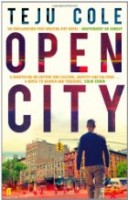
Teju Cole’s Open City

Teju Cole, Open City (2011, Faber and Faber 2012)

0571279430 Julius, the narrator–protagonist of this novel, is a psychiatrist by trade, but as far as we’re concerned he is a flâneur: we don’t quite have a word in English for such a person, one who strolls (flâne) around a city, observing people and things with a detached, intelligent curiosity, and no other agenda. Julius strolls from street to street, from church to bar, gallery to movie theatre to concert hall. He visits an old friend who is dying, phones a former girlfriend, has a casual sexual encounter, chats with the man who checks the air-conditioning vents on the subway, is mugged, runs into the sister of a friend from his teenage years. Almost always, he is moved by whim rather than intention, and when he does set out on a quest at one point, the quest comes to absolutely nothing.

The city is New York, though Julius visits Brussels for a spell and continues his flâning ways there. I didn’t read the book with a street map open beside it, but I expect that if I had I’d have known to within a block or two where I was on almost every page. The same goes for time: he visits and responds to particular films, concerts and exhibitions, and I’m reasonably sure that the date he saw them on could be approximated by a quick check of past issues of New York newspapers.

In a way, just as Julius’ wanderings trace the shape of the city, his encounters (not all of them are conversations) build a picture of the less tangible social and political world, mostly from perspectives other than the dominant one, as most of the people he talks to are not white – he himself is the Nigerian-born son of a German mother and a Nigerian father.

But the book is not the meandering bore or disguised tract that description may conjure up. True, it doesn’t have a central quest or conflict needing resolution. Also true, there are reflections on the state of racism and internalised racism in the US, on ‘political correctness’, on Middle Eastern politics. But none of the reflections amounts to a didactic ‘line’, and there is a quiet and unobtrusive overall arc. We get to know Julius, and start to wonder about him. He has an ambivalent attitude to African-Americans in general – welcoming the sense of connection but shying away from the enforcement of identity. He loves his old English professor and knows he is dying, yet visits him only twice over many weeks, and when he discovers on his third visit that his old friend has died, he resumes his peripatetic ways without missing more than a beat. There is a striking lack of affect in his account of a sexual encounter with a Czech woman in Brussels. His quest to find his German grandmother is oddly half-hearted. His music references are incredibly erudite, and you might start to wonder if ‘incredible’ might be more precise than it at first seems – that he might be straining to project an image of himself as a man of high culture. It’s not that we’re being given a coded alternative version, but we realise that, perhaps inadvertently, he is telling us a lot about what it means to be a mixed-heritage, middle-class African immigrant to the US. Perhaps it’s a sop to the conventional reader that there is a surprise revelation towards the end, but I found it both disturbing and deeply satisfying that Julius lets the revelation sit on the page with only a broad introductory comment, as if he is as stunned by it as we are.

I’m not sure what the title means. An open city, in the usual wartime context of the term, has declared that it will not defend itself in case of attack. Perhaps Manhattan is wide open, ready to yield its secrets to anyone who wants to walk its streets and buildings with eyes and mind on the alert. Or perhaps Julius is the open city of the title – laying himself out there without defensiveness.

Open City was one of the books I took home from our last Book[-swapping] Club. It took me months to actually pick it up because I’m generally suspicious of books and movies that treat New York as a cosmos. This isn’t one of those.

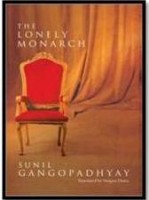
Sunil Gangopadhyay’s Lonely Monarch

Sunil Gangopadhyay, The Lonely Monarch (2005, translated from Bengali by Swapna Dutta, Hachette India 2013)

IMG_0723 My high school French and Latin teacher, Brother Gerard, taught us a healthy respect for the art of translation. When he wrote ‘Excellent attempt’ in the margin of one of my exercises, he explained that it was high praise, that all anyone could aspire to was an attempt at translation – the thing itself must remain forever elusive: if you stay too close to the original, your translation won’t sound like natural English, and if you produce something that feels natural in English you will have lost the feel of the original. Kumārajīva (343–430 CE), one of the sub-continent’s great translators of Buddhist texts from Sanskrit to Chinese, said that translation was like ‘chewing rice for others, which would not only lose its original taste, but also make people feel like vomiting’. (Translations of his statement differ.) So translators are heroic people who serve the common good, building bridges between cultures that might otherwise remain dangerously ignorant of each other, but they do so knowing that page after page, book after book, they must fail.

I don’t know any Bengali at all, so I can’t comment on the accuracy of Swapna Dutta’s translation of Sunil Gangopadhyay‘s Nihsanga Samrat. But it gave me that delicious sense of access to a place that would have remained closed to me without her labours. The eponymous lonely monarch is Sisirkumar Bhaduri (1889–1959), a pioneer of Bengali theatre, or at least a fictional stand-in for him, as this is a fictional rendition of the real Sisirkumar’s life. His theatrical project was to Bengal roughly what Louis Esson’s  Pioneer Players were to Australia, not quite a national theatre but a profound influence on audiences’ tastes, though the comparison underplays the significance of Sisirkumar. The theatre as he found it was ruled by Western conventions, women actors were generally prostitutes, the emphasis was on spectacle. He and his colleagues reached for a theatre that incorporated traditional jatra forms; his partner Kankabati was an educated woman who became even more acclaimed as an actor than he was; his plays were often adaptations from serious novels.

Calcutta (as it is called here) had a thriving theatre scene in the 1920s and 30s, rich with artistic ambition, greed, brilliant collaboration, vicious competition, surprising acts of generosity, sweet loyalty, despair, alcoholism, romance … Sisir, as he was known to his friends, was at the heart of it as an actor–producer. In a postscript to her translator’s note, Swapna Dutta gives brief introductions to twenty characters who were important personalities of the time ‘whom people outside Bengal might not know’: poets, artists, playwrights, scholars, political figures. Without this help, the sense of a flourishing cultural scene would still have been vividly realised, but for foreign readers like me the names would have passed in a blur (actually, they still mostly did, but now I knew the nature of the blur!). Some names didn’t need a note: the great Rabindranath Tagore is partly a kind of tutelary deity whose approval is beyond price for the younger generation, and partly the esteemed elder whose mould they need to break; Sunil Gangopadhyay himself makes a brief appearance as a young man among Sisir’s admirers; and Satyajit Ray, Bengali director of many great films including Pather Panchali, has a moment towards the end of the book.

Sisirkumar takes a troupe of actors to New York in 1930. The trip has its disastrous moments, but it starts with a rapturous welcome. A young Indian man living in New York explains:

Ordinary Americans hardly ever come across Indians. Most of them are under the impression that Indian women are either kept under lock and key or burnt as a sati; that young children who enter the river are devoured by crocodiles; that the roads in India are packed with sadhus and yogis, tigers and snakes. They are clueless about our art, culture, literature or music.

Although there’s no whiff of an instructional intention in this book, I’m at least a little less clueless for having read and enjoyed it.

(Sisirkumar Bhaduri does have a Wikipedia entry, but it doesn’t say very much, and IMDb lists the eight films that he directed and acted in, which were very much a sideshow to his career in the live theatre.)

Full disclosure: Swapna Dutta is a friend of mine, though we’ve never met in person. She contributed a number of elegant stories to The School Magazine when I was editor, including retellings from Hindu and Buddhist classics as well as original stories, and we have stayed in touch by email since. Hachette India sent me a complimentary copy of this book.

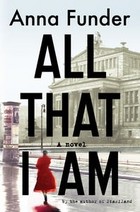
Anna Funder’s All that I Am

Anna Funder, All That I Am (Penguin Australia 2011)

1atia I read the first of this book’s three sections to the Art Student on the car trip from Airey’s Inlet in Victoria to Sydney. Given my proofreader past, this can be a punishing way to encounter a book – few things disrupt a book’s spell more than a reader-aloud complaining about misspellings, malapropisms, mixed metaphors, misquotes, or awkward turns of phrase. Embarrassing sex scenes will do it too (we may never get over The Slap). All That I Am stood up to the ordeal well, and we both enjoyed the trip. Mind you, the reading wasn’t disrupted by tears or cries of joy either. And I couldn’t tell at that stage whether hearing myself reading it all aloud made the different narrators’ voices sound much the same.

As everyone probably knows by now, the novel’s main characters were part of the left opposition to Hitler. Alternate chapters are told by Ernst Toller, a playwright and activist, dictating additions to his memoir in a New York hotel room in 1939, and Ruth Becker, a retired school teacher experiencing vivid memories in Bondi Junction in 2001. As both of them think back over their lives and their relationships, their shared story unfolds. Ruth, we are told in a note at the back, is based on a friend of the author. Ernst Toller was a real person, and so are the other main characters: Hans Wesemann, Berthold Jacob and the woman at the heart of the story, Dora Fabian.

Dora is a brilliant, charismatic, passionate revolutionary. She is Ruth’s adored cousin and intimate friend, and she is Toller’s assistant and the love of his life. Our narrators don’t have much to do with each other, but Dora has been central to both their lives. Through Ruth we see snatches of her childhood and later those parts of her activism that don’t revolve around Toller. Toller is very much the centre of his own world, both as the public figure Dora calls the Great Toller and as the private ma prone to depression and self doubt, but in 1939 he is acknowledging how important Dora has been to him in both spheres.

It’s a gripping yarn that takes us from the immediate aftermath of World War One to the brink of World War Two, with Ruth’s old age as a kind of integrated coda. I learned a lot about the resistance to Hitler in Germany and elsewhere, particularly  England. I can’t say that I was swept away by the story itself, but a slow burning emotional truth comes through about the importance of resistance, even in the face of apparently sure defeat: one of the characters says that they will all be forgotten by history, and it’s true that the Germans who opposed the rise of Hitler at huge cost to themselves tend to be ignored in popular versions of that history. The book captures brilliantly the gradual transformation of a group of revolutionaries who see their conflict with the Nazis, not necessarily as evenly matched, but at least on a scale that allows for cheerful awwbadge_2013derision, to their final condition as a dispossessed, demoralised group crying out from the margins and betrayed by those they held dearest. (I’m not giving you any spoilers there: most people know how that panned out.)

So that’s my second book in the Australian Women Writers’ Challenge. So far, so very good.

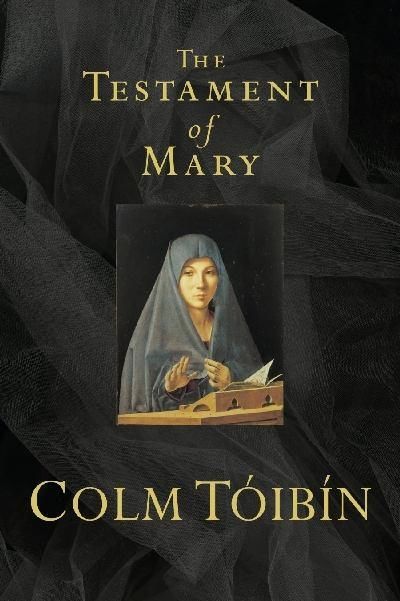
Colm Tóibín’s Mary’s Testament

Colm Tóibín, The Testament of Mary (Picador 2012)

1tm Last Christmas I read The Book of Rachael, Leslie Cannold’s debut novel about an imagined sister of Jesus. This year veteran novelist Colm Tóibín speaks in the voice of Jesus’ mother.

The Book of Rachael wasn’t completely satisfying as a novel, but it painted a convincing picture of what it may have been like to be poor or outcast or female in Jesus’ times, and entered convincingly into a world view where tales of miracles could be true without being true as we understand the word.

The Testament of Mary has different fish to fry – my trouble is I can’t tell what those fish are. There are passages that are pretty well straight retellings of incidents from the Gospel of John: the raising of Lazarus and the ecce homo. Other familiar scenes – the crucifixion, the miracle at Cana – are recast in ways that in effect claim that the Gospel is lying. For most of the book I felt I was reading notes towards a novel, something that would be fleshed out once a bit more research could be done, and a few crucial decisions made: is Mary’s son a charlatan followed by desperate misfits, and if so how does that fit with his bringing a corpse back to life? why are the Romans and ‘the Elders’ intent on killing him and all his followers, and in that context why does the head Roman try to save him? why have Mary flee the scene of the crucifixion before the actual death – might there be a less crude way of saying that the Gospel of John isn’t historically accurate?

I suspect that the heart of the piece is in something Mary says to the unnamed man who explains to her that Jesus died to save the world: ‘when you say that he redeemed the world, I will say that it was not worth it. It was not worth it.’ I read this as an emphatic repudiation of a 1950s Irish Catholic world view, and I go, like, ‘Whatever!’

It’s not a novel. It’s not an informed engagement with the gospels – it seems to assume, for example, that John’s gospel claimed to be a historical rather than a theological document. It’s not effective as polemic, because the thing it opposes is presented as arbitrary and fanatical. I don’t know what it is. Maybe Colm Toíbín felt that it was important to show his colours in the current struggle between fundamentalism and science, etc. OK, it does that – but I’m surprised the commissioning editor didn’t return the manuscript with a note: ‘Needs more work.’

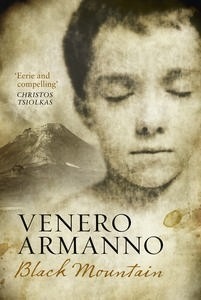
The Book Group climbs Venero Armanno’s Black Mountain, plus sonnet #4

Venero Armanno, Black Mountain (UQP 2012)

Before the Book Group meeting:
A hasty read of this book’s cover blurb led me to expect a kind of fictionalised misery memoir cum migration tale, a book where a second or third generation Australian explores his European heritage:

Beginning in the sulphur mines of Sicily over a century ago … Based on factual events … Italy … rural fringes of coastal Australia … a haunting exploration of what it means to be human.

There are elements of misery memoir: in the most powerful and memorable part of the book the main character, Cesare Montenero, is sold as a child into virtual slavery to work in Sicily’s sulphur mines in the early 20th century. But Cesare’s story is told in the literary equivalent of found footage, and the sulphur mines account for only 40 of the 200 or so pages of the found manuscript. A 30-page prologue has already set some creepy, horror-genre expectations, so that one’s antennae are out for hints of the darker, weirder underlying story. It’s hard to say much more without giving stuff away, but there are plenty of pleasing twists and turns. I’m glad I didn’t read any reviews beforehand, as one of the book’s pleasures is in the way appearances turn out to be deceptive, the ground shifts constantly under your feet, you can’t really be sure what kind of book you’re reading.

I enjoyed it, but can’t say I found it satisfactory. Too often I became aware of the plot mechanics, that someone was making it all up. A gauge of my lack of engagement is that I kept wanting to have a conversation with the copy editor: ‘If we’re going to opt for the US practicing,’ I wanted to ask her/him, ‘why not consistently use US spelling, like sulfur?’ Or, ‘Are sure you shouldn’t have queried whether resiled to should have been resigned to?’ There are more such moments, and the fact that I noticed them may say more about me than the book, but it does indicate I was less than fully engrossed.

After the meeting:
This was an unusual meeting. The group had been going for exactly 10 years last night, so there was much taking stock and reminiscing, and passing on of lore to those of us, like me, who weren’t there at the start. But our in-house facilitator made sure we each had a moment to give our personal take on this book, and uncharacteristically a consensus emerged: the book was OK, no one hated it, but all but one of us found it fairly ho-hum. The sulphur mine section got a general thumbs up – one chap had read the book a while ago and had trouble remembering anything else about it. And, as someone said, we enjoyed the brothels of Paris. But, while I think we all read to the end, the overarching plot failed to impress. Most of us didn’t feel the sulphur mines and the brothels to be integrated, so when those parts came to an end, the wheels of the plot had to start from a virtual standstill. The one person who had a different reading argued for a deep thematic coherence, but I won’t say more because it really is a book that can be spoiled by too much being given away.

And the obligatory sonnet:

Sonnet 4:
Ten years and more than 60 books
discussed by us (and mostly read) –
by builders, architects, home cooks
and sundry ageing chaps, well fed
each time in mind and body. Park,
Malouf, McEwan, Stead, Houellebecq,
Coetzee (twice), White, Ghosh (a naval
title), Falconer, Miéville:
We all loved Tolstoy. Tsiolkas split us.
Tonight: Armanno, reminiscence,
but mostly – here’s the Book Group’s essence –
not so much a tute on lit as
time for sharing – hip, hooray-able –
lives and minds around a table.

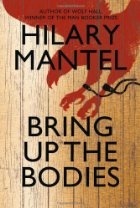
Hilary Mantel brings up the bodies

Hilary Mantel, Bring up the Bodies (Fourth Estate 2112)

20120704-175516.jpg I’m probably the only person of my generation whose grasp of what it was like to live in the courts of the Tudors comes mainly from an article written for The School Magazine by award winning children’s novelist and occasional commenter on this blog, Cassandra Golds. ‘The Princess in the Tower’ focused on Elizabeth, imprisoned during the reign of her half sister Mary, but there’s a memorable paragraph . It likens the court to a jungle where elegant people circled each other like wild beasts, seeking the advantage. Sadly, I’m writing this far from home, so can’t give you a quote. (Cassandra, if you read this, maybe you could add one in the comments section?) [Added later: Cassandra has commented with the passage which is even more apposite than I had remembered. Thanks, Cassandra.]

Even more than Wolf Hall, to which it’s a sequel, Bring up the Bodies validates that image in its portrayal of the court of Henry VIII. But at its heart there’s Thomas Cromwell, no wild beast but a methodical tactician, serving the king and good of the kingdom, receiving insults with apparent stolidity but forgetting nothing, keeping his own counsel, taming some beasts and destroying others.

I was reading this in a cafe in Goreme in Cappadocia, when an Australian woman (the cafe offered a decent flat white, much sought after by Australian coffee drinkers) called from several tables away.

Australian flat-white-drinking woman: ‘How are you finding that? I loved Wolf Hall but I found that one a bit hard to get into.’
Me: I’m loving it. I think it’s miraculous the way she gets right inside the minds of people from that time.
Australian flat-white-drinking woman’s grey-haired male companion: it’s all in the mind.
Me: Um, yes.
AFWDWGHMC: It’s past lives.
Me: Oh, you think Hilary Mantel was there in a past life.
AFWDWGHMC: Not just her, everybody.
Me: Well, that’s a conversation stopper if ever I heard one. (I didn’t say that, I just wish I had.)
AFWDWGH: She’s written another book, you know, a nonfiction book called Anne Boleyn, Witch.

So there you are. If anything was going to make me believe in past lives, it might well be this book. And if Hilary Mantel has written that nonfiction book, I wish she had spent the time on the next novel about Cromwell. It’s not that I want to see him get his comeuppance, as of course he will. I just want more of him. And I worry about his sweet, naive son Gregory.

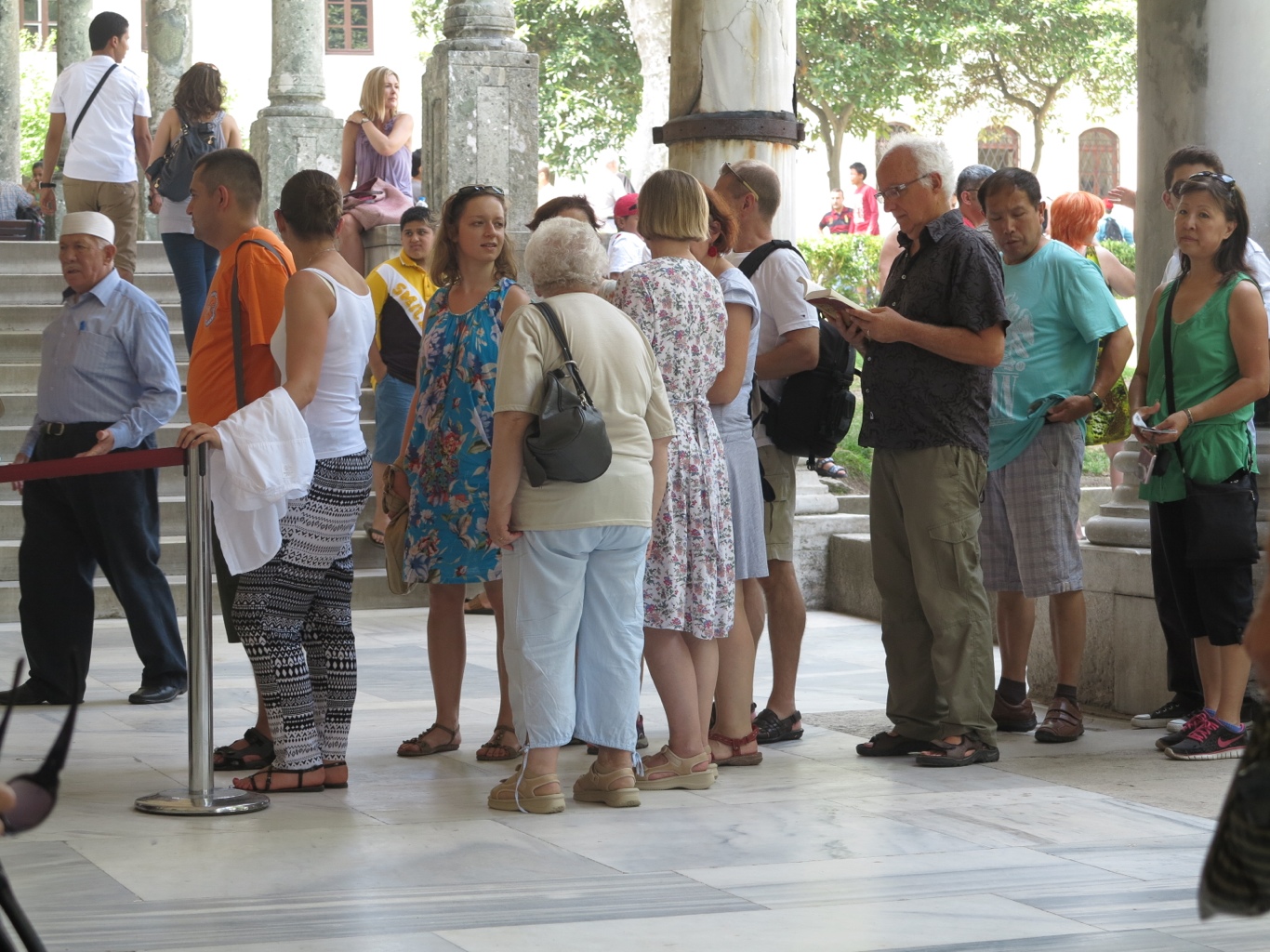
PS: I read this in Turkey, among relics of rulers at least as much at the mercy of their whims as Henry Tudor. I wonder how English history might have gone if Henry could have had a harem. Surely if he had four wives at a time the need to have a son might have been less desperate. Mostly I didn’t take the book on outings, preferring to take thinner volumes. But here I am, reading it in the queue to see the treasures in Topkapi Palace.

20120715-133643.jpg

Neal Stephenson’s Reamde

Neal Stephenson, Reamde (William Morrow / Atlantic Books 2011)

At 1044 pages, this is to a normal novel what The Wire or The Sopranos is to a feature film. Characters who loom large in the first couple of hundred pages are killed as summarily as any TV character whose actor has had a better offer. New characters turn up who come from whole other continents. Plot strands that appeared to be central are apparently resolved after a mere 350 pages, and, to mash my metaphors a bit, other strands arise from the ashes and shards that remain of them. As the action moves to a new location, that location is described in loving detail, usually over a couple of pages. Yet, with all those shifts of direction and detailed evocations of place, the narrative stays gripping.

Neal Stephenson is the man who raised the info-dump to the level of an art form. In the climactic battle scene, for instance, when two sets of jihadists are shooting it out with a heterogeneous collection of good guys, he pauses to notice that when machine-gun bullets hit the walls of a log cabin, the freshly exposed wood shows up starkly blond against the weathered outside wood. And elsewhere in the same battle, a character has time to reflect that one’s mental functions are less sharp when one is burning fat than when burning carbs. But there are none of the spectacular digressions of earlier books – no lectures on Babylonian mythology, nanotechnology, computer cryptography, advanced mathematics, or the fashions of the court of Charles the Second of England.

If you haven’t read any Neal Stephenson, I wouldn’t recommend starting with this. Snow Crash is a fabulous cyberspace thriller; Cryptonomicon goes deep into Second World War cryptography and modern electronic security; The Diamond Age is set in a world where nanotechnology is achieving wonders, yet has at its heart a book for small children (and a small child who reads it); The Baroque Cycle (Quicksilver, The Confusion, The System of the World) is a rollicking picaresque novel and also a fictionalised account of the dawn of capitalism, the Enlightenment and the scientific age. Compared to any of them, Reamde is just a thriller.

But it’s wonderful, improbable fun. You can get an idea of the plot from this little ‘story so far’ passage from page 827 (you need to know that T’Rain is a massively popular and profitable multi-user internet game, and it may help to know that Seamus is a semi-disgraced but still potent US secret operative and ‘these three’ are all in their early 20s and not generally inclined to risky living):

Seamus had no idea what level of precautions was appropriate here. Apparently these three had left half of the surviving population of China seriously pissed off at them, as well as making mortal enemies with a rogue, defrocked Russian organised crime figure. In their spare time they had stolen money from millions of T’Rain players, created huge problems for a large multinational corporation that owned the game, and, finally – warming to the task – mounted a frontal attack on al-Qaeda.

I confess that my enthusiasm was beginning to flag in the prolonged climactic battle, where not a lot was happening besides stuff blowing up and people shooting at each other, but generally this was an excellent summer, even all-of-summer, read. And what if my teetering To Be Read pile is calling me to  a world history of genocide, a revisionist account of the bombing of Hiroshima and Nagasaki, and the next Book Group title? Neal Stephenson is a major Guilty Pleasure, and I am unrepentant.

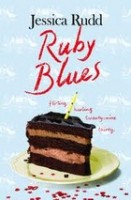
Ruby Blues in the car

Jessica Rudd, Ruby Blues (Text 2011)

This was our read-aloud on the car trip from Melbourne to Sydney, and it served well enough. I had a sinking feeling at first, as I was required to deliver a number of strained comedy routines that didn’t quite work, but by about page 20 I found I was laughing aloud quite a lot. It’s a genre piece, chick lit: much description of clothes and make up, a touch of Feminism 101, quite a bit of embarrassment of the heart and loins (I was reminded of Marieke Hardy’s TV creation Laid). The eponymous Ruby is the chief adviser to an Australian Prime Minister whose popularity is plummeting, and the chick lit adventures are supplemented by a plot involving political intrigue and blackmail, which manages – just – to provide a central thread.

One of the selling points of this book is that the author is Kevin Rudd’s daughter. This creates an expectation that though it’s manifestly fiction, the book will build on insider knowledge. Well, I wouldn’t put much store by such an implied promise. For example, fairly early on someone reminds Ruby that she has to prepare the PM’s briefings for Question Time, and 30 minutes later she has the folder ready. Um, without wanting to make too much of it, I’ve heard the odd anecdote from a PM staffer, and I’m pretty sure that job takes something closer to four hours. And Ruby’s intern- assistant Bettina, the source of most of the laughs, is a vastly improbable creation.

That, plus little things like poignant being used by Ruby, presumably with Jessica’s approval, where in English we would say pertinent, and a stretch towards the end where nothing is happening except some characters renting fancy dress, makes me slow to recommend the book. But we did laugh. And we did read the whole book, which is more than I can say for AC Grayling’s Descartes, a much more substantial text that just couldn’t keep the driver awake and was discarded after about 30 pages.