Tag Archives: Omar Musa

Omar Musa’s Parang

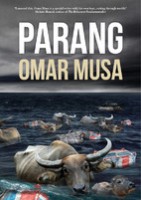
Omar Musa, Parang (©2013, Penguin 2014)
1parang

Omar Musa is a bit of a phenomenon: rapper, poetry slam champ (see below), TEDxSydney talker, he has produced a number of CDs and featured in a number of YouTube videos. Parang, first published by Blast! Publishing, an entity so small I couldn’t find it on the www, includes some poems that here make the transition from the stage to the page, and others that are definitely starting life as page poems.

The range of subject matter is wide. Asylum seekers, violence against women, alienated suburban life, the possibility of humanity’s disappearance, street lie, all rendered with exuberant rhetorical flourish of a public performance. In ‘My Generation’, there’s even a homage to Allen Ginsberg:

My generation
was populated by boozehounds and pillheads
crude clowns and bedspreads
stained with the neon dreams of cocaine fiends.
I mean,
the diamond-flooded visions of sex kittens
who sweat bullets, glitter and Chanel.

The most interesting poems are in the first section, ‘Parang’. Mostly shorter and more contained, perhaps more carefully shaped, these engage with Musa’s Malaysian heritage. Where Seamus Heaney famously compared his pen to a gun and a spade, and chose the tool over the weapon, Omar Musa takes the parang, the distinctive Malay machete, which can be either, as an emblem of what he is attempting in his poetry:

Parang,
______guardian angel of gangsters and pirates,
______headhunters and thieves.
Parang,
______patron saint of mob rule and blood bath,
______of the man who runs amok through the village.
Parang,
______guiding spirit of the housebuilder, the tool carver,
______the opener of paths.

In ‘The Parang and the Keris’, he contrasts the parang to the keris, the wavy-bladed, highly wrought dagger of heroic tales:

This parang is not heaven forged,
______blade five-waved,
smelted from meteoric iron, divine.
But it is mine.

The poetry has the spirit of humble making that this image claims for it: a hard poem about his father, a celebration of his grandmother, a piece on the inevitable disappointment and also joy of discovering the real place behind family stories of heritage (‘A Homeland’). The poetry also has the edge of danger implied in the parang image, particularly in ‘FELDA’ and ‘sunyi’, both of which demonstrate that Musa’s rage for social justice and environmental is not limited to a western context.

Musa is an electrifying performer. You can see him here in top form with a fabulous audience at Bankstown Poetry Slam. It’s nine minutes or so, and well worth the time. In case you need some of the noise explained, at slam poetry the audience is encouraged to express enthusiasm by clicking fingers and stamping feet.
Contemporary Asian Australian Poets

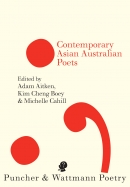
Adam Aitken, Kim Cheng Boey & Michelle Cahill, Contemporary Asian Australian Poets (Puncher & Wattmann 2013)

1caap

This book seems to be part of a current efflorescence of attention to Asian Australian writing, and of Australian attention to Asian writing. The current Southerly focuses on ‘Contemporary Diasporic and Postcolonial Poetries’, with particular attention to Asian Australian (or Asian-Australian, or Asian/Australian etc) work. The recent OzAsia Festival in Adelaide included a two-day OzAsia on Page component which featured ‘significant and contemporary Asian and Australian voices’. Vagabond Press’s Asia Pacific Writing Series is looking formidably good.

It’s hard to imagine a more disparate gathering of poets than those collected between these covers, not just in nationality or ethnicity (‘Asia’ is a big and varied place, and there seems to be someone here from just about every part of it except, interestingly, Japan), but in just about every other conceivable way as well. The poetry ranges from work with the exuberance and directness of Spoken Word to compressed, elliptical, allusive capital-L Literary offerings. It’s the poets who are Asian Australian, not necessarily the poetry, so though there are poems of the pain of loss of home and culture (I was going to say ‘nostalgia’, but that’s a word that no longer conveys any sense of real pain), poems that explicitly deal with or enact cultural duality or hybridity, poems about multicultural relationships, poems that tackle white racism head-on, and poems exploring questions of cultural identity, there are also poems that don’t do any of those things.

There is a brief introductory essay from each of the three editors. Adam Aitken outlines and celebrates the extraordinary range of voices and attitudes in the anthology, and the range of possibilities in the term ‘Asian Australian’ itself. Kim Cheng Boey focuses on the experience of migration:

Home is never a given, for first-generation migrants, and continues to be a complex issue for subsequent generations. Being beneficiaries of two or more cultures, and entangled in a complex web of affiliations and attachments, they are wary of identity politics and monolithic formations.

Michelle Cahill points out the anthology’s significance in bringing greater visibility to Asian Australian women poets, who experience ‘the double exile of migration and mediation of patriarchal terrain, so inimical to the female psyche’. Seventeen of the 37 poets in this collection are women, and very few Asian Australian women have been included in any previous anthologies.

All three introductory essays are worth reading, and they give invaluable guidance to the poetry. But in the end, it’s the poetry you pay for – and I’m happy to report that I was immersed in this book for days, being dragged from one engaged mind to another. Christopher Cyrill, whom I have previously known as the events organiser at Gleebooks who always spoke too softly when introducing people, here turns out to have a clear, strong, brilliantly modulated voice in the extract from his prose poem novella Quaternion (and that’s me saying it who hates extracts and doesn’t much care for prose poems). Andy Quan’s ‘Is This?’ is a brilliant abstraction of the moment of anticipation on meeting a new person. Omar Musa contemplates buying a pair of shoes and redefines the notion of choice. I finally get to read Kim Cheng Boey’s ‘Stamp Collecting’, which I’ve heard him read at festivals and loved, and his ‘Plum Blossom or Quong Tart at the QVB’ – what can I say? Eileen Chong is here, with some of the finest poems from ‘Burning Rice’. I was about to read Debbie Lim’s ‘How to Grow Feet of Golden Lotus’ aloud to a friend and then realised I wouldn’t want to inflict it on anyone who didn’t have plenty of time to recover. Merlinda Bobis’s ‘Covenant’ (‘after you bomb my town / I’ll take you fishing / or kite-flying or both’) conveys the poignancy (another word that has lost its hard meaning) of peace for a defeated people. Jaya Savige’s ‘Circular Breathing’ could hardly be more mainstream Australian, a kind of version of Les Murray’s ‘Perfectly Ordinary Rainbow’ set it in Europe and acknowledging Indigenous Australia (with only the barest allusion to Asia, but who’s counting?). Louise Ho’s ‘A Veteran Talking’ is a killer poem, a chilling, hard, dry killer. I’m glad Adam Aitken included a decent, brilliantly varied selection of his own work.

Please don’t let this book be seen as a marginal anthology of poems by the marginalised. It’s a fabulous collection and belongs at the centre of our culture.