Tag Archives: Pam Brown

The sixty-eighters’ young appreciators

Beautiful day in Sydney, what better to do than take the bus into town for a free event at the Museum of Contemporary Art. ‘The Young Appreciators‘ was part of the fourth floor exhibition, avoiding myth & message: Australian artists and the Literary world (capitalisation not mine!), which seems to be mainly about artists and literary folk from the late 1960s and on – that is to say, not so much Sidney Nolan–Ern Malley as Tim Burns–John Forbes.

Today is the first time I’ve realised that there is a group of Australian poets known as the 68ers, or perhaps the 69ers: John Forbes, Robert Adamson and John Tranter (whom those in the know refer to by second name only), and quite a few others who are sometimes hard to see because of the long shadows cast by those three. The three speakers at today’s event are younger than the 68/9ers: the oldest admitted to 39, and I’d guess the other two were quite a bit younger. That is to say, none of them had been born in those days when I used to go  regularly to poetry readings to hear John Forbes, who I thought was a bit of a smart aleck and not as interesting as, say Martin Johnston (another 68/9er who doesn’t seem to cast such a long shadow).

Anyhow, it was fun. The first speaker spoke of Vicki Viidikas, beginning her talk by saying she hadn’t known much about her until after she’d accepted the invitation to talk. Since I’d heard the ABC radio programs that she based most of her talk on (with acknowledgement), I can’t say I was riveted. The second tackled John Forbes, mostly, as she said, in terms of marginalia and biography – mentions of herself she’d found in published Forbes letters, for example. It was in her talk that I became aware that those poets of my youth have since become the subject of academic attention. The third, the elegant poet Tim Wright, speaking softly and swiftly enough to be near to incomprehensible to me, talked about Pam Brown, visibly writhing with embarrassment at having the subject of his talk actually in the room.

I loved the moment during the brief question time when Kerry Leves, another of the apparently short-shadowed 68/9ers, admitted that when he’d seen a particular person’s work on a table in the exhibition, he’d said, ‘I don’t remember her!’ It’s a small world, the world of Australian poets and artists.

And I got a real hand in my understanding of Pam Brown’s poetry. I managed to hear Tim Wright say that her work was in many ways similar to Jennifer Maiden’s, but that whereas you tend to read one of Jennifer Maiden’s poems right through to the end, and when you do you feel you’ve learned something (a true statement), with Pam Brown’s work it’s not like that. You tend to stop and ponder a phrase, stare into space, let it sink in or just be distracted (he called her the master of the poetry of distraction, or something of the sort), then go back and read it again: it’s perfect for reading on public transport. I realised that my unexamined working assumption that reading is a linear process – you start at the beginning and go to the end and derive meaning on the way – has made quite a lot of poetry hard to enjoy. And I do read it while walking the dog — surely picking up a bag of dog poo or playing tug-of-war with a stick between lines should have put me in the perfect state of mind. I’ll try again, not so much harder, as with less resistance to the forces of distraction.

My book club swag

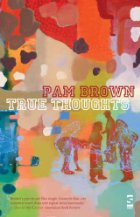
Pam Brown, True Thoughts (Salt Publishing 2008)
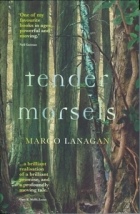
Margo Lanagan, Tender Morsels (Allen & Unwin 2008)
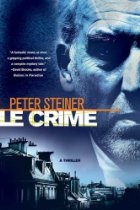
Peter Steiner, Le Crime (Thomas Dunne Books 2003, 2008)

Apart from the conviviality, the food, the cards, the ever expanding list of draconian (and largely ignored) rules, what I love about our book club is that it makes me read things I might otherwise not have touched – books about secret rendition and Guantanamo Bay, someone else’s favourite detective novels, intimidating poetry.

One of the welcome consequences of my self-imposed task of blogging something about every book I read is that it pushes me to reflect on my reading.

True thoughts

So with Pam Brown’s True Thoughts I’m doubly blessed: without the book club I doubt I would have read it, but here it is with an affectionate inscription to one of the club members; without the blog my mind might not have lingered on it any longer than it took my initial bemusement to fade. But here I am, remembering that poetry usually requires the reader to do a little work, and knowing that I would be revealing myself as an unforgivably lazy reader if I just wrote something like, ‘I don’t get it,’ or even, ‘I don’t grasp how these pieces hang together to make poems — I can barely tell where one ends and the next begins.’ (By pure serendipity, after I’d written that para I heard a Poetry Off the Shelf podcast in which Matthew Zapruder talks about immersing himself in John Ashbury’s poems because they moved him somehow even though he didn’t understand them at all, so I’m clearly in good company, and I imagine Pam Brown would be happy to be discussed analogously to Ashbury.)

So, in spite of feeling that I needed someone to take me by the hand and explain how to read Pam Brown’s poems, I went back, took my time, ruminated, savoured, absorbed and, eventually, enjoyed. It was a fascinating process. At the start I was like a colour-blind person looking at one of those red-and-green patterns, then with sustained, though not strained, attention it was as if the colour-blindness healed and the formless array of dots and squiggles reorganised themselves before my eyes into elegant shapes. For example, ‘Peel me a zibibbo’ begins:

I could go [extra characters are spacers &  meant to be invisible]
oooooooin any direction
but it’s best that ooohere and now
ooI remain lesbian,
ooooo keep my vanishing cream
sealed.

On first reading, this seemed little more than verbal noise, a bit like the start of an Ern Malley poem. And in the middle of the poem, there’s this:

imperfection in kindness
ooooooocomes with the void,
oyou need to
ooooochoose
ithe ‘I’m feeling lucky’ google option.

To which I said, ‘Huh?’

I still don’t really get this second quote, but now that the green dots and the red dots have sorted themselves out, I do get that the first quote is meant to tease, and not meant to yield its meaning until the last line, where she addresses the poets and others whose names have cropped as the poem meanders with apparent aimlessness through a day in the life of the poet, and we realise they are all men:

Hi Kurt, ooooooo oooooooooohi John T,
oooo
hi Nick, oPaddy, oooohi Shakespeare,
ooooooo
opeel me a zibibbo
ooooooo
ooooooo ooooo would you,
ooooone of you guys?

(A zibibbo, as a note up the back tells us helpfully, is a delicious kind of grape.) The first lines suddenly yield their meaning. The busy-busy Lesbian poet, after making workaday contact with male poets and artists alive and dead, indulges for a moment in a fantasy that she’s some kind of Mae West femme fatale surrounded by male attendants. And I am amused.

tendermorsels

Tender Morsels an exception as book club books go: I would have read it with or without the BC’s agency. In fact, I’ve been wanting to read it since it came out nearly 12 months ago. I gave it as a Christmas present to one of our members, secure in the knowledge that it would come to the table at one of our meetings. When it did surface, I was a little taken aback when the person offering it, she to whom I’d given it for Christmas, said she’d stopped reading at about 40 pages because she didn’t want to go on reading a litany of suffering. And I confess that when it was my turn, I was close to giving up on page 40 myself. But I read on, and can report that on page 42 everything changes!

This is a wonderful book, and the gruelling first movement is absolutely essential. We need to know just how much the heroine suffers, so that we understand her need to escape, and when other characters (and possibly the back cover blurb as well) make assumptions about what she is avoiding, we know that they completely fail to grasp the strength of character that has enabled her to survive and function as well as she does. The fairy tale ‘Rose Red and Snow White’ plays through the story beautifully. The use of language is exhilarating. Though in one sense things are resolved by about the two thirds mark, there are unexpected twists and turns right to the very last page. Margo Lanagan walked across in front of my car when I was stopped at lights in the city recently. She looked like just another person on her way to an office job. I wondered how many of those others crossing the street were also total geniuses in disguise.

lecrime

Le Crime‘s cover quotes compare Peter Steiner to John Le Carré, Len Deighton, Peter Mayle, Agatha Chsitie, Robert Ludlum, Alan Furst and Graham Greene. I have no idea how embarrassed the quoted reviewers are to see their phrases taken out of context like that. The book is not in the league of any of those writers. It creaks, its psychology is implausible, the plot is completely silly, and the structure barely holds up – but it’s a quick, enjoyable read. I liked it mainly for a flashback that lasts for three of the 26 chapters, in which the hero goes on a long walk through the French countryside, starting at Charles De Gaulle Airport and finally crossing the border into Spain (though we don’t go all the way with him). P and I have just booked in for a much shorter walk in France later this year, supported as befits our ageing selves, and these thirty-odd pages make it seem like a very good idea.

Ready for the next Book Club meeting now, I am.