
Raewyn Connell, Trans Lives: Social Realities Across the Globe (Polity 2026)
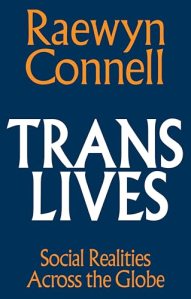
Raewyn Connell is an Australian social scientist who has written widely on education and gender issues. She is also a trans women. She brings a scholarly insider’s perspective to this short book on trans issues. The back cover does a nice job of summarising:
Raewyn Connell gathers the evidence about the lives of trans women and men, hijr, travesti, and other groups around the world. She looks at the forces shaping trans lives, including medicine and its limitations, precarity and poverty, unequal gender relations, the role of sex work, the state and the corporate economy. She discusses what is behind anti-trans campaigns, criticising the simplistic idea that ‘transphobia’ explains these, suggesting more potent causes. Finally, by exploring the creative ways trans groups have organised, she argues for the contribution they can and should make to solving our shared contemporary crises.
Written in clear and vivid language, this book offers illuminating new perspectives on gender transitions, and on gender itself.
In a field that often features mudslinging polemic from one direction and rigid insistence on correct language from the other, the book’s first sentences set a steady, good-humoured, magisterial tone:
Call it sex change, gender reassignment, gender affirmation, or gender transition. It is a very intimate and a very public process. It often means changes in the body, and always means changes in the way the body is seen by others.
‘Call it what you will, here are some realities.’ The book is interested in groups more than individuals. While acknowledging that voices from the individualistic USA tend to frame the way trans issues are discussed all over the world, it casts its net wide, citing scholars from Africa, Latin America and Asia, and reporting on personal visits to some of those places.
The most influential ideas in this discussion come from the global North, especially the USA. But most trans groups actually live in the post-colonial, majority world. Any attempt to understand transition and issues around it must take careful account of their experience. (Page 2)
Careful is a good word. The book does feel careful, not as in treading on eggshells, but handling with loving, scholarly care. Even its flashes of radical lefty-ism feel careful. On page 87, for example, Connell writes, ‘Perhaps the most researched of all social divisions, class is also the most denied.’ Or this on page 102: ‘Populist and fundamentalist influence has surged; the liberal oligarchies called “democracies” are in retreat.’
The most interesting bit of information about trans politics worldwide is that although homosexuality is vehemently condemned in Iran, in 1986 the Ayatollah formally declared that change of sex was not forbidden under Islamic law – and a bureaucracy now exists to deal with gender transitions in that country.
There’s an excellent discussion of gender, as it concerns people who are not trans as well as those who are. First, Connell questions the term ‘cisgender’ for a number of reasons, of which I really like the third:
It gives far too rosy a picture of sexed bodies and gender identities being ‘aligned’ … Cisgender people, it seems, have no gender trouble. They are the normals, the sun shines as they sit around their swimming pools in their married couples … The image of trouble-free conformity conveyed by the concept is unreal.
Humans share the ‘clever device’ of sexual reproduction with many animal and plant species. As humans (or, as she says, humanid apes) developed, ‘the process of biological evolution was gradually mingled with, and then outpaced by, the social dynamic of history’. She uses the term social embodiment: our bodies are given us by evolution, but ‘how they work in practice is given to us by our history’:
Our lives are both social and biological, and these realities are necessarily interwoven. There is not an either/or.
That is true of food, shelter, sexuality, and also of gender. I’m truncating her line of reasoning terribly, but what follows is that gender can be thought of as a project – that is, individuals respond to situations and expectations, and make their own paths. We all do this. For trans people the gender project is not ‘aligned’ with biology. The concept of gender dysphoria focuses on the emotional pain of this difference. As I understand Connell’s account, a trans person is someone who just knows that, for example, he is a girl even though his body is male. Any emotional pain, such as a sense of being betrayed by one’s body at puberty, is a consequence, not a cause. Some people who have this knowledge manage to conform to social expectations, others struggle to act on what they know of themselves. Some are lucky enough to find a community, a group, that they can join.
There’s a lot more. The history of trans medicine is fascinating. Likewise the placing of trans struggles in the context of other social realities including women’s issues and class struggles.
I’ll just draw attention to two more things, both aiming to break down the sense that trans people are inevitably set apart from the rest of humanity.
The cover blurb mentions that Connell criticises the USA-originated term transphobia. Her most interesting objection to the term is this:
I am concerned that the concept of ‘transphobia’ loads the responsibility for bigotry onto the general population, and lifts it off the right-wing politicians, bishops, journalists, sectarian feminists and other ideologues who have so visibly been stirring up fear and hatred recently. Even if we assume a vague popular prejudice in the background, that explains neither the wild exaggerations of supposed threat nor the spectacular cruelty of recent anti-trans campaigns.
The first thing I saw when I opened the book was the final entry in the ‘Notes and References’ section, which refers to the parable of the Good Samaritan in the Gospel of Luke:
Luke’s text was compiled at least half a century later, yet this seems likely to be a valid oral tradition about Jesus. It is consistent with both the style and content of his social teaching generally attested.
I love that careful framing of the Biblical quote as a historical resource of a particular kind. When I reached the section ‘Solidarity’ in which the Good Samaritan is mentioned, I was pleased all over again:
The point of the story is the despised outsider giving help, when the privileged do not.
Trans groups … have some resources: energy and agency, a history and distinctive experience, creativity, capacity to organise. Loving our neighbours, using those resources in cooperation with them, is the best thing we can do.
I know very few trans people, but those I know are well placed to rise to this challenge.
I am a man of settler heritage who has been alive for almost a third of the time since Arthur Phillip raised his flag on the shores of Warrane. I wrote this blog post on the currently rain-soaked land of Gadigal and Wangal of the Eora Nation. I acknowledge their Elders past and present and welcome any First Nations readers.


