
Kit Kelen, Food of Love: concert pieces / 101 poems (Flying Island Poets 2026)
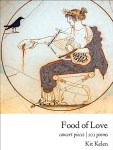
‘If music be the food of love, play on.’ Anyone who did the Queensland Junior exam in 1962 will recognise that as the opening line of Shakespeare’s Twelfth Night, which we read with commentary at least four times over the year. (Oddly, though I was in a class of 15 year old boys, I don’t remember any sniggering about the play’s gender-based comedy, but that’s another story.)
Each of the 101 poems in this pocket-sized book includes the name of a piece of music as a subtitle, and often the combination of title and subtitle could stand as a poem by itself. For example, ‘placating a serial killer / Rimsky-Korsakov’s “Scheherazade”’ or ‘we sing what the ghost sings / “Waltzing Matilda”’. Just the titles give joy. My favourite title-as-mini-poem is ‘trout as earworm / Schubert’s “The Trout”’.
Most of the music is classical, but the book casts a wide net – ‘The Teddy Bears’ Picnic’ and the theme tune from The White Lotus both get a guernsey.
What the poems do with their musical ‘sources’ varies widely. They might describe the music, as in the first line of ‘at the castle keep / Rimsky-Korsakov’s orchestration of Mussorgsky’s “Night on Bare Mountain”’ (page 38):
great insect or whirr of the orc hoard
They might enlarge on the music’s theme or narrative – as in ‘the cloud sorter’s dream / Joni Mitchell’s “Both Sides Now”’, or ‘numanah numananah and where are we now / Ron Grainer’s Dr Who theme’ (page 103):
someone must yet invent this planet

they have already in time to come
in time for supper sometimes
Some play with the associations the music has gathered over its lifetime – so Rossini’s Barber of Saville has inspired ‘on the occasion of Bugs Bunny’s 80th birthday’.
There’s nothing obvious or facile in the way the poetry does these things. At the book’s Sydney launch at the Addison Road Writers’ Festival last month, Peter Boyle described Kit Kelen’s poetry as ‘cubist’. Whether or not you know the relevant music, you have a sense that the poem is looking at it from a number of points of view – bouncing off it, coming back at another angle, sometimes going off and doing its own thing. This can make for difficulty, even incomprehensibility, but there’s pleasure in it.
I usually single out one poem when I write about a poetry book. Here, rather than my arbitrary choice of page 79 (my age), I’m looking at page 101 (may I live so long): ‘Cordelia’s song / John Cage’s 4’33”’:
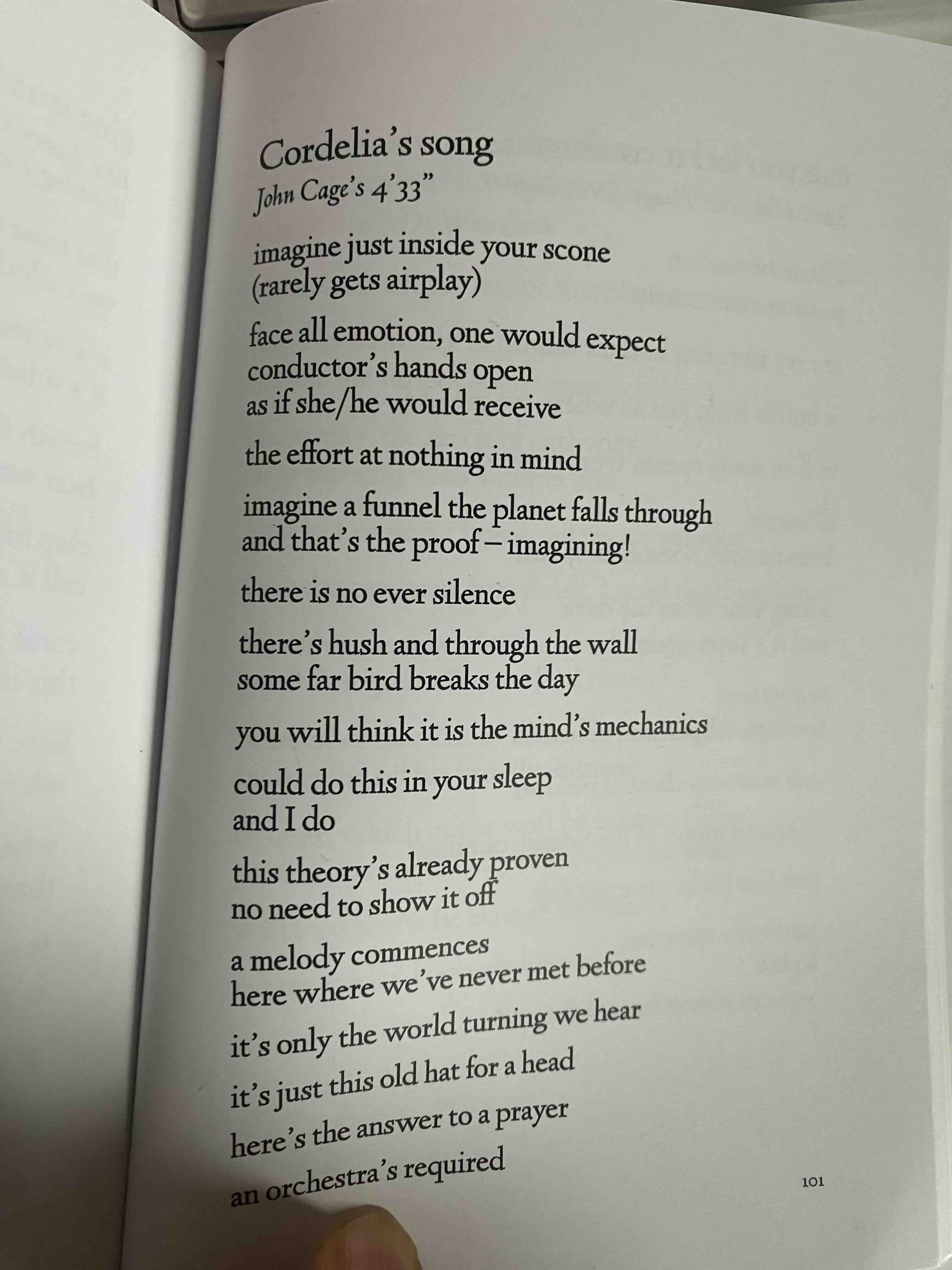
I love the pairing in the title. In case you need reminding, Cordelia is King Lear’s favourite daughter who, when asked what she can say about her love for him, replies, ‘Nothing, my lord.’ In case you also need reminding, the score John Cage’s ‘4’33″’ instructs the musicians not to play their instruments for 4 minutes and 33 seconds. They are two great Nothing moments, where the ‘nothing’ is rich – Cordelia will not speak because to do so would belittle her love; Cage, as I understand it, invites the audience to attend to the unscripted music of life itself.
The poem proceeds in the manner Kit Kelen has made his own. There are sentences whose subject is understood, and sentences that stop as soon as enough has been said for the reader to know (or guess, or invent) their endings. Syntax is just slightly out of kilter. Punctuation is scarce, which leads to teasing ambiguities. Language is made strange, but it stays friendly.
What I like most about the poem after a number of readings is the way its apparently fragmentary nature comes together into a deeply satisfying whole.
Take the first couplet:
imagine just inside your scone
(rarely gets airplay)
A prose paraphrase might be: ‘Imagine what’s going on inside your head, and only that. It’s something that you rarely pay attention to.’ But ‘scone’ is more interesting than ‘head’ – apart from the effect of its slangy informality, it implies the thinking mind as well as the physical head. And ‘airplay’ is more than attention: with Cage’s composition in mind, the word suggests that the piece allows what’s in your ‘scone’ to be heard as if in a concert: the random thoughts as well as the tinnitus (or whatever people who don’t have tinnitus hear in their ears).
The second triplet places us in the concert hall:
face all emotion, one would expect
conductor's hands open
as if she/he would receive
Well, not exactly in the concert hall. The book is dedicated ‘for everyone at ABC Classic FM, for all you have taught me over many years’. The dominant voice of the book isn’t that of a concert-gooer, but of a music-listener. This line implies that the poem’s speaker has not seen the piece performed. ‘One would expect…” The beautifully evoked image of the conductor about to begin has a mildly ironic flavour here.
We shift again in the next line, to an abstract reflection on the piece, placing it, perhaps, in the context of Eastern meditation practices:
the effort at nothing in mind
The next couplet takes another leap altogether, into pure, tantalising, paradoxical nonsense, about which I have nothing to say:
imagine a funnel the planet falls through
and that's the proof – imagining!
As I read it, the next few stanzas are versions of what goes through this listener’s mind during the piece. First, he realises that the absence of played music is not the same as silence, that there is never silence (the contorted syntax – ‘there is no ever’ – creating the effect of a thought being reshaped as it forms), that instead of silence there’s hush in which the sound of a distant bird can be herd, and the sound of what feels like your own brain at work:
there is no ever silence

there's hush and through the wall
some far bird breaks the day

you will think it is the mind's mechanics
As with any experimental art, derisory voices are heard, and responded to.
could do this in your sleep
and I do
This couplet reminds me of Alice Miller’s discussion of Picasso’s late paintings in her wonderful collection of essays on the role of trauma in creativity and destructiveness, The Untouched Key. People might look at those paintings and say, ‘A four year old could do this.’ Miller argues that it took genius create something with the simplicity that comes naturally to a four year old. Here, ‘You could do this in your sleep,’ is meant as a similar slur, but the response ‘and I do’ turns it into praise – the piece does something that most of us can only do when sleeping.
Then another resistant comment. Who hasn’t thought when faced with a piece of conceptual art, ‘I see the idea, I don’t need to see it played out’?
this theory's already proven
no need to show it off
In response, the poem takes off, with one couplet and four one-line stanzas, groping to put words to the experience of listening to Cage’s piece. It’s worth paying attention to pronouns. So far, there has been ‘one’, ‘you’ and ‘I’. Now it is ‘we’.
a melody commences
here where we’ve never met before

it’s only the world turning we hear

it’s just this old hat for a head

here’s the answer to a prayer
Each of those stanzas takes a different tack: perhaps it’s a pause at the start of something new; perhaps it’s a chance to think about our place in the cosmos; maybe it’s just something comfortable and undemanding (though ‘this old hat for a head’ refuses to be tied down to a specific neat meaning); perhaps it’s a quiet sense of spiritual presence. Maybe it’s all of those. Whatever:
an orchestra’s required
An orchestra and being part of an audience. It’s a lovely paradox: to be silent and imagine ‘just inside your scone’, an orchestra is required.
I’m reminded of a passage from David Malouf’s essay ‘Being There’, which could well have had Cage’s piece in mind:
All those elements of noise out of which organised sound arose – the street noises we have just stepped away from, voices in the foyer, the whispers and shuffling before the conductor is quite ready, the slight disturbance of the air that is created by 2000 men and women breathing, even the occasional cough, that substratum of undifferentiated sound against which made music has to assert itself, and against which we bring ourselves to attention. Somehow, to experience the fulness of what music offers we have all to be there. Presence is everything.
I think David Malouf would have enjoyed this poem.
I am a man of settler heritage who has been alive for almost a third of the time since Arthur Phillip raised his flag on the shores of Warrane. I wrote this blog post on the currently blue-skied land of Gadigal and Wangal of the Eora Nation. I acknowledge their Elders past and present and welcome any First Nations readers.


