Tag Archives: Robert Dessaix

Claire Keegan’s Small Things Like These

Claire Keegan, Small Things Like These (Faber & Faber 2021)
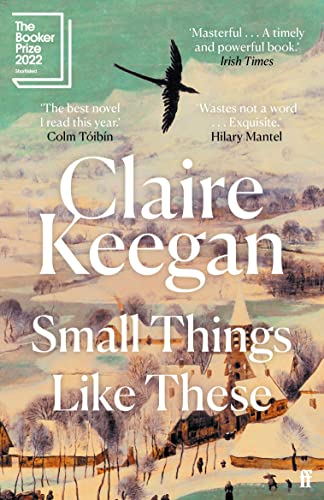
I first became aware of Claire Keegan through The Quiet Girl (An Cailín Ciúin), an Irish-language film based on her short story ‘Foster’. I saw the film at the 2022 Sydney Film Festival, and was blown away by its portrayal of a small girl’s escape from a terrible situation. The final moment, which I won’t describe because of spoilerphobia except to say that a single, ambiguous word is spoken, is one of the most powerfully moving I’ve seen. The acting (especially Catherine Clinch as the girl), the cinematography (Kate McCullough), the direction (Colm Bairéad) and the script (by Colm Bairéad, closely following Claire Keegan’s prose) are all brilliant. I still haven’t read ‘Foster’ but I was delighted to be given Small Things Like These on Father’s Day.

It’s a tiny book – just 117 pages. It’s set in a small Irish village. Its action takes place over a few days in late December in the time not so long ago when the Catholic Church dominated the lives of most Irish people. Bill Furlong, the coal and timber merchant, is being run off his feet in the pre-Christmas rush. The son of an unmarried woman, he and his mother were able to thrive in spite of the stigma thanks to the patronage of a wealthy Protestant woman – a situation that has uncanny echoes in the Thrity Umrigar books The Space Between Us (which I’m currently reading) and The Secrets Between Us (my blog post here). He is devoted to his wife and five daughters.

A shadow is cast over this benign scene by two pages that precede the beginning of the text proper. First there is the dedication: ‘to the women and children who suffered time in Ireland’s mother and baby homes and Magdalen laundries’. Then, on a page to itself, there is an excerpt from The Proclamation of the Irish Republic, 1916, which declares that the republic resolves, among other things, to cherish ‘all of the children of the nation equally’. Having a rough knowledge of the Magdalen laundries (Wikipedia entry here if you need to look it up), I was prepared for a little book of horrors.

Claire Keegan is a finer writer than that. There is horror, but not the jump-scare, demon-rising-from-the-grave kind, or even the Hanya Yanagihara A Little Life kind. Just outside the village there’s a ‘training school’ for girls of low character and an associated laundry, which ‘had a good reputation’. When Bill delivers a load of coal there on Christmas Eve, he comes upon a young woman who is obviously being abused, and he isn’t reassured by the nuns’ attempts to, well, gaslight him. It’s a small village, and the whispers say that no one can challenge the Church. Aware that his own mother could have found herself in the young woman’s situation, Bill faces a dilemma.

So the book hinges on a small chance encounter, a small crisis of conscience for an ordinary man, who many would say is leading a small life. The title can be read as the beginning of a sentence: Small things like these … pose big moral challenges / … can change the way you see the world / … can disrupt oppressive institutions / …

This blog generally looks at page 76. I might have preferred to talk about the page when Bill sits down to a cup of tea with the Mother Superior, or one of the pages where the abused girl talks to him. But page 76, it turns out, illustrates beautifully the way Claire Keegan tells her story.

It occurs at about the three-quarter point. We have been told very little of what’s happening in Bill’s mind. He doesn’t talk about what he has seen. Perhaps he can’t – he’s a working class Irishman of his era. But his wife, Eileen, can tell he’s ‘out of sorts’. The family go to Mass on Christmas morning. Bill stays back near the door when Eileen and their daughters walk down the aisle and slide into a pew, ‘as they’d been taught’. We’re not told if Bill usually stays by the door, or if this is a sign of new alienation. What follows could easily be a simple description of Irish villagers arriving for Mass in a past era (not all that dissimilar to Mass in the North Queensland town where I was a child in the 1950s):

Some women with headscarves were saying the rosary under their breath, their thumbs worrying through the beads. Members of big farming families and business people passed by in wool and tweed, wafts of soap and perfume, striding up to the front and letting down the hinges of the kneelers. Older men slipped in, taking their caps off and making the sign of the cross, deftly, with a finger. A young, freshly married man walked red-faced to sit with his new wife in the middle of the chapel. Gossipers stayed down on the edge of the aisle to get a good gawk, watching for a new jacket or haircut, a limp, anything out of the ordinary. When Doherty the vet passed by with his arm in a sling, there was some elbowing and whispers then more when the postmistress who’d had the triplets passed by wearing a green, velvet hat. Small children were given keys to play with, to amuse themselves, and soothers. A baby was taken out, sobbing in heaves, struggling to get loose from his mother’s hold.

This may feel like an exercise in nostalgia. But it’s not like, for example, the moment in Robert Dessaix’s Arabesques where he ‘realises’ that the lives of simple Portuguese women at Mass ‘had been redeemed, not by understanding, not by seeing Truth face to Face, but by being gathered up into the Church’ (my blog post here). Neither Bill Furlong not Claire Keegan, observing this gathering, projects visions of redemption onto it. This is an insider’s view. We are told people’s names. We can guess why the freshly-married man is red-faced, we recognise that different people make the sign of the cross differently (I love ‘deftly, with a finger’), there are class differences, children and babies need to be dealt with. It’s a picture of a community coming together that anyone of a certain age with an Irish-influenced Catholic childhood will recognise.

But it’s a critical insider’s view. Bill has a fresh distance because of his moral dilemma, Claire and the reader have perspective created by the seismic shifts in Irish culture since the time of the novel. This is a picture of a surveillance state, benign enough you’d think, but any small divergence from the normal – a sling, a new hat – is noted. It’s characteristic of Keegan’s writing that none of the divergences noted by the gossipers has any moral weight attached to it – we’re left to imagine for ourselves how that would go. We haven’t been told in so many words (this isn’t a Hollywood movie, after all) that Bill is mulling over what to do or not do, but as he looks over this scene, we feel with him the coercive pressure to conform, to accept the authority of the Church, not to rock the boat. The baby, ‘sobbing in heaves’, has to be removed – his mother’s hold is unescapable. Small things like these accumulate so that we understand the pressure Bill faces.

The whole book is a marvel.

Damon Galgut’s Arctic Summer

Damon Galgut, Arctic Summer (Atlantic Books 2014)

0857897195After Howard’s End was published, E M Forster began another novel named Arctic Summer, but never finished it. Damon Galgut has co-opted the title for this novel about Forster, appropriately enough given that the book is suffused with a sense of unfulfilled desire and unachieved goals.

Forster is homosexual (his term is ‘minorite’), which for a middle-class Englishman just a few decades after Oscar Wilde’s trial is terrifyingly illegal and paralysingly shameful. A central powerful thread of the novel follows Forster’s agonised path towards an active sexual life and the closely allied quest for intimacy. He has two great loves, neither of them ‘minorites’, and neither of them Englishmen. One, the Indian Masood, rejects his physical advances; the other, Egyptian Mohammed, accommodates what he calls his ‘foolishness’. Forster has other, more compliant sexual partners, but it is with these two men that he forms abiding emotional connections, as each of them reciprocates his love in deeply un-English, heartfelt ways.

The novel is also a story of artistic triumph, an imagining of how Forster came to write his greatest novel, A Passage to India. If I didn’t have other more pressing demands on my time I would now be rereading that novel, which must surely have been changed – enriched, I would guess – by the light shed on it by this one. Damon Galgut inspires trust, partly because he has obviously researched his subject meticulously, and partly because his protagonist’s inner life is so powerfully realised. The story he tells, persuasively, is that Forster’s cross-cultural relationships, with the men he loved and with others in India and Egypt, provided the emotional and dramatic heart of his novel. 

It’s interesting how much this book is in dialogue with others. There are Forster’s books, of course: phrases from and references to A Passage to India  are scattered though it, apparent even to someone whose memory of the book is as vague as mine; Howard’s End and Room with a View crop up, though they’re not named; Forster writes Maurice pretty much as wish fulfilment and shows the manuscript to friends; he has a couple of collections of short pieces published. The richly evocative dedication of Galgut’s novel, ‘To Riyaz Ahmad Mir and to the fourteen years of our friendship’, echoes that of A Passage to India, ‘To Syed Ross Masood and to the seventeen years of our friendship’, surely as elegant an indication of an author’s relationship to his subject as you’re likely to find anywhere.

Forster has significant conversations with other writers: Leonard and Virginia Woolf (the former wanting to publish him, the latter agreeing, not unkindly, when he says he’s not a novelist); Lytton Strachey (who loves Maurice and wants its title changed to Lytton); Edward Carpenter (who gives him a vision of relaxed homosexual intimacy); D H Lawrence (hilariously, dogmatically voluble, and totally heteronormative); and Cavafy (who reads his poems to Forster in Alexandria). Even the raffish character who in the first pages shows Forster some explicit erotic writing (a neat way of showing that Forster’s problem is not simply prudishness) turns out, according to the acknowledgements pages, to be historical.

As well as the intertextuality implied in these encounters, I wanted to put  Arctic Summer on a shelf between Amitav Ghosh’s Sea of Poppies and a DVD of The Best Exotic Marigold Hotel: the three of them could have an interesting chat about the Raj, with Galgut’s novel forming some kind of bridge between the horrors portrayed by Ghosh and the movie’s golden-glowing nostalgia. I’d also like to eavesdrop on this book in conversation with Robert Dessaix’s Arabesques: where I found it hard to read Dessaix’s accounts of Oscar Wilde and André Gide’s erotic adventures with much younger men of colour as anything other than sex tourism, Galgut’s version of Forster’s superficially similar experiences reads as complex cross-cultural encounters.

At the Sydney Gay and Lesbian Mardi Gras Fair on Sunday there was a Police Department stall in the middle of all the glitter. That evening I went to Belvoir Street to see the supremely silly and sexy The Blue Wizard – billed as ‘the gayest one-man show ever’. I had this book in my bag at both events.

Peter Timms in search of Hobart

Peter Timms, In Search of Hobart (UNSW Press 2009)

I enjoyed Delia Falconer’s book on Sydney in the Cities series very much, so when this turned up for borrowing at our Book Club, I fell on it with cries of joy.

Alas, after a characteristically elegant foreword by Robert Dessaix, in which he ominously mentions that the author is his partner and describes the book as ‘a concatenation of views of Hobart’, my enthusiasm took a beating. By page 15 the concatenated voices are complaining about the traffic, and before any of the beauties of the city have been evoked we’re treated to argument about town planning and the puncturing of self-serving quotes from government officials such as emanates from local ginger groups in any modern city. A swipe at Kevin Rudd’s ‘working families’ mantra left me feeling not just that I was listening in on local fights, but that the fights were old.

On page 40, in a dip into colonial history, ‘Having staked their claim, the authorities in London promptly put the struggling settlement out of their minds,’ I decided to follow their example and put the book out of mine. It might improve – if you know for sure it does, you know where comment button is.

Robert Dessaix’s Arabesques

Robert Dessaix, Arabesques: A tale of double lives (2008, Picador 2009)

Consider a hypothetical book that opens with two wealthy European men visiting a developing country. The elder of the two men asks the younger if he’d like to have sex with one of two adolescent musicians who are playing for them. When his friend answers in the affirmative he roars with laughter, and continues roaring as they drive away in a cab accompanied by the two boys. The younger of the two Europeans later reports that he had a great night with his boy. You’re likely to expect the book to be about sex tourism.

What if the Europeans were famous, not as sportsmen or politicians (which would make it a book about sex scandals), but as writers – one a great wit, playwright, essayist and children’s author and the other as a vastly erudite man of refined sensibility, a Nobel Prize winner? They’re still sex tourists, do I hear you cry? Why should having a way with words bestow immunity from ordinary moral considerations?

That hypothetical opening scene is strikingly similar to the opening of Robert Dessaix’s Arabesques. The Europeans are Oscar Wilde and André Gide, and the incident happens in the casbah of Algiers in 1895 . I don’t think I’m being unfair to Dessaix if I say that he appears to regard the power imbalance between the ‘moneyed’ writers on one hand and the Arab boys on the other as of no consequence – nobody forced the boys to do anything, after all, and it’s not paedophilia, because they were adolescents (which makes it pederasty, quite a different thing). When Dessaix’s friend Albert uses the mild word ‘sordid’ of this incident and Gide’s lifelong habit of visiting North Africa to have sex with adolescent boys, Dessaix wonders if Albert ‘secretly found something about homosexuals in general unpalatable’. Edward Said’s notion of Orientalism is mentioned only to be dismissed as ‘pretty one-sided, even wrong-headed, these days where I come from’. The word prostitution is never mentioned, nor is the phrase sex tourism. That would just be crude, rather like the pink tourists who turn up plodding and stunned at intervals throughout the narrative.

This is a very attractive book, beautifully designed and illustrated, written in mellifluous, finely nuanced prose, but it’s not a comfortable read. The casbah moment turns out to have stuck in Robert Dessaix’s mind from when he first read it at the age of 14, and he offers it to us as a moment at which Gide could ‘start living out who [he’d] been all along, at first in the shadows and now in the light’.

It’s a travel book. Dessaix visits Normandy, the south of France, Portugal, Algiers, Tunis. He does have living companions – a number of Parisians, an enigmatic north African – but his main travelling companion is André Gide. Dessaix visits Gide’s childhood home; the house where Gide lived with his pious wife Madeleine, whom he loved without sex and made miserable by going off on his sexual adventures; cities, towns and oases that Gide visited and wrote about. As well as the physical journey, he takes us on a journey to get to know Gide, and to get to know himself in relation to Gide. Though he eschews quick moral judgements, he does explore the ‘who’ that Gide lived out, questioning the effects on other people, defending him against criticism and then questioning his own motives for defending him.

The double lives of the subtitle are manifold. Dessaix sees himself as a kind of double of Gide: their lives have an astonishing number of similarities (a love of an eroticised North Africa, intensely Protestant adolescence, commitment to the writing vocation, marriage to a woman soon after discovering the joys of sex with men, and more). He and Gide each have a kind of doubleness – tension between adolescent religion and powerful homoerotic impulses that comes to a point of crisis and self-knowledge in their early 20s. And the book fairly teems with other doublings, pairings and dichotomies: the sexually active Gide and his wife Madeleine, who lived and died a virgin; Madeleine and the young man Dessaix describes as Gide’s beloved; European and North African attitudes to sexuality; Protestantism and Catholicism; and more.

One of the most interesting mini-essays deals with an ‘epiphany’ in a church in Oporto, in which Dessaix realises he is a Protestant. The moment of self-knowledge arrives when he looks at some women hearing Mass and realises that ‘every last loose thread’ of their lives ‘had already been lovingly gathered up and woven into the sacred tapestry of the Church’, that their ‘lives had been redeemed, not by understanding, not by seeing Truth face to Face, but by being gathered up into the Church’. His ensuing discussion of his own Protestantism is very interesting, but something about the scene gave me pause. Dessaix expresses his ‘realisation’ so beautifully that the reader almost fails to notice that he doesn’t know those woven women at all, that he’s projecting something onto them to  as a springboard for talking about himself. Which brings me back to my central worry about the book: when it talks about Gide’s sexual compulsions (another crude word that doesn’t darken its pages), isn’t there a similar projection involved? Edward Said may be old hat where Robert Dessaix lives, but those adolescent boys don’t emerge so much as individuals in their own right as dark-skinned screens onto which the finely tuned European can project his own desires.

I’m reminded of one of A D Hope’s ‘Sonnets to Baudelaire’ (just the last seven words, really, but here’s the whole thing):

You saw it rise, I see it set, that sun,
The bright aubade, the serenade's dying fall,
Between us, brother, we have seen it all.
But was it worth, now all is said and done,
The great Romantic theme: My heart laid bare?
One thing, like Ozymandias, they forgot:
To make it worth the trouble, someone must care

To watch Narcissus give himself a hug
Or Onan practise on his magic flute.
Now as the stars light up, for better or worse
Time throws away the key that locked those smug
Museums of self-regard, the universe
Expands, but something's slimy underfoot.

PS: If there’s a further edition I hope someone corrects the slip on page 242 where Gide is described as ‘reading the Aeneid in the original Greek’. Virgil wrote in Latin, chaps.