Tag Archives: Robert Frost

This is Happiness, Niall Williams and the Book Group

Niall Williams, This Is Happiness (Bloomsbury 2019)
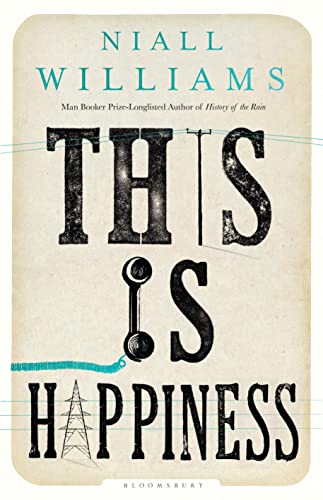
Before the meeting: When we discussed Niall Williams’s History of the Rain in October, a number of people had also read his next book, This Is Happiness. December’s chooser, impressed by their enthusiasm, decided we should all read it.

The book’s first sentence, ‘It had stopped raining’, which sits on a page by itself, is pretty much identical with the final sentence of the earlier book, and the tiny, backward village of Faha in West Ireland is again the setting, but the bulk of the narrative takes place in an earlier period, and there is no obvious reference to the characters or events of History of the Rain. It’s the story of the coming of electricity to the village; a coming of age story of young Noe, who has taken leave of the seminary and is telling the story as an old man in the USA; and a big romantic story of love lost and found by Christy, an older man who befriend Noe.

Page 75* must be one of the book’s few pages that doesn’t mention the absence of rain. It happens in the thick of one of the book’s comic set pieces. It’s not the set piece when the lights go down and the cinema comes alive with amorous grapplings, or the one where Noe goes to the communion rail at Sunday Mass in order to get a good look at the woman Christy left at the altar, or the spectacular one where he is knocked unconscious by a falling electricity pole. On page 75 Noe and Christy are on the first of a number of epic pub crawls.

These pub crawls are as much about music as about alcohol, music performed by men who are shy and nondescript until they start playing, and then are brilliant conduits of a great folk tradition. On this first adventure, when the evening is well under way, Christy startles Noe and everyone else in Craven’s pub by starting to sing:

Not only was Christy singing, he was singing with screwed-up eyes and fists by his side a ballad about love. He was singing it full-throated and full-hearted and before he had reached the second verse it was clear even to Roo the dog that a passionate truth was present in that place. It wasn’t only that this didn’t happen in Craven’s, it was that there was something raw in it, something deeply felt, that was, even to those who had descended blinking into the umbrae and penumbrae of numberless bottles of stout, immediately apparent and made those who first looked now look away.

(page 73)

Christy has come to Faha as a worker in the great electricity project. This episode is our first inkling of his profoundly romantic reason for signing up for the work. Not so obviously, it prepares us for the major role music is to play in Noe’s story. Page 75 itself is a beautiful piece of misdirection. After Christy has sung, Noe writes:

I did the only thing I could do. I went to the counter and got two bottles of stout.

Those bottles are followed by another two, and then another. Greavy the guard arrives and declares that it’s Closing Time (as Noe says, this is one more way in which Faha lags behind the times), but the two of them are incapable of moving. Alcohol-based humour usually leaves me cold, but Niall Williams’s version made me laugh out loud. I suppose the whole book could be read as an extended Irish joke: the villagers have an almost superstitious awe of the one telephone in town, and the coming of electricity has almost cosmic significance for them. If you read the whole book like that, the stereotypical Irish drunkenness in this passage is representative (including the sly invocation of Waiting for Godot):

Getting up proved aspirational. There was the idea of it, quite clear. Unmistakably clear now. There were hands placed on knees for push-off. There was a Right now. There was another when that failed to produce action. A Right so following. And still nothing. Between thought and verb a vacancy, not intended, but not grievous, just gently perplexed, and in that perplex the realisation that Craven’s was not in fact such a bad place at all, was downright comfortable in fact, in fact there were few places on this earth as agreeable. True? Too true. A person could stay here, could stay right here and be quite happy now, quite, for a very long time. What’s your rush? There’s no rush. All the problems of the world could be settled right here.
Right.
Will we go so?

I don’t want to minimise the book’s humour. Far from it. But there’s a seriousness to it that page 75 gives no clue of. Christy’s romance is genuinely touching. The villagers’ resistance to the coming of electricity is more than comic: and these villagers are described as custodians of their land, defending an ancient culture under siege by capitalism – without being at all heavy handed, the narrative reminds us that the Irish were the first people to be colonised by the English. The dramatic decline in the Catholic Church’s power since the 1950s is deftly evoked both in Noe’s commentary and in his own story: his turning away from his priestly vocation is a tiny reflection of the ending of Church-domination in Ireland at large.

After the meeting: There were seven of us. Covid–19 and other coronaviruses kept some away, while one or two had better things to do – and one sent video of spectacular drone art over Sydney Harbour.

This was our end-of-year meeting so we had other business besides the book, but it generated quite a bit of discussion. The discussion was unusual in that quite a few of us read out favourite passages. Indeed, two of the absentees sent lists of quotes – it’s that kind of book. One interesting insight was that the narrative as we receive it is created by an old man looking back on a key moment in his youth, making a story out of it, and casting a benevolent glow over the community in which that moment happened.

Other business, besides of course the plentiful food including a splendid pavlova, included a Kris–Kringle book exchange with the usual mixture of cautious delight and polite almost-hidden dismay, and a poetry reading. We were each supposed to bring a poem, and most did, even one of the absentees.

Poems were a nonsense poem by CJ Dennis (‘Triantiwontigongolope’), a poem about climate change (that was me – Kit Kelen’s ‘Parable’), a Thomas Hardy (‘Heredity’), a Robert Frost (‘A Time to Talk’), a poem from Claudia Rankine’s Just Us (‘sound and fury’), and two poems of Australian patriotism that couldn’t have been more different (Sara Mansour’s ‘My Australia‘ – link to her performing it on YouTube – and a poem whose name and creator I don’t remember celebrating the lump in the throat brought on by, for example, Anzac Day). This little reading, including by two people who said they felt awkward reading poetry aloud, left us reeling.

And that was a wrap for the Book Group for 2022.

* Currently when blogging about books I take a closer look, arbitrarily, at page 75 – moving on to page 76 at my next birthday if the idea works well enough.
Stephen Edgar’s Strangest Place

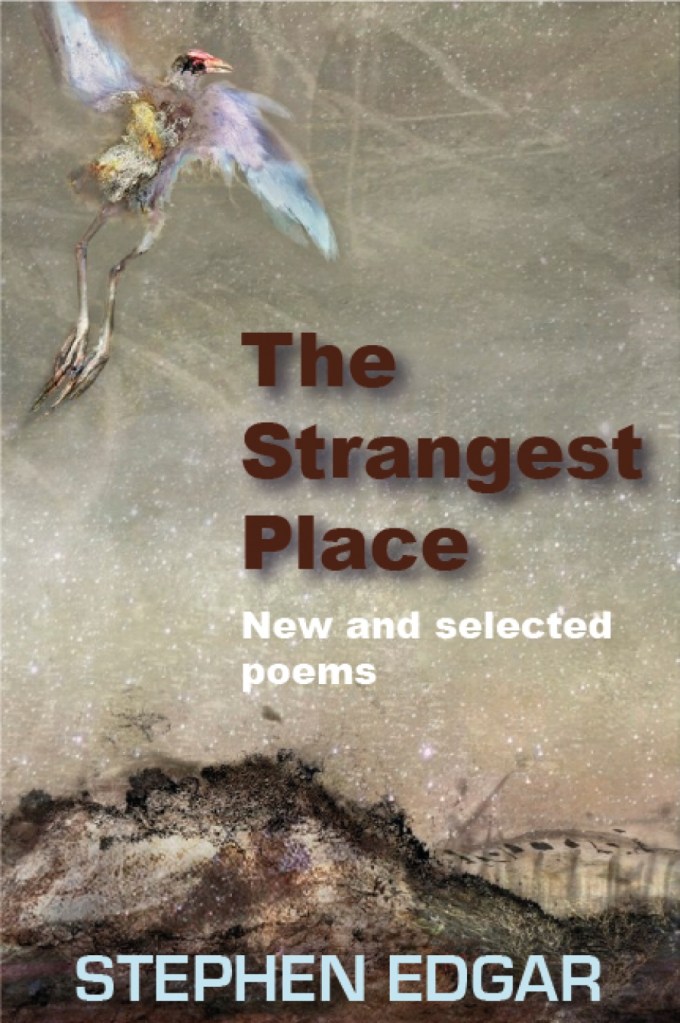
Stephen Edgar, The Strangest Place: New and Selected Poems (Black Pepper 2020)

This is a daunting book. It opens with 76 pages of new poems in a section titled ‘Background Noise’, enough for a respectable book on its own. But Stephen Edgar has had poetry published since 1976, so it was time for a retrospective, and more than 200 pages follow, a selection from his ten previous books. It’s a lot to take in if, like me, you’re new to his work.

Here’s part of what Clive James had to say about him:

Stephen Edgar stands out among recent Australian poets for the perfection of his craft, a limitless wealth of cultural reference, and an unmatched ability to make science a living subject for lyrical verse … The quickest way of summing up my appreciation of his mastery would be to say that if he were a jazz musician, he would be the kind who, when playing after hours, leads all the others to pack up their instruments and listen. 

From clivejames.com

James doesn’t mention Edgar’s commitment to rhyme (a commitment James shared). A typical poem in this book has a complex rhyme scheme with a strict metric count, a form that as far as I know is often invented by Edgar for the occasion. The poems adhere to these forms rigorously, rarely even using a half-rhyme or adding an extra syllable. This extraordinary, and deeply unfashionable formal constraint is a wonder to behold. James’s comparison to a jazz musician seems at first blush paradoxical or even perverse, but it makes sense if you think of the poem’s form as the basic melody, the regular rhythm, around which the syntax, ideas and images play wildly.

For me, it’s not jazz that comes to mind, but sculpture. Thoughts or observations on things mundane or evanescent, tiny or immense, uncanny or terrifying are worked into solid, well-defined shapes. There’s no chance that the reader will mistake the result for simple expression of emotion or anything other than an artifice, one charged with the tension between the fixed form and the mercurial play of mind. The range of subjects includes a Sydney summer day that ends with a Southerly Buster (‘Coming Up for Air’); a group of naked children walking on Hampstead Heath (‘Hampstead Incident’); a performer who builds a structure of feathers (‘Feather Weight’); a slo-mo film of mating finches (‘Song and Dance’); a woman plagued by voices (‘Voices Off’); the death of our planet (‘Shadow Line’); a glimpsed insect (‘Dragonfly’).

If the poems are sculptures, they are both sculptured shapes on the page, and sculptures in sound: these poems cry out to be read aloud.

After I’d written this far I read Martin Duwell’s excellent review of The Strangest Place at this link. Rather than write more about the poetry in general, I recommend that review.

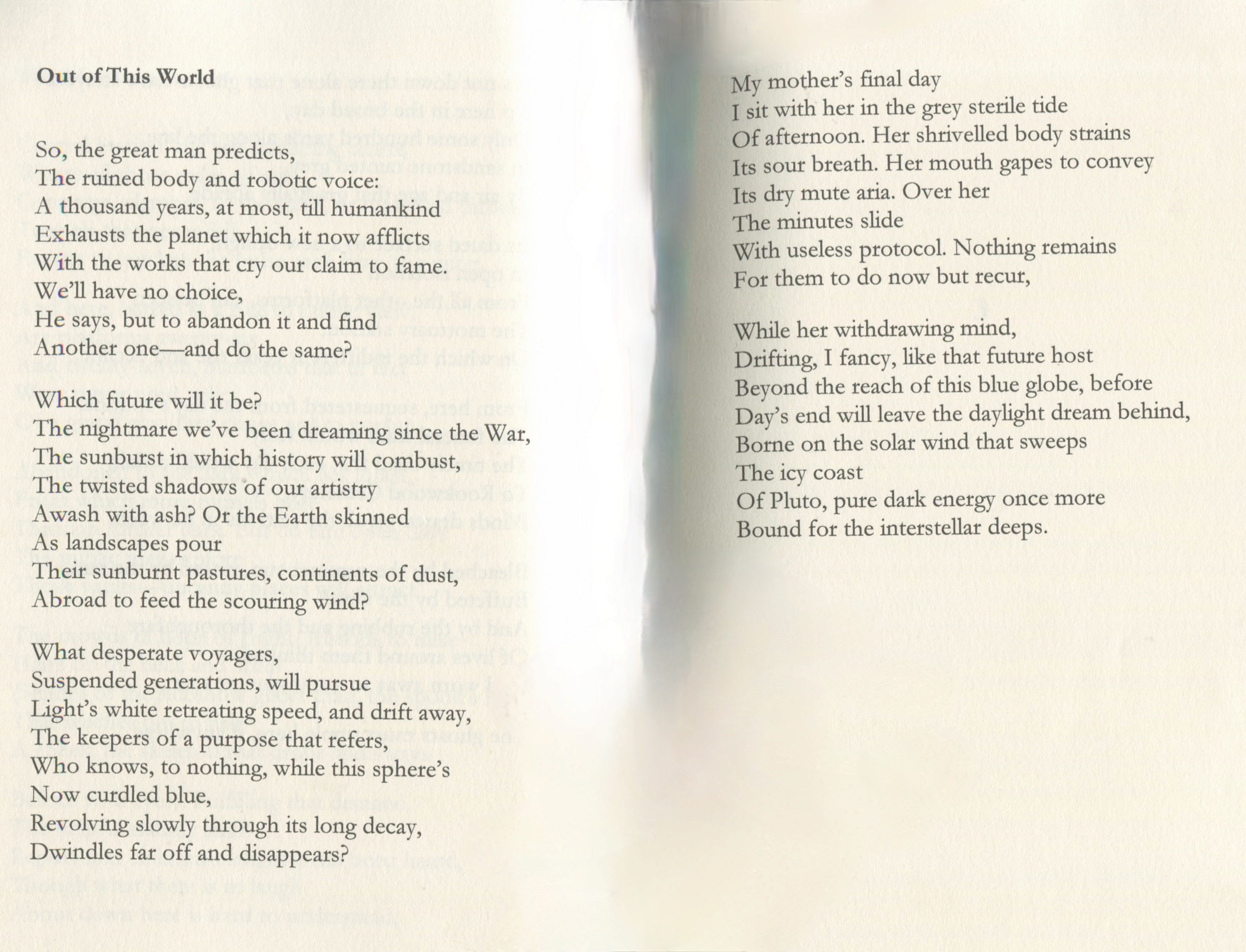
To pick one poem, here’s ‘Out of This World’ (pages 50-51). You can click on the image to open it in a new tab at a more readable size:

See what I mean about strict formal qualities? Each of these stanzas has eight lines. Most of the lines are iambic pentameters (that is, they have five two-syllable feet each); the lines that differ – the first, sixth and eighth line of each stanza – have three, two and four feet respectively. The rhyme scheme is abcadbcd; it may help understand the play of rhyme if it’s written abca-dbcd.

Each of the first three stanzas is a step in an argument: a) a prediction and a proposal; b) detail on the prediction; c) detail on the proposal. The fourth stanza ricochets unexpectedly, and the fifth arrives at an unexpected resolution.

So, the great man predicts,
The ruined body and robotic voice:
A thousand years, at most, till humankind
Exhausts the planet which it now afflicts
With the works that cry our claim to fame.
We'll have no choice,
He says, but to abandon it and find
Another one – and do the same?

The first two lines are mildly riddling: ‘the great man’ is of course Stephen Hawking. Shortly before he died in 2018, he predicted that our universe would eventually fade to darkness as the stars run out of energy, and he proposed that scientists might be able to find alternate universes. This stanza manages to evoke Hawking’s physical presence, put a version of his prediction and proposal into smooth verse (see above for what Clive James said about Edgar and science), and then challenge the proposal with a question that throws forward to the second stanza. It’s worth noting that, at least according to the report I linked to above, Hawking was talking about the end of the universe, whereas Edgar scales it back to the more imminent end of the planet, thereby introducing a moral element – the end of the planet is caused by the ‘works’ of humankind, whereas the end of the universe is due to inexorable processes. I guess that’s what my mother used to call poetic licence.

Which future will it be?
The nightmare we've been dreaming since the War,
The sunburst in which history will combust,
The twisted shadows of our artistry
Awash with ash? Or the Earth skinned
As landscapes pour
Their sunburnt pastures, continents of dust,
Abroad to feed the scouring wind?

The opening question may seem to be posing a choice, but it’s not so. This is not a poem for activists, nor is it an update of Robert Frost’s ‘Fire and Ice‘. The poem assumes that the prediction is correct, and catastrophe is assured; neither resistance nor preference comes into the question. There are two scenarios, nuclear holocaust and climate disaster, both of which have become more compelling in the actual world since the poem was published. Just as with Hawking in the first stanza, they are evoked by striking images rather than simply named. The effect is partly to draw attention to the poem as artifice, but also to invite an imaginative engagement with the predicted catastrophe(s).

What desperate voyagers,
Suspended generations, will pursue
Light's white retreating speed, and drift away,
The keepers of a purpose that refers,
Who knows, to nothing, while this sphere's
Now curdled blue,
Revolving slowly through its long decay,
Dwindles far off and disappears?

This stanza, step three, spells out Hawking’s proposal, again taking a familiar concept – this time a science fiction trope – and working it into the fore-ordained stanza shape. ‘Suspended generations’ neatly evokes those stories of spaceships full of people in suspended animation; ‘curdled blue’ draws great power from the way it evokes popular lyricism about earth as a beautiful blue planet. Unlike Hawking, the poem is pessimistic about the fate of the ‘voyagers’ – their purpose may lead to nothing. For all the strength of these images, and those of the preceding stanza, the poem is still fairly cerebral. And then, whiplash:

My mother's final day.
I sit with her in the grey sterile tide
Of afternoon. Her shrivelled body strains
Its sour breath. Her mouth gapes to convey
Its dry mute aria. Over her
The minutes slide
With useless protocol. Nothing remains
For them to do now but recur,

The focus shifts abruptly from the global to the intimate. The general ‘we’ in the first stanzas shrinks to ‘I’ and ‘her’. Where the strict adherence to form had a distancing effect in the previous stanzas, here not so much. There the effect is a kind of classicism – ‘what oft was thought but ne’er so well expressed.’ Here, powerful emotion is recollected, if not in tranquillity, then some time after the event. ‘Her mouth gapes to convey / Its dry mute aria’ brings the terrible scene vividly alive.

Much of the power of poetry can lie in what isn’t said. In this case, the gap between the third and fourth stanzas cries out for attention. I can’t be the only one who, having just read an evocation of the end of the Earth, comes to the line ‘My mother’s final day’ and thinks of Mother Earth. Probably more idiosyncratically, I thought of A D Hope’s 1958 poem, ‘On an Early Photograph of My Mother‘, in which the mother is Earth, and the vaporising effect of nuclear war is imagined. I’m not saying that Edgar had Hope’s poem in mind, but in my admittedly patchy knowledge of Australian poetry, Hope is the poet Edgar most resembles, mainly for his adherence to rhyming forms, but also for his interest in matters scientific and his occasional venture into the erotic (Hope’s ventures there were more than occasional).

Back to the poem. It resists the gravitational pull of the mother / Earth metaphor. Instead, her ‘withdrawing mind’ is likened to the desperate voyagers of the third stanza, and to the possible nothing at the end of their voyage:

While her withdrawing mind,
Drifting, I fancy, like that future host
Beyond the reach of this blue globe, before
Day's end will leave the daylight dream behind,
Borne on the solar wind that sweeps
The icy coast
Of Pluto, pure dark energy once more
Bound for the interstellar deeps.

The two parts of the poem are brought together, and though it might be tempting to see one of them as a metaphor for the other, it’s not that simple. Abstract emotion about the end of the world and immediate personal grief each has its own powerful validity, and they illuminate each other. Climate grief becomes intensely personal; personal loss becomes cosmic. Much of the stanza refers equally to the dying woman and the survivors of earth’s destruction: ‘daylight’s dream’ means both an individual life (Isn’t there a mystical tradition somewhere that says our life is but a dream, and reality lies elsewhere? If not, there’s certainly a children’s song) and the aeons in the human race has lived by the light and energy of the sun. ‘The icy coast / Of Pluto’ refers to both the planet, beyond which the survivors must go, and the underworld of the ancient Romans beyond the shores (coast at a stretch) of Acheron. ‘I fancy’ in the second line, while working nicely into the alliteration that is so striking in this stanza, declares that the poem is an artifice, but that in no way detracts from the pathos of the final lines.