Tag Archives: Sydney Writers’ Festival

My second full day at the SWF

I was off to Walsh Bay again for the day today.

10 : 00 Marie Munkara in conversation with Irina Dunn
I first heard of Marie Munkara’s Every Secret Thing on Will Owen’s blog last December, and it’s been on my To Be read list since then. If it hadn’t been, this session would have put it there, especially when she read the opening pages, beginning most memorably, ‘It had been a shit of a day for Sister Annunciata and Sister Clavier.’ Irina (full disclosure: she’s an old and dear friend) did a lovely job of drawing out Marie’s biography in relation to the book, giving her scope to be – miraculously –  funny about her experience as a member of the stolen generations meeting up at last with her Aboriginal family:

My mother was black. I was thinking, ‘That can’t be my mother. And you know how they say all black people look the same … I’d say, ‘Hello, Auntie,’ and my mother would say, ‘Don’t talk to her, she’s rubbish.’ I’d say, ‘But isn’t that Auntie …’ ‘No!’

When she was little her class at school had to draw a picture of what they wanted to be when they grew up. She drew a figure with a red cloak and a crown. Sister Damien said, ‘Marie, you can’t be a king.’ But young Marie insisted that that’s what she wanted to be, because a king has lots of money and can do what he wants. ‘Now,’ said Marie today, ‘I haven’t got much money but I do what I want.’

11 : 30  Terrorism: How to Win a Cosmic War – Reza Aslan talking to Tony Jones about the futility of the War on Terror
I am not a Tony Jones fan. Ever since his extraordinary performance interviewing Nicole Cornes on election night 2007, I have had trouble watching him interview anyone. But Reza Aslan’s articulate confidence was a match for his combative style, and their sparring was actually enjoyable. Reza Aslan distinguished between Islamism and Jihadism. Islamism, he says, is a form of nationalism seeking to establish an Islamic state in principle no more diabolical than a Christian state like Greece or a Jewish state such as Israel. Jihadism is anti-nationalist, seeking to establish planet-wide Islamic theocracy. He went on to say that Islamism is the answer to Jihadism: that if Islamists are able to participate in normal political processes, Jihadism will lose its recruiting grounds. It was a riveting presentation, and we bought his book.

13:00 to 14:00 Three Australias: Les Murray, Ali Cobby Eckermann and Kim Cheng Boey reading their poems, chaired by Rhyll McMaster
This was the only event I attended where I had to stand in one of the monster queues and for some reason receive a “Good work” stamp on my wrist. The readings were interesting. I was especially glad to hear more of Ali Cobby Eckermann’s work, having read only her long piece on the Intervention in the Best of 2009 collection. Kim Cheng read one of the poems he read on Friday morning, and it was a pleasure to hear it again. Les Murray, who was probably the reason this event was held in one of the bigger spaces, was as always Les Murray, and a good thing too.

Ali Cobby Eckermann acknowledged the Gadigal people, as Anita Heiss and Boori Prior did yesterday. I wonder if it was by formal decision that such acknowledgements were not made at any other events, at least none of those I attended. Whether deliberate or not, I think the festival was the poorer for the absence of such acknowledgements. I also missed the PEN chairs at paid events, and the brief explanation of the imprisoned writer each chair represented. There is a roped off area in the vast Heritage Pier populated by a dozen beautifully painted chairs and a soundscape. The chairs are to be auctioned to raise money for PEN, but that’s not the same as explicit acknowledgement of named individuals.

2: 30  Who’s Interviewing Who? Alan Ramsey and John Faulkner
These two – a retired journalist famous for his take-no-prisoners opinion pieces and the Federal Minister for Defence famous for his ineluctable pursuit of corruption – have been friends for 20 years or so. They told us in all seriousness that the reason the friendship has thrived for so long is that they never discuss politics. They then moved on to discuss politics, with some tense moments. They were very funny together. At one stage Ramsey left the stage to get the quotes he’d left somewhere. Faulkner continued in the role of interviewee.

17 : 30 The Big Reading: Hanan al-Shaykh, Willy Vlautin, Dubravka Ugresic, Natasha Solomons and Rupert Thomson
This was my last event for the festival. It was, as it always is, pleasant to be read to. In particular I loved being read to again by Rupert Thomson – and the tone of the extract he read from This Party’s Got to Stop couldn’t have been further from that of the one he read on Thursday morning. It must be an intriguingly complex book.

I had been planning to stay in the general area to hear Jennifer Maiden, David Brooks and Adam Aitken read. But the reading didn’t start until 9.30, and it was in a wine bar. As a non-drinker who is very often in bed by 10 o’clock, I found the deterrents outweighed the attractions. I had heard a little of Aitken and Brooks this week (though the latter hadn’t been reading his own work), and I decided with regret that I would have to forgo the great pleasure of hearing Jennifer Maiden.

The Festival’s slogan this year was Read, Rethink, Respond. There wasn’t a lot of space at the festival itself for responding (question times just don’t do it!), and for that matter not a lot of reading got done, at least by the punters. But I’ve come away with plenty to think about, and the world is full of opportunities to respond, and far too much waiting to be read.

A full day at the SWF

My yesterday was entirely devoted to the Sydney Writers Festival, and I had a great time, starting out at Walsh Bay, where my choices seemed to keep me away from the monster queues.


10 : 00 Poetry on the Harbour: Adam Aitken, Judith Beveridge and Kim Cheng Boey, with Ivor (‘I know they’re good poets because I published them’) Indyk in the chair.

In general I prefer to hear poets read their own work over having actors deliver sonorous, deeply felt renditions, because actors’ performances tend to narrow the range of possible readings. I also prefer poets’ readings that avoid the incantatory (though I’m delighted by the over the top bits of Yeats and Tennyson I’ve heard). All the same, all three of these poets read their work with such modesty and introspection that I longed for just a touch of the rock star, just a hint that they might be able to hold us in the palm of their hands and wring our withers.

It was an excellent reading nonetheless. Adam Aitken read his ‘Pol Pot in Paris’, and a poem taken from his father’s letters (introduced with, ‘I love my father, but he had colonial attitudes’) got actual laughs. Judith Beveridge began with an anecdote from Robert Creeley: at a school reading a child asked him, ‘Mr Creeley, was that a real poem or did you just make it up yourself?’ Among the poems that JB had made up herself was a lovely piece about a man washing himself at the railway station tap just outside Delhi. Of the extraordinarily cosmopolitan Kim Cheng Boey’s poems, I particularly liked ‘Stamps’, in which the poet converses with his little daughter.


11 : 30 First Nation Stories: Richard Van Camp and Boori Monty Pryor herded ‘like cats’ by Anita Heiss.

In introducing his poets, Ivor Indyk mentioned university positions and awards. In this session, Anita Heiss talked about which Indigenous Nations/mobs people came from, including herself. Both Richard and Boori perform and tell stories in schools. Richard gave us what I took to be one of his school performances; Boori talked about his. Both men were very funny, and Boori gets the Me Fail I Fly nomination for the most charming man on the planet. Yet with all the humour and charm he managed to put some hard truths. ‘This is the only country in the world,’ he said, ‘that mines a culture and sells it off to the world but doesn’t want to know about the people who produce it.’ He told of a group of preschool teachers who asked him for advice on how to tell Aboriginal stories to their charges. ‘Do you know about the 1967 Referendum? The Gurindji campaign? The reserves?’ he asked (though he probably named different specifics). ‘You won’t be able to tell the stories until you know about the fight to keep them alive.’


13 : 00 The Politics of Storytelling: Mike Daisey and William Yang, chaired by Annette Shum Wah.

I’m told Mike Daisy’s story was shattering, but I went to sleep during the loud, bombastic opening section of his monologue, which I guess was meant to be the warm-up (a baby cried, presumably at the sheer loudness, and was incorporated into the rant, to the delight of the fans in front of me but adding to my need to absent myself). William Yang showed a number of slides, and it was reassuring to see that his style worked just as well when taken out of the tightly controlled environment of his shows. The discussion was interesting – Annette asked about their provocativeness (William’s photos can be a bit rude, and Mike uses four-letter words, hardly confronting in Sydney I would have thought, but he did mention a show where a big bloc of the audience stood up and walked out – it’s on YouTube and his response is wonderful). William said that when he first did his shows he was part of an angry community. Now he might put in an occasional naughty photo out of impishness. These were such different men, yet their mutual appreciation was lovely to behold.


16 : 00 David Wessel, Meet Paul Keating with George Megalogenis

Note to anyone doing this kind of gig: it really really helps if you read up on the person you’re appearing with and can refer approvingly to his work. Both these men did that and it was a great leavening to what could have been a dry conversation about economics. David Wessell (economic editor of the Wall Street Journal, was able to drop a number of Keating’s famous phrases into his presentation (‘The recession we had to have’, ‘A shiver looking for a spine to run up’, etc). Wessell explained the causes of the GFC memorably as resulting from two false assumptions in the US: that house prices would never fall, and that extraordinary financial innovations spread risk in such a way as to diminish it to the point of negligibility. Keating, equally memorably described Chinese reserves as a great cloud full of water and electricity floating over the world, and Alan Greenspan building a copper pipe up into the sky to draw down the water. He also talked about Spain, Portugal, Ireland and Greece as having a big one-off party made possible by converting to the Euro and suddenly enjoying German interest rates. Right now we’re seeing the morning-after crash. Questions were probably intelligent, but were well above my head.


18 : 00 Have We All Been Conned?: An Emergency Town Meeting: Bill McKibben, Ross Garnaut and Clive Hamilton, with Tim Flannery as participating Chair, discussing the politics and science of climate change.

A case of false labelling. Of course, we all knew it was a Writers’ Festival event and not a political rally, so it was no surprise that it was, as my son described them, four bald men in glasses talking to an appreciative audience about the current state of affairs. No one was really concerned to plug his own book – it was, as Tim Flannery, said, a bit of a dream team.

Was Copenhagen a success or failure? Too soon to tell, but it has meant that developing countries are now taking on climate change rather than waiting for the developing countries to do their bit first.

How come Australia is the biggest laggard in climate change action, yet it has the most to lose? Ross Garnaut spoke with transparent obliqueness of lack of political leadership. Bill McKibben, I think it was, first mentioned Kevin Rudd by name. Clive Hamilton sunk the boot: Kevin Rudd thinks science is a lobby group, and he’s a manager not a leader.

What about the Greens’ rejection of the CPRS? A lamentable strategic error, seemed to be the consensus, rather than a grievous failure of principle as we have seen from federal Labor. Bill McKibben said wise words here. Coming from afar, he said, he had the luxury of responding without knowing or needing to know the details, but what we have to remember is that any victory, however small, is to be celebrated, and any victory, however large, is only a step forward. This is a struggle that will continue for our lifetimes and beyond.

Perhaps the grimmest note of the evening was the statement from, I think, Bill McKibben, that our challenge now is no longer to prevent climate change but to take action to deal with the new world we now live in.

In question time we reaped the consequences of the false advertising. Person after person took the microphone to tell us what they thought about the subject. One woman, from an outfit called A Hundred Percent Renewable, had even brought a banner, which she trailed after her disconsolately as she left the microphone, having failed to get a taker to hold up its other end.

And I’m off to another full day today.

SWF: History, Memoir, panels

The Sydney Writers Festival is now in full swing. I’ve managed to go to two events in the last two days, both of them excellent.

The first, cheerily titled ‘Swindlers, Doctors and Nationalists’, was held late yesterday afternoon in the Macleay Museum at Sydney University. Anyone who got bored could contemplate the huge object in the front corner of the room, probably the cast of a dinosaur’s skull. But it wasn’t the kind of event where  such distraction was needed. On the contrary, the three historians on the panel pretty much fitted Mark Twain’s famous remark about Australian history in Following the Equator:

It does not read like history, but like the most beautiful lies; and all of a fresh new sort, no mouldy old stale ones. It is full of surprises and adventures, and incongruities, and contradictions, and incredibilities; but they are all true, they all happened.

The panel was elegantly chaired by Jude Philp, senior curator of the Macleay Museum. She asked each of the panellists to introduce their books, then invited each of them to speak in turn to maybe three or four questions, a round on each question. I mention this format, because I’ve been to some deadly panels where the time is divided into blocks, one for each participant, and there’s very little opportunity for interaction. That wasn’t a problem here – possibly it helped that all three historians are in the same History Department. The first two were Penny Russell (Savagery and Civility: A History of Manners in Colonial Australia) and Kirsten McKenzie (A Swindler’s Progress: Nobles and Convicts in the Age of Liberty), both doing the kind of colonial history that an acute filmmaker could make brilliant use of: comedies of manners just waiting to be made (it was widely insisted that the colonies should cleave to English standards of behaviour, but ideas of what those standards were varied dramatically), tales of intrigue, fraud, and idealism.  The third was James Curran, whose book The Unknown Nation, co-written with Stuart Ward, deals with the period in the late 1960s and early 1970s when Australia’s British-based identity had been pulled out from under it and we were hunting around for a new sense of what it means to be Australian.

Then this morning, the fourth day of my festival, at last I reached the Harbour. Wharf 2/3 was humming, and I arrived just in time for a session on Creative Memoir featuring Ali Alizadeh (Iran: My Grandfather) and Rupert Thomson (This Party’s Got To Stop) talking to editor, novelist and blogger Sophie Cunningham. Again, it was excellently done. Sophie had obviously read and enjoyed both books, and other things written by both authors. They each read – well doing the voices – and then she asked a couple of questions that enabled them to talk interestingly about choices they’d made in writing the books, about how the people who feature in them feel about their family linen being aired in public. Did you know that in the UK you’re legally required to get written permission to publish a book in which you give information about someone’s private life, not because of possible libel suits, but as a result of privacy legislation?

I went to this session because I’ve enjoyed Ali Azadeh’s poetry. To judge from the passage he read to us, he is also a prose writer to be savoured.

I’m off to an excellent start. The plan is for tomorrow to be my first full day: at the Wharf by half past nine in the morning, and home from the Town Hall about half past seven at night.

SWF: Inside the Westside Writers Group

One of my highlights from last year’s Sydney Writers Festival was a staged reading in Bankstown Town Hall by members of the Westside Writers Group. Naturally, we trekked west in the rain to see what they were putting on this year.

A big room in Bankstown Youth Development Headquarters had been set up with a couple of sofas, cushions, a standard lamp and a coffee table for the group and seats for the audience in the rest of the room. They proceeded to have a meeting like the ones they’ve been having every fortnight for years: each member of the group read a piece she or he had been working on – some brand new, some reworkings or extensions of things the group had heard before.

It was a risky idea, and could have failed in any number of ways. But it was great. All the writers have been trained in reading to an audience, and as their mode of working is to read to each other rather than circulating printed copies of their work, they have all become skilled listeners. So we were treated to a lovely range of readings, and then some tender but forthright exploration of what made each one tick and where it could be improved. Luke Carman and Michael Mohammad Ahmad were the stand-outs for me, the former with another of his strangely surreal monologues/stories, the latter with a vignette (a word evidently much discussed by the group) of life in a small ethnic community in the western suburbs. Nothing was dull: sestinas by Lachlan Brown, other poems by Fiona Wright, Lina Jabbir and Rebecca Landon, stories by Susie Ahmad, Sam Hogg, Felicity Castagna and Peter Polites (the dark-haired man on the couch in the pic, shaven headed and unrecognisable on the night), and video in the making from Bilal Reda. All this with the delicate, respectful probing and prompting of Ivor Indyk, resident literary guru.

And you know, from where I was sitting none of these young writers seemed at all fazed by having an audience of roughly fifty people watching and listening from the shadows as they exposed the fruits of their imagination to one another’s critical gaze.

Later addition: I can’t believe I forgot to mention that Alexis Wright was there as a special guest, putting her two cents worth into the discussion and reading what may end up as the start of her next book. When she’d finished her reading – an unsettling piece involving a personification of drought, a young woman carrying a not-quite dead swan in her arms – Ivor Indyk challenged the group: ‘Anyone want to take on a Miles Franklin winner?’

Luke Carman audio

One of my highlights of last year’s Sydney Writers Festival was Alleyway Honour in the Bankstown Town Hall. Some of the same people who made it so brilliant will be in the prosaically named Inside the Westside Writers Group this year at Bankstown on 18 May. I hope Michael Mohammed Ahmad will read again. And Alexis Wright will be there as a special guest.

But my reason for blogging is to let you know that Luke Carman, whose readings at Alleyway Honour were a thrill and a delight, having had a couple of pieces in the latest Heat, has now, thanks to Penguin Plays Rough and FBi Radio, turned up in audio on the internet. You can hear him with just one click.

American Rust

Philipp Meyer, American Rust (Allen & Unwin 2009)

This is another Book Club book I approached with caution. At last year’s Sydney Writers Festival, Philipp Meyer read from it  in a sleep-inducing incantatory manner that I think of as peculiarly US-literary and which made the book singularly unattractive – at least it did to me. But in the spirit of challenging my own prejudgments, I chose it as one of my take-homes at our last Book Club meeting, and eventually opened it up. (Can you tell the next meeting of the Book Club is approaching, when I’ll have to return these books, and that I’d be embarrassed to admit to not having read them?)

This one confounded my negativity. The book is beautifully written and has a plot that, thriller-like, gathers momentum to a nailbiting last 20 pages. It’s set in Buell, town in Pennsylvania, on the banks of the  Mon River, and the place is probably the single most strongly realised character of a strong cast. Factories have closed down years before the action of the book, and the town, like all its neighbouring towns, is in a bad way. There’s little to keep people there except loyalty to each other and to the place itself. The decaying buildings of the abandoned enterprises are in stark contrast to the natural beauty of the countryside.

The plot traces the repercussions of a killing: a young man kills a homeless man to save his best friend from serious harm, and the ripples spread from the two young men, the sister and father of one of them, the mother of the other and the local police chief, who is in love with the mother. Each of the six main characters sees himself or herself as in some way responsible for the death, and each of them has a point. This is deftly done: despite the terrible sense that these working-class communities have been abandoned by the forces of capitalism and government and left to increasing dysfunction, violence, drugs, despair, these are still deeply moral characters. Good people do terrible things in this book, and we come to realise that none of the people who do terrible things in it are simply evil.

There are some longueurs (it may have been one of them that Philipp Meyer chose to read at the SWF), and some darlings that perhaps should have been murdered, but the characters ring true and are never patronised, the many-stranded action makes the book hard to put down, and in the end some kind of dignity, if not happiness, is salvaged from the mess.

For Book Club purposes, I’m giving it 4 1/2 out of 5.

Recent journals (1) – Heat 21

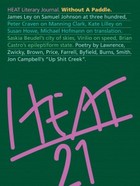
Ivor Indyk (ed), Heat 21: Without a paddle (Giramondo December 2009)

Some of the reasons why you should subscribe to Heat, or at least read it:

1. Worthiness. Your money and attention help to sustain cosmopolitan Australian literary culture.

2. Self-protection. Extracts from works in progress allow you to prejudge the finished work. I’ve decided to avoid a significant number of award winning books on the basis of such advance warnings, and I’m likely to steer clear of one or two foreshadowed in this issue. The poetry provides a similar warning function: poetry is so much a matter of taste, and journals like Heat can play the crucial role of taster. And there are the critical pieces: on the strength of Kate Lilley’s detailed exposition of Susan Howe’s The Midnight, I won’t go looking for it any time soon (far too rich and recondite for my thin blood); Peter Craven’s critical review has put me right off Brian Matthews’s biography of Manning Clark. But it hasn’t enamoured me of Peter Craven: he’s bracingly forthright in his judgements, and even when he’s completely wrong-headed he provokes interesting conversations, but he comes across as too full of himself and too pugnacious for me to actively seek him out.

3. Titillation. Then there are the poems and extracts from works in progress that have the opposite effect. Poems from, among others, Pam Brown, Ken Bolton, Chris Price make me want more.

4. Education. In this issue, Josiane Behmoiras embeds an introduction to the work of Paul Virilio, a cutting edge French thinker, in an account of her recent trip to France (complete with implied travel advisories on the stench of urine by the Seine and problems with Australian Visa cards on the Metro); where her discussion of his work descends from glorious abstraction, it seems to be arrive at important conclusions about how we should live, very close to those of Bill McKibben’s much less abstruse Deep Economy.

The four-colour section in the middle introduces us to the  painter Jon Campbell, and offers us a hand in understanding why we should be interested in his work.

5. Base pleasure. Maybe this is only for people who are or have ever been editors, but Heat can be counted on for regular hits of the sour pleasure of Other People’s Gaffes. The best one in this issue occurs in a poem: ‘a woman rides a / pink vesper that you could / park anywhere’. I’m reasonably sure the poet had a chic little Vespa scooter in mind rather than an evening star blazing to the kerb in the sky.

6. More substantial pleasure. This is of course the real reason for reading Heat at all.

Here, Jena Woodhouse interviews Michael Hofmann, poet and translator, and though her introductory paragraphs use rude words like polytropic, once we get to Hofmann himself the prose becomes a joy to read.

Luke Carman’s three prose pieces gathered under the title ‘The Easy Interactions of an Elegant Young Man’ have a wonderful, disturbingly comic cumulative effect. Part way through the second I realised I saw him read similar work at the Sydney Writer’s Festival earlier this year, and described his reading as rapidfire and surreal. It works that way on the page as well.

And then there’s James Ley’s ‘A Degree of Insanity’, a straightforward, intelligent essay on Samuel Johnson that is splendid in itself, not least because it quotes generously from Johnson’s sonorous prose. Its appearance in this journal gives added pleasure, as it seems to send ricochets out, pinging off the rest of the content. Peter Craven, for example, drops a couple of Johnson’s famous quips into his argument for no apparent reason other than to establish his own gravitas. The notion, from Johnson’s Rasselas, that ‘all power of fancy over reason is a degree of insanity’ bounces prettily off the mild derangement of Luke Carman’s pieces and some of the poetry. The excitement surrounding literary journals in eighteenth century London sparks reflections about the role of their descendants in our time, Heat among them.

Next:  Overland issue 197.

The Brain that Changes Itself

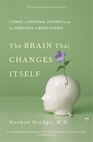
Norman Doidge, The Brain that Changes Itself (2007, Scribe 2009)

1DoidgeThis has been beside my bed since the Sydney Writers Festival in May, and had been vaguely circling my TBR list well before that. It was James Tiptree Jr’s stories that finally got me to the point of opening it up. Alice Sheldon was a research psychologist and her stories reflect a deeply pessimistic sense, presumably based on her professional knowledge, that brains are hardwired. In ‘Houston, Houston, Do You Read’, for instance, the all-female Utopia, faced with three men delivered to them by a freak of time travel, have to choose between allowing the innately violent, hierarchical creatures to ruin their society and killing them humanely. In an alternative reading, of course, it’s a mostly Australian-heritage Utopia faced with three US military types. Either way, plasticity – that is to say, the capacity for change – doesn’t enter into it. My own experience contradicts this pessimism: with enough thoughtful work, and enough taking of two steps forward for each step back, I believe we can achieve all sorts of things that look impossible. The Norman Doidge book promised good news from the hard sciences and I turned to it for evidence-based optimism.

As well as some unexpected echoes of my recent Tiptree reading (for example, Doidge’s account of the PETA’s 1981 intervention to ‘save’ monkeys from alleged experimental cruelty reads like a real-world equivalent of the fantasy exodus from the labs in Tiptree’s 1974 story ‘The Psychologist Who Wouldn’t Do Awful Things to Rats’), I got what I was looking for.

The book is immensely satisfying science for lay readers, that is to say for people who know Sweet Fanny Adams about neuroscience but are interested in the workings of human brains. The subtitle – Stories of Personal Triumph from the Frontiers of Brain Science – is a fair summary of the book’s approach to its subject: each of eleven chapters matches the work of a scientist or clinician with the story of a person who has benefited directly from that work. At the start of the twentieth century, mainstream brain scientists were localisationists, working with a model of the brain in which every function was performed by a particular section of the brain, and if that part was damaged, the function was permanently lost. With increasingly reliable and accurate techniques for mapping brain activities, brain scientists have been discovering that the brain is much more complex than that model allows, and much more adaptable. What’s done cannot be undone, sure enough, because the brain isn’t elastic, but nor is it made of stone. Neurons that fire together wire together – if you can figure out a way to make them fire separately, it takes a surprisingly short time to make them unwire from each other. A Spanish scientist named Alvaro Pascual-Leon demonstrated in the 1990s that ‘our thoughts can change the material structure of our brains,’ and that’s only a part of it.

Seen from one point of view, the book is full of wonders. A woman born with only half a brain nevertheless reads, relates intelligently to other people, performs astonishing feats of memory, and dreams of a heaven tailor-made for her needs. People paralysed by stroke years earlier recover speech or movement through an intensive exercise regime. Persistent pain in phantom limbs is relieved using a mirror in a box. People move objects using only their imaginations (helped by electrodes attached to their brains and linked to computers).

From another point of view, it charts the progress of hard science catching up with common wisdom. Contrary to the dogmas of the ‘mental health’ industry, observable changes in the brain don’t incontrovertibly indicate physical conditions that can only be remedied by drugs, surgery or electric shock. The aggressive assertions of evolutionary psychologists look even more ideologically based than they did without this evidence. Addictions, including to internet pornography, look a lot less like life sentences. Doidge is a Freudian, and the progress of one man’s analysis as an exercise in neuroplastic therapy. In an appendix, ‘The Culturally Modified Brain’ he writes:

Neuroplastic research has shown us that every sustained activity ever mapped – including physical activities, sensory activities, learning, thinking and imagining – changes the brain as well as the mind.

I’m glad my primary schooldays included endless amounts of memorising. It looks as if the years that lie ahead will need to include even more.

If Tiptree/Sheldon were writing now, perhaps her time-lost astronauts would be welcomed to the new Earth, and the story would have to become a novel to chart their progress. Perhaps, too, she would have found an intense, repetitive practice to overcome the depression that debilitated her.

Leave to remain

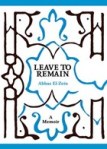
Abbas El-Zein, Leave to Remain (UQP 2009)

9780702236921

There was a piece on the news recently about a conference on Islamophobia. My lay thought on the subject is that the best way to make headway against that polysyllabic malady is to make friends with actual flesh-and-blood Muslims. A probably less efficacious but also less challenging cure might be to read books by Muslim writers. Irfan Yusuf’s Once Were Radicals is a case in point. So is Leave to Remain. Both books are memoirs by Australian Muslims who were born elsewhere, both deal with what it means to be Muslim and ‘of Middle Eastern appearance’ living in Australia; Irfan Yusuf comes from the rough and tumble world of blogdom and doesn’t know when to write ‘my friend and me’ rather than ‘my friend and I’, whereas Abbas El-Zein is a university professor and novelist, parts of whose book have appeared in literary journals. Once Were Radicals did a beautiful job (for me at least) of ‘de-Othering’ Islam – that is to say, I felt that the author had done a brilliant job of bridging the Islamophobia chasm. I approached Leave to Remain expecting something of the same, for a different generation, a different national background (Yusuf left Pakistan for Australia when he was a small child; El-Zein was an adult when he came here from Lebanon).

Paradoxically, even though Abbas El-Zein’s childhood and youth in war-torn Lebanon could hardly have been more different from mine in what someone has called the cotton-wool peace of White Australia, I had much less of a sense of chasms being bridged with this book. Perhaps that’s because Yusuf’s memoir deals largely with his adolescent exploration of Islam, which is still pretty much a closed Book to me; while El-Zein identifies unwaveringly as ‘an adherent … to Enlightenment ideas and practices concerning the secular state, pluralism, science and technology’, close to my own cultural identity.

The book has elements of biography, but is actually a collection of personal essays, each with a stage of the writer’s life as subject and springboard. It’s divided into two parts, of roughly equal length: the first, ‘Origins and Departures’, takes us up to the 32-year-old El-Zein’s arrival in Sydney in 1995, the second, ‘Unhappy Returns’, deals mainly with his return visits to Lebanon and his responses to the wars that have afflicted that part of the world since. I don’t have time to say much more than that there’s some wonderful writing and give some samples.

On his adolescent anti-Americanism (which he repudiates as naive, but records all the same):

As a teenager, I worried about America because I could not understand how it could show off its wealth so casually on screens around the world. Was it not afraid of exposing itself, of being so present in the lives of so many individuals, a presence which was all about America itself? Once, during the war in Beirut, my mother told my teenage sister not to go out with too much jewellery round her neck because the only men she would be likely to attract were robbers. I thought America could benefit from a little talk from my mother. Not that America was likely to grant an audience. America was a blind Narcissus, constantly playing mental images of himself with no hope of seeing himself, let alone anyone else, because he was Narcissus and because he was blind. America could not see. It was made to be seen.

On the War on Terrorism:

A Manichean view of history – in which ‘we’ are indisputably good and ‘they’ are inherently evil – remains the West’s dominant form of expression about terrorism, post–September 11, and barely disguises its racial overtones. It is one of the mysteries of our time that the Soviet nuclear warheads and the IRA campaign on the British mainland, to name two relatively recent threats, did not cause nearly the same ‘existentialist’ panic that a Middle-Aged tribesman has succeeded in inflicting on the West’s collective psyche from his remote hideout in Afghanistan. For all the atrocious deeds of Al Qaeda and European Jihadists in New York, London and Madrid, who does seriously believe that they pose a threat to our existence in the West?

There is a wonderfully comic–grotesque description of his first walk from Redfern Station to Sydney University a few weeks after his arrival in Australia. ‘There was more mutilation around this street than I could live with,’ he writes – and we remember that this is a man who grew up in a civil war. He writes beautifully about his parental anxieties: his little son Ali announces with glee that his name can be found in the word Australia, and a few days later, just as excitedly, that it’s also in Alien. He writes graphic and instructive accounts of religious practices, especially of the Shi-ite festival of Ashura – mentioning in an aside that the public bloodletting that is so alien to Western sensibilities may well have been imported into Islam from the practices of Catholic Spain.

Incidentally, the book was designed, beautifully, by Jenny Grigg, who has been responsible for some of Australia’s most beautiful books (she redesigned The School Magazine ten or so years ago).

NSW Premier’s Literary Awards Dinner [2007]

The Sydney Writers Festival is under way. I kicked off my personal festival yesterday with a workshop led by Patti Miller. The workshop was billed as ‘Memoir – Random Provocations’, which anyone who had read Patti’s book would have recognised as incorporating the title of her chapter on the personal essay. The rest of us signed on for what we thought was three hours looking at approaches to memoir. Heigh ho! It was an excellent three hours regardless, and probably useful. Then last night I went to a screening of Ten Canoes preceded by a conversation between Julianne Schultz and Rolf de Heer, for which the microphones were turned up far too loud for my comfort (I really must post about my tinnitus and booming ears some time). The conversation was interesting, if a little gossipy, and the film was even more wonderful the second time around.

This evening, though, was the real start of my festival. The great court of the Art Gallery of New South Wales was overrun once more by literary types, some who’ve had their likenesses on the walls, but mostly humble key-tappers and pen-wielders. I was at a table with, among others, my friend Madam Misrule, children’s literature activist Bernard Cohen, academic John Stephens, editor-writer-politician-parent Peter Coleman and a charming woman who lives in my street and is often walking her dog when I am walking mine – this was the first time we’ve exchanged names and discovered we have friends and interests in common. The meal was excellent, though I didn’t see anything that would have thrilled a vegetarian. There’s something wonderful about a conga line of waiters weaving between sculptures and tables with plates of beautifully arranged meat and what looked like a dainty caponata.

But on to the business of the evening. Geoffrey Atherden’s address and the award citations are, or soon will be, up on the Ministry for the Arts web site [links all dead in 2020]. I recently bought a microphone for my iPod, and took it for a trial run tonight, so I can give you verbatim bits of the acceptance speeches. But first, I can tell you, nerdishly perhaps, some of the differences between Geoffrey Atherden’s excellent speech as written and as spoken. He cut out about a third of it. In fact he cut out the parts where he argued his case against User Generated Content: someone, talking to me recently about the User Generated Content business model, said that mindless consumerism is being replaced by mindless producerism, and Geoffrey makes a similar argument. He also left out interesting reflections on the Free Trade Agreement, and on the argument that ‘the exciting new multi media, multi platform, new age of digital technology’ will increase the demand for good writing. Presumably these omissions were in order to save time. More interesting than the omissions was an insertion right at the end. Where the written speech, having lamented the current lack of opportunity for young writers in Australia, ends by inviting us to imagine ‘if we had an environment of artistic and cultural activity here that was so stimulating that all those talented young Australians would want to come back,’ and says, with something approaching a non sequitur:

You see, I’m only pretending to be gloomy. Deep down, I’m still hanging on to a last, thin shred of optimism.

The address as spoken ended like this:

… all those young Australians would come flooding back. I seem to remember it happened once before. I seem to remember it happened just after a federal election. Indeed, I’m only pretending to be gloomy.

Gough Whitlam, to whose election in 1972 he was of course referring, was in the room. On the tape I hear myself saying, ‘Stay gloomy, Geoffrey, stay gloomy. It’s not going to happen.’ I hope he’s a better prophet than I am. Given the company I was keeping, I was a little embarrassed when the premier later seized on Geoffrey’s remarks to be fairly crudely party political.

One other nice moment to do with the opening address. As a warm-up remark, Geoffrey said that Maggie Beare in Mother and Son was not based on his mother, and Geoff Morel’s political wheeler-dealer in Grass Roots was not based on Frank Sartor, Minister for the Arts and presenter of all but the final award. In thanking Geoffrey for his address, Frank said, in a welcome departure from his generally ill-at-ease manner, ‘You may not have known this, but Geoff Morel followed me around for two days before he started filming Grass Roots.’

I can’t offer an opinion on any of the awards, because I’ve read so few of the works on the shortlist, but I can tell you a little of what happened.

The first award, the NSW Premier’s Translation Prize and PEN Medallion, went to John Nieuwenhuizen, who has translated from Dutch and Flemish. ‘I’m actually invisible,’ he said. ‘At least that’s what a review of one of my books said, and the judges for this prize agreed. This is of course a huge compliment for a translator. But here I am.’ He also accepted the award as a validation of writing for children – many of the books he has translated have been for children, and this award counterbalances the times he has been asked when he was going to move on to ‘real’ books.

The UTS Award for New Writing was won by Tara June Winch for Swallow the Air. With lovely self deprecation, she said that she’d spent the week practising walking up and down in high heels instead of writing a speech. She made it to the dais and back without stumbling.

Gideon Haigh won the Gleebooks Prize for Critical writing for Asbestos House: the secret history of James Hardie Industries (Scribe). ‘Some books you want to write. Some books just have to be written. This was one of the latter. I couldn’t have turned it down and still considered myself a proper journalist.’

Community Relations Commission Award was won by Shaun Tan’s The Arrival (Hachette Livre Australia), a wordless graphic novel. A friend told me later that she’d nearly hit someone in the ladies’ who was mouthing off about how wrong it was to give a literary award to something that didn’t use words. Well, it’s a paradox I suppose, but it’s a marvellous book, and as Shaun said in his acceptance speech, it’s being read by people who don’t normally read graphic novels, or anything at all – older migrants, for whom the book was really written. I’d cheerfully predicted that this book would win three awards. It won two: it also won the Book of the Year Award. Ms Misrule leapt to her feet and cheered. ‘I love it when one of ours wins,’ she said, encapsulating the esprit de corps that prevails in the children’s literature mob at events like this.

The Scriptwriting Award went to Tony Ayres for the script of The Home Song Stories, a movie we haven’t seen yet. He explained that the story had started out as a memoir but turned into a film script because that’s what he knew how to do.

The Play Award was won by Tommy Murphy for Holding the Man. Impeccably dressed in suit and tie, he told of nervously reading his initial list of ideas for the play to his director: ‘This play might open on the moon. Perhaps the Grim Reaper will appear at some point. And when the character John gets sick he will become a puppet.’ He talked of the importance of collaboration. And he did a gracious thing, which you’ll understand better if you bear in mind that in the play the family of the dying John treat his lover Tim, devastatingly, as having no valid place at his bedside. Tommy, in contrast, thanked his family for teaching the seventh of eight children to embrace sharing, and said his family were represented in the hall by his boyfriend Dane. He went on with some high romance: ‘You can’t win a prize for a love story unless you love someone as deeply as I love Dane.’ He also paid tribute to Tim Conigrave, author of the memoir the play was based on: ‘Tim has taught me that writing is sharing too much. There’s no avoiding that, and I embrace it.’

The Patricia Wrightson Prize went to Narelle Oliver, a Queenslander, for Home (Omnibus), a picture book about peregrine falcons who built a nest high up in a building in Brisbane. She thanked, among many others, the falcons Freda and Frodo: ‘They are probably bedding down right now on their nest of stones upon which I did lie with my camera to capture their home a couple of years ago. I saw my city afresh, in a new and exciting way, through the eyes of falcons, and I hope to share that with children and adults in the book.’

The Ethel Turner Prize for young people’s literature was won by Ursula Dubosarsky’s The Red Shoe (Allen & Unwin). Ursula had had a dog accident in the morning, resulting in a broken wrist and her absence from the dinner. Her father, Peter Colemen, read her acceptance speech. ‘You may well ask what on earth does a six year old girl [the book’s heroine Matilda] make of something as weighty as the Petrov affair [A Soviet defection that made headlines in the 1950s]. What indeed do six year old children make of the current images of public fear – the Twin Towers, Saddam Hussein, global warming? Well, in reply, as the late Ted Hughes has observed, just remember, your first six years shape everything.’

John Tranter won the Kenneth Slessor Prize for poetry with Urban Myths: 210 Poems (UQP). He read a poem (which someone objected to as inappropriate, but I appreciated: it was ‘After Holderlin’, and John’s brief explanatory notes were illuminating). He then contributed to the political theme of the evening by thanking ‘the working men and women of New South Wales who elected this generous government and whose tax dollars went to make up this wonderful cheque’.

The Douglas Stewart Prize for non-fiction was won by Robert Hughes’s Things I Didn’t Know: a Memoir (Random House Australia). Bob wasn’t there but his acceptance speech was read by his publisher. His first remark – ‘The last time I won any sort of prize in Australia was a dismaying number of years ago: I won it for building a control line model aeroplane and flying it in Centennial Park’ – enraged one of my dinner companions: ‘That man is incapable of telling the truth. Everything he says is a lie.’ Be that as it may, the acceptance speech went on to a gracious tribute to Douglas Stewart, his nature poetry and his verse drama, in particular The Fire on the Snow, ‘much of which I still find I know by heart’.

Probably the most prestigious prize apart from book of the year, the Christina Stead Prize for fiction, went to Peter Carey for Theft: A Love Story (Random House Australia), another New Yorker, whose speech was read by the same publisher. After some nicely-turned complaints about a back injury and dental problems, this speech too paid tribute to the person who gave the prize its name. Christina Stead spent 46 years away from Australia; Peter Carey has been away for 16:

I can now understand Christina Stead as one part of that endless stream of Australian travellers most of whom come back in a year or two – most, but not all. Hundreds and thousands of us have become waylaid, up some foreign creek, some foreign road among people who cannot imagine who we are, or that our dreams each night are of Australian landscapes with those smooth, lovely trunks and the vast khaki canopy tossing in the wind showing the silver undersides of its fragrant leaves. I probably don’t need to say this to anyone who has read my work … but I am not only pleased that Theft has been read with pleasure and intelligence by its first true readers, people who do not need a footnote to know what a Blue Heeler is; but also deeply moved that it is the Christina Stead award I am receiving. The award this year is for Theft, but every year it makes us honour a brave artist who swam against the current, worked away from home for 46 years, and bequeathed us novels that are among the greatest works of Australian literature.

Special Award winner was Gerald Murnane. On the tape, when Frank Sartor mispronounces the name of the journal and enduring feature of Australia’s literary landscape Meanjin as ‘Minnajin’, it sounds as if the whole assembly murmurs in amazed disapproval. Frank hesitates, then realises that whatever he’s done wrong can’t be mended and ploughs on. Mr Murnane gave a curmudgeonly speech about receiving the award late in his career.

Shaun Tan was called back to the podium, this time to shake hands with the Premier, Morris Iemma (who seems to be winning people over, to the extent that I heard him referred to as Morris Yummy). One of the great things about the Book of the Year prize is that the recipient doesn’t necessarily know about it in advance, so we get some unprepared remarks. After muttering that there must have been a mistake and thanking the people he’d forgotten in his first trip up front, Shaun talked about his long campaign to have picture books recognised as being for adults as well as children: ‘Part of my success with this book may have been children getting their parents to read it. I’ve got this huge support base among children.’ He thanked independent booksellers for supporting the book, ‘and seeing its inability to be categorised as a blessing rather than a curse’.

And it was all over bar the tart, the chocolates and the schmoozing.

Crotchety note added later: The Sydney Morning Herald‘s report, headlined ‘Big Names Take Book Awards’, doesn’t even mention the Book of the Year or the Special Award, possibly because the sub-editor didn’t deem Shaun Tan or Gerard Murnane to be Big Enough Names, or because the money is the story, and the combined monetary value of Shaun’s two prizes amounts to $17 000 and Gerard raked in a measly $5000, whereas the Big Names each won $20 000. But then John Tranter and Ursula Dubosarsky each got a guernsey – perhaps as token poet and children’s writer, or to flesh out the subtext of resentment of expatriates by indicating that, unlike the judges, the Herald knows about non-expatriate talent. It’s a mystery.