Tag Archives: translation

The Melancholy of Resistance at the Book Group

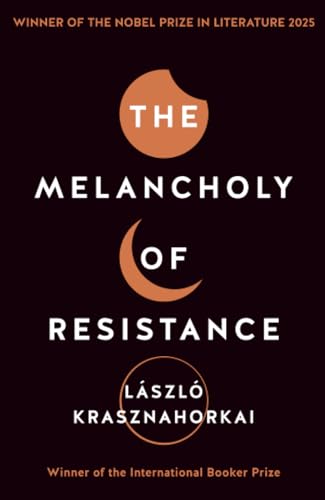
László Krasznahorkai, The Melancholy of Resistance (1989, translated by George Szirtes, published by Tuskar Rocks Press 2000)

Before the meeting: László Krasznahorkai won the 2025 Nobel Prize in Literature. The Melancholy of Resistance (Hungarian title Az ellenállás melankóliája) was his second novel. Written as the Communist regime was collapsing in Hungary in 1989, it centres around an outbreak of senseless mass violence in a small Hungarian town. In real life, happily, the transition from Communism to a version of democracy was peaceful, but the book’s nightmarish vision and weird allegorical tale resonate far beyond its immediate political context.

One thing was clear to me as I read: this book, with its absence of paragraph breaks, long internal monologues about, for example, esoteric musicology, a key character who remains unseen and unheard except for weird chirping sounds, and many story lines that peter out or are resolved with a throwaway comment in the middle of something else, could never be made into a film. I was wrong. In 2000 (the year this translation was published), Béla Tarr adapted it in Werckmeister Harmonies, which has been called ‘one of the major achievements of twenty-first-century cinema’ (an impressive accolade, even if it was written in the YouTube comments section).

I haven’t seen the film, but I can’t think of a better way to convey the feel of the book than to show you its trailer:

There you have it: the young, naive idealist who may well be the idiot people think he is; the old, disillusioned musicologist; the corpse of a huge whale wheeled into town; the ominously silent crowds of men; the awful mob violence; the invading military (though I don’t remember a helicopter in the book). Some elements are missing, though I expect they’re in the movie itself: a mysterious character known as the Prince, two children caught in the crossfire, and the key roles of two women. Nor do the streets of the movie seem quite as covered in frozen garbage as those of the novel.

The book’s most striking feature is absence of paragraph breaks and the predominance of long sentences. The sight of page after page of uninterrupted text is intimidating at first, and it’s annoying having to hunt around if you lose your place, but the effect on the page, as I imagine it is on the screen, is a dreamlike flow. And George Szirtes’ has translated the Hungarian into extraordinarily smooth English that enhances that effect. This isn’t Proust, where the sentences turn in on themselves, clauses nesting within clauses, with a hypnotic, introspective effect. Here the effect is more propulsive – the long sentences sweep you on. And they work brilliantly in a book where characters are always in motion (even if sometimes the motion is mental). They walk, stumble, run errands, occasionally waddle, stalk, pursue, flee, but always move.

It’s as if the characters can’t stop for breath, so the text has to hold out for as long as it can without a full stop, and even longer for a bit of white space.

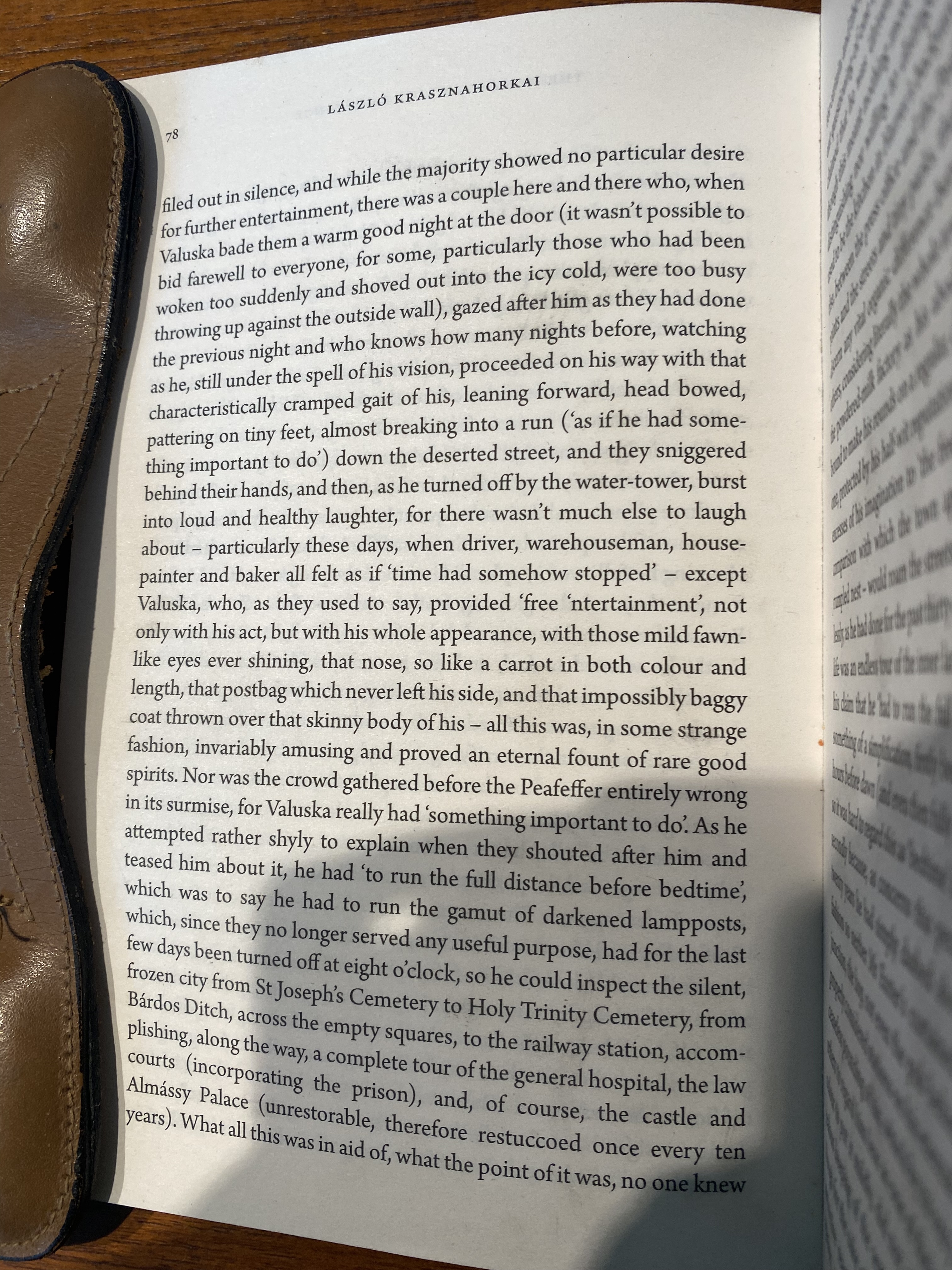
Page 78* occurs partway through the third paragraph/section, which unfolds from the point of view of Valuska, a kind of holy idiot and easily the book’s most sympathetic character. Valuska has been introduced doing his nightly routine at closing time in the Peafeffer tavern, in which he demonstrates the mechanics of a solar eclipse, deploying three paralytic drunks to represent the sun, the moon and the earth. His attempt to communicate the awe-inspiring order of the cosmos is tolerated by the drinkers as a way to delay closing time. At the top of this page, the evening is over and they walk out into the cold night:

The first thing to note about this page is that, counting the sentence that started on the previous page, there are just three sentences. The middle one is quite short: at 20 words it may be the shortest in the book, but is otherwise unremarkable. The others are typical of the book.

It would please my inner 11-year old Queenslander to analyse one of them – identify the main clause and the subsidiary clauses, and the nature of the subsidiary clauses. It probably wouldn’t be very entertaining for my readers, so I’ll limit myself to noting that the basic structure of this:

So they filed out in silence, and while the majority showed no particular desire for further entertainment, there was a couple here and there who, when Valuska bade them a warm good night at the door (it wasn’t possible to bid farewell to everyone, for some, particularly those who had been woken too suddenly and shoved out into the icy cold, were too busy throwing up against the outside wall), gazed after him as they had done the previous night and who knows how many nights before watching as he, still under the spell of his vision, proceeded on his way with that characteristically cramped gait of his, leaning forward, head bowed, puttering on tiny feet, almost breaking into a run (‘as if he had something important to do’) down the deserted street, and they sniggered behind their hands, and then, as he turned of by the water-tower, burst into loud and healthy laughter, for there wasn’t much else to laugh about – particularly these days, when driver, warehouseman, house-painter and baker all felt as if ‘time had somehow stopped’ – except Valuska, who, as they used to say, provided ‘free ’ntertainment’, not only with his act, but with his whole appearance, with those mild fawn-like eyes ever shining, that nose, so like a carrot in both colour and length, that postbag which never left his side, and that impossibly baggy coat thrown over that skinny body of his – all this was, in some strange fashion, invariably amusing and proved an eternal fount of rare good spirits

is five linked principal clauses:

So they filed out, and a couple gazed after him, and they sniggered, and then burst into laughter, for there wasn’t much else to laugh about.

That skeleton is adorned with images of the bitter cold, vaguely comic drinkers throwing up, descriptions of Valuska, an explanation of what they found amusing about him, and a reminder of the drinkers’ wider context – ‘driver, warehouseman, house painter and baker’.

Valuska stands out: time has ‘somehow stopped’ for the town in general, but he is fascinated by the continuous movement of the heavenly bodies and is himself always on the move. That stopped-ness comes into focus in chilling scenes in which the town square is full of motionless men, all as if waiting for something. And when they move, the effect is shocking, violent.

I don’t know that I’d recommend the book, but I enjoyed it, and it has stayed hauntingly in my mind. It makes many other books feel like plodding reportage.

After the meeting: This was one of the best meetings of the book group ever. We exchanged gifts – everyone was supposed to bring a book from their shelves, though the book I received (a Gary Disher title) is in suspiciously mint condition. Some of us read poems – by Adrian Mitchell, Mary Oliver, Simon Armitage and Robert Gray. We reminisced about the group’s history and argued about how firmly fixed our list of dates for the year should be. We shared stories of courage and shame. We ate well. We enjoyed the early summer evening. And we had a wonderfully animated discussion of the book.

Three out of eight of us had read the whole thing. A number of others were well under way and intend to finish it. Everyone had something to say. Here are some of my highlights.

I was reading Mrs Dalloway a couple of pages a day alongside of The Melancholy of Resistance, and felt strongly that the books spoke to each other but couldn’t say how. When someone mentioned the way the narrative focus transfers from one character to the next at the end of each section, I realised this is one of the similarities: where Virginia Woolf’s narrator slips from one character’s mind to another sometimes several times on a single page, Krasznahorkai’s narrator does a similar thing, but on a much wider arc.

One man read the book not realising it was more than 30 years old, and the political dimensions of it seemed right up to date. I don’t know if he mentioned the MAGA riots in January 2020, but they certainly seemed relevant.

Someone said it was hard to resist a book where a character spends four pages trying to work out the physics of hammering a nail while repeatedly hitting himself on the thumb. And then, having solved the problem by acting without thinking about it, he is told by his cleaning lady that he’s done it all wrong. Our group member who has been studying philosophy told us that this is even funnier when you know that one of Heidegger’s most famous passages involves a hammer. (That person’s favourite moment is Mr Eszter’s seemingly interminable rumination about the pointlessness of the diatonic scale (at least that’s what I think it’s about) – which was my second least favourite moment.)

Contrary to my own response, one man felt the book was intensely cinematic. And as we talked it was clear that it’s full of memorable scenes. We reminded each other of the scene where Valuska demonstrates the mechanics of an eclipse, the interrogation scene, the force with which Mrs Eszter’s hand comes down on Valuska’s shoulder to stop him from speaking, the horriific scene where the mob runs riot in the hospital, the brilliantly evoked streets full of frozen garbage, and more.

At heart, one man said, it’s a love story between Mr Eszter, an intellectual who has given up any hope that thinking could be of value, and naive, well-meaning Valuska.

And that’s a wrap for the Book Group for 2025.


The Book Group met on Gadigal land, and I have written this blog post on the land of Gadigal and Wangal of the Eora nation. I acknowledge Elders past and present of those clans, and welcome any First Nations readers.


My blogging practice is to focus on the page that coincides with my age, currently 78.

Geoff Page’s Codicil

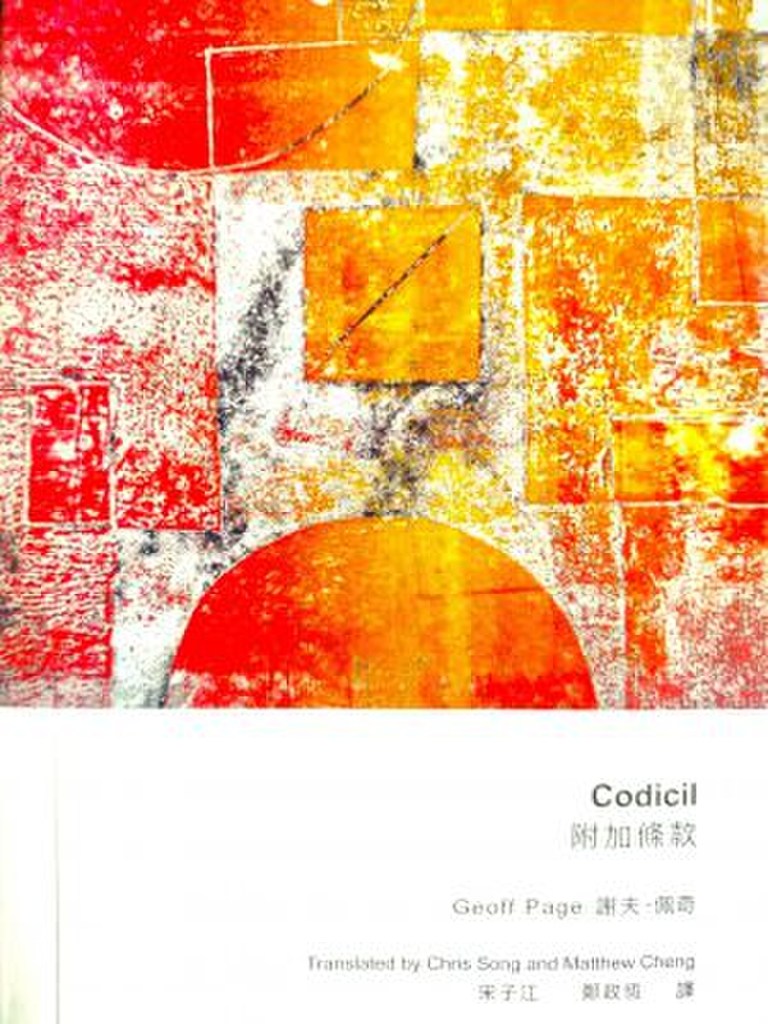
Geoff Page, Codicil, tanslated into Chinese by Chris Song and Matthew Cheng (Flying Island Books 2019)

It’s National Poetry Month in Australia. The Red Room Poetry site lists a plethora of events, workshops and competitions, promoted by ambassadors ranging from journalist Stan Grant to comedian Suren Jayemanne.

Codicil is the third book of poetry I’ve read so far in Poetry Month. I plan to read and blog about three more.

Geoff Page’s poetry has been around for a long time. I have an alarming number of anthologies of Australian poetry on my bookshelves, and his work appears in most of them, from Poet’s Choice (Island Press 1971, a limited, hand-set and -printed edition of 500 copies) to Contemporary Australian Poetry (Puncher & Wattmann 2016). His work is wonderfully accessible, using traditional forms without being trite or hidebound. For an intelligent discussion of his poetry, you’d find it hard to go past Martin Duwell’s review of his New Selected Poems (Puncher & Wattmann 2013). The whole review is worth reading, but I’ll just quote his description of Page as ‘a public poet who reflects the social concerns of the time of the Bicentennial and into the first decade of the twenty-first century’, and as a writer of personal poems with the ‘dominant image of himself as an outsider in a family he loves’.

Duwell’s description fits Codicil, which includes some new poems and at least three of his most anthologised poems, ‘Smalltown Memorials‘ (1975), ‘Grit’ (1979) and ‘My Mother’s God‘ (1988) – the links are to recordings of Page reading the poems on the Poetry Archive website. What I take to be the most recent poems here deal with ageing and the approach of death – the title poem is instructions for the disposal of the poet’s ashes on the Clarence River, where he spent his childhood.

I imagine that the poems were selected by the translators, themselves accomplished poets in Hong Kong, with the intention of introducing Page’s work to Chinese readers. I wish I could read Chinese, because I’d love to know how they have dealt with the frequent Australian idioms and throwaway references. Like this from ‘Three Akubras’:

Three Akubras in a row
my brothers underneath them
standing at the saleyards there

Or this, from ‘Severance’, an imagined speech to an employee being sacked:

User Pays and 
Market Forces
are all the rhet-
oric you'll get.

(And what have they done with that weird hyphen that’s there for the sake of metre and rhyme?)

And I’d love to know what a Chinese reader might make of his occasional professions of allegiance to iambics, as in ‘I Think I Could Turn Awhile’, in which he imagines writing ‘like the Americans’, an heir to Whitman. But then:

I'd hear the clipped
iambics calling,
my template just
beneath the line

For me, alas, the bilingual aspect of the book amounts to a purely visual effect – and it is fascinating to see what these very Australian poems look like in Chinese characters.

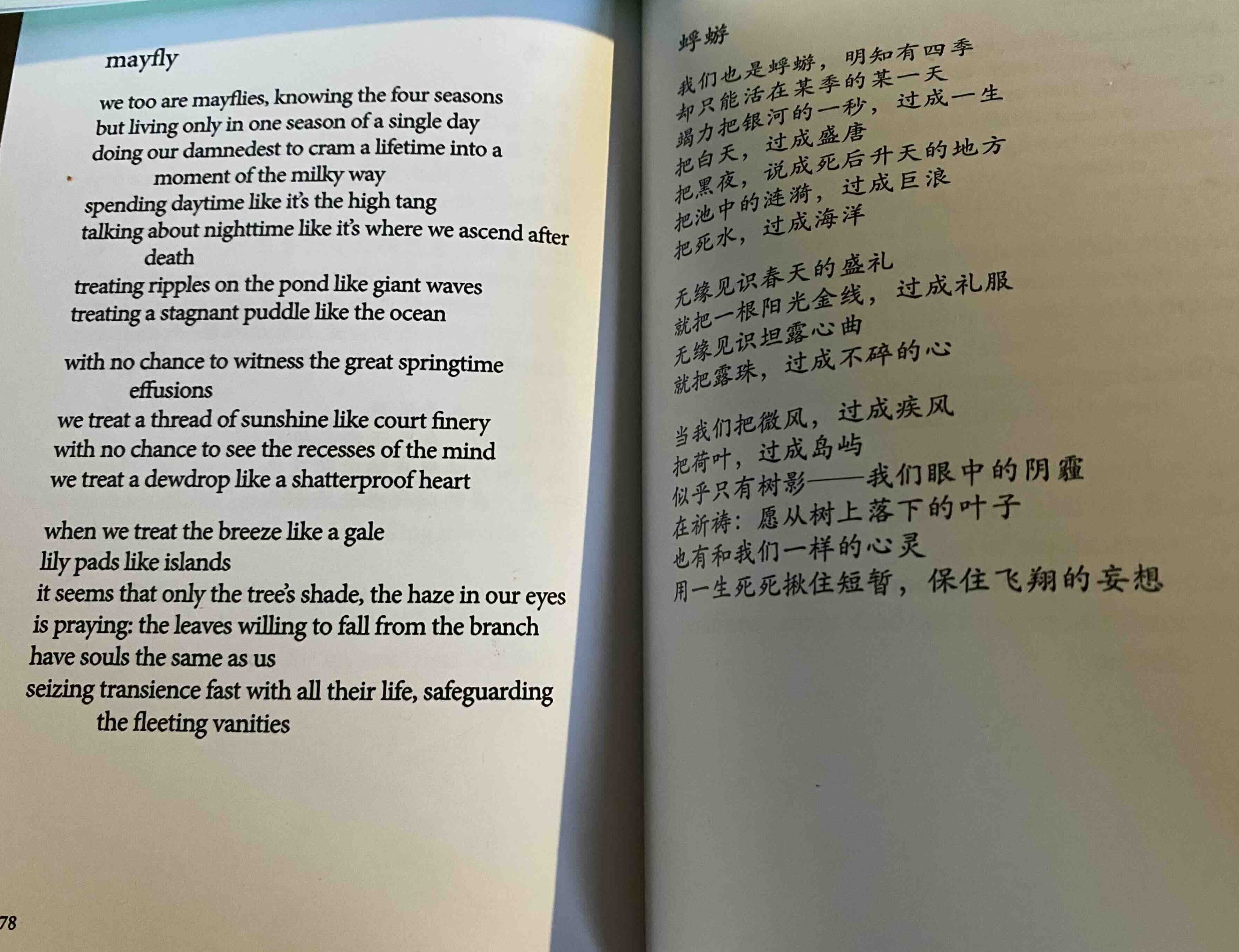
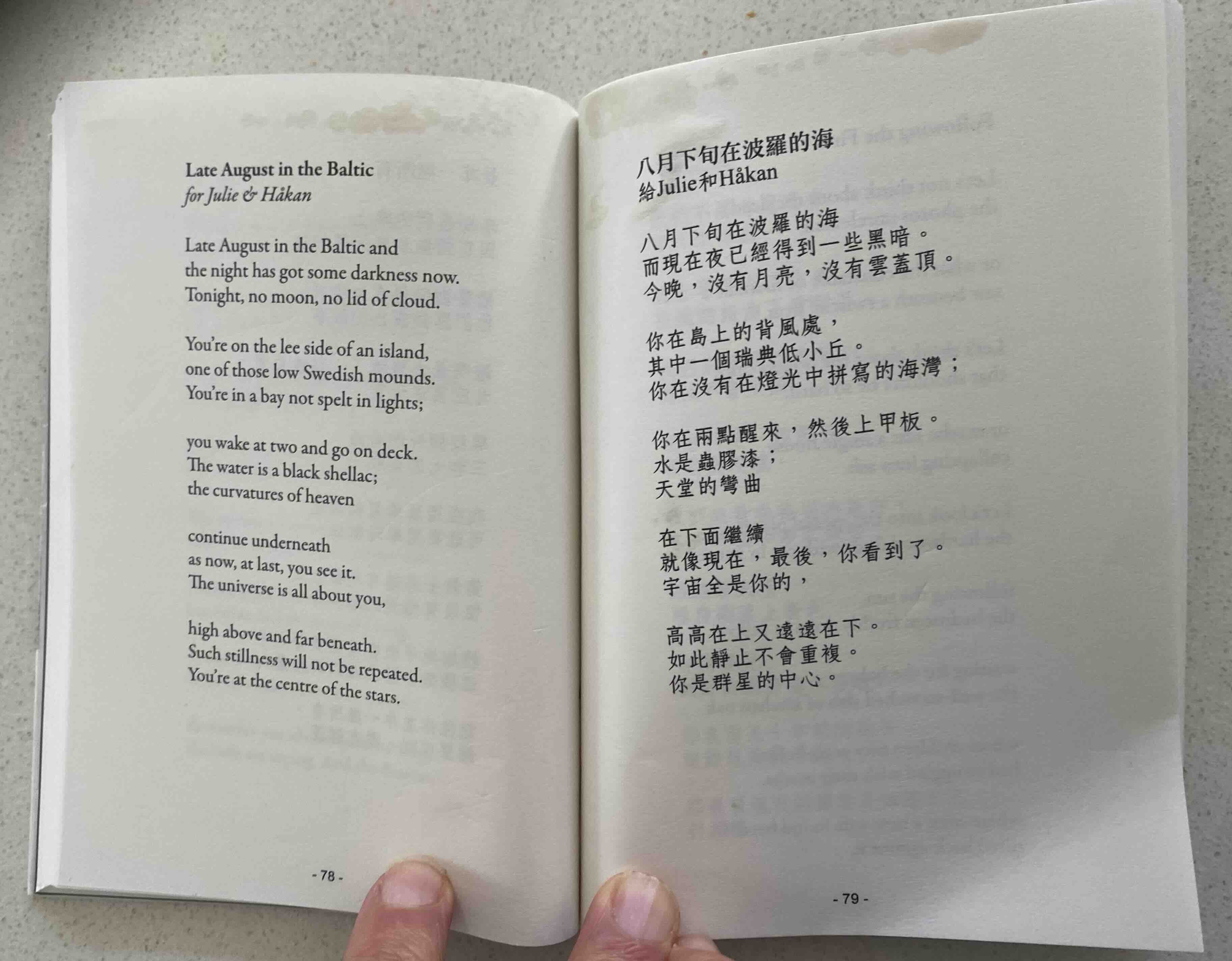
Here’s an image of pages 77 & 78*:

The poem, first published in Island magazine in September 2009, is neither a public poem dealing with issues of the day, nor a personal poem dealing directly with family or mortality. I read it as a letter to friends who are on a boat somewhere on the Baltic Sea, perhaps in response to a photo they have sent. Whatever, it’s a wonderful evocation of a still, moonless night on the water.

It’s almost a sonnet. The first eight lines paint the scene, and the almost perfectly regular iambic pentameters (de-dum de-dum de-dum de-dum) enact the calm of the night.

Late August in the Baltic 
for Julie & Håkan

Late August in the Baltic and
the night has got some darkness now.
Tonight, no moon, no lid of cloud.

You're on the lee side of an island,
one of those low Swedish mounds.
You're in a bay not spelt in lights;

you wake at two and go on deck.
The water is a black shellac;

Then there’s a turn, so gentle, in mid stanza with just a semicolon to mark it. The lines get shorter, and the literal elements of the poem – the island, the time of year, the deck, the absence of lights on shore – give way to more fanciful language:

the curvatures of heaven

continue underneath
as now, at last, you see it.

Then the regular iambics re-establish themselves – as if a small wave of metaphor has momentarily disrupted the stillness of the poem, and it can now continue, but with a broader view:

The universe is all about you,

high above and far beneath.
Such stillness will not be repeated.
You’re at the centre of the stars.

Pause for a moment to look at the second last line. Without it, the poem would have been a sonnet, and the bunching up of sibilants in ‘Such stillness’ strikes a dissonant note. I don’t think this is a flaw. What the line says – a warning not to expect life always to be like this – is unobtrusively reinforced by its comparative harshness and a faint sense that it disrupts the form. Whatever, it makes sure that what is to come in the last line is read as humbling rather than grandiose.

The last line gies us the word that has been implied but conspicuously missing from the first part of the poem: ‘stars’. It’s not completely irrelevant that this is the word that comes at the end of each book of Dante’s Divine Comedy.

We are at the centre of myriad points of light – not a narcissistic centre, but one who for this unrepeatable moment has a glimpse of the immensity and splendour of the cosmos. I’m reminded of Yayoi Kazuma’s infinity mirror rooms.

I’m in awe of Chris Song and Matthew Cheng for taking on the task of translating a poem that works so much through the rhythms and traditions of its native language.


I read Codicil on Wulgurukaba land, beautiful Yunbenun. I wrote the blog post on the land of Gadigal and Wangal of the Eora Nation. I acknowledge Elders past and present of all those Nations, and welcome any First Nations readers.


My blogging practice is to focus on the page that coincides with my age, currently 78.
Jean-Michel Guenassia, the Incorrigible Optimists’ Club and (not) the book group

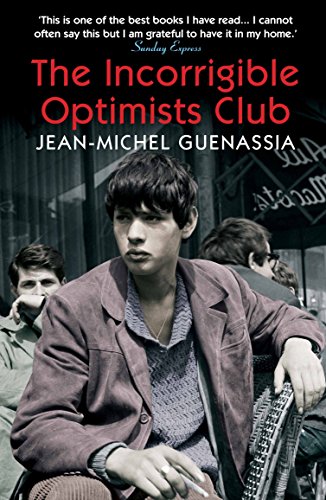
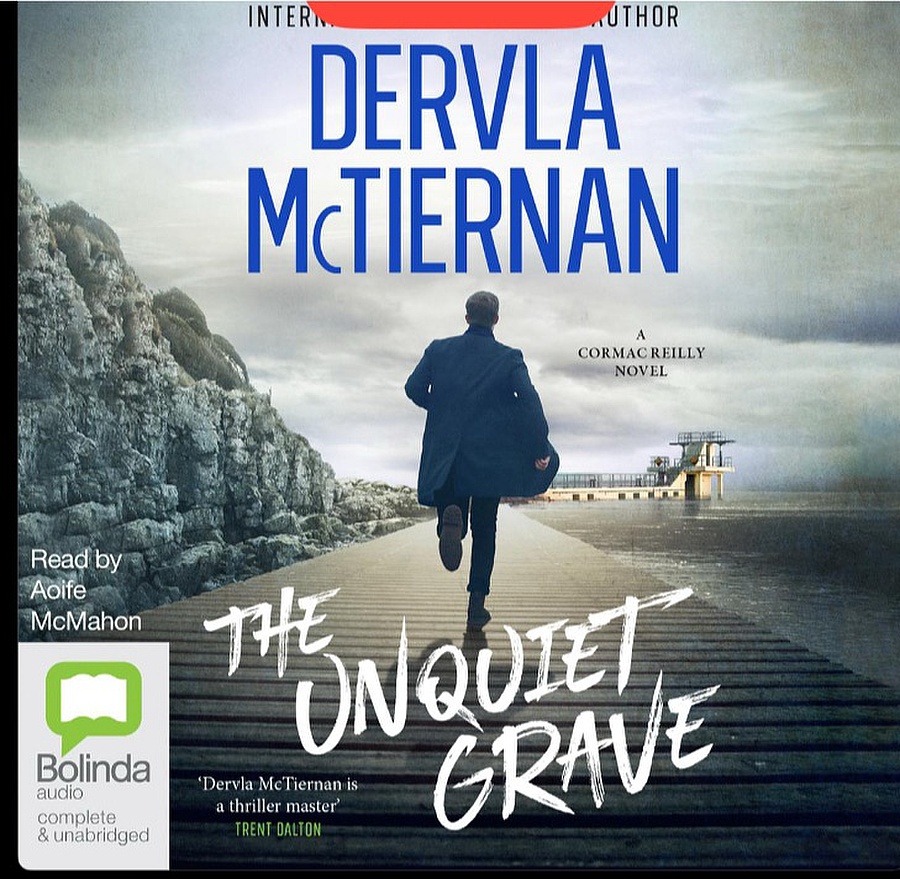
Jean-Michel Guenassia, The Incorrigible Optimists’ Club (2011, translation Euan Cameron 2014)

Before the meeting: The Book Group’s designated chooser defied recent practice and chose a long book – 624 pages in my edition. I doggedly put in the time, and had read the book well before the meeting, only to realise that I was away from home on the night and couldn’t be there.

The club of the title is a group of exiles in 1950s Paris who meet in the back room of a bistro, mostly to play chess but also to share news of their homelands, and to argue fiercely about love, politics and life in general. One of the two main strands of the book is made up of their stories. Mostly they are without ID, even stateless refugees or defectors from the Soviet Union. One has actually been a friend of Stalin’s, who defected for love but remains faithful to the Soviet cause. The rest are dissidents or men (they are all men) who were in the wrong place at the wrong time. Jean-Paul Sartre is a member and kind of patron, though after a riveting scene in which he registers news of Camus’ death, he pretty much fades from the narrative.

We see the club and its members through the eyes of Michel Marini, a schoolboy who first visits the cafe to play desktop football (whose French name, ‘baby-foot’, trand). His coming of age story, against the backdrop of the Algerian War of Independence, is the other main narrative strand. Michel befriends Cécile, the girlfriend of his older brother, Frank. Frank bunks off to fight in Algeria, then disappears, only to reappear as a fugitive. Cécile calls Michel ‘little bro’, and neither she nor he realise that he is completely in love with her. Meanwhile, Michel’s parents’ marriage goes through tumultuous times.

It’s never dull, richly political and just as rich in its focus on the storms of adolescence. Yet the blurb describes it as a debut novel. Could this possibly be the work of a young person? I went looking and found that it’s not. According to Wikipedia, Jean-Michel Guenassia is almost as old as me, and was 59 when the book was published. He had in fact previously published one novel, and three TV screenplays and some plays had been produced. The Incorrigible Optimists Club is another example of an overnight sensation that was years in the making.

Euan Cameron’s English version is smooth, lively and engrossing.

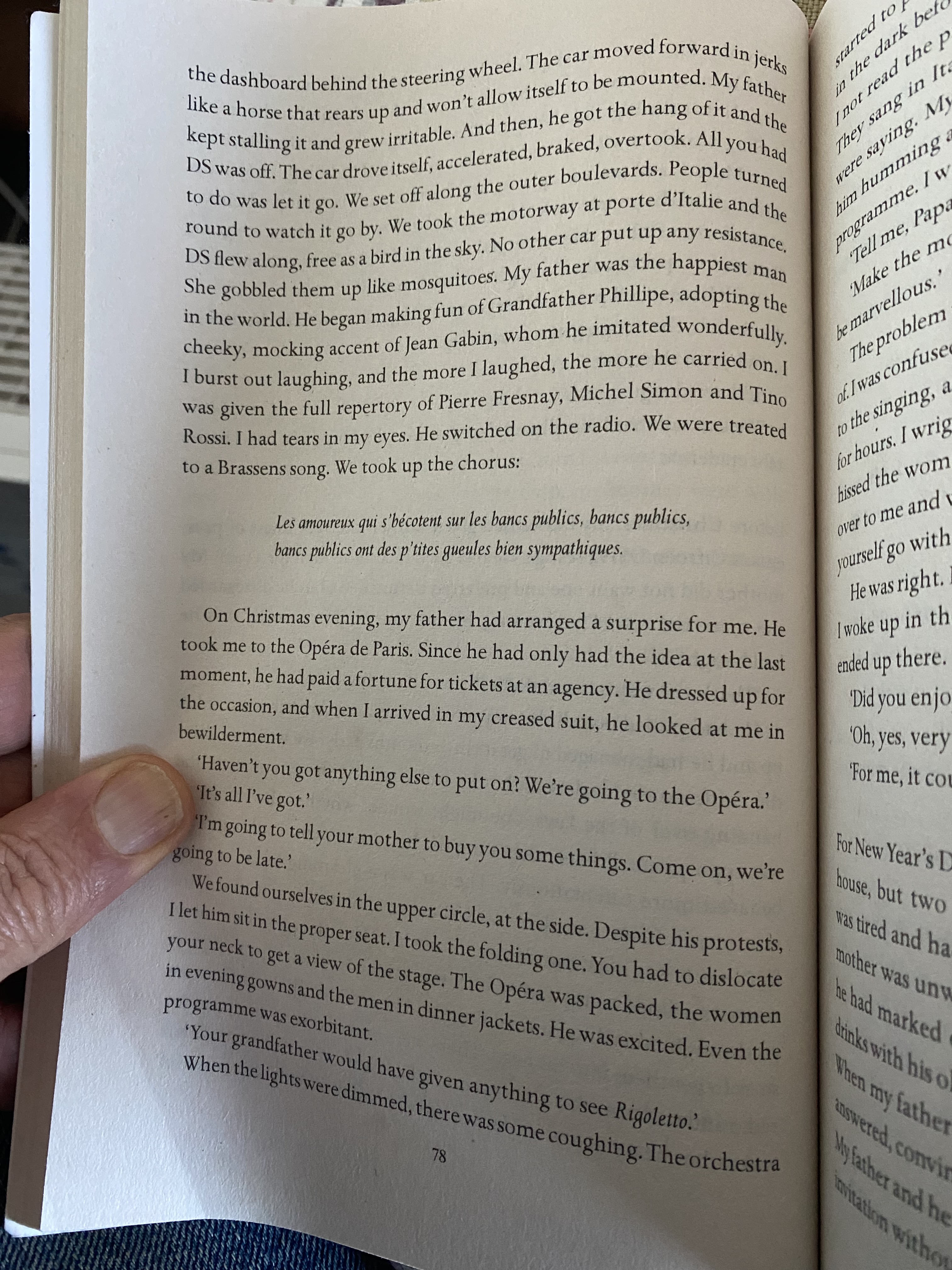
Page 78* highlights elements of the book that didn’t feature in that quick overview. But they’re qualities that are important to the way the book draws the reader into the warm embrace of its imagined time and place.

We’re still getting to know Michel before he becomes involved with the Incorrigible Optimists, before the realities of the Algerian War intrude into his life, before his parents’ relationship becomes fully hostile. His father, a small businessman, has just bought a flash car – a DS 19 – and takes it for a spin with Michel in the passenger seat:

After a rough start, the car behaves like a midlife-crisis dream come true. We’ve been told that Michel’s father loves to impersonate the cool screen actors of the day, and that he is more or less despised by his wife’s upper-class parents, including Grandfather Philippe mentioned here. This paragraph reminds us of that tension, shows him having fun with his son, and at the same time fleshes out the soundtrack of the era. This kind of detail is what brings the narrative alive, even for readers (like me) who have vague to nonexistent knowledge of he singers and actors mentioned:

My father was the happiest man in the world. He began making fun of Grandfather Philippe, adopting the cheeky, mocking accent of Jean Gabin, whom he imitated wonderfully. I burst out laughing, and the more I laughed, the more he carried on. I was given the full repertory of Pierre Fresnay, Michel Simon and Tino Rossi. I had tears in my eyes. He switched on the radio. We were treated to a Brassens song. We took up the chorus:
_ Les amoureux qui s’bécotent sur les bancs publics, bancs publics,
_ bancs publics ont des p’tites gueules bien sympathiques.

Jean Gabin played Maigret in 1958. Pierre Fresnay was the suave Frenchman in La Grande Illusion. Michel Simon was described by Charlie Chaplin as the greatest actor in the world. Tino Rossi, like the others that Michel’s father impersonates, was feted as a film actor who supported the Resistance. Even without all the googling, you can tell that this is a moment when father and son are enjoying each other and loving life, singing together, and celebrating an anti-Fascist strand of French culture.

Here’s a YouTube of George Brassens singing ‘Les amoureux des bancs publiques’. The words don’t really matter, but they translate as ‘The lovers who kiss on public benches, public benches, public benches, have very friendly little mouths.’

Then there’s this:

On Christmas evening, my father had arranged a surprise for me. He took me to the Opéra de Paris. Since he had only had the idea at the las moment, he had paid a fortune for tickets at an agency. He dressed up for the occasion, and when I arrived in my creased suit, he looked at me in bewilderment.
‘Haven’t you got anything else to put on? We’re going to the Opéra.’
“It’s all I’ve got.’
‘I’m going to tell your mother to buy you some things. Come on, we’re going to be late.’
We found ourselves in the upper circle, at the side. Despite his protests, I let him sit in the proper seat. I took the folding one. You had to dislocate your neck to get a view of the stage. The Opéra was packed, the women in evening gowns and the men in dinner jackets. He was excited. Even the programme was exorbitant.
‘Your grandfather would have given anything to see Rigoletto.’

This time Michel doesn’t share his father’s enthusiasm. The tiny incident, especially coming on the heels of the singing together with Georges Brassens, shows us the mutual affecrtion between father and son, as well as the distance that is growing between the generations, both of which become hugely important when the father disapproves of things done by Michel’s brother Frank but makes enormous sacrifices for him.

After the meeting: Sadly, I wasn’t there.


I wrote this blog post on Wulgurukaba land, the luxuriant island of Yunbenun, where cockatoos screech during the day and curlews serenade the night. I acknowledge the Elders past and present, and welcome any First Nations readers.


My blogging practice is to focus on the page that coincides with my age, currently 78.
Annie Ernaux’s Man’s Place at the Book Group

Annie Ernaux, A Man’s Place (La Place ©1983, translation © Tanya Leslie 1992)

Alphonse Duchesne, who ran a small cafe/grocery in Normandy with his wife, died in 1967, two months after his daughter Annie Ernaux qualified as a school teacher, marking a transition in the family’s class status. On the train journey home from the funeral, Ernaux writes:

I tried to keep my son entertained so that he would behave himself. People travelling first-class have no time for noise and restless children. I suddenly realised with astonishment, ‘Now I really am bourgeois,’ and ‘It’s too late.’ (Page 18)

Later that summer, she thought to herself, ‘One day I shall have to explain all this,’ meaning she needed to write about her father and the distance that had come between them during her adolescence: ‘Although it had something to do with class, it was different, indefinable. Like fractured love.’

This short book – just 64 pages – is a rigorous, spare and unsparing, attempt to rise to that need. In 1982, having already written three novels, Ernaux set out to write a fourth one, about her father. But, she writes:

I realise now that a novel is out of the question. In order to tell the story of a life governed by necessity, I have no right to adopt an artistic approach, or attempt to produce something ‘moving’ or ‘gripping’. I shall collate my father’s words, tastes and mannerisms, the main events of his life, all the external evidence of his existence, an existence which I too shared.

The book tells two stories: the life story of Ernaux’s father and – always in the present tense as if allowing us to look over her shoulder as she types – the self-reflexive story of the writing of the book.

The father was from a peasant background. His own father was illiterate, and he worked first as a farm hand, then as a factory worker and finally, along with his wife, ran the small grocery shop and café. He bickered with his wife, spoke a rustic version of French, never set foot in a museum, voted for reactionary politicians ‘for a lark, but without conviction’, was intensely proud of his daughter’s success in moving into the middle class but didn’t make any part of the transition with her.

Every now and then, Ernaux steps directly into the frame to say how long she has now been writing, explain that it is a slow process because she is avoiding her own emotional memories in order to focus on her father’s story. It’s not that she doesn’t draw on memory – as for example when she describes a photo of her father taken at her wedding reception, and recalls her sense of him at the moment it was taken, ‘certain that he wasn’t enjoying himself’. And through it all, told in flat unemotive language, the terrible undertow of the daughter moving away into a different world:

One day he said, ‘Books and music are all right for you. I don’t need them to live.’

This was the first of Annie Ernaux’s ‘autobiosociological’ books. It’s the fourth I’ve read, and with each one I become more grateful to the Nobel committee for drawing her to my attention. The others (with links to my blog posts) are:

After the meeting: I was a little apprehensive about this meeting, as I had picked the book. The job was sprung on me at the last meeting, it had to be a short book, and this was on my TBR list, so I named it on the spot without due consideration.

It turned out that, quite apart from the big plus of brevity, the book was generally much liked, and we had a discussion that made me glad all over again to be in the book group. At times the discussion was personal: one man honed in on the early part of the narrative when the family’s life was disrupted terribly by the bombing of Normandy in World War Two (a part of the narrative that had passed me by); a number of us drew parallels with the trajectories of our own lives – as the first generation in our families to go to university; and the conversation wandered, seemingly off-topic, to our relationships to our parents, and various ways in which the stories of different parents had been discovered and even published.

We had a wonderful difference of opinion. One man, call him K–, himself a recently retired small businessman, said that Annie Ernaux had completely failed to get that her father, as a small businessman, had made a life for himself that he was completely happy with: when Ernaux portrays him as ashamed of his lack of ‘culture’, that is complete projection. I must be just a little bit in love with Annie Ernaux because my defensive hackles went up, and I disagreed that the father was portrayed as anything other than happy with his life!

The back cover blurb of the Ftzcarraldo edition says that ‘Ernaux reveals the shame that haunted him throughout his life’. So K– isn’t alone in reading the book that way. I still disagree. But I’ve been reflecting for days, and while I still think K– was wrong, I believe he put his finger on something at the heart of the book.

There’s no doubt that Annie the character believed that she had a better life than her parents, that they were proud she had made the transition, that a gulf of mutual incomprehension developed between the generations. The father certainly feels shame in some social situations – not understanding what a school teacher means by ‘town clothes’, not being able to spell when filling out a form. It’s explicit that the people of the daughter’s world look on people like her father with scorn. But I don’t read Ernaux or her father as sharing their judgement. She lays out the detail of his world, and is pretty clear about her own ‘bourgeois’ perspective. When she mentions in passing that he votes for a reactionary politician ‘for a lark’, it’s clear that she disapproves, but her disapproval isn’t the point.

K– went hunting for passages to support his reading. His case doesn’t stand or fall by one tiny sample, but what he came up with was this, from when the 20-something Annie is visiting her parents:

As soon as I plugged in the bedside lamp, the wire blackened, sparks flew and the bulb went out. The lamp was in the shape of a ball resting on a marble base, with a brass rabbit standing upright, its front paws sicking out at its sides. I had once thought it very beautiful. It must have been broken for ages. Indifferent to things, they never got anything mended at home.

K– read the tone of that last sentence as something close to contempt: ‘These people are barely human, they care so little for their environment.’ I read it as more two-edged: ‘As the kind of person who travels first-class, I expect my things to function well and to meet certain aesthetic standards. My parents have different priorities, a much greater tolerance for imperfection.’

I’m going to reread the book.


The Book Group met on the land of Gadigal of the Eora nation. I wrote this blog post on Wangal and Gadigal land. I gratefully acknowledge the many generations of Elders past and present who have cared for this beautiful country.

The Book Group and Wolfram Eilenberger’s Visionaries

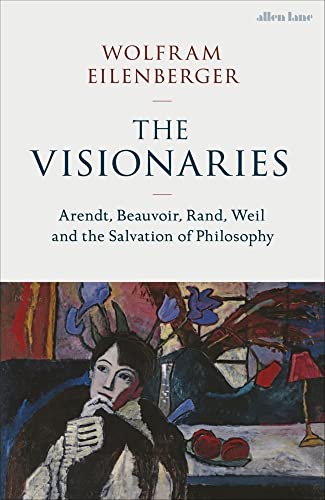
Wolfram Eilenberger, The Visionaries: Arendt, Beauvoir, Rand, Weil and the Salvation of Philosophy (©2020, translation by Shaun Whiteside 2023)

Before the meeting: It’s unlikely that the group would have read The Visionaries if we chose books by consensus. But The Chooser has spoken and we’re out of our comfort zones.

It’s a hard book to describe. Without anything by way of preamble or general argument, it plunges straight into its story. The first chapter, ‘Sparks: 1943’, introduces the book’s four subjects: four quite different women writers, each heroic in her own way, poised to take a major leap forward In the midst of the horrors of the Second World War. As with each of the book’s eight chapters and Coda, the chapter is subtitled:

Beauvoir is in the mood, Weil in a trance, Rand in a fury, and Arendt in a nightmare.

And the four philosophers are introduced:

  • Simone de Beauvoir, aged 35, is in occupied France in her famously unconventional ‘family’ with Jean-Paul Sartre, with ‘better things to do than worry about the judgment of that petit-bourgeois fascist’ (that is, Adolf Hitler): she is on the brink of ‘a new definition of man (sic!) as an acting creature. And one that was neither empty of content, as in Sartre’s latest work, nor bound to remain absurd, as in Camus’s writing.’
  • Simone Weil, 34, is in London, desperately ill and in pain, but lobbying for the creation of ‘a special unit of French nurses at the front who would be deployed only in the most dangerous places, to provide first aid in the middle of battle’. She would head this unit personally, in what looks awfully like a plan to commit suicide by altruism. De Gaulle dismisses the proposal out of hand: ‘She is mad!’ Instead she writes urgently and copiously, including ‘a 300-page redesign of the cultural existence of humanity in the modern age’ before collapsing in exhaustion.
  • After ten years as a freelance writer in New York City, Ayn Rand, 37, sees the publication of her 700-page novel, The Fountainhead, and launches her passionate espousal of independence, her worldview that saw altruism as the great destructive force.
  • Hannah Arendt, 36, also in New York, has been driven out of Hitler’s Germany, and is now finding in herself the courage to face the reality of the industrialised murder of millions of Jews. What mattered was ‘to be entirely present’, or, as paraphrased by Eilenberger, ‘to philosophise’.

In the following chapters, Eilenberger tells us the story of the life and work of each of these four women over the preceding decade. It’s left to the reader to discern any unifying theme or concern. In my reading, the closest he comes to articulating a central theme is on page 69:

The philosophising person seems to be essentially a pariah of deviant insights, the prophet of a life lived rightly, whose traces can be found and deciphered even in the deepest falsity. At least this is one way to understand the role that Ayn Rand as well as her contemporaries Weil, Arendt and Beauvoir assumed with ever greater confidence. Not that they had expressly made a choice. They simply experienced themselves as having been placed fundamentally differently in the world from how other people had been. And deep inside they remained certain of who or what the problem needing treatment was: not themselves, but the Others. Possibly, in fact – all the Others.

If one were to pursue that view, the actual impulse of astonishment at the beginning of all philosophising is not the surprise that there is ‘something and not nothing’, but rather, honest bafflement that other people live as they do.

If I understand this correctly, part of what he is saying is that whereas their male colleagues were interested in the individual human being in relation to the world, these four women were interested in human beings in relationship to each other.

It may be that what you find in any book depends on what you bring to it. A reader well-versed in 20th century philosophy would read this one differently from me: it seems that each of these women was pushed to the margins of political and philosophical thinking, and this book is part of a movement to rectify that. But I’m not that well-versed reader. I haven’t read a whole work by any of them, but I’ve known about all four in a general way.

In my mental landscape, Simone Weil is a weirdly saintly figure who embraced suffering (and loved one of my own favourite poems, as I blogged recently), a Jew who was lived her own intense version of non-Church Christianity; Ayn Rand is a demonic figure who celebrated and justified libertarian capitalism; Simone de Beauvoir is Jean-Paul Sartre’s devoted lover who wrote The Second Sex, a key text of second-wave feminism; and Hannah Arendt is a woman of extraordinary integrity who coined the phrase ‘the banality of evil’ and wrote about totalitarianism.

This book leaves those thumbnail sketches pretty much in place, but I now have a much richer understanding of the people and their works. I didn’t know, for instance, that Simone Weil had worked as a trade union organiser and had brilliant political insights, that Simone de Beauvoir had such a complex set of intimate relationships, that Ayn Rand was married and counted on her husband Frank O’Connor while she wrote fiercely about independence (and that ‘Ayn’ rhymes with ‘fine’), or that Hannah Arendt was quite so marvellous a human being as she appears in these pages.

Their stories are told independently, but Eilenberger makes occasional telling comparisons, and sometimes the women’s paths cross. I love the meeting between the two Simones on page 55, quoted from Simone de Beauvoir’s Memoirs of a Dutiful Daughter:

I managed to get near her one day. I don’t know how the conversation got started; she declared in no uncertain tones that only one thing mattered in the world: the revolution which would feed all the starving people of the earth. I retorted, no less peremptorily, that the problem was not to make men happy, but to find the reason for their existence. She looked me up and down: ‘It’s easy to see you’ve never been hungry,’ she snapped. Our relations ended right there.

And on page 190, the moment that has stayed with me as a piece of wisdom to live by – far from the self-abnegation of Simone Weil or the grand existentialist abstraction of de Beauvoir. Hannah Arendt, Eilenberger writes, is ‘laying the foundation of her own ethics of true self-determination in the face of the Other’:

Gratitude, for the existence of other people in the world, and active concern, for their always given vulnerability, are for Arendt the two true sources of our moral life. And it is no coincidence … that these two predispositions are the very ones that are essentially alien to Ayn Rand’s superhuman ideal figure, Howard Roark.

Amid all the egotism, altruism, self-sacrifice, angst, ambition, bitterness, sweetness, ruthlessness, pain, of those brilliant young adult lives, the notion that gratitude and concern are central went straight to my heart.

After the meeting: Usually, we spend quite a bit of time chatting before turning to the book of the night, but this time we were into it before we even sat down. The food was, as always, excellent. Our host had done a huge tray of roast vegetables and the contributions of the other five of us, with minimal advance coordination, worked well. He Who Usually Brings Dessert was on the other side of the continent, but it was someone’s birthday, and we had cake.

Though the book took us well outside our collective comfort zone, I think we were all glad to have read it. Most enjoyed it for the history, and tended to skip the philosophy. One of us is doing a philosophy course with the University of the Third Age, and had read Wolfram Eilenberger’s previous book, Time of the Magicians, about four male 20th century philosophers. He gave a couple of mini-lectures that cast light, gratefully received, on some of our dark places.

We had three different readings of ‘the Salvation of philosophy’ in the subtitle: these four women were saved by philosophy in times of extreme hardship; they saved philosophy from the dried-up mainstream by focusing on the connections among people; in the terrible time of the Second World War and Nazi atrocities, they kept the flame of philosophical thinking alive. Maybe all three are correct. (I’ve just seen the subtitle of the original is Die Rettung der Philosophie in finsteren Zeiten (1933-1943), literally The Salvation of Philosophy in Dark Times (1933–1943). And the title itself is Feuer der FreiheitFire of Freedom. It’s kind of intriguing that the four woman aren’t named, and there’s not even a hint that the book focuses on particular women. I wonder how much that change of packaging influences out reading.)

A couple of guys took against Simone de Beauvoir. I tried to defend her, and was supported by someone drawing a comparison between her and one of the participants in Australian Survivor that was as obscure to me as the extracts from Simone Weil’s journals. Incidentally, I now know how to pronounce Weil (it’s VAY).

We were in awe at how young the four women were in the years covered by the book. Some were pretty sure that Simone de Beauvoir’s entanglement with a student would get her fired and publicly shamed these days. It was a revelation that for de Beauvoir the war at times barely disturbed her way of life (someone had been to see the Anne Dangar exhibition in Canberra and had a similar revelation – ‘Oh yes, Hitler’s doing all that stuff,’ the artists in France said to each other, ‘but cubism is so interesting.’) It was pointed out that two of the four women were novelists rather than philosophers as such. Someone thought Hannah Arendt was a bit dull (I was shocked). Some were surprised to find themselves feeling sympathy for Ayn Rand (I was ashamed).

We barely talked about Donald Trump. I hope he noticed the lack of attention.

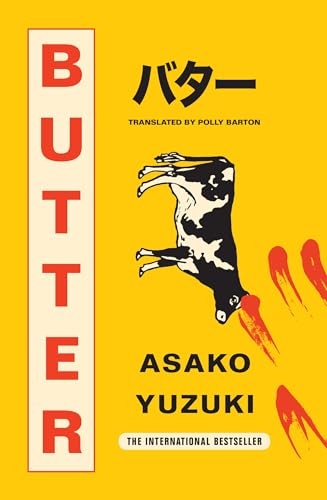
Asako Yuzuki’s Butter

Asako Yuzuki, Butter (2018, translation by Polly Barton, 4th Estate 2024)

This was my end-of-year gift from the Book Club. It is probably an excellent book about misogyny in Japanese culture, with sharp satiric assaults on attitudes to food, with extra piquancy derived from its claim to be based on a true-crime story. It was evidently a huge success in Japanese and this English translation by Polly Barton has been reviewed enthusiastically.

The protagonist, Kira, is an ambitious young woman journalist working on a sensationalist magazine. In searching for a career-defining scoop she becomes enthralled by Manako Kajii, a woman who defies the social norms of slender femininity and is currently in prison for having killed a number of elderly men, after winning their hearts by cooking luxurious food for them. Manako introduces Kira, who until now has survived on a spartan, negligent diet, to the joy of butter – cooking with it and eating the results.

My guess is that the key to enjoying the book is to read it fast, and I’m a slow reader. The themes are real and interesting: feminism versus feminine wiles; social norms versus desire; career ambition versus enjoyment of life. But I struggled with it, and gave up soon after my obligatory 77 pages.

It may well be that Polly Barton has reproduced the feel of the original Japanese, but the best way I can describe my response to the book’s language is to say that it reads like the kind of English you find in school students’ translations. The information is all there, but in the process of capturing it, the student forgets to pay attention to the natural rhythms and sequencing of English prose. That’s fine if you’re a teacher correcting someone’s homework, but if you’re reading a novel, it keeps yanking you out of the story.

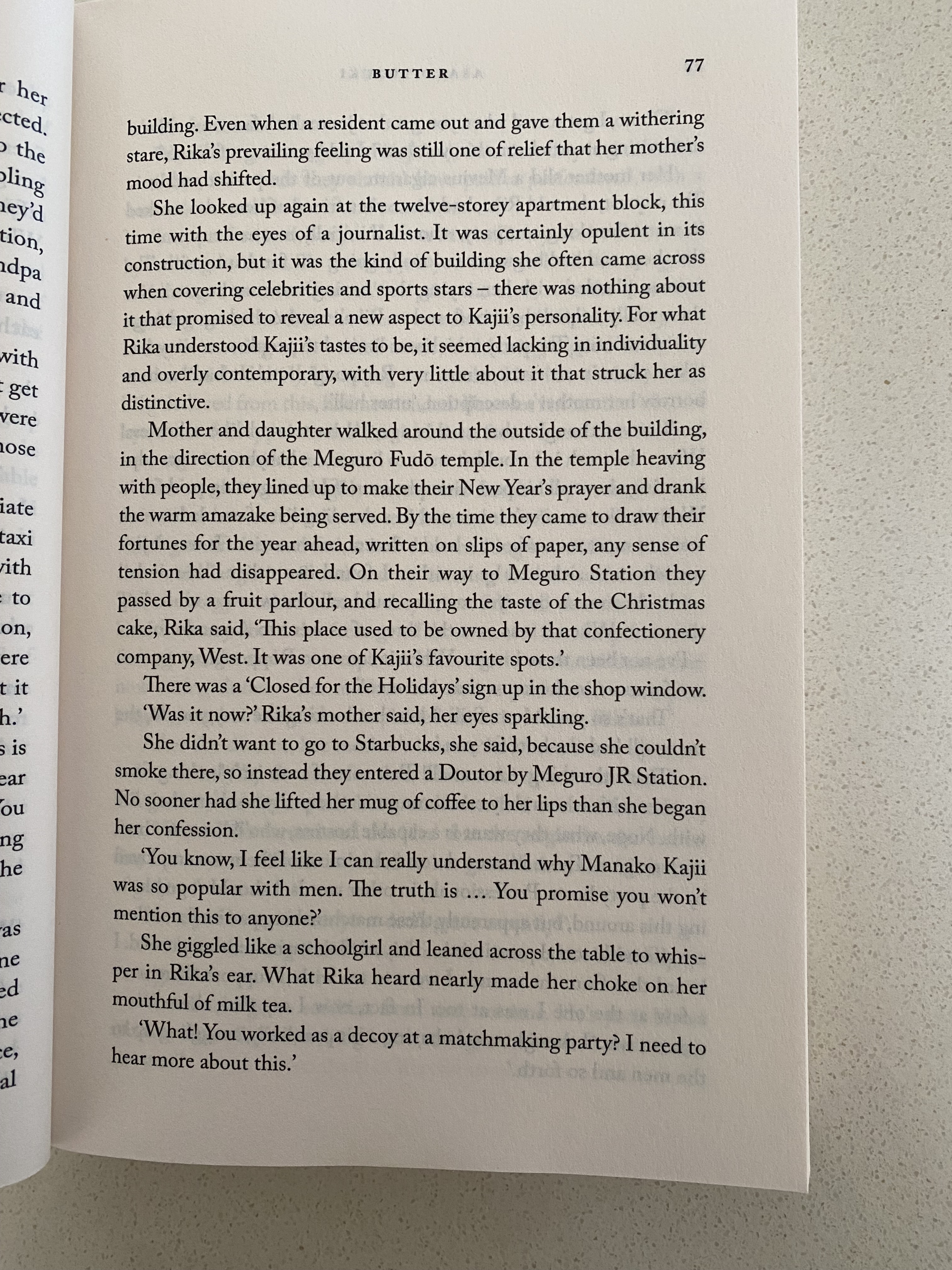
I don’t want to spoil anyone’s enjoyment, but I’ll try to articulate why I find the book such a slog. Page 77* isn’t particularly egregious, but it offers a number of examples. Rika is on an outing with her mother, partly to cheer her up, and partly with the undeclared intention of having a look at Kajii’s apartment. Rika’s mother becomes high-spirited as they inspect the building that has been ‘making a splash in the news’.

I’ll just talk about the beginning and ending of the page, but you can enlarge the image to read it in full:

The first sentence:

Even when a resident came out and gave them a withering stare, Rika’s prevailing feeling was still one of relief that her mother’s mood had shifted.

There’s nothing glaringly wrong with that, but a close look reveals a number of tiny problems contributing to the cumulative awkwardness.

To my ear, the phrase ‘even when’ suggests an extreme event of some kind, and it takes a microsecond to realise that this is something quite undramatic: a resident comes out of the building and gives the pair a withering look. For another microsecond, I wonder why the resident would pay them any attention at all. They’re just two women in a public street. And it’s not just a look, but a stare! How does Rika know that this more or less abstract person is a resident? Moving on, the awkward phrase ‘prevailing feeling’ suggests, if anything, that Rika is experiencing complex emotions, but that suggestion goes nowhere. ‘One of relief’ is clutter – why not just ‘relief’?

One last thing: the word ‘still’, which if you read this sentence without context is completely innocuous. But it’s another example of a micro-interruption to the narrative flow. This is the first time we’ve been told that Rika is feeling relieved. The reader (or at least this one) has to do a quick calculation: oh yes, Rika’s mother’s mood has lifted so of course it was implied that Rika felt relief, so now we’re being told that that relief has survived. This is a recurrent quirk: we’re told that something has happened, rather than seeing it happen.

I can enjoy a text that demands work of me, but these extra little bits of readerly labour bring no joy.

I won’t take you laboriously through the whole page, though I can’t resist mentioning the phrase, ‘In the temple heaving with people’. The meaning is clear, but it doesn’t quite feel like English.

At the end of the page, Rika and her mother are having a coffee (in a Doutor, which Rika’s mother prefers to Starbucks because Starbucks doesn’t allow smoking – in the kind of culture-specific moment that I confess to enjoying).

No sooner had she lifted her mug of coffee to her lips than she began her confession.
‘You know, I feel like I can really understand why Manako Kajii was so popular with men. The truth is … You promise you won’t mention this to anyone?’
She giggled like a schoolgirl and leaned across the table to whisper in Rika’s ear. What Rika heard nearly made her choke on her mouthful of milk tea.
‘What! You worked as a decoy at a matchmaking party? I need to hear more about this.’

Again, these are tiny things, but they accumulate. ‘No sooner than’ is just slightly wrong: can you begin to talk at the moment you lift a mug of coffee to your lips? Specifying a mouthful of tea is unnecessary and creates another of those micro-pauses: I suppose it’s technically possible to choke on a mouthful of liquid, but the term ‘mouthful’ suggests that it’s still in the mouth and more likely to cause spluttering. Having the reader learn what the mother says only when Rika repeats it is an unnecessary and (to me) annoying complication.

Your mileage may vary, and I hope it does. If you want a completely different take on the book, I recommend Theresa Smith Writes.


I wrote this blog post on land of the Gadigal and Wangal clans of the Eora Nation. I happily acknowledge their Elders past and present for caring for this land for many thousands of years.


My blogging practice is to focus arbitrarily on the page of a book that coincides with my age, currently 77.

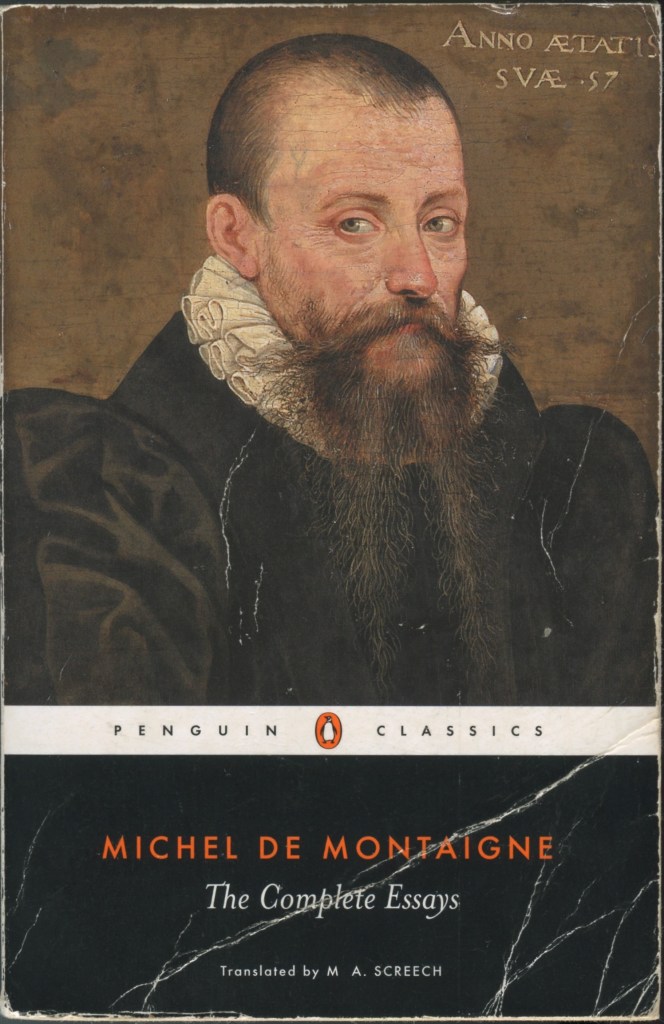
Montaigne final progress report

Michel de Montaigne, The Complete Essays (Penguin Classics 1991, translated by M. A. Screech)
– part way through Book 3, essay 10, ‘On restraining your will’ to end Book 3, essay 13, ‘On experience’

M A Creech, whose translation and edition of Montaigne’s essays I’ve been reading, a few pages a day, since March last year, says that it’s a mistake to read the Essais simply as a collection of separate pieces of varying lengths. There is a shape, he argues in his introduction, and in the final essay, ‘On experience’, Montaigne arrives at the place to which all the preceding essays have been heading.

Given the immersive task he has undertaken – not just finding English equivalents for Montaigne’s French, but also translating and identifying the sprinkling of quotes from Latin (and the few from Greek and more recent languages) – I’m not going to say he’s wrong, but I can’t see that he’s right.

But the final essay does read as a culmination, and a farewell. Its central argument is about the relationship between reason and experience, more specifically the limits of reason and the importance of giving full value to experience. There’s a long section in which he describes the mental process by which he comes to think of his extremely painful kidney stones as a good thing: the pain is intermittent so he has time to digest the experience; when the pain goes, its absence is delightful; unlike other diseases, this one doesn’t interfere with his normal life – he can spend up to ten hours in the saddle at the height of an attack; it’s an illness ‘which does not leave us guessing’ – that is, we know what it is, there’s no need to hunt for diagnoses; etc. At the end of the section, just as one is admiring his brilliant feat of mind over matter, he acknowledges that at least in part he has been whistling in the wind (page 1243):

With such arguments, both strong and feeble, I try … to benumb and delude my power of thought and to put ointment on its wounds. And tomorrow, if they grow worse, we will provide other escape-routes for them.

And then, in a twist that makes his writing as fresh now as it must have been nearly 500 years ago:

Since I wrote that, the slightest movements which I make have begun to squeeze pure blood from my kidneys again. Yet because of that I do not stop moving about exactly as I did before and spurring after my hounds with a youthful and immoderate zeal. And I find that I have got much the better of so important a development, which costs me no more than a dull ache and heaviness in the region of those organs. Some great stone is compressing the substance of my kidneys and eating into it: what I am voiding drop by drop – and not without some natural pleasure – is my life blood, which has become from now on some noxious and superfluous discharge.
Can I feel something disintegrating? Do not expect me to waste time having my pulse and urine checked so that anxious prognostics can be drawn from them: I will be in plenty of time to feel the anguish without prolonging things by anguished fear.

This last essay goes for more than 60 pages. It’s intensely personal: Montaigne describes his not entirely admirable table manners. He goes into some detail about his habits around eating, sleeping, excreting, walking, dressing, a little about sex (which at the ripe old age of fifty-something is largely in his past). He argues that what is customary for any individual or community should be maintained – it would be as wrong for a Frenchman to drink his wine undiluted as for a German to dilute his! And when he hits full stride he argues brilliantly that pleasure is a good thing, that life itself is a good thing. This is from page 1258:

When I dance, I dance. When I sleep, I sleep; and when I am strolling alone through a beautiful orchard, although part of the time my thoughts are occupied by other things, for part of the time too I bring them back to the walk, to the orchard, to the delight in being alone there, and to me. Mother-like, Nature has provided that such actions as she has imposed on us as necessities should also be pleasurable, urging us towards them not only by reason but by desire. To corrupt her laws is wrong.

And a little later:

What great fools we are! ‘He has spent his life in idleness,’ we say. ‘I haven’t done a thing today.’ – ‘Why! Have you not lived? That is not only the most basic of your employments, it is the most glorious.’ – ‘I would have shown them what I can do, if they had set me to manage some great affair.’ – If you have been able to examine and manage your own life you have achieved the greatest task of all. Nature, to display and show her powers, needs no great destiny … Our most great and glorious achievement is to live our life fittingly. Everything else – reigning, building, lying up treasure – are at most tiny props and small accessories.

How can I not love this man? All of this, of course, is interwoven with quotations from the ancients, with whom he sometimes argues robustly, even his beloved Socrates. Wonderfully, he ends with four lines from Horace:

Frui paratis et valido mihi,
Latoe, dones, et, precor, integra
Cum mentis, nec turpem senectam
Degene, nec Cythara carentem.

Which, drawing on M. A. Screech’s translation and explanatory footnote, I can paraphrase as: ‘Grant me, O Apollo god of healing, that I may enjoy the things I have prepared and, with my mind intact, I pray that I may not degenerate into a squalid old age, in which the lyre is wanting.’

It’s not age or death he feared, but the prospect of an old age when he was incapable of singing.


This blog post was written on Gadigal-Wangal land, on a fully hot, humid day when even the birds are silent. I acknowledge the Elders past, present and emerging of Gadigal and Wangal of the Eora Nation.

Montaigne progress report 9

Michel de Montaigne, The Complete Essays (Penguin Classics 1991, translated by M. A. Screech)
– part way through Book 3, essay 5, ‘On Some lines from Virgil’ to part way through Book 3, essay 10, ‘On restraining your will’

This post was due more than a week ago, but life in general made other plans for me. With a couple of lapses, though, I have consistently read four or five pages of Montaigne’s Essays each morning.

I won’t even try to summarise what I’ve read in the last six weeks. I’ll just mention that ‘On some lines from Virgil’ continued to be fascinating on the subject of sex and gender; in a piece with the innocuous title ‘On coaches’ Montaigne denounces the atrocities of the Spanish colonisation of Central and South America; in ‘On the disadvantages of high rank’ he pities those whose social position means no one will disagree with them, because they are deprived of the joys of conversation.

And then there’s ‘On vanity’, a long essay that made me fear age-related cognitive decline was catching up with me. As with many of the essays, ‘On some lines from Virgil’ being a prime example, this one’s title gives you no idea of its true subject. But in this case, I couldn’t tell if it even had a main subject. He writes about travel, about death (a lot about death), about how much he loves Rome. He explains why he’s glad he has no sons. He quotes at length from the document granting him Roman citizenship. He’s like a dog snapping – in slow motion – at whatever fly of an idea crosses his mental line of vision. But in the middle of it all, he has one of the passages that remind you that he is inventing the form of the personal essay – and k ows exactly what he’s doing:

There are works of Plutarch in which he forgets his theme, or in which the subject is treated only incidentally, since they are entirely padded out with extraneous matter … My God! what beauty there is in such flights of fancy and in such variation, especially when they appear fortuitous and casual. It is the undiligent reader who loses my subject, not I. In a corner somewhere you can always find a word or two on my topic, adequate despite being squeezed in tight. I change subject violently and chaotically. My pen and my mind both go a-roaming. If you do not want more dullness you must accept a touch of madness.

‘It is the undiligent reader who loses my subject, not I.’ I’ve been put in my place.

He defends his lack of coherence by applying to himself Plato’s description of a poet as someone who:

pours out in rapture, like the gargoyle of a fountain, all that comes to his lips, without weighing it or chewing it; from him there escape things of diverse hue, contrasting substance and jolting motion.

I don’t know that anyone seriously thinks that’s what poets do, but the idea that a reader needs to be ‘diligent’ to do justice to some writing has still got a lot of life in it, probably even more than it did in Montaigne’s day. He goes on to say he doesn’t stitch things together ‘for the benefit of weak and inattentive ears’:

Where is the author who would rather not be read at all than to be dozed through or dashed through? … If taking up books were to mean taking them in; if glancing at them were to mean seeing into them; and skipping through them to mean grasping them: then I would be wrong to make myself out to be quite so totally ignorant as I am. Since I cannot hold my reader’s attention by my weight, manco male [it is no bad thing] if I manage to do so by my muddle.

So, just as he’s getting tetchy with us for being lazy, he acknowledges that he’s a pretty lazy reader himself. And having claimed that his apparent incoherence is actually poetic brilliance, he now calls it a muddle.

Oh, and in the middle of all that charming back-and-forth between grumpiness and self-deprecation, there’s this lovely, enigmatic line:

Poetry is the original language of the gods.

I’m not sorry I gave up French Honours in 1968 because I found Montaigne almost as unreadable as Rabelais. I’m enjoying reading him now, in translation, much more than I possibly could have in the original when I was 22.


This blog post was written on Gadigal-Wangal land, where the days are getting hotter and more humid. I acknowledge the Elders past, present and emerging of Gadigal and Wangal of the Eora Nation.

November verse 4 & Montaigne progress report 8

Michel de Montaigne, The Complete Essays (Penguin Classics 1991, translated by M. A. Screech)
– part way through Book 2, essay 40, ‘On the resemblance of children to their fathers’ to part way through Book 3, essay 5, ‘On Some lines from Virgil’

Montaigne’s essays become even more interesting as he ages. By Book 3, he writes about his chronic pain from ‘the stone’ and, especially in the innocuously titled ‘On some lines from Virgil’, he does some spectacular writing about sexual politics.

I expect that whole books have been written about Montaigne and sex. I won’t try to untangle any of it here. I’ll just quote the paragraph from today’s reading that has given my poem its opening line. (For those who came in late, this November I’m writing at least 14 fourteen line poems, the first line of each coming from something I’ve heard or read that day.) The paragraph will give you just a glimpse of the complexity of Montaigne’s thought:

We do not weigh the vices fairly in our estimation. Both men and women are capable of hundreds of kinds of corrupt activities more damaging than lasciviousness and more disnatured. But we make things into vices and weigh them not according to their nature but our self-interest: that is why they take on so many unfair forms. The ferocity of men’s decrees about lasciviousness makes the devotion of women to it more vicious and ferocious than its characteristics warrant, and engages it in consequences which are worse than their cause.

I think he’s saying that making sexual behaviour a major criterion for a woman’s reputation is wrong; men make the rules that condemn women’s ‘immorality’; and the punishments are much worse than the so-called crimes. Further on in the essay he says that social expectations on women to be chaste are an intolerable burden.

I don’t know if he is putting a proto-feminist case, or arguing deviously that women should be more sexually available to men. Or both. Either way, it’s fascinating to have a voice from a very different epoch wrestling with questions that aren’t exactly resolved today.

But before I leave Montaigne for my own versification, I can’t resist quoting the final paragraph from Book 2, which follows some strong opinions about the medical profession, and rings out like a beacon of rationality for our times:

I do not loathe ideas which go against my own. I am so far from shying away when others’ judgements clash with mine … that, on the contrary, just as the most general style followed by Nature is variety – even more in minds than in bodies, since minds are of a more malleable substance capable of accepting more forms – I find it much rarer to see our humours and purposes coincide. In the whole world there has never been two identical opinions, any more than two identical hairs or seeds. Their most universal characteristic is diversity.

Yay Montaigne!

But on with my verse, which takes the phrase somewhere else altogether – and you can probably see the point when news from the USA knocked the poem off its tracks:

November verse 4: We do not weigh the vices fairly
We do not weigh the vices fairly,
thumb the scales to suit our whim:
I exaggerate, quite rarely –
you tell fibs – but look at him!
His lies destroy the trust that binds us,
lead us where no truth can find us.
Crowds have wisdom, mobs can rule,
electorates can play the fool.
He's murderous and self-regarding,
incoherent, vile, inane.
He once could boast a showman's brain,
but principles are for discarding.
Lord of Misrule, theatre's Vice:
How could you choose him once, then twice?

This blog post was written on Gadigal-Wangal land, where the tiny lizards are enjoying the beginning of hot weather, and jacarandas are the land’s most spectacular guests. I acknowledge the Elders past, present and emerging of Gadigal and Wangal of the Eora Nation.

The Essays of Montaigne, progress report 7

Michel de Montaigne, The Complete Essays (Penguin Classics 1991, translated by M. A. Screech)
– part way through Book 2, essay 17, ‘On presumption’ to part way through ‘On the resemblance of children to their fathers’

These aren’t so much progress reports as monthly snapshots from my reading of Montaigne’s Essays four or five pages a day. Last month I was part way though ‘On presumption’ and enjoying his unflattering self-portrait. That essay became even more fabulously self-deprecatory, including this (on page 730):

As for music, either vocal (for which my voice is quite unsuited) or instrumental, nobody could ever teach me anything. At dancing, tennis and wrestling I have never been able to acquire more than a slight, vulgar skill; and at swimming, fencing, vaulting and jumping, no skill at all. My hand is so clumsy that I cannot even read my own writing, so that I prefer to write things over again rather than to give myself the trouble of disentangling my scribbles. And my reading aloud is hardly better: I can feel myself boring my audience. That apart, I am quite a good scholar! I can never fold up a letter neatly, never sharpen a pen, never carve passably at table, nor put harness on horse, nor bear a hawk properly nor release it, nor address hounds, birds or horses.

Last month I snuck a look into the future and predicted that this month I would be writing about ‘Three good wives’. Fortunately I don’t have to spend time on that essay, as its version of a good wife is one who will kill herself when her husband dies. Did I mention that some of Montaigne’s views and attitudes can be pretty repulsive? The essay after that, ‘On the most excellent of men’, is hardly less repulsive: his three excellent men are Homer, Alexander the Great and Epaminondas, and in all three cases, including Homer, he seems to regard military skills as the main criterion for excellence. He also seems to take Alexander the Great’s PR at face value. (I shudder to think that essayists a thousand years from now will speak of Donald Trump as the greatest president ever.)

Today, however, I have started on the final essay of Book II, ‘On the resemblance of children to their fathers’, which is surely one of those that have endeared Montaigne to readers for nearly 500 years

Typically, the proclaimed subject of the essay is nowhere in sight in the first couple of pages. Instead, he reflects on the nature of his work and on changes that have happened in his life over the eight years he has been writing essays.

I think it’s true that Montaigne invented the essay form, and these paragraphs give a charming insight into how he went about it.

All the various pieces of this faggot are being bundled together on the understanding that I am only to set my hand to it in my own home and when I am oppressed by too lax an idleness. So it was assembled at intervals and at different periods, since I sometimes have occasion to be away from home for months on end. Moreover I never correct my first thoughts by second ones – well, except perhaps for the odd word, but to vary it, not to remove it. I want to show my humours as they develop, revealing each element as it is born. I could wish that I had begun earlier, especially tracing the progress of changes in me.

It’s probably that spontaneity and the possible vulnerability that goes with it, that makes the essays so alive even all these years later. Maybe I should be less judgemental about essays like the one on good wives – he may have thought differently on the subject on another day.

But that’s enough about the work. He needs to tell us about his health:

Since I began I have aged by some seven or eight years – not without some fresh gain, for those years have generously introduced me to colic paroxysms. Long commerce and acquaintance with the years rarely proceed without some such benefit I could wish that, of all those gifts which the years store up for those who haunt them, they could have chosen a present more acceptable to me, for they could not have given me anything that since childhood I have held in greater horror.

I’m roughly 30 years older than Montaigne was when he wrote that. Though I’m in reasonably good health, I recognise his impulse to tell the world about his bodily ills. As I turn the page, he moves on to one of his recurring topics: when it makes sense to kill oneself (see essay on good wives etcetera). Happily, he is leaning towards staying alive:

After about eighteen months in this distasteful state, I have already learnt how to get used to it. I have made a compact with the colical style of life; I can find sources of hope and consolation in it.

That’s a good thing for his readers, as there was a whole third book to come.


This blog post was written on Gadigal-Wangal land, where understandings of the universe beyond Montaigne’s imaginings were developed millennia before the Ancients he so loves. I acknowledge the Elders past, present and emerging of Gadigal and Wangal of the Eora Nation.